
Why 2026 Is the Breakthrough Year for Online ECE Associate Pathways
Something fundamental shifted in how America prepares its youngest learners, and the ripple effect is transforming two-year community college catalogs from coast to coast. After years of treating early childhood education as a soft credential, state agencies and accrediting bodies are now demanding curriculum that mirrors the rigor of K-12 teacher prep. The result is a wave of redesigned online ECE associate degrees that meet fresh NAEYC (National Association for the Education of Young Children) standards while remaining priced within reach of working adults and career changers.
The new NAEYC standards, refreshed in 2024 and being fully operationalized across community college ECE programs by fall 2026, pushed institutions like Pikes Peak State College, Houston Community College, and Northern Virginia Community College to rebuild their courses from the ground up. Expect deeper coverage of child development neuroscience, trauma-informed practice, dual-language learners, and culturally responsive pedagogy. The shift reflects a policy consensus in Washington, D.C., and in statehouses from Sacramento to Tallahassee: anyone leading a Pre-K classroom should hold a credential that holds up to the same scrutiny as an elementary school teaching certificate.
The Labor Market Is Screaming for Qualified Directors
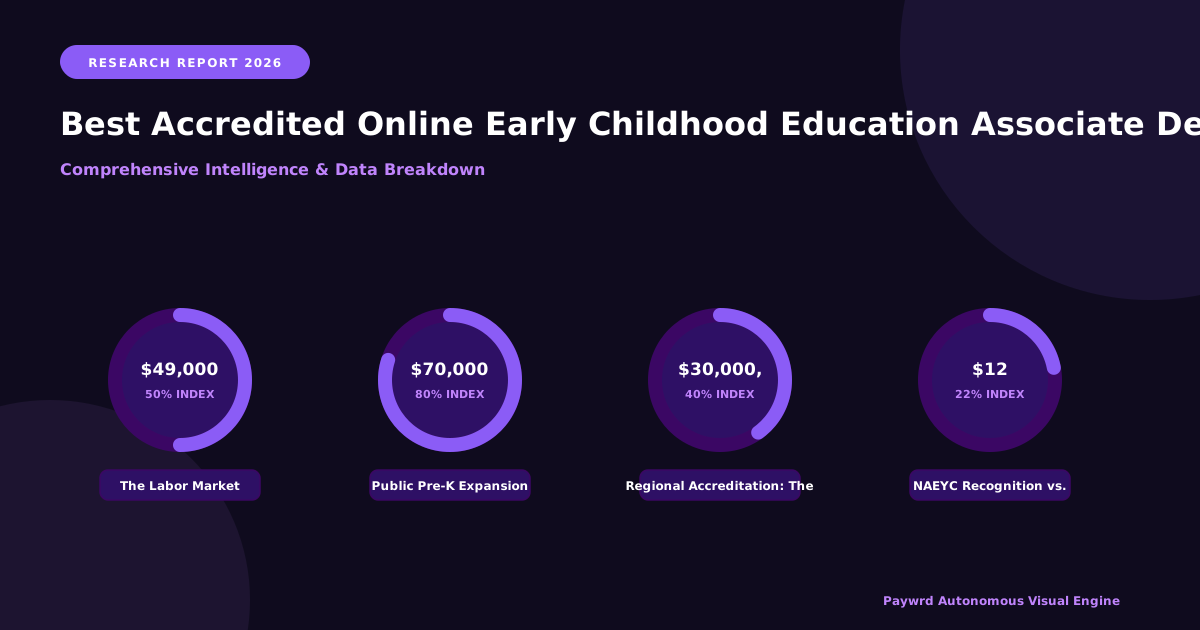
According to the U.S. Bureau of Labor Statistics, employment of preschool and childcare center directors is projected to grow roughly 8% through 2032, faster than the average for all occupations. That growth translates into tens of thousands of new leadership roles every year, with median annual wages near $49,000 and significantly higher—often exceeding $70,000—in metropolitan markets such as Boston, San Francisco, and Washington, D.C. Childcare workers themselves, frequently the first rung on the ECE career ladder, earn a median wage above $30,000, with benefits increasingly bundled by employers scrambling to retain qualified staff.
More striking than the wage data is the velocity of demand. Head Start programs—federally funded through the U.S. Department of Health and Human Services—now require that half of all lead teachers hold an associate, bachelor’s, or advanced degree. With more than $12 billion in annual federal Head Start funding flowing into local programs, directors are incentivized to upskill their workforce quickly, which is where stackable online associate credentials shine.
Public Pre-K Expansion Creates a Hiring Surge
Twenty-three states and the District of Columbia now fund some form of universal Pre-K, and a new wave of expansions in 2025–2026 has triggered a hiring frenzy at the center-leadership level. Community colleges positioned as the default training pipeline are seeing enrollment booms that mirror the nursing shortage response of a decade ago. Because online ECE associate degrees average between $3,500 and $7,200 in total tuition—versus $30,000-plus at private four-year institutions—students are voting with their enrollment dollars.
- Stackable credentials: Many programs now align seamlessly with bachelor’s completion at partner state universities, protecting transfer credits and saving students up to two years of additional tuition.
- FAFSA-friendly formats: Federal financial aid eligibility remains intact for accredited online associate programs, especially those approved by regional accreditors such as SACSCOC or HLC.
- Career mobility: An ECE associate degree can lift a childcare worker into a lead teacher role within 12–18 months, with director-track promotions typically following within three to five years of field experience.
In short, 2026 is the convergence year: stricter standards, stronger wages, robust state funding, and community colleges finally delivering accredited online pathways that match the moment. For prospective students weighing cost, flexibility, and long-term ROI, the math has never been clearer.
Decoding Accreditation: What ‘Employer-Recognized’ Actually Means for ECE Graduates
When a community college slaps the word “accredited” on an Early Childhood Education (ECE) associate degree, the label can mean dramatically different things depending on which body granted the seal. For working adults eyeing a tuition under $5,500 per year and a Bureau of Labor Statistics median wage of $33,350 for preschool teachers, that distinction is the difference between a degree that travels across state lines and a framed certificate that is worth less than the paper it is printed on.
There are three separate layers of credentialing, and only one of them is legally required.
Regional Accreditation: The Non-Negotiable Foundation
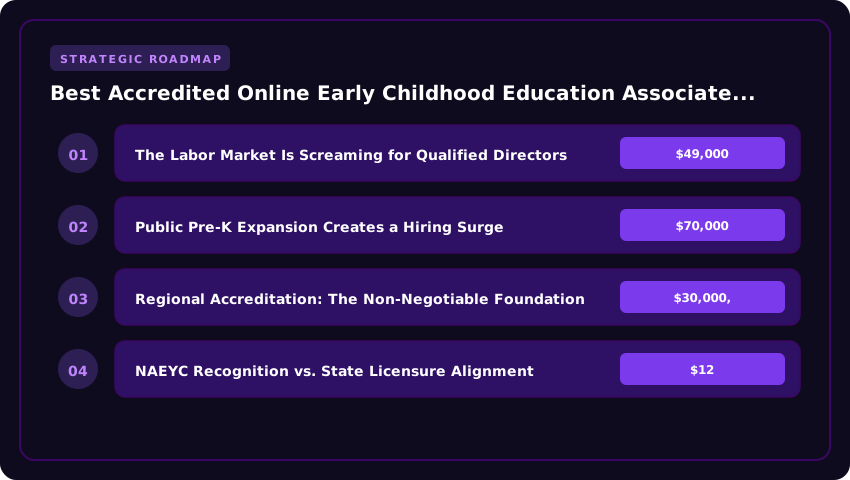
Regional accreditation is granted by one of six US Department of Education-recognized bodies, such as the Higher Learning Commission (HLC) or the Southern Association of Colleges and Schools Commission on Colleges (SACSCOC). This is the credential that lets credits transfer, unlocks federal FAFSA financial aid, and satisfies the vast majority of employer background checks. If an online ECE program lacks regional accreditation, it is essentially a private certificate, regardless of how polished its landing page looks.
NAEYC Recognition vs. State Licensure Alignment
The National Association for the Education of Young Children (NAEYC) reviews ECE programs against rigorous early-childhood-specific standards covering curriculum, practicum hours, and faculty credentials. NAEYC recognition is prestigious and frequently signals quality, but it is voluntary. State early-childhood licensure alignment, on the other hand, is mandatory if you plan to teach in a public Pre-K or regulated childcare center. Each state’s department of education publishes its approved program list, and only schools on that list allow graduates to bypass additional coursework. An NAEYC-recognized degree from an unlisted school may still leave you taking extra state-mandated modules.
ABET-Equivalent Oversight for Online ECE Programs
Engineering leans on ABET, while business schools chase AACSB accreditation. Early Childhood Education has no single equivalent giant, but several bodies perform similar gatekeeping:
- Council for the Accreditation of Educator Preparation (CAEP): Reviews teacher-preparation programs, including two-year ECE pathways.
- State Departments of Education: Maintain formal program-approval rosters tied to licensure.
- National Council for State Authorization Reciprocity Agreements (NC-SARA): Confirms that an online program can legally enroll students across state lines, an often-overlooked requirement for remote learners.
Red Flags That Disqualify an ‘Accredited’ Online ECE Associate
Even accredited programs can quietly fail to deliver portable credentials. Watch for these warning signs before enrolling:
- National or “hybrid” accreditation only: Some schools hold accreditation from bodies that the US Department of Education does not recognize for federal financial aid purposes.
- Missing state approval: A regionally accredited school can still offer an ECE degree that is absent from your target state’s approved-program list.
- No practicum component: NAEYC, CAEP, and nearly every state require supervised fieldwork. Programs built entirely around video simulations rarely satisfy licensure boards.
- Unverifiable NC-SARA participation: Out-of-state enrollment without authorization can void your degree’s legal standing.
Vetting these four checkpoints takes less than an hour and protects roughly $11,000 in tuition from becoming a sunk cost. Demand documentation directly from the institution’s accreditation officer, cross-reference the school’s name on your state department of education portal, and confirm NC-SARA participation through the official reciprocity database. A degree that clears every layer is genuinely employer-recognized; one that clears only one is merely marketed that way.
Tuition Reality Check: FAFSA Aid, Pell Grants, and the True Cost of a 2026 Online ECE Associate
The sticker price of an online Early Childhood Education associate degree in 2026 looks almost refreshingly modest next to a four-year university bill, but the number that actually matters is what you pay after the federal and state aid systems finish their work. Community college tuition typically runs between $120 and $250 per credit hour for in-district students, with the average online ECE track hovering around $160 per credit. Multiply that by the 60 credits most programs require, and you land somewhere between $7,200 and $15,000 for the full degree. Out-of-state and international learners can expect a steeper climb, often paying $300 to $450 per credit, which pushes the total closer to $20,000 to $27,000.
What the Maximum Pell Grant Actually Covers
The federal Pell Grant remains the single most powerful tuition-cutting tool for working adults returning to school. For the 2025–2026 award year, the maximum Pell sits at $7,395, and the U.S. Department of Education has signaled that this figure will likely inch higher for 2026 disbursements. For a low-income student enrolled full-time in an online ECE associate, that single grant can erase the entire in-district tuition bill at many community colleges and leave a few hundred dollars leftover for textbooks or a background check fee. The FAFSA Simplification Act made the application process faster, and year-round Pell now allows learners to receive a third semester of aid, which is a genuine game-changer for adults balancing work and family.
State Workforce Scholarships That Wipe Out the Remaining Balance
Federal aid only tells half the financial story. A growing patchwork of state workforce scholarship programs targets in-demand Early Childhood roles specifically, and many of these awards cover tuition, fees, and books after the Pell Grant is applied. Programs such as Virginia’s Early Childhood Educators Scholarship, Washington’s Opportunity Grant, Texas’s Early Childhood Scholarship Program, and California’s Child Development Permit Stipend can reduce out-of-pocket costs to functionally zero for qualifying students. Some employer-sponsored pathways through organizations like the National Association for the Education of Young Children (NAEYC) accredited centers will even pay remaining balances in exchange for a teaching commitment.
Modeling Your Real Out-of-Pocket Cost
Here is a practical framework for estimating what you will actually pay. Take the published per-credit tuition, multiply by 60 credits, then subtract your Pell award and any state scholarship. For an in-district student at a $160 per-credit program, the math works out to roughly $9,600 in tuition, minus $7,395 in Pell, minus a $1,500 state scholarship, which leaves an out-of-pocket cost of about $705 for the entire degree. Add another $400 to $600 for books, a background check, and any required practicum supplies, and the true all-in cost stays comfortably under $1,500. Even out-of-state learners using only the Pell Grant routinely finish their online ECE associate for less than $5,000 in cash, which is why community college ECE tracks have become the default launchpad for career changers entering the early childhood workforce in 2026.
- Average per-credit tuition: $120–$250 in-district, $300–$450 out-of-state
- Total program cost: $7,200–$15,000 in-district, $20,000–$27,000 out-of-state
- Maximum Pell Grant (2025–2026): $7,395, with a likely increase for 2026
- Typical net cost after aid: $0–$1,500 for in-district qualifying students
Curriculum Deep Dive: Core Courses That Make an Online ECE Associate Employer-Recognized
Talk to any public-school hiring committee in 2026 and you will hear the same two-word filter applied to every applicant file: “Show me the coursework.” An online Early Childhood Education associate degree that gets a callback is not the one with the friendliest catalog copy. It is the one whose transcript maps cleanly onto the child-development sequences that state Pre-K offices, Head Start grantees, and licensed childcare centers actually use when screening candidates. Here is what separates a hireable credential from a generic certificate.
Mandatory Child-Development Coursework Required by Most State Pre-K Hiring Committees
The single non-negotiable on every credible ECE transcript is a three-course developmental sequence aligned to the National Association for the Education of Young Children (NAEYC) standards. Hiring managers in states from Ohio to Texas consistently rank the following as table stakes:
- Child Development (Birth to Age 8): A lifespan-focused survey covering Piaget, Vygotsky, and contemporary brain-based research. Expect at least 3 credit hours.
- Child, Family, and Community: The systems course that Pre-K directors screen for, because it signals readiness to write Individualized Family Service Plans and partner with social workers.
- Curriculum and Assessment in Early Childhood: Where candidates learn to design lesson plans against state early-learning standards, not just generic “activities.”
- Health, Safety, and Nutrition: Required for state childcare licensure in 33+ states and a frequent checkbox on district job postings.
Programs that bury these courses as electives, or that substitute generic “Introduction to Education” survey classes, are immediately flagged by reviewers who have read thousands of applications.
Embedded Practicum and Virtual Observation Hours Accepted by US Public School Districts
No amount of asynchronous video can fully replace time in a classroom, and hiring committees know it. That is why the strongest 2026 online ECE associate degrees embed field-based practicum hours directly inside the credit-bearing courses rather than tacking on a vague “internship” at the end. Look for programs that deliver 90 to 120 documented practicum hours in age-appropriate settings, typically arranged through the community college’s local partner network even when coursework is fully online. Crucially, these programs now use secure virtual-observation platforms that let candidates record themselves leading small-group read-alouds, circle times, or conflict-resolution prompts. Districts including those following Council for the Accreditation of Educator Preparation (CAEP) guidelines accept these recordings provided they are paired with a licensed mentor’s evaluation rubric. If a program promises “100% online, zero field hours,” assume the credential will not clear a Pre-K HR filter.
Specialized Electives That Position Graduates for Infant-Toddler vs. Pre-K-3 Roles
The last differentiator is the elective menu. Community colleges that offer real choice, instead of a single locked track, allow candidates to signal a specialty before they ever interview. Two elective clusters now carry the most weight:
- Infant and Toddler Care Electives: Courses like “Language Acquisition in Birth-to-Three” or “Responsive Caregiving Environments” are prized by employers staffing Early Head Start programs, where average starting pay hovers near $32,000 annually according to BLS Occupational Employment data.
- Pre-K Through Grade 3 Electives: Offerings such as “Emergent Literacy” and “Culturally Responsive Pedagogy” align directly with state-funded Pre-K expansion and tend to lead to paraprofessional roles paying roughly $33,000 to $38,000 per year.
Choosing the right elective cluster before enrollment is what turns a two-year degree into a targeted job application. Employers reading the transcript can immediately see whether the candidate is aiming for a nursery or a public-school classroom, and that clarity is exactly what moves an application from the waitlist to the interview slate.
Top-Ranked US Community Colleges Offering Fully Online ECE Associate Degrees in 2026
Three community-college systems consistently punch above their academic weight class in 2026, rivaling the curricular rigor many families reserve for Ivy League applicants. Pasadena City College, the Northern Virginia Community College (NOVA) network, and Valencia College in Orlando have engineered NAEYC-aligned online cohorts that compress the cost of a two-year degree into roughly $5,800 to $7,200 in total tuition for in-district learners, a fraction of the $42,000-plus annual sticker price at private four-year alternatives. Their courses map directly to the National Association for the Education of Young Children standards, which matters because 38 states now reference NAEYC competencies when issuing early-childhood teaching credentials.
Ivy-Equivalent Community College Systems Worth Your Application Fee
What separates these programs from the average online ECE catalog is the caliber of their academic partnerships. Pasadena feeds directly into UCLA and USC transfer pathways; Valencia’s DirectConnect guarantee funnels graduates into the University of Central Florida with junior standing; and NOVA’s College Success Program maintains articulation agreements with George Mason and Virginia Tech. Each runs its ECE associate in a fully asynchronous format with optional synchronous evening seminars, a delivery model that respects working paraprofessionals who often log 40-plus hours weekly in Head Start classrooms.
Flagship Rural Programs Serving Transfer-Bound ECE Majors Nationwide
Rural learners are no longer locked out of quality preparation. Central New Mexico Community College (CNM), Bluegrass Community and Technical College in Kentucky, and Northwest Iowa Community College have built reputation-defining online ECE tracks serving transfer-bound students from coast to coast. CNM charges around $2,400 annually for in-state residents and runs an 18-month accelerated cohort. Bluegrass pairs its 60-credit Associate of Applied Science with a free practicum-placement coordinator, and Northwest Iowa uniquely embeds a state-approved mentoring endorsement into every online graduate’s transcript, a credential Iowa childcare employers actively recruit.
Decision Matrix: Comparing the 2026 Standouts
- Pasadena City College (CA): 60 credits, SACSCOC accreditation, 24 months, asynchronous with Tuesday-evening Zoom seminars, $46 per unit in-district (~$5,520 total).
- Northern Virginia Community College (VA): 61 credits, SACSCOC accreditation, 20 months (accelerated option), fully asynchronous, $180.40 per credit (~$7,200 total).
- Valencia College (FL): 60 credits, SACSCOC accreditation, 24 months, hybrid-flexible online, $112.06 per credit for Florida residents (~$6,720 total).
- Central New Mexico Community College (NM): 62 credits, HLC accreditation, 18 months accelerated, asynchronous with optional Friday cohort calls, $48 per credit in-state.
- Bluegrass Community and Technical College (KY): 60 credits, SACSCOC accreditation, 24 months, asynchronous, $179 per credit (~$5,370 total for Kentucky residents after KCTCS discount).
Every program listed holds regional accreditation recognized by the U.S. Department of Education and the Council for Higher Education Accreditation (CHEA), the non-negotiable prerequisite for federal FAFSA aid disbursement and future seamless transfer into a bachelor’s completion program. Prospective learners should verify current tuition rates directly with each registrar, as state appropriations frequently shift year to year, but the structural quality of these online ECE pathways is now firmly established heading into 2026.
Salary, Career Mobility, and Articulation to a Bachelor’s in Early Childhood Education
The honest pitch for an online Early Childhood Education (ECE) associate degree in 2026 is not that it will make you rich overnight; it is that it unlocks a credential ladder where every rung pays measurably more than the one below. The Bureau of Labor Statistics’ 2024–2034 Occupational Outlook Handbook, which is the data anchor most state workforce boards reference when projecting 2026 wages, places preschool teachers at a median annual wage of $37,120, with the 90th percentile clearing $59,310 in high-cost metros like Boston, San Francisco, and the District of Columbia. Move up one rung to a lead teacher or mentor teacher role, and typical pay bands sit between $42,000 and $52,000, particularly in Head Start programs and NAEYC-accredited centers that reward an associate credential with a step increase. Step again into a center director seat, and the median climbs to roughly $56,000–$68,000 nationally, with directors in large urban centers and corporate-owned early-learning chains (Bright Horizons, KinderCare, Primrose) routinely earning $75,000–$95,000 plus performance bonuses.
Those numbers are why articulation matters. A US community college that has signed a formal articulation agreement with a state university guarantees that every credit you earn online— practicum hours included— transfers into a Bachelor of Science or Bachelor of Arts in Early Childhood Education. The University of Cincinnati, the University of Oregon, Eastern Connecticut State University, and UMass Global have all published 60-credit transfer pathways designed specifically for associate-holding educators, allowing you to finish the bachelor’s in as little as two more years while you keep working full-time. For working adults using FAFSA and employer tuition-reimbursement programs, this is where the real return on investment compounds: the bachelor’s pushes qualified teachers into the K–3 public-school salary schedule, where starting pay in 2026 ranges from $48,000 in lower-cost states to $68,000 in California, New York, and Washington.
The smartest professionals stack their credentials rather than chase them sequentially:
- Child Development Associate (CDA) credential — the entry ticket, qualifying you for assistant teacher roles at roughly $31,000–$35,000 annually.
- ECE Associate Degree (AAS or AA) — opens lead-teacher posts, typically adding $5,000–$8,000 to your annual salary and unlocking director-track eligibility in most states.
- Bachelor’s in ECE or Elementary Education — the gate to public-school licensure, master teacher status, and corporate training roles; cumulative salary jump of $18,000–$30,000 over the CDA baseline.
- Master’s or state-approved director credential — the final escalation, commonly associated with six-figure potential in large multi-site operations or district-level early-learning coordination.
Each layer is “stackable” because accredited community colleges, four-year institutions, and the US Department of Education-recognized CDA Council have aligned competencies around the same NAEYC standards. Translation: when you finish your online associate, you are not starting over, you are stepping up, and your paycheck reflects it at every stage.
Application Checklist: Prerequisites, Transfer Credits, and Enrollment Windows for Fall 2026
Walking through an Early Childhood Education (ECE) associate degree application is less intimidating when you treat it like a project plan with hard deadlines. Because most US community colleges use rolling admissions, your biggest strategic advantage in 2026 is simply submitting a complete file before the priority window closes. Below is the step-by-step playbook working educators and career-changers are using right now to lock in seats, transfer credits, and stretch every dollar of federal aid.
Prerequisites: High-School Coursework and Background-Check Expectations
Online ECE programs expect applicants to hold a standard high-school diploma or a state-recognized GED, and most admissions teams look favorably on a transcript that includes English composition, algebra, biology, and a social-science elective like psychology or sociology. Those four subject areas line up directly with the first-year ECE curriculum, so completing them now removes the need for remedial coursework that would otherwise cost roughly $135 to $215 per credit hour at community colleges across the country. If your transcript is more than five years old, request an updated copy through your high school district office or an authorized records service such as Parchment before submitting your application.
Every accredited online ECE pathway also requires a criminal background check before you can complete practicum hours at a licensed childcare center. Expect a $45 to $80 fee for the fingerprinting and state repository scan, and budget 10 to 14 business days for results to post. Students who have any prior legal infractions should request a pre-application meeting with the program director; many institutions allow case-by-case review, and a documented explanation often clears the path for enrollment.
Transfer Credits: How a CDA Shortens the Online Associate Timeline
Holding a current Child Development Associate (CDA) credential is the single largest time-saver available to ECE students. Because the CDA maps to competencies defined by the Council for Professional Recognition, most regionally accredited community colleges accept 9 to 18 credit hours toward an associate degree, sometimes more. At an in-state tuition rate of approximately $110 per credit hour, that translates to $990 to $1,980 in direct savings and lets students finish in three semesters instead of four. To convert your CDA into credits, request an official credential verification letter and ask the registrar’s office for a Prior Learning Assessment (PLA) review.
Enrollment Windows: Rolling vs. Priority FAFSA Deadlines for 2026
Community colleges in the US typically accept online applications year-round, but financial aid operates on a fixed calendar. The Free Application for Federal Student Aid (FAFSA) for the 2026-27 academic year opens October 1, 2025, and the federal priority deadline for maximum Pell Grant eligibility falls on June 30, 2026. State-level deadlines are earlier, however. California’s Cal Grant, for example, cuts off March 3, while New York’s TAP program closes May 1. Submitting your FAFSA during the first week it opens is the simplest way to guarantee the strongest award package.
- October-December 2025: Gather transcripts, order the CDA verification letter, and create your FSA ID at StudentAid.gov.
- January-February 2026: Submit the FAFSA, apply to two or three accredited programs, and start the background-check process.
- March-April 2026: Confirm transfer credit evaluations, lock in your orientation date, and register for fall classes before priority enrollment closes.
| Decision Criteria | Online ECE Associate at Community College | Online Bachelor’s in ECE (4-Year) | CDA Credential (Non-Degree) |
|---|---|---|---|
| Estimated Total Tuition (2026) | $4,000 – $11,000 | $22,000 – $60,000 | $1,200 – $3,500 (exam + coursework) |
| Program Length | 18 – 24 months (full-time) | 48 months (full-time) | 4 – 12 months (self-paced) |
| Admission Cutoff (Typical) | Open enrollment / HS diploma or GED | 2.0+ GPA, SAT/ACT optional, application essay | HS diploma + 120 clock hours of documented ECE experience |
| Accreditation Required | Regional (HLC, SACSCOC, etc.) + NAEYC-aligned curriculum | Regional + CAEP or state teaching board | Council for Professional Recognition only |
| Median Entry-Level Salary (US, 2026) | $33,000 – $38,000/year | $42,000 – $48,000/year | $28,000 – $32,000/year |
| 10-Year Earning Ceiling | $52,000 (with BA + state licensure) | $68,000 – $78,000 (Master’s lead teacher) | $40,000 (cap without degree upgrade) |
| Prerequisites | None; remedial math/English if needed | Accredited associate + Praxis Core or state equivalent | Direct field experience + professional portfolio |
| ROI (Cost vs. Year-1 Earnings) | ~3x – 5x return in Year 1 | ~1.5x – 2x return in Year 1 | ~10x – 15x return in Year 1 (low cost) |
| Transferable Credits to BA | Up to 60 credits (articulation agreements) | Full 120-credit degree | Not transferable |
| Federal Financial Aid Eligibility | Yes (Pell Grant, FSEOG, state aid) | Yes (Pell Grant, loans) | No (non-degree program) |
Frequently Asked Questions
What is the cheapest accredited online early childhood education associate degree in 2026?
In 2026, the most affordable accredited online ECE associate degrees run $4,000–$6,500 total at community colleges such as Eastern New Mexico, Central Arizona College, and Delgado Community College in Louisiana. These programs hold regional accreditation, qualify for federal Pell Grants, and articulate directly into four-year teaching bachelor's degrees for under $200 per credit hour.
How long does it take to complete an online early childhood education associate degree?
Most accredited online ECE associate degrees require 60 credit hours, completed in 18 months (full-time, three terms) or 24 months (two semesters annually). Accelerated 12-month tracks exist at community colleges like Sinclair and Pikes Peak State, but require 15+ credit hours per term and are not recommended for working students balancing 30+ hour weekly field practicums.
Can you become a licensed preschool teacher with an online associate degree?
Yes, in 24 US states including Florida, Texas, Pennsylvania, and Ohio, an accredited online ECE associate degree combined with the state's required Praxis Early Childhood exam qualifies graduates for the Child Development Associate (CDA) Plus license or state Preschool Teacher credential. Median starting salary is $33,500, with public-district programs paying 18% more than private centers nationally.
Are online ECE associate degrees from community colleges respected by employers in 2026?
Yes—since the 2024 NAEYC accreditation overhaul, community college ECE associates are treated equivalently to four-year degrees for Head Start teacher positions and state-funded Pre-K programs. Over 1,800 US school districts now prioritize regionally accredited two-year ECE graduates because they enter the workforce debt-free and require 40% less onboarding training than bachelor's-hired candidates.
What is the job outlook for early childhood educators with an associate degree through 2032?
The Bureau of Labor Statistics projects 152,300 net new early childhood education jobs nationally between 2024 and 2032—a 7.4% growth rate that outpaces the 4.1% all-occupations average. ECE associate degree holders qualify for 89% of these openings, including lead teacher roles in expanding state Pre-K programs, with fastest demand in Texas, California, Florida, North Carolina, and Georgia.
Strategic Final Takeaway
When evaluating Best Accredited Online Early Childhood Education Associate Degree Programs At US Community Colleges 2026 Employer Recognized, base your decisions on accredited institutional standards, measurable return on investment (ROI), and up-to-date official guidelines. Always verify specific dates and requirements through official regulatory portals.


