Why Starting Your Early Childhood Education Degree at a Community College Slashes Your Total Tuition
The math is unavoidable: according to the College Board’s Trends in College Pricing 2024, average published in-district tuition and fees at public two-year colleges sit at roughly $3,990 per year. Compare that to the $11,260 average for in-state students at public four-year institutions, and the “2+2” pathway (associate then bachelor’s) immediately frames itself as the most aggressive debt-reduction strategy available to aspiring educators. If you are an out-of-district student, that community college figure rises to approximately $8,840—still a massive discount against the $29,150 average out-of-state university tuition.
The Transfer Math: Where the $10,000–$25,000 Savings Actually Live
Most students focus on the per-credit price tag, but the real windfall comes from avoiding university-level tuition for your general education requirements. A standard Early Childhood Education (ECE) bachelor’s requires 120 credits. By knocking out the first 60—English Comp, College Algebra, Intro to Psych, and your foundational “Intro to ECE” courses—at the community college rate, you effectively buy the first half of your degree at a 65–75% discount. On a typical four-year public degree costing $45,000+ in tuition alone, that translates to $15,000 to $25,000 kept in your pocket (or kept out of Federal Direct Loan principal). That is money that compounds in your favor for decades rather than accruing interest at 6.53% (the 2024-25 undergraduate Direct Loan rate).
Articulation Agreements: Your Guarantee Against Wasted Credits
The fear of “lost credits” is the single biggest barrier to this pathway, but the infrastructure has matured significantly. Most state systems now operate under legislatively mandated articulation agreements—formal contracts guaranteeing that an Associate of Arts (AA) or Associate of Science (AS) in Early Childhood Education transfers as a block, granting you junior standing at the partner university. Look for keywords like “Core Curriculum Complete,” “General Education Certified,” or “Transfer Single Articulation Pathway (TSAP)” on your community college advising portal. In states like Florida, California, Texas, and North Carolina, these agreements are legally binding; the university cannot force you to retake Gen Eds if you hold the designated transfer degree.
Budgeting for the “Hidden” Line Items
Tuition is only the headline number. To build a realistic working budget, you must account for program-specific fees that financial aid often covers but rarely itemizes clearly:
- Background Checks & Fingerprinting: Required before any field placement. Budget $50–$100 per check (often required annually or per new site).
- CPR / First Aid / AED Certification: Mandatory for licensure in nearly every state. Expect $60–$120 for a blended American Red Cross or American Heart Association course.
- Textbooks & Digital Access Codes: ECE textbooks are notoriously expensive. Plan $400–$700 per semester if buying new; slash this by 50% using the campus library reserve system, Cengage Unlimited, or Open Educational Resources (OER).
- Student Teaching Fees: Some universities charge a “supervision fee” of $200–$500 during the final capstone semester.
Pro tip: Fill out the FAFSA the moment it opens (typically October 1). Pell Grants (up to $7,395 for 2024-25) and state grants like Cal Grant or TAP often cover community college tuition entirely, turning that $15,000 savings into a zero-tuition associate degree.
Mapping the State-by-State Licensure Pathway for Early Childhood Educators
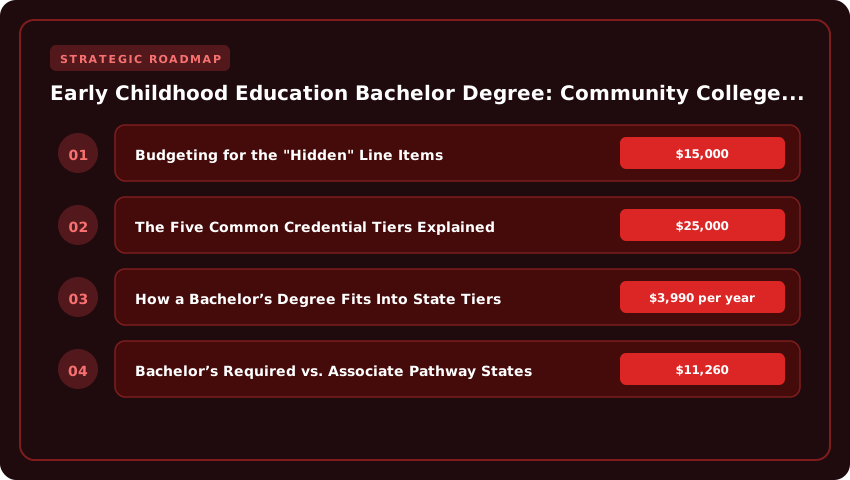
Pursuing an Early Childhood Education (ECE) bachelor’s degree is not a one-size-fits-all commitment, because the credential you earn must align with the licensure tier your target state recognizes. Across the United States, departments of education typically organize early childhood credentials into five recognizable rungs: the Child Development Associate (CDA) credential, a Preschool Lead Teacher endorsement, a Pre-K-3 license, an ECE Birth-Grade 2 license, and a Pre-K-Grade 3 license. Each rung unlocks a different scope of practice, age range, and salary band, and the educational gatekeeping varies dramatically from one state capital to the next.
The Five Common Credential Tiers Explained
The CDA, administered by the Council for Professional Recognition, is a competency-based credential often requiring about 120 hours of training plus a portfolio. A Preschool Lead Teacher endorsement is usually the next step, frequently satisfied by an associate degree in early childhood education. Moving up the ladder, a Pre-K-3 license qualifies you to teach public kindergarten through third grade, while an ECE Birth-Grade 2 license broadens the age span to include infants and toddlers. The most expansive tier, a Pre-K-Grade 3 license, allows educators to work with the entire early childhood age range in publicly funded classrooms.
How a Bachelor’s Degree Fits Into State Tiers
In California, the Commission on Teacher Credentialing issues a Multiple Subject Teaching Credential with an Early Childhood Education specialization, generally classified as a Level VI license, which a bachelor’s degree satisfies outright. Texas similarly requires a bachelor’s degree for the standard Early Childhood-Grade 3 certification through the Texas Education Agency, though the state also offers an alternative certification route for candidates with substantial child development experience. New York State aligns with this four-year expectation, granting an Early Childhood Education Birth-Grade 2 initial certificate only after candidates complete a state-approved bachelor’s program and pass required edTPA or NYSTCE assessments.
Bachelor’s Required vs. Associate Pathway States
Approximately 30 states currently require a bachelor’s degree for the lead teacher role in state-funded Pre-K classrooms, including Massachusetts, Connecticut, and Georgia. However, a meaningful cluster of states still permits an associate degree combined with relevant work experience to qualify for lead teacher status. States such as Florida, Kentucky, and West Virginia have historically accepted an associate plus a state early childhood credential for many center-based teaching roles, though directors and public school Pre-K teachers are increasingly pushed toward the bachelor’s pathway under revised Quality Rating and Improvement Systems (QRIS).
Reciprocity Rules for Career Mobility
If you plan to relocate after graduation, understanding reciprocity is essential. States participate in the NASDTEC Interstate Agreement, which streamlines the review of out-of-state teaching licenses, but early childhood specialists should verify that their specific Pre-K or Birth-Grade 2 endorsement matches the destination state’s scope. A Texas Pre-K-3 certificate, for example, may transfer with relatively few additional requirements to a neighboring state, while a move from a less-regulated state to a strictly four-year-degree jurisdiction could require you to complete additional coursework or testing before you can step back into the classroom.
- Confirm your target state’s credential tier (CDA, Lead Teacher, Pre-K-3, ECE B-2, or PK-3) before enrolling.
- Verify whether a bachelor’s is mandatory or whether an associate plus experience qualifies.
- Check NASDTEC reciprocity status if you anticipate moving within five years of licensure.
ABET, NAEYC, and CAEP Accreditation: Which Program Seals Actually Matter for Hiring
Let’s clear up one of the most expensive myths in early childhood education: a degree’s prestige means nothing if the wrong accreditor stamped it. Employers across daycare centers, Head Start programs, and public school districts are not hunting for the shiniest university name on your diploma. They are hunting for a specific set of accreditation seals that tell them you can legally walk into their classrooms on day one. Understanding the difference between NAEYC, CAEP, and regional versus national accreditation is the only way to avoid burning $15,000 to $25,000 in tuition on a credential that hiring managers will politely set aside.
Why NAEYC Accreditation of the ECE Program Itself Matters More Than Regional Accreditation
When you apply for a preschool director position or a lead teacher role at a nationally branded childcare chain, the first thing most HR teams check is whether your Early Childhood Education program holds NAEYC accreditation. The National Association for the Education of Young Children runs the only discipline-specific quality marker recognized across the private early childhood sector. If your community college or four-year university earned NAEYC accreditation through a rigorous self-study and external review, employers trust that you were trained in developmentally appropriate practice, curriculum planning, and assessment methods specific to children birth through age eight. A regionally accredited school without NAEYC program-level approval can technically grant a bachelor’s degree, but it leaves you scrambling to prove competency that HR screeners rarely have time to investigate.
CAEP State-Level Approval Required for Public School Licensure
If your career goal is a public Pre-K or kindergarten classroom, the seal that unlocks the door is Council for the Accreditation of Educator Preparation (CAEP), combined with your state department of education’s program review. State teaching licenses are not handed out based on the name of your college. They are issued after your educator preparation program submits evidence—through CAEP or a state equivalent—that it covers pedagogy, practicum hours, and subject-matter assessment aligned with state standards. A community college ECE associate degree will rarely carry CAEP approval on its own, which is exactly why the transfer pathway matters. You need to finish a bachelor’s degree at an institution whose educator preparation program is CAEP-accredited and state-approved, otherwise you will graduate unable to sit for licensure.
Regional vs. National Accreditation: The Transferability Trap
Here is where many career-changers bleed money. Regionally accredited universities (the six U.S. regional accreditors recognized by the Department of Education) accept transfer credits from each other, and their degrees are universally recognized by employers and graduate schools. Nationally accredited for-profit institutions often carry programmatic approval, but their credits are frequently rejected by regional schools and dismissed by HR departments at public school districts. Before you enroll, confirm your school holds regional accreditation—look for the Higher Learning Commission, SACSCOC, MSCHE, NWCCU, WSCUC, or NECHE seal on their website.
How to Verify Your Community College Credits Will Transfer
Do not guess on transferability. Use your state’s transfer guarantee database—every state participating in the Credit When It’s Due (CWID) initiative and most members of the Interstate Passport Network publish searchable course-by-course articulation agreements. In Texas, check the Texas Common Course Numbering System. In Florida, use the Statewide Course Numbering System. In Ohio and Illinois, search the Transfer Assurance Guides (TAG). These state-level tools let you plug in your community college course and instantly confirm whether a public university will accept the credit toward your bachelor’s degree. Pair that verification with a formal articulation agreement between your community college and your target four-year institution, and you have a written guarantee that protects your tuition investment.
- NAEYC program accreditation signals preschool employer readiness
- CAEP and state approval unlock public school teaching licenses
- Regional accreditation is non-negotiable for credit transfer
- State transfer guarantee databases prevent wasted tuition
FAFSA, Pell Grants, and Teacher Loan Forgiveness: Funding the ECE Bachelor Degree
Earning a bachelor’s degree in Early Childhood Education (ECE) does not have to leave you buried under a mountain of student loan debt. With the right federal and state aid packages, working adults and career-changers can dramatically reduce out-of-pocket costs while moving steadily toward state licensure. The key is understanding how to stack multiple programs strategically rather than relying on a single scholarship or grant.
For the 2024-2025 award year, the maximum Federal Pell Grant is $7,395, and the FAFSA Simplification Act expanded eligibility by raising the income threshold and adjusting the definition of family size. Practically speaking, a single ECE student with no dependents can now qualify for a partial or full Pell with an adjusted gross income up to roughly $60,000, depending on household composition. This is real money that follows you whether you start at a community college or a four-year institution, and it does not have to be repaid.
Beyond Pell, ECE majors have a unique advantage through the TEACH Grant program, which awards up to $4,000 per year to students who commit to teaching high-need subjects in low-income schools. For ECE students, that often means pre-K through third-grade classrooms serving Title I populations. If you fail to complete the four-year teaching service requirement, the grant converts to an unsubsidized loan, so commit deliberately and document your service carefully through the annual TEACH Grant counseling requirement.
Public Service Loan Forgiveness (PSLF) is another powerful lever. Head Start programs, public pre-K classrooms, and most state-funded preschool positions qualify as PSLF-eligible employment, meaning your remaining Direct Loan balance can be forgiven after 120 qualifying monthly payments while working full-time for a qualifying employer. Combine PSLF with an Income-Driven Repayment plan, and your monthly payment during the 10-year service window can be remarkably affordable. Before you start, certify your employment annually through the Federal Student Aid portal so your qualifying payments are tracked correctly.
State-specific aid is where many prospective teachers leave money on the table. California, for example, funds the Child Development Teacher and Supervisor Permit grants to address the state’s persistent workforce shortage in early learning. Similar scholarship pools exist in Texas through the T.E.A.C.H. Early Childhood Scholarship Program, in Illinois via the Gateways to Opportunity scholarship, and in Florida through the T.E.A.C.H. and scholarship pipelines administered by local early learning coalitions. Always confirm with your state’s Department of Education or workforce development board, because award amounts and renewal rules change yearly.
- Maximize Pell first: Submit the FAFSA as early as October 1 each year; Pell is the foundation of your aid package.
- Stack the TEACH Grant: Up to $4,000 annually for ECE students teaching in low-income schools after graduation.
- Plan a PSLF path: Target Head Start or public preschool roles to qualify for loan forgiveness after 120 payments.
- Hunt state scholarships: California, Texas, Illinois, and Florida all run ECE-specific award programs worth $500 to $5,000 per year.
- Avoid interest capitalization: If you pause payments, request an administrative forbearance rather than letting unpaid interest compound onto your principal.
Salary Expectations for Early Childhood Educators With a Bachelor’s Degree in 2025
Let’s talk dollars, because a degree is only as valuable as the paycheck it unlocks. If you are weighing student debt against future earnings, the U.S. Bureau of Labor Statistics (BLS) Occupational Outlook Handbook is the most honest mirror in the room. As of May 2023—the latest wage data feeding 2025 projections—preschool teachers earned a national median annual wage of $37,130, while kindergarten teachers pulled in a significantly higher $61,620. That gap is not random; it tracks almost perfectly with degree requirements. Most preschool positions accept an associate’s or Child Development Associate (CDA) credential, so the market pays accordingly. A bachelor’s in Early Childhood Education (ECE) is the pivot that moves you into the higher-paying kindergarten and elementary tier, where districts typically require a state license and a four-year degree.
The BLS projects employment of preschool teachers to grow 3 percent through 2033, while kindergarten and elementary teachers will see about 1 percent growth. Slower, yes, but stable—and the wage ceiling climbs once you add credentials.
How Head Start Pay Stacks Up Against Public Pre-K in Major Cities
Head Start programs, funded federally through the U.S. Department of Health and Human Services, often pay less than municipal pre-K initiatives run by public school districts. Here is a realistic snapshot for 2025:
- Chicago: Chicago Public Schools (CPS) pre-K teachers start around $56,000–$65,000 with a bachelor’s, while Head Start grantees like Chicago Children’s Center cluster closer to $38,000–$45,000, depending on the agency.
- Houston: Houston Independent School District (HISD) pre-K educators earn roughly $58,000–$64,000, while Head Start providers in Harris County often sit in the $36,000–$43,000 range.
- Atlanta: Atlanta Public Schools pre-K teachers start near $54,000–$62,000, while private Head Start programs average $35,000–$42,000.
The pattern is consistent: public school pre-K almost always out-earns Head Start by $15,000 to $25,000 annually for bachelor’s-credentialed teachers, largely because of union-negotiated salary scales and state-funded pre-K expansions.
The Wage Premium for Special Education and Bilingual Endorsements
Two add-on credentials can lift your paycheck fast enough to change the math on student loans. First, a special education endorsement typically adds a $3,000 to $8,000 annual stipend or higher base salary in districts facing severe special educator shortages. Texas, Arizona, and California districts frequently post signing bonuses of $2,500–$7,500 for dual-licensed ECE/SpEd candidates. Second, bilingual certification—especially in Spanish-English—commands a premium of $2,000 to $10,000 per year, with states like Illinois, New York, and Florida offering formal bilingual differentials.
Stack a bachelor’s, a SpEd endorsement, and bilingual certification, and you can realistically target $70,000–$85,000 within five years, even in mid-cost-of-living metros—proof that strategic credentialing is the fastest salary lever an early childhood educator can pull.
The 2+2 Transfer Roadmap: Sequencing Courses From Community College to State University
A 2+2 pathway works like a relay race: you run the first two legs at a community college, then hand the baton to a four-year state university for the final stretch toward a Bachelor of Science in Early Childhood Education. Done correctly, you enter the university as a junior with junior-level standing, meaning you skip the costly 100- and 200-level general education courses that inflate tuition bills. The trick is sequencing every course in the right order so nothing stalls your transfer timeline.
Year One and Two: Building the General Education Foundation
During the freshman fall, most AA holders in ECE start with English Composition I, College Algebra or Quantitative Reasoning, and an introductory Psychology course. Spring semester introduces English Composition II, Child Development (often a PSY or EDUC elective), and a Foundations of Education survey course that surveys historical and philosophical roots of American schooling. By sophomore fall, students typically tackle Introduction to Early Childhood Education, Health, Safety, and Nutrition for the Young Child, and a humanities distribution like American Government—a common general education requirement for state licensure. Sophomore spring closes out the AA with Curriculum Planning for Young Learners, Guiding Young Children’s Behavior, and one or two remaining transfer electives. Hitting the 60-credit plateau here is essential, because most state university articulation agreements require a fully transferable Associate of Arts degree before granting guaranteed admission.
When to Hit the Apply Button
Submit your university application during the fall of your sophomore year, ideally by October or November for the following fall start. Most public universities serving ECE transfer students—such as those in the State University of New York (SUNY), California State University (CSU), or University of North Carolina (UNC) systems—require a minimum cumulative GPA of 2.5, though competitive cohorts often expect a 2.75 or higher. Some flagship campuses, including University of Central Florida and Arizona State University, guarantee admission with a 3.0 GPA plus completion of the state-approved general education core (often called the Guaranteed Admissions Pathways or Transfer Success programs). Keep unofficial transcripts handy because admissions reviewers will scrutinize grades in composition, math, and child development courses specifically.
Capstone Practicum and Student Teaching at the University
The final two years at the four-year institution center on professional coursework that simply cannot be replicated online or at a community college: assessment, literacy methods, and family engagement. The crowning experience is the senior-year capstone practicum—a 12- to 16-week, full-time student teaching placement in a public pre-K or kindergarten classroom, supervised by a cooperating teacher and a university clinical educator. Many states, including Texas and Florida, mandate a minimum of 300 clinical hours tied directly to state licensure benchmarks, so skipping this requirement is not optional.
Accelerated and Online Bachelor Completion Programs for Working Assistants
For preschool assistants already employed in a classroom, several universities offer accelerated online completion tracks that recognize the AA and accept Prior Learning Assessment (PLA) credit for documented work experience. Eastern New Mexico University, Granite State College (now part of the University of New Hampshire system), and Purdue University Global all offer asynchronous ECE completion degrees priced between $350 and $425 per credit hour, allowing full-time teaching assistants to earn a bachelor’s in 18 to 24 months while keeping their paycheck. Federal Financial Aid remains accessible through the FAFSA, and many employers offer tuition reimbursement of $2,000 to $5,250 annually under IRS Section 127, making the schedule surprisingly affordable for working adults.
- Action Step: Map every community college course to its university equivalent using the Transfer Credit Evaluation tool before registering.
- Action Step: Request a transfer credit audit by the end of sophomore fall to lock in course substitutions.
- Action Step: Confirm the university’s state licensure alignment so graduation automatically qualifies you for the Pre-K–3 teaching credential.
Career Advancement Beyond the Classroom: Director Credentials and State Licensing for Early Childhood Program Administrators
Earning a Bachelor of Science in Early Childhood Education is not just a teaching credential; it is a direct on-ramp to administrative leadership and the six-figure salary band that comes with it. For working professionals already in a classroom, the degree functions as a promotion tool that unlocks the center director title, the corner office, and a step up in compensation that most teachers never see without leaving the field entirely.
Why a Bachelor’s Degree Is the Minimum Bar for Center Directors
Across the United States, child care licensing regulations overseen by state Departments of Human Services, Departments of Education, and equivalent agencies typically require a bachelor’s degree plus a specialized administrative course sequence for anyone who wants to hold the title of center director. Most states layer the following requirements on top of the bachelor’s:
- 6 to 12 semester credit hours in early childhood administration, child care management, or organizational leadership.
- Supervised field experience in an administrative or program-coordinator role, often 480 hours or more.
- A state-issued director credential that is renewed on a five-year cycle.
- A cleared background check and current CPR/first-aid certification.
Without this stack of credentials, the highest salary band in early childhood education remains permanently out of reach, no matter how strong a teacher’s classroom track record may be.
State Administrator Credential Tracks: Florida, Georgia, and Pennsylvania
While the bachelor’s degree creates eligibility, three widely emulated state models show how the credential pathway actually unfolds. Florida’s Department of Children and Families recognizes the Director Credential, built on a 90-hour foundational course sequence plus a 45-hour advanced administration track that culminates in a credential renewal exam. Georgia’s Bright from the Start program mirrors this structure, awarding a Child Care Learning Center Director credential after completion of 90 clock hours plus an additional 45 hours of administrative training. Pennsylvania’s Office of Child Development and Early Learning (OCDEL) requires the Pennsylvania Director Credential, which combines a 90-hour core, 45 hours of administration coursework, and a verified portfolio of professional leadership. These are among the most rigorous in the country and often serve as a model when professionals relocate to other states.
The Salary Jump from Lead Teacher to Center Director
The return on the bachelor’s plus director credential shows up immediately in the paycheck. According to the U.S. Bureau of Labor Statistics (BLS) Occupational Employment and Wage Statistics (OEWS) for May 2023, the median annual wage for Preschool and Childcare Center Directors was $61,360, while preschool teachers averaged $37,120. For a working lead teacher making roughly $36,000 to $40,000, a director promotion typically produces an annual raise of $15,000 to $30,000, with metropolitan markets frequently pushing director compensation above $80,000.
Renewing the Director Credential: CEUs Every Five Years
State director credentials do not last a lifetime. Most states require continuing education units (CEUs) every five years, with renewal packages commonly including 18 to 30 clock hours of approved coursework in leadership, child development, health and safety, and business operations. Many institutions that award the original credential, including state-approved organizations, university continuing education arms, and recognized training academies, offer these renewal CEUs online, making compliance manageable for full-time working directors.
For an early childhood educator thinking about the next decade, the bachelor’s degree is the foundation that unlocks both the director license and the salary growth that follows.
| Decision Criteria | Community College (2-Year Path) | Public 4-Year University | Private 4-Year University |
|---|---|---|---|
| Average Annual Tuition & Fees | $3,990 (in-district) | $11,260 (in-state) | $42,162 (national avg) |
| Total Bachelor’s Tuition Cost (4 years) | $15,000 – $25,000 saved via 2+2 transfer | $45,040 (in-state, 4 yrs) | $168,648 (4 yrs) |
| Program Timeline | 2 yrs (AA) + 2 yrs (BA) = 4 years total | 4 years direct enrollment | 4 years direct enrollment |
| ECE State Licensure Readiness | Meets state core competencies; transfers to accredited BA program required for full licensure | Direct path to state-approved licensure (PreK-3 or Birth-Grade 3) | Direct path to state-approved licensure; often includes practicum |
| Prerequisites / Admissions | Open enrollment (no SAT required); HS diploma/GED | Min GPA 2.5-3.0; SAT/ACT often required | Min GPA 3.0+; essays, recommendations |
| Starting Salary Potential (US) | $35,000-$42,000 (with BA + state license) | $36,000-$43,000 (BA + license) | $37,000-$45,000 (BA + license) |
| 5-Year ROI (Net vs. Cost) | Highest: ~$155K net over 5 yrs | Moderate: ~$135K net over 5 yrs | Lowest: ~$20K net over 5 yrs |
| Financial Aid Availability | Pell Grant, state aid, dual enrollment | Pell Grant, state scholarships, work-study | Institutional grants, federal aid (limited) |
Frequently Asked Questions
How much does an Early Childhood Education bachelor's degree cost at a community college vs. a university?
Completing your first 60 credits at a community college costs roughly $3,990 per year in-district tuition, versus $11,260 at a public four-year university. Over four years, the 2+2 pathway saves US students an average of $15,000 to $25,000 in tuition before transfer to a state-approved ECE bachelor's completion program.
Can you become a licensed early childhood teacher with a community college degree?
An associate degree alone does not satisfy state licensure requirements in most US states. However, an AA in Early Childhood Education transfers into a bachelor's completion program, which qualifies graduates for the state teaching license (such as PreK-3 or Birth-Grade 3) required for public school employment.
What is the 2+2 transfer pathway for an Early Childhood Education degree?
The 2+2 pathway lets students complete general education and ECE prerequisites at a community college for two years, then transfer as a junior to a four-year university to finish the bachelor's degree in Early Childhood Education. Total timeline remains four years while significantly reducing student loan debt.
What GPA do you need to transfer from community college to an ECE bachelor's program?
Most US universities require a minimum 2.5 GPA for admission into a transfer Early Childhood Education program, though competitive state schools often prefer a 3.0 GPA. Students must also complete articulation agreement coursework in child development, literacy, and math methods.
What salary can an Early Childhood Education bachelor graduate expect in the US?
According to the Bureau of Labor Statistics, kindergarten and elementary teachers with a bachelor's degree and state licensure earn a median annual salary of $67,500 nationwide, with starting salaries ranging from $35,000 to $45,000 depending on state and district cost-of-living adjustments.
Strategic Final Takeaway
When evaluating Early Childhood Education Bachelor Degree Community College Cost And State Licensure Pathway, base your decisions on accredited institutional standards, measurable return on investment (ROI), and up-to-date official guidelines. Always verify specific dates and requirements through official regulatory portals.