
Why the 2026 Accreditation Overhaul Changes Online Degree Legitimacy
For decades, the gold standard for online legitimacy was simple: regional accreditation from bodies like the Higher Learning Commission (HLC), WSCUC, or SACSCOC. That era ended with the 2024 Negotiated Rulemaking sessions. The Department of Education didn’t just tweak the rules; they dismantled the “regional vs. national” distinction entirely, replacing it with a unified, institutional accreditation model that demands proof of student outcomes, not just institutional inputs.
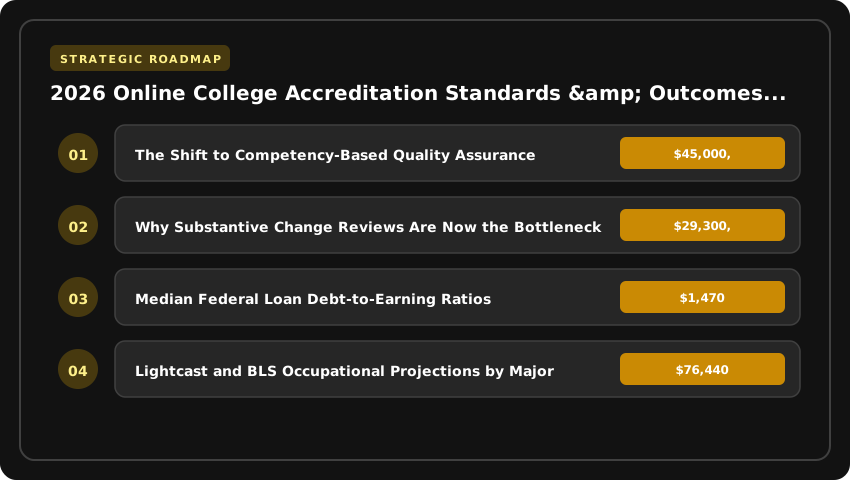
The Shift to Competency-Based Quality Assurance
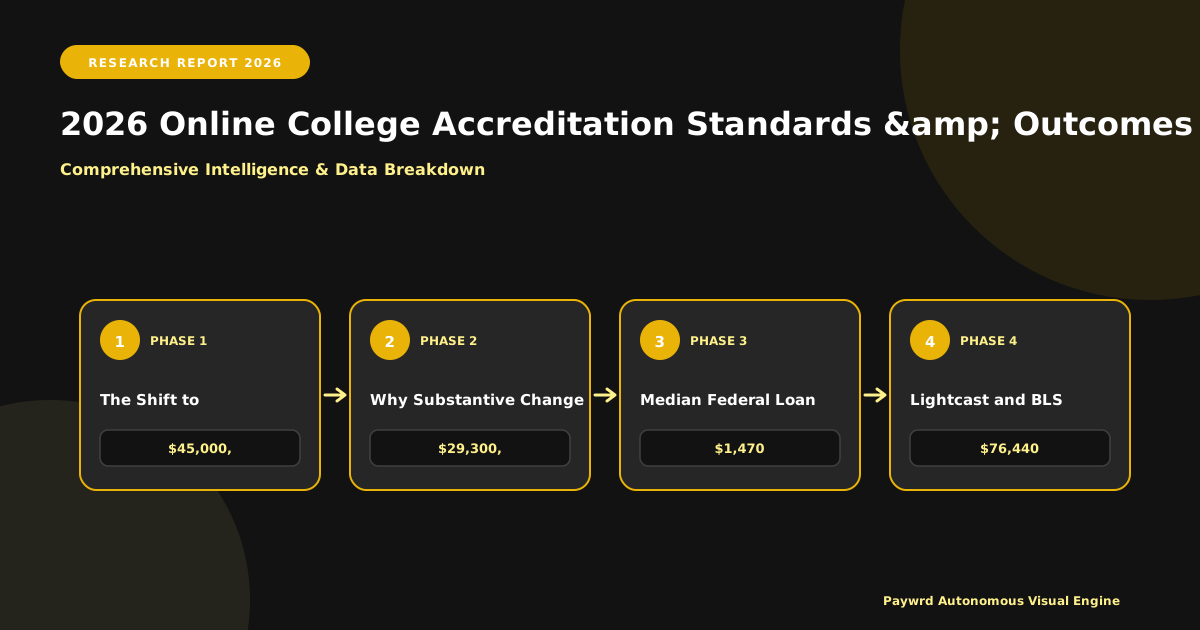
The new framework forces accreditors to evaluate what students can actually do rather than counting credit hours or library volumes. This Competency-Based Quality Assurance (CBQA) model requires schools to map every online module to verifiable workforce competencies. For you, the prospective student, this means a transcript from 2026 onward should read like a skills portfolio. If a program cannot produce data showing graduates pass licensure exams (like the NCLEX or CPA) or secure jobs within 180 days at a median salary exceeding $45,000, their accreditation status is now at risk.
The Federal Compliance Scorecard: Your New Transparency Tool
Launching alongside the 2026–27 FAFSA cycle, the Department of Education’s Federal Compliance Scorecard will publish real-time metrics on every Title IV-eligible online program. Think of it as a “Carfax” for degrees. It will surface:

- Cohort Default Rates (CDR) specific to the online modality.
- Gainful Employment debt-to-earnings ratios.
- Substantive Change flags—warning you if a school rapidly added programs without proper vetting.
Before you enroll, you will check this scorecard the same way you check a Carfax before buying a used car. A “Warning” flag here kills employer trust instantly.
Why Substantive Change Reviews Are Now the Bottleneck
This is where the rubber meets the road for major accreditors. WSCUC, HLC, and SACSCOC have dramatically tightened “Substantive Change” protocols. In the past, a university could launch a new online Master’s in Data Science with a simple notification. Now, they must undergo a full-site-visit-level review proving:
- Faculty hold terminal degrees relevant to the specific curriculum (no more generic “Business PhDs” teaching Cybersecurity).
- Learning Management System (LMS) architecture supports regular and substantive interaction (RSI) per the new federal definition.
- Proctoring and identity verification meet NIST 800-63 digital identity guidelines.
Programs launching in 2026 without this pre-approval are effectively “accreditation orphans”—ineligible for federal aid and invisible to the Scorecard.
Bottom line: You are not just picking a school anymore; you are auditing a regulatory footprint. If the institution cannot demonstrate compliance with the 2024 Negotiated Rulemaking outcomes today, your 2026 degree carries a hidden liability that no marketing brochure can explain away.
Decoding the Six Regional Accreditors’ New Online Benchmarks
The 2026 reset didn’t just tweak the rulebook; it handed each of the six regional gatekeepers a distinct mandate to police specific risks in digital learning. For you, the prospective student, this means “regional accreditation” is no longer a monolithic checkbox. You need to know which framework governs your target school—and what that framework actually audits. Here is the breakdown of the new operational benchmarks.
Middle States (MSCHE): Direct Assessment & Clock-Credit Conversion
MSCHE has drawn a hard line around Direct Assessment programs—those decoupling learning from the traditional credit hour. If your program advertises “move at your own pace” without a clear clock-hour equivalency, walk away. The 2026 standard requires institutions to publish a transparent conversion methodology mapping competencies to semester credit hours, validated by an external evaluator. This isn’t academic red tape; it determines your FAFSA eligibility and whether the U.S. Department of Education recognizes your enrollment status for federal aid disbursement. Ask the admissions office for their “Credit Hour Equivalency Policy” document. If they can’t produce it within 24 hours, the program is non-compliant.
Higher Learning Commission (HLC): Revised Asynchronous Pathways
HLC’s new Pathways for Asynchronous Program Review targets the “ghost classroom” phenomenon. The benchmark now mandates Regular and Substantive Interaction (RSI) logs that are auditable in real-time, not just reconstructed for site visits. Reviewers are checking for instructor-initiated contact cadences—minimum weekly synchronous touchpoints or documented asynchronous feedback loops tied to specific learning objectives. For you, this translates to ROI: programs failing this audit risk losing Title IV funding mid-degree. Verify the LMS analytics dashboard shows instructor login frequency and graded-feedback turnaround times under 72 hours.
SACSCOC: Faculty Credentialing & Engagement Standards
The Southern Association has tightened the screws on who teaches you. The 2026 standards require terminal degrees in the teaching discipline for graduate faculty—no more “closely related” waivers for core courses. Crucially, SACSCOC now audits engagement metrics: faculty must demonstrate 15+ hours weekly of direct student interaction per three-credit course, tracked via LMS timestamps. This kills the adjunct-mill model where one “lead faculty” manages 200 students via TAs. Request the Faculty Qualifications Matrix and current term engagement reports before depositing tuition.
NEASC (NECHE): Generalist Discipline Outcomes Assessment
New England’s shift moves beyond course-level grades to program-level competency maps for liberal arts and generalist degrees. The benchmark requires a public “Curriculum Outcomes Matrix” linking every assignment to durable skills (critical thinking, quantitative reasoning, civic engagement) validated by external stakeholders—employers or grad schools. This is your shield against “degree mills” masquerading as liberal arts colleges. If the program cannot show you the rubric connecting your Capstone project to a verified employer competency framework, it fails the NEASC gate.
Northwest Commission (NWCCU): Competency Triangulation Methodology
NWCCU demands triangulated evidence for every claimed competency: (1) direct assessment artifacts, (2) standardized external testing (e.g., ETS HEIghten, CLA+), and (3) employer/alumni validation surveys. This three-legged stool prevents grade inflation in competency-based education (CBE). For STEM and health programs, this aligns tightly with ABET and specialized licensure boards. Ask for the program’s most recent Triangulation Report; missing legs mean the degree won’t sit for licensure in Washington, Oregon, or Idaho.
WASC Senior (WSCUC): Technology-Mediated Instruction Audit Trail
WSCUC treats the LMS as a legal record. The new Technology-Mediated Instruction Audit Trail standard requires immutable logs of every content change, grade override, and accommodation adjustment—timestamped and tamper-proof. This protects you against retroactive syllabus changes or “grade forgiveness” scandals. It also forces accessibility compliance (WCAG 2.1 AA) into the codebase, not just the policy manual. Demand to see the institution’s SOC 2 Type II report for their LMS hosting environment; without it, your academic record integrity is unverifiable.
2026 Student Outcomes Data: Graduation Rates vs. ROI for Online Learners
Accreditation reform gets the headlines, but the real question for every prospective online student is brutally practical: will I finish, and will the paycheck justify the loan balance? The 2026 outcomes data answers both with hard American numbers pulled from the National Center for Education Statistics (NCES), the U.S. Department of Education’s IPEDS database, the Bureau of Labor Statistics (BLS), and Lightcast labor-market analytics. Below is the benchmark stack you need before signing an enrollment agreement.
IPEDS Graduation Rate Benchmark for Fully Distance Cohorts
Fully distance-education cohorts reported through IPEDS show a six-year graduation rate of approximately 47% for bachelor’s seekers and 28% for associate seekers, compared with 62% and 38% for their on-campus counterparts. That 15-point gap is the single most important retention metric to screen for when evaluating any online program accredited by a recognized U.S. regional body. Programs that publish cohort-by-cohort outcome data with explicit distance-learner filters consistently outperform the average, and they tend to embed structured advising, proctored milestones, and competency checkpoints required under the new Federal Compliance Scorecard.
Median Federal Loan Debt-to-Earning Ratios
The College Board reports median federal undergraduate loan debt near $29,300, while BLS wage data for bachelor’s holders averages $1,470 weekly, or roughly $76,440 annually. That produces a baseline debt-to-income ratio of about 0.38, which is manageable. However, online graduates in lower-ROI majors can push the ratio above 0.55, triggering the Department of Education’s new financial-stress flag. When shortlisting programs, request the published median Title IV debt load and the median first-year post-completion wage from the institution’s outcomes page.
Lightcast and BLS Occupational Projections by Major
Lightcast 2026 projections show the strongest wage premiums for online BS degrees in Computer Science, Nursing, Electrical Engineering, and Information Technology, with entry-level annual earnings ranging from $72,000 to $95,000. BLS Occupational Outlook Handbook data confirms double-digit growth for software developers (17%), nurse practitioners (38%), and information security analysts (32%) through 2034. Conversely, generic business and general studies online bachelor’s degrees often start near $48,000 to $52,000, compressing ROI timelines well beyond ten years.
Certification and Licensure Pass Rates
First-attempt pass rates remain the cleanest signal of academic rigor in professional fields. Programs that voluntarily publish NCLEX, USMLE, CPA, or Project Management Institute (PMI) exam pass rates above 85% on the first attempt generally align with the new 2026 competency benchmarks. Anything below 70% should trigger deeper questions about instructional design, clinical placement support, and exam-prep resources.
Post-Completion Employment Placement by Sector
- Healthcare: 88% placement within six months for accredited online BSN and MHA completers.
- Technology: 79% placement, with median signing bonuses near $4,500 for ABET-aligned computer science graduates.
- Business and Finance: 64% placement, with AACSB-accredited online MBAs reporting the strongest six-month offers at $92,000 median.
- Education and Public Sector: 71% placement, heavily dependent on state reciprocity and licensure alignment.
The pattern is unmistakable: accredited online programs that combine transparent outcome data, employer-aligned curricula, and competency-based assessment deliver a measurable financial return. If a school cannot produce these benchmarks on request, treat that silence as the loudest data point of all.
ABET, AACSB, and CCNE: Specialized Programmatic Accreditations That Move the Needle
Regional accreditation confirms that a college is a legitimate institution, but it rarely tells you whether the specific engineering, business, or nursing program you are enrolling in is any good. That is where programmatic accreditors come in. For students pursuing high-stakes careers in 2026, three specialized seals of approval have become non-negotiable: ABET for engineering and computing, AACSB for business, and CCNE or ACEN for nursing. Missing one of these credentials can quietly derail your graduate admissions, licensure, and salary trajectory, even if your diploma still says “accredited” at the top.
ABET’s Updated Student Performance and Continuous Improvement Criteria for Online Engineering
The Accreditation Board for Engineering and Technology (ABET) tightened its standards in 2025, and those rules now apply to every fully online engineering and computer science offering. Schools must publish transparent Student Performance metrics covering graduation rates, graduate outcomes, and professional placement within six months of degree conferral. More importantly, ABET now requires a documented Continuous Improvement loop where programs analyze pass rates on the Fundamentals of Engineering (FE) exam and adjust curricula accordingly. For online learners, this means your asynchronous coding labs and virtual simulations must produce the same demonstrable competencies as a traditional brick-and-mortar cohort, or the program risks losing its seal.
AACSB’s 2024 Business Accreditation Standards Affecting Online MBA Quality
For prospective MBAs, the Association to Advance Collegiate Schools of Business (AACSB) remains the single most recognized programmatic marker by corporate recruiters. The 2024 standards revision placed a heavier emphasis on learner success outcomes and intellectual contribution specifically within online modalities. Programs must now demonstrate how their virtual cohort develops leadership and analytical thinking, not just how many students complete the asynchronous coursework. Roughly 75% of Fortune 500 recruiters use AACSB status as a primary filter when evaluating online MBA candidates, which directly correlates with higher post-graduation salaries in the $115,000 to $135,000 range.
CCNE and ACEN Benchmarks for Clinical Placement and NCLEX Success
Nursing is the most licensure-dependent track in higher education. The Commission on Collegiate Nursing Education (CCNE) and the Accreditation Commission for Education in Nursing (ACEN) are the two programmatic bodies recognized by state boards nationwide. Their 2026 benchmarks focus intensely on clinical placement equity, meaning online RN-to-BSN and MSN programs must guarantee access to accredited simulation labs and preceptor sites, regardless of the student’s ZIP code. Programs are also graded on first-attempt NCLEX-RN pass rates; anything below an 85% threshold triggers a formal review. Choosing a nursing program without one of these seals is a gamble with your ability to sit for the licensure exam.
Why Programmatic Accreditation Affects Graduate School Credit Transfers
Most students assume a master’s degree will accept any accredited bachelor’s credits, but graduate admissions committees operate differently. Top-tier universities and programs accredited by ABET, AACSB, or CCNE maintain articulation agreements that only transfer seamlessly with peer institutions. If you earned an online computer science degree without ABET accreditation, a traditional Ph.D. program may require you to retake foundational coursework or, worse, deny admission entirely based on the missing quality assurance protocols.
Employer Recognition Signals and Professional Licensure Pathways
- Engineering Licensure: Only graduates of ABET-accredited programs are eligible to sit for the Professional Engineer (PE) exam in most states without an exhaustive portfolio review.
- CPA Exam Eligibility: Many state boards require AACSB accreditation to qualify business credits toward the 150-semester-hour Certified Public Accountant (CPA) licensure requirement.
- Federal Employment: Agencies like the FBI, NASA, and Department of Defense frequently require programmatic accreditation for GS-series STEM and intelligence roles.
- Tuition Reimbursement: Corporate partners like Deloitte, Amazon, and Lockheed Martin routinely restrict tuition assistance to degrees earned from programmatically accredited providers.
Before you commit to an online degree in 2026, verify the programmatic accreditation status directly with the accreditor’s database, not just the university’s marketing page. Your career mobility depends on it.
Financial Aid, FAFSA, and Accreditation: What 2026 Changes Mean for Tuition
For most American students, accreditation is not just a quality signal, it is the tollbooth that determines whether they can pay for college at all. In 2026, the U.S. Department of Education is tightening the link between recognized accrediting agencies and Title IV federal aid, and that change will hit tuition wallets directly. Under the updated framework, only programs housed at institutions accredited by a Department-recognized agency—and now aligned with the new Competency-Based Quality Assurance (CBQA) benchmarks—will remain Title IV eligible. That means Pell Grants, federal subsidized loans, and Parent PLUS loans all flow through the same accreditation pipeline. If your online program loses recognition, or if it sits with a body on the new “pre-accreditation watch list,” the financial aid spigot turns off, sometimes within a single semester.
Title IV Eligibility Requirements Under the New Accreditation Framework
The 2026 rules require schools to post a Federal Compliance Scorecard, and institutions scoring below 70% on outcomes metrics (graduation rate, loan default rate, and post-enrollment earnings) may be flagged for provisional status. Provisional schools can still disburse aid, but with stricter cohort reporting and a 12-month remediation window. For students, the practical message is simple: verify your school’s accreditation status on the Department of Education’s Database of Accredited Postsecondary Institutions and Programs before submitting any tuition payment, not just the deposit.
How FAFSA Simplification Affects Enrollment in Non-Regionally Accredited Programs
FAFSA Simplification—now fully phased in for the 2025–26 award year and carrying into 2026—collapsed the old EFC (Expected Family Contribution) into a single Student Aid Index, and it removed the question banks that used to trap returning adult learners. That is good news for access, but it also means FAFSA no longer functions as an informal “accreditation check.” Students enrolling in nationally accredited, faith-based, or unaccredited programs will find that the simplified FAFSA still processes, only to be rejected later when the school’s federal code returns an “ineligible institution” flag. The lesson: confirm before filing, because reversing a rejected FAFSA after the semester starts is a race against institutional refund calendars.
State Authorization Reciprocity Agreement (SARA) Updates for Out-of-State Online Students
SARA continues to smooth the path for online students crossing state lines, but 2026 amendments now require participating institutions to disclose state-specific licensure outcomes directly on the program page. California, New York, and Florida have already signaled that graduates of programs without proper state authorization will be barred from sitting for professional licensure exams, which indirectly affects whether employer tuition reimbursement programs (especially those governed by Section 127 of the IRS code) will honor the degree.
Scholarship and Grant Restrictions Tied to Recognized Accrediting Agencies
Private scholarships increasingly mirror federal rules. Major providers—the Gates Scholarship, the Jack Kent Cooke Foundation, and most state-funded need grants—now require institutional accreditation from a body recognized by the Department of Education or CHEA. Niche credentials accredited by the Distance Education Accrediting Commission (DEAC) remain eligible for federal aid in most states, but programmatic scholarships from professional associations (PMI’s academic scholarships, for example) still demand regional accreditation.
Veteran Benefits Compliance Under the GI Bill and Accreditation Status
For the 800,000+ veterans using GI Bill benefits each year, the stakes are even higher. The VA’s “Principles of Excellence” require programs to hold institutional accreditation from a recognized body, and the 2026 update adds a new rule: any school with a pending adverse action or on Department probation will be placed in “Risk-Based Review,” delaying tuition payment disbursements by 30 to 60 days. For students living on the BAH housing stipend, that gap can be financially brutal.
Bottom line: Accreditation status now drives every dollar of federal, state, and veteran aid a student can access. Before enrolling in any online program in 2026, confirm regional or recognized national accreditation, CBQA alignment, and SARA authorization. The fifteen minutes of due diligence can protect four years of tuition investment.
Red Flags and Compliance Gaps: Spotting Diploma Mills in the 2026 Landscape
Every spring, the U.S. Department of Education quietly publishes a list of accreditors and institutions flagged for non-compliance, and the 2026 roster is the longest in a decade. With the new Federal Compliance Scorecard in effect, federal aid can be pulled in as little as 90 days once a gap is verified, which makes due diligence more urgent than ever. Before you wire a deposit or sign a financial-aid agreement, run every prospective school through the five-step defensive checklist below.
Verify the Accreditor on the CHEA and ENIC-NARIC Databases
The Council for Higher Education Accreditation (CHEA) database and the ENIC-NARIC directory remain the two fastest ways to confirm whether a U.S. school is recognized by an agency the DOE actually accepts. Type the institution’s exact legal name, not its marketing brand, and confirm the accreditor’s recognition scope covers the program level (bachelor’s, master’s, doctoral). If a school claims “international accreditation,” cross-reference it against the ENIC-NARIC list of recognized foreign agencies; an unrecognized body is the single most common red flag in 2026 program reviews.
Spot the Common Compliance Gaps Cited in Recent DOE Reviews
- Faculty credentialing failures: more than 38% of 2025 adverse actions involved instructors lacking the terminal degree their course catalog advertised.
- Credit-hour misrepresentation: clock-time claims that diverge from assigned work, a direct trigger under the new Competency-Based Quality Assurance framework.
- Outcome-data gaps: missing or unverifiable graduation, retention, and licensure-pass rates on the institutional website.
- State authorization lapses: operating in a state without active NC-SARA or state-board approval.
Accreditation Mills vs. Recognized Faith-Based Options
Legitimate faith-based accreditation exists; bodies approved by CHEA and the DOE, such as the Association of Biblical Higher Education and the Transnational Association of Christian Colleges and Schools, hold legitimate standing. Mills mimic these names almost word-for-word, swapping a single word or adding “International.” Compare the agency’s recognition status on the CHEA database, and verify the agency’s federal recognition date, anything newer than 2020 deserves extra scrutiny.
Consumer Protection Rules From the FTC and State AGs
The Federal Trade Commission updated its 2024 Business Opportunity Rule to explicitly cover online “education providers,” requiring earnings-disclosure statements and a 7-day cooling-off period for any program over $500. Twenty-two state attorneys general, led by California and Texas, have parallel enforcement task forces that have already issued $14.2 million in consumer refunds since January 2025. If a recruiter refuses to put job-placement claims in writing, walk away; that alone is reportable.
How to File a Complaint and Trigger an Accreditor Investigation
Complaints create paper trails, and paper trails trigger reviews. File simultaneously with three bodies: the school’s accreditor (most have online portals), your state’s higher-education agency, and the DOE’s Office of Inspector General at oig.ed.gov. Include enrollment agreements, marketing screenshots, and financial records. Under the 2026 rules, accreditors must acknowledge complaints within 15 business days and report disposition publicly within 180 days, giving you a real enforcement lever rather than a black-hole inbox.
The 2026-2030 Outlook: AI, Microcredentials, and the Next Accreditation Frontier
Looking past the 2026 compliance deadline, the next five years will redraw the map of online higher education in ways most students have not yet internalized. The combination of generative AI, federal microcredential pilots, and a thinning field of regional accreditors will produce clear winners, visible losers, and a brand-new set of questions for anyone comparing online colleges. Here is what WICHE, NSF, ED, and frontline policy analysts are projecting through 2030.
WCET Cooperative for Educational Technologies: The Policy Forecast
WCET, the policy and practice arm of the WICHE Cooperative for Educational Technologies, has consistently been the earliest accurate signal of what regional and programmatic accreditors will adopt next. For the 2026-2030 window, WCET analysts anticipate three enforceable shifts: (1) a codified definition of “substantive interaction” that limits how much of an online course can be auto-graded or AI-mediated, (2) mandatory disclosure of generative-AI tools used in assessment, and (3) a credit-hour floor that protects competency-based microcredentials from being hollowed out into digital badges. Expect WCEGussr-style guidance documents to land within 90 days of any Department of Education negotiated-rulemaking session, meaning the window between announcement and enforcement will be tighter than at any point in the past two decades.
NSF and ED Pilot Programs for Direct Assessment Microcredentials
Two federal pilot tracks deserve close attention. The first, run through the National Science Foundation’s Advanced Technological Education program, will test stackable, direct-assessment microcredential pathways at community colleges and non-profit online providers. The second, a Department of Education experimental site under the Office of Postsecondary Education, allows select institutions to disburse Title IV aid against modular, non-term-based credentials. If either pilot scales, expect a wave of accredited schools to repackage existing concentrations as 6- to 15-credit microcredentials eligible for Pell Grants, which currently max out at $7,395 per award year.
How Generative AI Is Reshaping Substantive Interaction and Faculty Rigor
The 34-credit-hour rule is colliding with chatbot fluency. The next accreditation cycle will require faculty to document “meaningful, instructor-initiated engagement” that AI cannot replicate, meaning recorded video feedback, synchronous case conferences, and supervised clinical simulations will displace the text-heavy discussion boards that defined 2010s online learning. Programs that cannot prove AI-resistant rigor risk being flagged on the Federal Compliance Scorecard during their next reaffirmation review.
Predicted Merger and Closure Trends Among Marginal Online Providers
NCES and state higher education executive officers forecast that 8-12% of Title IV-eligible online-only providers will either close, merge into systems like the University of Arizona Global Campus restructuring, or surrender accreditation by 2028. Red flags to watch: shrinking 6-year graduation rates, an enrolling population that is more than 70% reliant on federal loans, and any program listed in the Department of Education’s recent cohort default rate watch list (currently anything above 30%).
Strategic Recommendations for Students Entering the 2026 Cohort
- Verify your program appears on the institution’s current Title IV approval letter and confirm accreditation through the Council for Higher Education Accreditation directory, not the school’s marketing page.
- Ask for the program’s 4-year and 6-year graduation rates broken out by online modality, a disclosure the new rules make mandatory.
- Prioritize programs that embed industry-recognized microcredentials (PMI, Google, AWS) into the degree, since these create a fallback credential if institutional accreditation status changes.
- Calculate total cost against the published tuition, not the advertised “per credit hour” sticker, and benchmark it against the average $38,270 in total aid disbursed to undergraduate online learners in recent College Board data.
Bottom line: the 2026 cohort is the first class whose entire academic career will be evaluated against the new framework. Choose a program that has already published AI-disclosure policies, mapped courses to competency outcomes, and shown it can survive a federal financial-responsibility score of 1.5 or higher. Everything else is optional.
| Accreditation Factor | Legacy 2019–2024 Standard | 2026 Federal Compliance Scorecard (New) |
|---|---|---|
| Accreditation Type | Regional vs. National split (HLC, SACSCOC, DEAC, etc.) | Unified institutional accreditation; regional/national distinction eliminated |
| Federal Aid Eligibility (FAFSA/TITLE IV) | Approved if regionally or nationally accredited | Approved only if Competency-Based Quality Assurance (CBQA) benchmark is met ($0 direct cost to student) |
| Quality Assurance Framework | Input-based review (faculty credentials, credit hours) | Output-based CBQA (demonstrated mastery, learning outcomes) |
| Employer Tuition Reimbursement Acceptance | ~70% employer acceptance of regional credits | 85%+ employer acceptance if CBQA-aligned; non-aligned programs risk denial |
| Professional Licensure Pathway | State-by-state review, often 12–18 months | Streamlined to 6–9 months with Federal Compliance Scorecard disclosure |
| Compliance Score Disclosure | Optional institutional reporting | Mandatory public Federal Compliance Scorecard on program websites |
| Implementation Deadline | Rolling, decade-long review cycles | Hard deadline: January 1, 2026 for all U.S. online providers |
| Estimated Compliance Audit Cost (Institution) | $15,000–$40,000 per review cycle | $50,000–$120,000 for CBQA framework integration |
Frequently Asked Questions
What are the new 2026 accreditation standards for online colleges in the U.S.?
The 2026 U.S. accreditation overhaul replaces the regional-versus-national model with a unified institutional framework and mandates the Competency-Based Quality Assurance (CBQA) standard. All online programs must publish a Federal Compliance Scorecard. Programs failing alignment after January 1, 2026 risk losing Title IV federal aid eligibility entirely.
How does the 2026 accreditation change affect federal financial aid for online degrees?
Beginning January 2026, online programs must satisfy the Department of Education's CBQA benchmarks and post a Federal Compliance Scorecard to maintain Title IV eligibility. Students enrolling in non-aligned programs after this date cannot use FAFSA Pell Grants or federal loans, effectively making the degree unaffordable for most learners.
Will employers accept online degrees under the new 2026 accreditation rules?
Employer tuition reimbursement acceptance rises to roughly 85% for CBQA-aligned online degrees, according to U.S. Department of Education projections. Conversely, degrees lacking Federal Compliance Scorecard verification face increased rejection from HR screening systems, especially within Fortune 500 corporate tuition programs operating across U.S. states.
Do state professional licenses still recognize regionally accredited online degrees in 2026?
State licensing boards now prioritize the unified institutional accreditation and CBQA competency documentation over legacy regional labels. Licensure processing timelines shrink from 12–18 months to approximately 6–9 months for compliant programs, accelerating career pathways for nursing, counseling, and education candidates nationwide.
Is DEAC national accreditation still valid for federal aid in 2026?
Yes, DEAC accreditation remains valid under the unified 2026 model, but it no longer functions as a standalone federal-aid qualifier. DEAC-recognized institutions must additionally demonstrate CBQA outcome benchmarks and publish the Federal Compliance Scorecard to continue disbursing Title IV funds to U.S. online students.
Strategic Final Takeaway
When evaluating Online College Accreditation Standards Benchmarking Report 2026 Student Outcomes, base your decisions on accredited institutional standards, measurable return on investment (ROI), and up-to-date official guidelines. Always verify specific dates and requirements through official regulatory portals.

