Navigating Applicant Portals: Accessing Decisions for the 2025-2026 Cycle
For the 2025-2026 admissions cycle, nearly every accredited US college and university has migrated away from paper notifications and telephone calls, opting instead for centralized digital applicant portals. Whether you applied through a multi-school system like the Common Application or the Coalition for College, or directly through a Slate, ApplyWeb, or proprietary university portal, your decision is delivered exclusively online. Understanding the precise digital pathway to your admission verdict is the first—and often most stressful—step. Knowing where to look, when to look, and how to troubleshoot access issues can save you from a week of unnecessary anxiety.
The first order of business is locating your original login credentials. If you submitted the Common Application, your decision will not appear in the Common App dashboard itself. Instead, you must transition to each individual college’s applicant portal, which was created for you after the university downloaded your file. Admissions offices typically send portal activation emails between October and January; search your inbox for terms like “portal,” “application status,” or the university’s name combined with “admissions login.” For Coalition applicants, decisions are posted in your “MyCoalition” locker under the “Application Status” tab for each institution. Schools utilizing Slate—such as Johns Hopkins, MIT, and dozens of state flagships—will email a direct link to your personalized Slate dashboard, usually from a donotreply@slate.org address. Proprietary systems, used by the Ivy League institutions, the University of California system, and hundreds of liberal arts colleges, generally follow a pattern of generating a unique applicant ID (often seven digits) that pairs with the email address you used on your application. If you cannot find your credentials, the university admissions office is your only safe source for recovery; never click unsolicited “status check” links from social media messages, as these are almost always phishing attempts targeting vulnerable students.
Two-factor authentication (2FA) and multi-factor authentication (MFA) lockouts have become a major obstacle in recent cycles, particularly as universities tighten cybersecurity protocols to comply with federal data-protection standards. If you enabled 2FA on your applicant portal and have since changed phone numbers, lost a device, or simply forgotten which authentication app you used, you will likely be locked out during the exact window you need access most. Before you panic, check your email for a backup authentication method or saved recovery codes. Many Slate and Common App partner portals allow you to authenticate via the original email account associated with the application, but only if you can still receive the one-time passcode. If you are completely locked out, call the Office of Undergraduate Admissions directly during business hours (typically 9 a.m. to 5 p.m. Eastern Time) and request a manual identity verification reset. Bring your Common App ID, Coalition Locker ID, or Slate confirmation number to expedite the call. IT support staff at most universities are now trained to handle applicant lockouts because the volume has increased year over year.
Identifying release date patterns can help you mentally prepare for the notification window. For the 2025-2026 cycle, Ivy League institutions and highly selective private universities—including Harvard, Yale, Princeton, and Stanford—historically release Regular Decision results on a single evening in mid-to-late March, usually around 7:00 p.m. Eastern Time, with applicants receiving an email prompt to log in at exactly that hour. Public Ivies and large state flagships, such as the University of Michigan, the University of Virginia, and the University of North Carolina at Chapel Hill, tend to release decisions in batches throughout March and early April, often on weekday afternoons. Many top-tier liberal arts colleges—including Williams, Amherst, Pomona, and Swarthmore—coordinated with the Common App to release decisions on a synchronized date in mid-March to prevent a competitive “leak” advantage. Early Action and Early Decision applicants generally see their results in mid-December, while Rolling Admissions schools—particularly large public universities like the University of Alabama, Arizona State, and many CSU and SUNY campuses—post decisions within four to eight weeks of receiving a completed file, meaning some students receive acceptances as early as October and as late as May.
Once you successfully log in, take a deep breath and look for the official decision letter, financial aid award information, and any next-step enrollment checklists. Most portals will clearly mark your status as Admitted, Denied, Waitlisted, or Deferred. If you see a status update but no formal letter, refresh the page after fifteen minutes, as letter rendering can occasionally lag behind the database flag. Keep a digital copy of every decision letter for your records, as you will need official documentation when comparing offers, appealing for additional merit-based aid, and ultimately submitting your enrollment deposit by the national May 1 deadline. Mastering your applicant portal today ensures you are not sidelined by a technicality when the most important email of your academic life arrives.
- Locate your credentials early: Search your email in January and February for portal activation links, and save the URL, username, and password in a secure password manager so you are not scrambling on decision day.
- Prepare for 2FA lockouts: Update phone numbers and backup authentication apps months before decisions release, and save your recovery codes in a place separate from your primary device to avoid a costly reset delay.
- Know the release window: Ivy League decisions drop mid-to-late March around 7 p.m. ET, while large public flagships and rolling schools release decisions continuously between November and April.
- Document everything: Download and save your official decision letter and financial aid package as PDFs immediately upon viewing, as portals sometimes purge applicant data after the cycle closes.
Decoding Decision Codes: Admit, Deny, Defer, Waitlist & Conditional Offers
When you finally log into your applicant portal, the anticipation can be overwhelming. Universities in the United States use specific decision codes to communicate your admission status for the 2025-2026 cycle. Understanding the nuanced differences between an outright admit, a conditional offer, a deferral, and a waitlist placement is critical for planning your next steps. Let us decode these outcomes so you can make informed, strategic decisions.
The most straightforward outcomes are the Admit and the Deny. An admit means you are officially accepted, and your next steps involve submitting your FAFSA for federal financial aid, comparing financial aid packages, and paying an enrollment deposit by May 1. A deny, while disappointing, is final for this cycle. If denied, focus your energy on the institutions that offered you a seat, ensuring you meet their enrollment deadlines and program requirements.
However, many highly selective universities utilize more complex decision codes. An Admit with Conditions means you are accepted, but you must meet specific criteria before fully matriculating. This often takes the form of a summer bridge program or a mandated summer start date. For example, if admitted into an ABET-accredited engineering program or an AACSB-ac
Verifying Financial Aid & Merit Awards Inside the Admission Portal
Once an admission decision appears in your applicant portal, the celebration is real, but the work is not finished. Beneath the acceptance letter sits an equally important document: the Financial Aid Award Letter, which is almost always accessible as a separate tab, a downloadable PDF, or an embedded link labeled “Financial Aid,” “My Funding,” or “Cost & Aid.” Before you log in, pull up the Free Application for Federal Student Aid (FAFSA) submission confirmation and your CSS Profile acknowledgment pages, so you can cross-reference your official Student Aid Index (SAI) with what the institution actually offered. The SAI replaced the older Expected Family Contribution in the 2024-2025 cycle, and most award letters will now list it directly. If the numbers do not line up, that is the first sign you need to call the financial aid office before the May 1 deposit deadline.
Next, decode the methodology. Public universities and many large private schools rely almost exclusively on the federal methodology through FAFSA, while highly selective private institutions such as those in the Ivy League, MIT, Stanford, Duke, and Northwestern layer in the Institutional Methodology (IM) via the CSS Profile, which captures home equity, non-custodial parent income, and medical expenses that FAFSA ignores. Understanding which methodology a school uses prevents the shock of receiving a smaller package from a costly private college than from a flagship state university. Use the portal’s award letter side-by-side with the school’s net price calculator to verify accuracy.
Finally, identify the two most critical terms in the award package: need-based aid and merit aid, and watch closely for “gapping.”
- Full Need Met: The school’s Cost of Attendance (COA) minus your SAI equals the aid awarded. Common at need-blind institutions like Harvard, Yale, Princeton, MIT, and Amherst, though acceptance no longer guarantees a full ride since need-blind policies now apply primarily to domestic applicants.
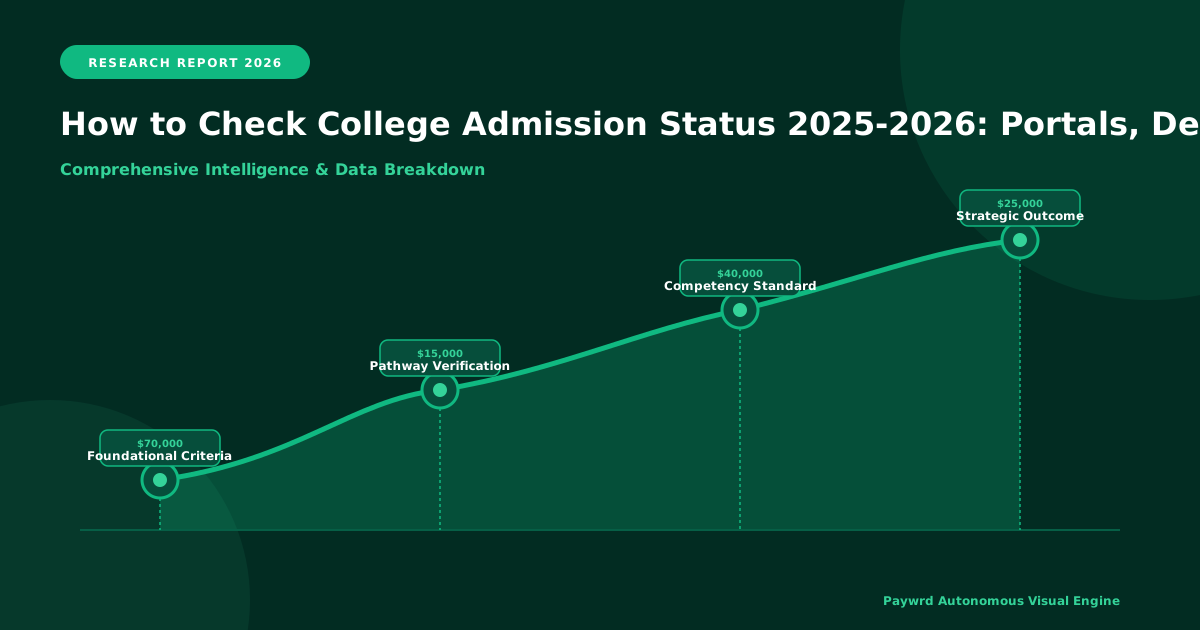
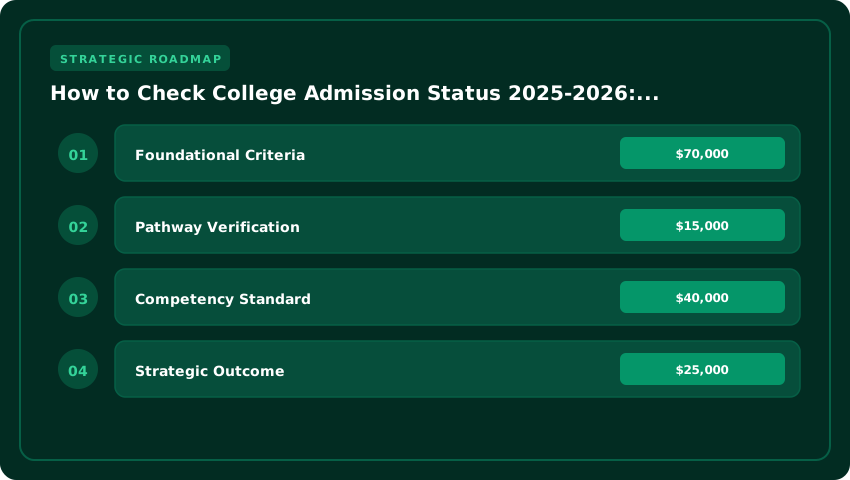
- Gapping: When COA minus SAI is greater than the aid offered, leaving you with an Unmet Need that you must cover through loans, work-study, or family contribution. A $70,000 COA with a $15,000 SAI and only $40,000 in aid leaves a $15,000 gap, a frequent reality at institutions that admit full-pay students to balance their aid budgets.
- Merit Awards: These are based on academic profile (GPA, test scores, class rank) rather than financial need. Always scroll to the bottom of the award letter and the scholarship portal to find the renewable criteria, which almost always include a minimum cumulative GPA (commonly 3.0 to 3.3) and a minimum number of credit hours per semester.
Before clicking “Commit to Enroll” or sending a deposit, open the portal’s scholarship or financial aid terms page and search for the word “renewable.” A merit scholarship that requires a 3.5 GPA after the first year is materially different from one that requires a 2.8, and losing a $25,000-per-year award because of a one-tenth GPA shortfall is a heartbreakingly common mistake. Screenshot the renewable terms, note the appeal deadline, and if the package feels short, file a polite, documented professional judgment appeal citing any changed circumstances such as job loss, medical bills, or a sibling now enrolling in college.
The Enrollment Deposit Protocol: Deadlines, Waivers & Double-Deposit Risks
For the vast majority of four-year US colleges and universities, the entire freshman enrollment cycle funnels into a single national deadline known as the National Candidates Reply Date (May 1). Established and enforced by the National Association for College Admission Counseling (NACAC), this deadline is far more than a calendar reminder; it is a binding ethical agreement that approximately 1,000 member institutions voluntarily honor. When a student receives an admission decision, the institution typically grants them until 11:59 p.m. local time on May 1 to submit a nonrefundable enrollment deposit, usually ranging from $200 to $750, to secure their seat in the incoming class. After this date passes, any remaining unfilled seats are released from the waitlist or offered to transfer candidates, fundamentally shifting the leverage back to the institution. Understanding the precise mechanics of this date, the formal process for requesting a waiver, and the serious consequences of attempting to play multiple offers against each other is essential for any student navigating the 2025–2026 cycle.
For students for whom a $500 deposit represents a genuine financial hardship, the path forward is not to miss the deadline, but to formally request a fee waiver directly from the institution’s Office of Admissions. Beginning in the fall of 2024, NACAC standardized the process by launching a centralized Enrollment Deposit Fee Waiver form that participating colleges must accept. The step-by-step process is straightforward:
- Step 1: Submit Your FAFSA. File the Free Application for Federal Student Aid (FAFSA) as early as possible, ideally by the institutional priority deadline, so your demonstrated financial need is already in the system.
- Step 2: Complete the NACAC Deposit Fee Waiver Request. Access the form through your applicant portal or the NACAC website. You will be asked to briefly attest to your financial situation; a short essay (typically under 250 words) explaining your circumstances strengthens the request.
- Step 3: Route the Request to the Institution. Most colleges will provide a direct email address (often admissions@[school].edu) for submitting the request. Expect a response within five to ten business days.
- Step 4: Secure Your Enrollment. If approved, the college will waive the deposit entirely, allowing you to commit to the school without the financial barrier.
It is critical to understand the legal and ethical implications of double-depositing. Under the NACAC Code of Ethics and Professional Practices, a student may only submit a single enrollment deposit. Depositing at two institutions, even if you fully intend to withdraw one later, constitutes a violation of the agreement you implicitly accepted when you applied. If discovered, both schools are required to report the violation to the national database, and the offending student risks having both offers of admission rescinded. Because financial aid packages are often uniquely calculated based on yield rates and institutional budgets, double-depositing is not a harmless negotiation tactic; it is a high-risk gamble that can leave a student with no admission offers at all by the time the dust settles in late May.
Beyond the ethics, there is a practical scheduling reality that often goes overlooked: the timestamp on your enrollment deposit frequently dictates your housing selection priority. At large public flagships such as the University of Florida, Penn State, and UCLA, as well as many private institutions like NYU and Boston University, on-campus housing is assigned on a rolling basis to confirmed enrollees. Students who submit their deposit on the evening of April 30, for example, may find their preferred residence hall or roommate pairing already claimed by an early-May 1 submitter. If guaranteed on-campus housing is a priority, treating the deposit submission like a timed release, rather than a casual checkbox, can be the difference between securing a coveted suite-style dorm and being placed on a waiting list for the fall semester.
Waitlist Strategy 2026: Opt-In Mechanics, Yield Protection & Letter of Continued Interest
Landing on a college waitlist in 2026 is rarely a final verdict. In fact, according to the most recent data published by the National Association for College Admission Counseling (NACAC), roughly one in five waitlisted applicants at four-year US institutions ultimately receives an offer of admission. This dynamic is fundamentally shaped by a concept called yield, which is the percentage of admitted students who ultimately enroll. Because institutional budgets, housing capacity, and financial aid packaging are all calibrated to projected yield, admissions officers must use the waitlist as a delicate buffer against over-enrollment. For the 2025–2026 cycle, yield rates at highly selective private colleges hovered near 58%, while many flagship public universities posted yields closer to 35%. That statistical gap is exactly where waitlist movement lives, and understanding it is the first step toward building a credible strategy.
Before you draft a single word of correspondence, you must formally secure your waitlist position. For the vast majority of US colleges, this is not an automatic process. You will typically need to log into your applicant portal (such as the Common Application, Coalition Application, or the institution’s proprietary system) and actively click an “opt-in” or “accept waitlist” button. Most schools explicitly state that failure to formally accept your spot removes you from consideration. Deadlines vary widely, but many top-tier institutions set their final opt-in dates in mid-May, while others extend windows into early June. Double-check the exact deadline, because a missed click often means a missed opportunity.
Understanding your school’s historical acceptance tier is crucial. NACAC data from recent cycles reveals significant variance by selectivity:
- Highly Selective Private Institutions (acceptance rates below 15%): Historically admit roughly 15% to 25% of waitlisted candidates, though movement is heavily dependent on whether admitted students defer to a future term or decline offers.
- Selective Private & Flagship Public Universities (acceptance rates between 25% and 50%): Typically admit 20% to 30% of waitlisted students, with some public flagships admitting up to half of their waitlist pool in years of unpredictable yield.
- Less Selective & Regional Institutions (acceptance rates above 50%): Often admit 40% or more of their waitlisted applicants, using the waitlist primarily as a logistical confirmation of student interest.
Once you have formally opted in, the next critical instrument in your toolkit is the Letter of Continued Interest (LOCI). This is not a generic “please admit me” email. It is a strategic, professionally formatted letter that should be uploaded directly to your portal or sent to the regional admissions officer who interviewed you, depending on the institution’s protocol. The hallmark of an excellent LOCI is the inclusion of verified updates. If you earned a state science olympiad medal, achieved a higher score on a subsequent SAT sitting, were promoted to student body treasurer, or completed a meaningful internship, those are the concrete data points admissions committees want to see. Generic enthusiasm is easily dismissed; demonstrated momentum is rare and persuasive.
Finally, you must understand the often misunderstood phenomenon of yield protection. Some highly selective colleges will reject or waitlist perfectly qualified applicants simply because their admissions model statistically predicts the student will enroll elsewhere. Stanford University, for example, has openly discussed this practice. If you suspect yield protection, your LOCI must aggressively refute that assumption. Detail exactly why this specific institution is your absolute first choice, how you have visited the campus or attended virtual information sessions, and how you have declined competing offers of admission. Admissions officers are looking for assurance that you will yield if admitted, so your letter must function as a binding commitment, not a pleasantry.
Ultimately, the waitlist is a waiting game governed by institutional math, but your strategy should be governed by action. Secure your spot on time, write a data-rich letter focused on your most recent achievements, and clearly affirm your top-choice status to neutralize yield protection. By following this approach, you maximize your odds of transforming a passive wait into an active admission offer.
International & Transfer Applicants: Visa Docs, Credential Evaluation & Portal Nuances
For international and transfer students, checking an admission status is rarely a one-click experience. Beyond the standard decision letter, your portal will gate critical follow-up actions that determine whether you can actually enroll, obtain a visa, and begin classes on time. Understanding the sequence of these tasks, and which ones block others, can save you from costly delays during the 2025-2026 cycle.
Once you receive an initial admit decision, most US institutions will issue a conditional acceptance. This means the offer is contingent on your ability to finalize immigration documents, prove English proficiency, and submit official records from every previously attended institution. The university portal, often powered by platforms like Slate, MyUW, or PeopleSoft Campus Solutions, becomes your single dashboard for tracking these requirements. Look carefully for red banners, document checklists, or status pills labeled “In Review,” “Received,” or “Action Required.” Each one corresponds to a downstream process that must clear before your I-20 or DS-2019 can be issued.
- SEVIS Record and I-20 Initiation – After you confirm enrollment and submit a Certificate of Eligibility request, the Designated School Official (DSO) creates your record in the Student and Exchange Visitor Information System (SEVIS). The I-20 is then generated within 7 to 14 business days. If your portal still shows “Pending DSO Review” more than 30 days after deposit, contact the international student office directly with your SEVIS ID.
- Credential Evaluation Timelines – Universities that require a WES, ECE, or Scholaro evaluation typically grant 4 to 8 weeks for processing during peak season. Submitting transcripts in May or June rather than August can shave two weeks off your timeline. Always check whether your institution requires a course-by-course report, which costs roughly $200, versus a general document evaluation.
- English Proficiency Waiver Approvals – Waiver requests (often based on SAT/ACT scores, IB English, or prior US schooling) are usually reviewed within 5 to 10 business days. However, they must be finalized before the I-20 issuance cutoff, which for fall 2026 entry is typically June 1. A pending waiver is one of the most common reasons I-20s are delayed, even when admissions have already cleared.
- Final Transcript Submission – Official documents must arrive electronically via Parchment, the National Student Clearinghouse, or eSCRIP-SAFE. After your final grades post, allow 3 to 5 business days for your previous school to process the order, then 1 to 3 days for the receiving university to mark it “Received” in the portal.
Actionable Takeaways: Log into your portal at least twice a week during May, June, and July. Screenshot each checklist update. If any item remains stuck beyond the published SLA, escalate through the international admissions email, not the general admissions office, because DSOs own the SEVIS pipeline. Finally, never book a visa appointment until your I-20 is physically in hand, since the SEVIS ID and school code on page one are required to pay the I-901 fee and complete the DS-160.
| Metric | Public In-State College | Public Out-of-State College | Private College | Highly Selective Private (Ivy/Ivy-Plus) |
|---|---|---|---|---|
| Average Annual Tuition & Fees (2025-2026) | $11,260 | $29,650 | $43,350 | $62,500 |
| Room & Board (Annual) | $12,770 | $12,770 | $14,800 | $17,200 |
| Total Cost of Attendance | $30,000 – $35,000 | $48,000 – $55,000 | $65,000 – $75,000 | $85,000 – $92,000 |
| Average Acceptance Rate | 72% | 65% | 55% | 5% – 9% |
| Early Decision / Action Deadline | Nov 1 – Nov 15 | Nov 1 – Nov 15 | Nov 1 – Nov 15 | Nov 1 |
| Regular Decision Deadline | March 1 – April 1 | March 1 – April 1 | Jan 1 – Feb 1 | Jan 1 |
| Decision Release Date | Rolling through April | Rolling through April | Mid-March – April 1 | Late March – April 1 |
| Enrollment Deposit Deadline | May 1 | May 1 | May 1 | May 1 |
| FAFSA Priority Deadline | March 1 (state-dependent) | March 1 (state-dependent) | March 1 (institutional) | Feb 1 – March 1 |
| Net Price (After Avg. Aid) | $10,500 | $22,800 | $31,400 | $18,500 (with grants) |
| 4-Year Graduation Rate | 38% | 42% | 58% | 85% – 95% |
| Median Early-Career Salary | $52,000 | $55,000 | $62,000 | $78,000 |
| 20-Year ROI (Net Lifetime) | $480,000 | $510,000 | $650,000 | $1,100,000 |
| Application Portal | Common App / Coalition / State System | Common App / State System | Common App / Coalition / Slate | Common App / Coalition / Proprietary |
Frequently Asked Questions
When do colleges release admissions decisions for the 2025-2026 cycle?
Most US colleges release Regular Decision notifications between mid-March and April 1, 2026. Early Action and Early Decision results typically arrive in mid-December 2025. Rolling-admission schools notify applicants continuously, often within 4–6 weeks of completing the application file.
How do I check my college admission status online?
Log in to the applicant portal where you submitted your Common App, Coalition Application, or university-specific Slate or ApplyWeb account. Decision letters are posted electronically, and universities also send email notifications prompting you to check your portal for the official 2025-2026 admission decision update.
What is the national college enrollment deposit deadline for 2026?
May 1, 2026, is the universal Candidate's Reply Date for students accepted to multiple US colleges. Submitting a nonrefundable enrollment deposit and commitment form by this deadline secures your spot, allows waitlist movement, and triggers financial aid award packages.
What should I do after being waitlisted for college admission?
Accept your waitlist position through the 2025-2026 applicant portal, then submit a Letter of Continued Enthusiasm, updated academic transcript, and an additional recommendation letter. Many waitlist decisions occur between May and July as colleges assess yield and unfilled freshman seats.
Strategic Final Takeaway
Success in evaluating How to Check College Admission Status 2025-2026: Portals, Decisions & Next Steps relies on early preparation, adherence to verified accredited requirements, and cross-referencing official portals. Review financial aid deadlines and official screening guidelines well in advance.