
What Exactly Is a Teaching Apprenticeship in the US Education System
For decades, the standard path to a US teaching license required a four-year bachelor’s degree followed by a semester of unpaid student teaching—a financial barrier that effectively locked out countless working adults. Today, the Registered Apprenticeship model, validated by the US Department of Labor (DOL) and the US Department of Education, flips that script. It classifies “K-12 Teacher” as an apprenticeable occupation, unlocking federal workforce funding (like WIOA grants) and requiring employers—school districts or charter networks—to provide structured, paid on-the-job training (OJT) aligned with rigorous academic instruction.

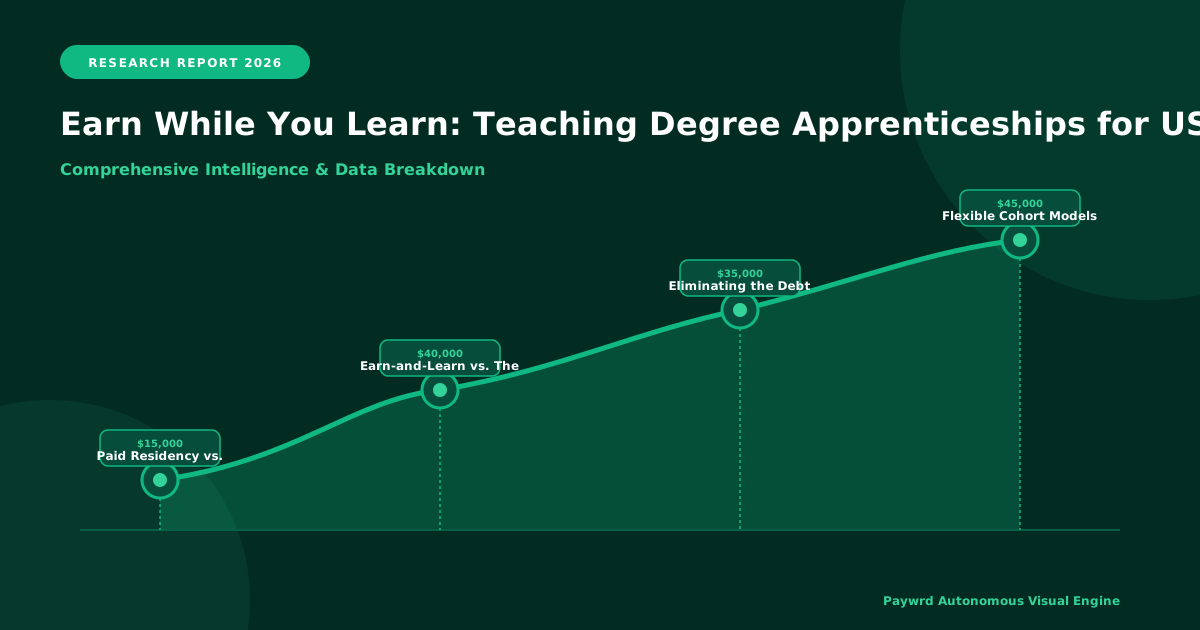
Paid Residency vs. Traditional Student Teaching
The most immediate difference is the paycheck. In a traditional preparation program, you pay tuition—often $15,000 to $40,000+ per year at public institutions per College Board data—while working full-time in a classroom for free. In a DOL-registered apprenticeship, you are a district employee from day one. You earn a competitive entry-level salary (frequently $35,000–$45,000 annually plus full benefits) while serving as a resident or co-teacher under a mentor teacher of record. This isn’t observation; it is progressive responsibility. You might start leading small groups in month one and assume full classroom load by the second semester, all while accumulating the 1,200–2,000 required OJT hours mandated by the apprenticeship standards.
Earn-and-Learn vs. The Four-Year Degree Track
This is not a “shortcut” that lowers standards; it is a structural redesign. Apprenticeships integrate the Related Technical Instruction (RTI)—your pedagogical theory, child development, and methods courses—directly into the workweek. Partner colleges (often community colleges or state universities) map this coursework to a bachelor’s or master’s degree, meaning you graduate with the exact same credential and licensure eligibility as a traditional student, but with zero student debt and two years of seniority on the salary schedule. For a career changer holding a bachelor’s in another field, many programs offer a “Degree + Licensure” track completed in 12–18 months while drawing a salary.
Credit-Bearing Experience vs. Alternative Certification (Teach for America)
It is critical to distinguish apprenticeships from fast-track alternative routes like Teach for America (TFA) or state “emergency licenses.” TFA corps members typically receive 5–7 weeks of summer training before becoming the teacher of record, often on a temporary credential. Apprenticeships, by contrast, require a minimum of 144 hours of RTI per year and a minimum 12-month residency before the apprentice assumes full licensure responsibility. The mentorship is non-negotiable: a 1:1 ratio with a trained mentor teacher is a federal registration requirement. Furthermore, because the apprenticeship is credit-bearing, every hour of classroom practice counts toward a degree, protecting your long-term mobility—if you move states, you hold a standard, regionally accredited degree, not just a provisional certificate tied to a specific program.
Why Working Adults Are Choosing Paid Residency Over Traditional Programs
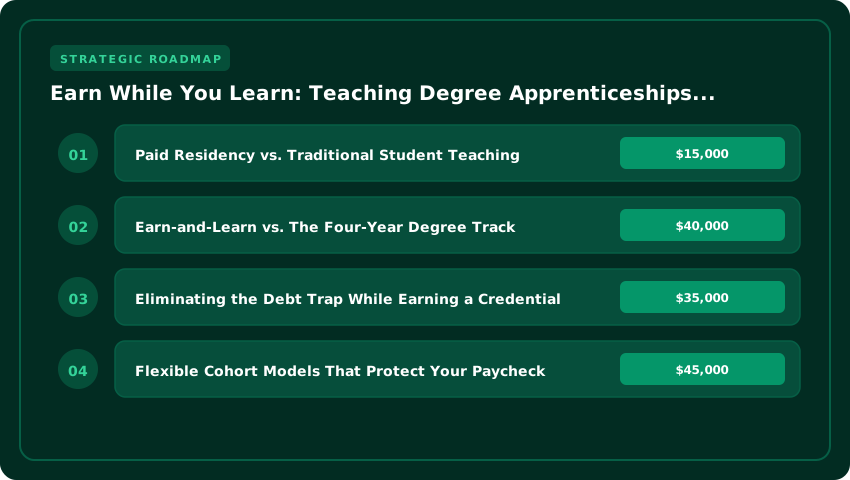
The math behind the traditional route to licensure has always been brutal for anyone over 25. A standard university pathway demands you quit your job, absorb $20,000 to $40,000 in tuition for a Master of Arts in Teaching, and survive a semester of unpaid student teaching. For a single parent or a mid-career professional with a mortgage, that “tuition versus rent” calculation doesn’t just discourage entry—it blocks it entirely. Paid residency models flip that equation, turning the clinical experience into a salaried position with health benefits and retirement contributions from day one.
Eliminating the Debt Trap While Earning a Credential
Registered Apprenticeship programs approved by the U.S. Department of Labor unlock access to Workforce Innovation and Opportunity Act (WIOA) funding and GI Bill benefits that traditional degree-seekers often miss. In states like Tennessee, West Virginia, and North Dakota, the “Grow Your Own” initiatives cover 100% of tuition at partner institutions—think Western Governors University or local community colleges—while the apprentice draws a paraeducator salary averaging $28,000 to $35,000 annually. Contrast that with the National Education Association data showing the average education graduate carries $37,000 in student loans, and the financial argument writes itself.
Flexible Cohort Models That Protect Your Paycheck
Districts and providers have cracked the scheduling code. Most apprenticeships now run on a competency-based timeline rather than a rigid credit-hour clock. Coursework is delivered asynchronously or during protected evening blocks—typically 6 p.m. to 9 p.m.—with weekend intensives once a month. This design lets a current paraprofessional in Dallas ISD or a career-changer in Baltimore City Schools keep their full-time wages while accumulating the 600+ clinical hours required for state licensure. No more choosing between a rent payment and a practicum seminar.
Mentorship That Beats Theory Every Time
Traditional student teaching often drops a novice into a classroom for 14 weeks with a cooperating teacher who may have zero training in adult coaching. Apprenticeships mandate a 1:1 mentor match for the full academic year—often 180 days—funded by a district stipend of $2,500 to $5,000 for the mentor. The apprentice co-teaches, leads small groups, and gradually assumes full instructional responsibility under real-time feedback. Research from the National Center for Teacher Residencies shows these residents stay in the profession at 80-90% rates after three years, versus roughly 50% for fast-track alternative certification grads.
District Partnerships as the Financial Engine
The secret sauce is the Memorandum of Understanding (MOU) between the Local Education Agency (LEA), the Educator Preparation Provider (EPP), and the state apprenticeship agency. The district leverages Title II-A funds, Elementary and Secondary School Emergency Relief (ESSER) allocations, and state apprenticeship grants to cover tuition, books, and certification exam fees (like the Praxis or edTPA). In return, they secure a pipeline of “day-one ready” teachers who already know the curriculum, the culture, and the kids. It’s workforce development disguised as teacher prep—and for the working adult, it’s the only model that respects the bills waiting on the kitchen counter.
State Certification Boards and Community College Pathways Across America
Teaching apprenticeship pathways in the United States are not governed by a single national authority. Instead, each state operates its own Department of Education or Office of Educator Certification, which means your paycheck, your mentor, and your final exam depend heavily on the zip code you call home. Understanding how these state certification boards interact with regional community college networks is the single most important step for any career changer evaluating this model.
State Apprenticeship Programs in Action
Texas has emerged as a national leader through its Texas Education Agency (TEA) and the “Grow Your Own” initiative, allowing districts to sponsor apprentices who complete university coursework while earning a full salary starting around $50,000 annually. Ohio’s Alternative Resident Educator License similarly partners with the Ohio Department of Education to offer a paid residency, often coordinated through local technical centers. In North Carolina, the North Carolina Teaching Fellows and lateral entry programs let mid-career professionals begin teaching immediately while completing licensure requirements through a hybrid community college and university schedule.
Community Colleges as Local Hubs
Your local community college frequently serves as the operational hub for these apprenticeships. Institutions such as Houston Community College, Cuyahoga Community College in Ohio, and Central Piedmont Community College in Charlotte have built direct articulation agreements with regional K-12 districts. These partnerships handle transcript evaluation, schedule Praxis prep workshops, and assign college advisors who walk alongside you through your two-to-three-year residency. For US adults balancing rent and tuition, this local infrastructure eliminates the need to relocate or commute to a distant four-year campus.
Navigating State-Specific Exam Requirements
Every state maintains its own testing gatekeeping. Most require the Praxis Core or Praxis II exams administered by ETS, while states like Washington and Illinois mandate the edTPA portfolio assessment, which requires video submission of your classroom teaching. Expect to budget roughly $150 to $300 per exam attempt, though your apprenticeship sponsor typically reimburses these costs. Pass scores vary, and some boards accept alternative assessments like ACT or SAT scores in lieu of Praxis Core for older career changers.
Reciprocity Agreements for Relocating Teachers
If your apprenticeship is in one state but life pulls you elsewhere, reciprocity agreements determine whether your license transfers cleanly. States participating in the NASDTEC Interstate Agreement generally honor out-of-state licenses for fully certified teachers, but apprentice or provisional licenses often require additional coursework in the new state’s standards. Always verify the current reciprocity map before accepting an apprenticeship offer, as policies updated annually by the U.S. Department of Education and individual state boards can shift unexpectedly.
Decoding the Salary Structure: Average Starting Pay for US Certified Teachers
Money matters, especially when you are weighing a career switch and calculating the return on investment for a multi-year apprenticeship pathway. Understanding exactly how much certified teachers earn across the United States helps prospective apprentices forecast their financial trajectory with real precision, not vague promises.
National Starting Salary Benchmarks
According to the US Bureau of Labor Statistics (BLS), elementary, middle, and high school teachers earn a national median annual wage of approximately $65,220, with most first-year public school teachers in America entering the classroom somewhere between $45,000 and $50,000 depending on district size and local tax bases. The National Education Association (NEA) reports that the average starting public school teacher salary for the 2023-24 school year reached roughly $45,000 nationally. These figures represent guaranteed base pay before bonuses, retirement contributions through systems like CalSTRS or TRS, or health insurance benefits, which typically add another 25-30% to total compensation value.
Regional Salary Variations That Reshape ROI
Geography dramatically impacts your paycheck. High-cost coastal markets pay significantly more in raw dollars, though purchasing power tells a different story. New York City public schools start first-year certified teachers at approximately $72,000 base salary, while California’s Bay Area districts often start credentialed teachers between $65,000 and $75,000. In contrast, Midwest markets offer lower nominal figures—Ohio, Indiana, and Missouri typically start teachers in the $38,000 to $42,000 range—but the lower cost of living means your dollar stretches considerably further on housing, groceries, and transportation. A $42,000 salary in Indianapolis often provides comparable or superior lifestyle value to a $60,000 position in an expensive metro.
Apprentice Pay Versus Traditional Substitute and Paraprofessional Rates
Teaching apprentices earn substantially more than substitute teachers and paraprofessionals (teacher’s aides) because apprentices hold a formal employment classification under the US Department of Labor’s Registered Apprenticeship framework. Substitute teachers typically earn $120 to $200 per day, which translates to roughly $25,000 to $40,000 annually when working full-time hours with no benefits. Paraprofessionals earn a median hourly wage of around $19.50, or approximately $35,000 annually according to BLS data. Apprentices, however, commonly earn between $40,000 and $55,000 during their residency year while receiving full employee benefits, employer-covered tuition through partner universities, and structured raises tied to competency milestones.
Master’s Degree Bumps and Completion Bonuses
Salary scales across most US school districts reward advanced credentials. Earning a master’s degree typically adds $3,000 to $8,000 annually to your base pay, with some districts offering larger bumps for specialized credentials in special education, STEM, or bilingual education. Apprenticeship completion bonuses vary by sponsor—some state apprenticeship programs funded through workforce development grants offer $2,000 to $5,000 retention bonuses for teachers who complete their residency and commit to teaching in high-need schools for three-plus years. When you stack a master’s bump against a completion bonus against annual step increases (typically 2-4% per year of service), a career-changer entering through an apprenticeship can realistically reach $70,000 to $85,000 within five years of full-time teaching.
- Bottom-line ROI calculation: A teaching apprentice earning $45,000 with full benefits and tuition covered outperforms an unpaid student teacher paying $15,000-$25,000 out-of-pocket for the same credential.
- Regional strategy tip: Research cost-of-living-adjusted salaries using BLS metropolitan data rather than fixating on raw dollar figures when comparing state offers.
- Long-term earnings ceiling: Experienced teachers with master’s degrees in high-demand subjects can reach $90,000-$110,000 in many US districts by mid-career, with administrative and specialist roles exceeding $120,000.
How to Evaluate Accredited Programs: ABET, AACSB, and CAEP Standards
Choosing a registered teaching apprenticeship is only half the battle. The other half is making sure the program you pick actually leads to a US teaching license you can use in any state. The credentialing landscape can feel like alphabet soup, but for aspiring educators specifically, CAEP accreditation (the Council for the Accreditation of Educator Preparation) is the gold standard. Unlike ABET (which accredits engineering and technology programs) or AACSB (which governs business schools), CAEP is the only body recognized by the US Department of Education and the Council for Higher Education Accreditation to evaluate teacher preparation. If your apprenticeship program does not hold CAEP accreditation or state-level approval, your credits may not transfer, your license could be denied, and your salary will likely stall at the bottom of the district pay scale.
Spotting Legitimate Providers vs. Diploma Mills
When vetting programs, start by identifying the sponsoring institution. Many high-quality apprenticeships are run by nonprofit state universities, public school districts, or nonprofit consortia in partnership with the US Department of Labor’s Registered Apprenticeship system. Be wary of for-profit providers that promise rapid “alternative certification” but lack CAEP or regional accreditation. These operations often pad their enrollment numbers with non-traditional students, inflate their job placement statistics, and leave graduates buried in private student loan debt averaging $30,000 to $50,000 with no guarantee of a teaching position.
- Check the US Dept of Labor apprenticeship registry. If the program isn’t federally registered, you likely won’t earn the journeyman credential that signals mastery to employers.
- Demand transparent debt and earnings data. Reputable programs publish graduate outcomes, including median debt loads and first-year teacher salaries (typically $40,000 to $48,000 in most US districts per Bureau of Labor Statistics data).
- Verify state licensing reciprocity. A CAEP-accredited program ensures your license is portable across most participating US states, protecting your mobility.
- Watch for red flags: high-pressure enrollment tactics, vague answers about cohort completion rates, or refusal to disclose apprenticeship sponsor names. These are hallmarks of non-registered training programs that fail to meet basic US workforce standards.
Ultimately, your apprenticeship is an investment of two to four years of your life. Insist on CAEP accreditation, a registered apprenticeship sponsor, and documented graduate success rates. With those three boxes checked, you can confidently trade tuition bills for a salaried classroom residency that launches a durable US teaching career.
Balancing a Full-Time Job With Coursework and Field-Based Hours
Juggling a salaried classroom role, graduate-level pedagogy coursework, and a personal life is the defining reality of every US teaching apprentice. Most programs expect you to treat your residency like a full-time profession while completing 30 to 36 credit hours across 18 to 24 months. The good news is that registered apprenticeships in the United States are explicitly designed for working adults, which means the scheduling architecture is built to bend, not break.
Cohort Schedules and Weekend Intensive Sessions
Apprenticeship cohorts typically meet one evening per week after the school day ends, supplemented by four to six Saturday “intensives” each semester. Programs such as those aligned with the US Department of Labor’s Registered Apprenticeship framework cluster assignments around long weekends so you can attend face-to-face seminars without burning precious PTO. Cohort coordinators publish calendars 12 months in advance, giving you predictable runway to arrange substitute coverage, family logistics, and study blocks.
Employer Tuition Reimbursement and Apprenticeship Tuition Coverage
One of the most underused financial levers is the employer tuition reimbursement program. Public school districts often partner with state apprenticeship intermediaries, and many forward-thinking districts now absorb 100 percent of tuition after each successfully completed semester. Private sector employers offering upskilling benefits under Section 127 of the Internal Revenue Code can also contribute up to $5,250 per year in tax-free educational assistance. Always file the Free Application for Federal Student Aid (FAFSA) first; many apprenticeship candidates qualify for TEACH Grants worth up to $4,000 annually, which do not need to be repaid if you teach in a high-need school for four years.
Family Support, Childcare, and Dependent Care Flex Accounts
Adult apprentice teachers frequently raise children while completing residency hours. Your district’s human resources office can walk you through a Dependent Care Flexible Spending Account (FSA), which lets you set aside up to $5,000 of pre-tax wages for licensed childcare, before-tax summer camps, and after-school programs. Many states layer additional subsidies on top of this, so contact your county’s childcare resource and referral agency to see whether you qualify for income-based vouchers that can shave another $400 to $800 per month off your family budget.
Mental Health and Burnout Prevention in High-Need Schools
Teaching in a Title I classroom while studying for licensure exams is genuinely demanding. Build a non-negotiable recovery window into your weekly calendar: even 90 minutes of protected downtime reduces cortisol levels measurably. Tap your Employee Assistance Program (EAP), which typically offers six free counseling sessions per issue, and explore the 988 Suicide and Crisis Lifeline or the National Education Association’s peer-support network when stress feels unmanageable. Finally, lean on your cohort: adult learners who study in tightly knit groups report a 30 percent higher program completion rate than those who go it alone.
- Lock the calendar: Block intensive weekends a full year out so family and work schedules bend around you, not the other way around.
- Stack the benefits: Combine FAFSA, TEACH Grants, employer tuition reimbursement, and Dependent Care FSA pre-tax savings.
- Protect recovery time: Schedule mental health appointments with the same seriousness as a parent-teacher conference.
- Build the cohort: Form a study group that meets weekly; shared lesson planning saves roughly five hours per week.
Career Advancement After Completing a US Teaching Apprenticeship
Finishing a registered US teaching apprenticeship is not a career endpoint; it is the launching pad for a stable, upwardly mobile profession with clearly defined rungs on the ladder. For working adults evaluating a mid-career switch, the most important question is not whether they can survive the residency, but where the credential takes them five, ten, and twenty years down the road. The short answer: significantly further than most corporate upskilling programs allow.
From Apprentice to Tenured Public School Teacher
Upon completing your apprenticeship and passing your state’s licensure exams (such as Praxis or edTPA), you enter the workforce as a fully credentialed teacher. Most US public school districts operate on a probationary timeline of roughly three years, during which you accumulate evaluated service years. After successfully meeting performance benchmarks and completing all required professional development hours, you typically achieve tenure or continuing contract status—a protection that effectively secures your position unless extraordinary circumstances occur. This pathway is especially valuable in high-need districts, where apprenticeship completers are often fast-tracked into permanent roles.
Pursuing a Master of Arts in Teaching While Employed Full-Time
One of the strongest financial arguments for the apprenticeship model is that it removes the traditional “stop working to go back to school” obstacle. Many new teachers pursue a Master of Arts in Teaching (MAT) or Master of Education (M.Ed.) while remaining in the classroom full-time, with districts frequently subsidizing tuition through tuition reimbursement programs. Federal TEACH Grants—administered by the US Department of Education—can convert up to $4,000 per year into fully forgiven funds if you teach in a high-need subject area or low-income school for four years. A master’s stipend on the salary scale typically adds between $2,000 and $8,000 annually, depending on the district contract.
Leadership Opportunities and Instructional Coaching
By year five to seven, tenured teachers become eligible for differentiated roles that substantially boost both income and influence:
- Instructional Coach or Mentor Teacher: Salaries commonly range from $65,000 to $90,000, depending on district size.
- Department Chair or Team Lead: Often paired with a stipend of $3,000 to $7,000 above base pay.
- Curriculum Specialist or District-Level Content Lead: Frequently crosses the $80,000 threshold.
- School Administration (Principal, Assistant Principal): Requires an additional credential, but median pay reaches $98,750 per BLS data.
Long-Term Earning Potential and Pension Benefits
According to the Bureau of Labor Statistics, the median annual wage for elementary, middle, and secondary school teachers in 2024 sits between $62,000 and $66,000, with top-quartile earners exceeding $100,000. Public school teachers also gain access to defined-benefit pension plans—typically Tier 1 or Tier 2 state systems—that vest after five to ten years and replace a meaningful percentage of pre-retirement income, often 60% to 80% of final salary. When you combine step-and-lane salary increases, pension accrual, and consistent raises negotiated through unions like the NEA and AFT, the lifetime earnings trajectory of a public school teacher is competitive with many private-sector roles, without the volatility of contract work.
For working adults weighing a career change, the math is straightforward: you graduate debt-light, earn while you learn, and step onto a track that compounds credentials, salary, and retirement security over a full 30-year career.
| Decision Criteria | Registered Teaching Apprenticeship | Traditional 4-Year Bachelor’s Degree |
|---|---|---|
| Total Tuition Cost | $0 – $8,000 (often fully covered by DOL/WIOA grants) | $40,000 – $110,000 (average public/private) |
| Earn While Studying? | Yes — $35,000 – $55,000 annual apprentice salary | No — tuition-based, loans common |
| Timeline to Licensure | 12 – 36 months (accelerated) | 48 months (standard 4 years) |
| Prerequisites | High school diploma/GED + district hire; SAT/ACT not required | High school diploma + standardized test scores + GPA cutoff (2.5-3.0+) |
| Salary Potential After Completion | $48,000 – $72,000 (Year 1 public school teacher) | $48,000 – $72,000 (Year 1 public school teacher) |
| Classroom Residency Hours | Paid, mentored 1,500+ hours | Unpaid student teaching (typically 1 semester) |
| Federal Funding Eligibility | Yes — WIOA, IRA Section 25001, district sponsors | Federal Pell Grants + loans only |
| ROI (5-Year Net) | +$175,000 to +$240,000 (no debt) | +$50,000 to +$150,000 (minus loan debt) |
Frequently Asked Questions
How much do US teaching apprenticeships pay in 2025?
Registered teaching apprentices in the US earn between $35,000 and $55,000 annually during their 12-36 month program, based on district scale and location. This is a full W-2 salary with health benefits, not a stipend, making it a viable path for career changers who cannot afford unpaid student teaching.
Are teaching apprenticeships in the US really tuition-free?
Yes, most US teaching apprenticeships are tuition-free or near-free for participants. The US Department of Labor covers tuition costs through WIOA workforce funding and Inflation Reduction Act Section 25001 grants, while the employing school district pays the apprentice's salary. Apprentices typically pay $0 out-of-pocket.
Do you need a bachelor's degree to start a US teaching apprenticeship?
No, a bachelor's degree is not required to begin a registered teaching apprenticeship in the US. Candidates need only a high school diploma or GED, must pass a basic skills assessment, and secure hire as an apprentice teacher by a participating school district or charter network.
How long does a registered teaching apprenticeship take to complete?
A registered US teaching apprenticeship typically takes 12 to 36 months to complete, depending on the state and sponsoring district. Apprentices work full-time in a classroom while completing state-approved licensure coursework through partner universities, earning their teaching credential at program end.
What is the ROI of a US teaching apprenticeship vs. a traditional degree?
A US teaching apprenticeship delivers a 5-year net ROI of roughly $175,000 to $240,000 because apprentices earn a salary while studying and incur zero tuition debt. Traditional bachelor's graduates in education typically net $50,000 to $150,000 over the same period after subtracting $40,000-$110,000 in student loans.
Strategic Final Takeaway
When evaluating Earn While You Learn Teaching Degree Apprenticeships For Working Adults In USA, base your decisions on accredited institutional standards, measurable return on investment (ROI), and up-to-date official guidelines. Always verify specific dates and requirements through official regulatory portals.

