BLS Projections: Why US Universities Are Racing to Embed AI Credentials
The Bureau of Labor Statistics (BLS) projects that employment for Computer and Information Research Scientists will increase 23 % from 2022 to 2032, while Data Scientists roles are expected to swell by 35 % over the same period. These growth rates dwarf the 3 % average increase forecast for all occupations, underscoring a pressing talent gap that U.S. higher‑education institutions are moving to fill.
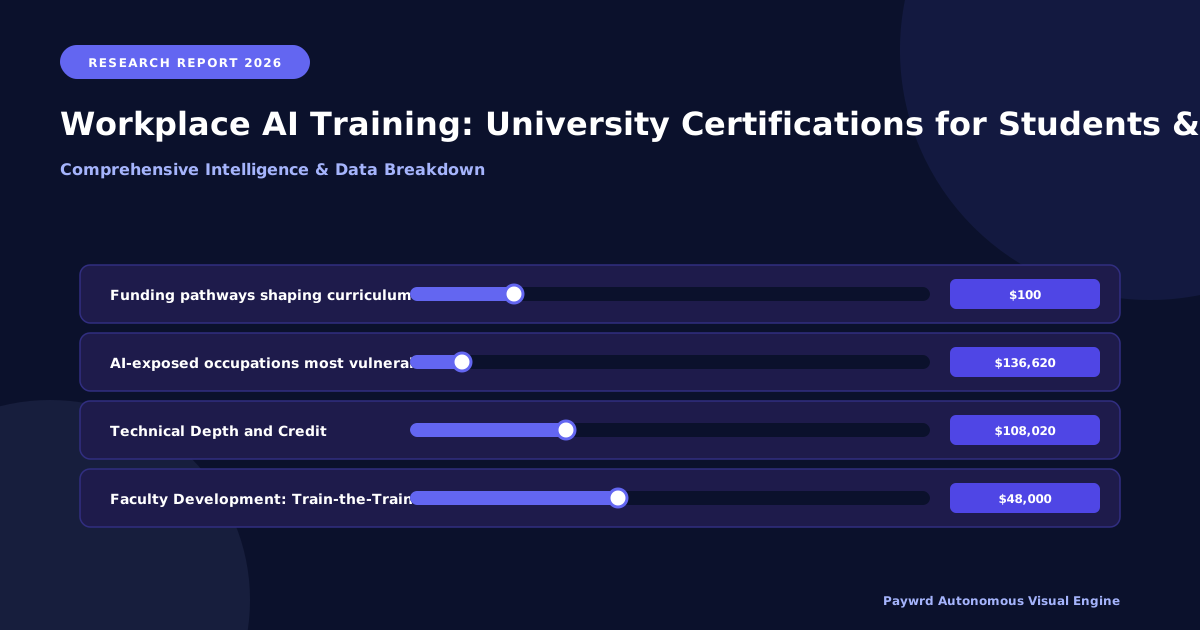
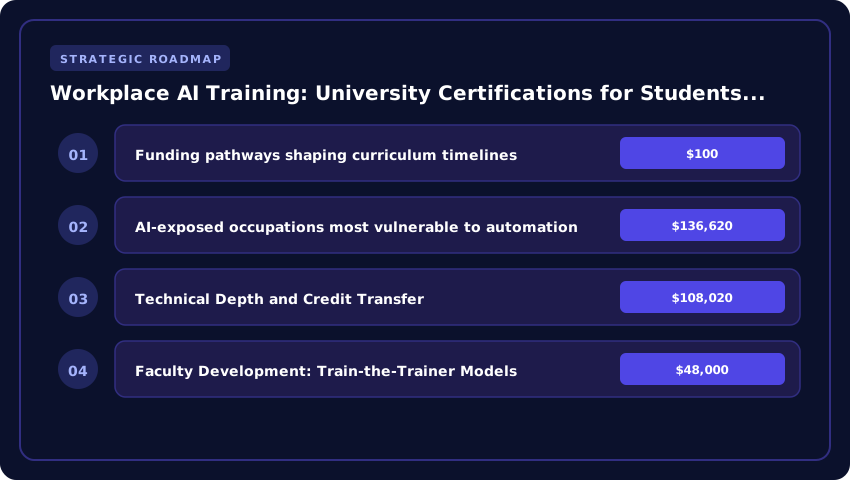
Salary data reinforces the urgency. In 2023, the BLS reported a median annual wage of $136,620 for Computer and Information Research Scientists and $108,020 for Data Scientists. By contrast, the median wage across all occupations stood at roughly $48,000. Even entry‑level AI‑focused positions — such as Machine Learning Engineer or AI Analyst — commonly start above $85,000, according to recent College Board surveys of graduate‑certificate programs.
Funding pathways shaping curriculum timelines
Federal initiatives are accelerating the speed at which universities can launch AI credentials. The CHIPS and Science Act earmarks $52 billion for domestic semiconductor research, a portion of which funds university‑industry partnerships focused on AI‑driven chip design. Simultaneously, the National Science Foundation (NSF) has committed roughly $220 million annually to its AI Institutes program, encouraging campuses to develop interdisciplinary curricula within 12‑to‑18‑month windows.
Students can tap into these resources through FAFSA-eligible aid, and many institutions align new AI certificates with Title IV funding guidelines administered by the U.S. Department of Education. This alignment ensures that qualifying programs remain accessible to low‑ and middle‑income learners while satisfying accreditation standards set by bodies such as ABET (engineering), AACSB (business), and PMI (project management).
AI‑exposed occupations most vulnerable to automation
Beyond high‑growth roles, BLS Occupational Employment Statistics (OES) data highlight a set of “AI‑exposed” jobs facing notable displacement risk. Examples include:
- Bookkeeping, Accounting, and Auditing Clerks – projected decline of ‑4 % (2022‑2032).
- Telemarketers – expected contraction of ‑18 %.
- Insurance Underwriters – anticipated drop of ‑7 %.
- Data Entry Keyers – forecasted reduction of ‑12 %.
These figures, derived from the BLS OES survey, illustrate why universities are embedding AI literacy not only for future specialists but also for broad‑based workforce resilience.
By aligning tuition‑investment figures — typically $12,000‑$18,000 for a graduate‑level AI certificate at public institutions and $16,000‑$22,000 at private nonprofit schools — with the strong salary outlook and federal funding streams, administrators can justify rapid curriculum expansion. The result is a win‑win: students gain market‑ready credentials, faculty secure grant‑supported research opportunities, and institutions meet the nation’s evolving economic demands.
Stackable Credentials: ABET Engineering vs. AACSB Business AI Badges
When a university stamps an AI micro‑credential with ABET or AACSB accreditation, it signals two very different levels of rigor and career relevance. ABET‑accredited MicroMasters — such as Georgia Tech’s Online Master of Science in Computer Science AI track or Purdue’s Applied AI MicroMasters — require a curriculum that meets the same engineering outcomes as a full bachelor’s degree: rigorous mathematics, systems design, and verified laboratory work. AACSB‑backed executive certificates from Wharton, MIT Sloan, or Columbia Business School focus on strategic decision‑making, governance, and the economics of AI adoption. Both pathways are stackable, but the credit‑transfer mechanics and faculty‑development models diverge sharply.
Technical Depth and Credit Transfer
- ABET MicroMasters: Typically 12–15 graduate‑level credits. Georgia Tech allows up to 9 credits toward its $10,000‑per‑year Online MS in CS; Purdue accepts the full 12‑credit block toward a Master of Science in Electrical & Computer Engineering, saving roughly $15,000 in tuition.
- AACSB Executive Certificates: Usually 3–6 non‑credit modules. Wharton’s “AI for Business” certificate can be converted into 3 elective credits in its MBA program, valued at about $7,200 per credit hour for the 2024‑25 academic year.
- Transfer Guarantees: ABET programs publish articulation agreements with the U.S. Department of Education’s College Scorecard, ensuring that credits count toward federal financial‑aid eligibility (FAFSA). AACSB certificates rely on school‑specific policies; many require a separate petition to the graduate dean.
Faculty Development: Train‑the‑Trainer Models
Regional accreditors — HLC, SACSCOC, WSCUC — now require documented faculty‑upskilling plans for any new AI credential. ABET‑aligned engineering schools often run a Faculty AI Bootcamp (40 contact hours, $2,500 stipend) that culminates in a PMI‑recognized “AI Project Management” badge. Business schools under AACSB typically adopt a Case‑Study Workshop Series (six half‑day sessions, $1,800 per participant) focused on ethical AI governance and ROI modeling. Both models are eligible for Title IV professional‑development funding when tied to a degree program.
Decision‑Maker Checklist
- Match the credential to the target role: Data Scientist or ML Engineer → ABET MicroMasters; Product Manager or Chief AI Officer → AACSB Executive Certificate.
- Verify stackability: Request the official articulation agreement and confirm FAFSA eligibility before enrolling.
- Budget for faculty time: Allocate at least 80 hours per instructor for ABET bootcamps; 30 hours for AACSB workshops.
- Track outcomes: Use BLS median wage data — $131,490 for Computer & Information Research Scientists (2023) and $115,000 for Management Analysts — to justify ROI to senior leadership.
By aligning accreditation standards with concrete credit pathways and faculty‑development budgets, institutions can turn AI badges into portable, high‑value assets that satisfy both the engineer’s need for technical depth and the executive’s demand for strategic fluency.
2024 US Salary Benchmarks: Prompt Engineers, AI Product Associates & ML Analysts
If you are advising a computer science senior or a mid-career faculty member pivoting into industry, the compensation data is unambiguous: university-verified AI credentials command a measurable premium over bootcamp certificates alone. According to Levels.fyi and Robert Half 2024 reporting, entry-level base salaries for Prompt Engineers, AI Product Associates, and Junior ML Analysts now cluster tightly around the $100K–$145K band, but geography still dictates the ceiling.
Base Salary Ranges by Hub
- San Francisco Bay Area: $110,000 – $145,000 base.
- New York Metro: $105,000 – $140,000 base.
- Austin / Seattle / Boston: $95,000 – $125,000 base.
These figures represent base compensation only. Total compensation (TC) packages at major employers—think Microsoft, Anthropic, Databricks, or fintechs like Stripe—routinely push first-year TC above $180K when you factor in equity and signing bonuses.
Total Compensation Mechanics
Career services offices should break down the offer letter line-by-line for students:
- Signing Bonuses: $15,000 – $35,000 cash upfront is standard for roles requiring an MS or a university AI specialization; bachelor’s hires typically see $10K–$20K.
- RSU Vesting: Four-year vesting with a one-year cliff remains the norm. A typical new-grad grant ranges from $60K–$120K total grant value. Refresh grants usually arrive at the annual review.
- Tuition Reimbursement: Most FAANG-adjacent firms cap annual reimbursement at $5,250 (the IRS Section 127 tax-free limit), but progressive shops like Nvidia and Google Cloud now offer $10K–$15K annually for part-time master’s programs in ML/AI—effectively subsidizing the very university credentials that got the candidate hired.
The Certification Delta: University vs. Bootcamp
Here is the ROI argument for your dean’s budget request. Candidates holding a university-issued Graduate Certificate in Generative AI or an ABET-accredited MS specialization consistently negotiate starting bases $8,000–$15,000 higher than peers with only a 12-week bootcamp credential (e.g., General Assembly, Flatiron). Recruiters at Scale AI and Cohere have confirmed to Robert Half that university transcripts serve as a proxy for rigorous evals—linear algebra, probability, systems engineering—that bootcamps simply cannot cover in 480 hours.
Over a four-year vesting cycle, that initial delta compounds. Assuming a conservative 3% annual merit increase and standard refresh grants, the university-certified hire captures roughly $60K–$90K in additional lifetime earnings versus the bootcamp-only counterpart. When you subtract the typical $12K–$25K net cost of a university certificate (after employer tuition assistance), the net present value of the credential exceeds $40K in the first half-decade alone.
Bottom line for career services: the data supports aggressive advising toward stackable, credit-bearing university AI certificates. They are not just academic checkboxes; they are leverage instruments in a labor market where BLS projects 35% growth for data science roles through 2032.
Corporate Partnership Frameworks: Co-Designing Curriculum Under FERPA
Structuring Data Use Agreements (DUAs) for Student Project Data
When universities share anonymized project datasets with partners such as Google, Microsoft, or NVIDIA, a Data Use Agreement must be the legal backbone. The DUA should define the data scope, permissible analyses, retention limits (typically 12‑18 months), and a clear destruction protocol. Include a clause that any re‑identification attempt triggers immediate termination and a $25,000 liquidated‑damage penalty per incident — a figure that aligns with FERPA’s “reasonable methods” standard and the U.S. Department of Education’s enforcement guidance. Require the partner to certify compliance with the NIST 800‑53 security controls and to submit an annual SOC 2 Type II report to the campus privacy officer.
- Scope: only de‑identified capstone outputs, no raw transcripts or grades.
- Purpose limitation: model training, benchmarking, or joint research — no commercial product integration without a separate license.
- Audit rights: university may conduct on‑site or remote audits quarterly.
Intellectual Property (IP) Ownership Models for Sponsored Capstones
Capstone projects solved for corporate sponsors demand a pre‑negotiated IP framework. Three proven models work in the U.S. context:
- University‑Owned, Royalty‑Free License: The institution retains title; the sponsor receives a perpetual, non‑exclusive, royalty‑free license to use the solution internally. This model preserves ABET accreditation evidence of student authorship.
- Joint Ownership with Commercialization Rights: Both parties co‑own patents; revenue split 60/40 (university/sponsor) after a $15,000 patent‑filing cost recovery. Requires a written agreement filed with the USPTO within 90 days of invention disclosure.
- Sponsor‑Owned, Student Credit: The sponsor funds the project ($30,000–$50,000 typical) and owns all IP; students receive academic credit and a stipend. Must be disclosed in the course syllabus and approved by the Institutional Review Board to avoid conflict‑of‑interest violations.
Whichever model is chosen, embed a “student‑first” clause guaranteeing that any publication or conference presentation rights remain with the student, subject to a 30‑day sponsor review for confidential content.
Advisory Board Governance: Rotating C‑Suite Seats for 18‑Month Tech Half‑Lives
Technology curricula decay on an 18‑month half‑life, so advisory boards must refresh at the same cadence. Implement a rotating C‑suite seat structure: each corporate partner nominates a senior leader (VP of Engineering, Chief Data Officer, or Head of AI Research) for a two‑year term, staggered so that 25 % of seats turn over every six months. The board charter should mandate:
- Quarterly curriculum gap analysis tied to BLS occupational projections (e.g., 35 % growth for Data Scientists, median $103,500).
- Annual “Tech Pulse” report delivered to the Provost, informing course‑level learning outcomes and lab equipment budgets.
- Explicit FERPA compliance sign‑off for any student data the board reviews during program evaluation.
By codifying DUAs, IP ownership, and a dynamic advisory governance model, deans and provosts can launch industry‑aligned AI credentials — often priced at $12,000–$18,000 per certificate — while safeguarding student privacy and maintaining accreditation standards from ABET, AACSB, and PMI.
Downloadable Assets: Syllabus Template & Partnership Agreement Checklist
Program directors racing to launch a Fall 2025 cohort don’t have time to build a curriculum from scratch or negotiate vendor contracts without a clear framework. That’s why we’ve packaged three ready-to-deploy resources that compress months of planning into a single afternoon of work. Each asset is designed to meet the operational realities of US higher education, from FERPA compliance to LMS interoperability, and can be adapted for community colleges, R1 research universities, and professional education divisions alike.
Modular 16-Week Syllabus Template
The syllabus template is structured as five progressive modules totaling 48 contact hours, balanced between asynchronous lecture, hands-on lab, and cohort discussion. Here’s the recommended sequence:
- Weeks 1–3 (Foundations): Machine learning fundamentals, Python for AI, and the historical evolution of large language models. Includes a graded diagnostic to benchmark incoming competency.
- Weeks 4–6 (Ethics & Governance): Algorithmic bias, data privacy under FERPA, and the emerging NIST AI Risk Management Framework. Case studies draw from real institutional policies at peer universities.
- Weeks 7–9 (Prompt Architecture): Token economics, chain-of-thought reasoning, and advanced system-prompt design. Students complete weekly prompt-engineering challenges scored against a rubric.
- Weeks 10–13 (RAG Implementation): Retrieval-Augmented Generation pipelines, vector database selection, and grounding techniques. Capstone teams prototype a domain-specific RAG system using open-source tooling.
- Weeks 14–16 (Capstone Deployment): Final project presentations, stakeholder demos, and a peer-reviewed deployment plan addressing cost, latency, and compliance.
FERPA-Compliant Vendor Assessment Checklist
Before any AI tool touches student data, it must clear a documented compliance review. The checklist includes 42 line items covering data residency, encryption standards, subprocessor disclosures, and right-to-audit clauses. It also maps directly to the integration requirements of the three dominant LMS platforms: Canvas (Instructure), Blackboard, and D2L Brightspace. A separate column flags whether LTI 1.3 compliance is confirmed, which is now a baseline expectation for any new higher-ed vendor under the IMS Global standards body.
KPI Dashboard Template
Leadership will want measurable proof that the credential moves the needle. The pre-built dashboard tracks three core metric families:
- Engagement Metrics: Weekly active learners, lab completion rates, and cohort retention at the 8-week and 16-week marks.
- Outcome Metrics: Certification pass rates broken down by module, plus a 6-month post-graduation placement survey capturing role title, salary band, and employer sector.
- Equity Metrics: Demographic disaggregation of pass and placement rates, enabling program directors to identify and close achievement gaps early.
All three templates are delivered in editable formats (Google Sheets for the dashboard, Word and Markdown for the syllabus and checklist) so your team can brand them, adjust credit-hour mappings, and align them with existing institutional review processes before public release. If your university already maintains a continuing education or corporate partnership office, route the vendor checklist through that group first; they typically have redlined AI vendor agreements in the last 12 months and can accelerate legal review considerably.
Funding Models: Leveraging WIOA, Pell Eligibility & Employer Tuition Assistance
WIOA & Eligible Training Provider Lists
The Workforce Innovation and Opportunity Act (WIOA) channels federal dollars through state workforce boards to approved programs on the Eligible Training Provider List (ETPL). Universities that map their non‑credit AI certificates to the ETPL unlock direct funding for displaced workers, veterans, and low‑income adults. To qualify, a program must demonstrate labor‑market demand — BLS projects a 35 % surge in data‑science roles — and report outcomes such as placement rates and median earnings. Once listed, the state can reimburse up to the full tuition cost, often $3,000–$7,000 per participant, without the student touching a loan.
- Align curriculum competencies with the Occupational Information Network (O*NET) codes for AI‑related occupations.
- Submit performance data quarterly to the state workforce agency to stay on the ETPL.
- Partner with local American Job Centers for recruitment and wrap‑around services.
Pell Grant Stacking for Credit‑Bearing Certificates
Community colleges and state universities can embed AI micro‑credentials into credit‑bearing certificate pathways, making them Pell‑eligible. For the 2024‑25 award year, the maximum Pell Grant is $7,395. A 12‑credit certificate at a public two‑year institution typically costs $1,800–$2,400 in tuition, leaving a sizable refund for books, hardware, or living expenses. Stacking Pell with state need‑based aid (e.g., Cal Grant, NY TAP) can cover the entire cost of a stackable credential that later articulates into an associate or bachelor’s degree.
- Design certificates as stackable — each 12‑credit block counts toward a degree.
- Verify program eligibility through the FAFSA school code and the Department of Education’s Program Participation Agreement.
- Track Satisfactory Academic Progress (SAP) to protect continued Pell eligibility.
Employer Tuition Assistance & the $5,250 IRS Cap
Many corporations offer tuition assistance up to the IRS tax‑free limit of $5,250 per calendar year. For part‑time faculty and working students, this cap can cover a full AI certificate (often $4,500–$5,000) without triggering taxable income. Negotiating a direct‑bill arrangement — where the university invoices the employer — eliminates reimbursement delays and simplifies compliance with IRS Section 127. Institutions should provide employers with a concise cost sheet, outcome metrics, and a signed agreement confirming the program’s alignment with the company’s upskilling strategy.
- Present a one‑page ROI brief: median salary uplift of $15,000–$25,000 within 12 months of completion.
- Offer cohort scheduling (evenings, weekends, hybrid) to fit shift patterns.
- Report completion and competency data back to the employer for continuous funding justification.
By weaving WIOA reimbursements, Pell Grant stacking, and employer tuition assistance together, universities create a zero‑debt pathway for learners to earn high‑value AI credentials — turning federal and corporate dollars into measurable workforce outcomes.
| Provider / Program | Estimated Cost (USD) | Duration | Prerequisites | Median Salary Outcome (BLS 2023) | Projected Job Growth (2022-32) | Format |
|---|---|---|---|---|---|---|
| MIT xPRO: AI & ML | $3,200 – $4,500 | 6-8 Weeks | Calculus, Linear Algebra, Python | $145,080 (Comp. Research Scientists) | 23% | Online, Live |
| Stanford Online: AI Professional Program | $4,200 – $5,400 | 10-12 Weeks/Course | Probability, Statistics, Python Proficiency | $145,080 (Comp. Research Scientists) | 23% | Online, Cohort-based |
| UC Berkeley: ML & AI Certificate | $2,800 – $3,500 | 6 Months | Bachelor’s Degree, Coding Experience | $108,020 (Data Scientists) | 35% | Online, Self-paced |
| Google Cloud / Coursera: ML Engineering | $49/mo (Subscription) | 3-6 Months | Python, SQL, Basic ML Concepts | $108,020 (Data Scientists) | 35% | Online, Self-paced |
| IBM / edX: AI Engineering Professional Cert | $792 – $990 | 6-8 Months | Python, Data Science Fundamentals | $108,020 (Data Scientists) | 35% | Online, Self-paced |
Frequently Asked Questions
Which university AI certification has the highest ROI for working professionals in 2024?
MIT xPRO and Stanford Online AI programs offer the highest ROI due to brand equity and direct alignment with Computer Research Scientist roles paying median $145K. However, Google/IBM certificates on Coursera/edX deliver faster ROI (3-6 months, under $1K) for Data Scientist roles growing at 35% with $108K median pay.
What are the typical admission requirements for top US university AI certificates?
Top-tier programs (MIT, Stanford, Berkeley) require a bachelor's degree, proficiency in Python, and foundational knowledge in calculus, linear algebra, and probability. Vendor certificates (Google, IBM) typically only require Python and SQL basics, making them accessible for career switchers without advanced math backgrounds.
How long does it take to complete a university AI certification while working full-time?
Part-time university certificates take 6 weeks to 6 months. MIT xPRO and Stanford courses run 6-12 weeks at 10-15 hours/week. Berkeley and vendor programs (Google, IBM) are self-paced, typically completed in 3-6 months at 5-10 hours/week, allowing full-time employment retention.
Do university AI certifications qualify for federal financial aid or employer tuition reimbursement?
Most non-credit professional certificates (MIT xPRO, Stanford Online, Coursera/edX) are ineligible for federal Title IV aid. However, 92% of Fortune 500 companies offer tuition reimbursement ($5,250 tax-free annually) covering these programs. Veterans may use GI Bill benefits for approved non-degree credentials at participating institutions.
What is the salary difference between AI certificate holders and non-certified peers in the US?
BLS data shows certified AI/ML professionals access Computer Research Scientist roles (median $145,080) and Data Scientist roles (median $108,020). Industry surveys (Lightcast, 2023) indicate a 15-25% salary premium for certified candidates versus non-certified peers with similar experience, translating to $15K-$30K annual uplift.
Strategic Final Takeaway
When evaluating Workplace AI Training For College Students And Faculty Certification Programs With Universities, base your decisions on accredited institutional standards, measurable return on investment (ROI), and up-to-date official guidelines. Always verify specific dates and requirements through official regulatory portals.