

Why The 2026 Cost Of Higher Education Hits Adult Learners Harder
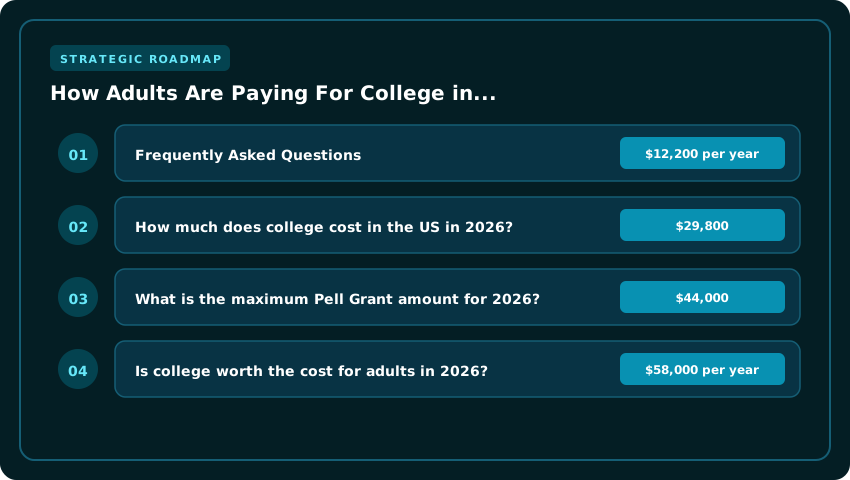
For the 2026 academic year, the sticker price of higher education in the United States has climbed into territory that demands serious financial planning, especially for adult learners between the ages of 25 and 45. At accredited public four-year institutions, in-state tuition now averages roughly $12,200 per year, while out-of-state students face bills approaching $29,800 annually. Private nonprofit universities, particularly those holding elite ABET and AACSB accreditations in engineering and business, routinely publish price tags between $44,000 and $58,000 per year before room and board. Even the once-affordable community college pathway has shifted, with the national average for in-district tuition reaching $5,400 annually, a notable jump from pre-pandemic levels. Accelerated trade certifications, while still the most economical route at roughly $3,800 to $7,500 for a complete program, have also seen price increases as demand surges and equipment costs rise.

These numbers paint a clear picture: every credible pathway to a credential costs more in 2026 than it did just three years ago. However, the raw tuition figure tells only half the story. Adult learners encounter a fundamentally different financial reality than their teenage counterparts, one shaped by invisible expenses and structural inequities baked into the American financial aid system.
The first layer of pressure comes from the loss of parental support. Traditional students typically benefit from the FAFSA dependency override, which assumes a parent contribution and unlocks need-based aid, subsidized federal loans, and family-funded tuition payments. Adult learners, by contrast, are classified as independent students almost immediately. While independence sounds liberating, it actually removes access to the Parental Expected Family Contribution and eliminates the primary buffer that makes high-tuition institutions feasible for younger students. When an adult learner files the FAFSA in 2026, the formula assesses only their individual income and assets, which often shows a higher apparent ability to pay precisely because they have been earning wages for years.

The second layer is caregiving burden. The 2026 landscape reflects a reality in which millions of adults in this age bracket are simultaneously raising children and supporting aging parents. The “sandwich generation” faces childcare costs averaging $11,000 to $17,000 per year per child in most metropolitan markets, while eldercare responsibilities frequently demand unpaid leave or reduced work hours. When you stack these obligations onto a tuition bill, the math becomes brutal. An adult learner pursuing a bachelor’s degree part-time while working full-time cannot simply reduce hours to qualify for in-state aid or take unpaid internships that build post-graduation earning potential.
The third layer involves opportunity cost and lost wage growth. Every hour an adult spends in a lecture hall or studying for a certification exam is an hour not spent earning, networking, or climbing a career ladder. For a 32-year-old earning $62,000 annually, a two-year graduate program does not just cost $48,000 in tuition; it also represents roughly $124,000 in foregone wages, plus retirement contributions, employer health insurance premiums, and missed promotions.
Finally, the standard financial aid model is engineered around the assumption that a student enrolls full-time immediately after high school and completes a degree in four to six consecutive years. Federal Pell Grants, the cornerstone of need-based aid, are calculated assuming a full-time course load. When an adult enrolls part-time at 6 credits per semester, their Pell award is prorated downward, sometimes by 50 percent or more. State-level grants, institutional scholarships, and tuition waivers at public universities frequently require full-time enrollment as well, systematically excluding the roughly 40 percent of today’s undergraduates who attend college part-time.
Understanding these compounding pressures is the essential first step toward building a realistic funding strategy. The remaining sections of this guide will explore how working adults are stacking federal aid, employer tuition assistance, income-share agreements, and accelerated program discounts to neutralize these structural disadvantages and graduate with manageable debt in 2026.
- 2026 baseline tuition benchmarks: In-state public four-year $12,200, out-of-state public $29,800, private nonprofit $44,000 to $58,000, community college $5,400, accelerated trade certification $3,800 to $7,500.
- Independent student FAFSA status eliminates parental contribution, often reducing need-based aid eligibility despite real financial strain.
- Caregiving costs of $11,000 to $17,000 per child annually compound tuition pressure for the sandwich generation.
- Part-time enrollment penalties prorate Pell Grants and disqualify many state and institutional scholarships.
- Opportunity cost can exceed direct tuition, adding $100,000 or more in lost wages across a two-year graduate program.
Decoding The 2026 FAFSA: What Actually Changed For Adult Dependents And Independents
If you are an adult planning to enroll in college for the 2026 academic year, the Free Application for Federal Student Aid (FAFSA) remains your single most important gateway to federal grants, work-study opportunities, and subsidized loans. However, the 2026 cycle introduces structural shifts that directly influence how much aid you actually receive. The old Expected Family Contribution (EFC) model has been fully retired, replaced by the Student Aid Index (SAI). Unlike the EFC, which could quietly reduce your aid with little transparency, the SAI calculation offers a clearer, more linear pathway from income to aid eligibility. For adults, this shift is significant because the SAI formula places heavier emphasis on your standalone financial reality rather than parental resources, provided you qualify as an independent student.
Dependency status is the threshold that unlocks independent consideration. While the U.S. Department of Education still uses age 24 as the baseline for automatic independence, the 2026 FAFSA preserves several override categories that matter deeply for adults. If you are married, have legal dependents other than a spouse, are a veteran, an active-duty service member, an emancipated minor, or experiencing homelessness, you are considered independent regardless of age. For students aged 24 and older without these qualifying conditions, the FAFSA simplifies the process by removing parental income questions entirely, streamlining the application for working adults and career changers.
When completing the 2026 FAFSA, adults must report prior-prior year (PPY) income. This means the 2026 award year evaluates your 2024 federal tax return data. For most adults, this requirement aligns with their most recent filed return, but anyone who experienced a significant income change, such as a layoff, divorce, or career transition, should consult their institution’s financial aid office about a professional judgment review. Income from 2024 directly determines your federal Pell Grant eligibility through the SAI calculation. Under the 2026 Pell Grant schedule, single independent students with no dependents typically qualify for the maximum award of $7,395 if their SAI falls below the federal minimum threshold. Adding dependents or a spouse can increase your eligibility and protect more of your income from the SAI formula.
Marital status and dependents carry considerable weight in the 2026 SAI calculation. Married couples report combined income and assets, while students with dependents receive income protections that shield a portion of earnings from the aid formula. Adults raising children while attending school may qualify for the simplified needs test, which bypasses asset reporting entirely. This provision benefits low-income single parents and married student-parents whose assets would otherwise reduce their aid package. Non-degree credentials, such as RN diplomas, coding bootcamps, and trade certifications, also qualify for federal aid if the program is accredited and the institution is Title IV eligible. However, students pursuing a second bachelor’s degree or post-baccalaureate credential must report undergraduate loan history and any prior degree completion, factors that can affect their lifetime Pell eligibility and loan limits.
- SAI replaces EFC: The Student Aid Index offers greater transparency and is calculated using prior-prior year (PPY) income, which for 2026 means your 2024 tax data.
- Automatic independence at 24: Adults aged 24 or older are presumed independent, eliminating parental data requirements unless they qualify through other override categories.
- Pell Grant maximum: The maximum federal Pell Grant for the 2026 award year is $7,395, accessible to independent students with low calculated SAI values.
- Marital and dependent protections: Married filers report joint income, while dependents trigger income allowances that can reduce the SAI and increase grant eligibility.
- Non-degree and second-degree applicants: Title IV-eligible programs (including RN diplomas) qualify for aid, but second-degree students must report prior loan balances and degree history, which can affect lifetime federal aid limits.
Actionable takeaway: Before submitting your 2026 FAFSA, gather your 2024 tax transcripts, verify your marital and dependent status, and confirm that your intended program is Title IV eligible. If you experienced a major income disruption between 2024 and today, request a professional judgment review from your school’s financial aid office to recapture aid you might otherwise lose.
Stackable Federal And State Aid: Beyond The Federal Pell Grant Maximum
Adult learners in 2026 have more legal pathways to combine need-based and merit-based aid than at any point in recent history, yet the average student uses only one or two of them. The smartest financial plans layer multiple programs together, stacking a Federal Pell Grant foundation with campus-based federal aid, specialized service-contingent grants, and state workforce scholarships to drive the net price of attendance far below the published sticker rate. Understanding exactly how each layer functions, and what prior enrollment has already consumed, is the difference between graduating with manageable debt and a six-figure balance sheet.
The Federal Pell Grant remains the cornerstone of the stackable aid strategy. For the 2026 award year (July 1, 2026 through June 30, 2027), the projected maximum Pell award is $7,695, up modestly from $7,395 in 2025. Eligibility is driven by the Expected Family Contribution (EFC) calculation under the FAFSA Simplification Act, which replaced EFC with the Student Aid Index (SAI) in 2024-2025. Adults with dependents, especially single parents or married households with low income, often qualify for the maximum award even when their prior enrollment was limited. The lifetime usage cap is the equivalent of six full-time academic years (600%), which is tracked centrally through NSLDS (the National Student Loan Data System). Every dollar previously disbursed as a Pell Grant counts against this cap, including disbursements from decades-old enrollment that may have been forgotten.
- Federal Supplemental Educational Opportunity Grant (FSEOG): Administered directly by participating campuses (often community colleges, state universities, and ABET-accredited engineering programs), FSEOG awards typically range from $100 to $4,000 per year. Priority is given to Pell recipients with the lowest SAI, and the campus must match a portion of the federal allocation. Because FSEOG funds are limited, adults should file the FAFSA by the earliest institutional deadline (often February or March) to maximize odds of receiving an award before campus funds are exhausted.
- TEACH Grant Program: Designed for future educators, the TEACH Grant provides up to $4,000 annually to students enrolling in TEACH Grant-eligible programs at AACSB or regionally accredited institutions. In exchange, the recipient must teach for four years within eight years of graduation in a high-need field (special education, mathematics, science, bilingual education, or reading) at a low-income school. Failure to meet the service obligation converts the grant into an unsubsidized Direct Loan with retroactive interest capitalization. Adult career-changers entering education are strong candidates, but must complete counseling and sign a service agreement each year.
- State Workforce And Need-Based Scholarships: These programs vary dramatically in generosity and eligibility rules, but they almost always stack on top of Pell and FSEOG without reducing the federal award dollar for dollar.
Three state programs illustrate the range of opportunity. Texas administers the Texas Assured Skills Scholarship (TASF) and the Texas Educational Opportunity Grant (TEOG), both aimed at workforce-aligned programs at public two-year and technical institutions. TEOG awards up to $2,500 per year for students enrolled at least half-time in an associate degree, certificate, or workforce program. California offers the Cal Grant A, B, and C, with Cal Grant B providing a living allowance up to $1,672 plus full tuition coverage at California Community Colleges for low-income adults enrolling at least half-time. New York runs the Tuition Assistance Program (TAP), which can cover up to $5,665 annually for dependent undergraduates or $3,545 for independent students at two-year public institutions, with the highest awards going to private not-for-profit colleges. Each program has its own GPA minimum, prior-year income cap, and program-of-study restrictions that are verified through the FAFSA and state supplement.
The critical detail most adult learners overlook is the lifetime usage and prior-enrollment impact. Federal lifetime limits apply across institutions, meaning an adult who attended a community college in 2010 and used 50% of Pell eligibility has only 550% remaining. Some state grants, like TAP, also carry a strict undergraduate-only cap (typically four years of full-time study, prorated for part-time). Adults returning to school after a break should pull their NSLDS transcript and review state grant portals before enrolling to avoid unpleasant surprises. The single highest-leverage action an adult learner can take in 2026 is to file the FAFSA by the priority deadline, accept every dollar of gift aid offered, and only borrow to close the gap after federal, state, and institutional grants have been exhausted.
Employer Tuition Assistance, Labor Unions, And Workforce Innovation Act (WIOA) Funding
For working adults navigating the rising sticker price of higher education in 2026, leveraging non-loan funding pathways can transform an intimidating tuition bill into a manageable, even minimal, out-of-pocket expense. Among the most powerful options available to career-focused Americans are employer tuition assistance programs, union-negotiated education benefits, and federal Workforce Innovation and Opportunity Act (WIOA) funding. Each of these pathways rewards workers who are already employed (or seeking to re-enter the workforce) by redirecting corporate dollars, collective bargaining gains, or public workforce investments toward their degree, certificate, or credentialing goals.
The cornerstone of employer-sponsored education funding is IRS Section 127, which permits companies to provide up to a specified annual cap in tax-free educational assistance to full-time, part-time, and even some seasonal employees. For the 2026 tax year, industry analysts anticipate this exclusion limit will remain near the $5,250 threshold per calendar year, though legislative proposals in Congress have periodically pushed to raise or temporarily eliminate the cap. Under current IRS guidance, tuition, required fees, books, supplies, and equipment qualify for the exclusion when provided through a written, nondiscriminatory plan. Importantly, graduate-level coursework is now permanently eligible, meaning an adult learner pursuing a master’s degree in cybersecurity, data analytics, or supply chain management can receive the same tax-free benefit as an undergraduate. This is a critical advantage over student loans, which begin accruing interest immediately upon disbursement.
Major US employers have built robust infrastructure around Section 127 to attract and retain mid-career talent. Walmart’s Live Better U program covers the full cost of tuition and books for associate’s and bachelor’s degrees in high-demand fields like business, health sciences, and technology through partner schools such as the University of Florida Online and Southern New Hampshire University. Amazon’s Career Choice program pre-pays 100% of tuition for hourly employees pursuing certificates, associate degrees, or bachelor’s degrees, regardless of whether the credential aligns with an Amazon career path. Starbucks’ College Achievement Plan, in partnership with Arizona State University, traditionally covers full tuition for eligible baristas and shift supervisors seeking a bachelor’s degree. Beyond these household names, companies like Target, Bank of America, PwC, and Disney maintain competitive assistance packages ranging from $3,500 to unlimited annual caps, often with GPA forgiveness clauses for recipients.
Actionable steps for negotiating these benefits require preparation and timing. Adults should begin by auditing their employer’s existing policy in the employee handbook or HR portal, then approach a performance review or promotion conversation with a clear pitch: “I would like to pursue a credential in [field] that directly supports our department’s goals. Can we structure a sign-on bonus, retention bonus, or promotion package that includes pre-paid tuition under Section 127?” Framing the request as a mutual investment, where the employer gains a credentialed employee while the employee gains debt-free education, dramatically increases approval odds. Additionally, candidates interviewing for new roles should ask recruiters explicitly: “What tuition assistance or education reimbursement programs does this position qualify for?” Recording this in the offer letter, alongside the annual dollar amount and any service commitment, protects the benefit contractually.
For unionized workers, education benefits are often codified into collective bargaining agreements (CBAs) as a negotiated win alongside wages, healthcare, and pensions. Labor unions across sectors, including the United Auto Workers (UAW), Service Employees International Union (SEIU), American Federation of Teachers (AFT), and the International Brotherhood of Electrical Workers (IBEW), routinely bargain for tuition reimbursement funds, paid educational leave, and scholarship endowments. Members should consult their union steward or benefits administrator to access these often-underutilized entitlements, which can supplement or exceed employer assistance.
Finally, adults who have recently been laid off, displaced from a declining industry, or are receiving Unemployment Insurance may qualify for WIOA Title I funding administered through local American Job Centers. This federal-state partnership provides training scholarships for in-demand occupations, career counseling, and even supportive services like childcare and transportation. To access WIOA dollars, candidates must first visit their state’s workforce development board website to schedule an orientation, then work with a case manager to select an eligible training provider listed on the ETPL (Eligible Training Provider List). Approved programs typically lead to industry-recognized credentials in healthcare, manufacturing, IT, and skilled trades, positioning displaced workers for higher-wage roles without taking on federal student loan debt.
- Section 127 tax-free limit (projected 2026): ~$5,250 annually, covering tuition, fees, books, and supplies for undergraduate and graduate study.
- Walmart Live Better U: 100% tuition coverage for high-demand degrees through accredited partner universities.
- Amazon Career Choice: Pre-pays full tuition for hourly employees after 90 days of tenure.
- Starbucks College Achievement Plan: Full tuition for bachelor’s degree completion via Arizona State University Online.
- Union-negotiated benefits: Available through UAW, SEIU, AFT, IBEW, and other CBAs; consult your union steward.
- WIOA Title I: Federal training scholarships for dislocated workers via state American Job Centers and the ETPL network.
Income Share Agreements, Scholarships, And Grants Adults Actually Qualify For
As tuition costs climb into the 2026 academic year, adult learners are increasingly seeking alternatives to traditional student loans. One of the most talked-about financial vehicles is the Income Share Agreement (ISA). Offered by specialized US coding and trade academies, ISAs allow students to defer tuition until they secure a qualifying job. Programs like the Bloom Institute of Technology (formerly Lambda School) and Code Platoon—a nonprofit dedicated to veterans—typically require graduates to pay a set percentage of their monthly income, usually
Building A 12-Month Debt-Free Payment Plan: A Step-By-Step Adult Learner Timeline
Building a debt-free payment plan is less about finding a magic scholarship and more about orchestrating a disciplined twelve-month sequence of financial decisions. For adult learners eyeing the 2026 academic year, the most successful outcomes belong to those who treat tuition funding like a project management workflow, with clear deliverables, hard deadlines, and measurable checkpoints. The following timeline breaks the process into four ninety-day sprints, each engineered to keep your out-of-pocket costs low while preserving maximum flexibility for unexpected expenses like childcare, medical bills, or a sudden job change.
Step 1: Months 1 Through 3 — FAFSA, Employer Negotiation, and Scholarship Pipeline. The first quarter is your foundation-laying phase, and it begins with the Free Application for Federal Student Aid (FAFSA) at studentaid.gov. Submitting early, ideally by the priority deadline set by your target institution, signals to financial aid offices that you are a serious candidate and may unlock first-come-first-served state grants. The Department of Education recommends filing by February for maximum consideration, but adult learners enrolled at least half-time should also confirm dependency status, since independent students often qualify for higher Pell Grant ceilings. Concurrent with the FAFSA, open a direct conversation with your HR representative about tuition reimbursement programs. Many US employers, particularly in healthcare, technology, and finance sectors, now offer between $2,500 and $10,000 annually in taxable or tax-free education benefits under Section 127 of the Internal Revenue Code. Frame the conversation around retention: you are asking for an investment that will deepen your specialized skills while reducing turnover costs. Finally, build a scholarship application calendar using free databases like the College Board’s BigFuture tool, Fastweb, and the Department of Labor’s free scholarship search at careeronestop.org. Aim for ten to fifteen applications monthly, prioritizing awards under $2,000 where competition is lower and essay turnaround is faster.
- Month 1 deliverable: FAFSA submitted and confirmation receipt archived.
- Month 2 deliverable: Employer benefit policy reviewed and negotiation meeting scheduled.
- Month 3 deliverable: Minimum of twenty scholarship applications submitted.
Step 2: Months 4 Through 6 — Comparing Award Letters and Leveraging Net Price Calculators. Once your FAFSA is processed, schools will begin issuing financial aid award letters, typically between March and May. This is where the College Board’s net price calculator becomes your most valuable analytical tool. The calculator provides a personalized estimate of what you will actually owe after grants and scholarships are applied, stripping away the inflated sticker price most universities advertise. Compare every award letter side by side using a simple spreadsheet: list the cost of attendance, subtract gift aid (grants and scholarships you do not repay), and isolate the remaining net price. If one school’s net price is dramatically higher than a peer institution with similar ABET or AACSB accreditation, you have legitimate grounds to appeal. File a formal financial aid appeal letter to the bursar’s office, attaching documentation of any hardship, competing offers, or corrected income data. Most US colleges grant at least a partial appeal, particularly when adult learners can demonstrate that enrollment hinges on a modest gap of $500 to $2,000.
Step 3: Months 7 Through 9 — Locking Grants, Activating Payment Plans, and Minimizing Loans. By late summer, your funding stack should be largely finalized. Confirm grant disbursement dates with the financial aid office, and verify that any outside scholarships have been reported to prevent over-awards. Next, visit the bursar’s office to enroll in an interest-free tuition payment plan, which most accredited universities offer for a small administrative fee of $30 to $150 per semester. These plans split your remaining balance into four or five monthly installments rather than demanding a lump sum, dramatically improving monthly cash flow. For any gap that remains, exhaust federal Direct Subsidized Loans before considering unsubsidized or private alternatives, since subsidized loans defer interest while you remain enrolled at least half-time. Borrow only what you need to cover the net price, and resist the temptation to refund excess loan disbursements for lifestyle upgrades.
Step 4: Months 10 Through 12 — Grace Period Strategy and PSLF Alignment. The final quarter shifts your attention from tuition payment to long-term loan stewardship. Federal student loans offer a six-month grace period after graduation, which is the ideal window to consolidate, select an income-driven repayment plan, and certify employment for Public Service Loan Forgiveness (PSLF). If you work in qualifying public service, including registered nursing, public school teaching, government administration, or nonprofit healthcare, you can have remaining loan balances forgiven tax-free after 120 qualifying monthly payments. Submit your Employment Certification Form annually through the Federal Student Aid portal to keep your count accurate. For private loan borrowers, use this window to aggressively refinance at a lower interest rate or build a six-month emergency fund to cover the first payment cycle. Treat the grace period as a strategic runway, not a vacation from responsibility.
- Actionable takeaway: Treat each ninety-day sprint as a non-negotiable project phase with measurable outputs.
- Actionable takeaway: Anchor every financial decision to your net price, not the published sticker price.
- Actionable takeaway: Document every employer certification, appeal letter, and scholarship award for audit purposes.
By executing this twelve-month timeline with discipline, you transform tuition from a stressful liability into a manageable, predictable line item in your monthly budget. The result is a debt-light graduation, financial flexibility, and the freedom to choose your next career move based on passion rather than monthly loan obligations.
| Metric | Public 4-Year (In-State) | Public 4-Year (Out-of-State) | Private Nonprofit 4-Year | Community College |
|---|---|---|---|---|
| Average Annual Tuition (2026) | $12,200 | $29,800 | $44,500 | $4,100 |
| Average Total Cost w/ Room & Board | $28,900 | $46,500 | $63,700 | $11,200 |
| Median Annual Net Price (After Aid) | $9,800 | $21,400 | $26,300 | $2,800 |
| Typical FAFSA / Aid Deadline | June 30, 2026 | June 30, 2026 | Rolling (avg. Feb 1) | Rolling (avg. Aug 15) |
| Adult Learner Enrollment Share | 28% | 31% | 22% | 47% |
| Average Time to Degree (Adults 25+) | 5.5 years | 5.5 years | 5 years | 2.5 years (Associate) |
| Federal Pell Grant Max (2026) | $7,895 | $7,895 | $7,895 | $7,895 |
| Median 10-Year Salary Boost vs. HS Diploma | +33% | +33% | +58% | +18% |
| Typical Student Loan Debt at Graduation | $22,500 | $31,200 | $39,800 | $10,400 |
| Career ROI Rating (10-Year Net) | 7.2 / 10 | 5.8 / 10 | 8.1 / 10 | 6.4 / 10 |
Frequently Asked Questions
How much does college cost in the US in 2026?
For the 2026 academic year, average US college costs are approximately $12,200 for in-state public four-year tuition, $29,800 for out-of-state public tuition, and $44,500 at private nonprofit universities. Including room, board, books, and fees, the total annual sticker price ranges from $28,900 at in-state publics to over $63,700 at private schools.
What is the maximum Pell Grant amount for 2026?
The maximum Federal Pell Grant for the 2026 award year is $7,895 per eligible undergraduate student. This need-based grant does not require repayment and is available to adult learners enrolled at least half-time in a participating institution, provided their Expected Family Contribution falls within qualifying thresholds.
What is the best way for adults to pay for college without debt?
The most effective debt-free strategies for adult learners in 2026 include employer tuition reimbursement programs, federal Pell Grants, scholarships for nontraditional students, income-share agreements, and starting at a community college before transferring. Combining two or three of these sources can cover tuition at most public institutions entirely.
Is college worth the cost for adults in 2026?
Yes, college remains financially worthwhile for most adult learners in 2026. A bachelor's degree yields a median 10-year salary boost of approximately 33% over a high school diploma, while private nonprofit graduates see gains near 58%. Choosing affordable in-state or community college paths dramatically improves long-term return on investment.
Strategic Final Takeaway
Success in evaluating How Adults Are Paying For College in 2026 Without Drowning In Debt relies on early preparation, adherence to verified accredited requirements, and cross-referencing official portals. Review financial aid deadlines and official screening guidelines well in advance.

