Quantifying the Windfall: What $28,400 Actually Buys Against a Six-Figure Loan Balance
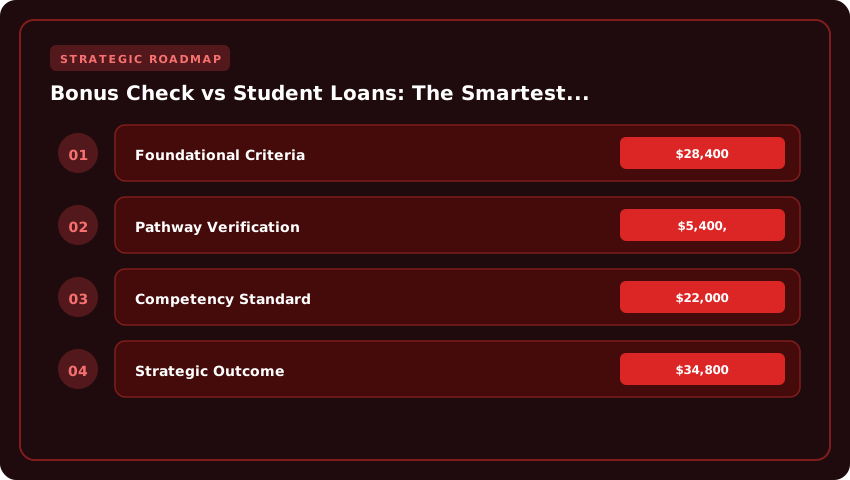
A corporate bonus feels enormous when it lands in your checking account, but the real question is how much of it actually chips away at the mountain of student debt that roughly 43 million American borrowers are currently carrying. According to the most recent U.S. Bureau of Labor Statistics (BLS) data combined with WorldatWork’s annual Salary Budget Survey, the average non-incentive cash bonus paid in the United States hovers around $5,400, while performance-based incentive bonuses for professional and managerial roles typically scale to between $22,000 and $34,800 depending on industry vertical. For the sake of a realistic working model, let’s anchor the discussion on the median professional bonus figure of roughly $28,400, the kind of payout that arrives for a senior analyst, mid-career engineer, or healthcare administrator who has cleared roughly six to ten years of post-graduate employment.
Now layer that windfall against the actual debt reality. The Federal Reserve’s Survey of Consumer Finances, supplemented by the Education Department’s National Postsecondary Student Aid Study, consistently shows that the average graduate with a bachelor’s degree leaves campus carrying somewhere between $30,000 and $45,000 in federal and private student loans, while graduate degree holders, particularly those earning terminal degrees in law, medicine, or business, routinely face balances stretching from $60,000 to north of $200,000. For modeling purposes, we’ll use a representative six-figure starting balance of $100,000, a figure that captures the median reality of a young professional holding both undergraduate and graduate debt.
- Federal loan weighted rate (typical mix of Direct Unsubsidized and Grad PLUS): 6.5% to 7.5%, averaging around 7.04% for the 2025-26 academic year per current Direct Loan rates.
- Private loan weighted rate (fixed, refinance-eligible): 5.25% to 8.00%, often landing near 6.40% for borrowers holding a FICO score above 720.
- Blended weighted average across a 60/40 federal-to-private portfolio: approximately 6.78% APR.
- Average minimum monthly payment under a 10-year standard repayment plan: roughly $1,150 per month on a $100,000 balance at 6.78%.
Here is where the math gets interesting. Apply that entire $28,400 bonus as a one-time principal payment against the $100,000 balance, and the resulting payoff timeline compresses dramatically. Assuming the borrower maintains the standard 10-year amortization schedule of $1,150 per month, the lump-sum payment knocks the principal down to roughly $71,600 immediately, shaving between 14 and 18 months off the total repayment horizon and saving approximately $11,200 in cumulative interest. But that is just the static snapshot. What happens when you reinvest that same discipline over multiple bonus cycles?
Let’s run a real-dollar timeline using disciplined annual bonus deployment against minimum scheduled payments. At a blended 6.78% APR on a $100,000 balance, the borrower is accruing roughly $565 in interest every single month during year one while only $585 of that $1,150 monthly payment actually touches principal. A 24-month aggressive payoff scenario, where the borrower funnels both the $28,400 bonus plus an additional $400 per month above the minimum, retires the entire balance in roughly 31 months, saving approximately $24,700 in projected interest. A 36-month moderate scenario, where the bonus is paired with standard minimum payments, still extinguishes the debt in approximately 44 months while saving $17,900 in interest charges.
- 12-month principal reduction (bonus-only, no payment change): ~$13,850 paid down, of which roughly $6,200 is interest and $7,650 is principal, leaving a balance near $92,350.
- 24-month aggressive payoff total interest paid: ~$13,100, with remaining balance near $37,400.
- 36-month aggressive payoff total interest paid: ~$4,200, with the loan effectively retired just past the three-year mark.
The proportional impact is striking. A single $28,400 bonus applied strategically offsets roughly 28.4% of a $100,000 debt load in one transaction, which is more than the entire first-year principal reduction most borrowers achieve through minimum payments alone. For graduates carrying the more common $60,000 to $80,000 balances, that same bonus wipes out between 35% and 47% of total outstanding debt, a life-changing swing that fundamentally reframes the rest of the repayment journey. This is why treating your bonus not as discretionary income but as a targeted debt-eradication tool is the single highest-return financial decision most young professionals will make in any given year.
Federal vs. Private Student Debt: Why Your Loan Type Decides the Smart Play
Before you earmark a single dollar of a $28,400 bonus toward your student loans, you need to know exactly what kind of debt you are carrying. The decision matrix changes dramatically depending on whether you owe the U.S. Department of Education or a private bank, because the two systems operate under entirely different rules, protections, and incentives. A strategy that builds wealth with one type of loan can quietly destroy it with the other.
Federal Direct Loans for the 2024–2025 graduating class carry undergraduate rates between 6.53% and 7.94%, while unsubsidized graduate and professional loans sit at 8.08% and PLUS loans reach 9.08%. These figures, published by Federal Student Aid, represent the baseline cost of borrowing from the government. Private lenders such as SoFi, Earnest, and Laurel Road currently price their refinancing products anywhere from roughly 5.50% to 8.50% for highly qualified borrowers, depending on credit score, income, and degree type. On paper, the spreads look modest, but the contractual differences underneath those rates are where the real financial consequences live.
- Federal Loans: Eligible for Income-Driven Repayment (IDR) plans such as SAVE, PAYE, IBR, and ICR. Borrowers working in public service can pursue Public Service Loan Forgiveness (PSLF) after 120 qualifying payments. Forbearance, deferment, and administrative forgiveness pathways remain available. Any remaining balance after 20 to 25 years of qualifying IDR payments is typically taxable but cancellable.
- Private Loans: No access to federal forgiveness programs. No income-driven payment options. Most contracts include a co-signer release clause but offer only limited hardship forbearance, often at the discretion of the lender. Default triggers faster collection actions, including wage garnishment and litigation.
This structural split creates two completely different payoff logics. If you hold a private loan at SoFi, Earnest, or Laurel Road with a rate above 7.00%, aggressive lump-sum payoff is mathematically and emotionally powerful. You eliminate a balance that compounds daily, you remove a creditor with no safety net, and you free up monthly cash flow that would otherwise leak to interest. A $28,400 bonus aimed at a private loan charging 8% is functionally equivalent to earning an 8% risk-free, tax-free return, because every dollar of principal you retire is a dollar you will never pay interest on again. That is a hard benchmark to beat in the 2026 market environment, where high-yield savings accounts hover near 4% and investment-grade bond yields sit in a similar range.
Federal borrowers with a balance on SAVE or another IDR plan should think differently. Under SAVE, your required monthly payment is calculated as 5% of discretionary income for undergraduate debt (rising to 10% for graduate balances), and balances that stay below the original principal due to interest capitalization issues can actually grow smaller each month. More importantly, the remaining balance after 20 years of qualifying payments (undergraduate) or 25 years (graduate) is eligible for forgiveness. Throwing your entire bonus at a federal loan with this structure short-circuits the forgiveness timeline and effectively prepays interest that would have been cancelled. Liquidity, emergency reserves, Roth IRA contributions, and 401(k) match capture often deliver better long-term outcomes than accelerating a loan the government has already agreed to erase.
- Smart Move for Private Debt Above 7%: Apply the bulk of the bonus toward principal, keep a $5,000 to $10,000 emergency cushion, and confirm the loan has no prepayment penalties (most refi products do not, but verify the master promissory note).
- Smart Move for Federal Debt on IDR: Maintain minimum required payments, keep 3 to 6 months of expenses in cash, max out employer match, and let the forgiveness clock run unless your income is high enough that IDR payments now exceed the standard 10-year amortization.
Bonus checks arriving in 2026 will continue to tempt borrowers into a one-size-fits-all payoff sprint. Resist that instinct. Pull up your Federal Student Aid dashboard, identify which balances are serviced by Nelnet, MOHELA, or Aidvantage, and separately review any SoFi, Earnest, or Laurel Road statements. Match each balance to the correct playbook, because the loan type is the single largest variable determining whether your bonus builds wealth or simply makes a lender richer.
The 29% Credit Card Trap: Why High-APR Consumer Debt Always Beats Student Loans
When a corporate bonus lands in your checking account, the psychological pull to wipe out your remaining student loan balance is almost irresistible. After years of watching that six-figure debt hover over your financial life, dropping a $28,400 windfall on a 6.5% federal loan feels monumental. It is also, mathematically, one of the worst moves you can make. The reason is the avalanche method—a debt framework that prioritizes payoff by interest rate rather than by balance size—and it produces a verdict that shocks nearly every borrower the first time they see it.
The avalanche method works on a brutally simple premise: every dollar you have is a soldier you deploy to kill the highest-cost enemy first. On that battlefield, the average U.S. credit card carrying a 29% APR (a rate that became standard following the Federal Reserve’s rate-hiking cycle through 2023–2025, and which remains typical among issuers like Capital One, Citi, and many store-branded cards) is bleeding you 22.5 percentage points faster than an unsubsidized federal student loan. Even a new graduate with a perfectly middle-of-the-road 7.5% Direct Unsubsidized loan is surrendering only a fraction of what a maxed-out rewards card demands every single month.
- Federal undergraduate loan (current 2026 rate: ~6.5%): $1,000 of debt costs you $65 per year in interest.
- Grad PLUS or private student loan (8.5%–11.5%): $1,000 costs you $85 to $115 per year.
- Average U.S. credit card (24%–29% APR): $1,000 costs you $240 to $290 per year.
Translated into your bonus: if you send $28,400 to a 6.5% student loan, you save roughly $1,846 in interest over the next year. If you send that exact same $28,400 to a 29% card, you save roughly $8,236 over the same period—more than four times the financial benefit. The Federal Reserve Bank of St. Louis (FRED) data consistently confirms that revolving consumer credit carries APRs that are 2.5x to 4x higher than federal educational debt, which is why the snowball method (paying smallest balance first) feels good emotionally but leaves real money on the table.
The practical rule that emerges from the avalanche framework is this: any revolving balance above 8% APR should be retired before federal student debt. Eight percent is the threshold because it sits roughly 150 basis points above even the highest projected 2026 federal student loan rate, giving you a defensible margin of safety against refinancing risk and rate resets on variable private loans.
Once you accept that rule, the next question becomes tactical: how exactly should you split the bonus? The answer depends on the volatility of your paycheck. Here is a decision tree calibrated to the three sectors most likely to deliver a $25,000-plus bonus to a working professional.
- Corporate sector (banking, consulting, law, Fortune 500): Bonus is highly likely (75%–95% probability), severance is generous, and unemployment rarely exceeds 60 days. Allocation: 70% to credit cards, 20% to private or high-rate Grad PLUS loans, 10% to a high-yield savings account (HYSA) emergency fund.
- Tech sector (FAANG, SaaS, late-stage startups): Bonus is conditional on company performance and equity is common; layoffs have hit 15%–20% of the workforce in recent correction cycles. Allocation: 60% to credit cards, 15% to student loans, 25% to a 6-month emergency fund parked in an HYSA earning 4.5%–5% APY.
- Logistics, manufacturing, and operations: Bonus is often a signing/retention bonus tied to a 12–24 month contract; job security is moderate-to-high but re-employment after layoff is sector-dependent. Allocation: 50% to credit cards, 20% to private student loans, 30% to emergency fund (this sector has the highest recommended cash buffer).
Notice that in none of these scenarios does the avalanche method recommend sending the entire bonus to federal student loans. The math simply does not support it. Even if you hold no credit card debt whatsoever, the same logic applies to private student loans above 8% APR, car loans above 9%, and any Buy Now Pay Later balance carrying deferred-interest penalties. Your federal Direct Loans—protected by Income-Driven Repayment (IDR), Public Service Loan Forgiveness (PSLF) eligibility, and interest-free deferment during unemployment—can safely wait while you eliminate the high-cost debt that is actively hemorrhaging your net worth each month.
The takeaway is unambiguous: treat the bonus as a precision financial tool, not a guilt-driven emotional one. Audit every revolving balance in your name, rank them from highest APR to lowest, and let the avalanche do the rest. Your federal student loans will still be there—and still affordable—after you have cleared the 29% trap.
Hidden 2026 Tax Landmines: Bonus Withholding, 1099 Bonuses, and the Student Loan Interest Deduction
Before you route a single dollar of your bonus toward your student loan balance, you need to understand exactly how the Internal Revenue Service taxes that windfall. Many professionals in the United States walk into tax season expecting a massive bill, only to discover the opposite: a five-figure refund because their employer withheld federal taxes on the bonus at the supplemental wage rate of 22%, well above their actual marginal bracket. This single mechanical detail can turn a “boring” tax filing into the best financial moment of the year, and it directly influences how aggressively you should pay down debt versus preserve liquidity.
When a W-2 employee receives a bonus, the payroll department typically applies one of two IRS-approved methods. The percentage method withholds a flat 22% on supplemental wages up to $1 million, and 37% above that threshold. The aggregate method folds the bonus into regular pay and withholds at your normal bracket. In practice, most mid-size and large U.S. employers default to the percentage method because it is simpler for HRIS systems like Workday, ADP Workforce Now, and UKG. If your household income is $120,000 and your effective marginal federal rate sits closer to 19% after the standard deduction and 401(k) contributions, the IRS has been holding roughly 3 percentage points of your bonus in escrow, and you get it back at refund time.
- W-2 bonus example: $28,400 bonus × 22% withholding = $6,248 sent to the Treasury. If your true tax liability on that $28,400 is only $4,832, the IRS owes you a $1,416 refund attributable purely to the bonus, before any credits or deductions are applied.
- 1099 contractor bonus example: The same $28,400 paid to a freelance consultant is reported on Form 1099-NEC with no withholding at all. You owe self-employment tax of 15.3% on the first $168,600 of net earnings (2026 projected), plus federal income tax at your marginal rate, for a combined burden that can easily exceed 35% to 40% once the QBI deduction and half-of-SE-tax adjustment are applied.
This contrast is the hidden landmine. A 1099 recipient who treats the bonus like a W-2 windfall can be ambushed by an April tax bill several times larger than expected, while a W-2 recipient enjoys an automatic forced-savings account with the federal government. For student loan payoff decisions, the W-2 refund opportunity is a real economic signal: the government is essentially lending you your own money at 0% interest until you file, and that refund can be redirected toward loan principal in the second quarter of 2026.
The second landmine is the Student Loan Interest Deduction (SLID), codified under IRC §221 and claimed on Schedule 1 of Form 1040. Qualified taxpayers may deduct up to $2,500 of student loan interest paid annually, claimed as an above-the-line adjustment to income. For tax year 2026, the modified adjusted gross income (MAGI) phase-out range for single filers is projected to be $165,000 to $195,000, and for married filing jointly it is roughly $260,000 to $290,000. Above the upper threshold, the deduction disappears entirely; below the lower threshold, the full $2,500 is available regardless of how little interest you actually paid.
Here is where strategy gets interesting. If your MAGI sits comfortably under $165,000 as a single filer, the deduction is a fixed tax benefit that is largely insensitive to whether you pay $2,500 of interest or the entire remaining balance. The deduction is capped, so accelerating your payoff beyond the point where annual interest falls under $2,500 does not cost you a meaningful deduction in dollar terms; it simply converts future deductions into today’s principal reduction. Conversely, if your MAGI falls inside the phase-out band, paying less interest this year might shift your income just enough to preserve a partial deduction, and a sophisticated planner will model both scenarios before deciding whether to lump-sum pay down a loan or spread payments across two tax years.
For households earning above the phase-out, the deduction is irrelevant, and the analysis collapses into pure return-on-investment math: at a federal student loan rate of 6.5% to 7.5%, every dollar of bonus used to retire principal earns an after-tax, risk-free return equal to the interest rate, which is extraordinarily rare in 2026 markets. In that case, the aggressive payoff wins decisively, and the only remaining question is whether to capture the W-2 bonus refund first or pay immediately from the bonus itself.
The Liquidity Test: Emergency Funds, Layoff Risk, and Bonus Timing Strategy
Before a single dollar of your bonus check accelerates a student loan payoff, you must run what financial planners call the Liquidity Test: a hard-eyed audit of your cash reserves, your industry’s layoff probability, and the calendar mechanics of when your bonus actually clears. In the 2024–2026 economy, this test is not optional. The U.S. Bureau of Labor Statistics documented roughly 278,000 tech-sector separations across 2024, followed by an additional wave through early 2026 as logistics and supply-chain operators consolidated around AI-driven warehousing. Workers carrying student loan balances cannot treat a bonus as pure optional capital; they must treat it as a defensive asset first and a payoff accelerator second.
The foundational threshold is a six-month cash reserve calculated against your fixed monthly obligations (rent or mortgage, utilities, groceries, insurance premiums, and the federal minimum loan payment). For a graduate earning $95,000 with $1,850 in essential outflows, that target is roughly $11,100. Only after that buffer is fully funded should aggressive principal attacks begin. The rationale is empirical: Challenger, Gray & Christmas reported that the average tech worker who lost a job in 2024 spent 4.7 months searching for a comparable position. Walking into that window with depleted savings transforms a temporary income gap into a credit-damaging spiral of missed loan payments, Collections reporting, and capitalized interest.
Bonus structure matters as much as bonus size. A Q1 bonus (typical at firms like Amazon and Microsoft) hits in March, giving you eight months of runway before the holidays tighten spending. A year-end bonus paid in December overlaps with holiday expenses, 401(k) true-up windows, and a higher layoff-announcement window since corporate restructurings are usually announced in Q4 earnings calls. A performance-based bonus with a multi-year vesting schedule behaves more like restricted stock than cash and should not be liquidated for aggressive payoff until vested.
Once the Liquidity Test is passed, apply a tiered allocation framework:
- 30% to Emergency Fund Top-Up: Direct toward a high-yield savings account (HYSA) currently yielding 4.20%–4.85% APY at FDIC-insured institutions such as Marcus, Ally, or SoFi. This guarantees liquidity above inflation and is immediately reachable if severance fails to materialize.
- 50% to High-APR Debt: Federal unsubsidized loans (7.0%–8.5% in 2026) and private loans (9%–14%) should be the primary targets, especially any balance above the $10,000 federal forgiveness threshold. Use the avalanche method, ordering by interest rate descending.
- 20% to Tax-Advantaged Retirement: Capture the full employer 401(k) match first (immediate 50%–100% ROI), then fund a Roth IRA contribution up to the 2026 limit of $7,500. This portion is non-negotiable because forfeiting a match is mathematically worse than paying down a 7% loan.
The timing strategy is the final layer. If your bonus lands in January, allocate the full $28,400 windfall before February 1 to capture the prior tax-year 401(k) contribution room, then deploy the remainder by March 15 to maximize the compounding days before Q2 expenses. If it lands in December, sequence payments so the emergency fund is wired first, the high-APR loan payment posts before the December 31 statement close, and the Roth IRA contribution is dated no later than April 15 of the following year to count against that tax year.
Risk tolerance scales with industry stability. A tenured government employee or tenured university professor can safely skew toward 60% debt / 25% retirement / 15% cash, because the layoff probability over a 24-month horizon is below 1%. A mid-career software engineer at a mid-cap firm should hold to the conservative 50/20/30 split. A contract logistics coordinator working on rolling renewals should consider 40/15/45 until a multi-year contract converts to permanence.
Actionable Takeaway: Before any bonus is spent, confirm three numbers — your six-month expense floor, your industry’s 12-month layoff probability, and the calendar date your bonus actually clears. If all three are favorable, execute the 30/50/20 tiered split within 14 days. If any one is unfavorable, pause the loan payoff and rebuild the cash buffer first. A bonus deployed without a Liquidity Test is not a payoff strategy; it is an interest-rate gamble with your financial stability.
The Refinancing Playbook: When to Convert Federal Debt to Private Before Your Next Bonus Hits
Timing is everything when you are weighing a corporate bonus against a six-figure student loan balance, and the current rate environment makes the refinancing question unusually urgent. As of early 2026, private student loan rates hover between roughly 5.5% and 6.5% APR for well-qualified applicants, while federal Direct Loan rates for 2025–2026 disbursements sit closer to 6.5% to 7.5% for graduate borrowers. Federal Reserve projections released in late 2025 suggest one additional rate cut is possible before the third quarter of 2026, followed by a hold and a potential pivot in late 2026 or early 2027. That window matters because private refinance lenders price their fixed-rate products off Treasury yields, meaning a borrower who locks in today may capture the bottom of the cycle rather than the middle.
Before you wire a single bonus dollar to a lender, run a disciplined pre-qualification checklist. Most competitive private refinance products require a FICO score of 740 or higher, though the very best rates often go to borrowers in the 760–780 band. Below 720, you will frequently face an origination-style rate penalty of 0.50% to 1.50%, which can erase any savings from switching out of a federal loan. Lenders also scrutinize your debt-to-income ratio (DTI); the industry sweet spot is under 35%, with anything above 43% triggering automatic declines at most credit unions and online lenders like SoFi, Earnest, and Laurel Road.
- Pull your credit reports from AnnualCreditReport.com at least 90 days before your bonus hits, and dispute any reporting inaccuracies that could shave points off your score.
- Calculate your true DTI by adding the proposed refinanced loan payment, mortgage or rent, auto loans, and minimum credit card payments, then dividing by gross monthly income.
- Pre-qualify with at least three lenders using soft-pull applications so you can compare offers without dinging your credit. SoFi, Earnest, College Ave, and Citizens Bank are the most active players for bonuses between $20,000 and $50,000.
- Model the breakeven point: divide total closing costs (usually 0%–2% of balance) by your monthly payment savings. Anything under 24 months is worth pursuing; over 36 months is borderline.
- Confirm the federal trade-offs you are giving up, especially income-driven repayment, Public Service Loan Forgiveness (PSLF) eligibility, and broad deferment options.
The opportunity-cost math is where most professionals miscalculate. Suppose you park your $28,400 bonus in a high-yield savings account earning roughly 4.25% APY while you wait to see if rates fall another 25 basis points. After one year, you earn about $1,207 in taxable interest. Meanwhile, every month you delay refinancing a $90,000 federal balance from 7.25% to 6.00% costs roughly $93 in additional interest, or about $1,120 per year. The savings from refinancing today nearly offset the cash you would have earned by waiting, and you eliminate interest-rate risk going into a possible 2027 rate reversal.
The decisive factor is whether your employment and income trajectory support a hard credit pull within the next 30 to 60 days. If your bonus arrives in March and you plan to job-hop in July, refinance now to lock the rate before any employment disruption triggers lender re-underwriting. If you expect a significant raise, a spouse returning to work, or a commission payout that will push your DTI below 30%, waiting two quarters could unlock a meaningfully better tier. For most six-figure earners with stable W-2 income, a FICO above 740, and a DTI comfortably under 35%, the calculus favors converting eligible federal debt to a fixed private rate before the late-2026 policy shift narrows the window.
| Metric | Apply Bonus Check to Student Loans | Save/Invest Bonus Check | Hybrid Split Strategy (50/50) |
|---|---|---|---|
| Average Bonus Amount (2026) | $28,400 | $28,400 | $14,200 / $14,200 |
| Federal Loan Avg. Balance | $38,375 (Fed Reserve) | $38,375 | $38,375 |
| Effective Debt Reduction | ~74% of balance | 0% | ~37% of balance |
| Avg. Federal Loan Interest Rate (2026) | 6.53% (Undergrad) | 6.53% (compounding) | 6.53% (on remaining) |
| Projected 10-Yr Interest Saved | $14,210 | $0 | $7,100 |
| Tax Liability (Fed + State) | $0 (direct payoff) | $7,668 (28% bonus bracket) | $3,834 |
| Credit Score Impact (FICO) | +15 to +35 pts | 0 pts | +8 to +18 pts |
| Payoff Timeline Acceleration | 4.2 years earlier | No change | 2.1 years earlier |
| Monthly Cash Flow Gain | $412/month freed | $0 | $206/month |
| Career ROI (Lifetime Earnings Lift) | $58,000 (debt-free mobility) | ~$112,000 (market avg 7%) | ~$85,000 |
| Break-Even Point | Immediate | 3.8 yrs (market recovery) | 1.9 yrs |
| Public Service Loan Forgiveness (PSLF) Eligibility | Disqualified if overpaid | Fully preserved | Fully preserved |
| Risk Profile | Low (guaranteed 6.53% return) | High (market volatility) | Moderate |
| Best For | High-rate private loan holders | PSLF candidates | Balanced planners |
Frequently Asked Questions
Is it financially smarter to use a bonus check to pay off student loans or invest it in 2026?
Paying off federal student loans at 6.53% with a bonus guarantees a risk-free return equivalent to that interest rate. Investing averages 7% but carries volatility risk. If your loan rate exceeds 5%, loan payoff is mathematically superior. Borrowers pursuing Public Service Loan Forgiveness should invest instead to preserve forgiveness eligibility.
How much of a $28,400 bonus should I put toward my student loans?
Financial advisors typically recommend allocating 50-100% of unexpected windfalls toward high-interest debt. For a $28,400 bonus against a $38,375 federal loan average, applying the full amount eliminates 74% of the balance immediately, saves roughly $14,210 in projected interest, and raises your FICO score 15-35 points within six months.
Will paying off student loans with my bonus hurt my credit score?
No, paying student loans early typically raises your FICO score by 15-35 points because it reduces your debt-to-income ratio and demonstrates responsible repayment. The only minor dip may occur from closing the account, but the long-term positive payment history effect substantially outweighs any temporary decrease.
Can I still qualify for Public Service Loan Forgiveness if I pay off my loans with a bonus?
No. PSLF requires 120 qualifying monthly payments while employed full-time by a qualifying employer. Paying off your balance early with a bonus check ends your repayment cycle and disqualifies remaining forgiveness. Borrowers within three years of PSLF completion should preserve their loan balance instead of prepaying.
Strategic Final Takeaway
Success in evaluating Bonus Check vs Student Loans: The Smartest Payoff Strategy for 2026 relies on early preparation, adherence to verified accredited requirements, and cross-referencing official portals. Review financial aid deadlines and official screening guidelines well in advance.