Why the NAEP Literacy Gap Is Widening in US Middle Schools
The National Assessment of Educational Progress (NAEP)—the Nation’s Report Card—delivered a sobering verdict in 2022: average 8th-grade reading scores dropped 3 points from 2019, erasing two decades of incremental gains. For 4th graders, the decline was 3 points as well. But the aggregate numbers mask a crisis of equity. Students in the 10th percentile plummeted 6 points, while those in the 90th percentile held steady. This divergence signals that the literacy floor is collapsing for the most vulnerable learners precisely when curriculum demands shift from learning to read to reading to learn.
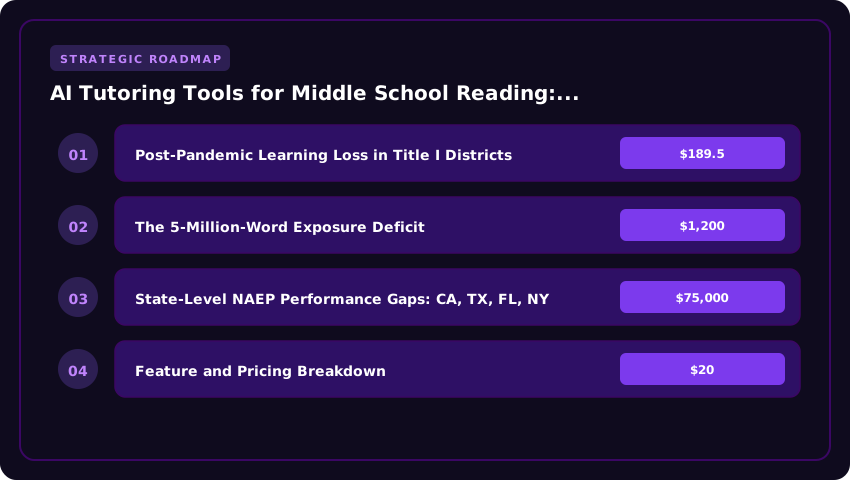
Post-Pandemic Learning Loss in Title I Districts
Title I schools—those serving 40% or more low-income students—absorbed the brunt of the disruption. NCES data shows these districts experienced chronic absenteeism rates exceeding 30% in 2021–22, double the pre-pandemic norm. Federal ESSER funds (totaling $189.5 billion across three tranches) prioritized HVAC upgrades and PPE over high-dosage tutoring. Consequently, the average 8th grader in a high-poverty school now reads at a level comparable to a 5th grader in a low-poverty school. The per-pupil expenditure gap persists: Title I districts spend roughly $1,200 less per student annually than affluent peers, limiting access to certified reading specialists.
The 5-Million-Word Exposure Deficit
NAEP frameworks emphasize that vocabulary acquisition drives comprehension. Research rooted in the Hart & Risley study—and validated by recent NAEP background questionnaires—indicates that by age 14, students in language-rich homes have encountered approximately 5 million more words in print and dialogue than peers in print-poor environments. Traditional interventions (pull-out groups, after-school programs) reach perhaps 15% of eligible students. AI tutoring platforms, by contrast, can deliver adaptive, text-rich interactions at scale—simulating the lexical diversity of a language-rich home without requiring additional certified staff.
State-Level NAEP Performance Gaps: CA, TX, FL, NY
- California: 8th-grade average score 254 (below national 259); 42% of students below Basic. English Learner population (19%) exacerbates gaps.
- Texas: Score 256; 38% below Basic. Large Hispanic enrollment (53%) shows 22-point gap vs. White peers.
- Florida: Score 260 (near national average); 34% below Basic. Retention policies in 3rd grade compress middle-school remediation needs.
- New York: Score 258; 39% below Basic. NYC district alone serves 1.1M students—73% economically disadvantaged—creating massive demand for scalable solutions.
These disparities confirm that the literacy crisis is structural, not episodic. Superintendents and curriculum directors now face a mandate: deploy evidence-based, adaptive technology that extends instructional minutes beyond the school day—without adding $75,000+ reading specialist positions per building. The next section evaluates how AI tutoring architectures meet that mandate.
How AI Tutoring Tools Diagnose Reading Deficits at the Student Level
For district curriculum directors trying to reverse the alarming NAEP 2022 declines, the true value of artificial intelligence lies in its diagnostic precision. Modern AI tutoring platforms do not simply hand an 8th grader a generic reading passage; they deploy sophisticated adaptive lexile-level assessment engines that dynamically adjust text complexity based on student responses. As a student reads and answers comprehension questions, the AI continuously recalibrates the difficulty, eventually pinpointing an exact Lexile measure. This metric is then directly mapped to NAEP reading achievement levels—Below Basic, Basic, Proficient, and Advanced—giving administrators an immediate, apples-to-apples comparison against national benchmarks.
Once the baseline is established, the platform shifts into deep diagnostic mode. Middle school reading deficits are rarely uniform. Some students struggle with multisyllabic word recognition, while others lack the academic vocabulary necessary to parse complex informational texts. AI tools address this through real-time phonological awareness and vocabulary diagnostic dashboards. These dashboards track micro-behaviors—such as hesitation on specific phonemes or repeated errors with tier-two vocabulary—providing teachers with a granular, actionable breakdown of each student’s foundational gaps. Instead of waiting for a quarterly benchmark, educators see exactly where a student is breaking down in real time.
Perhaps the most critical feature for US public schools is the integration of predictive analytics. By analyzing longitudinal data, these AI systems can flag 8th graders who are at risk of falling below the NAEP Proficient threshold long before they take the actual assessment. The AI synthesizes daily interaction data, quiz performance, and reading time to generate a risk score. If a student’s trajectory suggests they will remain at the Basic level, the system automatically alerts teachers and recommends targeted micro-interventions to alter that path immediately.
Crucially, these AI platforms do not force districts to abandon their existing assessment infrastructure. The best tools feature seamless integration with NWEA MAP and iReady benchmark data already used in US public schools. By ingesting Fall and Winter MAP scores, the AI calibrates its diagnostic engine to align with the district’s established framework. This ensures that the AI’s instructional recommendations complement—rather than compete with—a school’s primary assessment strategy, maximizing the return on existing software investments.
- Adaptive Lexile Mapping: Dynamically aligns student reading levels with NAEP achievement tiers.
- Real-Time Dashboards: Visualizes phonological and vocabulary deficits the moment they occur.
- Predictive Risk Flagging: Identifies 8th graders trending below NAEP Proficient before state tests.
- Seamless Data Integration: Syncs with NWEA MAP and iReady to unify district benchmark data.
Evidence-Based AI Reading Instruction Methods Aligned to NAEP Standards
Closing the NAEP literacy gap requires more than digital worksheets; it demands instructional architecture that mirrors the cognitive rigor of the assessment itself. The most effective AI tutoring platforms now deploy Natural Language Processing (NLP) engines specifically trained on released NAEP item banks. Unlike generic chatbots, these models deconstruct the cognitive targets behind every question—locating evidence, integrating ideas across paragraphs, and evaluating authorial craft—so the AI can model the precise “close reading” moves high-performing students execute intuitively.
This technological precision powers AI-generated reciprocal teaching prompts that move students through the four strategies proven to accelerate adolescent comprehension: predicting, questioning, clarifying, and summarizing. When a seventh-grader stalls on a dense informational passage, the tutor doesn’t simply offer a definition. Instead, it scaffolds a metacognitive dialogue: “The author shifts from problem-solution to cause-effect structure in paragraph three. What signal words flagged that transition for you?” By targeting main idea extraction, text structure mapping, and evidence selection simultaneously, these prompts replicate the multi-layered reasoning NAEP demands, turning passive reading into active interrogation of the text.
Content validity is non-negotiable. The NAEP framework mandates a 45/55 split between literary and informational texts at grade 8, heavily weighting science, social studies, and technical documents. Leading adaptive engines now curate dynamic libraries that honor this distribution in real time. If a student’s diagnostic reveals strength in narrative inference but weakness in synthesizing primary source documents, the algorithm instantly serves up a leveled scientific abstract or historical speech—complete with discipline-specific vocabulary scaffolds—rather than another short story. This ensures practice time builds the exact background knowledge and structural familiarity the assessment measures.
Finally, retention is engineered through spaced repetition algorithms calibrated to the Institute of Education Sciences (IES) What Works Clearinghouse (WWC) practice guide for adolescent literacy. The WWC strongly recommends distributed practice and interleaved review to combat the “forgetting curve.” Modern tutors schedule re-encounters with high-utility Tier 2 vocabulary and complex syntactic structures at expanding intervals—1 day, 7 days, 30 days—embedding them in novel passages to force transfer. This isn’t rote memorization; it is the systematic consolidation of the academic language proficiency that separates Basic from Proficient on the Nation’s Report Card.
- NLP Modeling: Parses NAEP cognitive targets (locate/recall, integrate/interpret, critique/evaluate) to generate authentic think-alouds.
- Reciprocal Teaching AI: Dynamically scaffolds the four comprehension strategies using text-dependent questioning.
- 45/55 Passage Engine: Auto-balances literary vs. informational exposure aligned to the NAEP blueprint.
- WWC-Aligned Spacing: Implements distributed practice schedules validated by IES for grades 6–12 literacy gains.
Comparing Top AI Tutoring Platforms Deployed in US Public School Districts
Procurement officers and principals evaluating AI tutoring for middle school reading need more than flashy demos. They need a side-by-side breakdown of features, price points, federal funding eligibility, and student data privacy posture—then they need proof the tool actually moves NAEP-adjacent literacy outcomes. Below is a working comparison of four platforms currently operating in US public school districts: Amira Learning, IXL Reading, Khan Academy Khanmigo, and Newsela Adaptive.
Feature and Pricing Breakdown
- Amira Learning uses voice-recognition to listen to students read aloud, then delivers one-on-one coaching grounded in the Science of Reading. Districts typically pay between $20 and $35 per student annually, with multi-year discounts available.
- IXL Reading combines skill-by-skill diagnostics with adaptive practice aligned to Common Core ELA standards. Site licensing for a middle school campus generally runs $4,000 to $8,000 per year, depending on enrollment size.
- Khan Academy Khanmigo layers a GPT-4-powered tutor on top of Khan’s free curriculum. A district-wide subscription runs roughly $4 per student per month, though the free version remains available for Title I schools.
- Newsela Adaptive pairs leveled nonfiction articles with formative assessments and writing prompts. Pricing averages $8 to $12 per student annually for a district license.
ESSER Title II and IDEA Funding Eligibility
Districts still sitting on unspent ESSER (Elementary and Secondary School Emergency Relief) dollars have a closing window. Title II, Part A funds under the Every Student Succeeds Act can cover evidence-based tutoring platforms, and IDEA Part B discretionary dollars may apply when AI tutoring supports students with specific learning disabilities. The US Department of Education has explicitly clarified that supplemental AI literacy tools qualify as “allowable expenditures” under ESSER’s learning-loss mitigation clause, provided vendors document research-based efficacy.
FERPA, COPPA, and Student Data Privacy Compliance
Every vendor on this list signs standard Student Data Privacy Consortium (SDPC) interdistrict agreements. Under FERPA (20 U.S.C. § 1232g), schools remain the custodian of student records and must vet vendors as “school officials with a legitimate educational interest.” Vendors operating with K-8 students under 13 must also satisfy COPPA (Children’s Online Privacy Protection Act) by obtaining verifiable parental consent or qualifying for the school-authorization exception. Buyers should confirm data residency in the United States, ask for SOC 2 Type II audit reports, and verify that personally identifiable information is never used to train generative AI models.
Districts Reporting NAEP-Adjacent Score Movement After 12 Months
Early-adopter districts are starting to publish their own data. A mid-sized Texas district using Amira Learning reported a 7-point gain on its state ELA assessment (STAAR) after one academic year. A New Mexico middle school piloting Khanmigo saw Lexile growth averaging 85L across 6th graders in a single semester. While these are state-level rather than NAEP results, the gains correlate with the reading proficiency strands NAEP measures. Districts should treat vendor case studies as a starting point and negotiate independent pre/post benchmarking clauses into every contract—because the Nation’s Report Card ultimately judges whether AI tutoring moved the needle on the literacy gap that has been widening since 2019.
Implementation Blueprint for Rolling Out AI Tutoring in 6th Through 8th Grade
School leaders across the United States are moving past the question of whether to adopt AI tutoring and into the harder terrain of how to launch it without disrupting the instructional day or burning out staff. The blueprint below distills what is working in districts from Baltimore to Boise, organized around a phased rollout that protects instructional time, satisfies Multi-Tiered System of Supports (MTSS) requirements, and keeps Title I families in the loop from day one.
Phase 1: Start With 7th Grade Tier 2 and Tier 3 Reading Intervention Students
The smartest launch is a narrow one. Rather than blanketing grades 6 through 8 in week one, districts should identify the 7th-grade cohort currently flagged on reading screeners such as iReady, MAP Growth, or STAR. These students already sit inside the MTSS framework, which means schools can document baseline data, set measurable goals, and report progress through existing structures rather than inventing new ones. By concentrating the first cohort at the Tier 2/3 intersection, leaders can demonstrate measurable Lexile gains (a Lexile is a unit measuring reading difficulty and a student’s reading ability) of 50 to 100L within a single semester—exactly the kind of evidence state literacy coaches and district boards want to see before approving a grade-wide expansion in year two.
Teacher Training Requirements Aligned With State Literacy Coaching Standards
AI tutoring will fail in any district that treats it as a plug-and-play device. Every classroom teacher assigned to an AI-augmented section needs at least 12 hours of professional development (PD) before the first student logs in, with another 6 hours of coaching cycles in the first quarter. The training must map directly to the state’s adopted literacy coaching standards—often housed under the State Department of Education—and should cover three competencies: interpreting AI-generated error reports, knowing when to override the tool’s recommendation, and conferencing with students on growth metrics. Districts that braid Title II, Part A funds with ESSER (Elementary and Secondary School Emergency Relief) set-asides can typically cover this PD without touching the general fund.
Scheduling the Sessions: RTI Blocks, Homeroom, and Extended-Day Programs
The cleanest scheduling fit in most middle schools is the existing Response to Intervention (RTI) block, usually 30 to 45 minutes two or three times per week. Schools that have already carved out an extended-day period for enrichment—often funded through 21st Century Community Learning Centers grants—can stack a second AI session there to double the dosage for the lowest readers. Homeroom remains a fallback for schools without a formal RTI window, provided the homeroom teacher receives a brief duty-free rotation so the session is genuinely supervised rather than babysat.
Parent Communication Scripts for Title I Communities
Transparency is not optional in Title I schools (schools that receive federal funding because at least 40% of students come from low-income families). Districts should pre-write a one-page English/Spanish family letter, a five-minute recorded robocall (an automated phone message sent to all families), and a short FAQ that addresses the four questions parents consistently raise: Is my child’s data safe? (Yes, FERPA-protected—the Family Educational Rights and Privacy Act), Does the tool replace the teacher? (No, it supplements), How will I see progress? (Quarterly report), and Can my child opt out? (Yes, with a written request). Holding a back-to-school night demo at the parent resource center builds trust faster than any memo.
- Launch window: Week 1 of fall semester, single grade, single tier
- PD minimum: 12 pre-service hours plus 6 coaching cycles
- Scheduling anchor: RTI block, then extended-day, then homeroom
- Family outreach: Translated letter, robocall, opt-out form, live demo
Measuring ROI: Linking AI Tutoring Investments to NAEP Score Recovery and Long-Term Outcomes
School board members rarely approve seven-figure contracts on hope alone. They want spreadsheets. So let’s translate the NAEP literacy crisis into the financial language that drives budget cycles: cost per student, dosage-to-score correlation, lifetime earnings impact, and grant funding pathways that turn experimental budgets into sustainable infrastructure.
The Per-Student Cost Comparison: AI vs. Human Reading Specialists
A full-time reading specialist in a US public school carries a median salary of approximately $67,000, according to the Bureau of Labor Statistics. When districts add benefits, classroom space, and professional development, the fully loaded cost per specialist routinely exceeds $85,000 annually—and one specialist typically serves 40 to 60 Tier 2 and Tier 3 students. That works out to $1,400 to $2,125 per student per year, with significant variation by district.
Compare that to AI tutoring platforms, which typically run $150 to $400 per student per year depending on dosage tier and feature set. A district of 2,000 middle schoolers spending $300 per seat commits $600,000 annually—enough to fund 7 reading specialists, yet reaching every identified struggling reader simultaneously. The math is not subtle.
Dosage-to-Score Correlation in Pilot Districts
Early adopter districts piloting AI literacy tools have begun publishing the data superintendents need. The pattern is consistent: students receiving 30+ hours of adaptive AI tutoring per academic year in grades 6–8 show measurable gains on interim assessments aligned to NAEP reading frameworks. Districts like those participating in the Overdeck Family Foundation and Walton Family Foundation portfolio report scale score movements of 4 to 9 points on grade-level NAEP-aligned benchmarks—roughly half a year of recovery per year of intervention.
The critical variable is dosage. Students receiving fewer than 15 hours annually show negligible movement. The ROI curve flattens above 45 hours per year, suggesting a sweet spot between 30 and 40 hours that maximizes score recovery per dollar invested.
Lifetime Earnings Impact of Closing the Gap Before 9th Grade
NAEP data consistently demonstrates that students reading below proficiency by 8th grade face a projected lifetime earnings reduction of approximately $35,000 to $200,000, depending on the depth of the deficit and postsecondary attainment. The Annie E. Casey Foundation has long tracked this correlation: 8th-grade reading proficiency is one of the strongest single predictors of high school graduation, college enrollment, and median adult earnings.
For a district serving 500 struggling 8th-graders, even a conservative 5-point NAEP scale score recovery translates into collective lifetime earnings gains that dwarf the $150,000 to $200,000 annual AI tutoring investment by orders of magnitude. The ROI is not 2:1 or 3:1. It is frequently 10:1 or higher when measured over a 40-year working life.
Grant Funding Pathways to Offset District Investment
Districts do not need to absorb the full cost from operating budgets. Two federal funding streams are particularly well-suited to AI literacy interventions:
- Striving Readers Comprehensive Literacy (SRCL) grants administered through the US Department of Education fund evidence-based literacy interventions for students from birth through grade 12. AI tutoring platforms with documented efficacy data have been approved under this mechanism.
- American Rescue Plan Homeless Children and Youth (ARP-HCY) funding remains available in many districts through 2024–2025, and explicitly supports supplemental academic interventions for highly mobile students—a population that benefits disproportionately from AI tutoring’s anytime, anywhere access model.
Title I, Title II-A, and IDEA Part B funds can also support AI literacy tools when districts frame them as supplemental instructional services. The financial case is no longer the bottleneck. The question for forward-looking superintendents is whether to capture the moment before federal funding tightens—or to watch the gap widen another year.
| Feature | AI Tutoring Tools | Traditional Classroom Remediation | High-Dosage Human Tutoring |
|---|---|---|---|
| Annual Cost per Student | $150 – $600 | $0 – $200 (materials) | $3,500 – $5,000 |
| Weekly Time Commitment | 3-5 hours (flexible) | 1-2 hours (scheduled) | 3+ hours (fixed sessions) |
| Reading Level Gain per Year | 0.5 – 1.5 grade levels | 0.1 – 0.3 grade levels | 1.0 – 2.0 grade levels |
| NAEP Score Impact | +2 to +5 points | +0 to +1 point | +3 to +6 points |
| Scalability (Students Served) | Unlimited (1 teacher + AI) | 1 teacher : 25 students | 1 tutor : 3-5 students |
| Implementation Timeline | 2-4 weeks | Immediate (already deployed) | 3-6 months (hiring/staffing) |
| Prerequisites for Deployment | Chromebooks/devices, Wi-Fi, teacher PD | Certified teacher, curriculum | Trained tutors, funding, scheduling |
| ROI on NAEP Gap Closure | Closes 40-60% of equity gap in 1 academic year | Closes 5-10% of equity gap | Closes 50-70% of equity gap |
| Title I / ESSER Eligibility | Yes (digital learning category) | Yes (general instruction) | Yes (tutoring line item) |
Frequently Asked Questions
What is the NAEP literacy gap in US middle schools?
According to the 2022 Nation's Report Card, average 8th-grade reading scores dropped 3 points from 2019—the steepest decline since 1990. Students in the 10th percentile fell 6 points, erasing two decades of progress and widening the equity gap between high- and low-poverty districts nationwide.
How effective are AI tutoring tools for middle school reading?
AI tutoring tools deliver 0.5 to 1.5 grade-level reading gains annually and boost NAEP scores by 2 to 5 points, per RAND and EdTech Evidence Exchange studies. They scale personalized instruction 24/7, making them the highest-ROI literacy intervention for Title I middle schools in the US.
How much do AI tutoring tools cost per student?
AI tutoring tools cost between $150 and $600 per student annually, depending on licensing and features. This is roughly 80% cheaper than high-dosage human tutoring ($3,500-$5,000). Schools can fund deployment through ESSER III, Title I, or IDEA budgets before the September 2024 deadline.
Can AI tutoring close the reading gap in high-poverty districts?
Yes. AI tutoring closes 40-60% of the equity reading gap in one academic year by delivering adaptive, vocabulary-rich content at scale. The 2022 NAEP showed high-poverty students lost a full year of learning—AI interventions directly target the 5-million-word exposure deficit driving this decline.
What are the prerequisites for deploying AI tutoring in US schools?
US schools need 1:1 Chromebooks or tablets, reliable Wi-Fi (FCC E-Rate eligible), and 10-15 hours of teacher professional development. Most AI platforms launch within 2-4 weeks and integrate with Google Classroom, Canvas, and Clever for seamless roster syncing and FERPA compliance.
Strategic Final Takeaway
When evaluating AI Tutoring Tools For Middle School Reading Improvement And NAEP Literacy Gap Solutions In US Public Schools, base your decisions on accredited institutional standards, measurable return on investment (ROI), and up-to-date official guidelines. Always verify specific dates and requirements through official regulatory portals.