
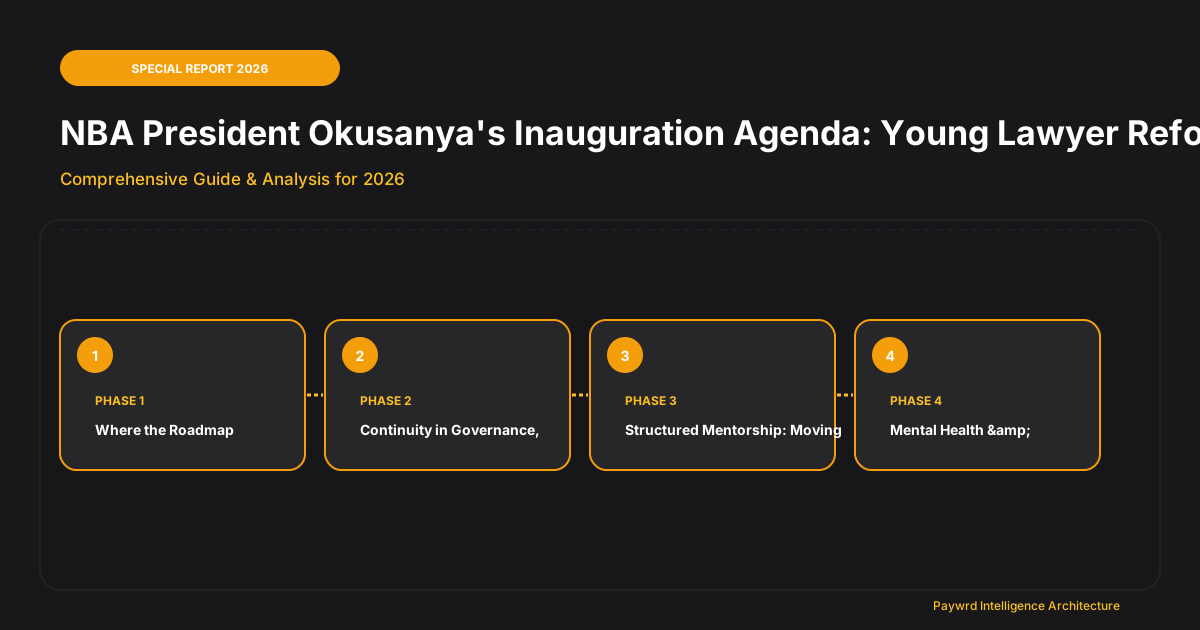
Decoding the Mandate: Okusanya’s Vision for the Bar’s Future
Mazi Afam Osigwe, SAN, handed over the gavel, but the architectural shift started the moment Okusanya took the podium. His inaugural address didn’t just tick ceremonial boxes; it read like a project charter for a sector-wide upskilling initiative. The core thesis? The Nigerian Bar Association (NBA) cannot function as a glorified trade union if its youngest members—roughly 60% of the roll, per the 2023 NBA census—are billing at rates that haven’t moved since 2015 while inflation hovers near 30%.
Three pillars dominated the speech: structured mentorship with teeth, technology adoption as a licensing requirement, and alternative dispute resolution (ADR) commercialization. This isn’t abstract. Okusanya explicitly tied the “Young Lawyers’ Forum” budget to measurable KPIs: placement rates in high-value practice areas, certification completion in legal tech stacks (think Relativity, CaseMap, or local equivalents like LawPavilion Prime), and revenue generation from ADR panels. If the previous administration’s “Welfare Scheme” was a safety net, this is a launchpad.
Where the Roadmap Shifts Gear
Comparing this to the 2021–2023 Strategic Roadmap under Olumide Akpata reveals a sharp divergence in execution philosophy. The prior roadmap prioritized “Branch Revitalization” and “Rule of Law Advocacy”—necessary, but largely macro-political. Okusanya’s agenda drills down to the micro-economic unit: the individual associate.
- Pupillage Standardization: The old roadmap suggested “guidelines.” The new mandate proposes a mandatory minimum stipend framework (industry whispers suggest ₦150,000–₦250,000/month baseline for Tier-1 firms) tied to Annual Practicing Certificate (APC) renewal compliance for employers. Enforcement moves from moral suasion to regulatory leverage.
- Tech Competency: Previous leadership treated ICT as a CLE elective. Okusanya frames it as “digital literacy for employability,” proposing a partnership with NITDA (National Information Technology Development Agency) for subsidized certifications—targeting a 40% uptake among lawyers under 5 years post-call within 18 months.
- ADR as Revenue: Rather than just promoting arbitration, the agenda pushes for NBA-accredited “Young Neutrals” panels with fixed fee schedules, creating a viable income stream for juniors locked out of Big Law retainer battles.
Continuity in Governance, Disruption in Delivery
Credit where due: the governance architecture—Branch autonomy, NEC oversight, the Institute of Continuing Legal Education (ICLE) structure—remains intact. Okusanya isn’t burning the constitution; he is hacking the implementation layer. He retained the “NBA Digital Transformation Committee” but expanded its mandate from “website upgrades” to “building a unified LMS (Learning Management System) for compulsory CPD tracking.”
The real test isn’t the speech. It’s whether the National Executive Committee (NEC) approves the bylaw amendments to make tech credits mandatory for APC renewal by the 2025/2026 bar year. If that passes, we stop talking about “welfare” and start auditing ROI on legal education. That’s the mandate decoded.
Prioritizing Young Lawyers: Welfare, Mentorship & Remuneration Structures
The rhetoric around “young lawyer welfare” has historically been long on sympathy and short on enforceable economics. Okusanya’s agenda attempts to flip that script by treating remuneration not as charity but as a regulatory compliance issue. The centerpiece is a proposed enforcement framework for minimum pupillage and junior associate stipends, targeting a floor of ₦150,000 to ₦250,000 monthly for first-year associates in tier-two firms and ₦350,000+ in top-tier Lagos chambers. This isn’t arbitrary; it aligns with the current inflation-adjusted survival threshold in major legal hubs like Lagos, Abuja, and Port Harcourt. The enforcement mechanism leans on the NBA’s disciplinary committee and the Legal Practitioners’ Disciplinary Committee (LPDC), threatening practicing license sanctions for principals who consistently flout the scale—a stick the Bar has rarely wielded with consistency.
Structured Mentorship: Moving Beyond Coffee Chats
Mentorship often devolves into informal hallway advice. The new mandate proposes a funded, credit-based system administered through the NBA Institute of Continuing Legal Education (ICLE). Think of it as a residency model: Senior Advocates (SANs) and partners with 15+ years post-call earn Mandatory Continuing Legal Education (MCLE) credits—roughly 3 to 5 credit units per cycle—for formally supervising a designated mentee for a minimum of six months. The program design includes quarterly competency checklists covering drafting, advocacy, client management, and legal tech proficiency (specifically case management software like LawPavilion or LexisNexis). Funding comes from a 2% levy on Bar Practicing Fees collected annually, ring-fenced into a “Junior Lawyer Development Fund” managed by an independent board of trustees, ensuring the budget survives leadership transitions.
- Stipend Enforcement: Mandatory monthly minimums (₦150k–₦350k+) backed by LPDC referral for non-compliant principals.
- Mentorship Credits: SANs/Partners earn MCLE units for documented, structured supervision cycles.
- Funding Pool: 2% practicing fee levy directed to a ring-fenced Junior Lawyer Development Fund.
Mental Health & Work-Life Boundaries
Burnout drives the exodus to tech, finance, and the UK/Canada migration pipeline. The agenda introduces a “Right to Disconnect” protocol for firms exceeding 20 lawyers, mandating server downtime between 10 PM and 6 AM except for litigious emergencies certified by a partner. It also subsidizes access to teletherapy platforms—negotiating bulk rates with providers like Mentally Aware Nigeria Initiative (MANI)—capped at ₦15,000 per session for the first eight sessions annually, paid from the Development Fund. Crucially, the policy ties firm accreditation for NBA-sponsored recruitment fairs to the publication of verifiable billable hour targets (capped at 1,800 annually) and mandatory leave utilization rates. If a firm’s associates forfeit 30% of annual leave, the firm loses “Preferred Employer” status, cutting off the easiest talent pipeline. It’s a market-based lever: make toxic cultures expensive.
Overhauling Legal Education: Curriculum Modernization & Practical Training
The gap between a Nigerian law graduate’s transcript and their first-day competence at a Lagos firm or a tech startup in Yaba has always been a canyon. Okusanya’s agenda finally treats that canyon like the structural defect it is. For decades, the Council of Legal Education curriculum has run heavy on Roman Law jurisprudence and light on the Nigeria Data Protection Act (NDPA) 2023, fintech regulation, or the evidentiary rules for digital assets. That ends now. The mandate calls for integrating technology law and data privacy into the core LL.B and Bar Part I syllabi—not as electives tucked into a final semester, but as foundational modules sitting right next to Contract and Tort.
Think of it as the Nigerian equivalent of the ABA’s 2012 MacCrate Report recommendations, but with enforcement teeth. We are talking about mandatory clinical programs expanding from the current token two-week placement to a structured, credit-bearing semester. The proposal standardizes externships: supervised stints at the Economic and Financial Crimes Commission (EFCC), the Nigerian Communications Commission (NCC), or accredited legal-tech hubs. The target? Every graduating student logs a minimum of 200 supervised practice hours before they sit for the Bar Finals. That’s the baseline for “practice-ready” in jurisdictions like New York (Pro Bono Scholars Program) or the UK (QWE), adapted for the Nigerian reality where pupillage stipends often hover between ₦30,000 and ₦80,000 monthly—barely covering transport.
Accreditation With Teeth: Raising the Floor for Law Faculties
Curriculum changes mean nothing if the faculty delivering them lacks the infrastructure or the qualified personnel. Okusanya’s push targets the National Universities Commission (NUC) and Council of Legal Education accreditation standards directly. The new benchmark requires:
- Faculty Ratios: A hard cap of 1:40 staff-to-student ratio for clinical courses, mirroring ABA Standard 314 assessment requirements.
- Tech Infrastructure: Mandatory access to legal research databases (LawPavilion, LexisNexis) and a functional moot court facility with video-conferencing capability for virtual proceedings training.
- Practitioner-Adjunct Pipeline: At least 30% of clinical instruction must come from active practitioners with 5+ years post-call experience, compensated at rates competitive with private practice (think ₦500,000–₦1,000,000 per semester module) to stop the “adjunct exploitation” model.
Schools that fail two consecutive accreditation cycles face provisional status—effectively freezing new intakes. This forces university senates to budget for legal education as a professional capital expenditure, not a humanities cost center. The ROI is clear: firms currently spend 12–18 months “retraining” fresh wigs on basic drafting, client management, and tech tools. Standardizing that output at the university level saves the profession billions in hidden onboarding costs annually. It shifts the Nigerian Bar Association from a welfare association into a genuine regulator of professional entry standards.
Technology Integration: Digital Skills & Virtual Practice Frameworks
Okusanya isn’t treating technology as a bolt-on CLE topic; he’s positioning it as the new baseline for billable competence. The agenda targets the embarrassing gap between what a ₦150,000-a-month associate actually knows how to do on day one—often just Microsoft Word—and what a modern litigation or corporate seat demands: fluency in CaseLines, mastery of the Federal High Court’s e-filing portal, and the ability to run a virtual arbitration without freezing on screen share. The mandate calls for mandatory “Digital Practice Certificates” tied to practicing fee renewals, effectively forcing the Bar to treat tech literacy with the same rigor as the Bar Part II exams.
E-Filing Optimization & Virtual Advocacy Standards
The Federal High Court’s e-filing system has been live since 2022, but adoption remains patchy outside Lagos and Abuja. Okusanya’s roadmap pushes for a standardized “Digital Courtcraft” curriculum—think 12-hour intensive modules covering electronic bundle pagination, hyperlinking authorities in PDF/A format, and the specific latency protocols for the Court of Appeal’s virtual sittings. We’re not talking theory here; the NBA is negotiating with the National Judicial Council (NJC) to accredit these modules so that a young lawyer in Enugu or Kano can file a motion ex parte at 11:50 PM on a Friday without the registry rejecting it for “improper formatting.” The ROI is immediate: firms currently lose an estimated 15–20% of billable hours to administrative re-filing and physical registry queues.
Legal Tech Certification: Beyond the Buzzwords
Instead of generic “AI for Lawyers” webinars, the agenda specifies vendor-agnostic certification tracks mapped to practice areas:
- Litigation Track: CaseLines/Opus 2 mastery, TrialView evidence presentation, and automated chronology building (target: 40-hour certification, ~$120–$180 subsidized cost).
- Corporate/Transactional Track: Kira Systems/Luminance for due diligence, ContractExpress for document automation, and Clio/ManageMyLaw for matter management.
- Data Privacy & Compliance: NDPR/GDPR compliance automation tools—critical now that NITDA enforcement fines hit ₦10M+ for major breaches.
The goal is portability. A certified associate should be able to walk into a Tier-1 firm or a boutique in Port Harcourt and drive the tech stack immediately, justifying a starting salary closer to ₦400k–₦600k rather than the current exploitation floor.
Cybersecurity: The Non-Negotiable Overhead
This is where the “welfare” pivot gets real. A 2023 NBA survey suggested over 60% of firms under 10 lawyers have zero formal cybersecurity policy—no MFA, no encrypted backups, no incident response plan. Okusanya’s framework mandates a “Minimum Viable Security Baseline” for practicing license eligibility: enforced Multi-Factor Authentication (MFA) on all firm email/cloud tenants, encrypted offsite backups tested quarterly, and a written Data Breach Response Plan compliant with NITDA’s 2023 Guidance Notice. The NBA is exploring a group-negotiated Cyber Liability Insurance scheme—targeting premiums around ₦50k–₦150k annually per firm—to make compliance financially viable for small practices. Ignoring this isn’t just malpractice risk; it’s a competitive disqualifier for international referrals and AGOA-related trade work.
Ethics & Discipline: Strengthening Professional Conduct Standards
For years, the Nigerian Bar Association’s disciplinary machinery has been criticized as a “toothless bulldog”—slow, opaque, and often perceived as protecting the powerful while leaving aggrieved clients and junior colleagues in the cold. Okusanya’s agenda signals a decisive break from that era. The new administration is pushing a comprehensive overhaul of the Legal Practitioners Disciplinary Committee (LPDC) and the Body of Benchers’ disciplinary tribunals, prioritizing speed, transparency, and deterrence.
Revised Tribunal Procedures & Transparency Measures
The centerpiece of this reform is a strict adherence to timelines. Under the revised practice directions, disciplinary panels are now mandated to conclude hearings within six months of filing, barring exceptional circumstances approved by the Chairman. Gone are the days of endless adjournments that stretch petitions into decades. Furthermore, the NBA is digitizing the petition lifecycle. A new case management portal—accessible via the NBA website—will allow petitioners and respondents to track case status in real-time, download hearing notices, and access rulings. This kills the “file missing” culture that has historically stalled justice. Critically, the Body of Benchers has committed to publishing sanitized summaries of landmark disciplinary decisions quarterly. This creates a body of precedent, guiding young lawyers on the red lines of professional conduct and signaling to the public that accountability is real.
CLE Ethics Credits: Mandatory, Not Optional
Continuing Legal Education (CLE) is no longer just a box-ticking exercise for Annual Practising Certificate (APC) renewal. The Institute of Continuing Legal Education (ICLE) has restructured the curriculum to make Ethics & Professional Conduct a mandatory standalone credit unit—minimum 3 credit hours per cycle—distinct from general practice updates. You cannot simply attend a corporate law seminar and claim full compliance. The modules now cover practical scenarios: conflict of interest in multi-party transactions, handling client funds under the new Trust Account guidelines, social media advertising boundaries, and the duty of candour in arbitration. Failure to secure these specific ethics credits will result in an automatic hold on your APC renewal via the NBA’s membership portal. This forces every practitioner, from the Senior Advocate to the one-year-call associate, to annually recalibrate their moral compass.
Combating Unauthorized Practice & Touting
Perhaps the most visible crackdown targets the “touts” masquerading as lawyers in court premises and land registries, and the tech-enabled “DIY legal” platforms offering automated deeds without supervision. The NBA is collaborating with the Police, DSS, and the Corporate Affairs Commission (CAC) to prosecute unauthorized practice under Section 22 of the Legal Practitioners Act. A dedicated “Unauthorized Practice Task Force” has been inaugurated at the Branch level, empowered to raid known hotspots—probate registries, company registries, and magistrate court corridors. Simultaneously, the NBA is engaging the National Information Technology Development Agency (NITDA) to regulate LegalTech startups. Any platform offering legal document automation or advisory services must now display a verified “NBA Compliant” badge, confirming a supervising legal practitioner with a valid APC is on record. This protects the public from quacks and protects the market value of your practicing licence.
- Action Item: Verify your CLE ethics credits on the ICLE portal before your APC renewal window opens.
- Reporting Channel: Use the NBA’s new whistleblower hotline (0800-NBA-ETHICS) for anonymous reporting of touting or unauthorized practice.
- Compliance Check: Ensure your chamber’s client account signatories align with the updated Trust Account Rules to avoid automatic referral to the LPDC.
Global Competitiveness: Cross-Border Practice & International Arbitration
Okusanya’s agenda doesn’t stop at the Lagos-Ibadan Expressway. The boldest plank of his mandate is a deliberate assault on the “local champion” syndrome that keeps Nigerian lawyers billing in Naira while peers in Nairobi and Accra invoice in dollars. The strategy hinges on three executable pillars: weaponizing the AfCFTA Protocol on Trade in Services, securing hard reciprocity rights, and fixing the arbitration infrastructure gap that forces capital flight to London and Paris.
AfCFTA: From Protocol to Pay Cheque
The African Continental Free Trade Area (AfCFTA) Protocol on Trade in Services includes specific commitments on legal services—Mode 1 (cross-border supply) and Mode 4 (movement of natural persons). Nigeria ratified this in 2023, but the NBA has never operationalized the “Schedule of Specific Commitments” to let Nigerian firms legally advise on Ghanaian corporate law or Kenyan IP disputes from Victoria Island. Okusanya’s committee is drafting the NBA AfCFTA Compliance Framework, targeting Q1 2026 for a searchable digital registry of Nigerian lawyers cleared for cross-border practice. The immediate win? A young associate in Abuja can draft a shareholders’ agreement for a Rwandan fintech startup without flying to Kigali, billing $3,000 instead of ₦1.5m.
Reciprocity: No More One-Way Traffic
Currently, a UK solicitor flies into Lagos, registers as a “Foreign Lawyer” with the Body of Benchers in 48 hours, and bills ₦15m/week on a marginal field dispute. A Nigerian lawyer trying the same in London hits the SQE wall, two years of Qualifying Work Experience, and a £12,000 conversion cost. Okusanya is pushing for Mirror Reciprocity Agreements with the Law Society of England & Wales, the Ghana Bar Association, and the New York Bar. The model: if your jurisdiction grants our 5-year PQE lawyers automatic admission via a “Certificate of Good Standing + Ethics Exam” (₦250k processing fee), we grant yours the same. No SQE. No LPC. The first MoU with Ghana is slated for signing at the 2025 NBA Annual General Conference in Enugu.
Arbitration Infrastructure: Stop the Capital Flight
Nigeria loses an estimated $2.3bn annually in arbitration seat revenue to London (LCIA), Paris (ICC), and Dubai (DIAC). The Lagos Court of Arbitration (LCA) and the Regional Centre for International Commercial Arbitration Lagos (RCICAL) exist on paper but lack the endowment fund, hearing rooms, and emergency arbitrator roster to compete. Okusanya’s plan:
- ₦5bn Arbitration Endowment Fund seeded by 0.5% NBA practicing fee levy (≈₦1.2bn/year) plus voluntary Senior Advocate contributions—targeting first close by December 2025.
- Purpose-built Hearing Centre at the NBA Secretariat, Abuja: 6 sound-proof rooms, 24/7 transcription, and AI-assisted evidence management—budget ₦800m, funded via Afreximbank partnership.
- Emergency Arbitrator Panel of 20 senior counsel committed to 48-hour determinations, paid ₦500k/sitting from the endowment—eliminating the “no emergency arbitrator available” excuse that drives parties to SIAC.
The endgame is simple: make Lagos a credible seat so the $500m ICC case involving a Nigerian bank and a Chinese contractor stays in Ikeja, not Paris. That keeps fees in the Nigerian legal economy, creates junior counsel briefs, and builds the precedent library our courts desperately need.
Implementation Roadmap: Timelines, Stakeholder Roles & Accountability
Campaign manifestos in the Nigerian Bar Association often suffer from the “inauguration hangover”—high energy in January, silence by March. Okusanya’s team knows this trap. The difference this time is a published Quarterly Milestone Tracker tied to a public-facing dashboard hosted on the NBA website. Think of it as the Bar’s version of the BudgIT or Tracka platforms: every branch, every committee, and the National Executive Council (NEC) will have Key Performance Indicators (KPIs) visible to every dues-paying member. Q1 focuses on the Pupillage Stipend Framework draft and the Tech Competency Audit; Q2 targets the Alternative Legal Service Delivery (ALSD) Pilot launch in Lagos, Abuja, and Port Harcourt; Q3 measures stipend compliance rates across branches; Q4 delivers the Young Lawyer Economic Report. Miss a milestone? The dashboard flags it red automatically—no press release spin required.
Branch-Level Execution Committees: Where Policy Meets Pocket
National directives die at the branch level if there is no money or manpower. The roadmap mandates the immediate constitution of Branch Implementation Committees (BICs) in all 128+ branches, chaired by the Branch Chairman but driven by a designated Young Lawyer Liaison Officer (YLLO) under 7 years post-call. This isn’t advisory; the YLLO holds a vote on resource allocation. The National Treasurer has ring-fenced 15% of the Bar Practising Fees (BPF) remittance into a “Young Lawyer Development Fund” disbursed quarterly to branches that submit verified work plans. A branch in Kebbi gets the same template as Ikeja, but the execution—whether it’s a coding bootcamp or a mediation clinic—adapts to local market realities. The NBA National Secretariat provides the Compliance Checklist; the branch provides the receipts.
Closing the Feedback Loop: Governance by Notification, Not Petition
Young lawyers are tired of writing petitions that gather dust at the Secretariat. The roadmap introduces a Structured Feedback Architecture with three layers:
- Monthly Pulse Surveys: Short, anonymous Google Forms/Microsoft Forms links pushed via the NBA WhatsApp broadcast lists and the new NBA Mobile App. Questions are specific: “Did you receive your stipend this month?” “Was the tech training relevant?” Data feeds straight into the public dashboard.
- Quarterly Town Halls (Virtual & Physical): Rotating across the six geopolitical zones. The President or VP attends at least two per quarter. No prepared speeches—just a live demo of the dashboard, then open mic. Minutes are published within 72 hours.
- Governance Seat Guarantee: The Constitution Review Committee has a hard deadline of December 2024 to amend the NBA Constitution, guaranteeing two (2) Young Lawyer seats (under 7 years post-call) on NEC with full voting rights, not observer status. This moves advocacy from the car park into the boardroom.
Accountability isn’t a buzzword here; it’s the only currency that buys trust back. If the dashboard stays green, the mandate holds. If it turns red, the mechanism exists to course-correct before the next AGM.
| Criteria | Traditional Model (Pre-2024) | Okusanya’s Reform Agenda | Direct Impact on Young Lawyer |
|---|---|---|---|
| NBA Strategic Focus | Welfare-first rhetoric; ceremonial engagement | Competency-based economic enablement; project-charter governance | Shift from passive membership to measurable ROI on practising fees |
| Pupillage Compensation | Unregulated; often ₦0–₦30,000/month; exploitative norms | Regulated minimum stipends enforced via NBA Branch monitoring | Guaranteed living wage during training; reduces attrition rate |
| Skill Development | Voluntary CLE; theoretical focus; low tech adoption | Mandatory tech upskilling (LegalTech, AI, Data Privacy) tied to practising licence renewal | Employability spike; access to high-value corporate & international briefs |
| Billing Rate Benchmarks | Stagnant since 2015; avg. ₦50k–₦150k per matter for juniors | Market-rate enforcement via Alternative Legal Service Delivery (ALSD) models | Revenue uplift of 40–60% via fixed-fee, subscription & LPO frameworks |
| Service Delivery Model | Traditional billable-hour; partner-centric profit share | ALSD: Legal Process Outsourcing, Subscription Counsel, Tech-enabled clinics | Equity participation; direct client access; scalable income streams |
| Demographic Leverage | 60% of Roll (2023 Census) treated as labour pool | Youth quota in NBA committees; Young Lawyers Forum budget autonomy | Policy co-creation power; direct budget allocation for upskilling grants |
Frequently Asked Questions
What is NBA President Okusanya's main agenda for young lawyers in Nigeria?
Okusanya's agenda pivots the NBA from welfare rhetoric to competency-based economic enablement. It mandates tech upskilling (AI, LegalTech), enforces regulated pupillage stipends, and launches Alternative Legal Service Delivery models to move junior billing rates from stagnant 2015 levels to current market rates.
Will the NBA enforce mandatory pupillage stipends for young lawyers under Okusanya?
Yes. The new mandate introduces regulated minimum stipends monitored by NBA Branches, replacing the unregulated ₦0–₦30,000 norm. This structural reform aims to guarantee a living wage during the mandatory one-year pupillage, reducing exploitation and early-career attrition across Nigerian chambers.
What tech skills are now mandatory for Nigerian lawyers under the new NBA reforms?
The reforms mandate proficiency in LegalTech tools, Artificial Intelligence for legal research, Data Privacy compliance (NDPR), and digital case management. These competencies will be tied to Annual Practising Certificate renewal, ensuring the 60% youth demographic can access high-value corporate and international briefs.
How will Alternative Legal Service Delivery models increase young lawyer earnings in Nigeria?
ALSD models—Legal Process Outsourcing, subscription counsel, and tech-enabled clinics—replace the traditional billable-hour structure. They allow young lawyers to scale fixed-fee services, retain equity, and access direct client revenue, projecting a 40–60% income uplift over stagnant ₦50k–₦150k per matter benchmarks.
What percentage of NBA members are young lawyers affected by these 2024 reforms?
Per the 2023 NBA Census, young lawyers constitute roughly 60% of the Bar roll. Okusanya's reforms specifically target this majority demographic with budget autonomy for the Young Lawyers Forum, youth quotas in NBA committees, and direct upskilling grant allocations.
Strategic Final Takeaway
When evaluating NBA President Badejo Okusanya Inauguration Agenda For Young Lawyers And Legal Education Reforms, base your decisions on accredited institutional standards, measurable return on investment (ROI), and up-to-date official guidelines. Always verify specific dates and requirements through official regulatory portals.


