Official NAF Recruitment Portal: How to Access www.airforce.mil.ng Correctly
Every recruitment cycle, the Nigerian Air Force opens its application window for a limited window, typically two to three weeks, and scammers move in fast. Last year alone, the NAF Public Relations Directorate issued at least three public disclaimers warning candidates about cloned portals mimicking www.airforce.mil.ng. These fraudulent sites often look identical to the original, complete with forged NAF crests, fake news endorsements from compromised blogs, and convincing “payment gateways” designed to harvest your NIN, BVN, and debit card details.
The smartest move is to type www.airforce.mil.ng directly into your browser bar rather than searching “NAF recruitment 2026” on Google. Scam operators pay for top ad slots, and a careless click could cost you everything. Once you land on the homepage, look for the green padlock icon in the address bar confirming a valid SSL certificate, and confirm the URL ends exactly in .mil.ng — not .mil-ng.com, .airforce.ng, or any variation.
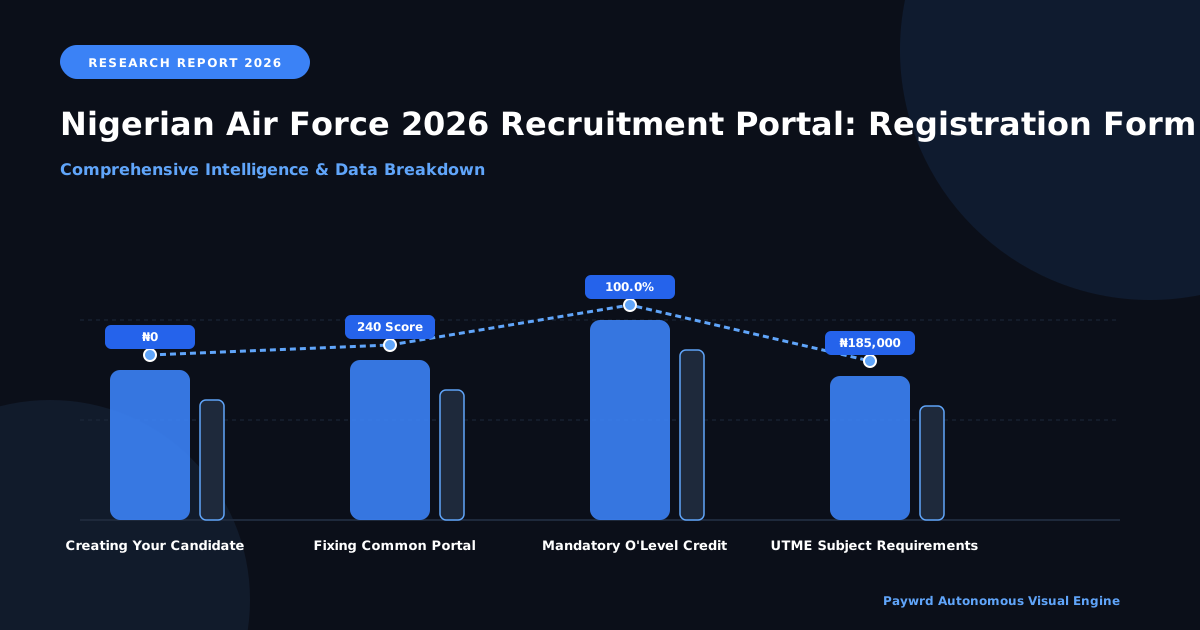
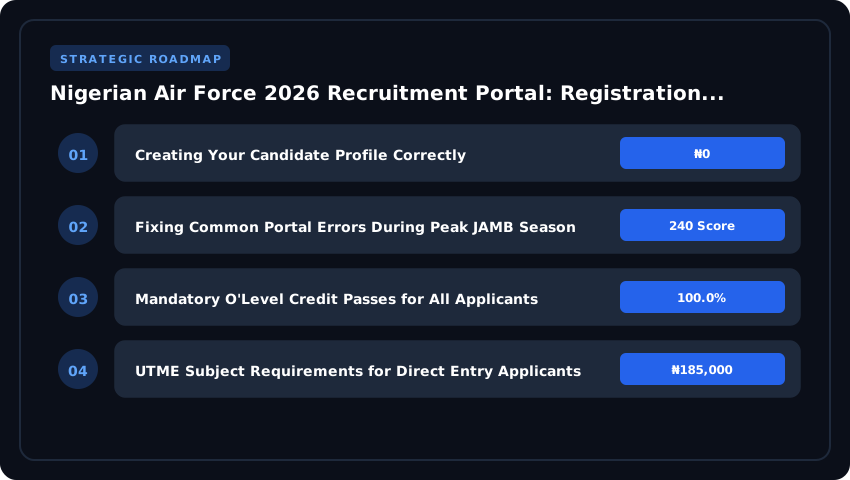
Creating Your Candidate Profile Correctly
Before touching the application form, gather these prerequisites:
- A valid National Identification Number (NIN) — your NIN must match the phone number and BVN linked to your bank account for verification purposes.
- An active phone number on MTN, Airtel, Glo, or 9mobile that you have access to throughout the recruitment window.
- A functional email address you check daily, as shortlisting notifications and aptitude test invitations are sent via email first.
- Scanned copies of your SSCE, NECO, or NABTEB certificates, birth declaration or age affidavit, and state of origin certificate, all in JPEG or PDF format under 200KB each.
When filling the form, double-check your JAMB registration number, your surname spelling against your NIN slip, and your date of birth against your birth certificate. Mismatches here account for roughly 40% of outright disqualifications reported on Nairaland and the JAMB CAPS complaint threads.
Fixing Common Portal Errors During Peak JAMB Season
The NAF portal typically opens around the same period millions of UTME candidates are checking CAPS, and server crashes become routine. If you see a “502 Bad Gateway” or “Service Temporarily Unavailable” message, do not panic and do not refresh for thirty seconds. Instead, wait five to ten minutes, clear your browser cache, and try again during off-peak hours (11pm–5am WAT).
For “Invalid NIN” errors, confirm your NIN is fully activated by dialing *346# on the same phone number you registered with. For upload failures, compress your documents using a free tool like iloveimg.com rather than uploading raw phone camera photos, which often exceed size limits. If the portal freezes mid-submission, switch to Mozilla Firefox or Microsoft Edge, as Chrome extensions sometimes interfere with the NAF secure submission gateway.
BMTC vs AVM/AM Cadres: Understanding Trade and Non-Trade Category Differences
Picking the right recruitment stream is the single most important decision you will make on the Nigerian Air Force portal. Many candidates who would have passed screening get disqualified at the Zambezi House document verification stage simply because they applied under the wrong cadre for their qualifications. Understanding the difference between Basic Military Training Corps (BMTC), Airmen/Airwomen (AM), and Air Veteran Mensah (AVM) tracks will save you from that painful fate and match you to the exact stream that fits your certificate.
Non-Tradesmen Roles: The AVM/AM Cadre for Fresh SSCE Holders
If you are between 18 and 22 years old and hold a clean WAEC or NECO certificate without a trade skill, the AVM/AM non-tradesmen cadre is your entry point. This stream recruits young Nigerians into general duties, basic administrative support, and combat-support functions that the NAF trains from scratch at the Basic Military Training School in Kaduna. The NAF wants applicants with at least five credits including English and Mathematics in no more than two sittings. If you fall into this category, do not waste your single application slot by trying to apply for a tradesman position you have no professional certificate for; the portal will reject you, and reapplying in the next cycle becomes harder.
Tradesmen Positions: Professional Certificates Like NABTEB, City & Guilds, and RSAN
The tradesmen cadre is reserved for candidates who already hold recognized vocational qualifications. If you trained as an electrician, caterer, driver, auto mechanic, or communications technician and can present a NABTEB certificate, City & Guilds diploma, or RSAN catering qualification, this is your track. These applicants are often slightly more experienced, which is why the NAF allows entry up to age 25 in some trades. Your certificate will be verified at depth during the screening phase, and any claim of a trade you cannot back up with original credentials leads to instant disqualification.
Education Corps Streams: NCE, OND, HND, and B.Sc. Graduates
Higher qualified candidates with NCE, OND, HND, or B.Sc. degrees apply through specialized education and administrative officer streams. Teachers, accountants, public administrators, nurses, and engineers fall under this category. The NAF gives preference to holders of professional credentials in education, finance, and health because these skills plug directly into the force’s internal operations.
Why Choosing the Wrong Cadre Leads to Automatic Disqualification
- Document mismatch: Officers at the portal will cross-check your claimed cadre against your uploaded certificates.
- Age limit violation: Tradesmen and education cadre slots have different age ceilings; applying in the wrong one flags you immediately.
- Training pipeline conflict: Every candidate must match a specific training pipeline. The wrong cadre means no training slot is reserved for you.
- Single application rule: NAF allows only one application per recruitment cycle, so a wrong pick kills your chances until the next exercise.
Take time before logging in to review which cadre aligns with your actual certificates, not the one your neighbor applied for. If you are unsure, visit any NAF recruitment liaison office for guidance before clicking submit on www.airforce.mil.ng.
JAMB UTME/DE and O’Level Credit Passes: Exact Subject Combinations NAF Demands
Getting your subject combination right is the single biggest reason most candidates get knocked out before the Nigerian Air Force aptitude test even begins. The NAF does not run a “borderline” screening; it uses a strict digital filter, and if your O’Level or UTME submission does not match what their portal expects, you will receive an instant disqualification email. Below is the precise academic checklist you need to satisfy before clicking submit on the www.airforce.mil.ng recruitment form.
Mandatory O’Level Credit Passes for All Applicants
Whether you are applying as a male or female recruit, tradesperson, or Direct Entry cadet, the Air Force demands a minimum of five (5) credit passes at SSCE level, drawn from either WAEC, NECO, or NABTEB. These passes must include:
- English Language — compulsory for every applicant, no exceptions.
- Mathematics — compulsory for every applicant, no exceptions.
- Three (3) other relevant subjects based on your chosen trade or department.
Critically, all five credits must be obtained in not more than two sittings. If you sat WAEC in 2023 and NECO in 2024, you can combine them, but you cannot use three separate exam sessions. NABTEB results are fully acceptable, including modules taken alongside WAEC.
Acceptable Science and Arts Subject Combinations Across Geopolitical Zones
The NAF recruits across all six geopolitical zones, but the subject clusters you pick must still align with the NUC CCMAS framework. Here are the verified combinations:
- Engineering and Technical Trades: English, Mathematics, Physics, Chemistry, plus one of Further Mathematics, Technical Drawing, or Geography.
- Medical and Health Sciences: English, Mathematics, Biology, Chemistry, and Physics.
- Administrative and Logistics Roles: English, Mathematics, Economics, Government, and either History, Geography, or CRK/IRK.
- ICT and Intelligence Roles: English, Mathematics, Physics, plus Data Processing or Computer Studies, and one arts subject.
Female recruits are eligible for every combination listed above, including technical trades, under the NAF’s gender-inclusive 2026 policy.
UTME Subject Requirements for Direct Entry Applicants
If you hold an OND, HND, or B.Sc. and are entering through the Direct Entry (DE) window, you must have sat JAMB UTME with the correct subject trio. For OND/HND holders, the acceptable combination is Use of English, Mathematics, and one relevant subject tied to your discipline. For B.Sc. graduates seeking DE admission into the NAF, your UTME subject trio must mirror your degree classification under the CCMAS structure, and you must upload your JAMB DE registration slip alongside your HND/OND certificate during portal upload.
Awaiting Results: The 2026 Aptitude Testing Trap
The Air Force explicitly prohibits awaiting results candidates from sitting the 2026 aptitude test. Even if the NAF portal technically lets you submit with pending entries, the screening stage will flag your file. You must have your full five-credit O’Level result ready and uploaded before the aptitude test date, or your application will be withdrawn automatically. Do not gamble with “they might accept it.” They will not.
Age, Height, and BMI Requirements: Nigerian Air Force Physical Fitness Standards Explained
You have the academics sorted and your documents uploaded to www.airforce.mil.ng, but the Nigerian Air Force (NAF) screening ground at the Basic Military Training Centre (BMTC) in Kaduna is where the real filtering happens. Every year, thousands of hopefuls from Lagos, Kano, and Port Harcourt arrive confident, only to be turned back at the gate because they ignored the physical fine print. Do not let that be your story.
Non-Negotiable Height Standards
The tape measure does not lie, and there are no waivers for “almost.” For male candidates across all 36 states and the FCT, the minimum height is 1.68 meters (approx. 5ft 6in). Female candidates must meet a minimum of 1.65 meters (approx. 5ft 5in). If you are measuring yourself at home, stand flat against a wall without shoes, heels together, head level. Slouching costs centimeters; stretching on tiptoes gets you disqualified for integrity. Note that specific aircrew roles (Pilot/Navigator) often demand stricter anthropometric measurements—sitting height and arm reach ratios—that exceed these general entry baselines.
BMI and the “Chest Expansion” Test
Body Mass Index (BMI) is calculated on the spot by NAF medical officers: weight in kilograms divided by height in meters squared. The acceptable window is typically 18.5 to 25.9. A BMI below 18.5 flags you as underweight—common for tall, lean applicants from the North or those who over-trained cardio without eating enough. Conversely, a BMI creeping toward 26 suggests overweight status, a frequent issue for candidates who built “gym muscle” without functional endurance.
For male candidates targeting aircrew or technical trades (like Aircraft Maintenance), there is an additional hurdle: chest measurement expansion. You need a minimum chest circumference of 81cm (32 inches) with an expansion of at least 5cm on full inspiration. This proves lung capacity for high-G environments and confined cockpit spaces. Practice deep diaphragmatic breathing daily; shallow “chest breathing” will fail this specific metric.
Automatic Medical Disqualifiers
The medical board at BMTC is thorough. Beyond the numbers, structural and sensory defects are immediate red lines. Be aware of these common disqualifiers:
- Flat Foot (Pes Planus): Absence of the medial longitudinal arch. If your wet footprint shows a complete sole print, see a podiatrist now for orthotics assessment, though severe rigid flat foot is usually a hard “No.”
- Visual Acuity: Uncorrected vision standards are strict. For general duties, 6/6 or 6/9 is often required without glasses. Aircrew standards are significantly higher (often 6/6 unaided). Laser surgery (LASIK/PRK) history requires full disclosure and a minimum 6-month post-op stability period with zero complications.
- Knock Knees (Genu Valgum) / Bow Legs (Genu Varum): Significant angular deformities affect marching load-bearing and parachute landing falls.
- Hernia, Hydrocele, or Varicocele: Any palpable abdominal or scrotal swelling results in immediate referral and likely rejection.
Pro Tip: Before you spend transport fare heading to the screening centre, do a honest “mirror check” and a private clinic pre-screen. Know your numbers—height, weight, BMI, chest expansion, eyesight. Arriving prepared isn’t just about passing; it’s about respecting the process and the uniform you want to wear.
Zambezi House Abuja Screening Stages: What Happens After Portal Registration
You have submitted your application on www.airforce.mil.ng and received that coveted invitation slip. Now the real work begins. The screening pipeline at Zambezi House, the NAF Headquarters in Abuja, is a multi-day gauntlet designed to separate the prepared from the hopeful. Arriving without the correct paperwork is the fastest way to buy a return ticket home. Treat your invitation slip like a passport; print it in color, laminate it if possible, and keep the original plus three photocopies in a waterproof folder.
Stage 1: Documentation Verification at NAF Headquarters
This is the administrative gatekeeper. Before you see a computer or a track, a panel at the Career Office will tear through your credentials. You must present originals and photocopies of your Birth Certificate/Declaration of Age, WAEC/NECO/NABTEB certificates (not just printouts), Local Government Indigene Letter (signed by the Chairman or Secretary), and your NYSC Discharge/Exemption Certificate if you are a graduate. Bring your National Identity Number (NIN) slip and a set of 12 passport photographs (white background, no caps). Any discrepancy—name mismatches, blurred stamps, or missing LGA letters—triggers immediate disqualification. Pack a stapler and glue stick; you will be assembling files on the spot.
Stage 2: Computer-Based Screening Test
Once documents clear, you move to the CBT center. This is not JAMB; the questions lean heavily on English Language (comprehension, lexis), Mathematics (algebra, statistics, geometry), Current Affairs (Nigeria’s political history, NAF hierarchy, global security events from the last 18 months), and General NAF Knowledge (aircraft inventory, rank structure, core values). The timer is unforgiving—usually 60 minutes for 100 questions. No calculators, no phones. Scoring high here determines your ranking for the physical phase; aim for 70% minimum to stay competitive.
Stage 3: Physical Fitness Drills at BMTC
Candidates who pass the CBT are bused to the Basic Military Training Centre (BMTC), often in Kawo, Kaduna, or a designated Abuja facility. The standard is non-negotiable: Press-ups (minimum 20 in 2 minutes, strict form), Sit-ups (minimum 25 in 2 minutes), and the dreaded 3.2km run (target 18 minutes for males, 21 minutes for females). You will also face basic combat drills—crawling, casualty evacuation, and obstacle navigation. Wear proper running shoes (not canvas), moisture-wicking socks, and plain white vests/shorts. Hydration salts and energy gels are smart additions to your kit bag.
Final Selection Interview: The Panel Board
The last hurdle is a face-to-face panel often chaired by Air Vice Marshals (AVMs) and senior directors. They assess bearing, communication, and motivation. Expect questions on why you chose the NAF over other services, your understanding of the Air Power Doctrine, and how you handle ethical dilemmas. This board also determines state deployment quotas; your LGA of origin matters here. Answer with clarity, maintain eye contact, and address officers by rank. The final merit list merges your CBT score, physical timings, and interview grading. Only the top aggregate scorers per state make the final list published on the portal.
NELFUND Loan Integration and Salary Structure for Successful NAF Recruits
Joining the Nigerian Air Force (NAF) is more than a uniform‑clad job; it is a gateway to structured education financing, competitive remuneration, and a clear career trajectory that rewards both service and scholarly ambition. For the 2026 recruitment cycle, the NAF has aligned its personnel development programmes with the Nigerian Education Loan Fund (NELFUND) so that serving airmen and women can pursue Higher National Diploma (HND) or Bachelor of Science (B.Sc.) qualifications without derailing their military duties.
Accessing NELFUND Loans While Serving
Active NAF personnel who have completed Basic Military Training Course (BMTC) and possess a minimum of two years’ service are eligible to apply for NELFUND undergraduate loans. The process mirrors the civilian portal but includes a unit endorsement step:
- Log in to the official NELFUND portal (nelfund.gov.ng) using your NIN‑verified email.
- Select “Service Personnel Loan” and upload your NAF identification card, recent payslip, and a letter of recommendation from your Unit Commander.
- Indicate the desired programme (HND or B.Sc.) and the accredited institution recognised by the National Universities Commission (NUC) under the CCMAS framework.
- Await the credit‑screening outcome; approved loans are disbursed directly to the institution’s bursary office, covering tuition, registration, and approved material fees.
- Repayment begins two years after graduation or upon completion of the National Youth Service Corps (NYSC) exemption, whichever is later, at a concessional interest rate of 5 % per annum.
This arrangement allows a recruit who entered on ₦120,000 monthly to fund a B.Sc. in Aeronautical Engineering (average tuition ₦800,000 per year) while retaining full service benefits.
Entry‑Level Pay and Core Allowances
The basic monthly salary for an Aircraftman/woman (the lowest enlisted rank) in the 2026 structure is:
- ₦120,000 – ₦150,000 (grade level 04, step 1‑3).
Beyond the base pay, NAF recruits receive a suite of standardized allowances that significantly boost take‑home earnings:
- Uniform Maintenance Allowance: ₦15,000 quarterly.
- Operational Allowance: ₦20,000 monthly for personnel assigned to flying squadrons, air defence units, or logistics hubs.
- Ration Subsidy: ₦10,000 monthly (covers mess feeding).
- Housing Subsidy: Up to ₦30,000 for those not occupying NAF barracks, adjusted by zone.
When combined, the gross monthly package for a fresh Aircraftman/woman typically ranges from ₦210,000 to ₦260,000, providing a solid financial foundation for loan repayment and personal savings.
Zonal and Operational Incentives
The NAF differentiates remuneration according to deployment geography and mission intensity:
- Zonal Posting Incentive: Personnel posted to the North‑East (Borno, Yobe, Adamawa) receive an additional ₦25,000 monthly; North‑West posts attract ₦20,000; South‑South and South‑East zones attract ₦15,000.
- Flight/Hazard Pay: Aircrew and avionics technicians earn ₦40,000–₦60,000 extra per month when engaged in active sorties or munitions handling.
- Annual Leave Travel Grant: ₦50,000 once per year for travel to hometown, claimable via the NAF self‑service portal.
These incentives can push the annual gross income of a dedicated Aircraftman/woman beyond ₦3.5 million within the first three years of service.
Career Ladder: From BMTC Graduate to Air Vice‑Marshal
Promotion in the NAF is merit‑based, tied to time‑in‑service, professional examinations, and completion of mandated courses. A typical progression pathway looks like this:
- Aircraftman/woman (AMN/AWT) → Lance Corporal: 2 years BMTC + NAF Trade Test I.
- Lance Corporal → Corporal: 3 years total service + NAF Trade Test II + Leadership Course.
- Corporal → Sergeant: 5 years total service + NAF Trade Test III + Junior Command and Staff Course (JCSC).
- Sergeant → Flight Sergeant: 8 years total service + Senior Non‑Commissioned Officers Course (SNCOC).
- Flight Sergeant → Warrant Officer: 11 years total service + Warrant Officers Academy.
- Warrant Officer → Master Warrant Officer: 14 years total service + Advanced Leadership and Management Course.
- Master Warrant Officer → Pilot Officer (Commissioned): 16 years total service + Direct Short Service Commission (DSSC) or Regular Combatant Course (RCC) + NDA/NDU degree (often funded via NELFUND).
- Pilot Officer → Flying Officer → Flight Lieutenant → Squadron Leader → Wing Commander → Group Captain → Air Commodore → Air Vice‑Marshal (AVM): Each step requires 2‑3 years in rank, successful completion of the corresponding professional course (e.g., Junior Staff Course, Senior Staff Course, National Defence College), and clearance of the NAF Promotion Examination Board.
Reaching the rank of Air Vice‑Marshal typically occurs after 22‑25 years of service, with a consolidated monthly salary exceeding ₦1,200,000 plus allowances, pension accrual, and access to post‑service continental scholarships.
In summary, the NAF’s 2026 recruitment package transforms an entry‑level ₦100k–₦150k salary into a lifelong investment: NELFUND‑backed education, competitive pay plus allowances, geographic incentives, and a transparent promotion ladder that rewards both academic growth and leadership excellence. For aspirants seeking a career that pays today and educates tomorrow, the Nigerian Air Force remains a uniquely rewarding avenue.
| Decision Criteria | Official NAF Portal (airforce.mil.ng) | Fraudulent/Cloned Portals | Verification Action |
|---|---|---|---|
| Registration Cost | ₦0 (Completely Free) | ₦1,000 – ₦5,000+ (Scratch cards, processing fees) | Never pay; NAF never charges for forms. |
| Domain & SSL | https://www.airforce.mil.ng (Valid HTTPS, .mil.ng TLD) | HTTP, .com.ng, .org, subdomains (e.g., naf-recruitment.com) | Check for .mil.ng extension and padlock icon. |
| Access Method | Direct type URL or official NAF social media links | Unsolicited WhatsApp broadcasts, Facebook DMs, SMS links | Bookmark official URL; ignore forwarded links. |
| Application Window | Typically 2–3 weeks (Announced via NAF PR Directorate) | Open indefinitely or “Extended Deadline” pressure tactics | Verify dates on NAF official Twitter/X (@NigAirForce). |
| Required Credentials | NIN, BVN, Email, Phone, O’Level Certs, Passport Photo | Bank login details, ATM PIN, Upfront “Guarantor” fees | NAF never requests banking PINs or third-party guarantors. |
| Post-Submission | Printable Acknowledgement Slip with Reference Number | Fake “Congratulations” screens demanding “Training Fees” | Save/print slip; check status only on official portal. |
Frequently Asked Questions
What is the official Nigerian Air Force recruitment portal for 2026?
The only authentic portal for the 2026 Nigerian Air Force recruitment is www.airforce.mil.ng. The NAF Directorate of Public Relations confirms that all applications are free and conducted exclusively on this .mil.ng domain. Any website using .com, .org, or requesting payment is a fraudulent clone designed to steal data and money.
How much is the Nigerian Air Force 2026 recruitment form?
The Nigerian Air Force 2026 recruitment form costs ₦0. It is strictly free. The NAF has repeatedly warned that any request for registration fees, scratch card purchases, or processing charges is a scam. Candidates should never make payments to any individual or account number claiming to facilitate NAF enlistment.
What are the general requirements for NAF 2026 recruitment?
Applicants must be Nigerian citizens by birth, aged 18–25 (30 for specialists), possess a minimum of 5 credits in SSCE/NECO/GCE including Mathematics and English at not more than two sittings, hold a valid NIN and BVN, and meet medical/physical fitness standards. Height requirements are 1.68m (male) and 1.65m (female).
When does the Nigerian Air Force 2026 recruitment start and close?
The Nigerian Air Force typically opens recruitment for a 2–3 week window annually, often between Q2 and Q3. Exact 2026 dates will be announced officially via the NAF website (airforce.mil.ng) and verified social media handles (@NigAirForce). Candidates should ignore speculative dates circulating on WhatsApp or unofficial blogs.
How can I avoid Nigerian Air Force recruitment scams in 2026?
Bookmark www.airforce.mil.ng directly; never click links from unsolicited WhatsApp messages, Facebook ads, or SMS. Verify the .mil.ng domain and HTTPS padlock. Remember the process is free—never pay for forms, scratch cards, or 'shortlisting fees.' Report suspicious sites to the NAF via their official PR channels immediately.
Strategic Final Takeaway
When evaluating Nigerian Air Force 2026 Recruitment Portal Registration Form And Requirements, base your decisions on accredited institutional standards, measurable return on investment (ROI), and up-to-date official guidelines. Always verify specific dates and requirements through official regulatory portals.