What Exactly Is Cosigner Release and How Does Refinancing Change the Math?
A cosigner release is a formal legal amendment to a private student loan contract that permanently removes the cosigner from the borrower’s repayment obligation. It is not a forgiveness program, not a payoff event, and not a courtesy gesture by the lender. Under US contract law, a cosigner (often a parent, spouse, or grandparent) signs the original promissory note as a co-borrower, accepting joint and several liability for the debt. The only way to sever that liability is for the lender to issue a written release, and most private lenders will only do so after the primary borrower demonstrates independent creditworthiness through a documented seasoning period, on-time payment history, and a fresh underwriting review.
It is critical to understand that federal student loan consolidation has no relation to cosigner release. Federal Direct Consolidation Loans, administered by the US Department of Education, never required a cosigner in the first place, and the federal government does not recognize private cosigners as part of its underwriting model. If you consolidate federal loans through StudentAid.gov, you are simply blending multiple federal loans into one new federal loan with a weighted average interest rate, and the only party on the hook is the borrower. Cosigner release is exclusively a private loan concept, governed by the Consumer Financial Protection Bureau (CFPB) truth-in-lending disclosures and the individual lender’s master promissory note.
Here is where refinancing changes the math. When you refinance a private student loan with a new private lender (or even the same lender under a new product), you are legally paying off the original loan and originating an entirely new credit agreement. That new agreement carries its own promissory note, its own interest rate, its own term length, and its own cosigner release clause. Think of it as a clean slate: the original loan’s 24 or 36 month seasoning clock resets to zero, because the borrower of record on the new loan has to prove creditworthiness again from the date of refinance. However, many lenders also embed an early-release window into the refinance product itself. If the new loan is underwritten at a significantly lower APR, the borrower may qualify for cosigner release after as few as 12 consecutive on-time payments, rather than the standard 24 to 48 month window.
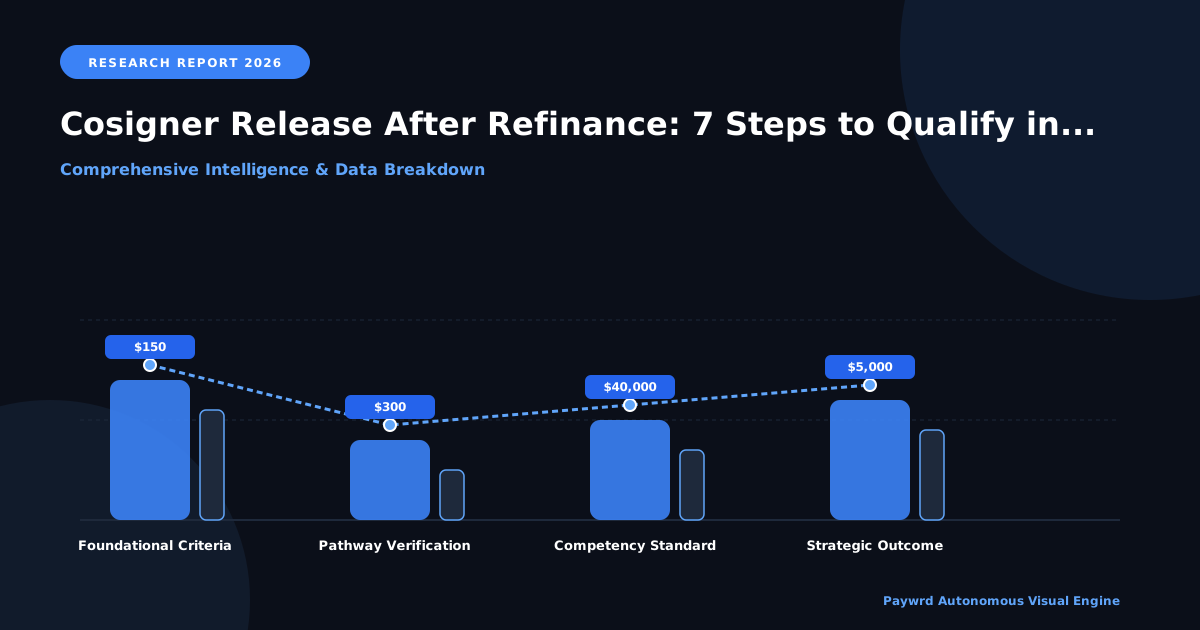
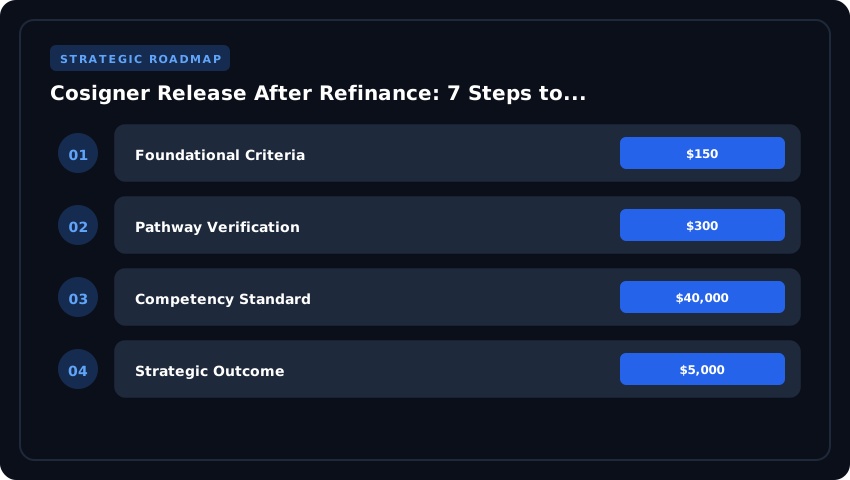
Average private student loan refinance rates in the United States for late 2024 and early 2025 illustrate why this matters. According to the Federal Reserve’s G.19 consumer credit report and aggregator data from Credible.com and LendingTree, fixed APRs for highly creditworthy refinance borrowers (740+ FICO, in-school degree completed, debt-to-income ratio below 35%) currently range from roughly 5.50% to 7.25%, while variable rates hover between 5.00% and 6.50%. Five-year fixed refinance rates for the strongest applicants have dipped below 6.00% for the first time since 2022. A borrower who originally took out a private loan in 2018-2020 at 8% to 11% APR can often refinance into the mid-5% range, saving $150 to $300 per month on a $40,000 balance, which in turn lowers the debt-to-income ratio and accelerates the path to qualifying for cosigner release.
- Legal reset: Refinancing extinguishes the original contract and creates a new one, restarting the seasoning clock but also offering the chance to negotiate a more borrower-friendly release clause.
- Federal distinction: Federal consolidation is not cosigner release territory; it is a separate federal process with no cosigner involvement at any stage.
- Rate-driven eligibility: A 200 to 400 basis point rate reduction strengthens the refinance approval and frequently unlocks a 12-month early release window with lenders such as SoFi, Earnest, College Ave, and ELFI.
- Verification requirements: Most lenders still demand a current credit pull, proof of income, and confirmation that the original loan has been paid in full through the refinance before they will consider releasing the cosigner on the new note.
The math, then, is straightforward: a lower post-refinance rate reduces the monthly payment, improves the borrower’s debt-to-income ratio, and often shortens the seasoning period required for release. The borrower essentially trades the original high-rate contract (which may have buried a 48-month release clause in fine print) for a streamlined new agreement that rewards prompt repayment with a faster exit ramp for the cosigner. Understanding this dual benefit is the foundation for the seven-step qualification strategy that follows.
The Hidden Lender Checklist: 5 Underwriting Criteria That Quietly Decide Approval
Behind every polished refinance marketing campaign from SoFi, Earnest, Laurel Road, or College Ave lies a quiet, unforgiving checklist that determines whether your cosigner walks free or remains anchored to your debt. Most lenders will never publish this checklist verbatim, but experienced underwriters across the United States rely on the same five non-negotiable benchmarks to assess risk. Understanding these unspoken criteria is the single most important step you can take to engineer an approval, because by the time a borrower applies without meeting them, the loan officer is already mentally closing the file.
The first and most heavily weighted benchmark is a demonstrated repayment history. The vast majority of US-based refinancing institutions require a minimum of 36 consecutive on-time monthly payments before the cosigner release door will even unlock. Some premium lenders, particularly credit unions with stricter risk appetites, push that threshold to 48 months. An on-time payment is not simply a payment made within the grace period printed on your billing statement; it must be posted and reported to all three national credit bureaus (Equifax, Experian, and TransUnion) before the underwriting clock starts ticking.
The second benchmark is creditworthiness. While loan officers will not publicize a single magic number, the industry consensus for private student loan cosigner release is a FICO Score of 680 or higher. Lenders like Earnest and Laurel Road often drift toward the 700 threshold for the most competitive tiered products, especially for borrowers refinancing high-balance graduate degrees. Because student loan refinancing is unsecured consumer debt, a thin credit file or recent derogatory mark can override years of perfect repayment, no matter how clean your federal Direct Loan history looks.
Third, debt-to-income ratio quietly functions as the gatekeeper of the entire process. The unspoken ceiling used by major US refinance lenders is generally a back-end DTI below 40%, though the safest approvals cluster closer to 36%. Underwriters calculate this by dividing your documented gross monthly income against all recurring debt obligations, including the proposed refinanced loan payment, auto loans, credit card minimums, and any mortgage or rent that appears on your credit report.
Fourth, lenders require verifiable proof of economic stability. This usually means documented graduation from the degree program the loan funded, transcripts, or, for non-degree professional loans, a W-2, offer letter, or two years of tax returns showing consistent earned income in the same field. Fifth, and most rigidly enforced, is US residency status. Federal and private student loan programs are only available to US citizens, permanent residents, or certain visa holders with long-term work authorization. International students without eligible cosigners are categorically excluded from cosigner release review.
Equally important is how lenders investigate you. Underwriting credit inquiries fall into two distinct categories. A soft pull allows a lender to pre-screen your file or run a periodic account review without affecting your score; these are invisible to other creditors and harmless. A hard pull, by contrast, is a formal credit application that typically deducts 5 to 15 points from your FICO and remains on your report for 24 months. When you formally apply for cosigner release, expect at least one hard inquiry, and sometimes two if the lender re-underwrites both borrower and cosigner profiles.
- Payment history: Minimum 36 consecutive on-time payments, verified across all three major US credit bureaus.
- Credit score benchmark: FICO above 680, with the cleanest approvals reserved for borrowers above 700.
- Debt-to-income ceiling: Back-end DTI must remain below 40%, ideally closer to 36%.
- Economic stability: Proof of graduation or stable employment in the degree-relevant field.
- Residency requirement: US citizen, permanent resident, or qualifying work-authorized visa holder.
Rebuilding a Thin File: Credit Score Strategies Before You Apply
If your credit profile looks more like a whisper than a roar, you are not alone. Millions of borrowers under 30 carry what lenders call a “thin file,” meaning you have too few open tradelines, too short a payment history, or too little revolving activity for the FICO algorithm to generate a confident predictive score. When a private lender like SoFi, Earnest, or Citizens Bank evaluates your refinance application, they are not just looking at the raw number on your screen; they are evaluating the depth, seasoning, and stability of the data underneath. Before you ever submit that release paperwork to your original cosigner, you need to build a credit profile that tells underwriters you can stand on your own two financial feet. The following playbook is designed for borrowers with borderline credit who need to bridge the gap between “approved with a cosigner” and “approved all by myself.”
Step 1: Aggressively Pay Down Revolving Balances to Under 7% Utilization. Your credit utilization ratio, the amount of credit you are using compared to your total limits, is the single most influential factor inside your “amounts owed” category, which accounts for roughly 30% of your FICO Score. Most financial advisors recommend keeping utilization below 30%, but for a refinance application, that threshold is not aggressive enough. Aim to pay every revolving card down to under 7% of its individual limit at least one billing cycle before your official credit pull. If you have a $5,000 credit card with a $200 statement balance, you look dramatically safer than a borrower maxing out half the limit. Because utilization has no memory and is calculated in real time, a meaningful drop can shift a 640 score into the 680+ range in as little as 30 days.
- Step 2: Request Credit Limit Increases Without Triggering a Hard Inquiry. Many card issuers, including Chase, Discover, and American Express, will periodically review your account for an automatic CLI, or they will grant a request over the phone after six months of on-time payments. A higher limit instantly lowers your utilization ratio. Ask for an increase based on your improved income, a long payment history, or a recent positive account review. This move is most powerful when paired with a balance payoff, because it widens the gap between what you owe and what you could owe.
- Step 3: Become an Authorized User on a Seasoned Tradeline. Being added to a parent, spouse, or trusted family member’s oldest credit card can graft decades of perfect payment history onto your thin file. The account does not even need to be physically used; simply having your name attached allows the primary holder’s history to be imported into your credit report. Most major lenders will reflect the seasonal age within 30 to 45 days, though a full re-score can take up to 60 days. This is one of the fastest ways to increase both the length of your credit history and your overall score when you have no negative items dragging you down.
- Step 4: Dispute Erroneous Late Marks on Older Sallie Mae or Navient Accounts. Legacy private student loans serviced by Sallie Mae, Navient, or even AES often contain reporting errors from the 2008-2014 era, including misapplied payments, incorrect late marks during deferment, or duplicate reporting after a servicer transfer. Pull a free copy of your report at AnnualCreditReport.com and scrutinize every entry. If you find a 30-day late mark that should not be there, file a direct dispute with both the servicer and the three major bureaus (Equifax, Experian, TransUnion). Successful removals typically process within 30 to 45 days, though complex investigations can stretch to 90 days. Each deleted late mark is worth 50 to 100 points depending on your starting position.
Step 5: Understand the 30-90 Day Re-Score Timeline and Plan Accordingly. Credit scoring is not instantaneous, and patience is part of the strategy. Paying down balances and requesting limit hikes will reflect on your next billing statement, usually within 30 days. Becoming an authorized user can take 45 to 60 days to fully populate your credit file. Disputes and goodwill deletions may take up to 90 days, especially if the original creditor fights back. If you are targeting a refinance application in early fall, you should begin aggressive optimization in midsummer to ensure every data point is mature by the time the underwriter pulls your report. Lenders do not see your “real-time” score; they see the score as of your last statement cycle, so build that snapshot with intention.
Step 6: Diversify Your Credit Mix Responsibly. Once your utilization is optimized and your seasonal tradeline is seasoning, consider adding a small installment loan to your profile, such as a credit-builder loan from Self Lender or a small personal line of credit from a credit union. Lenders reward borrowers who can manage both revolving debt and installment debt simultaneously. This step is optional for thin files that already have one or two federal student loans in active repayment, but it can be a difference-maker for borrowers with no installment history whatsoever.
Step 7: Freeze Non-Essential New Applications. In the 90 days before your refinance credit pull, stop applying for new credit cards, store financing, or auto loans. Each application triggers a hard inquiry, which can shave 5 to 10 points off your score temporarily. The FICO algorithm groups multiple mortgage, auto, or student loan inquiries within a 14- to 45-day window, so once you begin your refinance shopping, do it efficiently and finish it within a focused sprint.
By layering these tactical moves, you transform a thin, fragile file into a robust, lender-friendly profile. The goal is not just to qualify for the refinance today, but to ensure that 12 to 24 months from now, when you apply for that formal cosigner release, your score will be unassailable. Lenders evaluate release requests against the same credit thresholds as a brand-new application, so the work you do now compounds well into your cosigner’s freedom day.
Income, Employment, and the ‘Ability to Pay’ Stress Test
The moment a private student loan servicer begins evaluating you for cosigner release, the conversation shifts from creditworthiness to ability to pay. Lenders are not just asking whether you have a pulse and a paycheck; they are running a forensic analysis of your income streams to determine whether you can survive a financial shock without the safety net of a parent, guardian, or spouse. Under current 2025 federal and private lending guidance—much of which mirrors standards published by the Consumer Financial Protection Bureau (CFPB) and aligned with Federal Reserve underwriting principles—the “Ability to Pay” stress test is the gatekeeper. If your verified earnings cannot withstand a simulated rate hike, a job loss, or a regional cost-of-living crisis, the cosigner stays on the contract regardless of how impressive your salary looks on paper.
For borrowers with traditional W-2 employment, the verification process is relatively straightforward. Lenders typically request two years of federal tax returns, recent pay stubs covering the last 30 to 60 days, and sometimes a direct verification match through The Work Number (Equifax) or Plaid. A stable W-2 trajectory—ideally showing year-over-year wage growth in the same industry or occupation—signals predictability. However, lenders treat 1099 freelance or self-employed income with significantly more skepticism. Because independent contractors face variable monthly cash flow, most servicers require a minimum of two years of self-employment history, a consistent or rising Schedule C net profit, and sometimes a year-to-date profit and loss statement. Lenders will often average the last two years of net earnings to smooth out volatility, but if your 2024 Schedule C showed a 40 percent income dip compared to 2023, expect a denial even if your 2025 YTD earnings look stellar.
A growing and often misunderstood category is PSLF-eligible public service employment. Borrowers working for 501(c)(3) nonprofits, government agencies, military branches, or qualifying healthcare and education institutions sometimes assume that PSLF eligibility automatically translates into a smooth cosigner release. It does not. While PSLF focuses on federal Direct Loan forgiveness, private refinance lenders evaluating standalone income will still apply the same residual income formula they use for any applicant. The good news is that public service salaries, when paired with rock-solid tenure and defined-benefit pensions, can actually strengthen an application because they imply job stability and predictable future earnings. The bad news is that a $52,000 social worker salary in Boston will be stress-tested against Boston rent, and that is where the math can quietly fall apart.
This brings us to the residual income formula—the silent killer of cosigner release applications. After calculating your gross monthly income, lenders subtract your verified monthly obligations: minimum debt payments (including the loan you are trying to release the cosigner from), housing costs (rent or mortgage plus insurance and property taxes), estimated taxes (federal, state, FICA, and Medicare), and sometimes childcare or alimony. The remaining figure must clear a threshold set by the lender, often benchmarked against the USDA’s moderate-cost family budget or the MIT Living Wage Calculator. A borrower earning $145,000 in Manhattan might bring home roughly $8,900 per month after taxes, but if their verified rent is $4,200 and their remaining student loan minimum is $650, their residual income could fall below the threshold for a single adult in a high-cost metropolitan area. Meanwhile, a borrower earning $88,000 in a mid-sized Midwest city might clear the same threshold with ease because their housing burden is half as much.
This geographic mismatch is precisely why some borrowers fail despite a high salary. If you are refinancing in New York City, San Francisco, Boston, Seattle, Washington D.C., or Los Angeles, your lender will pull regional cost-of-living data—often using HUD Fair Market Rent tables or proprietary metropolitan multipliers—to adjust the residual income requirement upward. A six-figure salary in San Francisco can look like a middle-class income on paper once the stress test is applied. To counter this, borrowers should proactively submit documentation of any non-traditional income sources that reduce housing burden, such as rental income from a roommate, documented commuting cost savings from remote work, or a lease renewal that locks in a lower rent for the next 12 months. Every dollar of verified, recurring income or expense reduction strengthens the residual calculation and moves you closer to cutting the cosigner loose.
- Document W-2 stability: Provide two years of W-2s and 30 days of recent pay stubs to demonstrate consistent employment and year-over-year wage growth.
- Strengthen 1099 applications: Supply two years of tax returns plus a current profit and loss statement if you are self-employed; show consistent or rising net profit to offset volatility concerns.
- Leverage public service tenure: Highlight PSLF-eligible employment with HR-verified letters confirming indefinite appointment status and pension eligibility to signal long-term stability.
- Audit your residual income: Before applying, run your own debt-to-income calculation using your lender’s published formula and regional cost multiplier to identify any shortfall.
- Reduce housing burden: If you live in a high-cost metro, consider documenting roommates, lease renewals at locked-in rates, or remote-work status to lower the housing expense the lender will count against you.
The Application Process: Paperwork, Phone Calls, and Reconsideration Tactics
Successfully navigating a cosigner release application is less about luck and more about meticulous preparation. Once you meet the preliminary qualification benchmarks outlined by your lender, the real work begins in the borrower portal. Most major US student loan servicers, including SoFi, Earnest, and Discover, have streamlined their digital intake systems to accept cosigner release requests in roughly 15 to 20 minutes, provided you have the right documents uploaded. Treat this submission as a formal job interview for your financial life. Every pay stub, identification document, and proof of residence tells a story about your creditworthiness, stability, and capacity to shoulder the debt independently. Sloppy submissions get delayed, and delays cost you months of momentum toward full financial independence.
Before you click submit, gather the essential documentation that virtually every US lender requires. You will need two recent pay stubs dated within the last 30 to 60 days to verify steady income. Lenders typically look for a debt-to-income ratio below roughly 43 percent, though some programs stretch to 50 percent for highly qualified borrowers. A valid driver’s license serves as your primary identification, while a recent utility bill, cable statement, or bank statement (usually no older than 60 days) confirms your current residential address. If you have moved recently, update your records with the Social Security Administration and your lender’s customer profile before applying. Mismatched addresses are among the top three reasons applications get kicked back for manual review.
Once your documents are scanned and uploaded in the lender portal, the underwriting review typically takes between 10 and 30 business days, depending on volume and whether the file triggers an automated decision or a manual underwriter review. During this window, monitor your email and the borrower portal daily for documentation requests. Responding within 24 to 48 hours keeps your file active. If you receive a denial letter, do not panic. A denial is not the end of the road; it is the beginning of a reconsideration strategy.
Leveraging a formal reconsideration request requires three core components: a hardship explanation letter, a summary of your post-refinance payment history, and a corrected or clarified credit profile. Begin with the hardship explanation letter, which should be one page, typed, and addressed to the lender’s credit committee or executive customer relations team. Here is sample language you can adapt:
<blockquote
Subject: Formal Reconsideration Request — Account [Your Loan Number]
Dear Underwriting Committee,
I am writing to formally request reconsideration of my cosigner release application, which was denied on [Date]. I understand the decision was based on [specific reason, e.g., “a recent inquiry on my credit report”]. I want to provide context that was not fully captured in the initial review.
Since refinancing my private student loan with your institution in [Month, Year], I have made every single payment on time, for a total of [X] consecutive on-time payments. My most recent credit inquiry resulted from [explain: rate shopping for auto insurance, mortgage pre-approval, etc.], not from new debt accumulation. I have attached updated pay stubs demonstrating an annual income of $[Amount], along with a revised budget summary showing a debt-to-income ratio of [X] percent.
I respectfully request that the committee reconsider my file with this additional context. Releasing my cosigner, my [mother/father], would allow them to retire with peace of mind, and it would reward the responsible financial stewardship I have demonstrated over the past [X] months.
Thank you for your time and consideration.
Sincerely,
[Your Full Name]
[Your Phone Number]
[Your Email Address]
Pair this letter with a printed amortization schedule showing your perfect payment streak, bank statements highlighting automatic payment execution, and any goodwill letters from prior creditors if you have disputed items on your credit report. Many borrowers overlook the power of pointing to post-refinance payment history as proof of responsible stewardship. Lenders want to see that the refi was not a desperate escape hatch but a strategic move, and that you have honored every obligation since the loan transferred. If the denial stemmed from a technicality, such as a high credit utilization ratio, include a statement showing you have paid down revolving balances since the application date.
Finally, escalate intelligently. If the reconsideration letter does not yield a reversal within 30 days, request a meeting with a senior loan officer or a supervisor in the lender’s executive office. Document every phone call, noting the representative’s name, the date, and the outcome. Filing a complaint with the Consumer Financial Protection Bureau (CFPB) is a last-resort leverage tool, but it often accelerates responses from institutions that value their public reputation. With the right paperwork and a calm, persistent tone, the majority of reconsiderations succeed within 60 to 90 days of the initial denial, freeing your cosigner and closing the chapter on shared debt.
Life After Release: Refinancing Again, Buying a Home, and Protecting Your Co-Borrower
When a cosigner release is finally approved and recorded with the loan servicer, the borrower experiences more than just paperwork relief—they undergo a meaningful recalibration of their entire financial profile. For the first time since signing that original promissory note, the borrower holds the loan independently. Their monthly obligation is now reported solely under their name to the three major credit bureaus, and importantly, the cosigner no longer shares legal liability for the remaining balance. This shift creates what many financial planners call a “clean baseline,” a moment from which the borrower can confidently pursue new milestones without dragging a co-borrower’s credit utilization into the equation.
One of the most immediate changes shows up in the borrower’s debt-to-income ratio (DTI). Under FHA guidelines, lenders generally prefer a backend DTI below 56.9%, while Conventional financing through Fannie Mae and Freddie Mac typically caps qualifying ratios around 45% to 50%. VA loan guidelines, by contrast, place greater emphasis on residual income rather than a hard DTI ceiling, but they still scrutinize the borrower’s total monthly obligations. Removing a cosigned tradeline that was being counted against the borrower—even indirectly, through lender overlay rules—can sometimes push an applicant from a marginal approval into a strong approval tier. This is especially valuable for borrowers targeting homes priced in the $350,000 to $600,000 range, where a few percentage points of qualifying ratio can mean the difference between a 7.00% interest rate and a 7.25% one, potentially saving thousands of dollars over a 30-year term.
Beyond the mortgage industry, the release also reshapes the borrower’s credit utilization story. Credit scoring models such as FICO and VantageScore treat cosigned debt cautiously; even after release, the closed account can remain on the cosigner’s credit report for up to ten years in some cases, depending on the bureau. For the primary borrower, however, the loan now reflects as a single-party obligation, and on-time payments continue to build standalone credit depth. A borrower who refinanced federal Direct Loans into a private loan before graduating college may now find their score responding favorably to the simplification of their credit mix.
Here are the key practical steps to take once release is confirmed:
- Request written confirmation from the loan servicer that the cosigner has been formally removed, including the effective date and the updated contract terms. Save this document in a secure digital folder.
- Pull your own credit report within 30 to 45 days through AnnualCreditReport.com to verify that the loan is now reported under your name only, with no remaining cosigner reference. Dispute any lingering inaccuracies directly with the bureaus.
- Notify your former cosigner so they can independently monitor their credit file and confirm the tradeline is closed on their end. This is both an ethical obligation and a relationship-preserving courtesy, especially when family members or close friends are involved.
- Reassess mortgage readiness by requesting a fresh pre-approval letter from at least two lenders familiar with FHA, Conventional, and VA products. Compare the quoted rates, which can vary by 0.25% to 0.50% depending on lender overlays.
- Avoid new major debt in the 90 days leading up to a mortgage application, including car loans, additional credit cards, or large financed purchases, as these can disrupt the strengthened DTI profile.
- Document your payment history on the refinanced loan, ideally maintaining at least 12 months of consecutive on-time payments, since this strengthens both future refinance and home purchase applications.
Ethical transparency with the released cosigner deserves particular emphasis. Many borrowers overlook the fact that their cosigner—a parent, sibling, or trusted mentor—may not actively monitor their credit reports. Sending a brief, written notice along with the servicer’s confirmation letter accomplishes two things: it allows the cosigner to verify the closure and it formally transfers full responsibility back to the borrower. This kind of proactive communication transforms what could be a quiet administrative event into a respectful financial milestone, reinforcing trust and protecting a relationship that may have been strained by years of shared liability.
Looking ahead, borrowers who achieve release often discover new refinancing opportunities emerge sooner than expected. With a cleaner credit profile, a stronger DTI, and several additional months of payment seasoning, a second refinance into an even lower-rate product becomes plausible. For example, a borrower who initially refinanced at 8.50% might qualify for a 6.75% rate 18 to 24 months later, generating meaningful monthly savings. Each successful cycle compounds financial independence, and the cosigner—now fully shielded from future liability—can finally focus on their own goals, whether that is retirement planning, funding a grandchild’s 529 account, or simply enjoying the peace of mind that comes from being completely removed from someone else’s debt obligation.
| Metric | Standard Cosigner Release | Refinance-Based Release (2025) |
|---|---|---|
| Typical Eligibility Timeline | 24–48 months of consecutive on-time payments | Immediate upon refinance closing (new loan under borrower-only signature) |
| Minimum Credit Score (Borrower) | 680–700 FICO (lender-specific) | 650–680 FICO (refinance lenders often more flexible) |
| Minimum Income Requirement | $25,000–$35,000/year proven | $40,000+/year (Debt-to-Income under 43%) |
| Application / Processing Fee | $0 (most lenders) – administrative review only | $0–$0 origination fee on refinanced loans |
| Hard Credit Inquiry Impact | 1 inquiry at release request | 1 inquiry at refinance application |
| Documentation Required | Pay stubs, ID, 2 years tax returns, loan history | Pay stubs, ID, loan payoff statement, debt-to-income proof |
| Average Processing Time | 30–60 days (manual underwriter review) | 7–21 days (refinance closing) |
| Cosigner Legal Liability Post-Release | Ends upon lender approval & contract amendment | Ends automatically (original loan is paid off via refinance) |
| Effect on Interest Rate | No rate change on existing loan | New rate based on borrower-only credit (potential 0.25–1.5% variance) |
| Long-Term Career ROI | Preserves cosigner’s credit & future borrowing capacity | Builds borrower’s standalone credit profile for mortgages, auto loans, business financing |
Frequently Asked Questions
How does refinancing a student loan automatically release a cosigner?
When you refinance, a brand-new loan pays off the original cosigned debt in full. The old contract—including the cosigner's liability—is extinguished by payoff. The new loan is under your signature alone, so the cosigner is legally removed without a separate lender approval process, provided you qualify independently.
What credit score do I need to refinance a student loan without a cosigner?
Most 2025 refinance lenders require a minimum 650 FICO score, though competitive rates typically demand 700+. You also need verifiable income meeting a debt-to-income ratio below 43%. Strong payment history on the existing loan and stable employment significantly improve approval odds and rate offers.
Does cosigner release hurt the cosigner's credit score?
No, a cosigner release typically does not damage the cosigner's credit once completed. The account closes with a positive status, demonstrating successful repayment. However, during the application, a hard inquiry may temporarily dip the cosigner's score by 5–10 points before recovering.
Is refinancing or cosigner release better for removing a parent from a student loan?
Refinancing is faster, often more accessible, and simultaneously removes the cosigner while potentially lowering your interest rate. Traditional cosigner release preserves the original loan terms but requires 24–48 months of on-time payments and strict credit/income underwriting that many borrowers fail.
Strategic Final Takeaway
Success in evaluating Cosigner Release After Refinance: 7 Steps to Qualify in 2025 relies on early preparation, adherence to verified accredited requirements, and cross-referencing official portals. Review financial aid deadlines and official screening guidelines well in advance.