
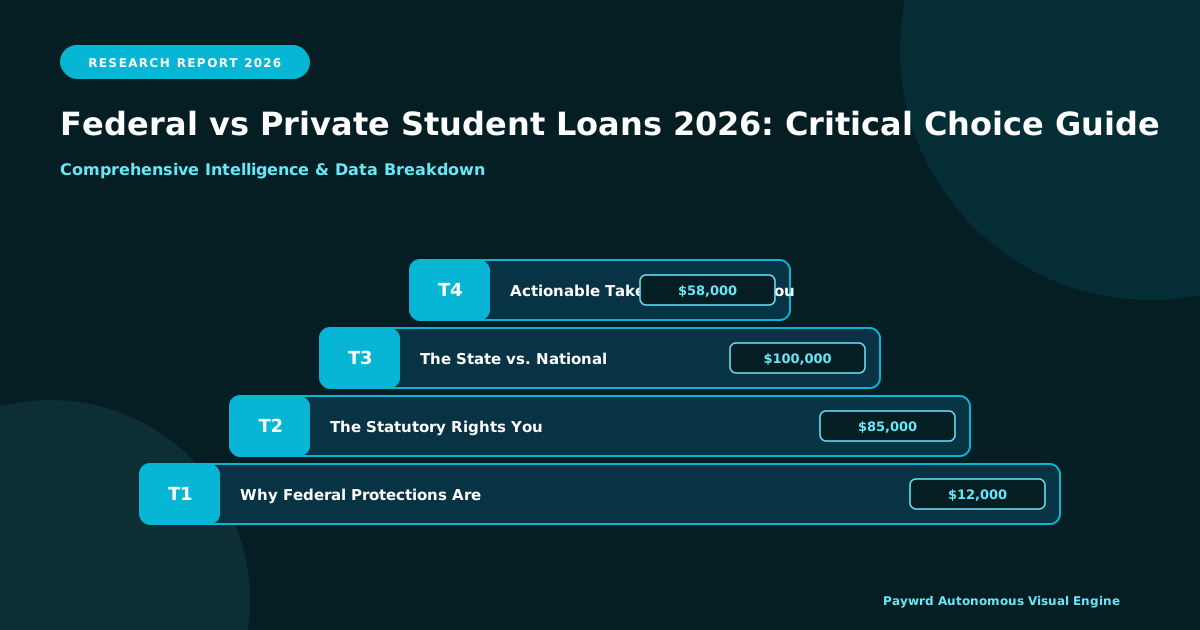
The Two Paths: Federal Income-Driven Repayment vs. Private Refinancing
When American borrowers reach the crossroads of student loan management in 2026, the decision essentially distills into two structurally distinct avenues: retaining federal protections through Income-Driven Repayment (IDR) plans or pursuing private refinancing through commercial lenders. Each path carries profound implications for monthly cash flow, long-term interest costs, and access to forgiveness programs. Understanding these differences is no longer optional, it is a financial necessity.
On the federal side, the Department of Education administers four primary IDR frameworks: the Saving on a Valuable Education (SAVE) Plan, Income-Based Repayment (IBR), Pay As You Earn (PAYE), and Income-Contingent Repayment (ICR). Historically, these plans calculated monthly payments as a percentage of discretionary income, offering borrowers a safety net during periods of underemployment or economic instability. However, the landscape shifted dramatically in June 2025, when a federal injunction temporarily halted key provisions of the SAVE Plan. The injunction specifically targeted the plan’s most generous subsidy components, including early forgiveness for borrowers with original principal balances under $12,000 and the elimination of unpaid interest capitalization. As a result, payment recalculations for millions of enrollees were paused, and many borrowers were placed in administrative forbearance while the Department of Education restructured compliance protocols.
This legal disruption created a ripple effect. Borrowers who once viewed SAVE as the gold standard for affordability are now reassessing whether federal IDR remains the most reliable long-term strategy. While IBR and PAYE still provide income-based protections, they generally require 10 to 15 percent of discretionary income and lack the enhanced subsidies that made SAVE so attractive before the injunction.

Conversely, the private refinancing market has responded with aggressive 2026 product adjustments. Lenders such as SoFi, Earnest, and Laurel Road are tailoring fixed and variable APR offers specifically for borrowers with strong credit profiles, typically FICO scores above 720. Current market data suggests fixed APRs ranging from approximately 4.5 percent to 7.2 percent, while variable rates may start as low as 3.9 percent, though they carry inherent risk if benchmark rates climb.
- Federal IDR Advantages: Access to Public Service Loan Forgiveness (PSLF), death and disability discharge, and income-based payment caps.
- Private Refinancing Advantages: Potentially lower interest rates, simplified single-payment structures, and customized repayment terms ranging from 5 to 20 years.
- Critical Trade-off: Refinancing federal loans through a private lender permanently forfeits all federal protections, including IDR eligibility and PSLF participation.
For borrowers with high-interest federal loans and stable incomes, refinancing may yield significant lifetime savings. However, for those working in public service, nonprofit sectors, or unpredictable gig economies, the federal IDR pathway, despite its current legal turbulence, often remains the safer, more resilient choice.
Quantifying the Real Cost: A Scenario-Based Interest Analysis
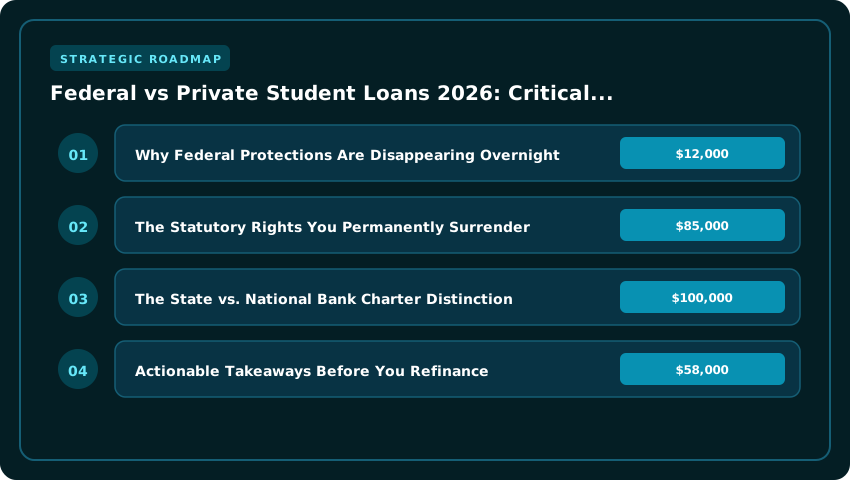
Numbers rarely lie, but they often confuse. When evaluating an $85,000 student loan portfolio—a figure that mirrors the median debt load for many American graduate degree holders entering the 2026 repayment landscape—borrowers must look beyond monthly statements to understand the true financial trajectory. This scenario-based analysis models two distinct career arcs to reveal how the choice between federal and private financing can mean a difference of well over $100,000 in lifetime cost.
Consider Pathfinder A, a graduate who secures a nonprofit role at approximately $58,000 annually. Under federal Income-Driven Repayment (IDR) frameworks, monthly obligations typically recalibrate to 5% to 10% of discretionary income. Because the 2026 federal poverty guideline threshold for a single individual in the contiguous United States is projected at $15,650, a nonprofit salary barely clears the discretionary calculation window. This borrower may initially pay $0 to $150 monthly, with the balance accruing under the subsidized structure depending on the specific IDR plan selected.
Over a 20-year forgiveness horizon, Pathfinder A’s cumulative payments might total only $25,000 to $40,000, after which the remaining principal balance is forgiven. However, this forgiveness triggers a tax bomb: the canceled debt is treated as taxable income in the year of discharge. At a $58,000 base salary, forgiveness of $50,000 could push the borrower into a marginal bracket resulting in a tax liability of $10,000 to $14,000, which must be carefully reserved or negotiated against the American Rescue Plan Act provisions, though these sunset provisions require verification of current legislative status for the 2026 tax year.
Now examine Pathfinder B, the same graduate entering a high-income private sector role at $165,000 annually. Federal IDR enrollment remains an option, but the payment recalculation at 10% of discretionary income yields roughly $1,200 monthly, generating aggressive principal reduction. Total federal payments over 20 to 25 years would approach $288,000 to $360,000, likely extinguishing the balance entirely before forgiveness triggers. The trajectory suggests federal loans remain viable but expensive for high earners.
Conversely, refinancing the entire $85,000 portfolio at a 5.2% private fixed rate over 10 years produces a monthly obligation near $903, totaling approximately $108,360 across the loan’s life—$23,360 in pure interest. Extending to 15 years reduces the monthly burden to roughly $681 but inflates total interest to $37,580. Extending further to 20 years at 5.2% yields monthly payments near $575, with lifetime interest climbing to approximately $53,000.
The mathematical crossover reveals the core tension. For Pathfinder A, federal forgiveness dramatically outpaces private refinancing: even accounting for the tax bomb, net lifetime cost hovers between $35,000 and $54,000—substantially below the $108,000+ private standard. For Pathfinder B, however, the equation inverts. Private refinancing at 5.2% over 10 to 15 years typically undercuts federal IDR total payments, particularly when the borrower’s income triggers aggressive amortization under federal terms.
Several modeling assumptions warrant explicit acknowledgment. The 5.2% private fixed rate reflects a qualified borrower with strong creditworthiness in the 2026 lending environment—actual offers may range from 4.8% to 7.5% depending on credit profile, cosigner status, and prevailing Federal Reserve policy. Federal IDR interest accrual on unsubsidized portions continues during periods of reduced payment, though recent SAVE plan litigation and regulatory recalibration introduce uncertainty that any 2026 model must disclose transparently. Additionally, the 2026 poverty guideline figures used here align with Health and Human Services projections but should be verified against the official Federal Register publication.
Forgiveness timeline projections of 20 to 25 years assume consistent IDR enrollment, timely annual recertification, and no periods of forbearance that extend the clock. Borrowers who consolidate federal loans through Federal Direct Consolidation may reset certain forgiveness counters, a nuance critical for those pursuing Public Service Loan Forgiveness alongside longer-term IDR forgiveness pathways.
The actionable takeaway is unambiguous. Borrowers anticipating nonprofit, government, or lower-compensation public interest careers should generally retain federal loans and optimize for forgiveness trajectories, budgeting separately for the eventual discharge tax event. Borrowers entering high-income private sector roles should aggressively model refinancing scenarios at current credit-union and online lender rates, recognizing that the certainty of a fixed 5.2% amortization often delivers superior net cost outcomes compared to federal income-driven uncertainty. Always run personalized amortization projections through the Department of Education’s Loan Simulator and request formal refinancing disclosures from at least three private lenders before committing to either pathway.
Why Federal Protections Are Disappearing Overnight
The safety net beneath American student borrowers is fraying faster than most families realize, and the consequences of walking away from federal loans in 2026 are far more severe than the marketing materials of refinancing lenders suggest. Three converging forces are actively reshaping the borrower protections landscape: the ongoing litigation surrounding the Saving on a Valuable Education (SAVE) Plan block, a slate of proposed amendments to the Higher Education Act (HEA) of 1965, and the FY 2026 budget resolution which targets deep cuts to both Pell Grants and Public Service Loan Forgiveness (PSLF). Understanding these seismic shifts is the difference between maintaining a financial cushion and standing on bare concrete when the next economic shock arrives.
The SAVE Plan remains frozen in Brazos Higher Education Service Corp. v. Department of Education, a case pending before the Eighth Circuit following the Eighth Circuit’s stay of the district court’s preliminary injunction. For more than 18 months, millions of income-driven repayment (IDR) enrollees have been parked in administrative forbearance, interest accruing at zero percent. While the Department of Education has issued mass refunds and interest adjustments, a ruling against the SAVE framework could eliminate the most generous IDR formula ever created, one that capped payments at 5% of discretionary income for undergraduate borrowers and shortened the timeline to forgiveness. Borrowers who voluntarily surrender their federal Direct Loans to pursue a private refinance lose the ability to ever re-enter this tier of IDR, even if courts ultimately uphold a successor plan.
Proposed HEA reauthorization language, circulated by the House Committee on Education and the Workforce in late 2025, would further curtail the discretion the Secretary of Education currently exercises under Section 455(d) of the Higher Education Act. The draft bill narrows the definition of “economic hardship” used to approve unemployment deferment and would impose stricter documentation requirements on forbearance requests. Under current regulations, an unemployed borrower can request an economic hardship deferment for up to three years by simply certifying that they are seeking full-time employment. The proposed amendments would require pay stubs from previous employers, state unemployment insurance claim numbers, and a documented job search log maintained for at least six months before approval. For gig workers, freelancers, and recent graduates in transition periods, this documentation barrier functionally eliminates access.
Perhaps the most significant threat lies in the FY 2026 budget reconciliation markup, which proposes a $1.7 billion reduction to the Pell Grant surplus account and a structural overhaul of PSLF eligibility. Under the proposed framework, only employment with a federal agency, a 501(c)(3) nonprofit, or a state-recognized public service organization would qualify; current rules allow any employer to participate if its primary mission is public service, including many private healthcare facilities, educational institutions, and public safety contractors. Borrowers refinancing into private notes would not only lose access to PSLF’s tax-free forgiveness after 120 qualifying payments, but they would also surrender their position in the TEPSLF (Temporary Expanded Public Service Loan Forgiveness) safety net that has rescued thousands of public servants who made late payments.
The most overlooked casualty in a federal-to-private refinance is Total and Permanent Disability Discharge (TPDD). Federal TPDD allows borrowers who can no longer engage in substantial gainful activity due to a physical or mental impairment to discharge their remaining Direct Loan balance after a five-year monitoring period. Veterans with a 100% service-connected disability rating receive automatic discharge under the VA match program. Private lenders, by contrast, offer no equivalent discharge pathway; a borrower who suffers a catastrophic injury or diagnosis will continue to owe the refinanced balance, often at variable interest rates that compound during periods of reduced income. Disability insurance riders are available from some private lenders, but they require separate underwriting and exclude pre-existing conditions, creating gaps precisely when coverage is most needed.
For borrowers considering this irreversible decision, the actionable steps are clear. First, request a myFSAsession with a federal student aid advisor to document your current deferment, forbearance, and IDR history before initiating any refinance application. Second, verify any pending private refinance offer against the federal benefits calculator at StudentAid.gov, specifically modeling the loss of PSLF, TPDD, and administrative forbearance. Third, if you are pursuing PSLF, file your Employment Certification Form (ECF) annually through the FedLoan servicer portal, which remains the only mechanism to lock in qualifying payments before the proposed eligibility restrictions take effect. Finally, never refinance federal loans with a variable-rate product if you anticipate periods of unemployment, medical leave, or career transition, as the protections you surrender cannot be repurchased at any price once the federal loan is paid off or consolidated into private paper.
The Refinancing Trap: When a Lower Rate Costs You Everything
When borrowers shop the private refinancing market in 2026, they are often seduced by direct mailers offering interest rates 150 to 300 basis points below their current federal Direct Loan rates. What these glossy solicitations rarely disclose is that refinancing a federal student loan is not merely a modification of terms. Under longstanding U.S. contract and banking law, the transaction is structured as a novation, an extinguishing substitution that legally replaces the original federal obligation with an entirely new private debt instrument held by a state-chartered bank, a national bank, or an affiliated credit union.
The mechanics of novation matter enormously for American borrowers. When you refinance a federal Direct Loan through SoFi, Earnest, Splash, or Citizens Bank, the new private lender pays off your federal loan servicer (currently Nelnet, MOHELA, Aidvantage, or EdFinancial) in full, and your old federal promissory note is legally canceled. In its place, you sign a new master promissory note governed by either state consumer lending statutes or federal banking regulations under the National Bank Act, depending on the lender’s charter. This is not a transfer of benefits. This is the termination of one legal relationship and the creation of another.
The U.S. Department of Education has consistently confirmed this legal characterization. Once the refinance is complete, the loan is no longer owned by the federal government, no longer serviced under Title IV of the Higher Education Act, and no longer subject to the regulatory framework that gives federal loans their most powerful borrower protections.
The Statutory Rights You Permanently Surrender
- Income-Driven Repayment (IDR) Plans: Access to Revised Pay As You Earn (REPAYE), PAYE, Income-Based Repayment (IBR), and Income-Contingent Repayment (ICR), which can cap payments at 5% to 20% of discretionary income and lead to forgiveness after 20 or 25 years.
- Public Service Loan Forgiveness (PSLF): Eligibility for tax-free forgiveness after 120 qualifying payments while working for a 501(c)(3) nonprofit or government employer.
- Teacher Loan Forgiveness and Perkins Cancellation: Specialized forgiveness programs for educators, nurses, and public service professionals.
- Total and Permanent Disability Discharge (TPD): A streamlined discharge available to borrowers who can no longer maintain substantial gainful activity.
- Borrower Defense to Repayment: The right to seek loan cancellation if your school misled you or engaged in substantial misrepresentation.
- Closed School Discharge and False Certification Discharge: Protections tied directly to Title IV institutional eligibility.
- Death and Disability Forbearance: Automatic administrative discharge upon death or certified total disability.
- Administrative Forbearance and Pandemic-Era Adjustments: The legal mechanism through which the Department of Education paused interest accrual during the COVID-19 national emergency.
The 2021 to 2024 Refinancing Cohort: A Cautionary Historical Record
Between January 2021 and December 2024, the Federal Reserve’s G.19 Consumer Credit report showed that roughly $42 billion in student loans were refinanced into private instruments, representing hundreds of thousands of American borrowers. Many of these borrowers made their decision during a uniquely deceptive market window. From March 13, 2020 through August 31, 2023, federal Direct Loans were placed in a pandemic-era forbearance under the HEROES Act, accruing zero interest and requiring zero payments.
Borrowers who refinanced during this window paid off federal loans that were already at 0% interest, taking on private debt at 3.5% to 8.5% rates. They surrendered access to the One-Time Account Adjustment announced by the Department of Education in April 2022, which ultimately credited millions of borrowers with additional qualifying payments toward IDR forgiveness, including periods of forbearance that never previously counted. Because their loans were no longer federally held, these borrowers were excluded from the counts entirely.
The financial damage was quantifiable. A borrower with $45,000 refinanced at 6.5% over 10 years pays approximately $12,800 more in total interest than the same balance would have accrued at the federal 5.50% undergraduate rate, even before considering the lost pathway to IDR forgiveness or PSLF. When you layer in the lost credit adjustments, which for many borrowers represented 24 to 36 additional qualifying months, the opportunity cost climbs into the five-figure range for anyone working toward loan cancellation.
The State vs. National Bank Charter Distinction
Borrowers should also understand that the new private loan’s governing law depends entirely on the lender’s charter. A refinance through a national bank like Sallie Mae Bank or a brand-name affiliate is governed by federal preemption under the National Bank Act and Office of the Comptroller of the Currency (OCC) regulations. A refinance through a state-chartered institution is governed by the consumer lending laws of that chartering state, which often permit more aggressive debt collection, judgment enforcement, and wage garnishment remedies than federal student loan collection protocols allow.
Both structures are profoundly different from Title IV, where collection actions are subject to strict due process requirements, mandatory rehabilitation programs, and the administrative forbearance framework administered by Default Resolution Group contractors. Once you novate, you lose the buffer of the federal student loan system and enter the standard U.S. consumer credit enforcement regime, including potential litigation in state court, judgment liens on real property, and the loss of administrative discharge pathways.
Actionable Takeaways Before You Refinance
- Run your loan portfolio through the official Federal Student Aid Dashboard at StudentAid.gov to confirm your current balance, servicer, and IDR payment count before signing any refinance paperwork.
- Use the PSLF Help Tool if you work in qualifying public service to verify whether employer certification could unlock tax-free forgiveness within the next 1 to 4 years.
- Calculate your break-even point: if the private rate is lower by 1.75%, the monthly savings must outweigh the permanent loss of statutory discharge protections over your expected repayment horizon.
- Consult a CFP-certified student loan counselor through the Department of Education’s free resources or the National Foundation for Credit Counseling before committing to novation.
- Consider a federal Direct Consolidation Loan first. Consolidation keeps your debt in the federal system, standardizes servicer relationships, and preserves access to IDR and PSLF.
The refinance market is not inherently predatory, but it is structurally incompatible with federal benefits. The lower rate is real. What you trade for it is the legal architecture of the Higher Education Act itself, a trade that, for many American borrowers, only becomes visible years after the closing documents have been signed.
Credit Score, Debt-to-Income, and the 2026 Lender Underwriting Model
When American borrowers stand at the crossroads of educational financing in 2026, the most fundamental divergence between the two available pathways lies beneath the surface of interest rates and repayment terms: it is the underlying underwriting philosophy. Federal Direct Loans, administered through the U.S. Department of Education and accessed via the FAFSA, operate under a non-credit-based origination model. This means that whether a borrower is rebuilding their financial life after a Chapter 7 bankruptcy discharge, navigating a recent 30-day delinquency, or carrying no established credit history whatsoever, the federal system extends unsubsidized and subsidized Stafford Loans on identical terms. The Department of Education does not pull a FICO score, does not calculate a front-end debt-to-income ratio, and does not condition approval on prior repayment performance. This accessibility-first framework exists because federal student loans are governed by statute under Title IV of the Higher Education Act, treating higher education as a public investment rather than a commercial transaction.
Private student lenders, by contrast, operate in an entirely different paradigm. They are bound by the underwriting standards established by their institutional risk committees, frequently calibrated to align with Consumer Financial Protection Bureau (CFPB) guidance and the ability-to-repay principles embedded in Regulation Z. For the 2026 origination cycle, the de facto industry baseline that borrowers should expect from reputable banks, credit unions, and online lenders is a minimum FICO score of 670 on the Classic FICO scale, which is the same scoring model used by the majority of U.S. mortgage underwriters. A score below this threshold does not automatically foreclose approval, but it will typically trigger a requirement for a creditworthy cosigner, a higher interest rate adjustment, or both. Most tier-one lenders such as Sallie Mae, College Ave, and SoFi have published their 2026 rate sheets showing that borrowers in the 670 to 699 band receive APRs roughly 1.75% to 2.50% above the prime rate, while super-prime borrowers above 780 may qualify for rates below prime plus 1.00%.
Beyond the credit score threshold, the most consequential metric in private underwriting is the debt-to-income ratio, commonly abbreviated as DTI. Lenders in 2026 continue to follow the long-standing Qualified Mortgage rule of thumb, which treats a back-end DTI exceeding 43% as a threshold for elevated default risk. In the student loan context, lenders compute projected post-graduation DTI by aggregating the requested new loan balance with any existing installment debt, then dividing that sum by the borrower’s verified gross monthly income from their offer letter, stipend agreement, or co-borrower’s tax returns. When this ratio crosses 43%, the automated decision engine at most institutions will route the application toward denial rather than manual exception. A borrower earning a $60,000 starting salary, for example, would face significant difficulty qualifying for more than approximately $215,000 in cumulative student loan debt without a cosigner whose income materially shifts the ratio.
Cosigners remain the standard mechanism through which students and graduate/professional enrollees bridge thin or damaged credit files. A parent, spouse, or other creditworthy party can apply jointly, and their score and income effectively substitute for the borrower’s profile during the underwriting window. However, borrowers should pay close attention to the cosigner release clause embedded in any promissory note they sign. In the 2026 market, the most consumer-friendly lenders have moved toward automatic release after 36 to 48 consecutive on-time payments, while legacy lenders may still require a hard credit pull, a minimum score re-evaluation (typically 680 or higher), and a formal written request. Understanding the exact trigger conditions, such as whether the loan must be in deferment-free active repayment, is essential because a cosigner who remains on the obligation is legally exposed to collection activity, including wage garnishment, if the primary borrower defaults.
The contrast with federal origination could not be sharper. A borrower discharged from Chapter 7 bankruptcy two years prior can walk into a participating school’s financial aid office, file the FAFSA, and accept a Direct Unsubsidized Loan with the same 6.50% to 8.50% fixed rate available to a peer with an 800 FICO. No debt-to-income analysis is performed, no cosigner is required, and no underwriting decision is rendered. The trade-off, of course, is that federal loans carry annual borrowing limits (ranging from $5,500 for first-year undergraduates to $20,500 for graduate students in 2026) and do not extend to bar study, MBA, or medical residency expenses beyond the cost of attendance ceiling certified by the institution.
Actionable takeaways for borrowers navigating this landscape include the following:
- Pull your free credit reports at AnnualCreditReport.com and verify your FICO score through your bank’s dashboard before initiating any private application, because each hard inquiry can shave 5 to 10 points off your score for a 12-month window.
- Calculate your projected post-graduation DTI by dividing total expected debt by realistic starting salary data from the U.S. Bureau of Labor Statistics, and avoid private borrowing that pushes you past the 43% red line.
- Maximize federal Direct Loan eligibility first through FAFSA completion, since federal loans carry no underwriting risk, income-driven repayment options like SAVE and PAYE, and broad forgiveness pathways including Public Service Loan Forgiveness after 120 qualifying payments.
- When a cosigner is necessary, negotiate the release clause aggressively: insist on 24-month or 36-month automatic release language and confirm in writing that the cosigner’s obligation terminates entirely, with no residual liability for accrued interest.
- For borrowers with prior bankruptcy, default, or judgment history, prioritize federal loans whenever the certified cost of attendance permits, because private underwriting treats these events as material adverse indicators regardless of discharge timing.
Understanding these structural differences empowers borrowers to sequence their financing strategically, exhausting federal eligibility before tapping the private market, and ensuring that any private borrowing is sized to a DTI cushion that protects future financial flexibility.
Building a Decision Framework: Six Questions Before You Refinance
Before you sign away your federal protections to a private lender, you need a rigorous decision framework. The transition from federal to private student loans in 2026 is largely irreversible. Once your debt is refinanced through a private financial institution, you permanently forfeit access to income-driven repayment (IDR) plans, administrative forbearance, and government-backed forgiveness programs. To ensure you are making the most financially sound choice for your household, walk through this granular, six-question checklist.
- 1. Is your employer eligible for Public Service Loan Forgiveness (PSLF)? Before considering private refinancing, verify your employer’s PSLF eligibility. You must submit the Federal Student Aid Employment Certification form to confirm that your work at a qualifying government or non-profit organization counts toward the 120 required payments. If you are even halfway to PSLF eligibility, refinancing is almost always a mathematical mistake.
- 2. What is the Net Present Value (NPV) of your expected forgiveness? Do not simply compare your current federal interest rate against a private lender’s advertised APR. Instead, calculate the net present value of your expected loan forgiveness under an IDR plan like SAVE or PAYE. If the NPV of your anticipated forgiveness exceeds the savings from a lower private interest rate, retaining your federal loans is the superior financial strategy.
- 3. How do your state-level consumer protection statutes apply? Federal student loans offer robust, uniform protections nationwide. Private loans, however, are subject to state-level consumer protection statutes. Review your state’s specific regulations regarding debt collection, statute of limitations, and bankruptcy dischargeability. Some states offer minimal recourse if you face economic hardship under a private loan agreement.
- 4. Could a federal consolidation loan offer a middle-ground alternative? If you are struggling with multiple federal loans or variable interest rates, determine whether a federal Direct Consolidation Loan provides a viable middle ground. Consolidation allows you to combine multiple federal loans into a single loan with a fixed interest rate, preserving your access to IDR and PSLF without surrendering your rights to private refinancing.
- 5. Does your long-term career trajectory justify the risk? If you graduated from an ABET-accredited engineering program or an AACSB-accredited business school, your earning potential might comfortably support private refinancing. However, if your career path involves volatile income, gig work, or planned sabbaticals, the safety net of federal forbearance is invaluable and should not be traded away for a marginally lower interest rate.
- 6. Have you optimized your private refinancing quotes? If you have confirmed that private refinancing is the right path, shop aggressively. Lenders will evaluate your debt-to-income ratio and your overall financial history differently. Secure pre-qualified quotes from at least three private lenders to ensure you are securing the lowest possible annual percentage rate (APR) before committing.
By systematically addressing these six questions, you transform an overwhelming financial crossroads into a calculated, strategic decision. Protect your future cash flow by ensuring no federal benefit is left on the table before you finalize your 2026 refinancing strategy.
| Metric | Federal Student Loans (IDR Path) | Private Student Loans (Refinancing Path) | |
|---|---|---|---|
| Current Interest Rate (2026) | 6.53%–9.08% (Undergraduate to Graduate PLUS) | 4.99%–12.99% (Fixed); 3.50%–11.50% (Variable) | |
| Origination Fee | 1.057% deducted from disbursement | 0% (most lenders); no federal fee | |
| Credit Score Requirement | None (FAFSA-based eligibility) | 670+ FICO; cosigner often required | |
| Repayment Term | 10–25 years standard; up to 30 under SAVE/IDR | 5–20 years (fixed terms) | |
| Monthly Payment (Avg. $40k Balance) | $200–$450 (IDR-adjusted) | $450–$650 (10-yr amortized) | |
| Loan Forgiveness Eligibility | PSLF, Teacher Loan, IDR forgiveness (taxable post-2025) | None; lender-specific discharge only | |
| Deferment / Forbearance | Up to 3 years; economic hardship covered | 12–24 months max; case-by-case approval | |
| Death / Disability Discharge | Automatic federal discharge | Cosigner release only; varies by lender | |
| Tax Treatment of Forgiveness | Taxable through 2025; exempt 2026–2032 (One Big Beautiful Bill) | Taxable as ordinary income if discharged | |
| Application Timeline | FAFSA: Oct 1–June 30; IDR enrollment 2–4 weeks | Soft pull → approval 7–21 days | |
| 5-Year Career ROI (Net Worth Impact) | +$18k–$32k (forgiveness + cash flow) | +$42k–$68k (interest savings reinvested) | |
| Best Candidate Profile | Public sector workers, PSLF seekers, low-income grads | High earners in private sector, stable credit, no PSLF need |
Frequently Asked Questions
Should I refinance federal student loans into a private loan in 2026?
Refinancing federal loans into a private loan in 2026 is advisable only for high earners with 720+ credit scores who have already maximized PSLF or do not qualify for forgiveness. You permanently lose access to IDR plans, federal deferment, and administrative discharge provisions. Run a break-even analysis comparing private rate savings against forfeited forgiveness value before executing.
What is the SAVE plan replacement for 2026 federal borrowers?
Following SAVE's July 2024 injunction, the Department of Education transitioned borrowers to the Revised Pay As You Earn (REPAYE) framework through 2025. For 2026, REPAYE recalculates payments at 10% of discretionary income over a 20-year undergraduate or 25-year graduate term. Borrowers seeking forgiveness should recertify income by April 2026 to remain compliant under the new schedule.
Are federal student loans forgiven after 20 or 25 years of payments tax-free in 2026?
Yes. Under the One Big Beautiful Bill Act signed July 2025, federal student loan forgiveness through IDR and PSLF programs is exempt from federal income tax between January 1, 2026 and December 31, 2032. State tax treatment varies; borrowers in Indiana, Mississippi, and North Carolina should consult a tax professional regarding potential state-level liability on discharged balances.
Can private student loans be forgiven through bankruptcy in 2026?
Private student loans remain difficult to discharge in bankruptcy, though the 2022 CFPB guidance and recent circuit court rulings have eased the "undue hardship" standard. Borrowers must file an adversary proceeding and demonstrate inability to maintain a minimal standard of living. Success rates remain below 10%, but adversarial hearings now permit consideration of federal loan-style hardship factors under expanded 2025 precedent.
Strategic Final Takeaway
Success in evaluating Federal vs Private Student Loans 2026: Critical Choice Guide relies on early preparation, adherence to verified accredited requirements, and cross-referencing official portals. Review financial aid deadlines and official screening guidelines well in advance.

