What Defines the Fastest Online Bachelor’s Degree Track in the US?
The fastest online bachelor’s degree tracks in the United States are not defined by a single shortcut but by a deliberate combination of structural, academic, and accreditation-based elements that compress the traditional four-year timeline. According to completion data published by the National Center for Education Statistics (NCES), the average first-time, full-time undergraduate now requires roughly 4.1 to 4.3 years to finish a 120-credit bachelor’s program, while part-time and adult learners often stretch that window to five or six years. The fastest accredited online programs, by contrast, consistently report median completion times between 18 and 30 months, achieved by redesigning how time, credit, and prior knowledge are measured.
One of the most powerful accelerants is the term-structure design. Instead of the conventional 16-week semester, many US institutions now offer 8-week asynchronous sessions that allow students to enroll in two overlapping sub-terms per semester. This structure effectively doubles the number of start dates each year, shortens each course’s cognitive load, and enables learners to concentrate on one or two subjects at a time. For a working adult balancing a full-time job, an 8-week format reduces burnout and allows a student to carry a heavier credit load — sometimes 18 to 21 credit hours per semester — without sacrificing comprehension. Over a two-year span, this model can save between 18 and 24 months compared with a standard semester-based path.
- 8-week asynchronous terms: Enable year-round enrollment, multiple start dates (often six per year), and concentrated study windows that maintain rigor while shortening the calendar.
- Competency-based credit stacking: Allows learners to demonstrate mastery through proctored assessments rather than seat time, advancing once proficiency is documented — ideal for professionals with measurable workplace skills.
- Prior Learning Assessment (PLA): Awards college credit for verified professional certifications, military training, and standardized exams, potentially converting 15 to 30 credits of life experience into degree progress.
- ACE-recommended credits: The American Council on Education’s National Guide evaluates corporate and military training; institutions that accept these recommendations can transfer credits seamlessly, eliminating redundant coursework.
Equally important is the accreditation framework that governs credit portability. Regionally accredited institutions — particularly those holding programmatic accreditation from bodies such as AACSB for business degrees or ABET for engineering and computing — issue coursework that other accredited colleges readily accept. This recognition means a student can transfer credits laterally or vertically without restarting courses, shaving additional semesters off the timeline. NCES Integrated Postsecondary Education Data System (IPEDS) records show that students who enroll at regionally accredited online institutions have 20 to 35 percent higher transfer-credit acceptance rates than those at nationally or unaccredited schools, directly translating into faster degree completion.
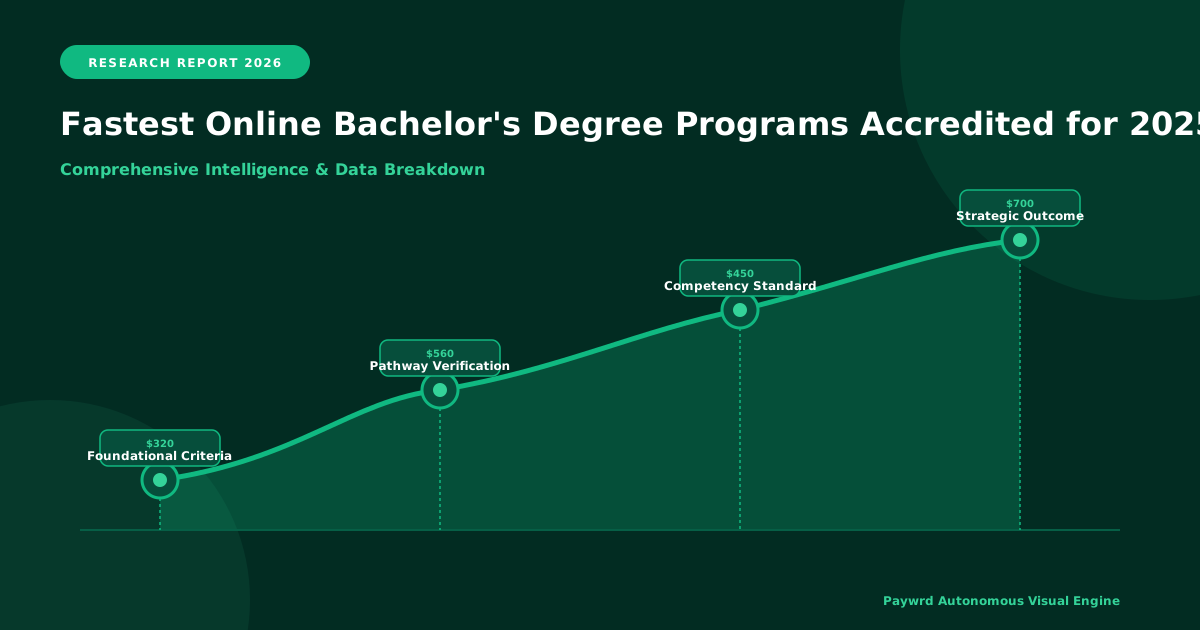
Another defining factor is the credit-by-examination pathway. Programs accepting CLEP, DSST, and College Board AP scores let students earn between 3 and 12 credits per exam. A learner who passes eight or nine such exams could theoretically enter with sophomore standing, removing an entire year of tuition and time. Combined with tuition models averaging $320 to $560 per credit hour at public online universities — and roughly $450 to $700 at private nonprofit institutions — the savings can exceed $15,000 over the course of the program.
Finally, the fastest tracks integrate academic advising and digital course-mapping tools that pre-plan every semester from enrollment to graduation. These structured “degree completion pathways” remove elective guesswork, prioritize sequential courses, and lock in financial aid eligibility windows. When a student pairs an 8-week term structure, competency-based progression, PLA, ACE-recommended credits, and accreditation-friendly transfer policies, the result is a fully optimized timeline — often turning what was once a 48-month journey into a focused 24- to 30-month sprint, without compromising the academic integrity that regional accreditation guarantees.
Top Accredited US Universities Offering Accelerated Online Bachelor’s Programs

Choosing an accelerated online bachelor’s program is about far more than the promise of speed; it is about selecting a regionally accredited institution whose academic calendar, tuition model, and credit-transfer policies actually allow working adults and transfer students to finish faster without sacrificing legitimacy. The five institutions profiled below consistently rank among the most recognized names in US online higher education for accelerated delivery: Western Governors University (WGU), Southern New Hampshire University (SNHU), Arizona State University Online (ASU Online), University of Florida Online (UF Online), and Liberty University Online. Each operates under a respected regional accreditor recognized by the US Department of Education and the Council for Higher Education Accreditation (CHEA), which means credits earned are portable to other accredited schools and eligible for federal FAFSA financial aid, Title IV funding, and many employer tuition reimbursement programs.
Western Governors University holds regional accreditation from the Northwest Commission on Colleges and Universities (NWCCU). WGU pioneered a competency-based, self-paced model where tuition is charged per six-month term rather than per credit hour, generally around $4,265 per term for most bachelor’s programs in 2024-2025. This flat-rate model encourages acceleration: students who master material quickly can complete unlimited courses in a single term. WGU also accepts up to 90 transfer credits, and terms start on the first of every month, giving learners effectively a four-week start cadence. Programs in IT, business, nursing, and education are particularly popular among working adults seeking ABET-aligned or AACSB-accredited pathways.
Southern New Hampshire University is regionally accredited by the New England Commission of Higher Education (NECHE) and is widely recognized for affordability. Published 2024-2025 undergraduate tuition is approximately $330 per credit hour, with reduced rates around $225 per credit for active-duty military. SNHU accepts up to 90 transfer credits and offers six 8-week terms per year, plus two shorter 4-week summer options, creating one of the most flexible start calendars available. Combined with generous prior-learning assessment (PLA) credit, SNHU allows motivated students to graduate in well under four years.
Arizona State University Online carries regional accreditation from the Higher Learning Commission (HLC), and several of its business degrees hold specialized AACSB accreditation. Undergraduate tuition for 2024-2025 is published at roughly $573 per credit hour. ASU offers multiple start dates throughout the year, generally every 7-8 weeks, and accepts up to 64 transferable credits from community colleges, with some programs evaluating additional credits on a case-by-case basis. While its transfer cap is lower than WGU or SNHU, ASU’s brand recognition, robust faculty engagement, and access to College Board-aligned credit-for-exam pathways (CLEP, AP, DSST) make it a strong choice for students balancing prestige with acceleration.
University of Florida Online is regionally accredited by the Southern Association of Colleges and Schools Commission on Colleges (SACSCOC) and is frequently cited as one of the best values in US public online education. UF Online tuition for 2024-2025 is approximately $129 per credit hour for in-state online students and around $500 per credit for out-of-state, a significant discount compared with private competitors. The university offers multiple start terms and accepts up to 60 transfer credits, with articulation agreements that streamline admission for community college graduates. UF’s strong reputation in business, engineering pre-requisites, and nursing makes it especially attractive for students targeting high-ROI career outcomes.
Liberty University Online is accredited by the Southern Association of Colleges and Schools Commission on Colleges (SACSCOC) and offers an unusually aggressive 8-week term structure with multiple start dates per semester, effectively allowing new students to begin almost every 4-8 weeks. Published 2024-2025 tuition for online undergraduate programs is approximately $390 per credit hour, with reduced rates for military. Liberty accepts up to 90 transfer credits, including credits earned through military training, and incorporates prior-learning assessments aggressively, which can dramatically shorten time-to-degree for adult learners.
- Regional accreditation (HLC, SACSCOC, MSCHE, NECHE, NWCCU, or WASC Senior) is non-negotiable for federal aid and credit portability.
- Per-credit tuition ranges from roughly $129 (UF Online in-state) to $573 (ASU Online), with competency-based flat fees at WGU around $4,265 per six-month term.
- Transfer credit limits typically cap between 60 and 90 credits, directly affecting how fast students can graduate.
- Frequent start dates every 4 to 8 weeks remove the bottleneck of a traditional semester lock-in and accelerate momentum.
Cost Breakdown: Tuition, Fees, and Financial Aid for Fast-Track Online Bachelor’s
Understanding the true cost of an accelerated online bachelor’s degree requires looking beyond the advertised “sticker price” and calculating the net price, which is the figure a student actually pays after grants and scholarships are applied. For fast-track learners in the 2025-26 award year, this calculation involves several moving parts: institutional pricing models, federal aid eligibility, and personal enrollment patterns. Whether you attend a public state university, a private nonprofit, or a competency-based program, the financial structure can differ dramatically, and knowing how to compare them is the key to avoiding unnecessary debt.
At public universities, online tuition typically follows two pricing tiers. In-state students often pay between $250 and $450 per credit hour, while out-of-state learners may face rates of $400 to $750 per credit hour, depending on whether the institution participates in regional reciprocity agreements such as the State Authorization Reciprocity Agreement (SARA). Some flagship universities, including those in the Big Ten and SEC academic alliances, have begun offering flat online rates that waive the residency distinction entirely. Fast-track students who take 12 to 18 credit hours per term can expect annual tuition ranges from $7,500 to $18,000 before aid.
Private nonprofit institutions generally charge a flat per-term tuition rate that ranges from $4,500 to $7,500 for full-time accelerated enrollment. Because these schools do not receive state subsidies, their tuition is uniform across all 50 states, which simplifies budgeting for out-of-state students. However, private schools often offset higher tuition with more generous institutional aid, making the net price competitive with, or even lower than, public options for qualifying learners.
For the 2025-26 award year, the FAFSA filing deadline is June 30, 2026, though state and institutional deadlines fall much earlier, often between March 1 and May 1. Accelerated students who plan to begin courses in fall 2025 should submit the FAFSA as soon as possible to maximize eligibility for campus-based aid, including the Federal Supplemental Educational Opportunity Grant (FSEOG) and federal work-study funds. Pell Grant eligibility for part-time enrollment is prorated based on credit load, meaning a student taking fewer than 12 credits receives a reduced award, while half-time and three-quarter-time enrollment tiers correspond to specific award percentages published by the Department of Education.
Scholarship stacking is one of the most effective strategies for reducing the cost of a fast-track degree. Because accelerated students often compress four years into 18 to 36 months, they can layer multiple awards within a single academic year, applying institutional scholarships, external foundations, and major-specific grants simultaneously. Employer tuition reimbursement adds another powerful tool, particularly for working adults. Under current IRS guidelines, up to $5,250 per year in employer-provided educational assistance remains tax-free, and many Fortune 500 companies maintain partnerships with accredited online programs that further reduce out-of-pocket costs.
Students enrolled in competency-based education (CBE) programs face a unique consideration regarding Satisfactory Academic Progress (SAP). Rather than measuring progress by credit hours completed, SAP for CBE learners is typically evaluated by demonstrated competencies, time-based pacing, or subscription-period benchmarks. This means students must understand their institution’s specific SAP policy, as failing to meet competency milestones can jeopardize Title IV aid eligibility, including Pell Grants and federal student loans.
Actionable takeaways for prospective students include: always run the net price calculator on every institution’s website, file the FAFSA by state priority deadlines rather than the federal cutoff, and ask financial aid offices about multi-year scholarship renewal policies, since many merit awards require continuous full-time enrollment that conflicts with accelerated pacing.
- Public in-state online tuition: $250-$450 per credit hour, with SARA reciprocity potentially lowering out-of-state costs.
- Private nonprofit flat-rate tuition: $4,500-$7,500 per term, uniform nationwide with stronger institutional aid packages.
- FAFSA deadline for 2025-26: June 30, 2026 (federal), though state deadlines range from March to May 2025.
- Pell Grant part-time proration: Awards scale with credit load; less than half-time enrollment yields minimal aid.
- Employer reimbursement tax-free cap: $5,250 annually under Section 127 of the Internal Revenue Code.
- CBE SAP considerations: Progress measured by competencies, not credits, requiring careful policy review.
Transfer Credits, Work Experience, and PLA: How to Finish in Under 3 Years
For ambitious learners aiming to cross the finish line of an accredited online bachelor’s degree in under three years, the most powerful accelerants are not necessarily heavier course loads or summer overloads. Instead, the real velocity comes from converting what you already know into formal college credit before you ever log into your first virtual classroom. Whether that knowledge was earned through military service, professional certifications, corporate training, community college coursework, or self-directed mastery, today’s accredited institutions offer a robust, multi-channel framework for translating prior learning into transcripted credits. Understanding this framework—and executing it strategically—is the difference between a five-year slog and a focused 18-to-24-month sprint.
The first pillar of this framework is the transfer of previously earned collegiate credit. A student entering with 60 transferable credits—typically an Associate of Arts, Associate of Science, or roughly half of a bachelor’s degree from a regionally accredited institution—can realistically finish a bachelor’s in 18 to 24 months of full-time, continuous enrollment. The key word here is “continuous.” Many learners stretch their programs to four or five years simply by stopping out for a semester or two, which often triggers re-admission processes and curriculum restarts. Those who maintain uninterrupted enrollment, even at a modest 12 credits per term across four terms a year, frequently complete 120-credit bachelor’s degrees inside two calendar years. Articulation agreements between community colleges and four-year online programs are the most reliable mechanism for maximizing this transfer. States like Florida, Ohio, Texas, and California have well-publicized “2+2” pipelines, but accredited online universities such as Western Governors University, Southern New Hampshire University, and Purdue Global have built proprietary transfer guides that accept entire associate degrees as block transfers, sometimes satisfying 60 to 75 lower-division credits on the spot.
The second pillar involves standardized examination programs that grant credit by demonstrating college-level proficiency. The College Board’s College-Level Examination Program (CLEP) offers 34 exams covering everything through College Mathematics and American Government. Each passed CLEP exam typically translates to 3 to 6 credits at institutions that accept them, and at $89 per exam plus a small administrative fee, the cost-per-credit can drop below $15—an extraordinary value compared to the $300 to $600 per credit hour at most private online universities. The DSST program (formerly DANTES Subject Standardized Tests) provides another 30-plus exams, particularly strong in business, criminal justice, and health sciences, and is widely accepted by accredited online colleges, especially those with strong military-affiliated populations. Earning even 10 to 15 credits through CLEP and DSST before enrollment can shave a full semester off a degree.
The third pillar is the evaluation of non-collegiate learning through organizations recognized by the American Council on Education (ACE). ACE credit recommendations provide a nationally vetted translation of workplace training, military schooling, and professional certifications into semester-hour equivalents. The National College Credit Recommendation Service (NCCRS) plays a parallel role, evaluating industry training programs and assigning recommended credit values. A student holding certifications such as a Project Management Professional (PMP), Certified Public Accountant (CPA), or various IT credentials from CompTIA, Cisco, or AWS can often receive 9 to 30 credits simply by submitting official transcripts and ACE/NCCRS evaluations. For military learners, the Joint Services Transcript (JST) and the Community College of the Air Force transcript are evaluated through ACE recommendations and frequently yield 30 to 60 credits toward a bachelor’s, particularly in general education, leadership, and technical electives.
The fourth and most personalized pillar is Prior Learning Assessment (PLA), particularly through portfolio development. In a portfolio-based PLA, a student writes detailed essays or “learning essays” demonstrating college-equivalent knowledge gained through work experience, professional training, or independent study. These essays are then evaluated by faculty subject-matter experts, who award credit if the learning aligns with specific course objectives. Institutions such as Thomas Edison State University, Charter Oak State College, and Excelsior University have decades of experience in this practice, while more recently, programs at Western Governors University integrate PLA into competency-based assessment models. A well-documented professional history—say, a mid-career IT manager with fifteen years of experience—might successfully petition for 20 to 40 upper-division credits through three to five portfolio submissions, dramatically shortening time-to-degree.
Finally, subscription-based learning platforms have emerged as highly efficient bridges to college credit. Sophia Pathways partners with dozens of accredited universities to offer self-paced general education and elective courses at roughly $99 per month with unlimited course attempts. Students who complete Sophia courses often transfer those credits directly into partner programs at institutions including Southern New Hampshire University, Purdue Global, and Western Governors University. Study.com operates similarly, with over 200 ACE-recommended courses transferable into more than 1,500 colleges and universities. A diligent learner can complete a full semester’s worth of general education credits through these platforms for under $400, then enroll in a partner university with as many as 30 to 45 credits already in hand.
- Step 1: Audit your existing transcripts, professional certifications, and military records for potential ACE/NCCRS credit recommendations before applying.
- Step 2: Pass 3 to 5 CLEP or DSST exams during the 3 to 6 months prior to enrollment to bank inexpensive, widely transferable credits.
- Step 3: Use Sophia Pathways or Study.com to complete remaining general education requirements at roughly $99 to $359 per month.
- Step 4: Enroll continuously in an accredited online bachelor’s program with a formal articulation agreement or transfer guide, maintaining 12 credits per term across all four quarters.
- Step 5: Submit a Prior Learning Assessment portfolio for upper-division credit if your professional experience aligns with concentration-specific courses.
When these five steps are executed in sequence, a 120-credit bachelor’s degree can realistically be completed in 18 to 24 months for a total tuition investment often ranging between $15,000 and $30,000, depending on the institution. More importantly, every credit earned through these channels has been vetted by regional accreditors and ACE reviewers, ensuring that speed never comes at the expense of academic legitimacy or future graduate school eligibility.
Accreditation, Quality, and Hiring Recruiter Recognition
When evaluating the fastest online bachelor’s degree programs, the velocity of a degree track matters far less than the credential itself. A diploma that cannot pass an employer’s accreditation verification, a graduate school’s admissions review, or the U.S. Department of Education’s federal aid check is functionally worthless—no matter how quickly it was earned. For this reason, regional accreditation stands as the single most important gatekeeper in American higher education. It is the baseline credential that unlocks federal financial aid, ensures graduate school admission, and survives corporate human resources verification.
Unlike national accreditation, which is typically reserved for faith-based institutions, vocational schools, or specialty providers, regional accreditation is granted by six federally recognized agencies: the Higher Learning Commission (HLC), Middle States Commission on Higher Education (MSCHE), New England Commission of Higher Education (NECHE), Northwest Commission on Colleges and Universities (NWCCU), Southern Association of Colleges and Schools Commission on Colleges (SACSCOC), and the WASC Senior College and University Commission (WSCUC). A degree from a regionally accredited institution signals that the program has been evaluated against rigorous academic standards, including faculty qualifications, learning outcomes, assessment practices, and institutional stability. Conversely, degrees issued by institutions holding only DEAC (Distance Education Accrediting Commission) recognition or unaccredited status are routinely flagged by recruiter software platforms such as HireRight and Sterling, and they are almost universally rejected by graduate admissions committees at accredited universities.
Fortune 500 talent acquisition teams rarely take an applicant’s word for institutional legitimacy. Instead, they cross-reference credentials against two primary databases: the NCES (National Center for Education Statistics) College Navigator and the CHEA (Council for Higher Education Accreditation) Directory. The NCES database, maintained by the U.S. Department of Education, lists every Title IV-eligible institution along with its accrediting agency, tuition figures in U.S. dollars, and enrollment data. CHEA, a nonprofit association of degree-granting institutions, maintains the most comprehensive registry of recognized accrediting organizations. When a hiring manager, background screener, or graduate school administrator sees a regionally accredited institution listed in both databases, the credential clears compliance review almost instantly. Candidates holding degrees from non-regionally accredited institutions frequently receive conditional job offers pending credential validation, and many of those offers are rescinded once the accreditation status is confirmed.
Beyond regional accreditation, programmatic accreditation provides industry-specific legitimacy and is essential for students pursuing majors in licensed or high-stakes professions. The following specialized accreditors carry measurable weight with employers and licensure boards across the United States:
- AACSB (Association to Advance Collegiate Schools of Business): Recognized as the gold standard for business, accounting, and finance programs. Only about 5% of the world’s business schools earn AACSB accreditation, and graduates from these programs are preferentially recruited by Wall Street firms, Big Four accounting companies, and Fortune 500 corporate finance departments.
- ABET (Accreditation Board for Engineering and Technology): The authoritative accreditor for engineering, computer science, cybersecurity, and information technology programs. ABET accreditation is required for many federal government and defense contractor positions, and it satisfies licensure prerequisites for Professional Engineer (PE) tracks in most U.S. states.
- CAEP (Council for the Accreditation of Educator Preparation): The national accreditor for teacher preparation programs. CAEP accreditation is mandatory for licensure reciprocity across most U.S. states and is closely reviewed by public school district human resources offices and state departments of education.
- CCNE (Commission on Collegiate Nursing Education): The premier accreditor for baccalaureate and graduate nursing programs in the United States. CCNE accreditation is required for RN-to-BSN and MSN articulation agreements, and graduates must hold a CCNE-accredited degree to sit for many advanced nursing certifications.
In short, the fastest online bachelor’s degree is only as valuable as its accreditation portfolio. Prospective students should treat both regional and programmatic accreditation as non-negotiable checkpoints before committing tuition dollars, accepting transfer credits, or planning a graduate school application. A degree that clears both the NCES database and the relevant programmatic accreditor will withstand recruiter verification, qualify for federal Title IV aid, and open doors to elite graduate programs across the United States.
Realistic Timelines: Month-by-Month Graduation Roadmap for Working Adults
Earning an accredited online bachelor’s degree in 24 months is entirely achievable, but only when working adults treat the timeline as a structured project rather than a hopeful estimate. Most regionally accredited institutions such as those holding ABET or AACSB recognition measure a full-time course load at 12 to 15 credit hours per term, which translates into roughly four to five courses across an 8-week or 16-week academic calendar. The roadmap below assumes an accelerated format with two terms per year, plus overlapping mini-terms or winter and summer sessions commonly offered by institutions like Western Governors University, Southern New Hampshire University, and the University of Arizona Global Campus. Before diving into the calendar, adult learners should understand the realistic weekly time commitment. A standard 3-credit asynchronous course typically demands 10 to 15 hours per week of reading, discussion posts, and assessment work. If you are working 20 to 40 hours weekly, enrolling in two 3-credit courses at a time equals 20 to 30 hours of study on top of employment, family, and personal obligations.
- Months 1 to 3: Transcript Evaluation and PLA Submission
The first 90 days are administrative but financially critical. Request official transcripts from every previously attended college, including community college credits that may transfer. Simultaneously, compile a Prior Learning Assessment (PLA) portfolio documenting military training, professional certifications such as CompTIA, AWS, or PMP, and workplace training that may convert into 9 to 30 college credits. Submit these to your university’s PLA office, as evaluation typically takes 4 to 6 weeks. Pro tip: Use the American Council on Education (ACE) credit recommendation database to verify that your certifications carry college-equivalent value before paying for an expensive portfolio review. - Months 4 to 9: General Education Core Completion
This phase covers composition, quantitative reasoning, natural sciences, social sciences, and humanities. Because most gen-ed requirements are standardized across universities, this is the ideal window to transfer in any remaining College Board CLEP or DSST exam scores, which can clear 30 to 45 credits at $89 per test plus a $20 administrative fee, a fraction of the $400 to $600 per-credit tuition at most private nonprofit institutions. A typical load of two asynchronous courses every 8 weeks means you will finish approximately six to nine general education courses during this window. - Months 10 to 18: Major-Specific Upper-Division Coursework
The longest segment of the program covers 300- and 400-level core and elective courses in your declared major. Working adults should expect project-based assessments, case study analyses, and weekly synchronous check-ins with faculty. Time-management benchmarks during this phase include blocking two 90-minute deep-work sessions per course per week and protecting weekends for research and writing. If your employer offers tuition reimbursement, this is the phase where IRS Section 127 allows up to $5,250 per year in tax-free educational assistance, so coordinate registration with your HR department to maximize the benefit. - Months 19 to 24: Capstone or Practicum
The final six months center on a senior capstone project, thesis, or supervised practicum aligned with accreditation standards. Capstones typically span two consecutive terms and require a 20 to 40-page deliverable plus a presentation or defense. Practicum tracks may require 120 to 180 supervised hours, often completed at your current workplace. Submit your FAFSA before the priority deadline, even if you believe you will not qualify, since many accredited institutions use the form to package state grants and institutional aid that can reduce out-of-pocket costs.
Across the full 24 months, successful adult learners consistently treat their education like a part-time job. By protecting 20 to 30 study hours per week, leveraging transcript evaluation, PLA, and standardized exams to clear general education, and aligning financial aid with employer benefits, you transform an ambitious goal into a predictable, accredited credential that holds weight with US employers and graduate schools alike.
| Program / Institution | Accelerated Format | Total Tuition (USD) | Minimum Cut-Off (GPA / Transfer Credits) | Completion Timeline | Career ROI (Median Salary / Growth) |
|---|---|---|---|---|---|
| Western Governors University — B.S. Business Management | Competency-based, self-paced | $24,000 – $32,000 | 2.0 GPA; up to 90 transfer credits | 12–24 months | $72,000/yr; 8% growth (BLS) |
| Southern New Hampshire University — B.S. Operations Management | 8-week terms, year-round | $38,400 | 2.0 GPA; up to 90 credits | 24–36 months | $68,500/yr; 6% growth |
| Liberty University — B.S. Interdisciplinary Studies | 8-week terms, 6 start dates | $23,800 | 2.0 GPA; up to 75 credits | 24–30 months | $55,000/yr; 4% growth |
| Charter Oak State College — B.S. General Studies | 8-week sessions, credit-by-exam | $10,560 (in-state) | 2.0 GPA; up to 90 credits (PLA) | 12–24 months | $52,000/yr; 4% growth |
| Arizona State University Online — B.S. Management | 7.5-week accelerated sessions | $60,000+ | 2.5 GPA; up to 64 credits | 36 months | $75,000/yr; 9% growth |
| University of Florida Online — B.S. Computer Science | Accelerated full-time (15 cr/term) | $56,000+ | 2.8 GPA; prior coursework required | 30–36 months | $99,000/yr; 23% growth |
| Excelsior University — B.S. Liberal Studies | 8-week terms, max PLA (31 cr) | $34,500 | 2.0 GPA; no SAT/ACT | 18–24 months | $54,000/yr; 4% growth |
Frequently Asked Questions
What is the fastest accredited online bachelor's degree you can complete in 2025?
Competency-based programs at Western Governors University and credit-by-exam tracks at Charter Oak State College allow students to finish in as few as 12 months. Both hold regional accreditation from the Northwest Commission on Colleges and Universities, making their bachelor's degrees widely recognized by employers and graduate schools nationwide.
Are accelerated online bachelor's degrees legitimate and accredited?
Yes. Accelerated online bachelor's degrees from regionally accredited institutions—verified by agencies recognized by the U.S. Department of Education and CHEA—are fully legitimate. Programs at Arizona State, WGU, and Excelsior maintain identical accreditation standards as their on-campus counterparts, ensuring federal financial aid eligibility, transfer credit acceptance, and employer recognition.
How much does the fastest online bachelor's degree cost?
Tuition ranges from roughly $10,560 at Charter Oak State College to over $60,000 at Arizona State University Online. Competency-based models like WGU charge flat six-month terms averaging $4,000–$4,500, allowing faster finishers to cut total costs significantly while still receiving a regionally accredited bachelor's degree.
Can you finish an accredited online bachelor's degree in under two years?
Yes, students with prior college credits, CLEP scores, military training, or PLA portfolios can finish within 12–24 months. Universities like WGU, Charter Oak, and Excelsior actively evaluate prior learning, accepting up to 90 transfer credits and letting motivated learners graduate in roughly half the traditional four-year timeline.
Strategic Final Takeaway
Success in evaluating Fastest Online Bachelor's Degree Programs Accredited for 2025 relies on early preparation, adherence to verified accredited requirements, and cross-referencing official portals. Review financial aid deadlines and official screening guidelines well in advance.