Why Community Colleges Are Reshaping the Early Childhood Education Workforce in 2026
The landscape of early childhood education (ECE) in the United States is experiencing a seismic shift in 2026, driven by an unprecedented surge in bachelor’s degree enrollment at community colleges. For decades, the ECE workforce has been characterized by underfunding and high turnover, but a convergence of progressive policy changes and economic realities is finally transforming the sector. Several key factors are fueling this rapid expansion:

- Universal Pre-K Expansion: The rapid rollout of universal pre-K programs across numerous states has created an urgent, sustained demand for highly qualified educators.
- Head Start Staff Mandates: Updated federal requirements now mandate that lead teachers hold a bachelor’s degree, pushing thousands of dedicated professionals back into the academic classroom to upskill.
- Post-Pandemic Teacher Shortages: Lingering vacancies in school districts and private childcare centers have forced institutions to rethink how they train and deploy new talent.
This educational push comes at a critical time for the American economy. According to the Bureau of Labor Statistics (BLS), the nation is projected to see an average of 16,400
Real 2026 Tuition, Fees, and Hidden Costs You Will Actually Pay
When you start comparing Early Childhood Education (ECE) bachelor’s pathways at US community colleges, the sticker price on the catalog is only the beginning of the story. The real cost of earning your degree in 2026 is shaped by where you live, whether you already hold an associate credential, and a handful of mandatory compliance fees that most enrollment advisors gloss over. Below is an honest, line-by-line breakdown using the published 2025–2026 fee schedules at three flagship ECE programs: Houston Community College (HCC), Northern Virginia Community College (NOVA), and Pasadena City College (PCC).
In-district versus out-of-state tuition. HCC charges Texas residents roughly $85 per semester credit hour, while out-of-state and international students pay around $245 per credit hour. A full-time ECE junior taking 15 credit hours will therefore see a tuition bill of about $1,275 per semester in-district versus $3,675 out-of-state. NOVA’s structure is similar: Virginia residents pay approximately $180 per credit, out-of-state students pay $360 per credit, and students holding a Gustavus-friendly reciprocity agreement (such as those participating in the Virginia Maryland College Tuition Reduction program) often land in the middle. PCC uses California’s resident rate of $46 per unit, the non-resident rate of $348 per unit, and an additional $19 per unit Capital Outlay fee for international students. Across all three institutions, the differential between in-district and out-of-state tuition easily exceeds $8,000 per academic year, which is why most non-traditional learners establish a domicile at least twelve months before enrolling.
- HCC 2025-2026 published fees: $85 in-district / $245 out-of-state per credit hour; $300 student activity fee per semester; $100 technology fee.
- NOVA 2025-2026 published fees: $180 in-state / $360 out-of-state per credit; $20 parking decal; $35 student services fee.
- PCC 2025-2026 published fees: $46 resident / $348 non-resident per unit; $19 capital outlay surcharge; $42 student representation fee.
Mandatory compliance costs that quietly inflate your bill. Every ECE cohort at these colleges must complete field-based clinical rotations before graduation, and that means paying for background checks, immunization records, and life-safety certifications out of pocket. Most campuses require a state and federal background check costing between $45 and $75, a TB skin or blood test priced at $25 to $60, and a pediatric CPR certification that runs $65 to $110 through the American Heart Association or Red Cross. If you plan to teach infants and toddlers, many programs also require the Child Development Associate (CDA) credential, whose national exam fee is $425 plus a $25 application fee. Budget roughly $650 to $850 in compliance expenses above your tuition, even before you buy textbooks.
How the FAFSA Simplification Act changes Pell Grant eligibility. Beginning with the 2024-2025 award year and now fully mature in 2026, the FAFSA Simplification Act restored Pell Grant access for short-term certificates of fewer than 16 semester hours, as long as the program leads to a recognized occupation. This is a game-changer for ECE stackable credentials. A low-income traditional student can now receive a Pell award for an eight-week CDA prep program, an Early Childhood credential, or a paraprofessional endorsement, layering those mini-awards into a future bachelor’s pathway. The new Student Aid Index (SAI) formula also treats a parent’s home equity more favorably, meaning many 18-year-old dependents will see a higher award than under the old Expected Family Contribution model.
Calculating true out-of-pocket expense. Let us compare two real students using 2025-2026 figures. Alex, age 18, a recent high school graduate with an SAI of 2,500, enrolls full-time at HCC. Tuition is $1,275 per semester, but his Federal Pell Grant is roughly $3,500 per year, his Texas Public Education Grant kicks in another $1,200, and HCC’s Tigers Care scholarship covers the remainder. Alex’s out-of-pocket cost for his first year is effectively $0 for tuition, plus about $750 for compliance fees and books. Jordan, age 34, already holds an Associate of Applied Science in Early Childhood Education and enrolls as a non-traditional transfer student at NOVA. Because Jordan is independent on the FAFSA, his SAI is calculated on his own income, but the simplified formula no longer penalizes him for prior savings the way EFC did. He receives a Pell Grant of $2,100 and a Virginia Workforce Credential Grant of $1,000, but he still owes $3,400 per semester in tuition plus $815 in compliance expenses, books, and the CDA exam. Over a two-year junior/senior track, Jordan’s realistic net cost sits between $15,000 and $18,000, roughly five to seven times what Alex will pay.
- Actionable takeaway for traditional students: File the FAFSA by March 1, 2026, to maximize Pell eligibility and access state grants that may be first-come, first-served.
- Actionable takeaway for non-traditional students: Ask your financial aid office whether you qualify for the Federal Supplemental Educational Opportunity Grant (FSEOG) or employer tuition reimbursement, both of which can offset the out-of-state gap.
- Actionable takeaway for everyone: Build a $900 compliance cushion into your first-semester budget so the CDA exam and background check never delay your field placement.
Understanding these layered costs up front allows you to compare community college ECE bachelor’s programs like an informed investor rather than a hopeful applicant. The 2026 numbers are transparent, the Pell door is wider than it has been in a decade, and a little planning now can save you thousands before you ever set foot in a practicum classroom.
NAEYC Accreditation, State Alternative Pathways, and the CDA-to-Bachelor Bridge
Understanding the difference between national accreditation and state-level alternative pathways is one of the most important decisions an aspiring early childhood educator will make. The National Association for the Education of Young Children (NAEYC) remains the recognized gold standard for early childhood programs in the United States, and its accreditation carries weight that extends far beyond a simple line on a resume. When a community college program carries NAEYC accreditation, it signals that the curriculum has been rigorously evaluated against standards covering child development, curriculum design, assessment practices, family engagement, and field-based learning experiences. For graduates seeking employment with Head Start programs, this accreditation is often a hiring prerequisite rather than a preference. Head Start grantees funded through the U.S. Department of Health and Human Services are generally required to hire lead teachers who hold degrees from NAEYC-accredited programs, making this designation a direct pathway to federal employment.
Not every future educator needs a Head Start career, however, which is precisely why state alternative pathways exist. Two of the most widely referenced models in 2026 are Florida’s Department of Education Educator Certification pathway and the California Child Development Permit Matrix. Florida’s route awards an Educator Certificate covering Birth through Age 2, Prekindergarten/Primary, and Early Childhood levels, and it recognizes degrees from regionally accredited institutions alongside alternative competency-based assessments. California’s Permit Matrix, administered by the California Commission on Teacher Credentialing, uses a six-tier structure (Assistant, Associate Teacher, Teacher, Master Teacher, Site Supervisor, and Program Director) where candidates can qualify through a combination of units, work experience, and specialized training rather than a single degree-granting program. Both pathways are particularly valuable for working adults, career changers, and parents who need state-recognized credentials while continuing to earn a living.
- NAEYC-Accredited Programs: Best for students targeting Head Start, federal early learning grants, or doctoral study. Usually embedded in Associate of Arts in Teaching (AAT) or Associate of Science in ECE degrees at community colleges.
- Florida DOE Educator Certification: Ideal for Florida residents planning to teach in public prekindergarten, Title I programs, or licensed child care centers. Recognized reciprocity in several Gulf Coast states.
- California Child Development Permit Matrix: Suited to California-based educators working toward Site Supervisor or Program Director roles, especially in subsidized programs like CSPP and Head Start.
- CDA Plus Bachelor’s Track: Designed for incumbent early childhood educators who already hold a Child Development Associate credential and want to earn a bachelor’s without repeating coursework they have already mastered.
The Child Development Associate (CDA) credential, awarded by the Council for Professional Recognition, is the most widely held early childhood certification in the country, with more than 800,000 issued since its founding. It is organized around twelve specialized areas of competency, grouped into four functional domains. The first domain covers planning a safe and healthy learning environment, including the competencies of safe environments, healthy environments, and learning environments. The second domain focuses on advancing physical and intellectual development, addressing physical development, cognitive development, communication development, and creative development. The third domain covers supporting social and emotional development, with self-concept, guidance, and family engagement as its pillars. The fourth and final domain, establishing productive relationships with families, encompasses building family relationships and creating a community of learners, while a fifth operational area covers program management, professionalism, and adult learning for those pursuing the CDA in a center-based or family child care setting.
For community college students holding a current CDA, the CDA-to-Bachelor Bridge typically converts all nine CDA subject-area credits into the capstone and practicum portion of a four-year degree at partner universities. Schools like the University of Cincinnati Online, Southern New Hampshire University (SNHU), and Western Governors University (WGU) have built articulation agreements specifically accepting the CDA as lower-division credit. This bridge allows a learner to complete an Associate of Applied Science (AAS) in Early Childhood Education at a community college, stack the CDA on top, and finish the bachelor’s in roughly two additional years, often for a total tuition investment between $22,000 and $38,000 depending on the institution and residency status.
For students weighing their options, the decision matrix below distills the practical trade-offs. If you intend to teach in a public school prekindergarten or move into administration, an Associate of Arts in Teaching (AAT) with seamless transfer is typically the strongest choice because it satisfies general education core requirements and feeds directly into a bachelor’s completion program. If you are already employed in a licensed center and need to upgrade your credential quickly to meet a state QRIS rating or a Head Start mandate, the CDA plus bachelor’s track leverages your existing experience. If you are certain of your four-year institution and want a streamlined pathway, direct transfer enrollment through programs like the Michigan Transfer Agreement or the California IGETC pattern guarantees credit acceptance and saves an estimated 30 to 45 semester units of redundant coursework, which can translate into $7,000 to $12,000 in tuition savings.
The bottom line for 2026 is that no single pathway fits every learner. The smartest approach is to map your career goal to the credential that is most respected in your state, verify that your chosen community college holds NAEYC accreditation or an equivalent state alignment, and confirm in writing how many credits will transfer before enrolling in your first course.
Salary Uplift, ROI Timeline, and Career Mobility After Graduation
One of the most compelling arguments for pursuing an Early Childhood Education (ECE) bachelor’s degree through the community college transfer pathway is the remarkable return on investment (ROI) it delivers in real dollars. According to the U.S. Bureau of Labor Statistics Occupational Employment and Wage Statistics (OEWS) survey released in May 2024, the median annual wage for preschool teachers sits at $37,120, while kindergarten and elementary school teachers earn a median of $63,670. More importantly for this discussion, child care workers—a category that includes many Head Start assistants and entry-level pre-K staff—earn a median of $30,520 annually. However, OEWS data also reveals that workers in the top 90th percentile of child care roles can earn upwards of $48,430, demonstrating meaningful wage progression within the field for credentialed professionals.
The first-year earnings differential becomes even more striking when you layer in specialized roles. Head Start teachers, who must meet federal performance standards outlined in 45 CFR 1302, typically earn between $38,000 and $45,000 in their first year after earning a bachelor’s degree, depending on the region and sponsoring agency. Public pre-K teachers employed by school districts often start on district salary schedules at $42,000 to $48,000, with many states now mandating bachelor’s-level preparation for pre-K instructors. Private child care center lead teachers with a bachelor’s credential and a Child Development Associate (CDA) or state teaching license frequently command $36,000 to $42,000 in their inaugural year.
- Community College Pathway Cumulative Cost: Approximately $11,200 for the first two years at an in-district community college, plus an estimated $22,000 to $28,000 for the final two years at a public university, totaling roughly $33,200 to $39,200 for the entire bachelor’s degree.
- Private Four-Year ECE Program Cost: Between $64,000 and $94,000 in total tuition and fees, excluding room, board, and textbooks, which can add another $40,000 to $60,000 over four years.
- First-Year Salary Range Post-Graduation: $36,000 to $48,000, depending on employer type, geographic region, and additional certifications held.
Now let’s calculate the break-even point in months. If we assume a community college graduate enters the workforce earning $40,000 annually (a reasonable midpoint between Head Start and public pre-K starting salaries) and carries an average student loan debt of $5,000 from the transfer pathway—reflecting the lower overall cost and many scholarship opportunities available—versus a private institution graduate earning the same $40,000 but carrying roughly $35,000 in federal student loan debt at a 6% interest rate, the math becomes illuminating. The community college graduate reaches positive net earnings almost immediately, while the private school graduate needs approximately 18 to 24 months just to overcome the debt-to-income gap created by higher borrowing. When you factor in that community college graduates can begin earning an associate-level salary ($28,000 to $34,000) while still completing their bachelor’s, the pathway becomes even more financially advantageous.
The lifetime earnings differential across career trajectories is where the bachelor’s degree truly pays dividends. A lead teacher who remains in the classroom can expect cumulative earnings of approximately $1.8 million to $2.2 million over a 30-year career, assuming modest 2% annual raises. A family advocate or home visitor—often a role requiring a bachelor’s for Head Start programs—earns a median of $45,000 to $52,000 annually, generating lifetime earnings of roughly $2.1 million to $2.4 million. However, the center director pathway offers the most dramatic financial upside. OEWS data shows that education and childcare center directors earn a median annual wage of $56,680, with top earners in the 90th percentile reaching $98,790. Over a 30-year career, a center director’s cumulative earnings can exceed $2.8 million to $3.5 million, representing a lifetime differential of $600,000 to $1.3 million compared to staying in a lead teacher role.
- Lead Teacher (30-Year Cumulative): ~$1.8M–$2.2M with average 2% annual raises and step increases.
- Family Advocate / Home Visitor (30-Year Cumulative): ~$2.1M–$2.4M with specialized Head Start or early intervention certifications.
- Center Director (30-Year Cumulative): ~$2.8M–$3.5M with median growth and potential for program expansion bonuses.
- Break-Even Timeline: Community college graduates typically achieve positive net financial position within 6 to 12 months of graduation; private school graduates require 18 to 24 months to offset higher debt loads.
Career mobility also accelerates substantially with the bachelor’s credential. Graduates who complete the community college transfer pathway qualify for state teaching licensure in all 50 states, opening doors to public school pre-K and kindergarten classrooms that increasingly require bachelor’s-level preparation. The credential also unlocks pathways to National Board Certification, which can boost annual salaries by $5,000 to $10,000 depending on the state. Additionally, bachelor’s-holding ECE professionals are eligible for Title II federal funding streams, Head Start program leadership positions, and administrative roles within state Departments of Education—career trajectories that remain closed to associate-degree holders regardless of experience.
Hybrid, Evening, and Online Formats Designed for Working Adults
For tens of thousands of assistant teachers, paraprofessionals, and family childcare providers across the United States, the traditional 8:00 a.m. to 3:00 p.m. university schedule is simply out of reach. In 2026, three community colleges have emerged as national benchmarks for serving this exact population: Rio Salado College in Arizona, Pikes Peak State College in Colorado, and SUNY Westchester Community College in New York. Each institution offers a Bachelor of Applied Science (BAS) or Bachelor of Science (BS) pathway in Early Childhood Education built around asynchronous coursework, evening cohort residencies, and weekend practicum intensives. The result is a degree that bends to the rhythms of a working adult rather than the other way around.
Rio Salado College pioneered the fully asynchronous model more than a decade ago, and its 2026 ECE bachelor’s cohort continues to operate on an 8-week accelerated calendar. Students log into the Canvas-based learning management system between 6:00 p.m. and midnight, completing weekly discussion posts, video case-study analyses, and competency-based assessments at their own pace. Faculty hold optional virtual office hours on Tuesday and Thursday evenings, and proctored exams are offered at one of 27 Rio Salado testing centers across the Phoenix metropolitan area, including extended-hours sites open until 10:00 p.m. Tuition remains a competitive $85 per credit hour for in-state residents, and the program accepts up to 45 transfer credits from prior Child Development Associate (CDA) credential coursework, dramatically shortening time-to-degree for incumbent childcare workers.
Pikes Peak State College takes a hybrid approach that combines six Saturday residencies per semester with asynchronous online modules. Cohorts meet at the Centennial Campus from 9:00 a.m. to 4:00 p.m. on predetermined Saturdays, allowing assistant teachers to maintain full-time employment Monday through Friday. The Colorado Department of Education has formally aligned the practicum sequence with state competency standards, meaning every Saturday residency counts toward the 480 documented contact hours required for the Colorado Early Childhood Professional Credential. Pikes Peak State College tuition sits at $208 per credit hour for Colorado residents, with a flat-rate cap that protects students from semester fee escalation.
SUNY Westchester Community College, the only New York institution in this comparison group, delivers its BS in Early Childhood through a 2+2 articulation with SUNY Empire State University. Students complete two years of fully online associate-level coursework, then transition into an upper-division hybrid cohort that convenes two evenings per week at the Valhalla campus. The program is particularly popular among Head Start employees in the Hudson Valley, many of whom qualify for the federal Head Start Act wage differential once they accumulate 60 credit hours toward a bachelor’s degree.
Across all three institutions, practicum substitution policies for assistant teachers with three or more years of documented classroom hours have become a defining feature of the 2026 landscape. Rio Salado allows candidates to submit a professional portfolio documenting 2,000 or more hours of direct service with children birth through age eight in lieu of two of the four required practicum courses. Pikes Peak State College accepts a similar portfolio plus a 30-minute video demonstration of an authentic teaching episode, reviewed by a faculty panel using the Colorado Quality Standards rubric. SUNY Westchester requires verification letters from a licensed program director and a reflective case study aligned with the New York State Education Department (NYSED) teaching standards. In each case, the field experiences satisfy state competency requirements because they are mapped explicitly to the same observable indicators that traditional student teachers must demonstrate, including responsive caregiving, curriculum planning, family engagement, and assessment literacy.
Childcare access remains a quiet but critical barrier for adult learners, and the three colleges have responded with on-site family-friendly solutions. Rio Salado operates a drop-in study lab at its Tempe headquarters with supervised children’s activities available to enrolled parents on Tuesday and Thursday evenings from 5:30 p.m. to 9:30 p.m. Pikes Peak State College partners with the YMCA of the Pikes Peak Region to offer subsidized evening childcare at $5 per child per Saturday residency. SUNY Westchester provides a similar arrangement through the Valhalla Children’s Center, which holds reserved slots for student-parents each semester.
For working adults negotiating employer tuition reimbursement, a well-prepared script can mean the difference between an approved $4,000 benefit and a denied request. Effective framing emphasizes how the ECE bachelor’s satisfies both the employee’s professional goals and the employer’s regulatory exposure under state licensing rules. A proven template opens by citing the specific statute or licensing regulation driving the upskilling need, then requests written confirmation of the reimbursement amount, grade requirements (typically a B or better), and the employer’s preferred billing cycle. Students should ask whether the company will pay the college directly, request a Grade 7 Itemized Tuition Statement from the registrar, and confirm whether books, fees, and technology charges are included.
The most significant 2026 funding development for low-income upskillers is the expansion of WIOA Title II through the Workforce Innovation and Opportunity Act. Title II, administered by the U.S. Department of Education’s Office of Career, Technical, and Adult Education, now explicitly covers industry-recognized credentialing exam fees for adults enrolled in approved career-pathway programs. For aspiring early childhood educators, this means the cost of the Praxis Core, Praxis II Early Childhood Education, and the Child Development Associate (CDA) credentialing exam can now be fully reimbursed through a local American Job Center. Applicants must register with their state workforce development board, complete an Individualized Career Plan with a designated case manager, and provide proof of enrollment in one of the three partner colleges listed above.
Working adults evaluating a 2026 ECE bachelor’s should request a detailed cost-and-aid worksheet from each institution’s financial aid office, confirm the exact practicum substitution documentation required for their state, and schedule a 30-minute benefits conversation with their employer before the first day of class. The combination of flexible scheduling, accelerated tuition rates, expanded WIOA Title II coverage, and employer reimbursement makes earning an accredited ECE bachelor’s in 2026 more financially accessible than at any point in the past two decades.
Action Plan: Admissions Checklist, Transfer Deadlines, and Financial Aid Windows
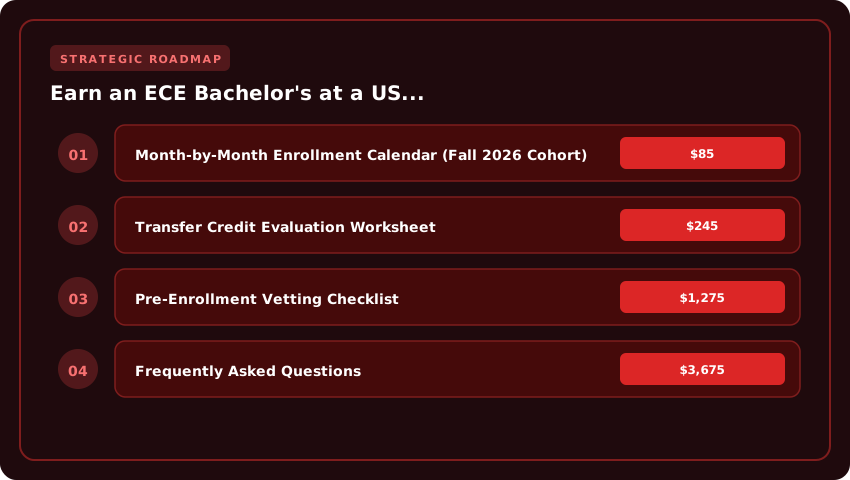
Turning a community college ECE bachelor’s goal into a conferred degree requires treating the process like a project with hard dependencies. Below is a month-by-month calendar built for a Fall 2026 cohort start, though spring entrants should shift the timeline forward by six months. Print this, post it near your workspace, and treat every bolded date as a non-negotiable milestone.
Month-by-Month Enrollment Calendar (Fall 2026 Cohort)
- October 2025 – December 2025 (Discovery & Vetting): Narrow your list to three target colleges. Verify each program holds current NAEYC accreditation—check the NAEYC Accredited Program Search for re-accreditation cycles; a site visit scheduled during your junior year could temporarily affect course availability. Request articulation agreement PDFs from the registrar; confirm they are valid through at least Summer 2028. Attend one virtual info session per college.
- January 2026 (FAFSA Launch & Transcript Audit): The 2026–27 FAFSA opens October 1, 2025, but the priority institutional deadline for most community college baccalaureate programs is April 1, 2026. Submit by March 15, 2026 to maximize state grant eligibility (e.g., Cal Grant, TEXAS Grant, NY TAP). Simultaneously, order official transcripts from every prior institution. Run a preliminary degree audit using the college’s transfer equivalency tool.
- February – March 2026 (Portfolio & Prior Learning Assessment): Compile your Prior Learning Assessment (PLA) portfolio. Map documented work experience (minimum 1,000 verified hours in licensed settings), professional development clock hours (CDA renewal hours, state registry training), and stackable certificates (CDA, state Infant/Toddler credential, Director’s Credential) to the program’s junior-year standing requirements. Most ECE bachelor’s programs cap PLA at 30 credits; aim to convert 15–18 credits to enter as a true junior.
- April 1, 2026 (Hard Deadline): Priority FAFSA submission date. Submit institutional scholarship applications (often separate from FAFSA). Confirm articulation agreement renewal windows—many consortia renew MOUs in April; a lapsed agreement can void guaranteed credit transfer.
- May – June 2026 (Admission & Registration): Accept admission offers. Register for fall classes immediately—upper-division ECE cohorts fill fast. Submit final transcripts showing associate degree conferral. Complete mandatory orientation and background check/fingerprinting for field placements.
- July – August 2026 (Final Prep): Verify financial aid disbursement schedule. Purchase textbooks via the college bookstore’s price-match tool. Confirm field placement site agreements for Practicum I.
- September 2026 – May 2028 (Degree Completion): Maintain a 2.75 cumulative GPA (typical NAEYC standard). Apply for graduation by October 1, 2027 for Spring 2028 conferral.
Transfer Credit Evaluation Worksheet
Use this matrix during your February PLA prep. List every credential/hour block in Column A; map to the target college’s course code in Column B; note the credit value in Column C. Total Column C must meet or exceed 60 lower-division credits for junior standing.
- Associate Degree Core: 30–35 credits (usually block transfer).
- CDA Credential: 6–9 credits (typically ECE 101, 102, 103).
- State Infant/Toddler Certificate: 3–6 credits.
- Verified Work Experience (1,000+ hrs): 3–6 credits via portfolio review.
- Professional Development (clock hours): 1 credit per 15–20 hours (varies by college).
- Military/CPR/First Aid: 1–2 credits elective.
Pre-Enrollment Vetting Checklist
Before signing any enrollment agreement, run the program through this five-point stress test:
- Accreditation Status: Active NAEYC accreditation and regional accreditation (HLC, MSCHE, SACSCOC, WSCUC). No “candidacy” status.
- Articulation Guarantee: Signed, dated MOU with your specific associate-degree college valid through your projected graduation date.
- Faculty Credentials: >50% of upper-division faculty hold terminal degrees (Ph.D./Ed.D.) in ECE or Child Development.
- Field Placement Pipeline: Dedicated coordinator, >20 partnered sites within 30 miles, and a documented placement rate >90%.
- Total Cost Transparency: Published “all-in” cost (tuition, fees, books, background checks, portfolio fees) < $18,000 for the upper-division 60 credits.
If a program fails even one item, schedule a call with the department chair before committing. Your time and FAFSA lifetime eligibility are too valuable to spend on a pathway that doesn’t deliver a license-eligible degree.
| Metric | Community College ECE Bachelor’s (2026) | Traditional 4-Year Public University | Private Non-Profit University |
|---|---|---|---|
| Average Total Tuition (In-State) | $12,000 – $18,000 | $40,000 – $55,000 | $120,000 – $180,000+ |
| Time to Degree (Full-Time) | 2–3 Years (Post-Associate) | 4 Years | 4 Years |
| Admission GPA Cut-off | 2.0 – 2.5 (Associate Grad) | 3.0 – 3.5 (Freshman/Transfer) | 3.3 – 3.8+ |
| Licensure Exam Pass Rate (Praxis/State) | 85% – 92% | 88% – 95% | 90% – 97% |
| Student-Teacher Ratio (Upper Division) | 15:1 – 20:1 | 20:1 – 30:1 | 12:1 – 18:1 |
| Median Starting Salary (Public Pre-K/K) | $42,000 – $48,000 | $43,000 – $50,000 | $44,000 – $52,000 |
| ROI (5-Year Net Earnings vs. Cost) | High (Low Debt, Immediate Workforce Entry) | Moderate (Moderate Debt) | Low/Moderate (High Debt Burden) |
| Accreditation Standard | NAEYC / CAEP / Regional | CAEP / AAQEP / Regional | CAEP / AAQEP / Regional |
Frequently Asked Questions
Can you get a teaching license with a community college bachelor's degree in ECE?
Yes, regionally accredited community college ECE bachelor's programs meet state licensure requirements for Birth–Grade 3 certification. Graduates must pass state-mandated exams (e.g., Praxis) and complete background checks. In 2026, 24 states authorize community colleges to confer licensure-eligible ECE degrees, ensuring parity with university pathways.
What is the average cost of an ECE bachelor's degree at a community college in 2026?
Total tuition for the upper-division coursework (60–90 credits) averages $12,000–$18,000 for in-district residents. This excludes the prior associate degree cost. Federal Pell Grants, TEACH Grants, and state workforce scholarships often cover 100% of tuition, resulting in near-zero debt for most graduates.
How long does it take to finish an ECE bachelor's at a community college if I have an associate degree?
Full-time students typically complete the bachelor's in 2 years (4 semesters). Part-time pathways, designed for working educators, take 3–4 years. Programs require 60 upper-division credits including capstone student teaching. Accelerated 18-month cohorts exist in states like Washington and Colorado for certified paraprofessionals.
Do employers value community college ECE bachelor's degrees the same as university degrees?
Public school districts and Head Start programs prioritize state licensure and NAEYC accreditation over institutional prestige. Because community college programs align curricula with state competencies and local district needs, graduates experience equivalent hiring rates. Salary schedules are based on degree level and credits, not the granting institution's classification.
Strategic Final Takeaway
Success in evaluating Earn an ECE Bachelor's at a US Community College in 2026 relies on early preparation, adherence to verified accredited requirements, and cross-referencing official portals. Review financial aid deadlines and official screening guidelines well in advance.