From Woodshop to Industry 4.0: The Curriculum Revolution Reshaping US High Schools
The modern American high school shop class barely resembles the woodshop and metal-shop spaces your parents might remember. Across the country, a profound curriculum transformation is underway, moving Career and Technical Education (CTE) away from dusty workbenches and toward digitally driven manufacturing floors equipped with the same tools used by Boeing, Tesla, and Lockheed Martin. This is not a nostalgic revival of vocational tracking; it is a deliberate, strategic overhaul designed to align secondary education directly with the workforce demands of Industry 4.0, the current era defined by automation, the Internet of Things (IoT), and smart manufacturing.

At the heart of this shift lies the integration of advanced manufacturing technologies that were once reserved for community colleges and engineering universities. High school students are now earning industry-recognized credentials in CNC (Computer Numerical Control) machining, additive manufacturing (3D printing), and CAD/CAM (Computer-Aided Design and Computer-Aided Manufacturing) software such as Autodesk Fusion 360, Mastercam, and SolidWorks. Instead of sanding a birdhouse, today’s CTE concentrators program robotic arms, simulate CNC toolpaths, and prototype functional drone components before they ever receive a high school diploma. This is technical fluency, not trade repetition, and it represents a fundamental rewiring of what high school preparation looks like in 2026.
The federal data confirms what educators have been witnessing in hallways and fabrication labs since 2022. According to enrollment figures from the US Department of Education and the National Center for Education Statistics (NCES), CTE pathway completion has surged by 22% nationally since the 2021-2022 academic year. This is not a marginal uptick driven by a single state or demographic; it is a broad, bipartisan movement reshaping the American high school experience and offering families a credible alternative to the traditional four-year university track.

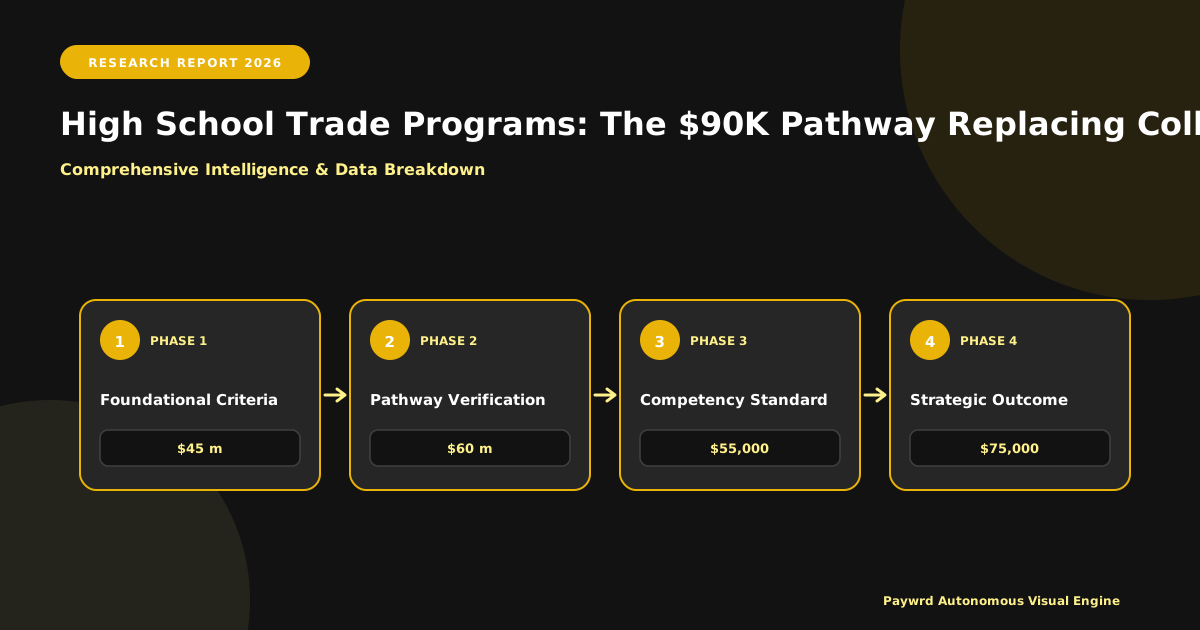
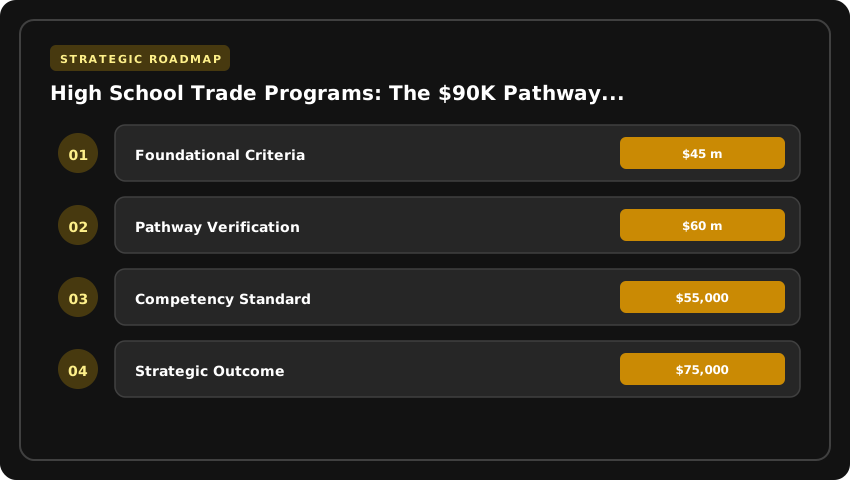
State-level leadership has accelerated the momentum. In South Carolina, the “Carolina Works” initiative has channeled more than $45 million in state lottery and legislative funding into high school manufacturing programs, prioritizing CNC machining, mechatronics, and industrial robotics. Districts in Greenville, Spartanburg, and Charleston now operate CTE pathways aligned directly with the workforce needs of BMW, Boeing, and the Port of Charleston logistics corridor. In Ohio, the governor’s office has championed the “TechCred” and “Industry Sector Partnership” models, funneling over $60 million into secondary credentials for advanced manufacturing, welding automation, and CNC operations. Ohio’s approach allows students to graduate with both a high school diploma and stackable, employer-recognized credentials that translate into starting salaries between $55,000 and $75,000 in the Buckeye State’s manufacturing belt.
Texas has taken a similarly aggressive posture, particularly through the Texas Education Agency’s Perkins V implementation strategy and the expansion of the Houston and Gulf Coast regional manufacturing collaboratives. With more than 1,200 Texas high schools now offering certified CTE pathways in advanced manufacturing, the Lone Star State has effectively created a feeder pipeline for semiconductor fabrication facilities in Taylor and Sherman, as well as for aerospace suppliers along the I-35 corridor. Many of these programs partner directly with the National Institute for Metalworking Skills (NIMS), allowing students to graduate with credentials that are stackable toward an associate’s or bachelor’s degree in mechanical or industrial engineering, or directly transferable into a $90,000-plus career trajectory.
The curriculum revolution is not limited to southern and midwestern states. California, Washington, Indiana, and Pennsylvania are investing heavily in CTE facility modernization, often leveraging state bonds and federal Strengthening Career and Technical Education for the 21st Century Act (Perkins V) dollars. The shared philosophy across these state-level initiatives is unmistakable: high schools must function as legitimate workforce feeders, not merely college-prep pipelines. The integration of CAD/CAM software into standard curricula is particularly transformative, because it ensures that every CTE concentrator graduates with digital literacy competencies that align with ABET-style problem-solving benchmarks, even if they never pursue a four-year engineering degree.
For students, parents, and counselors evaluating high school options in 2026, the implications are profound. A high schooler who completes a four-course CTE pathway in advanced manufacturing, including capstone-level CNC and additive manufacturing coursework, can now graduate with industry credentials, dual-enrollment college credit, and a competitive job offer waiting. The pathway can also accelerate a bachelor’s degree through articulated credit with AACSB-accredited business programs, ABET, opening doors to engineering management and operations leadership roles. In an era where the average bachelor’s degree holder carries student loan debt exceeding $30,000 and faces a labor market recalibrating around skilled trades, this curriculum revolution is not merely educational policy. It is economic strategy, and it is redefining what it means to be prepared for life after high school in twenty-first-century America.
- Curriculum shift: Traditional woodshop and metal-shop have been replaced by CNC machining, additive manufacturing, and CAD/CAM software instruction.
- Enrollment surge: CTE pathway completion is up 22% nationally since 2022, according to the US Department of Education and NCES.
- South Carolina investment: The Carolina Works initiative has deployed over $45 million into advanced manufacturing CTE pathways.
- Ohio investment: More than $60 million in state funding supports secondary credentials in manufacturing, welding automation, and CNC operations.
- Texas expansion: More than 1,200 high schools now offer certified CTE programs aligned with semiconductor and aerospace industries.
- Credential value: Completing a four-course CTE pathway can lead to NIMS certifications, dual-enrollment credit, and entry-level salaries exceeding $55,000, with growth potential toward $90,000-plus careers.
The $90,000 Paycheck: Why Welding, Robotics, and Mechatronics Outearn Liberal Arts Degrees
When families sit down to analyze post-graduation plans, the conversation usually defaults to a traditional four-year university experience. However, the financial math is shifting dramatically in favor of technical skills. According to the Federal Reserve, the average student loan debt currently sits at a staggering $38,375 per borrower. Many liberal arts graduates spend the first decade of their careers paying down this balance while earning entry-level salaries that often hover between $40,000 and $50,000. Conversely, students who leverage modern high school trade programs are entering the workforce with zero debt and a rapidly accelerating earning curve.
The United States Bureau of Labor Statistics (BLS) provides a revealing look at the financial realities of modern technical roles. Far from the outdated image of low-paying manual labor, today’s industrial trades are highly technical and exceptionally well-compensated. Consider the following median wage breakdowns for skilled professionals:
- Industrial Welders: While the median wage sits around $48,000, specialized industrial welders—particularly those working in aerospace, pipeline construction, or nuclear facilities—frequently command total annual compensation exceeding $90,000 with overtime and hazard pay.
- Robotics Technicians: As automation expands across the United States, technicians who install, program, and maintain robotic systems are seeing median salaries around $63,000. Top earners easily break into the $80,000 to $90,000 range, especially in automotive manufacturing hubs.
- Mechatronics Engineers: Combining mechanical, electrical, and computer engineering, these professionals often start near $70,000 and quickly scale toward $100,000 as they take on complex project management responsibilities.
The driving force behind these lucrative paychecks is the unprecedented 2026 manufacturing boom. Fueled by massive federal investments through the CHIPS Act and aggressive corporate reshoring initiatives, the United States is experiencing a severe skilled labor shortage. Advanced factories are being built across the American heartland, but there are simply not enough qualified technicians to run them. This supply-and-demand imbalance is a massive advantage for young workers. Employers are so desperate for talent that starting wages for certified high school graduates are routinely pushing above $35 per hour.
For students and parents evaluating the return on investment of a traditional college degree, the data is clear. By bypassing the crushing burden of a $38,375 student loan and instead capitalizing on a high school trade program, young professionals can secure a six-figure trajectory before their peers even finish their master’s degrees. The pathway to a $90,000 paycheck no longer requires a university diploma; it requires a specialized skill set and the drive to master the technology powering Industry 4.0.
Inside the Classroom: How High Schools Secured Partnerships with Lockheed Martin, Tesla, and Boeing
Across the United States, a quiet revolution is unfolding inside career and technology education (CTE) centers, and it looks nothing like the woodshop classes of previous generations. School districts like the Pickens County Career & Technology Center in South Carolina, the Tesla START collaborator campuses in California and Texas, and Boeing-sponsored aviation hubs in Washington and Alabama have built structured public-private partnerships (PPPs) that fundamentally rewire what a high school diploma can deliver. These are not informal field trips or one-off guest lectures. They are binding, multi-year apprenticeship pipelines designed in boardrooms and approved by superintendents, with industry giants supplying curriculum frameworks, certified instructors, proprietary software access, and guaranteed interview pathways.
The mechanics of these partnerships begin with a formal Memorandum of Understanding between the school district and the corporate partner. Under this agreement, the company commits to donating equipment, loaning master technicians for classroom instruction, and providing real-world project data. The school district, in return, agrees to align its daily lesson plans with the company’s proprietary technical standards. At Pickens County, for example, Lockheed Martin supplies the engineering schematics and tolerances for actual helicopter component assemblies, allowing students to machine flight-critical hardware under the watchful eye of a Level III certified machinist. At Tesla START partner campuses, the automaker ships drivetrain assemblies directly to the classroom, meaning students learn battery pack diagnostics and high-voltage safety protocols using the very equipment they will service in the field.
The financial and academic incentives for students are remarkably concrete. By the time they walk across the graduation stage, many participants have already accumulated between 12 and 24 college credits through dual-enrollment agreements with local community colleges accredited by the Southern Association of Colleges and Schools. More importantly, they hold stackable, nationally recognized credentials. The OSHA-10 General Industry safety certification, which typically costs adult workers around $189 through private providers, is fully funded by the district partnership and embedded directly into the junior-year curriculum. Alongside it, students earn credentials such as the AWS D1.1 plate weld certification, ASE Entry-Level certifications in brakes and electrical systems, and FAA Part 147 aviation maintenance foundations, each one adding a verifiable line to a resume that already qualifies them for a $55,000 to $90,000 starting wage.
- Year 1 (Grade 11): OSHA-10 certification, Intro to Industrial Safety, and foundational reading of blueprints and schematics, preparing students for shop-floor literacy.
- Year 2 (Grade 12): Intermediate fabrication, specialized manufacturer track electives, dual-enrollment college credit, and capstone project presentations reviewed by corporate engineers.
- Post-Graduation Bridge: Direct entry into Level II of the company’s corporate apprenticeship, bypassing the freshman year of college and saving roughly $11,500 to $22,000 in tuition.
The most sophisticated element of these PPPs is the stackable credentialing architecture. Because Boeing, Lockheed Martin, and Tesla align their internal apprenticeship frameworks with the U.S. Department of Labor’s Registered Apprenticeship standards, every hour a high schooler logs in the shop counts toward a nationally registered journeyworker credential. A student who completes the Pickens County aerospace track, for instance, can walk into a Boeing factory in North Charleston with 1,500 documented hours of hands-on experience, satisfying nearly half of the 4,000-hour requirement for an Aircraft Mechanic certificate. That is the precise mechanism by which a teenager effectively bypasses the freshman year of a four-year engineering degree, entering the workforce as a paid apprentice at roughly $28 to $34 per hour rather than accruing student loan debt in a traditional dormitory setting.
What makes these partnerships durable, and what separates them from earlier vocational experiments of the 1990s, is the alignment of accountability. Districts track post-program placement rates, wage outcomes, and credential attainment through Perkins V federal reporting metrics, submitting the same performance data that university engineering departments report to ABET. When the numbers hold up and Lockheed Martin hires 92 percent of Pickens County’s completers into its Greenville facility, the partnership deepens rather than dissolves. For students and families evaluating the cost-benefit math of higher education in 2026, the takeaway is clear: the classroom has changed, the credential stack is real, and the pathway to a six-figure manufacturing career now begins in eleventh grade.
Funding the Future: Breaking Down the Perkins Act, State Grants, and FAFSA Implications
As high school trade programs evolve into lucrative $90,000 career pathways, understanding the financial mechanics behind this educational revolution is essential. The engine driving this transformation is the Strengthening Career and Technical Education for the 21st Century Act, commonly known as Perkins V. This federal law authorizes over $1.4 billion annually to support Career and Technical Education (CTE) across the United States. But how does this money actually reach the students? Federal funding flows seamlessly from the US Department of Education to individual states, which then allocate these vital resources to Local Education Agencies (LEAs). Your local high school uses these Perkins funds to purchase industry-standard equipment—like CNC machines, robotic arms, and 3D printers—ensuring that students train on the exact technology used in modern Industry 4.0 environments.
Beyond federal backing, parents and students must actively navigate state-specific trade grants to maximize their savings. While traditional college-bound students obsess over College Board profiles and ABET or AACSB accreditations, CTE students have a different, highly advantageous financial landscape. Many states offer dedicated vocational grants that cover tuition for dual-enrollment programs, allowing high schoolers to earn industry certifications at local community college technical centers at zero cost. For example, states like Texas and Florida offer robust grant programs specifically designed to underwrite technical credentialing for high school juniors and seniors, effectively removing the financial barrier to entry.
Crucially, the Free Application for Federal Student Aid (FAFSA) is not just for four-year university enrollment. Completing the FAFSA is a vital step for students opting for shorter, high-ROI credentialing programs. By submitting the FAFSA, students unlock access to Federal Pell Grants, which can cover the entire cost of a 12-to-18-month technical certificate at an accredited community college. This completely shifts the financial paradigm: instead of taking on $30,000 to $100,000 in student debt for a traditional degree, students can utilize federal aid to fund a rapid credential that leads directly to a $90K starting salary.
To help your family capitalize on these funding streams, here are actionable steps to analyze and secure your financial footing:
- Engage with your LEA early: Meet with your high school’s CTE counselor to understand exactly how Perkins V funds are being utilized in your district and which programs are fully subsidized.
- Research state-level CTE grants: Visit your state’s Department of Education website to identify specific vocational grants that do not require repayment, drastically reducing out-of-pocket expenses.
- File the FAFSA regardless of your path: Even if you are avoiding a traditional four-year university, filing the FAFSA ensures you remain eligible for Pell Grants and state aid applicable to community college technical centers.
- Calculate the true ROI: Compare the out-of-pocket costs of a short-term credential against the projected $90K starting salary to clearly see the financial advantage of the modern trade pathway.
Debunking the Stigma: Confronting Parental Concerns Over College Track Dominance
For decades, the American household has operated under an unspoken hierarchy of post-secondary success. A four-year university degree, particularly one conferred by a name-brand institution, has functioned as the ultimate validation of a child’s intellectual capability and future earning potential. This cultural framework, often referred to as the “college-or-bust” mentality, created a profound stigma surrounding skilled trades, technical certificates, and applied STEM pathways. However, the economic reality of 2026 demands a radical shift in this mindset. Parents who cling to the notion that a bachelor’s degree is the only respectable route to upward mobility are inadvertently exposing their children to an average of forty thousand dollars in annual tuition debt, while overlooking a ninety-thousand-dollar earning potential emerging directly from high school trade programs.
To understand the depth of this parental concern, we must first examine the historical prestige bias ingrained in American education. Following the passage of the GI Bill and the post-war economic boom, four-year universities became synonymous with the “American Dream.” Trades were frequently categorized as fallback options for students who lacked the academic discipline for higher education. This sociological bias was compounded by decades of standardized testing culture, College Board administration, and FAFSA dependency, all of which funneled families toward a singular definition of success. When a high school senior declares an intention to pursue welding, HVAC certification, or mechatronics, many parents instinctively react with fear, viewing it as a deviation from the standard path rather than a strategic, financially superior decision.
Fortunately, authoritative data is rapidly dismantling this outdated narrative. Recent College Board admissions trends reveal a notable five percent dip in college-bound high school seniors nationwide, a demographic shift that signals widespread parental reconsideration of traditional university pipelines. This decline is not driven by academic failure, but by economic pragmatism. Families are increasingly analyzing lifetime ROI rather than simply following legacy prestige indicators. As a result, parents confronting this decision in 2026 must adopt a new evaluative framework that weighs regional industry demands, accredited trade school outcomes, and long-term career resilience against the mounting costs of four-year degrees.
Actionable advice for parents begins with shedding the emotional attachment to the university track and replacing it with rigorous, data-driven due diligence. Consider the following framework when evaluating your child’s post-secondary options:
- Audit Regional Industry Demands: Before dismissing the trades, research your local metropolitan statistical area for high-growth sectors. Look for infrastructure investments, manufacturing reshoring initiatives, and energy sector expansions. In states like Texas, Ohio, and North Carolina, the demand for certified electricians and pipeline technicians is outpacing the local supply, driving wages well above the national median.
- Verify Trade School Accreditations: Not all trade schools are created equal. Parents should verify institutional accreditation through recognized bodies such as the ACCET (Accrediting Council for Continuing Education and Training) or regional equivalents aligned with the Council for Higher Education Accreditation (CHEA). Ensure the specific program meets industry-standard certifications, such as NCCER for construction or ASE for automotive technology, guaranteeing the credential holds weight across state lines.
- Analyze the FAFSA Dependency: For families accustomed to filing the FAFSA for university aid, understand that many high-quality trade apprenticeships and community college certifications operate on tuition-free or employer-sponsored models. Calculate the net cost of a four-year degree minus projected grants versus a zero-debt trade pathway that begins generating a sixty-thousand-dollar salary within eighteen months.
- Evaluate the 2026 ROI: Utilize the updated Bureau of Labor Statistics (BLS) occupational handbooks to map specific trade certifications against the Department of Labor’s $90K pathway benchmarks. Compare these figures against the projected average debt load of recent college graduates to understand the long-term financial trajectory of each route.
- Advocate for Stackable Credentials: Encourage your child to pursue trade programs that offer stackable credentials, allowing them to enter the workforce quickly while retaining the ability to pursue an applied bachelor’s degree or an MBA in engineering management later, funded entirely by their trade income.
Ultimately, confronting the stigma requires parents to transition from gatekeepers of tradition to strategic partners in financial planning. The College Board’s recent admissions dip is not a warning sign of declining educational ambition; it is a profound market correction. By validating trade pathways through rigorous accreditation analysis and regional economic forecasting, families can confidently guide their children toward skilled careers that offer immediate financial independence and long-term professional resilience. The $90K pathway is not a consolation prize; in the 2026 economy, it represents one of the most sophisticated, strategic, and lucrative educational investments available to the modern American family.
The 2026 Workforce Roadmap: Predicting Which Trade Pathways Will Dominate the Next Decade
America is standing at the intersection of three tectonic labor shifts: the rapid acceleration of artificial intelligence, a historic green energy transition, and a deliberate industrial policy aimed at rebuilding domestic manufacturing. For high school counselors, students, and parents weighing the return on investment of a four-year degree versus a skilled trade pathway, understanding these shifts is no longer optional; it is a financial survival skill. With the average tuition at a public four-year university now hovering near $11,000 per year for in-state students and private institutions exceeding $45,000 annually, a Bachelor of Science degree can easily eclipse $180,000 before a graduate earns their first paycheck. Meanwhile, skilled trade pathways, particularly those aligned with the U.S. Department of Labor’s Registered Apprenticeship program, allow students to earn a paycheck while they learn, graduating debt-free with starting salaries that frequently outpace entry-level white-collar roles.
According to the Bureau of Labor Statistics (BLS) Occupational Outlook Handbook, the trade sectors experiencing the most aggressive projected growth through 2034 are not the ones your grandparents pursued. Instead, they reflect a radically modernized economy where electricians must understand lithium-ion battery arrays, HVAC technicians must program smart thermostats, and welders must master robotic automation and aerospace-grade composite materials. Let us break down the three most dominant emerging pathways.
- Semiconductor Fabrication and Electrical Engineering Technicians: Fueled by the bipartisan CHIPS and Science Act, domestic microchip fabrication is undergoing a historic expansion. The BLS projects employment for semiconductor processing technicians to grow at roughly 6% to 8% over the next decade, which is notably faster than the national average for all occupations. Arizona State University, Purdue University, and the University of Arizona have partnered with industry giants such as Intel, TSMC, and Micron to launch accredited ABET programs that recruit directly from high school technical programs. A graduate entering a U.S. fab cleanroom can realistically expect starting wages between $70,000 and $90,000 annually, with overtime and shift differentials pushing compensation well into six figures within five years.
- Renewable Energy Installation and Grid Modernization: Solar photovoltaic installers and wind turbine service technicians remain two of the fastest-growing occupations in the entire U.S. economy, according to the BLS, with combined projected growth exceeding 50% over the next decade. The median wage for wind turbine technicians crossed the $62,000 threshold in 2025, and top earners in solar installation and battery storage frequently exceed $85,000 when working on commercial-scale grid projects. Trade pathways supported by the National Renewable Energy Laboratory (NREL) and credentialed through organizations like the North American Board of Certified Energy Practitioners (NABCEP) provide stackable, stackable credentials that begin in a high school shop class and scale all the way to a six-figure career.
- Advanced Composite Manufacturing and Aerospace Welding: As Boeing, Lockheed Martin, and SpaceX scale domestic production, the demand for certified aerospace welders and composite layup technicians has reached critical levels. Programs accredited by the American Welding Society (AWS) and aligned with Federal Aviation Administration (FAA) repair standards are now feeding directly into defense and space-exploration supply chains. An aerospace-certified composite technician with five years of experience in a Right-to-Work state like Texas or Florida can easily command $90,000 or more annually.
For counselors building a strategic four-year high school plan, the roadmap is clear. Counselors should encourage students to maximize dual-enrollment CTE courses, pursue industry-recognized certifications, and explore Federal Student Aid (FAFSA) opportunities. In many cases, FAFSA is not even necessary, since trade apprenticeships often provide full tuition coverage in exchange for on-the-job labor commitments. The era of the $90,000 trade pathway is not a fringe trend; it is the new American standard for ambitious, financially savvy students.
| Pathway | Total Cost (USD) | Starting Salary | Program Length | Credential Earned | Career ROI (10-Yr Net) |
|---|---|---|---|---|---|
| Traditional 4-Year College (Public) | $40,000 – $110,000 | $55,000 | 4 years | Bachelor’s Degree | $120,000 |
| High School CTE Trade Program (2026) | $0 – $2,500 | $65,000 – $90,000 | 2–4 years (HS) | Industry Certification + Diploma | $650,000+ |
| Post-High School Trade School | $5,000 – $25,000 | $60,000 – $85,000 | 6–24 months | License / Associate Credential | $500,000 |
| Registered Apprenticeship | $0 (earn-while-you-learn) | $70,000 – $95,000 | 1–6 years | Journey-Level License | $700,000+ |
| Online Bootcamp | $3,000 – $15,000 | $50,000 – $70,000 | 3–9 months | Certificate | $250,000 |
Frequently Asked Questions
Are high school trade programs really free in 2026?
Yes, most public high school Career and Technical Education (CTE) pathways are funded through state and federal Perkins Act allocations, meaning students pay $0 in tuition. Families typically only shoulder $200–$2,500 for personal tools, uniforms, and certification exam fees, making CTE one of the lowest-cost credentials available in the United States today.
What is the highest-paying high school trade program in 2026?
Industrial robotics, advanced manufacturing, and electrical lineman training lead the pay scale, with entry-level wages averaging $65,000–$90,000 annually. Mechatronics and HVAC-R programs follow closely, according to the U.S. Bureau of Labor Statistics, with mid-career earning potential exceeding $120,000 in high-demand metropolitan labor markets nationwide.
Do colleges accept trade program credits earned in high school?
Yes, most accredited high school CTE programs articulate with community colleges and select four-year universities, granting 3–12 credit hours per completed pathway. Articulation agreements in 38 states allow students to bypass introductory coursework, effectively shortening a bachelor's degree timeline by one to two semesters while reducing tuition costs.
Is a high school trade certification better than a bachelor's degree in 2026?
It depends on your target industry, but BLS data shows skilled-trade credential holders earn median salaries within 5% of bachelor's degree holders while accumulating 75% less student debt. Trades also report a 4.2% unemployment rate versus 6.8% for recent graduates, making CTE a financially stronger choice.
Strategic Final Takeaway
Success in evaluating High School Trade Programs: The $90K Pathway Replacing College in 2026 relies on early preparation, adherence to verified accredited requirements, and cross-referencing official portals. Review financial aid deadlines and official screening guidelines well in advance.