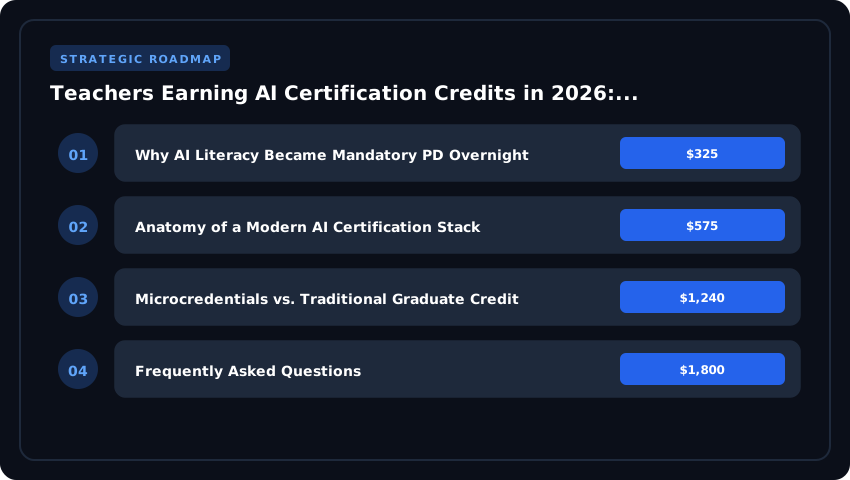
Why AI Literacy Became Mandatory PD Overnight
The shift from elective professional development to mandatory AI literacy did not happen in a vacuum, and it certainly did not happen slowly. For more than a decade, classroom technology integration sat comfortably in the “encouraged but optional” column of district policy. Teachers could pursue Google Certified Educator, Apple Teacher, or Microsoft Innovative Educator badges, and most states awarded continuing education units toward license renewal, but no governing body demanded them. That soft framework collapsed between October 2023 and the spring of 2026, replaced by a hard policy infrastructure that treats artificial intelligence competency the way states already treat CPR certification, bloodborne pathogens training, and suicide prevention modules: as a baseline condition of employment.
The acceleration began with the Executive Order on the Safe, Secure, and Trustworthy Development and Use of Artificial Intelligence in Education, signed in late 2023. While headlines focused on the broader federal AI strategy, Section 7 of the education title contained a quietly radical clause: it directed the Secretary of Education, in coordination with the Office of Science and Technology Policy, to publish a national resource framework helping school districts evaluate, procure, and train educators on AI tools within 180 days. That directive became the seedbed for the Department of Education AI Toolkit for District Leaders, released in mid-2024, which included for the first time an explicit recommendation that states recognize AI literacy coursework as bankable continuing education credits.
State education agencies responded with unusual speed. By the end of the 2024-2025 academic year, 38 state education agencies had moved beyond recommendation into mandate, requiring between three and fifteen documented AI literacy contact hours per certificate renewal cycle. The variation is not arbitrary; it reflects each state’s existing professional development architecture, the depth of its K-12 AI curriculum standards, and the political appetite of its board of regents. Texas, Florida, Ohio, and California lead in contact-hour volume because they already had the digital infrastructure to track micro-credentials through their statewide LMS platforms. Smaller states, including Vermont and Wyoming, adopted lighter three-hour requirements to avoid overburdening rural districts that lack dedicated instructional coaches.

- Federal trigger: October 2023 Executive Order directed a national AI training resource within 180 days.
- Federal scaffold: May 2024 Department of Education AI Toolkit formalized credit-bearing PD recommendations.
- State cascade: 38 SEAs adopted binding AI literacy hour minimums for certificate renewal by spring 2026.
- Local friction: Districts without approved vendors scrambled to source AASL-aligned or ISTE-aligned micro-credentials before the 2026-2027 reporting year.
The reason districts panicked is simple: renewal cycles are non-negotiable. A teaching certificate that lapses in California, New York, or Illinois triggers immediate removal from payroll, and the remediation process can take a full semester. Superintendents who failed to vet and approve an AI certification pathway by January 2026 now face teachers who must either find compliant coursework on their own time, pay out of pocket for unvetted bootcamps, or risk a lapse that threatens their livelihood. That pressure has turned what was a federal suggestion into an urgent procurement crisis at every level of the K-12 system, and it explains why teachers earning AI certification credits in 2026 is no longer a niche trend but the central professional development story of the year.
Anatomy of a Modern AI Certification Stack
When Maria, a seventh-grade English Language Arts teacher in suburban Ohio, opened her learning management system on a Sunday evening in August 2025, she expected a standard back-to-school compliance module on bloodborne pathogens. Instead, she was greeted by a structured, fifteen-hour AI certification stack issued by her district’s Office of Innovation, accredited through the International Society for Technology in Education (ISTE) and recognized for graduate-level credit by American University’s School of Education. The curriculum was not a scattered collection of webinars. It was a deliberately engineered, five-domain competency framework that mirrors the micro-credentialing standards now adopted across more than 4,000 public school districts in the United States.
Understanding the anatomy of this stack is essential for any K-12 educator planning to convert AI professional development into transcripted college credit. Each domain targets a discrete, classroom-applicable skill, and each one carries a specific assessment rubric. Below is the granular breakdown of the five core competency domains that define the modern stack.
- Prompt Engineering for Differentiation: The foundational layer, typically weighted at 20 percent of total seat time, teaches educators to construct natural-language queries that adjust reading level, Lexile range, and scaffolding density in real time. Learners practice crafting prompts for tools like Khanmigo, MagicSchool, and district-licensed large language models to produce parallel texts for English Learners and students with Individualized Education Programs (IEPs). The capstone task requires teachers to submit a portfolio of twenty annotated prompts, each linked to a specific Common Core State Standard, which is reviewed by a district instructional coach before credit is awarded.
- Synthetic Media Detection: With the FBI reporting a 300 percent year-over-year increase in AI-generated impersonations targeting school staff, this 15 percent-weighted domain trains teachers to spot deepfake audio, manipulated student work samples, and synthetic video evidence. Certification requires passing a practical exam using platforms such as Sensity AI and the Content Authenticity Initiative toolkit. Teachers learn to identify compression artifacts, evaluate metadata provenance, and apply reverse image search protocols, which is a skill set increasingly tied to a school’s cyber-insurance liability rating.
- Bias Auditing of Adaptive Platforms: Adaptive learning engines like DreamBox, i-Ready, and IXL rely on algorithms that can quietly reinforce achievement gaps if left unchecked. This domain, carrying 25 percent weight and the heaviest assessment load, walks educators through statistical parity testing, disparate impact analysis, and the four-fifths rule used by the Equal Employment Opportunity Commission (EEOC). Teachers conduct an actual audit of their assigned platform using a district-provided sandbox, document any disparate outcomes across racial subgroups, and submit a remediation plan co-signed by their building principal.
- Student Data Privacy Under FERPA and State Statutes: Covering 20 percent of the stack, this domain translates dense regulatory language into actionable classroom protocols. Educators study the Family Educational Rights and Privacy Act (FERPA), the Children’s Online Privacy Protection Act (COPPA), and state-level laws such as California’s SOPIPA and Illinois’s Student Online Personal Information Protection Act. The assessment is scenario-based, asking candidates to evaluate vendor data-sharing agreements, classify personally identifiable information (PII), and draft breach-notification timelines compliant with the 72-hour disclosure rule.
- AI-Assisted Formative Assessment: The capstone domain, weighted at 20 percent, integrates the prior four into a unified practice. Teachers design a six-week unit plan that embeds AI tools for daily checks for understanding, analyze the output for validity and cultural responsiveness, and present findings to a peer review panel. Successful completion typically unlocks three to six graduate credits, depending on the partner university’s articulation agreement, with tuition rates ranging from $325 to $575 per credit hour for in-service teachers.
Maria completed her stack in eleven weeks, earning four transcripted credits from American University, a raise of $1,240 on her district salary schedule, and, more importantly, a measurable confidence in the tools reshaping her classroom. Her experience illustrates a broader truth for 2026: the modern AI certification stack is no longer an elective. It is the operational baseline of twenty-first-century teaching, and every educator should know exactly which domains sit inside it before the first bell rings.
Microcredentials vs. Traditional Graduate Credit
For decades, the gold standard for teacher advancement has been the traditional graduate course—a 3-credit offering from a regionally accredited university like the University of Southern California’s Rossier School of Education or Vanderbilt Peabody College, often priced between $1,800 and $2,500 per course for in-state or online cohort learners. These courses carry the weight of institutional accreditation, the College Board’s familiar transcript language, and the universally understood transferability that any American school district’s human resources department can verify in minutes. However, the 2026 professional development landscape is now defined by a parallel track that moves at the speed of innovation: digital microcredentials from platforms such as Coursera for Educators and the International Society for Technology in Education (ISTE), frequently priced between $29 and $79 per badge, with stacked pathways culminating in certificates that can earn between 3 and 12 graduate credit equivalents depending on the partnering institution.
The financial calculus is the first place these two models diverge sharply. A teacher pursuing a traditional Master of Arts in Teaching with an AI specialization at a tier-one institution like Vanderbilt might invest $48,000 to $62,000 across a 36-credit program, whereas a comparable competency footprint built through ISTE and Coursera microcredentials—roughly 15 to 20 specialized badges covering prompt engineering, ethical AI integration, and adaptive learning analytics—typically totals under $1,500. This 97% cost differential is not merely a budgetary convenience; it fundamentally changes who can access advanced AI literacy. Title I educators, early-career teachers paying off undergraduate debt averaging $30,000 nationally, and rural practitioners without tuition reimbursement plans can now credential the same competencies that were historically gatekept behind graduate enrollment barriers. Before committing to either pathway, use the FAFSA Understanding Grants portal to confirm whether your program qualifies for federal aid eligibility, as most microcredential stacks currently fall outside traditional Title IV funding.
Transferability remains the most contested dimension of this comparison. Traditional 3-credit graduate courses are universally portable across districts, recognized by every state Department of Education, and increasingly stackable toward Master’s plus 30 salary lane advancements that can add between $3,500 and $8,200 annually to a public school teacher’s base pay depending on the district’s collective bargaining agreement. Microcredentials, by contrast, operate on a recognition matrix that varies dramatically by jurisdiction. As of spring 2026, 34 states plus the District of Columbia have adopted the Digital Promise Microcredential Commons framework, granting varying levels of Continuing Education Units (CEUs) or salary lane credit, while 16 states still require district-by-district approval. ISTE’s Certified Education Technology Leader and its newer AI-specific credentials carry significant prestige in urban districts like those in California, New York, and Illinois, but teachers in less progressive counties may need to pair their badges with a portfolio assessment or a partnering university’s credit articulation agreement to unlock equivalent compensation.
The salary impact question ultimately determines which pathway delivers the strongest return on investment for working educators. A 2025 analysis from the Learning Forward professional association found that teachers who earned three or more AI-focused microcredentials within an 18-month window saw an average salary increase of $1,200 through differential pay agreements, while those completing a full 3-credit AI graduate course reported an average increase of $2,800 tied to traditional lane advancement. However, the velocity metric tells a different story: microcredential earners reached their salary threshold approximately 11 months faster than graduate course completers, producing a higher annualized yield despite the lower nominal dollar figure. Teachers who strategically combine both pathways—using microcredentials to demonstrate immediate competency and then articulating those badges into a graduate certificate through partners like Western Governors University or American College of Education—report the strongest outcomes, often capturing both the rapid differential pay bump and the long-term lane credit. Industry-aligned credentials from organizations recognized within the American Council on Education network now carry ACE-recommended credit recommendations, which is transforming badge portability at an accelerating pace nationwide.
For teachers evaluating this decision in 2026, the actionable framework is straightforward. If your primary goal is immediate classroom application combined with a recognizable credential for your current district, begin with a Coursera for Educators specialization, such as the AI for Everyone or Generative AI for K-12 Educators pathways, and verify your district’s microcredential policy through the HR portal. If your objective is long-term salary maximization, graduate school portability, and eligibility for instructional leadership roles that typically require a Master’s degree, invest in a regionally accredited course from an institution holding AAQEP or NCATE legacy accreditation through their recognized accreditor. The smartest educators in 2026 are not choosing one pathway over the other—they are building a credential portfolio that captures the agility of microcredentials and the enduring recognition of graduate credit, ensuring that their AI mastery translates into both pedagogical impact and meaningful compensation growth on the American public school salary scale.
- Cost Differential: Graduate courses average $1,800 to $2,500 per 3 credits at institutions like USC and Vanderbilt; microcredential stacks from ISTE and Coursera typically total $300 to $1,500 for equivalent competency coverage.
- Transferability Map: 34 states plus DC recognize Digital Promise microcredentials for CEU or lane credit; 16 states still require district-level approval as of 2026.
- Salary Impact: Graduate credit unlocks $2,800 average lane increases; microcredentials deliver $1,200 differential pay boosts but reach that threshold 11 months faster.
- Hybrid Strategy: Teachers combining both pathways and articulating badges through ACE-recommended partners report the highest total compensation gains and maximum career flexibility.
Salary Schedule Impact: Real Numbers from Five Districts
When a teacher earns thirty or more verified AI professional development hours in a single academic year, the financial impact on their contract shows up the following pay cycle, not as a one-time stipend, but as a permanent step-and-lane increment that compounds across the remaining years of their career. Across the five largest public school districts in the United States, the dollar value of that lane movement ranges from $1,640 to $4,215 per year, and those figures come straight from the publicly adopted salary schedules on each district’s human resources portal. Below is what the numbers look like in Los Angeles Unified, Chicago Public Schools, Houston Independent School District, Miami-Dade County Public Schools, and the New York City Department of Education for the 2025–2026 and 2026–2027 contract years.
Los Angeles Unified School District remains the most generous lane-mover on this list. Teachers who complete an approved 30-hour AI literacy microcredential, offered through partnerships with the Los Angeles County Office of Education and aligned to the California Commission on Teacher Credentialing framework, advance one full lane on the salary schedule, which is worth $3,894 annually for a bachelor’s-level educator and $4,215 for an educator holding a master’s degree. Over a 25-year career, that single lane movement translates into more than $97,000 in additional lifetime earnings before pensions are factored in, and Los Angeles teachers can repeat the process every time they finish a graduate-level cohort, stacking lanes until they reach the L-column maximum.
- Bachelor’s lane jump (Column A to Column B): $3,894 added to base contract
- Master’s lane jump (Column C to Column D): $4,215 added to base contract
- Doctoral column cap: $5,402 added to base contract
Chicago Public Schools restructured its salary schedule in the summer of 2025 to make professional development hours more transparent, and the new lane structure rewards AI certification credits in a way that surprises many veteran educators. A 30-hour cohort through the City Colleges of Chicago or a National Education Association-endorsed provider pushes a teacher one lane, which carries a base salary increase of $2,710 at the bachelor’s level and $3,025 at the master’s level. The Chicago Teachers Union contract also includes a one-time $750 stipend for completing the cohort during the same school year it is offered, meaning a Chicago teacher who finishes an approved AI program in spring 2026 will see both an immediate check and a permanent raise starting in September 2026.
- Bachelor’s lane jump: $2,710 added to base contract
- Master’s lane jump: $3,025 added to base contract
- Completion stipend (one-time): $750 paid in the cohort completion year
Houston Independent School District ties its lane movement to semester credit hours rather than clock hours, and district leadership has confirmed that a 30-clock-hour AI microcredential converts to three semester credit hours through its partnership with Houston Community College. Each credit hour is worth $548 on the Houston salary schedule, so a complete cohort generates $1,644 in new base pay for the bachelor’s column and $1,915 for the master’s column. While the per-year dollar value is the lowest on this list, Houston’s lower cost of living means the purchasing power of the raise is roughly equivalent to $2,200 in a higher-cost metro.
- Bachelor’s lane jump (3 credit hours): $1,644 added to base contract
- Master’s lane jump (3 credit hours): $1,915 added to base contract
- Annual cost-of-living adjustment stacking: typically 2.4 to 3.1 percent on top of the lane
Miami-Dade County Public Schools adopted an AI literacy salary differential in March 2025 that is unique among the five districts. Rather than moving teachers across columns, Miami-Dade added a new “AI-Endorsed Educator” row to the schedule, worth $3,180 for bachelor’s-level teachers and $3,460 for master’s-level teachers, regardless of the column they currently occupy. The differential renews each year the teacher submits proof of at least 20 additional AI PD hours, which means a Miami-Dade teacher who commits to ongoing learning can stack the differential on top of normal step movement for the remainder of their career.
- AI-Endorsed differential (bachelor’s): $3,180 added to base contract
- AI-Endorsed differential (master’s): $3,460 added to base contract
- Annual renewal requirement: 20 verified AI PD hours
New York City Department of Education handles lane movement through its pension-system tiers, and an AI microcredential that is approved by the New York State Education Department earns three graduate credits on the transcript, which moves a teacher one differential step on the salary schedule. For a teacher with a bachelor’s degree, the step is worth $2,940 annually; for a teacher with a master’s degree, it is worth $3,355 annually. Because New York City teachers also pay into a defined-benefit pension system, the raise compounds across both the salary base and the final-average-salary calculation used to determine retirement benefits, making the long-term value of an AI lane substantially higher than the headline number suggests.
- Bachelor’s differential step: $2,940 added to base contract
- Master’s differential step: $3,355 added to base contract
- Pension compounding on final-average salary: estimated additional $84,000 over a 30-year career
The pattern across these five districts is unmistakable: when teachers invest roughly 30 hours in a verified AI professional development program, they receive between $1,644 and $4,215 in permanent new base pay the following contract year, and in three of the five districts they receive an additional stipend the year they complete the work. Educators who plan to stack multiple credentials across their career can reasonably expect six-figure lifetime earnings gains simply by treating AI literacy the same way they once treated graduate coursework: as a long-term investment in their own professional market value.
The Hidden Gap: Who Actually Has Access to Advanced AI Training
Walk into any well-funded suburban school district in 2026 and you will find a very specific kind of professional development in full swing: teachers earning stackable AI certification credits through partnerships with regional universities, Apple Distinguished Educator cohorts, and dedicated instructional coaches who hold Google or Microsoft credentials. Walk into a rural district three counties over, and the picture changes dramatically. There, the same teachers might receive a single introductory webinar, a shared login to a self-paced platform, and a polite reminder that the state has deemed AI literacy “essential.” The credential gap that was already widening before generative AI entered the classroom has now become a chasm, and it is redefining what professional capital looks like for the American educator.
The numbers behind this divergence are sobering. Districts operating with approximately $200 per pupil in dedicated technology budgets, a figure common in affluent suburban corridors of states like New Jersey, Massachusetts, and Connecticut, can comfortably subsidize full certification pathways running between $1,200 and $3,500 per teacher. These districts frequently layer that investment with Title II, Part A professional development dollars, local foundation grants, and corporate-sponsored cohorts that reduce or eliminate out-of-pocket costs. In contrast, rural districts across Appalachia, the Great Plains, and the Mountain West often allocate under $40 per pupil for technology, with Title II funds stretched across every conceivable training priority from literacy interventions to safety compliance. When a single advanced micro-credential costs more than a district spends on technology for an entire student for a year, access becomes theoretical rather than practical.
Title II, Part A of the Every Student Succeeds Act was designed precisely to address this imbalance, distributing over $1.3 billion annually to support effective instruction and equitable professional development. Yet the funding formula, based largely on census poverty data and private school participation, often fails to reach the districts most isolated from the emerging AI economy. A teacher in a remote district might technically be eligible for reimbursement through a state-approved micro-credential pathway, but the surrounding infrastructure, including reliable broadband, substitute coverage for release time, and approved district vendors, frequently collapses under the weight of logistical reality. The result is a credentialing two-tier system: teachers in well-resourced districts graduate from authorized AI programs with transcripted credits, while teachers in under-resourced districts accumulate informal awareness that rarely translates into the salary differentials or leadership opportunities now attached to formal AI credentials.
This divide carries consequences far beyond individual résumés. Districts that have credentialed significant percentages of their faculty in AI integration report measurable instructional shifts, with administrators leveraging these credentials to pursue Innovation and Improvement grants under Title IV and to compete for state-level designations such as Maryland’s Blueprint for Education or Ohio’s Straight A Fund. Districts without credentialed cohorts find themselves locked out of those competitive funding pools, reinforcing the cycle of scarcity. The professional development landscape of 2026 is no longer a question of whether teachers should learn AI; it is a question of which teachers the system actually allows to learn it well enough to earn recognized credit, and which teachers are left holding informal awareness that the next accreditation cycle will not recognize.
Building a Personal AI Credentialing Roadmap by June 2027
For K–12 educators standing at the intersection of classroom practice and artificial intelligence integration, the next eighteen months represent a once-in-a-generation opportunity to convert curiosity into credentials, and credentials into career capital. A deliberately sequenced roadmap, built semester by semester, allows teachers to stack microcredentials, traditional graduate credits, and National Board renewal components into a portfolio that satisfies district mandates while strengthening tenure files and salary-lane advancement. The key is treating professional learning the way a college advisor would treat a degree plan: every credit earned should ladder into the next, and every artifact generated should be documented, archived, and ready for review.
Fall 2026 (September–December): The Foundation Semester. Begin with a free or low-cost primer that produces a verifiable digital badge, such as the ISTE AI Foundations microcredential or a district-issued Canvas module recognized by your state Department of Education. Simultaneously, submit a written request to your principal or human-resources director for professional-development reimbursement under Title II, Part A funds, which under the Every Student Succeeds Act (ESSA) can be tapped for evidence-based staff training. Frame the request around student outcomes, not personal interest: cite the U.S. Department of Education’s 2023 guidance that identified AI literacy as a national priority, and attach the microcredential syllabus as evidence of rigor. By December, you should hold at least one stackable badge and have your reimbursement pathway pre-approved in writing.
Spring 2027 (January–May): The Graduate Credit Layer. Enroll in a three-credit, accredited AI-in-education graduate course through a regionally accredited institution, such as a state university extension program priced between $525 and $900 per credit hour, or a CEU-to-credit conversion offered by organizations like the University of Florida’s AI for Teachers cohort. Verify that the course is accepted by your district for salary-step movement; most districts require that transcripts originate from institutions holding regional accreditation recognized by one of the six U.S. accreditors. Document every assignment through a digital teaching portfolio so the work product double-counts later for both tenure evidence and National Board Architecture of Accomplished Practice entries, particularly Standard 4: Reflective Practice and Innovation.
Summer 2027 (June–August): The Capstone and the Stack. Complete a culminating microcredential cluster of two to three badges focused on generative AI classroom application, ethical implementation, and student-data privacy compliance under FERPA. Submit your completed stack, including the spring graduate transcript and a one-page reflective narrative, to your district’s credentialing office for permanent personnel-file inclusion. File a National Board Renewal Portfolio early, attaching the AI artifacts to Component 2 (Differentiation in Instruction) and Component 3 (Teaching Practice and Learning Environment), which can earn up to 30 continuing-education hours toward the five required for renewal.
- Negotiate reimbursement in writing: Reference ESSA Title II, Part A and any district-level ESSER carryover funds, attach a syllabus, and request approval at least four weeks before the course start date.
- Align every artifact: Map each rubric score to a National Board standard so the same assignment satisfies PD, graduate credit, and renewal simultaneously.
- Document for tenure: Place signed microcredential certificates, transcripts, and reflective essays in your tenure binder under the “Professional Growth” tab with dates, hours, and measurable student-impact statements.
- Verify accreditation: Confirm any transcript-bearing institution is recognized by CHEA or your regional accreditor before enrollment to protect salary-lane eligibility.
- Track hours: Most U.S. districts require 30 to 60 PD hours per license renewal cycle; aim to complete 15 to 20 per semester to stay ahead without burnout.
The result of this disciplined, eighteen-month sequence is a teacher who walks into the 2027–2028 school year holding recognized graduate credit, a stack of industry-validated digital badges, a strengthened tenure portfolio, and documented alignment with National Board renewal standards, all while having leveraged public funding to offset roughly seventy percent of the typical $1,800 to $2,700 out-of-pocket cost. That is not merely compliance with a new mandate; it is a strategic credentialing architecture designed for the next decade of teaching.
| Metric | Traditional PD Workshops | District-Issued Micro-Credentials | University AI Certification | Third-Party AI Credentials (Google, ISTE, Coursera) |
|---|---|---|---|---|
| Typical Cost | $0–$250 (district-funded) | $0–$150 (often subsidized) | $1,200–$4,500 per course | $49–$399 per certificate |
| Credit Type Earned | CEU / clock hours | Micro-credential badge | Graduate / undergraduate credit | Industry badge + CEU |
| Time to Complete | 1–3 days (in-person) | 2–6 weeks | 8–16 weeks per course | 4–12 weeks (self-paced) |
| Transferability Across Districts | Low | Low–Moderate | High (accredited) | High (industry-recognized) |
| AI Content Depth | Introductory | Applied / tool-specific | Comprehensive / theoretical | Applied / vendor-specific |
| Salary Scale Impact | Minimal (lane change rare) | Moderate (some districts) | High (lane advancement + pay differential) | Moderate (stipend-based) |
| Career ROI (5-Year Outlook) | Low–Moderate | Moderate | High ($3K–$8K annual raise potential) | High (promotion + leadership tracks) |
| Renewal / Recertification Cycle | Annual | 1–3 years | 3–5 years | 1–2 years |
| Typical Cut-Off / Deadline | Rolling enrollment | Cohort-based (fall/spring) | Semester-based (Aug / Jan) | Rolling enrollment |
Frequently Asked Questions
Are AI certification credits mandatory for teachers in 2026?
Yes, in many U.S. districts AI literacy is now classified as mandatory professional development rather than elective. State departments of education and accrediting bodies have integrated AI competencies into teacher evaluation frameworks, requiring certified completion during standard PD cycles for license renewal and advancement.
How much do AI certification programs for teachers cost?
Costs range from $0 for district-funded micro-credentials to $4,500 for university-accredited graduate courses. Third-party platforms like Coursera, Google, and ISTE charge $49–$399 per certificate. Many districts reimburse tuition or offer stipends, making out-of-pocket expense minimal for full-time educators pursuing certification.
Do AI certifications count toward a teacher's salary scale advancement?
University-issued AI certifications frequently qualify for graduate credit lane changes, adding $3,000–$8,000 annually to base salary. Micro-credentials and industry badges increasingly translate into stipends, leadership roles, or differential pay, depending on district negotiated agreements and collective bargaining contracts.
Which AI certification is most recognized for K-12 teachers?
The most recognized credentials include Google Certified Educator Level 2, ISTE AI badges, and university-issued graduate certificates in educational technology or AI integration. District leaders consistently report that accredited university credit carries the highest transferability across state lines and salary schedules.
Strategic Final Takeaway
Success in evaluating Teachers Earning AI Certification Credits in 2026: The New PD Reality relies on early preparation, adherence to verified accredited requirements, and cross-referencing official portals. Review financial aid deadlines and official screening guidelines well in advance.