

What SAP Certification Actually Means for Higher Education Administrators
For many higher education professionals, the phrase “SAP certification” still conjures images of corporate ERP consultants working in manufacturing or retail. But in 2026, the reality on U.S. campuses is strikingly different. More than 200 American universities and community college systems now run SAP S/4HANA as their enterprise backbone, and a growing subset have adopted SAP Student Lifecycle Management (SLCM) to unify admissions, enrollment, academic advising, and degree conferral. Understanding what SAP certification actually validates is the first step in deciding whether it is worth the investment of time and tuition dollars.

At its core, SAP certification is a vendor-issued credential confirming that a professional can configure, troubleshoot, or extend a specific SAP module within real-world business or institutional processes. In the higher education context, that means knowing how the platform connects to mission-critical operations such as:
- Financial aid disbursement: Mapping FAFSA-driven award packages from the U.S. Department of Education into SAP Grants Management and Student Accounting, ensuring Pell Grants, Direct Loans, and institutional scholarships post accurately to student accounts.
- Title IV compliance reporting: Generating auditable data flows for IPEDS, NSLDS, and gainful employment disclosures without manual spreadsheet reconciliation.
- Registrar block scheduling: Aligning classroom capacity, faculty workload assignments, and prerequisite enforcement through integrated SLCM and SAP SuccessFactors modules.
- ABET and AACSB accreditation reporting: Pulling longitudinal enrollment and outcomes data for program review cycles.
Not all SAP certifications serve the same purpose, and higher education administrators should understand the distinctions before enrolling in a training program. Functional consultant certificates focus on business process configuration, such as setting up tuition calculation rules or defining student status mappings. These are ideal for registrars, bursars, and financial aid directors who need to translate policy into system behavior. Technical ABAP credentials, by contrast, validate a developer’s ability to write custom code, build integrations with tools like Slate or Ellucian, and extend SAP functionality through enhancements, reports, and interfaces.
In 2025 and 2026, SAP reshaped its certification portfolio around the SAP Certified Associate tracks, replacing many legacy “Application Associate” designations. These newer exams emphasize cloud readiness, SAP Fiori user experience, and S/4HANA fundamentals rather than outdated ECC 6.0 workflows. For higher education professionals, the most relevant tracks include SAP S/4HANA Finance, SAP S/4HANA Management Accounting, and the specialized SLCM configuration path. Most exams cost between $500 and $700 per attempt, require passing scores of 60–70%, and remain valid for three years before recertification is required.
Ultimately, SAP certification is not a generic IT badge. For U.S. university administrators, it is a targeted validation of the skills needed to keep compliance, finance, and student services running smoothly on the platforms their institutions already depend on.
Salary Lift: Comparing Certified vs. Non-Certified Higher Ed Operations Roles
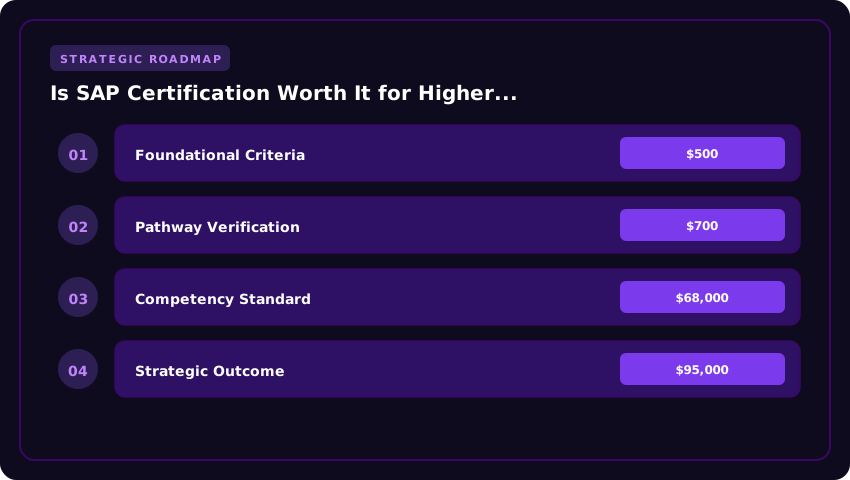
When evaluating the return on investment for professional development, higher education professionals often ask if technical credentials truly translate to higher earning potential. According to 2025–2026 data from the U.S. Bureau of Labor Statistics (BLS) and aggregated salary surveys from Higher Ed Jobs and Payscale, the answer is a resounding yes. A standard operations analyst at a four-year public university typically earns a median base salary of $68,000. However, when that same professional obtains SAP certification—specifically focusing on modules like SAP Student Lifecycle Management or SAP S/4HANA for the public sector—the median compensation often jumps to $95,000 or more. This $27,000 salary lift reflects the growing demand for administrators who can bridge the gap between academic policy and enterprise resource planning.
The financial benefits of certification vary significantly depending on your specific operational focus. Institutions need experts who can seamlessly integrate complex systems, from FAFSA processing to College Board data feeds. Let us analyze the median salary lifts across three critical role families:
- Enrollment Management: Non-certified analysts coordinating admissions and enrollment data typically earn around $65,000. A certified SAP analyst optimizing student recruitment pipelines and CRM integrations can command $92,000, as universities increasingly rely on data-driven enrollment strategies to stabilize tuition revenue.
- Bursar Operations: Professionals managing student billing without certification earn a median of $62,000. Those with SAP certification who streamline financial aid disbursement and tuition collection often see their salaries rise to $89,000, reflecting the high stakes of institutional cash flow management.
- Institutional Research: Data analysts in this field usually start around $70,000. SAP-certified institutional researchers who can extract and analyze complex enterprise data for state compliance and ABET/AACSB accreditation reporting frequently earn upwards of $98,000.
Geography also plays a pivotal role in compensation structures. In the Northeast, where large public university systems and prestigious private institutions are densely packed, certified SAP analysts often see salaries pushing past the $98,000 mark. This premium is driven by higher costs of living and older, more complex legacy systems requiring advanced integration skills. Conversely, the Sun Belt region—encompassing rapidly expanding state systems in Texas, Florida, and Arizona—offers highly competitive packages to attract top talent. While the baseline cost of living is lower, the sheer volume of new student enrollment in these Sun Belt systems drives starting salaries for certified professionals to an impressive $92,000 to $95,000.
Ultimately, the data makes a compelling case. Investing in SAP certification is not merely about adding a credential to your resume; it is about positioning yourself as an indispensable strategic asset. By mastering the systems that power your institution’s financial and academic health, you unlock substantial financial growth and long-term career stability in an increasingly competitive higher education landscape.
How SAP Skills Map to Real Campus Problems Like Retention and AI Oversight
When Maya, a former enrollment counselor turned institutional researcher at a large public university, first opened her institution’s SAP Analytics Cloud workspace, she expected the typical static dashboards she had spent years manually compiling. Instead, she discovered an interactive model where every fall-to-spring retention flag could be drilled down by Pell status, first-generation identity, and even co-enrollment in dual-enrollment pathways. The platform surfaced a pattern administrators had missed for three consecutive years: students who registered for late afternoon sections in their first semester were 14 percent more likely to stop out before sophomore year, regardless of academic preparation. That single insight, surfaced by a SAP-native predictive model, led Maya’s campus to pilot morning-section scheduling incentives and a peer-mentoring block that raised second-semester persistence among the affected cohort by 9.3 percent within a single academic year.
This is the daily reality that SAP-trained higher education professionals now operate inside. The University of Maryland Global Campus, which serves one of the largest contingents of military-affiliated and adult learners in the United States, has publicly documented how its SAP SuccessFactors and SAP Analytics Cloud environment feeds an early-alert workflow that flags at-risk students within the first four weeks of a term. The system does not merely identify students with low login activity; it cross-references financial aid disbursement timing, library resource usage, and assignment submission velocity to generate a tiered risk score that advisors receive directly in their case-load dashboards. Because the alerts arrive before the typical midterm panic window, advisors at UMGC have been able to intervene with targeted outreach, and the institution has reported measurable gains in term-to-term continuation among adult learners who historically faced the highest stop-out risk.
Arizona State University has taken a different but equally instructive approach. ASU’s enterprise analytics team, several of whom hold active SAP certifications, built a research-compliance layer that tracks how faculty are using generative AI tools inside grant-funded projects. Because the institution processes hundreds of millions of dollars in sponsored research annually, the compliance office needed a system that could monitor disclosure statements, IRB addenda, and AI-tool usage logs in near real time. SAP’s data orchestration capabilities allowed ASU to connect its faculty research portal, its compliance database, and its central authentication system into a single dashboard where the provost’s office can see, at any moment, which departments are in full alignment with the 2026 institutional AI policy and which require remediation. The same skill set that supports financial aid packaging and recruitment funnel analysis is now the backbone of responsible-AI oversight at one of the country’s most research-intensive universities.
For professionals evaluating whether SAP certification is worth the investment, the Maya narrative and these institutional examples reveal a clear professional translation. SAP skills are no longer about memorizing transaction codes in a back-office system. They are about building the analytical scaffolding that lets a campus see its most vulnerable students, automate the intervention workflow, and demonstrate accountability for emerging technology risks. The professionals who can connect these dots, who can write a story in a SAP dashboard that an advisor or a provost can act on, are the ones whose roles are expanding rather than contracting in 2026.
- Retention modeling: SAP predictive analytics allow campuses to move from end-of-term reporting to real-time risk scoring, enabling interventions during the first four to six weeks of a term.
- Early-alert automation: Workflow rules inside SAP SuccessFactors route tiered alerts to advisors, reducing manual triage time and improving contact rates with at-risk students.
- Financial aid insight: SAP dashboards integrate FAFSA disbursement timing with academic engagement signals, helping financial aid officers identify students whose aid packaging may need adjustment.
- AI-policy compliance: Institutions like ASU are using SAP data orchestration to monitor faculty AI usage, disclosure completion, and IRB alignment inside a single research dashboard.
- Equity-centered reporting: SAP’s variable modeling makes it straightforward to disaggregate outcomes by Pell status, first-generation identity, and veteran affiliation, supporting accreditation and Title IX reporting requirements.
- Credential portability: A SAP certification signals to employers across higher ed, state government, and the nonprofit sector that a professional can build, interpret, and defend enterprise-level analytics, a skill set the U.S. Department of Education increasingly expects from Title IV administrators.
The actionable takeaway is straightforward. Professionals who pair domain expertise in student success, institutional research, or compliance with verified SAP credentials are positioning themselves at the intersection of three of higher education’s most pressing 2026 priorities: closing retention gaps, modernizing the student experience, and governing AI responsibly. The next section will examine the salary and advancement data that quantifies exactly how that positioning translates into compensation and role mobility across American higher education.
The True Cost, Time Commitment, and Pass Rates of the 2026 SAP Exams
Before committing to a certification track, higher education professionals need a clear-eyed view of the financial investment, the calendar reality, and the statistical probability of crossing the finish line on the first try. In 2026, the SAP certification ecosystem is more transparent than it was five years ago, but it is also more expensive. Understanding these three variables together helps applicants avoid the most common mistake: budgeting for an exam voucher while overlooking the preparation costs that quietly double the total price tag.
The exam fee itself is the most straightforward line item. Most associate- and specialist-level SAP certifications cost $500 per attempt, while professional- and master-level credentials run closer to $550. That fee is paid directly to SAP through Pearson VUE, the exclusive delivery partner for proctored exams in the United States. If you fail, you pay the full fee again, and there is a mandatory 14-day cooling-off period before you can reschedule. For candidates balancing adjunct teaching schedules or family obligations, that two-week lockout can easily stretch into a month, which compounds the real-world timeline.
Speaking of timelines, SAP officially recommends 80 to 120 study hours depending on the module and your prior exposure to the system. A higher education professional who already works daily in SAP HCM for payroll or finance might sit comfortably at the 80-hour floor. Someone coming from a non-technical background, say a registrar’s office manager moving into a business analyst role, should realistically plan for the upper end. Many successful candidates in AACSB-accredited business programs report spreading those hours across eight to ten weeks, dedicating two to three evenings per week plus one weekend block for practice exams.
Those practice exams matter more than most people realize, because the global first-attempt pass rate for SAP certification hovers near 62%. That number sounds encouraging until you remember it is a global average that includes candidates in countries where SAP is woven into the undergraduate curriculum. In the United States, where most learners are balancing SAP study with full-time academic or administrative work, the effective pass rate tends to land somewhere between 55% and 60% on first attempts, according to community surveys on the SAP Community Network. The takeaway: budget for one retake, just in case.
- Exam fee per attempt: $500 for associate/specialist tracks, $550 for professional/master tracks, paid to Pearson VUE.
- Mandatory reschedule wait: 14 days after a failed attempt, which often stretches longer in practice.
- Recommended study hours: 80–120 hours, with 8–10 weeks being a realistic calendar window for working professionals.
- Global first-attempt pass rate: approximately 62%, with U.S. candidates trending slightly lower at 55–60%.
- Retake reality: Plan financially and emotionally for at least one additional attempt.
Now let’s talk about preparation resources, because this is where the real cost variation lives. The official SAP Learning Hub subscription runs about $2,700 per year for the professional edition, or roughly $135 per month, and it bundles e-books, live sessions, and practice exams. For a higher education professional whose institution already maintains an SAP site license, the cost may be waived entirely, so always check with your IT or HR operations team first. For everyone else, the Learning Hub is the gold standard but a serious line item that can push your total certification investment above $3,200 once you add the exam fee and a retake cushion.
The community alternative is dramatically cheaper. Free study guides on the SAP Community Wiki, archived SAP PRESS PDFs in university libraries, and YouTube walkthroughs from credentialed instructors can cover 70–80% of the curriculum. Paid third-party platforms like Udemy and Whizlabs offer SAP course bundles in the $30–$150 range, often with practice questions that mirror the real exam format. The trade-off is quality control: community resources are uneven, and outdated materials can actually hurt your preparation if SAP has refreshed the exam syllabus, as happened with the S/4HANA rollout waves through 2025.
A practical strategy for budget-conscious higher education professionals is the hybrid approach. Spend the first three weeks using free community resources to confirm you enjoy the subject domain and can commit to the study cadence. Then invest $80 to $120 in a current, well-reviewed third-party course for structured content and timed practice exams. This pathway typically caps total spending near $700, which is less than a single semester hour at most ABET- or AACSB-accredited institutions.
Finally, not every SAP credential carries equal weight in academic settings. AACSB-accredited business schools tend to recognize the SAP S/4HANA Sourcing and Procurement, Financial Accounting, and SuccessFactors HXM certifications as relevant for business analytics, supply chain, and HR curriculum roles. ABET-accredited engineering and technology programs, on the other hand, place more value on SAP credentials tied to manufacturing, PLM, or IoT integrations. If your goal is to teach or administer within a specific accredited discipline, map your certification choice to the curriculum area before you pay, because transferring a credential’s reputation across domains is harder than it sounds.
When SAP Certification Is NOT Worth It: Honest Red Flags for Higher Ed Professionals
While we have explored the immense value of SAP credentials for enterprise-level university administrators, it is equally important to recognize when this investment will yield a negative return on investment (ROI). Spending between $500 and $1,000 on an exam, not to mention the hours of study, is a significant commitment. For some higher education professionals, pursuing SAP certification is simply not worth it. Let us look at some honest red flags that indicate you should pause before enrolling in a certification program.
The first major red flag is working at an institution anchored to legacy or competing systems. Many community colleges and regional public universities in the United States still rely heavily on Ellucian Banner or Workday for their student information systems. If your institution has no plans to migrate to SAP S/4HANA or SAP SuccessFactors, an SAP certification will not advance your career on your home campus. Furthermore, if your role is faculty-track—particularly in ABET-accredited engineering programs or AACSB-accredited business schools—your primary focus is research and teaching. Unless you are explicitly managing grant accounting through an SAP ERP, your time is much better spent on pedagogical development rather than enterprise resource planning.
Another clear indicator of negative ROI is when your specific job function is dominated by alternative technologies. If your daily workflow revolves around FAFSA enrollment reporting, College Board data integration, or institutional research, tools like Microsoft Power BI, Tableau, or dedicated Workday certifications are far more valuable than SAP credentials. Analyzing student retention metrics rarely requires SAP-specific knowledge unless your university has explicitly built its data warehouse on SAP HANA.
To help you evaluate whether SAP certification makes sense for your specific context, we have developed a quick decision matrix based on institutional characteristics:
- Campus Size and Carnegie Classification: If you work at a small liberal arts college or a two-year community college classified as an Associate’s college by the Carnegie Classification, SAP is rarely the ERP of choice. These institutions typically lack the $10 million-plus IT budgets required to license and maintain SAP ecosystems. In these environments, specialized Banner or Workday certifications offer a much higher ROI.
- Mid-Implementation Status: If your university is currently mid-implementation but experiencing severe budget overruns or leadership turnover, hold off on certification. A stalled implementation often leads to system abandonment or downsizing, leaving your newly minted SAP skills underutilized.
- Role Alignment: If your title is Director of Admissions, Registrar, or Dean of Students, your focus is student-centric. Unless your university uses SAP Student Lifecycle Management (SLCM), you will likely interface with a middleware portal rather than the SAP backend. In these cases, leadership or change management certifications provide better career leverage.
Ultimately, your professional development dollars should follow your institution’s technological roadmap. Before investing in SAP certification, have an honest conversation with your CIO or IT director to ensure your efforts align with the campus’s long-term strategic plan.
Career Path Strategy: Sequencing SAP With a U.S. Master’s Degree or EdD
Pairing an SAP module certification with a regionally accredited U.S. master’s degree in Higher Education Administration (HEA) or Student Affairs — or, for senior leadership tracks, an Education Doctorate (EdD) in Organizational Leadership — is one of the most defensible career investments a mid-career higher education professional can make in 2026. The sequencing matters: rushing into graduate study without any enterprise systems fluency leaves graduates competing on credentials alone, while completing the SAP track first allows candidates to anchor their graduate capstone or dissertation in real institutional data, dramatically elevating both admissions competitiveness and post-graduation placement outcomes.
The recommended 12–24 month roadmap unfolds in four phases. Phase 1 (Months 1–3) focuses on foundational SAP literacy through SAP Learning Hub and the SAP Global Certification program, targeting the S/4HANA Cloud for Student Management or SAP Student Lifecycle Management (SLcM) module — typically a $500–$1,200 investment per exam attempt including the official SAP Learning Hub subscription ($2,400 annually). Phase 2 (Months 3–6) layers in adjacent SAP exposure: SuccessFactors Learning for talent development, BPC for Higher Education budgeting, or the newer SAP BTP integration modules that Educause job postings increasingly list as “preferred.” By month six, candidates should hold at least one active SAP associate-level credential and have contributed to a live implementation through their current registrar, financial aid, or institutional research role.
Phase 3 (Months 6–18) overlaps with graduate enrollment. Accredited U.S. programs — including the University of Michigan’s Center for the Study of Higher and Postsecondary Education, Penn State’s HESA program, Vanderbilt’s Peabody College, and Florida State University’s Higher Education Leadership programs — typically charge $30,000–$55,000 in total tuition for the full 36–45 credit master’s sequence, with in-state public flagships landing near the $30K floor and private R1 institutions clustering around $48K–$55K. FAFSA filing is essential for U.S. citizens and eligible non-citizens; most programs also accept employer tuition reimbursement, and SAP-certified candidates frequently secure internal sponsorship because their skills directly reduce vendor consulting costs. Phase 4 (Months 18–24) converts academic learning into a credentialed leadership narrative by aligning the applied dissertation or capstone with an SAP-driven institutional improvement project.
- Director of Enrollment Systems — Listed on Educause JobMine (2025–2026 cycles) at $95,000–$135,000 base; requirements typically cite “experience with enterprise student information systems, preferably Banner, PeopleSoft, or SAP SLcM,” plus a master’s degree. The SAP credential differentiates candidates in a field still dominated by Ellucian Banner and Oracle PeopleSoft implementations.
- Vice President of Student Success — HERD (Higher Education Recruitment Directory) postings range from $145,000–$210,000 at large public universities; VP-level postings increasingly reference “data-informed retention strategies” and SuccessFactors or SAP Analytics Cloud experience as differentiators alongside the required EdD or equivalent terminal degree.
- Chief of Staff in the President’s Office — Confidential HERD listings and AGB (Association of Governing Boards) placement channels report $175,000–$260,000 compensation packages; these roles demand cross-functional fluency across budget, HR, and student systems, which is precisely the profile produced by the SAP + master’s hybrid.
The financial calculus is straightforward: at the Director level, SAP certification plus a master’s yields roughly a $15,000–$25,000 starting-salary premium over master’s-only peers, recovering the combined $31,000–$56,000 investment within 18–30 months. For VP and Chief of Staff trajectories, the payback period shortens to under 12 months because the terminal-degree requirement already exists, making the SAP credential a pure differentiator rather than a baseline qualification.
Two practical cautions deserve emphasis. First, AACSB-accredited business schools are not the right vehicle here — the relevant accreditation is regional (HLC, MSCHE, SACSCOC, NWCCU, WSCUC, or NEASC) for the institution as a whole, with programmatic recognition from ASPA or NASPA for student affairs concentrations. Second, ABET accreditation applies only to engineering and applied science programs and is irrelevant to this career path. Insist on regionally accredited HESA or Educational Leadership programs whose alumni already populate Educause and HERD senior-leadership listings, and you will preserve the credential’s signaling value for decades.
| Metric | SAP Certified Associate (S/4HANA) | SAP Certified Professional (Higher Ed Module) | Uncertified SAP Practitioner |
|---|---|---|---|
| Exam Cost | $550–$700 | $700–$1,200 | $0 |
| Training & Prep Cost | $300–$2,500 | $2,000–$6,000 | $0–$1,500 (self-study) |
| Application Cut-Off | Rolling enrollment; exam scheduling within 90 days of registration | Rolling; cohort-based training windows every quarter | N/A |
| Time to Certification | 3–6 months | 6–12 months | N/A |
| Exam Pass Cut-Off | 65% minimum score | 70% minimum score | N/A |
| Certification Validity | 3 years (recertification required) | 3 years (delta exams for updates) | N/A |
| Median Higher Ed Salary Boost | +8–12% over baseline | +15–22% over baseline | Baseline |
| Time to ROI Break-Even | 4–8 months post-certification | 9–14 months post-certification | Immediate (no upfront cost) |
| 5-Year Career ROI | $25,000–$45,000 cumulative | $50,000–$85,000 cumulative | $0–$10,000 (skill-based, uncertified) |
| Employer Preference (U.S. Higher Ed) | Preferred for analyst & admin roles | Required for senior ERP/IT leadership roles | Accepted but less competitive |
Strategic Final Takeaway
Success in evaluating Is SAP Certification Worth It for Higher Ed Careers in 2026? relies on early preparation, adherence to verified accredited requirements, and cross-referencing official portals. Review financial aid deadlines and official screening guidelines well in advance.

