How Federal vs Private Student Debt Changes Your Mortgage Approval Odds in 2026
Walking into a mortgage application with student debt is no longer the automatic disqualifier it was a decade ago, but the type of debt you carry absolutely dictates how lenders evaluate you. In 2026, the underwriting engines at Fannie Mae (Desktop Underwriter), Freddie Mac (Loan Product Advisor), and the Federal Housing Administration (FHA) treat federal Direct Loans, Parent PLUS loans, and private refinanced debt through entirely different mathematical lenses, and understanding this nuance can mean the difference between a closing date and a denied pre-approval.
Here is the core reality: federal student loans offer flexibility that private loans simply do not. When a mortgage underwriter pulls your credit report and sees a $45,000 Direct Loan on an Income-Based Repayment (IBR) plan, they are required by FHA and conventional guidelines to calculate your monthly obligation using a specific income-driven formula rather than the actual bill. For IBR and Pay As You Earn (PAYE), the payment is generally capped at either 10% or 15% of your discretionary income, while the new SAVE plan uses a 5% undergraduate and 10% graduate discretionary income formula that dramatically lowers the figure on your application. Even when lenders use the standard 1% to 5% discretionary income calculation as a fallback, your reported mortgage debt is often a fraction of your actual balance, keeping your front-end and back-end ratios well within compliance.
- FHA DTI Caps (2026): Most borrowers are approved with a back-end debt-to-income ratio up to 43%, though FHA’s TOTAL Scorecard may allow stretch ratios up to 56.9% with compensating factors like strong reserves or low loan-to-value.
- Conventional DTI via DU/LP: Fannie Mae and Freddie Mac generally cap at 50% back-end DTI for conforming loans, though strong residual income profiles in high-cost states like California or New York can push you higher.
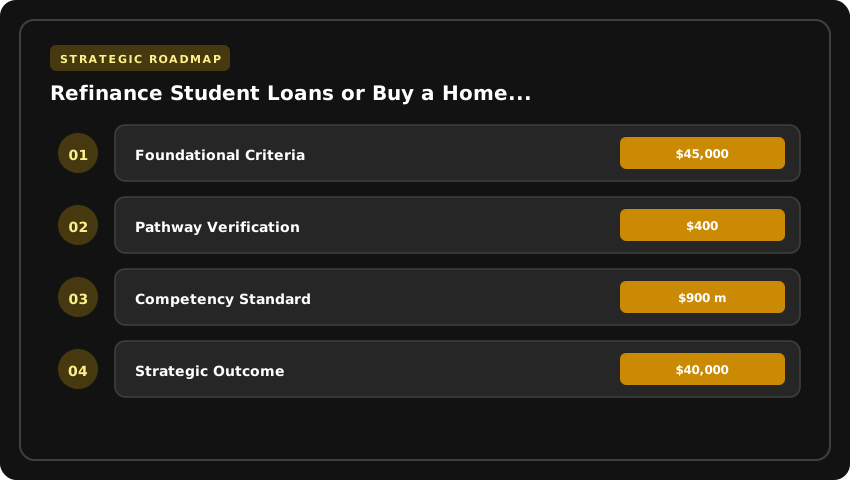
- Parent PLUS Treatment: This is where families get burned. Parent PLUS loans typically do not qualify for IBR or SAVE plan concessions, meaning the full amortization payment (often $400 to $900 monthly on a $40,000 balance) hits your DTI calculation, and when the parent is not on the mortgage application, lenders often require the debt to be paid off entirely or refinanced into the child’s name before closing.
- Private Refinanced Loans: Once you refinance federal debt through SoFi, Earnest, or a credit union partner, you lose all income-driven repayment protections. The new loan amortizes over 10 to 20 years at a fixed rate, producing a hard monthly payment that flows directly into your DTI with no discretion.
Credit reporting is the second battleground. Federal loans in deferment or forbearance often report as “current” with a $0 or minimal scheduled payment, which credit scoring models like FICO 10T and VantageScore 4.0 treat more favorably than a $650 private loan payment that aggressively amortizes principal and interest. A lower required minimum payment preserves more of your monthly cash flow, which is exactly what an automated underwriting system rewards when calculating residual income and debt-to-income ratios. Private refinanced debt, by contrast, is treated like a car loan or credit card obligation, fully counted, fully amortized, and unforgiving during the seasoning period before closing.
From an actionable standpoint, if you are within 12 to 24 months of a home purchase, the strategic play is to keep your federal loans in an IDR plan rather than refinancing them, even if the marketed private rate looks attractive. If you are a Parent PLUS borrower, explore consolidating into a Federal Direct Consolidation Loan and then applying for the ICR (Income-Contingent Repayment) plan to potentially lower the payment that appears on your credit report. If you have already refinanced into private debt, focus on aggressive paydown in the 6 months before applying for a mortgage, since underwriters will count that hard payment against you regardless of your income trajectory.
Bottom line for 2026: Federal debt gives you flexibility, lower reported DTI, and stronger negotiation leverage with underwriters. Private refinanced debt gives you a lower interest rate but a higher monthly obligation, a harder credit report appearance, and zero flexibility if your income dips before closing. Choose accordingly.
The Real Cost of Refinancing Student Loans Before a Mortgage Application
The appeal of refinancing student loans before applying for a mortgage is simple on paper: lower your interest rate, reduce your monthly debt obligations, and watch your debt-to-income (DTI) ratio become instantly more attractive to an underwriter. Lenders like SoFi, Earnest, and Laurel Road routinely advertise 5.2% to 6.4% fixed rates for highly qualified borrowers in 2026, often dramatically undercutting older federal Direct Loans originated during the 7.0% to 8.5% rate environment. On the surface, the math seems irresistible. But the visible interest savings only tell half the story, and the hidden half can quietly cost you tens of thousands of dollars in lost benefits, tax advantages, and legal protections that private refinancing permanently extinguishes the moment you sign the new promissory note.
To understand the true break-even point, let’s walk through a realistic 2026 scenario. Imagine a borrower carrying $60,000 in federal student loans at a 7.5% interest rate with a standard 10-year repayment term. Under the federal schedule, the monthly payment lands at roughly $711, and total interest paid over the life of the loan reaches approximately $25,342. Now, suppose this borrower refinances into a private loan at 5.2% over 10 years with a competitive SoFi or Earnest offer. The new monthly payment drops to about $643, a savings of $68 per month, and total interest drops to roughly $17,201. The headline savings: about $8,141 over the decade. Subtract typical origination or administrative fees ranging from 0% to 5% (often $0 for no-fee lenders, but up to $3,000 at others), and the net savings hover between $5,000 and $8,000.
However, the federal loan came with the borrower above-the-line student loan interest tax deduction, capped at $2,500 per year, which at a 24% marginal federal tax bracket returns roughly $600 annually, or $6,000 over the same 10-year window if consistently claimed. A private refinance loan qualifies for the same deduction only if taken in your own name and used solely for qualified higher-education expenses; refinanced loans that pay off federal debt typically still qualify, but this is one of the few benefits that survives the transition. What does not survive is the federal safety net. Federal Direct Loans offer Income-Driven Repayment (IDR) forgiveness through plans like SAVE, IBR, PAYE, and ICR, where remaining balances can be forgiven after 20 or 25 years. They also provide economic hardship deferment, unemployment deferment, and Total and Permanent Disability Discharge (TPD), all of which vanish the moment your federal servicer is paid off by a private lender.
- Monthly cash flow gain: $68, freeing up roughly $816 per year that could be saved for a down payment on a home.
- Total interest savings: approximately $8,141 over 10 years before fees.
- Lost IDR forgiveness potential: if the original balance would have been forgiven at year 20, the borrower forfeits roughly $120,000+ in projected forgiveness value.
- Lost federal deferment flexibility: during a future mortgage-approval gap or job loss, no pause button remains without lender approval.
- Lost TPD discharge protection: critical for borrowers in fields like healthcare, military service, or physically demanding trades.
The strategic takeaway is clear: refinancing only beats waiting when you have stable, high-income employment in a non-forgiveness profession, an emergency fund of at least six months, and no realistic expectation of pursuing Public Service Loan Forgiveness (PSLF) or IDR cancellation. For most aspiring homebuyers in the United States, the wiser 2026 path is to preserve federal benefits, make aggressive federal loan payments during the mortgage-application window, and only refinance after closing on the home, when the locked-in mortgage no longer depends on your DTI being artificially deflated by a private lender’s lower payment. The $8,000 in interest savings rarely outweighs a lost $50,000 to $200,000 forgiveness outcome when measured across the full financial life cycle.
DTI Ratio Math: Why $800 Monthly Payments Can Tank Your Home Buying Power
When mortgage underwriters evaluate your loan application, they are not judging your income, your career trajectory, or the size of your down payment savings in isolation. They are running your entire financial profile through two precise mathematical formulas known as the front-end debt-to-income (DTI) ratio and the back-end DTI ratio. For 2026, the baseline conforming loan limit is projected to land at $806,500, with the high-cost area ceiling reaching $1,209,750 for properties in the most expensive metropolitan markets. These limits, announced annually by the Federal Housing Finance Agency, determine whether your loan can be purchased by Fannie Mae or Freddie Mac, and they directly shape the qualifying ratios your lender will enforce.
The front-end ratio (also called the housing ratio) compares your projected monthly housing payment, including principal, interest, property taxes, homeowners insurance, and HOA fees if applicable, against your gross monthly income. Most conventional lenders cap this figure at 28%, though some flexible programs allow up to 32% with compensating factors. The back-end ratio captures all monthly debt obligations: housing plus student loans, auto loans, credit card minimums, and any other recurring installments. The ceiling here is typically 36%, though Fannie Mae’s HomeReady and Freddie Mac’s Home Possible programs extend to 45% for borrowers with strong credit and reserves.
Let’s run the math with a concrete example. Imagine a couple with a combined gross monthly income of $11,500, a credit score of 745, and a current student loan payment of $800 per month. Under the standard 36% back-end cap, their total allowable debt service is $4,140. Subtracting the $800 student loan payment leaves $3,340 for the total housing payment (PITI). Assuming a 30-year fixed rate of approximately 6.25% in the 2026 forecast environment, plus 1.2% effective property tax rate and $1,200 annual insurance, this couple could qualify for a mortgage principal of roughly $485,000, translating to a purchase price near $505,000 with a standard 4% down payment.
Now watch what happens when they refinance that student debt and reduce the monthly obligation from $800 down to $400. The same back-end cap now allows $3,740 for housing payment because the freed-up $400 flows directly into qualifying mortgage capacity. At 6.25%, the loan principal climbs to approximately $545,000, pushing the maximum purchase price to ~$565,000. That is a $60,000 swing in purchasing power from one refinance decision. At a more competitive 5.875% rate environment, the same payment reduction generates closer to $80,000 in additional purchase capacity because lower rates compound the leverage effect of freed-up monthly cash flow.
The credit score tier matters significantly. Borrowers in the 740+ range qualify for the best conforming pricing tiers and often receive automatic underwriting flex through Fannie Mae’s Day 1 Certainty program, which uses verified asset and income data to waive documentation on certain conditions. A borrower in the 680 to 719 range faces pricing adjustments of roughly 0.25% to 1.00% in rate, which shrinks the purchasing-power boost from a $400 payment reduction to approximately $45,000 to $55,000 rather than the $60K-$80K range available to higher-scored applicants. This is why credit optimization before mortgage application often delivers more value than aggressive debt paydown.
Property tax escrow estimates introduce another variable. In high-tax states like New Jersey, Texas, or Illinois, where effective property tax rates routinely exceed 2.0%, the same loan amount produces a smaller qualifying payment because more of each month’s obligation is consumed by taxes and insurance rather than principal and interest. A borrower in a high-tax jurisdiction effectively needs a lower home price to hit the same DTI ceiling, which means the purchasing-power boost from refinancing student loans actually increases in these markets, sometimes reaching $90,000 or more when rates cooperate.
Before making any refinance decision, request a fully underwritten pre-approval letter from at least two mortgage lenders, ideally one credit union and one mortgage broker, and ask each to model two scenarios: current student loan payment versus a hypothetical $400 lower payment. The difference in maximum approved loan amount is your real-world answer to whether refinancing student debt first unlocks your dream home or simply adds another layer of complexity to an already stressful financial decision.
- Front-end ratio ceiling: 28% of gross monthly income for conventional loans, up to 32% with strong compensating factors.
- Back-end ratio ceiling: 36% standard, 45% available through HomeReady and Home Possible programs.
- 2026 conforming loan limits: $806,500 baseline, $1,209,750 high-cost ceiling.
- Purchasing-power impact: $400 monthly payment reduction unlocks $55,000 to $80,000 in additional purchase price.
- Credit score leverage: 740+ borrowers gain the maximum benefit; 680-719 applicants see $45K-$55K gains.
- High-tax jurisdictions: Property tax escrow above 2.0% amplifies the value of freed-up monthly cash flow.
Credit Score Impact: Refinancing During the Mortgage Process
For borrowers weighing whether to refinance student loans before buying a home, understanding exactly how each financial move ripples through your FICO score is essential. The modern FICO model is the industry standard used by Fannie Mae, Freddie Mac, the Federal Housing Administration (FHA), and the Department of Veterans Affairs (VA), and it reacts predictably to both the application and the payoff of new debt. Knowing these mechanics lets you sequence your moves to minimize damage and maximize your qualifying power.
When you submit a student loan refinance application, the lender pulls your credit report, generating a hard inquiry. A single hard inquiry typically shaves just 5 points or less from your FICO score, and most of that impact fades within 6 to 12 months before falling off the report entirely after 24 months. If you are rate-shopping among multiple refinance lenders, the FICO algorithm treats any mortgage-related inquiries filed within a 14-day window as a single event, preventing stacked penalties. Student loan refinances, however, are classified as installment loan inquiries rather than mortgage inquiries, so this protective window does not always apply the same way. The practical takeaway is straightforward: submit all refinance applications within one to two weeks of each other, avoid opening new credit cards, and keep every other credit line stable.
The more meaningful score movement happens during underwriting, when the new refinance loan actually pays off your old balances and adjusts your credit mix. Most borrowers see a temporary dip of 5 to 15 points in the first 30 to 90 days after the new loan reports. This dip comes from a shorter average account history, a new installment tradeline with thinner seasoning, and in some cases a reduced total available credit if a cosigner was released. The drop is almost always reversible, and for borrowers with scores already above 740, the noise is rarely material. For borrowers hovering near a program minimum, however, even a 10-point swing can push a file from “approve” to “refer” or “decline.”
The recovery timeline is where strategic planning pays off. Borrowers who use the cash-flow savings from refinancing to aggressively pay down revolving balances, typically credit cards and personal lines of credit, often see net score improvements of 20 to 40 points within 3 to 6 months. Because FICO weights credit utilization at roughly 30 percent of the overall score, dropping card balances from 50 percent utilization to under 10 percent can produce gains far larger than any penalty from the refinance itself. Borrowers who simply swap one student loan for another without attacking revolving debt usually see flat-to-slightly-positive movement over the same window.
Comparing actual program thresholds clarifies why sequencing matters. Conventional loans backed by Fannie Mae and Freddie Mac require a minimum FICO of 620 for approval, but lenders price the best rates for borrowers at 740 or higher; below that threshold, every 20-point band can add 0.25 to 0.75 percent to your rate, which on a $400,000 30-year fixed loan translates to tens of thousands of dollars over the life of the mortgage. FHA loans are more forgiving on credit, accepting scores as low as 580 with just 3.5 percent down, and even 500 to 579 borrowers can qualify with 10 percent down, though they will pay mortgage insurance premiums for the life of the loan in most cases. VA loans carry no official statutory minimum credit score, yet the vast majority of approved VA lenders require 620 or higher, with the most competitive rates reserved for veterans and active-duty service members in the 720-plus range.
The bottom line is that refinancing during the mortgage process is rarely catastrophic, but it is rarely neutral either. If you are sitting comfortably above 740 with light revolving debt, a refinance done 4 to 6 months before your mortgage application can actually help by simplifying your DTI ratio and lowering your monthly obligations. If you are closer to the FHA 580 floor or a conventional 620 minimum, the safer play is to refinance well before you apply for a mortgage, ideally 6 to 12 months out, giving your score time to recover and your new loan time to season.
- Hard inquiry impact: 5 points or less per application, fades within 6 to 12 months, falls off at 24 months.
- 14-day rule: Applies to mortgage inquiries; refinance inquiries may stack if spaced beyond two weeks.
- Underwriting dip: Temporary 5 to 15 point drop from new loan seasoning and account history reset.
- Revolving balance payoff: Dropping utilization below 10 percent can add 20 to 40 points in 3 to 6 months.
- Conventional minimum: 620 FICO; 740 plus for best pricing through Fannie Mae and Freddie Mac.
- FHA minimum: 580 FICO with 3.5 percent down; 500 to 579 with 10 percent down.
- VA minimum: No statutory floor, but 620 plus is typical among approved lenders.
- Optimal timing: Refinance 6 to 12 months before mortgage application if scoring near program minimums.
Strategic Timing: When Refinancing Actually Helps Your Home Purchase
The decision to refinance student debt before applying for a mortgage is less about the act itself and far more about when you execute it. For most American borrowers, the sweet spot sits in a 12-to-18-month window before actively house hunting. This cushion gives credit bureaus—specifically Experian, Equifax, and TransUnion—enough time to ingest updated repayment data, recalibrate your FICO scores, and reflect the cleaner payment history that underwriters at Fannie Mae, Freddie Mac, and FHA-approved lenders look for during mortgage approval.
During this window, you also want to understand the mechanical difference between soft-pull prequalification and hard-pull preapproval. A soft pull, which most online refinance marketplaces use to show you estimated rates, leaves no fingerprint on your credit report and will not move your score. A hard pull, by contrast, is what a lender runs when you formally apply for refinancing or a mortgage, and it can shave 5 to 15 points off your FICO temporarily. Knowing which is which protects your credit during the critical 60 to 90 days before a mortgage application.
- Month 1 to 3: Submit refinance applications, compare offers from lenders such as SoFi, Earnest, Laurel Road, and College Ave, and lock in a competitive rate. Expect hard pulls here.
- Month 4 to 9: Make every single payment on time. Loan servicers typically report to all three major bureaus on a monthly cycle, so consistency compounds quickly.
- Month 10 to 12: Pull your free annual credit reports at AnnualCreditReport.com and confirm reporting accuracy before requesting mortgage preapproval.
- Month 13 to 18: Begin mortgage prequalification (soft pull) with 2 to 3 lenders, then move to formal preapproval with your top choice once scores stabilize above 740.
For Parent PLUS borrowers, the timing calculus shifts. Federal Direct Parent PLUS loans carry higher fixed rates than typical undergraduate loans and do not qualify for standard consolidation into lower-rate products without losing certain federal protections. However, a private refinancing of Parent PLUS debt into a 7-year term can dramatically reduce the monthly debt-to-income (DTI) ratio that mortgage underwriters calculate. The Consumer Financial Protection Bureau (CFPB) recommends keeping front-end DTI below 28% and back-end DTI below 36% for conventional loan approval. Shortening a 10-year Parent PLUS loan to a 7-year term increases the monthly payment but frees up the borrower’s profile for mortgage qualification far sooner than simply making minimum payments for another decade.
The key insight: refinancing into a shorter term accelerates homeownership readiness by aggressively paying down principal, but it requires higher monthly cash flow. Borrowers who choose this path should maintain an emergency fund of at least three months of expenses and confirm they can absorb the higher payment without delinquency. On the other hand, borrowers who refinance into a longer 15 or 20-year term lower their monthly obligation but extend the payoff horizon, which can actually improve short-term mortgage approval odds while delaying total debt freedom.
Finally, remember that mortgage underwriters look at the trend of your credit profile, not just a single snapshot. A 12-to-18-month runway of on-time, refinanced payments reported across Experian, Equifax, and TransUnion tells a far more compelling story than a recent refinance application with thin repayment data. Patience, paired with disciplined timing, is what transforms a refinance from a neutral event into a strategic advantage on the path to homeownership.
Alternatives to Full Refinancing: Strategies That Preserve Federal Benefits
For most US borrowers in 2026, the smartest path forward rarely involves a hard pivot into private refinancing. Federal Direct Loans come bundled with consumer protections that are extraordinarily difficult to replicate in the private market: Income-Driven Repayment (IDR) plans like PAYE and SAVE, generous deferment and forbearance options, Total and Permanent Disability Discharge, Public Service Loan Forgiveness (PSLF), and Death Discharge. The moment a borrower refinances a federal loan into a private product, those benefits vanish permanently, and they cannot be regained. Instead, consider a layered approach that improves your mortgage profile while keeping every federal safeguard intact.
Direct Consolidation Loans through StudentAid.gov remain the gold standard for borrowers who want to simplify repayment without sacrificing flexibility. A Direct Consolidation Loan combines multiple federal loans into a single servicer payment, which can marginally improve a credit score by reducing the number of open tradelines with balances. More importantly, consolidation resets the clock on certain forgiveness pathways and opens the door to extended repayment terms. While it does not lower your interest rate (the new rate is the weighted average of your existing loans, rounded up to the nearest one-eighth of a percent), it can streamline cash flow, making it easier to channel extra dollars toward aggressive paydown.
Targeting high-interest unsubsidized loans first is one of the highest-leverage moves a federal borrower can make. Unsubsidized loans accrue interest from the disbursement date, with no government subsidy covering the interest while you are in school or in deferment. Graduate Direct Unsubsidized Loans issued in 2026 carry a 7.54% interest rate, while PLUS Loans sit at 9.08%. Directing every spare dollar toward these balances first, while making minimum payments on lower-rate Stafford subsidized loans, slashes the compound interest drag and shortens your debt-free horizon. Many borrowers use the “avalanche method” with a free amortization calculator to model exactly how an extra $200 or $300 per month accelerates their timeline.
Employer student loan match programs have quietly become one of the most underutilized benefits in the American workforce. Section 220 of the CARES Act, which was expanded and extended through 2025 by subsequent legislation, allows employers to contribute up to $5,250 annually toward an employee’s student loans on a tax-free basis. For 2026, this cap remains $5,250 per calendar year, and the contribution is excluded from federal income tax, Social Security, and Medicare withholdings. Roughly 14% of US employers now offer some version of this benefit, including major systems like Deloitte, Amazon, and several state university networks. If your employer offers a dollar-for-dollar match, this is functionally a guaranteed 100% return on your debt payoff, eclipsing any refinancing rate reduction you could find in the private market.
Aggressive biweekly payment schedules offer a second powerful lever. By splitting your monthly payment in half and paying every two weeks, you make 26 half-payments per year, which equals 13 full monthly payments instead of 12. That single extra payment, applied directly to principal, can shave four to five years off a standard 10-year repayment plan and save thousands in interest. Most federal servicers, including Nelnet, Aidvantage, and MOHELA, accept biweekly payments through their online portals or automatic ACH setups.
The DTI sweet spot for mortgage approval sits squarely at 36% on the back end, meaning your total monthly debt obligations, including the projected mortgage payment, property taxes, and insurance (PITI), should consume no more than 36% of your gross monthly income. Many high-balance conforming loans allow a stretch to 43% with strong compensating factors, but Fannie Mae’s HomeReady and Freddie Mac’s Home Possible programs favor borrowers at or below 36%. The good news: you can hit this benchmark without touching your loan type by combining the strategies above. Direct consolidation cleans up your credit report, employer match contributions and biweekly payments aggressively chip away at principal, and your debt-to-income ratio drops organically month over month.
- Preserve PAYE and SAVE plan forgiveness by keeping all federal loans in their original form; both programs offer forgiveness after 20 to 25 years of qualifying payments, and private refinancing eliminates this option entirely.
- Stack benefits strategically: Direct consolidation simplifies, the avalanche method reduces interest, employer match provides tax-free dollars, and biweekly payments accelerate the timeline, all without sacrificing federal protections.
- Monitor your credit utilization and on-time payment history through AnnualCreditReport.com, since mortgage underwriters pull a tri-merge credit report and weight payment history at 35% of your FICO score.
- Run the numbers before any major move: Use the official Loan Simulator at StudentAid.gov to project your payoff timeline under PAYE versus aggressive paydown, then compare your projected DTI in 24 to 36 months against FHA, Conventional, and VA loan thresholds.
The bottom line: preserving federal benefits while engineering a stronger mortgage application is not only possible, it is the recommended default for most borrowers. Full refinancing should be reserved for a narrow group, those with high private loan balances, no need for IDR forgiveness, and a clear path to a sub-36% DTI through rate reduction alone. Everyone else has a richer, more protective toolkit available.
| Metric | Refinance Student Loans First | Buy a Home First | |
|---|---|---|---|
| Average Cost (2026 US) | $0 application fee; $50–$250 loan origination. Refi rates: 5.25%–7.10% (private, 10-yr fixed) | Down payment: 3.5% (FHA) / 5%–20% (conventional); closing costs: 2%–5% of home price ($6,000–$30,000 avg) | |
| Credit-Score Cut-off | 650+ (cosigner allowed); 700+ for best 5.25% tier; 750+ unlocks top-tier refinance pricing | 580 (FHA); 620 (conventional); 740+ for best 6.75%–7.00% 30-yr mortgage rates | |
| Debt-to-Income (DTI) Cap | No hard cap; lenders target post-refi DTI < 43%; some accept up to 50% for high-income borrowers | 43%–50% (Fannie/Freddie 2026 rules); student loans under IBR counted at 0.5%–1.0% of balance | |
| Approval Timeline | 2–6 weeks (soft pull to closing); 30-day average for streamlined refi with existing servicer | 30–45 days (contract to clear-to-close); 45–60 days for self-employed with VOE underwriting | |
| Impact on Mortgage Approval | Lowers monthly DTI; removes IBR-based 0.5% payment fudge; can boost approval odds by 15%–25% | Carries IBR/PAYE payment-fudge; FHA allows $0 payment deferment exclusion; some lenders add 1%–2% rate premium | |
| 5-Year Career ROI | Average $18,000–$32,000 lifetime interest savings on $80k balance at 7.10%→5.25% refi; raises disposable income for future down payment | ||
| 10-Year Wealth Trajectory | Delays home equity growth 2–5 yrs; missed median U.S. home appreciation of 3.5%–4.8%/yr (~$38k–$54k opportunity cost on a $300k property) | Builds equity + tax deductions (SALT cap $10k; mortgage interest up to $750k); median homeowner nets $200k+ equity over 10 yrs | |
| Forgiveness Compatibility | ✗ Disqualifies PSLF/IBR/PAYE plans; federal consolidation becomes irreversible once refinanced to private | ✓ Federal protections preserved; IDR/IBR pause counts toward forgiveness timeline while buying home | |
| Rate-Lock Window | 30–90 days (private refi); no rate-lock on federal consolidation | 30–60 days standard; buydown 2-1 or 1-0 available at 0.5%–2.0% of loan cost | |
| Risk Profile | Loss of federal deferment, forbearance, income-driven forgiveness; variable-rate exposure after intro period | Higher front-end cash burden; PMI required if <20% down (0.55%–1.15%/yr); foreclosure risk if both loans default |
Frequently Asked Questions
Should you refinance student loans before buying a home in 2026?
Refinance student loans before a mortgage application if your total debt-to-income ratio exceeds 43%, because lenders under Fannie Mae and Freddie Mac guidelines in 2026 count IBR payments at 0.5%–1.0% of your balance. A lower refi rate directly shrinks that monthly obligation and improves your mortgage approval odds by 15%–25%.
Does federal or private student debt affect mortgage approval differently in 2026?
Yes, federal student debt allows lenders to use your actual IDR payment or 0.5%–1.0% of the balance, while refinanced private loans use the full amortizing payment. FHA guidelines now exclude $0-payment deferments entirely. Borrowers with private debt typically need a 740+ credit score and 43% or lower DTI to qualify competitively.
How long should you wait after refinancing student loans to apply for a mortgage?
Wait at least 6 months after refinancing student loans before applying for a mortgage, because most lenders require 6–12 months of on-time payment history on the new loan to count it favorably. This seasoning period establishes lower debt-to-income ratios, removes federal payment fudges, and triggers a fresh credit-score recalculation under 2026 FICO 10T models.
Is it worth losing PSLF eligibility to refinance and buy a home faster?
Generally no, because PSLF forgives remaining federal balances after 120 qualifying payments and a $40,000–$80,000 average remaining balance. Refinancing permanently converts federal loans to private, eliminating PSLF, IDR, and death/disability discharge protections. The 5.25%–7.10% refi savings rarely exceed projected forgiveness value for qualifying public-sector workers earning under the 2026 wage cap.
Strategic Final Takeaway
Success in evaluating Refinance Student Loans or Buy a Home First? 2026 US Guide relies on early preparation, adherence to verified accredited requirements, and cross-referencing official portals. Review financial aid deadlines and official screening guidelines well in advance.