
Why Two-Year Schools Now Offer Four-Year Early Childhood Teaching Degrees
For nearly a century, the American higher education architecture treated the associate degree as the ceiling for community and junior colleges. Two-year institutions were expected to prepare students to transfer upward to a four-year university, not to graduate them with a baccalaureate of their own. That long-standing boundary began to blur in the late twentieth century, and it has effectively dissolved for many teaching pathways in the twenty-first. Today, an accredited community college can legally confer a Bachelor of Science in Early Childhood Education (B.S. in ECE) in more than two dozen states, and the regulatory mechanics behind that shift are worth understanding if you are evaluating this fast-track pathway.

The catalyst was a quiet but consequential wave of state legislation, beginning in Florida with Senate Bill 1162 in 2001 and continuing through subsequent authorizations in Washington (HB 1091, 2005), Texas (SB 286, 2003 and follow-up expansions), Hawaii (Act 183, 2007), and California (SB 850, 2014). Each of these statutes carved out a narrow but powerful exception to century-old norms that reserved baccalaureate authority for four-year institutions. Legislators framed these bills as workforce responses to documented teacher shortages, particularly in early childhood settings where compensation is low and degree completion rates are historically poor. The argument was straightforward: if two-year colleges already serve the largest share of incoming early educators, let them confer the credential those students already need.
By 2024, the Education Commission of the States counted roughly 26 states with statutes permitting community colleges to offer applied bachelor’s degrees, and at least 18 of those have active B.S. in Early Childhood Education programs operating under state authorization. These programs are distinct from university transfer tracks; graduates receive a single institutional diploma, not a degree awarded by a partner university. That distinction matters for accreditation and for federal financial aid eligibility, which is why the role of accreditors became the second half of the policy story.

Regional accreditors historically defined a “baccalaureate institution” through institutional mission, governance structure, and faculty credentials. The Higher Learning Commission (HLC), which accredits institutions across the north-central United States, was the first major regional body to formalize a pathway for two-year colleges to offer baccalaureate programs. Through its “Teach-Out and Baccalaureate” policies and the more recent “Programmatic Accreditation” framework, the HLC created an explicit mechanism for community colleges to apply, scale, and sustain four-year offerings, provided the institution could demonstrate adequate library holdings, doctoral-level faculty in the discipline, and a coherent assessment of student learning outcomes. The HLC currently oversees the largest concentration of accredited community colleges conferring B.S. in Early Childhood Education degrees, particularly across Texas, Oklahoma, Kansas, and the upper Midwest.
Meanwhile, the Southern Association of Colleges and Schools Commission on Colleges (SACSCOC) and the Middle States Commission on Higher Education (MSCHE) approached the same question with more institutional caution. SACSCOC’s “Substantive Change” policy requires any member institution proposing a new baccalaureate level to undergo an extensive review, including evidence of fiscal capacity, faculty credentials at the master’s and doctoral level, and a demonstrated student demand that cannot be met by existing four-year institutions. As a result, SACSCOC-accredited community colleges conferring B.S. in Early Childhood Education remain comparatively rare, concentrated in states such as Florida and Georgia where enabling legislation preceded or ran parallel to accreditor permission. MSCHE has taken a similarly incremental approach, allowing community colleges in its region to apply for baccalaureate authority but rarely approving new programs without a strong workforce shortage rationale tied to state labor data.
For prospective students, the practical takeaway is this: when a community college advertises an accredited B.S. in Early Childhood Education, you should verify two distinct credentials. First, confirm the institution holds regional accreditation from HLC, SACSCOC, MSCHE, NWCCU, WASC-WSACC, or NEASC, because that recognition is what allows you to access federal Title IV aid through the FAFSA and to have your credits recognized by graduate programs and state teaching licensure boards. Second, confirm that the specific B.S. in Early Childhood Education degree program has been approved as a “substantive change” or “program-level” addition by the same accreditor, because institutional accreditation alone does not guarantee that a four-year offering has cleared the additional review.
- Confirm regional accreditor recognition: Look for HLC, SACSCOC, MSCHE, NWCCU, WSCUC, or NECHE on the institution’s accreditation page, and cross-check the status directly on the accreditor’s website, which is the same step the U.S. Department of Education uses to certify participation in federal student aid programs.
- Verify program-level approval: A community college may be institutionally accredited to award associate degrees while only separately authorized to award baccalaureate degrees in specific fields, so confirm the B.S. in Early Childhood Education is on the substantive change or programmatic approval list.
- Check state authorization and licensure alignment: Even if the accreditor approves the program, your state’s department of education must recognize the degree for early childhood licensure, so review your state teaching standards office’s approved program list before enrolling.
- Compare tuition benchmarks against Title IV eligibility: Because accredited community college B.S. in Early Childhood Education programs typically qualify for federal Pell Grants and subsidized loans, the net price after FAFSA aid is often dramatically lower than a comparable state university pathway.
The shift from associate-only authority to applied baccalaureate authority is now mature enough that accreditors, state legislators, and the U.S. Department of Education have aligned around a consistent review framework. For students evaluating a fast-track pathway into early childhood teaching, the result is a credential that carries the same regulatory weight as a traditional four-year university degree, often at a meaningfully lower cost, and increasingly delivered by the same community college faculty who already understand the local early educator workforce.
Inside the 2+2 Bachelor’s Curriculum: CDA Credits, Capstones, and Clinical Fieldwork
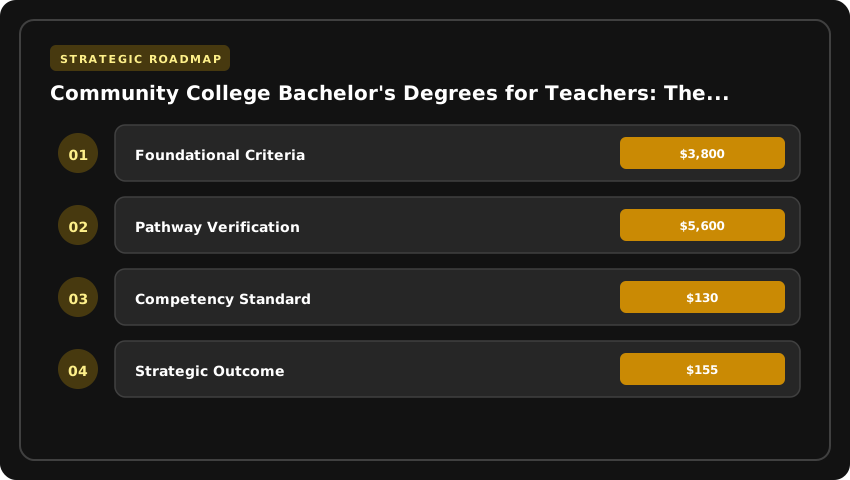
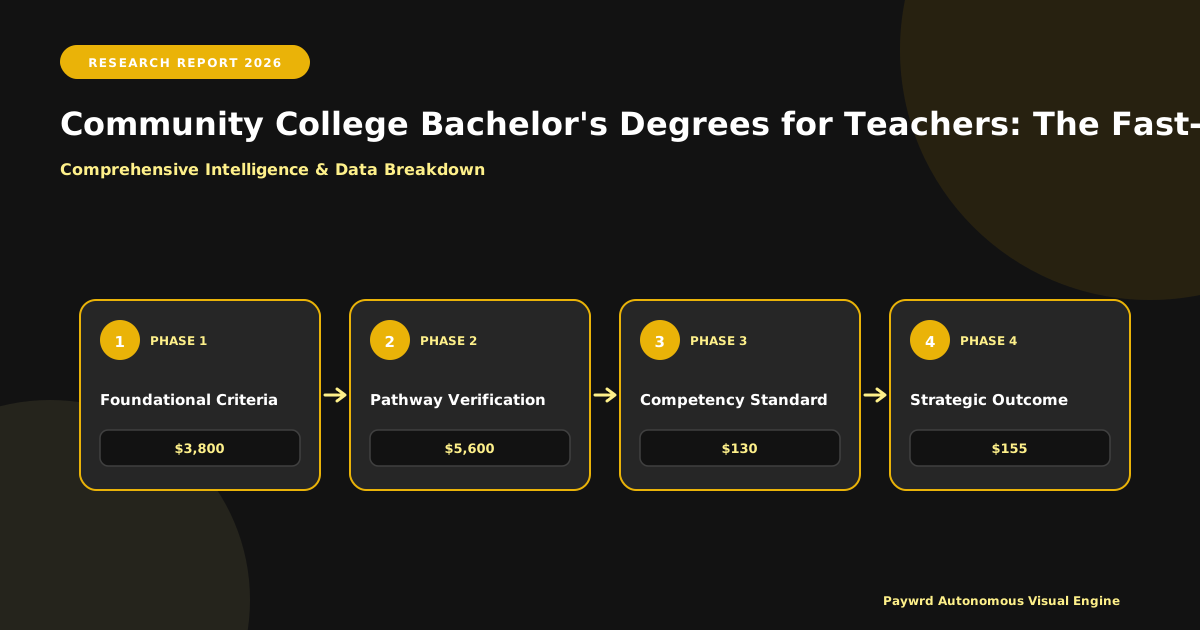
For the working early childhood educator who already holds an Associate of Arts (AA) or Associate of Applied Science (AAS) in Early Childhood Education, the 2+2 bachelor’s pathway is engineered to honor prior learning rather than waste it. The most valuable currency in this transfer architecture is the Child Development Associate (CDA) National Credential, awarded by the Council for Professional Recognition. Because the CDA is grounded in 120 hours of formal early childhood training, 480 hours of documented work experience, a professional portfolio, and a verified observation by a Professional Development Specialist, community colleges routinely map the credential toward 30 to 42 semester credits—essentially an entire academic year of advanced standing. At institutions such as Pikes Peak State College in Colorado, Seminole State College in Florida, and Washtenaw Community College in Michigan, this translates to roughly $3,800 to $5,600 in tuition savings, since in-state community college tuition averages $130 to $155 per credit in the 2025-2026 academic year, according to the College Board’s Trends in College Pricing report.
Once the CDA block is locked in, the upper-division curriculum typically unfolds across four academic semesters of 15 credits each, weaving together developmental psychology, emergent literacy, mathematics and science pedagogy, child assessment, and inclusive classroom practices. A representative course map reads much like a learning arc from theory to praxis:
- Foundations Block (Semester 1): Child Development from Birth to Age Eight, Language Development in Multilingual Learners, and Foundations of Early Childhood Education. Courses align with NAEYC Standard 1 (Promoting Child Development and Learning) and Standard 2 (Building Family and Community Relationships).
- Curriculum and Instruction Block (Semester 2): Emergent Literacy and Phonics, Teaching Mathematics in Early Childhood, and Integrated STEAM Curriculum Design. These courses cover the science of reading aligned with state literacy statutes and the Council for Exceptional Children’s evidence-based practices for PreK-3 learners.
- Assessment and Inclusive Practice Block (Semester 3): Authentic Assessment, Observation, and Documentation; Behavior Guidance and Trauma-Informed Teaching; and Early Childhood Special Education. Learners typically master tools such as the Teaching Strategies GOLD assessment system and the Ages and Stages Questionnaire (ASQ-3).
- Capstone and Clinical Fieldwork Block (Semester 4): A senior capstone seminar paired with the clinical practicum, which serves as the culminating evidence for state licensure and the baccalaureate degree.
The clinical fieldwork requirement is the heart of the 2+2 program and the component most scrutinized by state Departments of Education. Most participating community colleges align their practicum hours with the Council for the Accreditation of Educator Preparation (CAEP) and state-specific early childhood license endorsements, which range from 300 to 800 documented clock hours. For example, Florida’s Prekindergarten/Primary Education (PK/Primary) endorsement requires a minimum of 480 hours, while Colorado’s Early Childhood Education (Age 3 to Grade 3) license calls for approximately 800 hours of field-based experience, distributed across at least three grade bands (PreK, kindergarten, and primary grades 1-3). Texas similarly mandates that candidates complete a minimum of 300 clock hours in early childhood settings under the guidance of a certified mentor teacher, broken into scaffolded pre-student teaching and student teaching phases.
Fieldwork placements are intentionally arranged in NAEYC-accredited or equivalent high-quality early learning environments—public PreK classrooms, Head-1 programs, lab schools hosted by the community college, and Reggio-inspired child care centers—so candidates observe authentic assessment, lesson study cycles, and family engagement practices in real time. The capstone course then requires candidates to design, implement, and evaluate a four-to-six-week action research project or thematic unit, submit a professional e-portfolio, and pass a state-approved edTPA or equivalent performance assessment. Candidates who complete this sequence graduate eligible to apply for an initial state teaching license in PreK-3 or Birth-Grade 3, with many institutions also pairing the degree with a Reading Endorsement or English to Speakers of Other Languages (ESOL) endorsement to expand employability across districts.
The takeaway is clear: a 2+2 bachelor’s curriculum is not a watered-down version of a traditional four-year program. It is a deliberately compressed, competency-mapped pathway that validates real credentials, costs roughly $22,000 to $28,000 in total tuition at most public community colleges—less than a single year at a flagship state university—and culminates in the same state license, the same accreditation standing, and the same career advancement eligibility, all while the early educator continues to earn a paycheck in the classroom.
Cost Breakdown: Tuition, FAFSA Pell Grants, and Loan Limits for Working Educators
Money is rarely the headline reason a person becomes a teacher, but it is almost always the deciding factor in whether that person can stay in the classroom long enough to matter. Working educators who return to school for a community college bachelor’s degree (often called a Bachelor of Applied Science or BAS in Early Childhood Education) are usually balancing a paycheck, a family, and a caseload of small humans. They need a credential that is academically rigorous, regionally respected, and financially survivable. Fortunately, this is precisely the gap the two-year, four-year pathway was designed to fill, and the math on tuition, grants, and loans tells a very encouraging story when compared to the cost of a traditional state university route.
Tuition Benchmarks: Community College vs. State University. Across the United States, in-state tuition for the upper-division coursework in a community college bachelor’s program generally falls between $180 and $340 per credit hour. That range reflects the 2024-2025 published rates at flagship programs such as Broward College in Florida, St. Petersburg College, the City Colleges of Chicago, and Eastern New Mexico University-Ruidoso, all of which sit at or under the $300 threshold. Because most BAS pathways are designed as 60 upper-division credits beyond an associate degree, the total tuition for the final two years typically lands between $10,800 and $20,400.
By contrast, a traditional state university bachelor’s in education generally charges between $400 and $950 per credit hour for in-state undergraduates. Flagship public universities like the University of Florida, the University of Texas at Austin, and the University of Illinois Urbana-Champaign now post tuition figures between $6,500 and $11,000 per semester for full-time enrollment, which translates to roughly $400 to $600 per credit. Out-of-state and private alternatives climb even higher, often exceeding $1,200 per credit. A 60-credit upper-division sequence at a state university can therefore cost anywhere from $24,000 to $57,000, which is roughly two to four times the community college price tag.
- Community college BAS tuition: $180-$340 per credit (approx. $10,800-$20,400 total)
- State university tuition: $400-$950 per credit (approx. $24,000-$57,000 total)
- Average savings over two years: $13,200 to $36,600
Federal Pell Grant Disbursements for Independent Students. Tuition is only part of the equation; the real affordability story lives in the FAFSA data. For the 2024-2025 award year, the maximum Federal Pell Grant is $7,395 per academic year, and the Department of Education has confirmed that maximum will rise to $7,500 for 2025-2026. Independent students who file their own FAFSA (no parental contribution, usually because they are over 24, married, a parent themselves, or a veteran) often qualify for the full award. Working educators frequently fall into this category, especially if they are head-of-household filers supporting children on a teacher’s salary.
For a student enrolled full-time across the fall and spring semesters, the Pell Grant is typically disbursed in two equal payments of roughly $3,697 each. Summer enrollment can unlock a third disbursement if the student is enrolled at least half-time during the summer term, a common arrangement for educators using the summer to accelerate their timeline. Over a two-year BAS completion, a maximum-Pell independent student can receive between $14,790 and $15,000 in grant funding that does not need to be repaid. When combined with state-level Teacher Shortage Scholarships and workforce grants, the net out-of-pocket cost for many community college BAS students drops below $4,000 across the entire program.
- Maximum Pell Grant (2024-2025): $7,395
- Projected maximum Pell Grant (2025-2026): $7,500
- Two-year Pell total at maximum award: $14,790-$15,000
- Repayment obligation: $0 (grant funds, not loans)
TEACH Grant Eligibility and the Title I Service Obligation. The Teacher Education Assistance for College and Higher Education (TEACH) Grant is the single most powerful federal tool for pre-service and in-service teachers, and it pairs especially well with the community college BAS pathway. The TEACH Grant provides up to $4,000 per year ($8,000 across two years of upper-division study) to students who commit to serving in a high-need field at a low-income school, more commonly known as a Title I school. To remain eligible, a recipient must complete a FAFSA, maintain a 3.25 GPA, and complete the TEACH Grant counseling and Agreement to Serve (ATS) on the Federal Student Aid portal each year.
The service obligation is concrete and enforceable. Recipients must teach full-time for at least four complete academic years within eight calendar years of finishing their program, in a Title I school, in a high-need subject area (which currently includes early childhood education, special education, bilingual education, mathematics, and science, among others). If a recipient fails to meet the obligation, the grant retroactively converts to an unsubsidized Direct Loan, complete with accrued interest from the original disbursement date. For working educators, the practical takeaway is straightforward: teaching in a Title I early childhood classroom is the closest thing to a tuition-free pathway that exists in American higher education.
Federal Direct Loan Limits for Working Educators. Even with maximum Pell and TEACH awards, most students need to bridge a small funding gap, and that is where federal student loans enter the picture. For undergraduate students, the annual Direct Loan limits are $5,500 for first-year students, $6,500 for sophomores, and $7,500 for juniors and seniors, with a lifetime undergraduate cap of $31,000. Independent students and those whose parents cannot borrow a PLUS Loan are eligible for an additional $4,000 to $5,000 in unsubsidized Direct Loans each year, depending on grade level. Because community college BAS tuition is so much lower than state university tuition, most students never approach these ceilings, and the typical graduating debt for a community college teacher pathway is dramatically smaller than the national average of $30,000 for a four-year degree.
- Annual unsubsidized Direct Loan add-on for independent students: up to $6,000 at upper-division level
- Lifetime undergraduate federal loan cap: $31,000-$57,500 depending on dependency status
- Typical community college BAS graduate debt: $5,000-$15,000 (well below national average)
Actionable Takeaways for Working Educators. Before enrolling, file the FAFSA as early as October 1, list every community college BAS program you are considering, and confirm each school’s federal school code. Ask the financial aid office to model a four-semester award letter that includes Pell, TEACH, and state teacher scholarship stacking. If you are currently employed in a Title I classroom, document that status carefully, because it strengthens both TEACH Grant eligibility and future loan-forgiveness applications through Public Service Loan Forgiveness (PSLF) after graduation. And finally, run the numbers side by side: at the high end, a community college BAS costs roughly $20,400 before aid, a state university costs roughly $57,000, and a single maximum TEACH Grant can cover nearly 20 percent of the community college price tag outright. The financial case for the two-year-to-four-year pathway is no longer subtle; it is one of the strongest economic arguments in American higher education today.
State Approval, Accreditation, and Reciprocity for Out-of-State Transfers
When evaluating a community college bachelor’s degree for educators, the three regulatory layers that protect your investment of time, energy, and tuition dollars are programmatic accreditation, regional institutional accreditation, and state-level approval to recommend candidates for licensure. Each layer operates independently, and a program that satisfies all three is positioned to support a teaching career across state lines, whereas a program that satisfies only one or two may create frustrating barriers the moment a graduate relocates for a spouse’s job transfer, military reassignment, or simply a better salary schedule in a neighboring state.
The first layer, programmatic accreditation, is typically granted by specialty bodies recognized by the Council for Higher Education Accreditation (CHEA) or the U.S. Department of Education. For early childhood, elementary, and special education programs, the two most common accreditors are the Council for the Accreditation of Educator Preparation (CAEP) and its predecessor legacy bodies such as the National Council for Accreditation of Teacher Education (NCATE) and the Teacher Education Accreditation Council (TEAC). When a community college program lists CAEP accreditation, graduates can be confident that the curriculum has been reviewed against nationally accepted standards for clinical practice, content knowledge, and candidate assessment. A smaller subset of programs, particularly those housed in career and technical education divisions, may pursue accreditation through organizations like the Association of Career and Technical Education, but most transfer-friendly baccalaureate pathways will display the CAEP seal prominently on their institutional web pages.
The second layer, regional institutional accreditation, is the credential most often required for credit transfer and for graduate school admission. The seven regional accreditors are the Higher Learning Commission (HLC), the Northwest Commission on Colleges and Universities (NWCCU), the New England Commission of Higher Education (NECHE, formerly NEASC), the Middle States Commission on Higher Education (MSCHE), the Southern Association of Colleges and Schools Commission on Colleges (SACSCOC), the WASC Senior College and University Commission (WSCUC), and the WASC Accrediting Commission for Community and Junior Colleges (ACCJC). Community college bachelor’s programs generally fall under the jurisdiction of the same regional body that accredits their parent institution. The HLC oversees the largest share of these programs, including those in Illinois, Minnesota, Iowa, Wisconsin, Michigan, and Ohio. NWCCU accredits community college baccalaureates in Washington and Oregon, while NECHE accredits programs in Connecticut and Massachusetts. Because these regional accreditors operate under reciprocal agreements codified in the Interregional Accrediting Committee’s (IAC) policies, a regionally accredited degree from one jurisdiction is generally recognized by institutions and licensing bodies in another.
The third layer, state approval, is where reciprocity becomes most consequential. Every U.S. state maintains a Department of Education or Office of Educator Licensing that publishes an approved list of teacher preparation programs. Graduating from an approved program in the issuing state is the simplest pathway to a reciprocal license in a destination state, but only if that destination state has signed onto a licensure reciprocity compact. The most comprehensive compact is the National Association of State Directors of Teacher Education and Certification (NASDTEC) Interstate Agreement, which nearly every state has signed. Under this agreement, a teacher who completes a state-approved program in one member state and earns an initial license can apply for a comparable license in another member state, often with additional testing or a fingerprint-based background check but generally without repeating an entire preparation program.
For community college bachelor’s graduates specifically, the practical implications of reciprocity deserve careful attention. First, verify that the awarding institution appears on the approved list published by the state Department of Education in which the program is offered. Second, confirm that the regional accreditor is recognized by the destination state’s licensing office; a handful of states decline to accept degrees from institutions accredited solely by national, faith-based, or specialized accreditors, but regional accreditation is universally honored. Third, before relocating, request a transcript evaluation through a service recognized by the American Association of Collegiate Registrars and Admissions Officers (AACRAO) if graduate study is anticipated, and consult the NASDTEC Educator Identification (ID) database to confirm that your credential will travel cleanly across state lines.
Actionable steps for prospective students include saving copies of the program’s CAEP accreditation letter, the institutional regional accreditation status page, and the state approval verification screenshot. These three documents, stored in a portable digital folder, will streamline any future transfer, endorsement, or out-of-state application. When in doubt, a fifteen-minute phone call with the destination state’s Office of Educator Licensing can clarify whether additional coursework, a Praxis or edTPA submission, or a mentoring period will be required. With the right documentation in hand, a community college bachelor’s degree in education is a credential designed for geographic mobility as much as for classroom readiness.
Career Outcomes: Salary Schedules, Title I Bonus Pay, and Master’s Degree Acceleration
For early childhood educators considering the leap from an associate degree or Child Development Associate (CDA) credential to a Bachelor of Applied Science (BAS) or Bachelor of Science in Early Childhood Education, the financial payoff begins on day one of professional service. Across major metropolitan public school districts in the United States, a freshly minted pre-K lead teacher holding a bachelor’s degree typically enters the salary schedule between $48,000 and $62,000 annually, depending on geographic region, cost of living, and local collective bargaining agreements. In high-demand urban hubs such as Chicago, Houston, Los Angeles, Miami-Dade County, and the greater New York City metropolitan area, starting salaries for bachelor-prepared pre-kindergarten teachers frequently reach the upper band of this range, while mid-sized cities in the Midwest and Southeast tend to anchor closer to the $48,000 to $54,000 entry point. These figures represent the baseline gross compensation before any supplemental stipends, retention bonuses, or differentiated pay incentives are applied.
The salary differential between a two-year credential holder and a bachelor’s-prepared educator is not incremental—it is structural. Most public district salary schedules across the country are organized into vertical “lanes” tied directly to academic attainment. An associate degree typically places a teacher on Lane 1 or Lane 2, which in many districts caps annual earnings near $40,000 to $44,000 even after a decade of service. Earning a bachelor’s shifts the educator into Lane 3 or Lane 4, unlocking not only a higher starting wage but also additional horizontal “step” increases for each year of classroom experience. Over a 25-year career, this lane placement alone can compound into a six-figure lifetime earnings advantage when pension contributions, retirement matching, and cost-of-living adjustments are factored in.
- Federal Title I Bonus Pay: Teachers assigned to schools qualifying for Title I federal funding—often the highest-need urban campuses—frequently receive annual supplemental stipends ranging from $1,500 to $5,000, with many districts stacking this bonus on top of the bachelor’s lane placement. Head Start lead instructors working in district-operated or federally grantee programs may also qualify for additional early childhood incentive pay under the Head Start Act workforce compensation initiatives.
- Master’s Degree Acceleration: The community college bachelor’s pathway is uniquely engineered to feed directly into graduate study. Articulation agreements with partner universities—including regional state systems, Hispanic-Serving Institutions, and AACSB- or CAEP-accredited schools—commonly allow graduates to apply up to 30 graduate credits toward a Master of Education (MEd), Master of Arts in Teaching (MAT), or Master of Science in Education (MSEd) program, trimming the traditional 36-credit master’s down to as few as 24 to 30 credits.
- Tuition Discounts and Cohort Models: Many partnerships offer in-state tuition rates, cohort-based evening classes, and embedded practicum experiences that allow working teachers to complete a master’s in 12 to 18 months while maintaining full salary and benefits.
Actionable takeaway for prospective educators: request the official salary schedule PDF from any district under consideration, locate the exact lane placement for a bachelor’s degree, and cross-reference that with Title I school rosters. Then map that salary trajectory against the accelerated master’s pathway at the partner university named in the articulation agreement. The arithmetic is straightforward—a bachelor’s degree secured through a community college-based BAS program typically pays for its remaining tuition within two to four years of full-time classroom service, with master’s acceleration adding another $4,000 to $8,000 in annual lane-schedule earnings thereafter.
Application Strategy: Transfer Articulation Agreements and Rolling Enrollment Deadlines
Navigating the admissions landscape for a community college bachelor’s degree in early childhood education requires a fundamentally different playbook than the one most transfer guides describe. Traditional transfer pathways assume a student completes an associate degree, then applies separately to a four-year institution through a standard cycle. The community college bachelor’s model collapses that distance: you apply, enroll, and progress within a single institutional framework, often with the same advisor from orientation through student teaching. That structural difference changes everything about how you should plan your application timeline, evaluate your prior credits, and select the right entry point.
The single most important strategic decision is identifying whether your state and your target program operate under a guaranteed admissions agreement, sometimes called a transfer articulation agreement, a 2+2 pathway, or a seamless transfer compact. In states like Washington (Direct Transfer Agreements), Florida (2+2 Articulated Programs), Texas (Field of Study curricula), and Ohio (Transfer Assurance Guides), community college coursework is pre-mapped to satisfy lower-division requirements at flagship state universities such as the University of Central Florida, the University of Texas at Austin, and Ohio State University. When you complete an Associate of Arts in Teaching or Associate of Science in Early Childhood Education under one of these agreements, your credits are not merely “accepted in transfer”; they are contractually guaranteed to count toward the bachelor’s degree, provided you maintain a minimum GPA (typically 2.5 to 3.0) and apply to the partner institution by the published deadline.
Students should treat the articulation agreement as a binding financial planning document. If your community college has a formal compact with a public university system, you can often lock in resident tuition rates for the upper-division coursework, saving anywhere from $8,000 to $22,000 compared to out-of-state or private alternatives. Verify the agreement’s expiration date, confirm whether the program is offered on your home campus or requires relocation, and ask whether the bachelor’s completion cohort includes hybrid or evening formats designed for working paraprofessionals.
Understanding rolling enrollment deadlines is the second critical lever. Unlike flagship universities that observe hard November 1 or January 15 priority dates, most community college bachelor’s programs review applications continuously and admit students for multiple start terms: fall, spring, and sometimes summer. The practical advantage is that a strong applicant who applies in March can often begin coursework in May rather than waiting nine months. The practical risk is that competitive cohorts, particularly those with capped enrollment due to clinical placement requirements in partner school districts, can close without warning. Submit your application at least 8 to 12 weeks before your intended start term to allow time for transcript evaluation, background check clearance (required for any field experience in a K-3 setting), and financial aid processing.
For the application itself, you will almost never use the Common App. Community college bachelor’s programs rely on institutional applications, either the state-wide community college application (such as the Florida Shines application gateway, the Washington State Board for Community and Technical Colleges portal, or the California Community Colleges CCCApply system) or the home-campus application portal. This is administratively simpler: no letters of recommendation are typically required, no personal statement of 650 words, and no consideration of SAT or ACT scores. What institutions do weigh heavily is your high school transcript or GED scores, any prior college transcripts, and a short goal statement (often 200 to 400 words) explaining your interest in early childhood education. Some programs, particularly those partnered with Teach For America or state alternative certification networks, request a brief structured interview.
Adult learners and career changers should pay special attention to the non-traditional credit evaluation process. If you have military training, professional development from a school district, Child Development Associate (CDA) credential, or coursework completed at a regionally unaccredited institution, expect a separate portfolio review rather than an automatic transcript match. Most community colleges will evaluate up to 30 to 45 semester hours of prior learning credit, but the documentation burden falls on you. Prepare a credit portfolio that includes course descriptions, learning outcomes, and a crosswalk showing how each experience aligns with the program’s competency framework. The American Council on Education (ACE) credit recommendations serve as the national benchmark, and institutions that have earned ABET-equivalent recognition through their regional accreditor (such as SACSCOC, HLC, or MSCHE) typically accept ACE-recommended credit without additional petition.
Build a 12-month admissions calendar that front-loads these milestones: Month 1-2, finalize your program shortlist and confirm articulation agreements; Month 3-4, request all official transcripts and complete prior learning documentation; Month 5-6, submit your institutional application and FAFSA (priority deadline for maximum Pell Grant eligibility is typically June 30 for the following academic year, but state grants often close earlier); Month 7-9, complete any required placement testing or background checks; Month 10-12, attend orientation and register for your first term. Treating this as a structured project, rather than a single application event, is the difference between a seamless transfer and a delayed graduation.
| Metric | Community College Bachelor’s (ECE) | Traditional 4-Year University | Associate + Transfer Pathway |
|---|---|---|---|
| Total In-State Tuition (Est.) | $10,000–$15,000 | $40,000–$100,000+ | $25,000–$45,000 (Combined) |
| Admission GPA Cut-off | 2.0–2.5 (Often open access) | 3.0–3.5+ (Competitive) | 2.5–3.0 for Transfer Admission |
| Time to Degree (Full-Time) | 2–3 Years (Post-Associate) | 4 Years | 4–5 Years (Credit Loss Risk) |
| Timeline (Night-Shift/Working) | 3–4 Years (Designed for Cohorts) | 5–6+ Years (Limited Evening Sections) | 5–7 Years (Scheduling Conflicts) |
| Student-to-Faculty Ratio | 15:1 – 20:1 | 25:1 – 40:1 (Lower Division) | Varies by Institution |
| Clinical/Student Teaching Hours | 600+ Hours (Embedded Locally) | 400–600 Hours | 400–600 Hours (Senior Year) |
| Median Starting Salary (ROI) | $38k–$45k (Debt-Free Advantage) | $38k–$45k (High Debt Burden) | $38k–$45k (Moderate Debt) |
| State Licensure Pass Rates | 90%+ (Aligned to State Standards) | 92%+ | 88%+ |
Frequently Asked Questions
Which states currently allow community colleges to award bachelor’s degrees in Early Childhood Education?
As of 2024, over 24 states—including California, Colorado, Florida, Texas, and Washington—authorize community colleges to confer applied bachelor’s degrees in Early Childhood Education. Authority is granted via state legislature or higher education coordinating boards, often restricted to workforce-critical fields like teaching to address local shortages.
How much does a community college bachelor’s degree in teaching cost compared to a public university?
Total tuition for a community college bachelor’s typically ranges from $10,000 to $15,000 for in-district residents. This represents a 60–80% savings over public university tuition ($40,000–$100,000+), allowing graduates to enter the workforce with minimal debt while meeting identical state licensure requirements.
Are community college bachelor’s degrees fully recognized for state teacher licensure and certification?
Yes. Programs approved by state departments of education and accredited by bodies like CAEP or NAEYC meet identical licensure standards as university degrees. Graduates sit for the same Praxis or state exams, complete equivalent student-teaching hours, and receive the same initial teaching credentials recognized across reciprocal states.
Can I complete a community college teaching bachelor’s while working full-time as a paraprofessional?
These programs are explicitly designed for the night-shift workforce, offering hybrid, weekend, and asynchronous cohorts. Credit for prior learning (CPL) often awards 15–30 credits for CDA credentials or work experience, enabling working paraprofessionals to graduate in 2–3 years without leaving their current classroom positions.
Strategic Final Takeaway
Success in evaluating Community College Bachelor's Degrees for Teachers: The Fast-Track Pathway relies on early preparation, adherence to verified accredited requirements, and cross-referencing official portals. Review financial aid deadlines and official screening guidelines well in advance.

