

Which California Community Colleges Now Offer 4-Year Bachelor Degree Programs in 2026?
For students in Nigeria and across West Africa who have successfully navigated WAEC/NECO examinations and the rigorous JAMB UTME, the global higher education landscape is evolving rapidly. Just as the Nigerian NUC CCMAS framework has redefined local curriculum standards to meet modern workforce demands, the California Community Colleges (CCC) system has undergone a historic transformation. Thanks to the lifting of the legislative cap under the updated 2021-2026 education code provisions, the California Community Colleges Chancellor’s Office can now authorize up to 30 districts—encompassing more than 70 campuses—to confer four-year baccalaureate degrees. This expansion provides a highly affordable alternative for international students looking beyond local Post-UTME cutoffs, offering specialized degrees that align directly with global industry needs.

The expanded roster of approved institutions includes highly regarded schools such as Fresno City College, Santa Monica College, and Modesto Junior College. These institutions are not simply offering generic degrees; they are pioneering highly specialized, career-focused programs. Students can now pursue Bachelor of Science degrees in critical fields such as Respiratory Care, Dental Hygiene, Mortuary Science, and Industrial Automation. For a Nigerian student weighing the costs of studying abroad—especially when local options might require navigating stringent Post-UTME cutoffs or waiting for NELFUND student loan disbursements—these CCC programs offer a unique value proposition. While tuition will be paid in US dollars rather than Naira (₦), the cost remains a fraction of what traditional four-year universities charge, making global education significantly more accessible.
- Fresno City College: Renowned for its advanced Industrial Automation and Respiratory Care baccalaureate tracks.
- Santa Monica College: Offering cutting-edge degrees in fields like Interaction Design and Dental Hygiene.
- Modesto Junior College: Pioneering specialized programs including Mortuary Science and advanced agricultural technology.
It is crucial to understand the distinction between the original pilot programs and the fully approved baccalaureate degrees available in 2026. The initial pilot programs were limited in scope, strictly monitored, and temporarily authorized to test the viability of community colleges granting four-year degrees. Now, under the permanent legislative framework, these degrees are fully approved, accredited, and seamlessly integrated into the state’s higher education matrix. This means that degrees earned from these CCCs hold the same academic weight as those from traditional universities, both in the United States and internationally.
For West African applicants, this shift is monumental. Instead
Total Tuition Costs: Community College Bachelor Degree vs. CSU or UC in 2026
For Nigerian and West African students considering a California education pathway, understanding the true cost of a four-year baccalaureate is essential for budget planning, especially when comparing options against domestic tuition under the NUC CCMAS framework or the costs associated with relocating abroad. California Community Colleges (CCCs) offering bachelor degrees in 2026 present one of the most affordable routes to a recognized American qualification, with tuition structures designed to keep higher education within reach for working adults, transfer students, and international applicants seeking value without sacrificing academic quality.
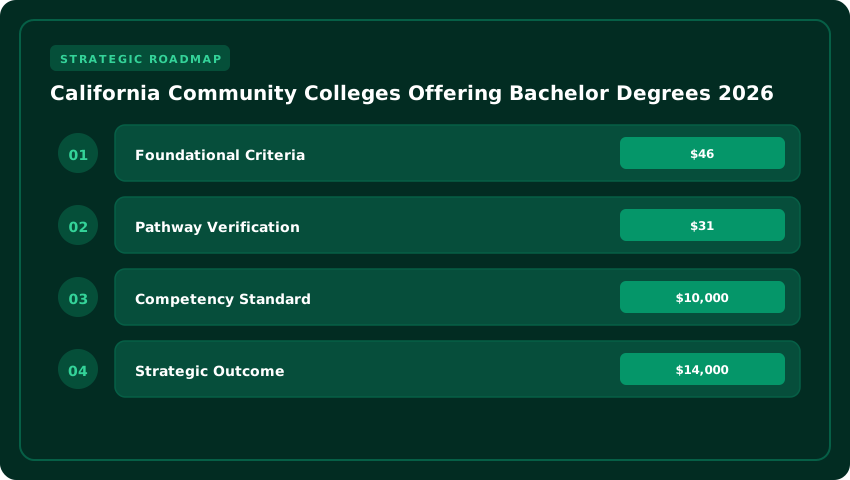
For the 2025–2026 academic year, California residents pursuing an upper-division bachelor degree at a participating CCC pay a flat tuition rate of $46 per semester unit, which is significantly lower than the standard lower-division community college fee of $31 per unit. Because most baccalaureate programs require approximately 120 semester units to graduate (with around 60 upper-division units completed at the community college level), the total tuition for a full bachelor degree for a California resident typically falls between $10,000 and $14,000. When students add required fees, books, and living expenses, the all-in cost rarely exceeds $26,000 across the entire four-year sequence, making it one of the most economical accredited pathways in the United States.
Non-resident students, including international applicants from Nigeria, Ghana, or other West African nations, face a different fee schedule. In 2026, non-California residents enrolled in CCC bachelor programs pay roughly $300 to $400 per semester unit in capital outlay and tuition surcharges, depending on the specific college. International students on F-1 visas typically pay between $350 and $420 per unit, which translates to a total degree cost ranging from $21,000 to $32,000 for tuition alone. While this is higher than resident tuition, it remains dramatically lower than equivalent programs at public universities or private institutions.
Compare this to the California State University (CSU) system, where 2026 tuition for residents runs approximately $6,000 to $7,500 per academic year, culminating in roughly $24,000 to $32,000 over four years. Non-resident and international CSU students, however, often pay an additional $420 per unit surcharge, pushing their totals well beyond $60,000 for the degree. At the University of California (UC) system, resident tuition plus student fees for 2026 averages around $14,000 to $16,000 annually, totaling $45,000 to $60,000 across four years, while non-resident undergraduates face total costs frequently exceeding $140,000 to $180,000 once living expenses and supplementary fees are factored in.
- CCC Resident Total (4 years): ~₦15,000,000 to ₦40,000,000 (≈$10,000–$26,000 USD)
- CSU Resident Total (4 years): ~₦36,000,000 to ₦48,000,000 (≈$24,000–$32,000 USD)
- UC Resident Total (4 years): ~₦54,000,000 to ₦69,000,000 (≈$36,000–$45,000+ USD)
- UC Non-Resident Total (4 years): ~₦216,000,000+ (≈$140,000+ USD)
One of the most powerful cost-saving tools available to qualifying students is the California College Promise Grant (CCPG), formerly known as the Board of Governors Fee Waiver. This grant completely eliminates enrollment fees for California residents who demonstrate financial need, including those enrolled in upper-division coursework. For students who qualify under the CCPG’s “Method A” (CalWORKS recipient), “Method B” (monthly income below set thresholds), or “Method C” (any Pell Grant recipient), the tuition component of their bachelor degree is effectively covered, though some colleges still require payment of the $10 to $25 campus-based fees per semester. For Nigerian students already familiar with how JAMB UTME fee waivers or NELFUND student loan disbursements function, the CCPG operates on a similar principle of reducing out-of-pocket expenses for qualifying applicants.
Working adults juggling employment, family obligations, and studies can further reduce their financial burden through strategic textbook and materials planning. Many CCC bachelor programs now embrace Open Educational Resources (OER), which are zero-cost digital textbooks aligned with course learning outcomes. Students should also explore institutional library reserves, rented textbooks through services like Amazon Rental or Chegg, and course-material scholarships offered by campus foundations. Additionally, enrolling in accelerated winter or summer intersessions can help students complete units faster while taking advantage of compressed fee schedules, ultimately lowering the total semester-unit burden.
For international students, exploring whether their home country’s scholarship body, such as the Nigerian Education Trust Fund (TETFund) or bilateral exchange agreements, recognizes CCC bachelor credentials is a smart move, since several community college degrees in fields like Health Information Technology, Industrial Technology, and Cybersecurity are now accredited by WASC Senior College and University Commission (WSCUC), making them portable for graduate studies and professional licensure both domestically and abroad.
Step-by-Step Admission Process for Working Adults and Single Parents
Pursuing a bachelor degree through the California Community College system in 2026 is one of the most practical and affordable pathways available to working adults and single parents across the West African diaspora, but the process requires careful navigation of the CCCApply portal, prerequisite verification, and upper-division transfer requirements that differ significantly from what students experience in Nigerian tertiary institutions. Understanding each stage in sequence helps you avoid costly delays, especially when coordinating applications with JAMB UTME deferments, NELFUND student loan disbursement cycles back home, and Post-UTME result release windows.
Begin by creating your CCCApply account at least 90 days before your intended fall 2026 start date. The portal functions similarly to JAMB’s CAPS interface in that it centralises your demographic data, academic history, and program selections, but it requires an openCCC account that remains valid across all 116 California community colleges. Nigerian applicants with WAEC or NECO results must request official transcript evaluations through a credential service such as WES or ECE, and upload scanned copies of their JAMB UTME result slips and Post-UTME admission letters where relevant. After submission, you will receive a ten-digit CCCID number, which serves as your student identifier for enrollment, library access, and child care subsidy applications.
Prerequisite verification represents the most overlooked step. Most community college bachelor programs in 2026 mandate lower-division coursework in English composition, college mathematics, oral communication, and critical thinking before you can declare upper-division status. Working adults who previously completed associate degree for transfer (ADT) pathways gain significant priority admission, because California Education Code Section 66746 guarantees ADT holders admission to the California State University system and, increasingly, to participating CCC bachelor programs with junior standing. If you earned an ADT in business administration, early childhood education, or public safety administration, present your degree audit report during intake to lock in priority consideration and waive redundant coursework.
Flexible enrollment options have expanded substantially in 2026 to accommodate single parents juggling shift work and childcare responsibilities. Hybrid classes combine asynchronous online lectures with one evening lab session per week, while dedicated weekend cohorts meet Saturdays from 8:00 a.m. to 4:00 p.m. on campuses in Los Angeles, San Diego, and Sacramento. Evening sections typically run 6:00 p.m. to 9:30 p.m., Monday through Thursday, and several districts now offer competency-based education (CBE) pathways where you advance by demonstrating mastery through project portfolios rather than seat time. For a 12 to 15 unit semester balanced against full-time employment, plan for roughly 18 to 22 hours of weekly study, ideally front-loaded on Saturday and Sunday mornings when childcare may be available through extended family.
Child care support is a deciding factor for many single parents, and CalWORKS childcare subsidies can cover up to 100% of licensed provider costs for eligible students enrolled at least half-time. Apply through your county social services agency before classes begin, and request a priority registration code from the campus child development centre, which reserves infant and toddler slots for student-parents. Parking logistics also warrant early planning: most urban campuses charge between $4.50 and $7.00 daily, but semester permits ranging from $150 to $250 offer better value if you commute three or more days weekly. Coordinate your CCCApply submission with NELFUND disbursement timelines so that tuition holds do not delay your enrollment confirmation, and you will enter fall 2026 with a clear, achievable roadmap toward graduation.
- CCCApply preparation: Open your account 90 days ahead, upload evaluated WAEC/NECO transcripts, and retain your CCCID number for all future transactions.
- ADT priority admission: Submit your associate degree for transfer audit report during intake to guarantee junior standing and waive redundant lower-division courses.
- Flexible scheduling: Choose hybrid, weekend, evening, or competency-based education formats that align with shift work and childcare availability.
- CalWORKS childcare: Apply through your county agency before registration to secure subsidies covering up to 100% of licensed provider fees.
- Parking and budgeting: Purchase a semester permit early, and coordinate tuition payments with NELFUND loan cycles to avoid enrollment holds.
High-Demand Career Pathways: Which Bachelor Degrees Lead to 6-Figure California Salaries?
For ambitious students in Lagos, Abuja, or Accra watching the California Community College Bachelor Degree landscape, the return on investment (ROI) is the ultimate metric. The 2025–2026 Bureau of Labor Statistics (BLS) projections for California reveal a stark reality: specific applied bachelor’s degrees—particularly the Bachelor of Science in Respiratory Care, BSN in Nursing, and Cybersecurity—routinely command starting salaries that dwarf the national average, often exceeding ₦150 million annually when converted at current parallel market rates. This is not theoretical; it is the calculated outcome of the California Community Colleges Baccalaureate Degree Program aligning curriculum directly with acute workforce shortages.
Consider the Respiratory Therapist pathway offered at colleges like Skyline College or Ohlone College. BLS data pegs the California median wage at $110,000–$135,000. Because these programs embed clinical rotations inside Kaiser Permanente and Sutter Health systems, students often transition seamlessly from practicum to payroll. Similarly, the RN-to-BSN completion degrees at San Diego City College or West LA College position graduates for $120,000–$155,000 roles in the Bay Area and Los Angeles basins—figures that make the total program tuition (often under $10,500 for the upper division) look like a rounding error compared to private university costs exceeding $200,000.
- Cybersecurity Analysts: Programs at MiraCosta and Coastline College feed directly into SOC (Security Operations Center) roles at major tech employers, yielding $95,000–$140,000 with zero student loan debt for many in-state residents.
- Air Traffic Controllers: The specialized degree at Mt. San Antonio College remains a “golden ticket” with federal hiring preference, median pay $140,000+, and a mandatory retirement pension.
- Dental Hygienists (BS): West LA College and Foothill College graduates enter private practice or DSO (Dental Service Organization) roles at $115,000–$130,000, often with signing bonuses covering relocation.
The debt-to-income ratio is where the community college bachelor’s degree obliterates the traditional four-year model. A Nigerian student funding studies via NELFUND or family savings faces a total cost of attendance (tuition + living expenses) roughly 40–60% lower than a CSU or UC counterpart. Graduating with $0–$15,000 in debt versus $60,000+ means your first paycheck builds wealth immediately, not debt service. For the West African professional targeting the H-1B cap-exempt hospital or university route, this financial velocity is the strategic advantage that turns a degree into a dynasty.
Cal Grant, Pell Grant, and Financial Aid Eligibility for Upper-Division Students
Students who advance into the junior and senior years of a California Community College bachelor’s degree program remain eligible for the same federal and state aid streams that supported their lower‑division coursework, with a few important nuances. Understanding how each program applies to upper‑division enrollment helps you plan budgets, meet deadlines, and avoid surprises when the tuition bill arrives.
Federal Pell Grant
The Pell Grant is the cornerstone of need‑based aid. For the 2025‑2026 award year the maximum award is $7,395. Eligibility is determined by the Free Application for Federal Student Aid (FAFSA) and is based on your Expected Family Contribution (EFC), enrollment intensity, and cost of attendance. Upper‑division students must maintain at least half‑time enrollment (typically 6 units per term) and continue to demonstrate financial need each year. Because the Pell Grant does not require repayment, it can be stacked with state awards to cover a substantial portion of tuition and fees.
Cal Grant B and C
Cal Grant B provides a living‑allowance stipend plus tuition assistance for students from low‑income households. Cal Grant C supports vocational and technical programs, but many bachelor‑degree pathways at community colleges are classified as “academic” and therefore fall under Cal Grant B. To remain eligible:
- Submit a verified GPA (minimum 2.0 for Cal Grant B) by the March 2 deadline.
- Maintain satisfactory academic progress (SAP) as defined by your college.
- Enroll at least half‑time in an eligible program each term.
Award amounts vary with enrollment status; full‑time students can receive up to $1,656 for living expenses plus tuition coverage that mirrors the Pell Grant’s need‑based calculation.
Middle‑Class Scholarship (MCS)
The MCS bridges the gap for families whose income exceeds Cal Grant limits but still struggle with college costs. For the 2025‑2026 year, awards range from 10% to 40% of the systemwide tuition fee, scaled by income and assets. Upper‑division students must:
- File a FAFSA or California Dream Act Application (CADAA) by the priority date.
- Have a household income ≤ $200,000 (for dependent students) or ≤ $150,000 (for independent students).
- Maintain SAP and enroll at least half‑time.
Because the MCS is applied after Pell and Cal Grant awards, it often reduces the remaining out‑of‑pocket balance to a manageable level.
California Dream Act for AB 540 Students
Undocumented students who meet AB 540 residency requirements can access state aid through the CADAA. The process mirrors the FAFSA:
- Complete the CADAA online at dream.csac.ca.gov (available Oct 1 – Mar 2).
- Submit AB 540 affidavit and any requested documentation to the college’s Admissions and Records office.
- List all California Community College bachelor’s programs you intend to attend; the CADAA will automatically calculate eligibility for Cal Grant B, C, and the Middle‑Class Scholarship.
- Monitor your WebGrants portal for award notifications and disbursement schedules.
Note that federal Pell Grant funds are not available to undocumented students, but state aid can cover a significant portion of tuition and living costs.
2026 Expansion of CalFresh for Low‑Income Bachelor Degree Candidates
Effective fall 2026, California expands CalFresh (SNAP) eligibility to include students enrolled in a bachelor’s degree program at a community college who meet income thresholds and work‑requirement exemptions. Key points:
- Students earning ≤ 200% of the federal poverty level (≈ $2,700 monthly for a single individual) may qualify.
- Enrollment in at least 6 units satisfies the “student” exemption; no work‑hour requirement is needed.
- Applications are processed through the county Human Services Agency; many colleges now host on‑site CalFresh enrollment fairs.
- Benefits provide up to $281 per month for groceries, easing the cost‑of‑living burden for upper‑division students juggling tuition, books, and transportation.
Combining CalFresh with Pell, Cal Grant, and MCS can dramatically reduce the need for private loans or extensive part‑time work.
Financial Aid Office Contacts at Major Participating Districts
Below are the direct lines and email addresses for the financial aid offices of the districts that have announced bachelor’s degree programs for 2026. Keep these handy for questions about award verification, document submission, or CalFresh enrollment assistance.
- Los Angeles Community College District (LACCD) – Main Office: (213) 891‑2000 • financialaid@laccd.edu
- San Diego Community College District (SDCCD) – Main Office: (619) 388‑6000 • finaid@sdccd.edu
- Foothill‑De Anza Community College District – Foothill College: (650) 949‑7000 • finaid@fhda.edu; De Anza College: (408) 864‑5600 • finaid@deanza.edu
- Contra Costa Community College District – Diablo Valley College: (925) 969‑2000 • financialaid@dvc.edu; Los Medanos College: (925) 473‑7500 • finaid@losmedanos.edu
- Santa Monica College – (310) 434‑4000 • financialaid@smc.edu
When you call, have your student ID, FAFSA/CADAA confirmation number, and a list of the specific bachelor’s program you’re pursuing ready. This speeds up verification and ensures you receive the most accurate, up‑to‑date award information.
By layering federal, state, and supplemental benefits— Pell Grant, Cal Grant B/C, Middle‑Class Scholarship, California Dream Act aid, and the new CalFresh expansion— upper‑division students at California Community Colleges can construct a robust financial aid package that keeps tuition affordable and living costs manageable. Stay proactive with annual FAFSA/CADAA renewals, monitor SAP requirements, and leverage your district’s financial aid office as a partner in your educational journey.
Transfer Credits, Accreditation, and Graduate School Acceptance Rates
For students in Nigeria and across West Africa planning a transition from WAEC or NECO results into the California Community College (CCC) bachelor’s pipeline, understanding accreditation is non-negotiable. Every CCC baccalaureate program operates under the WASC Senior College and University Commission (WSCUC), the same regional accreditor that governs Stanford, UCLA, and UC Berkeley. This parity means your degree carries identical federal recognition for graduate school admissions, professional licensure, and employer tuition reimbursement programs. When you apply for a Master’s program—whether at a CSU, a UC, or a private university like USC—admissions committees evaluate your transcript based on institutional accreditation, not the institutional label of “community college.”
However, the admissions pathway differs significantly from the traditional transfer route. If you enter a CCC bachelor’s program directly after secondary school (bypassing the standard Associate Degree for Transfer/ADT route), CSU and UC admissions offices evaluate you as a first-time freshman applicant for graduate school purposes, not as a junior-level transfer. This distinction preserves your eligibility for freshman-specific scholarships and housing guarantees at some universities. Conversely, if you transfer into a CCC bachelor’s program after earning units elsewhere, you must navigate ASSIST.org meticulously. This is the official articulation repository for California’s public segments. Always verify that your prior coursework—especially General Education (GE) Breadth or IGETC patterns—maps directly to the specific CCC program’s lower-division requirements before enrolling.
A critical structural constraint is the 70-semester-unit maximum transfer cap applied by the CSU and UC systems. Even if you accumulate 90 units at the community college level, only 70 transferable units count toward the 120-unit bachelor’s requirement. The remaining 20+ units are considered “excess” and satisfy subject requirements but do not reduce the total units needed to graduate. For Nigerian students holding WAEC/NECO credits or JAMB UTME scores, these are typically evaluated as “credit by exam” or advanced standing; they rarely articulate as direct course-to-course equivalents on ASSIST.org, so petition early with the CCC Evaluations Office.
To accelerate completion, leverage Prior Learning Assessment (PLA). California Education Code Section 78212 mandates that colleges award credit for validated learning outside the classroom. Actionable pathways include:
- Military Service: Submit your Joint Services Transcript (JST) for evaluation against ACE (American Council on Education) credit recommendations.
- Industry Certifications: Current CompTIA Security+, AWS Solutions Architect, PMP, or CNA licenses often articulate for 3–6 units each in IT, Business, or Health Science majors.
- Work Experience/Portfolio: Petition for Credit by Portfolio Assessment. This requires a faculty sponsor, a detailed narrative linking experience to Course Student Learning Outcomes (SLOs), and supporting evidence (letters from employers, project artifacts).
Pro Tip: Initiate PLA petitions during your first semester. Processing takes 8–12 weeks, and approved credits count toward residency requirements but do not count toward the 70-unit transfer cap, effectively giving you “free units” toward your 120-unit goal. For families budgeting in Naira (₦), maximizing PLA reduces the total semesters enrolled, directly lowering tuition outflow and living costs in high-cost California counties.
| College | Bachelor’s Program (Major) | Est. Annual Cost (₦) | Admission Cut-off / Reqs | Timeline (Yrs) | Career ROI (Median US Salary) |
|---|---|---|---|---|---|
| Foothill College | Dental Hygiene (B.S.) | ₦42,000,000 – ₦48,000,000 | Associate Degree (Dental Hygiene) + CA License; 2.5 GPA; WAEC/NECO eval | 2 (Upper Division) | $105,000 / High Demand |
| San Diego Mesa College | Health Information Mgmt (B.S.) | ₦40,000,000 – ₦46,000,000 | AS-T in HIT or 60 units + 2.5 GPA; RHIT eligibility preferred | 2 (Upper Division) | $95,000 / 16% Growth |
| Rio Hondo College | Automotive Technology (B.S.) | ₦38,000,000 – ₦44,000,000 | AS in Auto Tech + ASE Certs; 2.0 GPA; Portfolio review | 2 (Upper Division) | $85,000 / Specialized Niche |
| Solano College | Biomanufacturing (B.S.) | ₦41,000,000 – ₦47,000,000 | AS in Biotech/Science; 2.5 GPA; Calc/Chem prereqs; WAEC Sciences (C6+) | 2 (Upper Division) | $98,000 / Biotech Hub Access |
| Bakersfield College | Industrial Automation (B.S.) | ₦39,000,000 – ₦45,000,000 | AS in Electronics/Eng Tech; 2.0 GPA; Math/Physics proficiency | 2 (Upper Division) | $92,000 / Logistics/AG Tech |
Frequently Asked Questions
Can Nigerian students with WAEC/NECO results apply directly to California Community College Bachelor's programs?
No. CCC Bachelor's programs are upper-division only (years 3-4). Nigerian applicants must first complete an Associate Degree (60 units) at a CCC or accredited institution. WAEC/NECO (C6 or better in 5 subjects including Math/English) satisfies freshman admission to the Associate level, but not direct entry to the Baccalaureate program.
What is the total estimated cost in Naira for a 4-year California Community College Bachelor's degree for international students?
Budget ₦160M–₦190M for the full 4-year pathway (2 years Associate + 2 years Bachelor's). This covers non-resident tuition (~$300/unit), health insurance, and living expenses in California at ₦1,550/$1. Costs vary by college location; Bay Area colleges (Foothill) trend higher than Central Valley (Bakersfield).
Do California Community College Bachelor's degrees qualify for US work visas (H-1B) and OPT?
Yes. CCC Baccalaureate degrees are regionally accredited (WSCUC) and recognized by USCIS. Graduates qualify for 12-month Post-Completion OPT. STEM-designated majors (Biomanufacturing, Health IT, Industrial Automation) qualify for the 24-month STEM OPT extension, enabling 3 years total work authorization for H-1B sponsorship.
How does CCC Bachelor's admission differ from standard UC/CSU transfer for Nigerian applicants?
CCC Bachelor's programs require a specific Associate Degree (often AS-T) and industry licensure/prerequisites (e.g., Dental Hygiene license), not just 60 transfer units. Admission is competitive (2.5+ GPA) but separate from UC/CSU TAG agreements. Nigerian transcripts require NACES evaluation (course-by-course) for prerequisite verification.
Strategic Final Takeaway
Success in evaluating California Community Colleges Offering Bachelor Degrees 2026 relies on early preparation, adherence to verified accredited requirements, and cross-referencing official portals. Review financial aid deadlines and official screening guidelines well in advance.

