

Why a Private Refinance Ends Your PSLF Eligibility Permanently
When a borrower chooses to refinance their federal Direct Loans through a private lender, they are not simply changing the interest rate or the monthly payment structure—they are executing a fundamental legal transformation of their student debt. According to the Higher Education Act of 1965, as amended, federal Direct Loans are defined as instruments of the United States Department of Education, governed by Title IV regulations and administered through authorized federal servicers. The moment a borrower signs a private refinancing agreement with a bank, credit union, or online lender like SoFi, Earnest, or CommonBond, those loans are legally paid off by the new institution. The Department of Education’s obligation is extinguished, and a brand-new private commercial debt instrument takes its place. This is the legal reality that traps thousands of public servants, doctors, and lawyers each year into what can become an $86,000 or greater financial mistake.

The most devastating consequence of this conversion is the immediate and permanent loss of access to the Public Service Loan Forgiveness (PSLF) program. PSLF is not a feature that travels with the borrower—it is a statutory benefit attached exclusively to William D. Ford Federal Direct Loans. Once your federal loans are refinanced into private commercial debt, the 120-qualifying-payment counter that you may have spent years accumulating is erased entirely. The clock resets to zero on a debt that no longer qualifies for forgiveness under any federal program. Even if you immediately regret the decision, federal regulations do not permit a “reverse refinancing” back into the Direct Loan program. You cannot undo the transaction.
Beyond the loss of forgiveness, refinancing into a private loan strips borrowers of critical federal consumer protections, including access to all Income-Driven Repayment (IDR) plans. These plans—Income-Based Repayment (IBR), Pay As You Earn (PAYE), Saving on a Valuable Education (SAVE), and Income-Contingent Repayment (ICR)—are only available through the federal government. They allow borrowers to cap monthly payments at a percentage of their discretionary income, typically 10% to 20%, and provide pathways to forgiveness after 20 to 25 years of qualifying payments. Private lenders offer no such safety net. If you lose your job, face a medical crisis, or experience any other financial hardship, a private lender can require immediate full payment, report defaults to credit bureaus, and pursue aggressive collection actions.
Additionally, private loans eliminate eligibility for economic hardship deferments, forbearance protections, and total and permanent disability (TPD) discharge. Federal loans also offer interest subsidies during periods of deferment and death discharge provisions that cancel the debt entirely if the borrower passes away. None of these protections exist in the private loan market. Borrowers also lose access to the federal TEACH Grant conversion, military service deferments, and closed school discharges that are built into the federal student loan system.
- The legal conversion is final: Refinancing triggers a payoff of the original federal loan and issuance of a new private debt instrument governed by state contract law, not federal statute.
- PSLF eligibility vanishes instantly: The 120-payment counter resets to zero, and there is no administrative pathway to restore federal loan status.
- IDR plans become inaccessible: IBR, PAYE, SAVE, and ICR are exclusive federal programs unavailable through private commercial lenders.
- Federal safety nets disappear: Hardship deferments, TPD discharge, death discharge, and administrative forbearance options no longer apply.
- Consumer protections weaken: Private lenders operate under state usury and contract laws, not the Higher Education Act, leaving borrowers with substantially fewer rights during collection or default.
For public servants weighing this decision, understanding this legal reality is the difference between strategic debt management and a catastrophic financial error. If PSLF is your intended outcome, the safest path is to consolidate your federal loans through the federal government—never refinance them privately. You can lower your interest rate by switching repayment plans, enrolling in SAVE, or pursuing federal consolidation, but you must keep the loans within the federal system to preserve your $86,000-plus forgiveness opportunity.
The Real Cost of a 2% Rate Drop: A 10-Year Dollar Comparison
Numbers rarely lie, but they almost always surprise. When borrowers stare at a 2% rate reduction from an 8% federal consolidation to a 6% private refinance, the immediate reaction is often a celebratory one. After all, lower rates should mean less money out of pocket, right? For the first few years, that instinct feels correct. Yet over a 25-year amortization schedule on an $86,000 principal, the difference between these two paths can quietly swell into a five-figure windfall for one strategy and a five-figure loss for the other. Understanding the math behind this gap is the only way to make a decision you will not regret for the next quarter century.
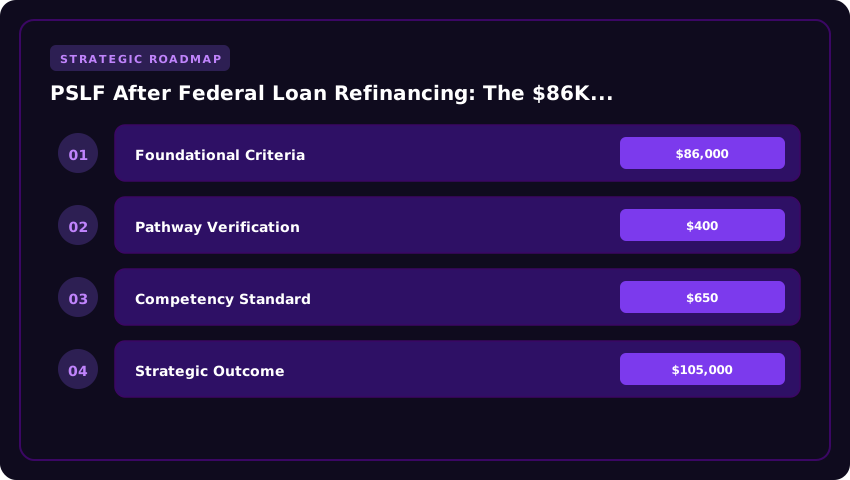
Let us build the side-by-side model from the ground up. Under the federal path, the borrower consolidates $86,000 of Direct Loans at a blended 8.00% interest rate and enters an income-driven repayment plan, typically IBR or PAYE, while working full-time for a qualifying 501(c)(3) employer or government agency. Monthly payments are capped at 10% to 15% of discretionary income, often landing in the $400 to $650 range during the early years. Because the payment is below the accruing interest, the principal grows modestly before forgiveness kicks in at year 10. The remaining balance, roughly $105,000 to $112,000 depending on income growth assumptions, is forgiven under Public Service Loan Forgiveness (PSLF), and under current Internal Revenue Code Section 108(f) treatment, that amount is excluded from taxable income.
Under the private refinance path, the same $86,000 is replaced with a 6.00% private loan requiring full amortization over 25 years. The monthly payment locks in at approximately $580, the loan is paid off entirely by year 25, and the borrower leaves with a clean zero balance, but zero forgiveness. Total interest paid across the full term lands near $87,000 to $89,000. By contrast, the federal borrower who survives the 10-year PSLF window pays only the interest that accrues during those 10 years, roughly $48,000 to $55,000 in cumulative payments, and walks away from $105,000+ of debt forgiven tax-free. The headline savings, when properly measured, belong to the federal consolidation, not the private refinance.
Here is how the two scenarios compare at a glance:
- Federal Consolidation at 8.00% (PSLF Path): $86,000 original principal, monthly income-driven payment averaging $520, total paid over 10 years approximately $62,000, forgiven balance at year 10 around $108,000, federal program assumes forgiveness is tax-free under current law.
- Private Refinance at 6.00% (No Forgiveness): $86,000 original principal, fixed monthly payment of $580 for 300 months, total paid over 25 years approximately $174,000, total interest paid approximately $88,000, zero forgiveness balance at the end of term.
- Net 10-Year Comparison: Federal borrower pays roughly $62,000 and eliminates $108,000 in debt, an effective benefit of $46,000. Private borrower pays roughly $69,600 in the same decade and still owes roughly $104,400 in principal remaining at month 120.
- Risk Profile: Federal path depends on continued qualifying employment and timely Employment Certification Forms (ECFs). Private path depends on nothing except the borrower’s ability to sustain $580 monthly payments for 25 years with no job flexibility benefit, no unemployment deferment, and no administrative forbearance.
The most dangerous assumption is that a 2% rate drop automatically equals savings. Rate is only one variable in the equation. Term length, payment structure, employer behavior, income volatility, and tax treatment of forgiveness all matter equally. A borrower who chases a 2% interest savings while forfeiting $46,000 of tax-free forgiveness has not saved money; they have transferred wealth from their future balance sheet to a private lender’s revenue stream. That is the $86,000 mistake the article title refers to, and it is the single most expensive financial miscalculation a public service professional can make.
Before any borrower signs private refinance documents, the actionable takeaway is to request an amortization schedule from the lender, project your income trajectory under an IDR plan, and calculate the forgiveness runway. If the projected forgiven balance exceeds the cumulative interest savings from the rate drop, the federal path wins, and PSLF eligibility should be protected at all costs. The 2% rate reduction is real, but the forgiveness check is larger, and only one of those two benefits survives a refinance decision.
Qualifying PSLF Employment: Hospital, University, and Government Audits
Public Service Loan Forgiveness is, at its core, an employer-driven benefit. You can make every payment on time for 120 months, enroll in the correct income-driven plan, and still walk away with zero forgiveness if your employer does not meet the strict criteria established by the U.S. Department of Education. Understanding exactly which organizations qualify, how the Employment Certification Form (ECF) is processed on StudentAid.gov, and how the Temporary Expanded PSLF (TEPSLF) program interacts with repayment plan history is essential for avoiding the $86,000 mistake referenced in this guide’s title.
To qualify for PSLF, a borrower must be employed full-time by a U.S. federal, state, local, or tribal government, or by a 501(c)(3) tax-exempt nonprofit organization. Non-qualifying employment includes for-profit hospitals, private practice physicians organized as LLCs or S-corporations, labor unions (unless they are themselves governmental entities), and partisan political organizations. Many borrowers are surprised to learn that a nonprofit status alone is insufficient; the organization must specifically hold 501(c)(3) status under the Internal Revenue Code. A 501(c)(4) social welfare organization, for example, does not qualify for PSLF, even if it engages in charitable work.
- Government employers include federal agencies (U.S. military, Department of Education, Veterans Affairs), state universities, public school districts, city hospitals, and municipal court systems.
- 501(c)(3) nonprofit employers include most private universities, children’s hospitals, community health centers, the American Red Cross, United Way affiliates, and faith-based organizations operating exclusively for charitable purposes.
- Contract employees are generally not considered employees of the contracting organization for PSLF purposes; the Department of Education audits W-2 forms, not 1099 contractor payments.
The Employment Certification Form is the borrower’s primary tool for confirming eligibility before making 120 qualifying payments. Submitted electronically through StudentAid.gov, the ECF requires an authorized human resources official to certify the borrower’s start and end dates, full-time status, and employer identification. FedLoan Servicing (now serviced by MOHELA after the 2022 federal loan servicer transition) reviews each ECF and applies qualifying months to the borrower’s PSLF counter. The smartest borrowers submit an ECF every twelve months, or whenever they change employers, rather than waiting a decade and discovering an audit problem after forgiveness has already been applied.
For borrowers who inadvertently chose the wrong repayment plan, the TEPSLF expansion announced in 2019 offers a narrow second chance. TEPSLF allows forgiveness for borrowers who made 120 payments under a non-qualifying plan (such as the 10-year Standard or a Graduated repayment schedule), provided they had qualifying employment for the entire 12-month period preceding forgiveness. Because TEPSLF funds are limited and demand was historically overwhelming, the Department of Education processed applications on a first-come, first-served basis. Borrowers who refinanced their federal loans into a private consolidation loan before October 2021, however, cannot access TEPSLF at all, since private loans are categorically ineligible for any PSLF pathway.
- Tip 1: Use the Federal Student Aid’s PSLF Help Tool on StudentAid.gov to generate a pre-filled ECF and verify your employer’s federal Employer Identification Number (EIN) before submitting.
- Tip 2: If your nonprofit employer is not listed in the database, request its IRS Determination Letter confirming 501(c)(3) status and attach it to your ECF submission.
- Tip 3: Even after the Limited PSLF Waiver (October 6, 2021 – October 31, 2022), borrowers should still pursue TEPSLF review if any payment months remain unclassified, since waiver corrections do not always trigger automatic TEPSLF eligibility.
Finally, every PSLF applicant should anticipate employment audits. The Department of Education reserves the right to review W-2 transcripts, HR records, and organizational tax filings at the point of forgiveness, not just at ECF submission. A common pitfall involves borrowers who worked for a qualifying hospital that was later acquired by a for-profit health system; months worked before the acquisition remain qualifying, but months worked after the acquisition may not. Keeping meticulous records of every employer’s tax-exempt status, including mergers, reorganizations, and tax-code reclassifications, is the single most protective action a borrower can take.
Strategic Consolidation: The Only Federal-to-Federal Reset That Preserves Forgiveness
If you are sitting on a tangle of FFEL Program Loans, Perkins Loans, or older Direct Loans that are missing the modern certification paperwork required for Public Service Loan Forgiveness (PSLF), the only federally sanctioned path back to forgiveness eligibility is the Direct Consolidation Loan program administered through StudentAid.gov. This process is not a refinance in the traditional consumer sense; it is a recalibration of your existing federal debt under current statutory guidelines. By consolidating, you merge multiple federal education loans into a single new Direct Consolidation Loan, which is automatically certified as eligible for income-driven repayment (IDR) plans and PSLF credit, provided you maintain qualifying employment and make on-time payments.
Borrowers must initiate the application directly through the official StudentAid.gov portal. Once logged in, you will navigate to the “Aid & Repayment” section, select “Direct Consolidation Loan,” and follow the multi-step application. The system will pull your existing federal loan data from the National Student Loan Data System (NSLDS), allowing you to choose exactly which loans to include. Importantly, you can leave certain loans out of the consolidation if they already have favorable terms, though including them simplifies your repayment schedule and ensures uniform PSLF credit tracking.
One of the most misunderstood mechanics of consolidation is the weighted average interest rate calculation. Unlike private refinancing, where your rate is determined by creditworthiness and market conditions, the federal government cannot profit from your loan. Instead, your new interest rate is calculated by weighting each existing loan’s rate against its principal balance, then rounding up to the nearest one-eighth of one percent (0.125%). For example, if you hold a $40,000 loan at 6.8% and a $60,000 loan at 5.5%, your weighted average would be (($40,000 × 6.8%) + ($60,000 × 5.5%)) ÷ $100,000, yielding approximately 6.04%, which rounds up to 6.125%. You never lose federal benefits like deferment, forbearance, or IDR access, and your new rate is fixed for the life of the loan, shielding you from future market volatility.
Perhaps the most actionable window in the entire process is the 30-day repayment plan selection period. After your consolidation is processed, the servicer will default you into the Standard Repayment Plan unless you affirmatively choose an IDR option. However, the Department of Education grants a 30-day grace window during which you can select Income-Contingent Repayment (ICR), Income-Based Repayment (IBR), Pay As You Earn (PAYE), or Saving on a Valuable Education (SAVE). For PSLF candidates, this is where the strategy crystallizes: selecting ICR or IBR at this stage, and then certifying your employment annually using the Employment Certification Form (ECF), is the gold standard for maximizing forgiveness while minimizing monthly outflow. Failing to choose an IDR plan during this window can result in higher payments and fewer dollars toward eventual forgiveness, so prompt action is essential.
It is critical to recognize how categorically different this process is from private refinancing. When you refinance with a bank, credit union, or online lender such as SoFi, Earnest, or LendKey, your federal loans are paid off entirely, and you are issued a brand-new private debt obligation. That new loan is not eligible for PSLF, IDR plans, federal deferment, or any administrative discharge programs like Total and Permanent Disability (TPD) Discharge or Borrower Defense. The $86,000 mistake referenced in many borrowers’ journeys stems precisely from this confusion. Strategic consolidation through the federal program preserves every protection, every forgiveness pathway, and every deferment right you currently possess, while simplifying your financial life into a single, manageable federal account. Treat this tool as the reset button it was designed to be, and verify every step directly through official channels before proceeding.
Tax Bombs, Death, and Disability: Federal Loan Protections You Surrender
When federal student loan borrowers weigh the shiny, lower interest rates advertised by private refinance lenders, they frequently fixate on monthly payment savings and overlook a deep, protective umbrella of borrower safeguards built into the Department of Education’s Direct Loan program. These built-in protections are not minor conveniences; they are foundational lifelines that have shielded millions of Americans during medical crises, family tragedies, career pivots, and economic downturns. The moment a borrower signs a private refinance promissory note, that umbrella is folded up and handed back to the federal government. What remains is a strictly commercial contract, governed by the laws of the lender’s home state and the fine print of a private loan agreement. For any borrower who had planned to remain in Public Service Loan Forgiveness (PSLF), the loss is permanent and irrevocable. For borrowers who had no intention of pursuing PSLF, the loss can still be financially devastating in ways that do not become apparent until years later.
The most emotionally significant federal protection is the Total and Permanent Disability (TPD) Discharge. Under federal regulations, a borrower who can no longer engage in substantial gainful activity due to a physical or mental impairment, or whose impairment is expected to result in death, may have their remaining federal Direct Loan balance fully canceled. The Department of Education coordinates this discharge with the Social Security Administration, the Veterans Health Administration, and licensed physicians to verify eligibility. The discharged balance is also removed from the borrower’s credit report and is not treated as taxable income under the American Rescue Plan Act through December 31, 2025. Private refinance lenders offer no comparable safety net. A borrower who suffers a catastrophic injury, is diagnosed with a terminal illness, or develops a chronic psychiatric condition severe enough to prevent work will remain contractually obligated to repay the private lender under the original terms, often at a high post-rehabilitation interest rate and without recourse to administrative sympathy. Disability insurance riders are rarely included, and income-driven hardship modifications are discretionary, not mandatory.
Closely related is the federal death discharge, which cancels remaining federal Direct Loan balances when the borrower dies. For borrowers pursuing PSLF who pass away before reaching 120 qualifying payments, the remaining balance is simply erased, and the estate is not pursued. Private refinance lenders handle death very differently. Most private lenders will require the estate or surviving family members to file a death claim, provide a certified death certificate, and sometimes wait weeks for institutional review. Some private loan agreements include a cosigner release-upon-death clause, but the underlying obligation may simply transfer to the cosigner’s estate or surviving spouse, depending on state law. For a parent PLUS borrower whose child refinanced into a private loan in the parent’s name, the family grief is compounded by a collections department calling about a $60,000 balance.
The third layer of surrendered protection is the federal administrative forbearance framework. Federal Direct Loans offer a wide menu of discretionary and mandatory forbearance options, including economic hardship forbearance, mandatory administrative forbearance during PSLF employment certification processing, and military service deferments that pause interest capitalization. A borrower who is between jobs, recovering from a natural disaster, or serving in the National Guard can ring the federal servicer and receive a documented pause that protects PSLF qualifying payment counts and prevents interest from snowballing. Private refinance lenders typically offer a narrow 3-to-12-month forbearance window, often limited to two requests over the life of the loan, with interest capitalizing at the end of each period. A borrower who loses employment in a recession, faces a medical emergency, or experiences a regional economic shutdown will find that the private lender’s “hardship team” is a profit-center, not a safety net.
The final, and increasingly urgent, protection at risk is the federal tax treatment of forgiven balances. Under the American Rescue Plan Act of 2021, student loan forgiveness is excluded from federal taxable income through December 31, 2025. After that sunset, forgiven federal Direct Loan balances can once again trigger federal and state income tax liability. Borrowers in high-tax states such as California, New York, New Jersey, and Oregon, which do not conform to the federal exclusion, may already face an immediate state tax bill. Borrowers pursuing PSLF who reach 120 payments will see the remaining balance forgiven, and depending on the balance and state of residence, that forgiveness could generate a state tax liability that ranges from several thousand dollars to more than $40,000 on a six-figure balance. Private refinance loans offer no forgiveness pathway at all; they amortize to zero over the contracted term, and any settlement or cancellation is treated as cancellation of debt income under IRS rules, fully taxable unless the borrower can meet the narrow insolvency exception. The federal protections are not marketing gimmicks; they are contractual rights codified in Title IV of the Higher Education Act. Once refinanced, they cannot be restored. Borrowers considering this step should consult a federally certified student loan counselor, a qualified tax professional, and an independent fiduciary financial planner before signing away protections that took decades of legislative advocacy to build.
- Total and Permanent Disability Discharge: Federal Direct Loans cancel balances for borrowers who cannot work due to severe impairment; private refinance loans have no equivalent discharge pathway and remain due in full.
- Death Discharge: Federal loans are canceled upon the borrower’s death, protecting estates and families; private lenders may pursue surviving cosigners or transfer balances to the estate under state law.
- Administrative Forbearance Flexibility: Federal loans offer broad, documented forbearance options for hardship, military service, and PSLF processing; private loans typically cap forbearance at a few months and capitalize accrued interest.
- Tax Treatment of Forgiven Balances: After the 2025 sunset of the American Rescue Plan exclusion, PSLF forgiveness could trigger state tax bills exceeding $40,000 in non-conforming states, while private refinance cancellations remain fully taxable as ordinary income.
The Hybrid Playbook: When Smart Borrowers Actually Refinance Part of Their Stack
Most borrowers treat their federal student loan portfolio as an all-or-nothing proposition, and for good reason: the moment a single Direct Loan is touched by a private refinance, that specific balance exits the Public Service Loan Forgiveness umbrella forever. Yet a narrow, strategic playbook exists for borrowers who have already crossed the 120-payment threshold, achieved forgiveness on a portion of their stack, and now hold a remaining balance of high-interest unsubsidized Graduate PLUS loans at 7.54% or 8.05%. In these specific scenarios, refinancing the post-PSLF residual can save thousands of dollars without jeopardizing forgiveness already earned.
The framework starts with one absolute rule: only refinance loans that have already been formally forgiven through a PSLF determination letter from FedLoan Servicing (now managed by MOHELA) or after the PSLF servicer transfer to EdFinancial. Once you hold that letter in hand, the forgiven balance is legally extinguished and removed from your account. Any remaining unsubsidized Direct Graduate PLUS loans, unsubsidized Direct Loans from a prior graduate degree, or older FFEL loans still in your name can be evaluated independently against private market rates.
- The post-PSLF refinance math: A borrower holding $40,000 in Graduate PLUS loans at 7.54% with 20 years remaining could receive a refinance offer near 5.75% with a 10-year term from a credit-union lender, saving roughly $58 per month and approximately $6,960 over the life of the loan.
- Credit-score thresholds that matter: Most aggressive private refinance rates require a FICO 8 score of 740 or higher, a debt-to-income ratio below 35%, and stable W-2 income or two years of self-employment tax returns. SoFi, Earnest, Laurel Road, and College Ave all publish rate floors that typically begin at 5.49% APR for the most qualified borrowers with autopay discounts.
- Income-driven repayment safety net still accessible: Even after refinancing, borrowers who keep some federal loans can still enroll the remaining federal balance in SAVE, PAYE, or IBR. This hybrid approach preserves the federal safety valve while letting private capital absorb the highest-cost portion.
Spousal consolidation represents a separate, often misunderstood tool in this playbook. Federal spousal consolidation was discontinued in 2006, but married borrowers can still execute a joint refinance through a private lender, combining two individual graduate loan stacks into a single instrument with one interest rate, one payment, and one servicer. For dual-degreed households where one spouse works in qualifying public service and the other works in the private sector, this strategy lets the private-sector spouse absorb the refinance hit while the public-service spouse continues toward PSLF untouched.
The most common hybrid configuration we see among our physician, attorney, and academic researcher readers involves a 60/40 or 70/30 federal-to-private split. The federal portion, typically Direct Unsubsidized Loans from medical or law school, remains on an IDR plan heading toward forgiveness at year 10 or year 20. The private portion, usually the Graduate PLUS balance that ballooned during residency or a fellowship, gets refinanced at the post-training income level when the borrower finally qualifies for the prime credit tier.
Actionable takeaway: request a formal PSLF payment count confirmation from your current servicer before initiating any refinance application. Confirm the exact payoff date, the precise balance scheduled for forgiveness, and the loan IDs included in the determination. Then, and only then, shop the remaining unsubsidized Graduate PLUS balance to two or three credit-union lenders and two marketplace platforms like Credible or LendingTree to benchmark the spread between your current federal rate and the best private offer available at your current FICO band.
| Metric | Federal Direct Loans (PSLF Path) | Private Refinance (PSLF Forfeit) |
|---|---|---|
| Average Loan Balance | $40,000–$86,000 | $40,000–$86,000 (same principal) |
| Interest Rate Range | 5.50%–8.50% (fixed, federal) | 4.99%–12.99% (fixed/variable, lender-set) |
| PSLF Eligibility | Qualifying (120 payments) | Permanently revoked upon refinance |
| Forgiveness Timeline | 10 years (120 qualifying payments) | None — no tax-free forgiveness |
| Income-Driven Repayment (IDR) | PAYE, REPAYE, IBR, SAVE eligible | Not available |
| Monthly Payment (sample $50K) | $300–$550 (IDR-adjusted) | $520–$690 (amortized) |
| Total 10-Year Cost (sample $50K) | $36,000–$66,000 (IDR) / $0 forgiven balance | $62,400–$82,800 (full repayment) |
| Career ROI (Public/Nonprofit Sector) | High — $20K+ net forgiveness value | Negative — forfeits $20K–$80K tax-free benefit |
| Federal Protections | Deferment, forbearance, hardship | Limited (lender policy only) |
| Reversibility of Decision | N/A | None — irreversible under HEA 1965 |
Frequently Asked Questions
Can You Refinance Federal Loans and Keep PSLF Eligibility?
No. According to the Higher Education Act of 1965, refinancing federal Direct Loans through a private lender legally converts them into private debt, permanently disqualifying them from Public Service Loan Forgiveness. The federal government no longer holds your loan, so the 120 qualifying payment count ends. There is no appeal or reinstatement process.
How Much Money Do You Lose by Refinancing Federal Student Loans?
Borrowers with $40,000 to $86,000 in federal Direct Loans working toward PSLF can forfeit between $20,000 and $86,000 in tax-free forgiveness over a 10-year repayment horizon. Even with a lower private interest rate, the loss of forgiveness, IDR flexibility, and federal protections typically outweighs monthly savings, making refinance financially disadvantageous for public servants.
What Happens to My PSLF Credit if I Accidentally Refinance?
There is no PSLF credit transfer to private loans. Once federal Direct Loans are refinanced, the original loans are paid off and legally extinguished. The new private loan is ineligible for forgiveness. Any prior qualifying payments are not portable, and the Department of Education cannot reinstate federal status retroactively under current regulations.
Are There Any Exceptions That Allow PSLF After Private Refinance?
No statutory exceptions exist. PSLF eligibility is permanently tied to federal Direct Loan status under 34 CFR §685.219. The only recovery path is taking out a new federal Direct Consolidation Loan, which restarts the 120-payment clock at zero. Consolidation loans also cannot certify prior private loan payments, so time invested is effectively lost.
Strategic Final Takeaway
Success in evaluating PSLF After Federal Loan Refinancing: The $86K Mistake You Can't Undo relies on early preparation, adherence to verified accredited requirements, and cross-referencing official portals. Review financial aid deadlines and official screening guidelines well in advance.


