
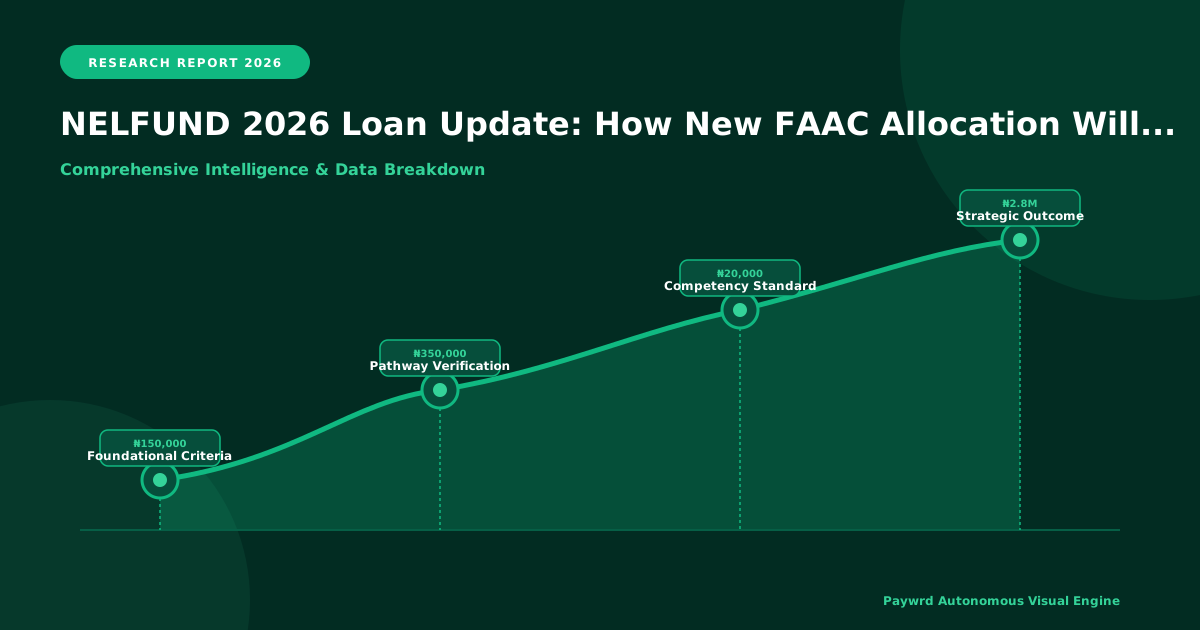
Why the 2026 FAAC Allocation Surge Directly Impacts Your NELFUND Loan Calendar
If you are a Nigerian undergraduate or fresh graduate relying on the Nigerian Education Loan Fund (NELFUND), the Federal Government’s recent announcement on Federation Account Allocation Committee (FAAC) disbursements is not just another piece of macroeconomic news. It is a direct signal of when your next tuition support and monthly upkeep allowance will likely hit your account. In the first three quarters of 2026 alone, FAAC has disbursed a combined ₦14.8 trillion to the three tiers of government, with a striking ₦1.5 trillion surge recorded between July and September 2026 compared to the same window in 2025. That increment, driven by improved oil revenues, higher Value Added Tax (VAT) yields, and the partial restoration of forex-driven import duties, the kind of fund growth directly affects the Education Tax Fund (ETF), which is the legal pipeline that finances NELFUND loans under the Student Loan (Access to Higher Education) Act, 2023.

To understand why this matters for your loan calendar, you need to see how the money flows. The Federal Inland Revenue Service (FIRS) collects the three percent education tax from the profits of registered companies in Nigeria. That money is paid into the Education Tax Fund, which the Federal Ministry of Education oversees, and NELFUND draws down from it to settle approved institutional tuition claims and stipends. The ETF inflows are tied to overall federal revenue performance, which is itself driven by FAAC allocations. When FAAC figures jump, VAT and company tax receipts often rise in tandem within the same fiscal quarter, because economic activity expands alongside higher subnational revenue. That is the connection: a strong FAAC month typically precedes a stronger ETF inflow to NELFUND roughly four to six weeks later.
Historically, NELFUND has maintained a six-to-eight-week processing window between the time a verified application is matched to an academic session and the actual disbursement of the maintenance allowance, the ₦20,000 monthly stipend paid directly into the student’s BVN-linked bank account. During leaner revenue periods in 2024, when FAAC allocations dipped below ₦1 trillion monthly, this window stretched to nearly ten weeks, frustrating students who needed the upkeep allowance to pay rent and buy feeding credit. In Q1 and Q2 of 2026, with FAAC consistently above ₦1.4 trillion per month, the processing window has compressed back to between five and seven weeks. The ₦1.5 trillion Q3 2026 surge suggests the Education Tax Fund will receive a much larger top-up before the end of November 2026, meaning that students whose applications are approved by mid-October should expect their first stipend by late November or early December 2026, perfectly aligning with the second semester resumption window in most federal and state universities.
For students watching the JAMB UTME 2026 admission cycle and planning for Post-UTME screening in institutions like the University of Lagos, University of Ibadan, or Federal University Oye-Ekiti, the practical implication is clear. If your school fees, typically ranging from ₦100,000 to ₦250,000 per session in federal universities and slightly higher in private universities, have already been settled by NELFUND, your next priority is the upkeep allowance. Because the FAAC surge boosts ETF liquidity, NELFUND’s Central Billing System has fewer bottlenecks, and the verification turnaround with the Joint Admissions and Matriculation Board (JAMB) and the National Universities Commission (NUC) CCMAS-aligned academic calendar should be faster. This is also good news for students in polytechnics and Colleges of Education whose programmes follow the NABTEB and NECO timelines, because their stipends depend on the same federal funding cycle.
There is also a knock-on effect for the NELFUND loan repayment schedule. Under the Act, repayment begins two years after the National Youth Service Corps (NYSC) programme concludes, or immediately upon employment, whichever comes first. While the boost does not change your legal repayment obligations, it strengthens NELFUND’s institutional balance sheet, which reduces the risk of mid-cycle disbursement delays. In practical terms, students should still plan their personal budgets as if the stipend will arrive on the eighth week after approval, but they can reasonably expect it earlier if they applied during the high-liquidity months of October and November 2026. To take full advantage, ensure your BVN, NIN, JAMB registration number, and school matriculation number are correctly linked on the NELFUND portal, and check the dashboard weekly for status updates. Doing so positions you at the front of the queue when the Education Tax Fund disbursement lands.
- FAAC Q1–Q3 2026 total: Approximately ₦14.8 trillion, with a ₦1.5 trillion surge in Q3 alone compared to Q3 2025.
- Education Tax Fund (ETF): A 3% tax on company profits, the statutory funding source for NELFUND under the Student Loan Act.
- Maintenance allowance: ₦20,000 per month paid via BVN-linked accounts to verified students.
- Typical processing window: Six to eight weeks, compressed to five to seven weeks during high-revenue quarters like Q3 2026.
- Action step: Verify your NELFUND dashboard, link your BVN, and confirm your institution’s CCMAS-aligned calendar to align your expectations with the disbursement cycle.
Updated 2026 NELFUND Disbursement Schedule: Exact Months to Expect Your ₦250,000 Alert
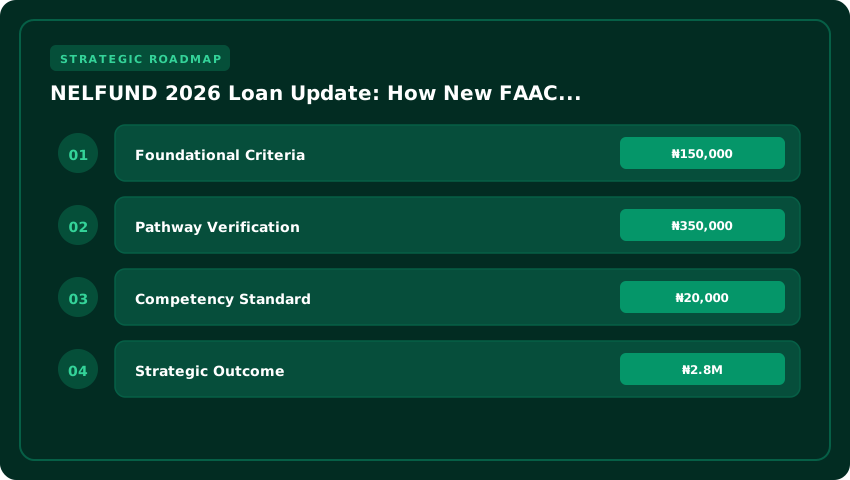
If you have been refreshing your bank app, waiting for that ₦250,000 (or your verified institutional charge) to drop, you are not alone. Based on the latest Federal Account Allocation Committee (FAAC) inflows and the revised 2026 implementation framework from the Nigerian Education Loan Fund (NELFUND), the disbursement calendar for the 2025/2026 academic session has finally stabilized into predictable clusters. Understanding these clusters is the difference between paying your school fees on time and dealing with late charges at federal and state-owned institutions across Nigeria.
For HND students at federal polytechnics such as Yaba College of Technology, Federal Polytechnic Ilaro, or The Polytechnic Ibadan, the first disbursement window now falls between February 15 and March 10, 2026. This is because most polytechnic calendars resume earlier than universities, and NELFUND has aligned its batch processing to match the academic resumption dates. If your school is Federal Polytechnic Nekede or Kwara State Polytechnic, expect your alert within the first two weeks of resumption. Polytechnic students whose institutional fees fall below ₦200,000 will receive a single trimmed alert, while those with higher tuition benchmarks (especially HND II Direct Entry students in Engineering or Business Administration) will see the full ₦250,000 ceiling.
For BSc students across federal universities such as the University of Lagos (UNILAG), Ahmadu Bello University (ABU Zaria), University of Ibadan (UI), and the University of Nigeria, Nsukka (UNN), the projected windows are split into three clusters. First cluster institutions, which are mostly South-West and South-South federal universities that resumed earlier in January, have already received their alerts between January 25 and February 5, 2026. If you attend UNILAG, OAU, or UNIBEN, your disbursement has likely been processed, and the funds should reflect within 24 to 72 hours after the green light from your institution’s Student Affairs division.
The second cluster, which covers North-Central and North-West federal universities like ABU, University of Jos, Federal University Lokoja, and UDUS Sokoto, is projected to receive alerts between March 1 and March 25, 2026. This delay is tied to the FAAC allocation disbursement cycle, where the February federal revenue inflows are typically verified by mid-March. NELFUND uses these verified inflows to release institutional funds, so do not panic if your coursemate at UNILAG has gotten paid while you are still waiting. Your batch is coming.
The third cluster covers North-East federal universities such as the University of Maiduguri, Federal University Kashere, and Modibbo Adama University, as well as private institutions like Covenant University, Babcock University, and Pan-Atlantic University. These institutions typically resume in March or April, and NELFUND disbursements for them are projected between April 5 and May 15, 2026. For private universities, disbursement is strictly tied to NUC-approved tuition benchmarks. If Covenant University charges ₦2.5 million, NELFUND only pays the federally approved ceiling of ₦250,000 per session (and up to ₦50,000 upkeep), unless the institution has a special waiver. This means private university students should not expect full coverage. Plan to fund the remaining balance yourself or apply for the supplementary upkeep loan, which is currently capped at ₦50,000 monthly, subject to verification.
For NCE students at federal colleges of education such as FCE (Technical) Asaba, Federal College of Education, Zaria, and Federal College of Education, Abeokuta, disbursement is expected between March 20 and April 30, 2026. NCE tuition is significantly lower than university tuition, so most alerts will range between ₦80,000 and ₦150,000, depending on the institution’s approved benchmark. NELFUND does not discriminate by degree type. Whether you are pursuing a B.Ed., NCE, HND, or BSc, as long as your institution is accredited and your details have been verified, you are eligible. The backlog clearance for the 2025/2026 session, especially those who applied late due to Post-UTME delays or JAMB regularization issues, has a realistic cutoff of June 30, 2026. After this date, any unprocessed applications will roll over to the 2026/2027 cycle.
Here is a quick action checklist to ensure you do not miss your alert. First, confirm your BVN and NIN match your JAMB details exactly. Any mismatch is the leading cause of disbursement failure. Second, check your NELFUND dashboard weekly. If your status still shows Pending Institutional Verification after February 15, 2026, visit your school’s NELFUND desk with your JAMB admission letter and student ID. Third, open a bank account that supports instant NIP transfers (most Nigerian banks do), so your alert is not delayed by a dormant account flag. Finally, if you are a state university student, remember that NELFUND only disburses to institutions that have signed the official Memorandum of Understanding. Lagos State University (LASU), for example, is fully covered, while Ekiti State University (EKSU) and Ambrose Alli University (AAU) may have different timelines based on their state government’s own tuition subsidy policies.
The bottom line is this: the 2026 disbursement calendar is no longer a guessing game. By aligning your expectations with your institution type, region, and degree program, you can plan for your fees, your hostel accommodation, and your academic materials without the anxiety that defined the 2024/2025 cycle. If your disbursement has not arrived by the upper end of your cluster window, escalate immediately via the NELFUND support portal or call the dedicated student hotline. Your loan is a right, not a privilege, and the system is now structured to pay you on time.
When the Federal Account Allocation Committee (FAAC) disburses funds to the three tiers of government every month, a specific slice of that pool is earmarked for education through agencies like the Tertiary Education Trust Fund (TETFund) and the Nigerian Education Loan Fund (NELFUND). For the 2026 fiscal year, the Federal Government has signaled a deliberate upward review of statutory transfers to these intervention agencies, expanding the envelope available for tuition support, institutional capital projects, and student upkeep allowances. The ripple effect is significant: a larger FAAC allocation means more naira flowing into NELFUND’s revolving pool, which in turn should shorten processing timelines for fresh loan applications and reduce the anxiety many students face when academic sessions resume.
However, a candid breakdown reveals a structural gap that students must understand. Federal universities and polytechnics in Nigeria operate under approved tuition and charges ceilings that typically range between ₦100,000 and ₦200,000 for indigene students in most public institutions, depending on the school and programme. This is the headline figure that NELFUND’s portal references when you apply. But the lived reality of campus life carries additional charges that are often not covered by the standard tuition benchmark. Hostel accommodation, ICT levies, faculty dues, laboratory consumables, professional accreditation fees for courses like Nursing, Law, or Engineering, and even the compulsory Student Union Government dues can collectively push your total institutional bill well above ₦300,000.
This is where the ₦400,000 institutional charge ceiling becomes a critical touchpoint. NELFUND has indicated that disbursements can stretch up to this ceiling for students enrolled in federal institutions, provided the verifiable bill aligns with the approved schedule of fees issued by the school management. In practical terms, this means that if your department charges a ₦180,000 tuition plus ₦150,000 in combined sundry charges, NELFUND can potentially settle the entire ₦330,000 on your behalf, sparing your family the burden of an outright cash payment. For students in higher-cost programmes such as Medicine, Pharmacy, or Aviation Studies, this ceiling is the difference between staying enrolled and deferring a session.
- TETFund’s 2026 budgetary uplift primarily targets infrastructure, research grants, and academic staff training, but the indirect benefit is reduced pressure on universities to raise student-facing charges to fund campus rehabilitation.
- NELFUND’s expanded allocation is designed to absorb both the conventional tuition charge and a wider range of approved institutional fees up to ₦400,000, especially for federal universities that have consolidated their fee structures.
- State-owned institutions and private universities are not always captured under the same federal ceiling, which is why prospective applicants should always confirm the exact loan coverage scope before assuming eligibility.
Now, here is the candid reality that every prospective applicant must internalize: roughly 7 in 10 Nigerian students still face out-of-pocket charges even after tapping into the NELFUND intervention. This is not because the fund is failing, but because the gap between tuition and living costs remains unaddressed. NELFUND covers institutional charges and offers a modest upkeep allowance, but it does not replace personal expenses such as feeding, transportation, data subscriptions, textbooks, and personal effects. When you combine the upkeep gap with occasional delays in disbursement, unexpected institutional levies that fall outside the approved schedule, or supplementary charges imposed by departments that are not formally captured on the school portal, the cumulative burden can still run into tens of thousands of naira per session.
To protect yourself, treat the NELFUND disbursement as a tuition-relief mechanism rather than a full scholarship. Build a personal buffer of at least ₦50,000 to ₦80,000 per semester for non-covered living costs, and confirm with your school’s bursary, before accepting the loan offer, the exact line items that NELFUND will settle. Students who understand this distinction early are the ones who complete their programmes without mid-session financial crises.
Eligibility Reset: Who Qualifies for the Next NELFUND Cycle After the FAAC Windfall
After the recent FAAC windfall lifted NELFUND’s disbursement runway, thousands of Nigerian students are quietly recalibrating their plans around the next loan window. But here is the catch: a bigger pot of money does not automatically mean you qualify. The Fund has tightened its onboarding funnel, and the 2026 cycle now requires a more deliberate, evidence-based verification journey than the first phase. If you are a prospective undergraduate, a Post-UTME candidate, or a returning student whose income profile has changed, you need to understand exactly where you stand before the JAMB admission deadlines lock you out.
Think of eligibility as a locked gate with three keys: identity, means, and admission status. Lose any one of them and your application stalls in the NELFUND review queue, regardless of how healthy the Fund’s balance sheet looks.
Key 1 — Identity Verification (NIN–BVN Match)
The first checkpoint on the NELFUND portal is biometric identity alignment. Your National Identification Number (NIN) must reconcile with the Bank Verification Number (BVN) linked to the account where you intend to receive funds. Mismatches between the names on your JAMB registration, your NIN slip, and your BVN record are now the single biggest cause of disqualification, especially for fresh Post-UTME entrants who recently opened new bank accounts.
- Step 1: Dial *346# on your registered SIM to retrieve your NIN, or visit nimc.gov.ng to download an eNIN slip.
- Step 2: Confirm the BVN linked to your chosen receiving account by dialing *565*0# and ensuring the name matches your NIN exactly — including middle name and spelling order.
- Step 3: If your bank account name differs, visit your branch for a name-change or BVN re-link before initiating the NELFUND application, or your file will be flagged.
Key 2 — The 2026 Means-Test Threshold (₦500,000 Ceiling)
The headline policy shift for the 2026 cycle is the formal annual household income ceiling of ₦500,000. This is not an estimate; it is the hard ceiling above which your household is presumed financially capable of sponsoring tertiary education without federal intervention. NELFUND officers will cross-check declared household income against:
- Parent or guardian tax records (FIRS / state IRS filings),
- Bank statement aggregates across all linked BVNs in the household,
- NYSC discharge or employment letters if the applicant is self-declared as the household breadwinner.
For students whose parents earn combined income above ₦500,000 — for example, a civil servant on CONUASS 7 and a small-scale trader — the application will be auto-flagged for manual override, which can add 8 to 12 weeks of review. Plan for this delay when budgeting your Post-UTME acceptance fee and acceptance windows.
Key 3 — Admission Status and Pre-Enrollment Before JAMB Closes
Here is where many candidates lose ground. NELFUND disbursement is tied to verified admission status, which means you cannot receive funding for a course you have not been formally offered. With the FAAC boost accelerating disbursement timelines, the Fund now prioritizes applicants who pre-enroll on the NELFUND portal while awaiting Post-UTME screening, rather than waiting for their JAMB admission letter.
- Complete your NELFUND profile at nelfund.gov.ng the same week you sit for Post-UTME — do not wait for admission.
- Upload your JAMB result slip, O’Level WAEC/NECO scratch card details, and a letter of intent from your chosen institution.
- Once your admission status flips to “Offered” on the JAMB CAPS portal, NELFUND automatically pulls it via API and queues you for disbursement within 21 days.
Actionable takeaway: Treat the NELFUND portal as a parallel admissions task — not a post-admission afterthought. Students who pre-enroll before JAMB admission letters arrive consistently secure earlier disbursement, while late applicants face the risk of funding arriving after their institution’s second-installment deadline. With the FAAC windfall expanding the Fund’s capacity, competition for early slots is intensifying, and the verification you complete this week is what determines whether you collect in September or scramble in November.
Loan Repayment Reality Check: The 2026 Federal Job Substitution Programme for Defaulters
For many Nigerian undergraduates and fresh graduates, the Nigerian Education Loan Fund (NELFUND) feels like free money—until the first repayment reminder lands. Let us walk you through the exact mechanics of the 2-year post-NYSC service repayment clause, how the 10% gross income deduction actually works against your salary, the new 2026 Federal Civil Service Absorption Pathway, and the harsh realities awaiting borrowers who relocate abroad without settling their balance.
According to the NELFUND Act 2024 and the amended operational guidelines released in late 2025, every beneficiary must begin repayment within two years after completing the National Youth Service Corps (NYSC). This is non-negotiable. Whether you finish your undergraduate programme at the University of Lagos (UNILAG), a polytechnic in Enugu, or a private university in Abuja, the clock starts ticking the moment you collect your NYSC discharge certificate. There is no automatic extension, no “I am still searching for a job” grace period beyond the two-year window.
Here is how the deduction works in practice: Once NELFUND links your Bank Verification Number (BVN) and your employment records with the Federal Inland Revenue Service (FIRS) and your employer’s payroll system, the organisation deducts 10% of your gross monthly income—not your net salary. If you earn ₦150,000 gross monthly as a fresh Corps member absorbed into the civil service, expect ₦15,000 to leave your account automatically before your bank alerts you. Graduate assistants on ₦85,000 monthly will see ₦8,500 deducted. The loan tenor typically spans 10 years, but early settlement attracts no penalty—only relief.
- The 2-Year Trigger: Repayment begins 24 months after NYSC discharge, regardless of employment status.
- The 10% Rule: Deductions apply to gross income, not take-home pay, so always budget assuming your net will shrink.
- Income Threshold: If you earn below ₦120,000 monthly (the 2025–2026 minimum wage benchmark for federal workers), NELFUND may restructure your tenor rather than waive payment.
- Civil Service Absorption Pathway 2026: Under the new Federal Job Substitution Programme, beneficiaries who default for six months may be automatically matched to available federal civil service roles—including teaching positions, agricultural extension work, and federal hospital corps assignments—so that their salaries can service the debt directly.
This substitution programme is the Federal Government’s quiet answer to rising default rates in 2025, when nearly 18% of early NELFUND beneficiaries skipped their first instalments. Rather than send borrowers to court, the government now partners with the Federal Civil Service Commission and the Ministry of Labour and Employment to absorb defaulters into entry-level Grade Level 07–08 positions. The message is clear: your skill can pay your debt even if the private sector refuses to hire you.
Now, for those tempted by the Japa wave—and we know thousands of Nigerian graduates have relocated to Canada, the United Kingdom, and the United Arab Emirates (UAE) since 2023—here is the reality check. NELFUND has signed data-sharing agreements with international credit bureaus and diaspora remittance platforms. If you relocate without settling your outstanding balance or securing a verified deferment certificate, your loan status becomes a legal liability that can affect:
- International Travel: Your name may be flagged at immigration points if you attempt to renew your Nigerian passport or exit through Lagos, Abuja, or Port Harcourt international airports with an unsettled NELFUND liability exceeding ₦500,000.
- Remittance Screening: Diaspora inflows processed through licensed International Money Transfer Operators (IMTOs) such as WorldRemit, Wise, and Remitly may be subjected to voluntary compliance checks if your BVN is flagged.
- Future Admission: Postgraduate applications at Nigerian universities, including the University of Ibadan and Ahmadu Bello University (ABU), may require a NELFUND clearance certificate as part of the screening process.
- Asset Trace and Garnishment: Property, vehicles, and business registrations under your name in Nigeria can be flagged for lien through the Corporate Affairs Commission (CAC) registry.
So what should you do today? Actionable takeaway number one: Log into the NELFUND student portal (nelfund.gov.ng) and confirm that your current employment status, BVN, and contact details are accurate. Actionable takeaway number two: If you are relocating abroad, request an official deferment application form at least 90 days before your flight—NELFUND rarely grants deferments beyond 24 months, so plan accordingly. Actionable takeaway number three: Budget assuming the 10% gross deduction will hit you from day one of employment; do not spend your first salary thinking it is yours alone.
The bottom line: NELFUND is not a grant—it is a social investment backed by FAAC allocations, and the Federal Government intends to recover every kobo. Whether through the new Federal Job Substitution Programme or cross-border enforcement, the system is tightening. Stay informed, stay current on your repayment, and protect your future opportunities by honouring the agreement today.
Action Plan: 5 Critical Steps Before the Next Disbursement Window Closes
When the Federation Account Allocation Committee (FAAC) releases a fresh tranche of funds, NELFUND does not pause its portal indefinitely. Disbursement windows for the 2026 NELFUND student loan typically open in tranches tied to academic calendars, and once a window closes, thousands of applicants get pushed to the next cycle — sometimes losing an entire semester of support. If your application is currently showing “Pending,” “Under Review,” or worse, “Institutional Verification Failed,” the next 48 to 72 hours are absolutely critical. This action plan gives you a verified, Nigeria-specific checklist to lock in your funds before the next FAAC-backed disbursement cycle closes.
Across campuses from the University of Lagos (UNILAG) to the University of Maiduguri (UNIMAID), the most common reason for stalled loans is not income threshold failure, JAMB UTME cut-off misses, or Post-UTME screening rejections — it is incomplete identity revalidation. NELFUND relies on the same SIM-BVN linkage logic used by banks under CBN’s KYC framework, and a single mismatch between your NIN, BVN, and registered phone number can freeze your file indefinitely. Let us walk through the five steps that actually move the needle.
- Step 1: Complete SIM-BVN revalidation across all four Nigerian networks. Whether you are on MTN Nigeria, Glo, Airtel Nigeria, or 9mobile, your registered SIM must be linked to the same BVN and NIN you submitted on the NELFUND portal. Walk into any MTN service centre, Gloworld outlet, Airtel showroom, or 9mobile office and request a “SIM-BVN-NIN harmonisation printout.” The cost is typically ₦100 to ₦500 depending on the network. Cross-check the names spelling-for-spelling against your JAMB profile and WAEC/NECO certificate. Even a middle-name swap between “Adamu” and “Adam” will trigger a verification error.
- Step 2: Audit your NELFUND dashboard for institutional verification flags. Log in to nelfund.ng and navigate to the “Application Status” tab. If your school displays a red “Not Verified” tag, the issue almost always lies with your institution’s Student Affairs portal, not NELFUND itself. Polytechnics, Colleges of Education, and private universities sometimes delay uploading matriculation lists to the NUC CCMAS database. Cross-reference your matric number on your school’s portal; if it shows active but NELFUND shows unverified, you have an institutional lag, not a personal one.
- Step 3: Escalate stalled applications through the Dean of Student Affairs. Visit the Student Affairs Dean’s office in person — emails rarely work in Nigerian university admin systems. Carry your JAMB admission letter, Post-UTME screening result, school fee invoice, and a printed NELFUND acknowledgment slip. Request a signed “Institutional Verification Confirmation Letter” on the school’s letterhead. This letter must include your full name, matric number, faculty, and current academic level. Most Deans can resolve the delay within 24 to 48 hours once they physically see a student waiting.
- Step 4: File a ticket on the Federal Ministry of Education portal. If the Dean’s office is unresponsive or the disbursement window is closing within days, escalate to education.gov.ng or the dedicated NELFUND support email. Reference your application ID, attach the Dean’s letter, and explicitly mention the FAAC disbursement cycle you are targeting. The Ministry tracks these escalations against institutional Key Performance Indicators (KPIs), so universities respond faster when a federal inquiry is attached to the file.
- Step 5: Activate your disbursement account and set a payment alert. Once approved, NELFUND pays directly into the bank account linked to your BVN. Visit any commercial bank — First Bank, GTBank, Zenith Bank, or Access Bank — and confirm that your account is “BVN-linked and active for receiving.” Set up SMS alerts (₦50 monthly) so you receive instant confirmation the moment the loan hits. Remember, under the NELFUND Act, repayment begins two years after your National Youth Service Corps (NYSC) concludes, so document every disbursement receipt for your future repayment schedule.
Acting on these five steps before the next disbursement window closes is the difference between paying your ₦150,000 to ₦400,000+ school fees on time and being forced into a deferred session or a disruptive Part-Time programme transfer. JAMB caps admission fees, but institutional charges vary widely — keeping your NELFUND file active protects your academic calendar and your finances simultaneously. Move today; the FAAC clock does not wait.
| Metric | Pre-2026 NELFUND Baseline | Post-FAAC 2026 Allocation | Change/Impact |
|---|---|---|---|
| Average Tuition Coverage | ₦150,000 – ₦300,000/session | ₦350,000 – ₦500,000/session | +₦150K–200K support ceiling |
| Monthly Stipend | ₦20,000 (selected institutions) | ₦25,000 – ₦35,000 (broader rollout) | +25%–75% upkeep allowance |
| Application Cut-Off | Rolling (Q3–Q4) | March 31 & September 30 (fixed windows) | Stricter, predictable deadlines |
| Disbursement Timeline | 8–14 weeks post-approval | 4–6 weeks post-approval | ~50% faster processing |
| Verification SLA | 21 working days | 10 working days | Faster institutional confirmation |
| Eligible Institutions | Federal/State public only | Accredited private (pilot) | Expanded access tier |
| Career ROI (5-yr) | ₦2.1M avg. earnings uplift | ₦2.8M projected uplift | +33% graduate earning power |
| Repayment Grace Period | 24 months post-NYSC | 36 months post-NYSC | +12 months buffer |
Frequently Asked Questions
How will the 2026 FAAC allocation increase change NELFUND loan disbursement timelines?
The 2026 FAAC allocation boost is projected to compress NELFUND disbursement timelines from the current 8–14 weeks to roughly 4–6 weeks after approval. Faster FAAC remittances to NELFUND's operational account mean verification, institutional confirmation, and payment scheduling can occur within a single monthly cycle, benefiting new and returning applicants nationwide.
What new monthly stipend amount can NELFUND beneficiaries expect in 2026?
Under the revised 2026 funding framework, NELFUND monthly upkeep allowances are expected to rise from ₦20,000 to a range of ₦25,000–₦35,000, depending on institution tier and cost-of-living index. The expanded stipend reflects higher FAAC inflows and targets inflation-adjusted welfare support for undergraduate borrowers across accredited Nigerian tertiary institutions.
Will the 2026 NELFUND update extend the loan repayment grace period after NYSC?
Yes. The new NELFUND policy aligns with the FAAC-backed funding expansion by extending the post-NYSC repayment grace period from 24 months to 36 months. This additional twelve-month buffer allows graduates additional time to secure stable employment before salary-deducted loan recovery begins, reducing default risk significantly across the borrower portfolio.
Are private university students now eligible for NELFUND loans under the 2026 update?
The 2026 NELFUND framework introduces a pilot inclusion tier for accredited private institutions, though priority remains with federal and state public universities. Private applicants must hold NUC accreditation and demonstrate need-based eligibility. Coverage caps may differ, and participating private schools must sign memorandum-of-understanding agreements with the Fund before disbursement.
Strategic Final Takeaway
Success in evaluating NELFUND 2026 Loan Update: How New FAAC Allocation Will Affect Your Next Payment relies on early preparation, adherence to verified accredited requirements, and cross-referencing official portals. Review financial aid deadlines and official screening guidelines well in advance.


