The State of Vocational STEM Education in US High Schools
Career and Technical Education (CTE) has quietly become one of the most dynamic sectors within American secondary schooling, and the numbers tell a remarkable story of growth, reinvention, and strategic federal investment. According to the most recent data published by the National Center for Education Statistics (NCES), roughly 8.3 million high school students are currently enrolled in CTE programs across the United States, representing nearly two-thirds of all public high school learners. That figure marks a steady climb from the post-recession nadir of 2012, when vocational pathways were still struggling to escape the stigma of being perceived as alternatives to four-year college tracks. Today, the landscape looks fundamentally different: CTE is no longer the quieter cousin of Advanced Placement coursework, but a central pillar of how school districts prepare a generation of learners for the evolving labor market.
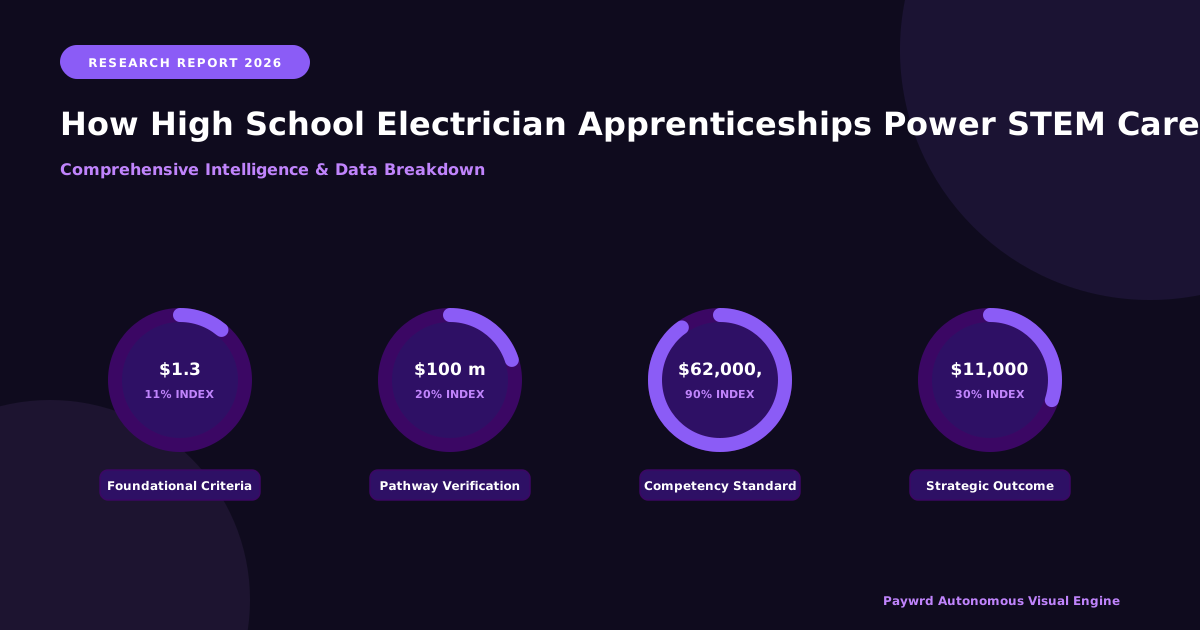
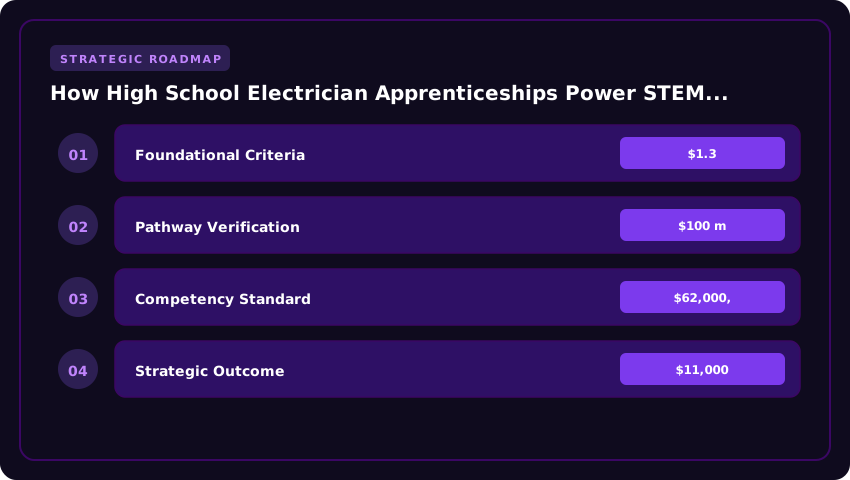
Federal support for this transformation has been substantial and deliberate. The Strengthening Career and Technical Education for the 21st Century Act, widely known as Perkins V, authorizes approximately $1.3 billion in annual formula funding distributed to state CTE programs, with an additional $100 million reserved for competitive innovation grants. These allocations flow from the US Department of Education through state agencies and ultimately to local education agencies, where superintendents and CTE directors decide how to invest in equipment, instructor credentials, and dual-enrollment partnerships. For districts contemplating the launch of a new electrician apprenticeship pathway, Perkins V dollars frequently underwrite the cost of conduit benders, multimeters, programmable logic controller (PLC) trainers, and even the licensed master electricians who serve as adjunct instructors.
What distinguishes the contemporary CTE classroom from its 1990s predecessor is the deliberate fusion of traditional skilled trades with advanced STEM competencies. An electrical trades program in 2026 is rarely limited to wire-stripping and breaker-panel familiarization. Students are increasingly expected to demonstrate fluency with Internet of Things (IoT) device commissioning, BACnet communication protocols for HVAC and lighting integration, and the smart building automation systems now standard in LEED-certified commercial construction. The National Electrical Contractors Association (NECA) and the Independent Electrical Contractors (IEC) apprenticeship programs have both revised their curriculum frameworks to embed these technologies, recognizing that a modern electrician must understand IP addressing, network topology, and data-analytics dashboards as comfortably as the National Electrical Code (NEC).
Enrollment patterns reflect this convergence. NCES data show that programs blending electrical trades with information technology and engineering principles have grown at roughly 7 to 9 percent annually over the past five years, outpacing growth in standalone vocational clusters. Several factors drive that acceleration. First, the US Bureau of Labor Statistics projects electrician employment to expand by approximately 6 percent through 2032, with median annual wages approaching $62,000, a figure that climbs significantly for technicians holding certifications in building automation, fire alarm systems, or renewable energy integration. Second, the rising cost of four-year college degrees, where average annual tuition and fees at public four-year institutions now exceed $11,000 for in-state students, has prompted families to reconsider the return on investment of a skilled trades pathway that can deliver comparable lifetime earnings without accumulating student loan debt.
- Approximately 8.3 million US high school students are currently enrolled in CTE programs, per NCES.
- Perkins V federal funding allocates roughly $1.3 billion annually to state CTE programs, plus $100 million in competitive grants.
- Electrician apprenticeship programs increasingly integrate IoT, BACnet, and smart building automation into their core curriculum.
- Median electrician wages have reached approximately $62,000 annually, with substantial premium potential for automation-certified technicians.
- Average public four-year tuition now exceeds $11,000 per year, sharpening the financial appeal of debt-free trades pathways.
States have responded to these signals with targeted policy frameworks. California, Texas, Florida, New York, and Pennsylvania collectively account for nearly 40 percent of all CTE concentrators nationwide, and each has expanded its high school electrician pathway to include articulation agreements with community colleges, industry-recognized apprenticeship sponsors registered with the US Department of Labor, and stackable credential pathways aligned to frameworks such as the Manufacturing Skill Standards Council (MSSC) and the National Center for Construction Education and Research (NCCER). These credentials are increasingly portable, allowing a high school apprentice to enter the workforce at a higher wage tier or to ladder directly into an associate degree in electrical engineering technology, renewable energy systems, or industrial automation.
Perhaps the most consequential shift in vocational STEM education is philosophical. School districts have moved away from tracking students into separate academic and vocational sequences, instead pursuing integrated CTE models where apprentices complete rigorous college-preparatory mathematics, physics, and computer science coursework alongside hands-on electrical training. This integrated approach is endorsed by organizations ranging from the National Academy of Sciences to the US Chamber of Commerce Foundation, both of which have published reports emphasizing that the future workforce requires hybrid competencies blending technical fluency with analytical reasoning. For students and families evaluating the modern high school electrician apprenticeship, the takeaway is clear: today’s vocational STEM pathway is not a detour from college readiness, but a sophisticated on-ramp into some of the most technically demanding and financially rewarding careers in the American economy.
Electrician Apprenticeship Pathways: From High School to Journeyman License
For American students who discovered a love for circuits, code, and problem-solving inside their high school’s Career and Technical Education (CTE) program, the electrician apprenticeship pathway offers one of the most reliable on-ramps into a high-paying STEM career. Unlike a four-year university degree that loads debt onto an 18-year-old’s future, the apprenticeship model pays you to learn while you master a trade that the United States Bureau of Labor Statistics projects will grow faster than average through 2032. Understanding the step-by-step roadmap, from your first high-school pre-apprenticeship class all the way to your journeyman license, is the key to turning curiosity into a credential.
- Step 1 — Build a Foundational Transcript in High School: Enroll in your school’s CTE electrical program, which is often articulated with community college credit. Coursework in Algebra II, Physics, and Blueprint Reading strengthens your application to a Department of Labor Registered Apprenticeship.
- Step 2 — Complete a Pre-Apprenticeship: Programs like the National Center for Construction Education and Research (NCCER) Core Curriculum, the Electrical Training Alliance (ETA), or union-sponsored bootcamps (IBEW, NECA) certify you as “construction-ready.” Many sponsors require this 6-to-12 month step before accepting you as a candidate.
- Step 3 — Apply to a Registered Apprenticeship: Apply directly to sponsors such as the International Brotherhood of Electrical Workers (IBEW) Local Unions, Associated Builders and Contractors (ABC), or independent contractors. Your application is matched to available openings on a state-by-state basis.
- Step 4 — Complete Required Classroom Hours (576+): Each year you complete a minimum of 144 hours of related instruction in a classroom or online setting, adding up to at least 576 hours over the typical four-year program.
- Step 5 — Log Required On-the-Job Training Hours (8,000-10,000): Working under the supervision of a licensed journey-level electrician, you must document roughly 2,000 paid OJT hours per year, for a program total between 8,000 and 10,000 hours.
- Step 6 — Sit for the Journeyman Exam: Upon meeting your state’s hour and classroom requirements, you are eligible to take the journeyman licensure exam, administered by your State Department of Labor, Division of Professional Regulation, or equivalent Construction Trades Board.
- Step 7 — Earn Your License and Begin the Master Track: After receiving your journeyman license, most electricians accumulate 6,000-8,000 additional verifiable hours (typically 2-4 years) before they can apply to test for the master electrician credential.
Most Registered Apprenticeship programs in the United States are sponsored through a partnership between the U.S. Department of Labor’s Office of Apprenticeship (OA) and a local sponsor. According to the OA’s Registered Apprenticeship data, more than 25,000 active electricians are currently progressing through these earn-while-you-learn programs nationwide, with combined sponsor investments topping $300 million annually in classroom instruction alone. For high-school graduates, this means tuition is generally paid by the sponsor, while apprentices earn a progressively increasing percentage of journey-level wages (usually starting at 40-50 percent of the current prevailing wage, and rising to 90 percent by the final year).
State-level licensing requirements, however, vary significantly and can dramatically affect your timeline. States like Texas and Colorado do not issue a universal journeyman license, instead deferring to municipal or county jurisdictions, while California, Washington, and Oregon demand strict adherence to the 8,000-hour floor. Illinois requires exactly 8,000 hours of OJT plus 576 hours of classroom instruction before candidates may sit for the journeyman exam, and the application fee sits near $25-$75. New York’s Department of Labor mandates 8,000 hours as well, plus a four-year term, with reciprocal agreements that allow licensed electricians from qualifying states to apply through a streamlined endorsement process. Before committing to any apprenticeship, smart candidates verify their state’s published hour requirements through the State Department of Labor or the State Board of Electricians, ensuring the program they choose aligns with both the federal Registered Apprenticeship standards and local licensure law.
What truly separates apprenticeship from other STEM pathways is the dual-enrollment model. Apprentices split their week between paid on-site work and nightly or weekend classroom instruction, often delivered through a local community college partner such as the Community College of Allegheny County, Lone Star College, or Portland Community College. This means apprentices frequently graduate with an Associate of Applied Science (AAS) degree in Industrial Electrical Technology, fully paid for by their sponsor. For students worried about FAFSA-eligible higher education expenses, this route eliminates tuition debt entirely while still building a college transcript that transfers to a four-year institution if a bachelor’s degree in Electrical Engineering or Construction Management is desired later.
Financial benchmarks reinforce why this pathway is increasingly attractive. According to the Bureau of Labor Statistics’ Occupational Outlook Handbook, the 2023 median pay for electricians was $61,590 per year, with the highest 10 percent earning over $102,200. Apprenticeship graduates who pass their journeyman exam often see an immediate 20-40 percent wage jump, recouping the opportunity cost of foregone entry-level wages within two to three working years. Many sponsors also extend healthcare, retirement annuity contributions through the National Electrical Benefit Fund (NEBF), and tool allowances that can exceed $1,500 annually.
For high-school students mapping out a multi-year roadmap, the actionable takeaway is to start the credentialing chain as early as sophomore year. Earn your OSHA-10 Safety Certification, complete the NCCER Core, pass the ETS/SAT-aligned Accuplacer assessment often required by apprenticeship sponsors, and secure a recommendation from your high-school CTE instructor. Those small steps create a candidate profile that is competitive, credible, and ready to enter the workforce without a four-year tuition bill waiting at the end.
Smart Building Technology and the Modern Electrician’s Skill Set
The image of an electrician solely twisting copper wire inside a residential junction box is rapidly fading into nostalgia. Across the United States, the trade has undergone a profound metamorphosis, driven by the proliferation of intelligent infrastructure, energy mandates, and the relentless expansion of the Internet of Things (IoT). Today’s apprentice electrician is just as likely to program a building automation controller as they are to pull Romex through a stud cavity, and this evolution is fundamentally reshaping what Career and Technical Education (CTE) programs must deliver to keep pace with employer expectations.
Modern commercial structures operate as interconnected digital ecosystems. Electricians now routinely install and commission building automation systems (BAS) that govern everything from lighting scenes to occupancy analytics. Low-voltage networking has become a core competency: pulling Cat6 data lines, terminating fiber-optic backbone cabling, and certifying pathways to support Power over Ethernet (PoE) devices. HVAC control integration is another expanding frontier, where electricians work alongside mechanical contractors to wire variable air volume boxes, install smart thermostats, and connect duct-mounted CO2 sensors to centralized energy management dashboards.
- Building Automation & Energy Management: Apprentices learn to configure dashboards that track real-time kilowatt-hour consumption, demand-response signals, and predictive maintenance alerts. These systems help facilities meet the stringent benchmarking requirements of programs like the EPA’s ENERGY STAR and local benchmarking ordinances in cities such as New York, Boston, and Los Angeles.
- IoT Sensor Deployment: Smart buildings depend on dense networks of sensors monitoring temperature, humidity, air quality, and occupancy. Electricians must understand wireless mesh topologies, BACnet communication protocols, and cybersecurity hardening to ensure these data streams remain reliable and tamper-resistant.
- Low-Voltage Specialization: Structured cabling, audiovisual systems, access control, and video surveillance are no longer siloed sub-trades. Employers increasingly expect electricians to terminate RJ45 connectors, fusion-splice single-mode fiber, and troubleshoot network drops using Fluke certification testers.
Industry-recognized credentials have multiplied accordingly. The National Institute for Certification in Engineering Technologies (NICET) offers tiered certifications in Fire Alarm Systems and Security Systems that are highly valued by union shops and government contractors. The BACnet Testing Laboratories (BTL) certification validates a technician’s ability to integrate devices using the ASHRAE-standardized BACnet protocol, a skill set increasingly required for federal building projects. Additionally, manufacturer-specific credentials from Schneider Electric, Siemens, and Honeywell carry significant weight on resumes.
Community colleges and technical centers are responding with agility. Institutions such as Dunwoody College of Technology in Minnesota, Ranken Technical College in Missouri, and the New England Institute of Technology have overhauled their electrical programs to include courses on programmable logic controllers (PLCs), IP networking fundamentals, and renewable energy integration. Tuition for these updated programs typically ranges from $4,000 to $12,000 per year, with many high school partnerships offering dual-enrollment credits at reduced or no cost through Perkins Act funding.
For high school students weighing their postsecondary options, this convergence of skills represents an extraordinary opportunity. By layering traditional electrical apprenticeship hours with exposure to automation platforms and data networking, young electricians position themselves for roles that command median wages between $65,000 and $85,000 annually in metropolitan markets, with substantial upward mobility into project management, systems integration, or electrical engineering technology careers. The modern electrician is no longer just a tradesperson; they are a technology integrator whose wiring decisions directly shape how efficiently America builds, operates, and decarbonizes its built environment.
Salary Outlook and Job Market Demand for Electricians in the United States
The economic case for pursuing an electrician apprenticeship directly out of high school has rarely looked stronger. According to the United States Bureau of Labor Statistics (BLS), the occupation of electrician is projected to grow approximately 6 percent from 2022 to 2032, outpacing the average growth rate for all occupations. With roughly 73,000 annual openings projected on average over that span, the field represents one of the most stable vocational pipelines in the country. When factoring in mass retirements from a generation of skilled tradespeople who entered the workforce between the late 1970s and mid-1990s, the replacement demand effectively doubles the practical opportunity for new entrants who complete an apprenticeship program.
Median annual wages for electricians nationally sit near $60,000, but regional variation is striking and should inform any geographic decision-making. The top-paying states, including Alaska, Illinois, New York, Hawaii, and the District of Columbia, routinely report mean wages exceeding $80,000 per year, particularly for journeymen working in heavy industrial, marine, or high-voltage substation environments. By contrast, southern states with strong residential construction growth, such as Texas, Florida, and the Carolinas, feature lower hourly rates but compensate through higher overtime availability, especially during hurricane season or peak summer construction cycles. For high school graduates evaluating their first post-secondary move, the takeaway is clear: location matters as much as the credential itself.
The apprenticeship wage progression deserves particular attention. Sponsored through joint training programs affiliated with organizations like the International Brotherhood of Electrical Workers (IBEW) and the National Electrical Contractors Association (NECA), apprentices typically begin at 40 to 60 percent of journeyman scale, with scheduled raises every six to twelve months. By the final year, top-tier apprentices may approach 85 to 90 percent of full journeyman compensation, meaning a four-year program can deliver a fully credentialed tradesperson earning above $75,000 in many metropolitan markets without a single dollar of tuition debt.
- Year 1: Approximately 40-50% of journeyman scale, often $18-$22 per hour.
- Year 2: Approximately 55-65% of journeyman scale, often $22-$28 per hour.
- Year 3: Approximately 70-80% of journeyman scale, often $28-$34 per hour.
- Year 4: Approximately 85-95% of journeyman scale, often $32-$40+ per hour.
Comparisons with traditional four-year degree holders sharpen the argument further. The average student loan debt for a bachelor’s degree recipient now exceeds $30,000, while the average starting salary for many humanities and even some business graduates hovers near $50,000. Electricians enter the workforce debt-free, often with benefits from day one through union or large-contractor employers, and reach median earnings faster than many white-collar peers. Over a ten-year horizon, the cumulative net worth advantage for an electrician who invested zero in tuition can easily exceed $200,000 when accounting for avoided interest, opportunity earnings, and retirement matching.
Regional demand hotspots are equally telling. States like Texas, California, Florida, Arizona, and Nevada continue to lead in absolute electrician job postings, fueled by residential expansion, data center construction, and renewable energy grid upgrades. The CHIPS Act and ongoing electrification mandates under the Inflation Reduction Act are further amplifying demand for licensed electricians capable of installing EV charging infrastructure, solar arrays, and smart-grid systems. For high school students mapping their futures, these policy tailwinds translate directly into sustained job security and upward wage pressure.
Ultimately, the salary outlook confirms what apprenticeship advocates have long argued: skilled trades offer economic mobility without the financial friction of traditional higher education. By layering STEM literacy onto trade credentials, young electricians position themselves to transition into roles such as electrical engineering technician, project supervisor, or licensed master electrician, each of which can push annual earnings comfortably above the $100,000 threshold over a career arc.
Top US Apprenticeship Programs and How to Enroll
Choosing the right electrician apprenticeship can shape an entire STEM career trajectory, and three program pathways dominate the American landscape: the International Brotherhood of Electrical Workers (IBEW) union apprenticeships jointly administered with the National Electrical Contractors Association (NECA), the merit-shop Associated Builders and Contractors (ABC) programs, and dual-enrollment partnerships that braid high school Career and Technical Education (CTE) with community college credentials. Each route offers paid on-the-job learning, classroom instruction, and portable credentials recognized by the U.S. Department of Labor, but enrollment requirements, timelines, and tuition structures differ in ways that matter for high school students planning their next two to four years.
The flagship option for thousands of American apprentices remains the IBEW/NECA Inside Wireman apprenticeship, delivered through local Joint Apprenticeship and Training Committees (JATCs) in roughly 300 cities. Applicants must be at least 18, hold a high school diploma or GED with a passing grade in one year of high school algebra (or equivalent), and pass the National Joint Apprenticeship and Training Committee (NJATC) aptitude test covering algebra, reading comprehension, and mechanical reasoning. Top-scoring candidates are placed on a ranked list and called as openings arise, sometimes within weeks and sometimes after a year-long wait. Cohort application windows typically open in January, March, June, and September, and registration fees range from $25 to $50. Apprentices earn roughly $18 to $45 per hour with progressive wage increases, and the five-year program logs 8,000+ paid hours and 900+ classroom hours.
The Associated Builders and Contractors (ABC) pathway appeals to students who want the same DOL-registered credential in a non-union environment. ABC chapters operate apprenticeship.com as a national portal where candidates filter by state, craft, and employer. Requirements mirror IBEW: a high school diploma or GED, qualifying algebra coursework, a valid driver’s license, and a passing score on the NJATC aptitude exam. Tuition is significantly lower, usually between $600 and $1,200 per year of classroom instruction, and many sponsors reimburse books and tools. Application cycles run continuously, though most chapters close intake in early spring for late-summer starts.
For high schoolers still earning their diploma, school district and community college partnerships are the fastest on-ramp. State-approved CTE programs in districts from Austin to Atlanta let juniors and seniors split their schedule between campus labs and college classrooms, finishing a Career and Technical Certificate or an Associate of Applied Science (AAS) in Electrical Technology two semesters after graduation. Tuition is typically waived for in-district dual-enrollment students, and for adults or out-of-district learners, a single AAS credit hour averages $100 to $200 at public community colleges, well below the national four-year tuition benchmark of $11,260 annually.
Importantly, an apprentice enrolled in a registered program who is simultaneously pursuing a degree can usually file the Free Application for Federal Student Aid (FAFSA) at studentaid.gov as a degree-seeking, half-time student, unlocking Pell Grants (up to $7,395 for 2025–2026) and, in many states, the Promise Program or state need-based aid. Because apprentices earn taxable wages, the FAFSA may reduce some grant eligibility, so applicants should coordinate with their school’s financial aid office to maximize employer tuition assistance and Federal Work-Study opportunities.
Preparation for the NJATC aptitude test is straightforward and inexpensive. Recommended study tools include the official “Electrical Aptitude Test Prep” practice book, Khan Academy algebra refreshers, and free timed reading comprehension drills from College Board’s SAT suite. A 30-day study plan focusing on linear equations, ratios, percent word problems, and passage mapping typically lifts scores by 10 to 15 percentile points.
Actionable takeaways: Decide first whether a union or merit-shop culture aligns with your career goals. Submit your FAFSA between October 1 and the priority deadline of your state even if admission decisions are pending. Register for the NJATC exam at least 60 days before your target cohort window, and download the FREE “Apprentice Electrician Career Starter” checklist from the Department of Labor’s Apprenticeship.gov to compare sponsors side by side. The best apprenticeship is the one that begins.
Funding, FAFSA, and Financial Aid for Apprenticeship Students
Financing an electrician apprenticeship while still in high school may sound daunting, but the United States has quietly built one of the most robust financial support ecosystems for skilled-trades students anywhere in the world. Because registered apprenticeships are recognized by both the U.S. Department of Labor and the U.S. Department of Education, apprentices can stack multiple funding sources to dramatically reduce, and sometimes eliminate, out-of-pocket costs. Understanding how these layers fit together is essential for any family mapping a STEM career path through the trades.
Many students and parents are surprised to learn that FAFSA can absolutely apply to apprenticeship programs, but only when the program carries the right accreditation and the related technical instruction (RTI) is delivered by an eligible Title IV institution. If a high school student enrolls in a community college electrical construction program while simultaneously working for a participating contractor, those college credits can be FAFSA-eligible. The student simply lists the school on the Free Application for Federal Student Aid, and any federal aid is disbursed through that institution. The on-the-job portion of the apprenticeship is paid, so the apprentice is essentially earning while learning, with federal aid potentially covering tuition, books, and lab fees.
The Pell Grant, the federal government’s foundational need-based grant, is now available for approved apprenticeship pathways under updated U.S. Department of Education guidelines. For the 2024–25 award year, the maximum Pell Grant is $7,395, and many apprenticeship students who file a FAFSA qualify for between $2,500 and $5,000 depending on their Expected Family Contribution (EFC) and enrollment intensity. Because apprentices typically take fewer than 12 credit hours per semester due to their full work schedules, they often receive a prorated award that still meaningfully offsets technical-instruction costs averaging $1,200 to $3,400 per year at community colleges.
Beyond federal aid, state workforce development grants represent an enormous and often underutilized resource. Nearly every state channels Workforce Innovation and Opportunity Act (WIOA) dollars through local American Job Centers, and apprentices who register with their state apprenticeship council can receive tuition assistance ranging from $1,000 to $5,000 annually. States such as Wisconsin, Indiana, Pennsylvania, and Ohio have been particularly aggressive, with some offering full tuition coverage for high-demand electrical apprenticeships. Your state’s Department of Labor or Office of Workforce Development maintains a searchable directory of approved sponsors and funding pools.
Don’t overlook employer tuition reimbursement programs, which are standard among large electrical contractors, union shops, and many IBEW-affiliated local unions (NECA/IBEW partnership employers in particular have well-documented education assistance benefits). Because apprentices are employees from day one, sponsors commonly reimburse textbooks, cover tool purchases, and pay exam fees. Unionized apprentices in many locals receive a dedicated education allowance averaging $500 to $1,500 per year, on top of their escalating wages. For non-union shops, the average reimbursement is similar when the employer is registered through a state apprenticeship agency.
For the sponsoring company side, the Internal Revenue Code Section 45F Apprenticeship Tax Credit remains one of the strongest incentives in the country. Eligible employers can claim up to $5,000 per apprentice per year, totaling up to $10,000 per apprentice over a two-year period, simply for hiring and training apprentices in registered programs. Some states layer additional credits on top, such as California’s apprenticeship tax incentive and Washington’s Career Connect Washington grants, which can exceed $2,000 per apprentice annually. These credits are why so many contractors actively recruit and even financially pre-screen prospective apprentices.
- File the FAFSA early (the priority deadline is typically March 1, but many state-specific deadlines fall earlier) and list the community college or technical school delivering your related instruction, even if you are not yet enrolled full time.
- Verify your apprenticeship is registered with the U.S. Department of Labor’s Office of Apprenticeship or your State Apprenticeship Agency. Only registered programs unlock Pell Grants, WIOA funds, and the Section 45F employer credit.
- Visit your local American Job Center to screen for WIOA Individual Training Accounts (ITAs), which routinely cover full tuition for high-demand electrical trades.
- Negotiate a clear education-benefit clause into your apprenticeship offer letter, asking specifically about textbook reimbursement, tool allowances, and exam-fee coverage.
- Track cumulative out-of-pocket costs. The realistic all-in expense for a high school apprentice pursuing an associate degree alongside their training is roughly $3,000 to $8,000 over four years, easily reduced to under $1,500 by stacking Pell, state grants, and employer benefits.
When these resources are combined strategically, a motivated high school apprentice can graduate with journeyman credentials, an associate degree, and zero student debt, a value proposition that is increasingly reshaping how American families evaluate STEM career pathways.
| Program / Pathway | Typical Cost (USD) | Age / Education Cut-Off | Timeline to Journeyman | Career ROI & Wage Potential |
|---|---|---|---|---|
| High School CTE Electrical Program | $0 – $2,500 (toolkit + fees) | Grades 9–12; no GPA minimum federally required | 2–4 years (foundational) | Entry: $38K–$48K/yr; sets groundwork for apprenticeship |
| Youth Apprenticeship (School District Partnered) | $0 – $1,200 | 16–18 yrs; enrolled in HS; district approval | 1–2 years pre-apprenticeship | Earn-while-learn: $15–$22/hr; direct IBEW/NECA credit |
| Registered Apprenticeship (IBEW / NCCER) | $0 tuition; sponsor-funded | 18 yrs (17 with HS diploma/GED) | 4 years (8,000 OJT hrs) | Journeyman avg: $66K–$82K/yr; raises every ~6 months |
| Trade School / Community College (Diploma) | $4,000 – $15,000 | 17+; HS diploma required | 9–24 months | Wireman/Helper roles; $45K–$58K starting |
| Associate Degree (AAS Electrical Technology) | $8,000 – $25,000 (in-state public) | 18+; HS diploma/GED required | 2 years | Pathway to estimator/PM; $55K–$75K/yr early-career |
| Military Electrical Training (US Navy/Marines) | $0 (paid service) | 17–39 yrs; HS diploma required | 2–6 years active duty | GI Bill eligible; civilian equivalency; $60K+ post-service |
| Bachelor’s in Electrical Engineering Technology | $40,000 – $110,000 | 18+; HS diploma + SAT/ACT | 4 years | Engineer roles; $72K–$95K entry; leadership ceiling $130K+ |
Frequently Asked Questions
How old do you have to be to start a high school electrician apprenticeship in the US?
Students can begin exploratory electrical coursework through CTE programs in grades 9–12. Paid youth apprenticeships typically require age 16 with a school district partnership. Registered apprenticeship programs under the Department of Labor allow enrollment at 17 with a high school diploma, or 18 without one.
Do high school electrician apprenticeships cost anything for students?
Most public high school CTE electrical pathways cost $0–$2,500, covering only toolkits and consumables. School-district-sponsored youth apprenticeships are typically tuition-free. Registered apprenticeships through IBEW, NECA, or NCCER are entirely sponsor-funded, so participants earn wages while training with zero out-of-pocket tuition costs.
How long does it take to become a licensed journeyman electrician starting from high school?
Beginning in high school, students can complete a CTE program in 2–4 years, then enter a Department of Labor-registered apprenticeship requiring 8,000 documented on-the-job training hours plus 576 classroom hours. Most apprentices reach journeyman status within 4–5 years after high school graduation, often by age 22.
What is the salary difference between an electrician with a high school apprenticeship versus a college degree?
Electricians who complete a registered apprenticeship typically earn $66,000–$82,000 annually as journeymen within five years of graduation, with master electricians exceeding $100,000. Bachelor's-level electrical engineering technologists start at $72,000–$95,000 but carry $40,000–$110,000 in student debt, slowing early ROI significantly.
Strategic Final Takeaway
Success in evaluating How High School Electrician Apprenticeships Power STEM Careers in the US relies on early preparation, adherence to verified accredited requirements, and cross-referencing official portals. Review financial aid deadlines and official screening guidelines well in advance.