From Surulere to Six Figures: The Real 2026 Lagos Creator Blueprint
Picture a one-bedroom flat in Surulere, Lagos, where the generator hums outside, a small inverter box cools a corner of the room, and a young Nigerian sits cross-legged on a bed with a ₦450,000 HP laptop balanced on their knees. This is the daily reality of the 2026 Lagos laptop creator, a figure no longer hidden in the shadows of Silicon Valley fantasies but proudly navigating the chaotic, brilliant intersection of global freelancing platforms and West African street-level hustle. The transformation from local hustler to remote professional is not a straight road, but a layered, calculated climb marked by disciplined spending, smart infrastructure choices, and an unapologetic hunger for foreign currency.

Every serious Lagos creator begins with the most fundamental constraint: electricity. In 2026, the cost of running a reliable power setup for remote work has stabilized but remains a significant line item. A 1.5kVA inverter system, comprising two deep-cycle batteries, a pure sine wave inverter, and basic installation, runs between ₦285,000 and ₦380,000, depending on the vendor in Computer Village or Alaba International Market. Fuel costs for the backup generator add another ₦12,000 to ₦18,000 weekly if you factor in the recent petrol price adjustments. The smart move? Most creators partner with two or three colleagues in a shared apartment to split inverter costs, bringing individual weekly power overhead down to roughly ₦4,000.
Then comes the data subscription, the true lifeblood of Zoom calls, client file transfers, and platform submissions. MTN and Airtel SME data bundles have become the unofficial standard for Lagos remote workers. A typical creator subscribes to a monthly MTN SME 120GB bundle for ₦22,000, paired with an Airtel 75GB plan for ₦15,000 as redundancy. For heavier users handling video editing or live client demonstrations, the MTN 5G SME 250GB tier at ₦45,000 monthly is becoming common. Total monthly connectivity spend: ₦37,000 to ₦60,000, a non-negotiable tax on participating in the global digital economy.

Now, the platforms. Fiverr and Upwork remain the dominant gateways, but the 2026 Lagos creator is no longer putting all eggs in one foreign basket. Local equivalents and supporting tools have matured significantly. Terawork continues to serve as the premier Nigerian freelancing marketplace, with growing demand for copywriting, virtual assistance, and basic graphic design. Cowrywise creator tools, while primarily a savings and investment platform, now offers integrated invoicing and payment request features that help creators receive USD payments through domiciliary accounts and convert to Naira at competitive rates. Other notable mentions include Andela for tech talent, Toptal for elite developers, and Selar for digital product sellers building passive income streams.
The income reality is where most aspirants need a serious reality check. The journey from zero to ₦500,000 monthly is rarely linear. Here is a realistic ₦-denominated income split for a mid-tier Lagos creator 12 months into the journey:
- Upwork (primary): ₦280,000 — ₦350,000/month (converted from $175–$220 at current parallel rates)
- Fiverr (secondary): ₦95,000 — ₦130,000/month (converted from $60–$80)
- Terawork (local gigs): ₦40,000 — ₦65,000/month
- Digital products (Selar/Cowrywise): ₦25,000 — ₦50,000/month (growing)
- Total realistic range: ₦440,000 — ₦595,000/month
The weeks-to-first-payment timeline is the make-or-break detail most gurus conveniently skip. On Upwork, a Nigerian creator with a polished profile and portfolio typically takes 4 to 8 weeks to land a first contract, assuming they send 10 to 15 tailored proposals weekly. Fiverr is faster, with first orders arriving in 2 to 5 weeks for niches like voiceover, article writing, or social media management. Terawork can yield payment within 1 to 2 weeks, but rates are significantly lower. The brutal truth: the average Lagos creator needs 3 to 6 months of disciplined grinding, proposal-writing nights, and occasional NEPA failures before hitting a consistent ₦400,000+ monthly run rate.
Actionable takeaway? Start with a hybrid strategy: build a Fiverr gig portfolio for quick wins while simultaneously applying to long-term Upwork contracts, and use Terawork for cash flow during the lean ramp-up months. Dedicate ₦15,000 monthly to a Cowrywise savings plan as an emergency buffer, and reinvest at least 30% of every foreign payment into better equipment, faster data, and a NELFUND-style micro-loan for advanced certifications. The bedroom-to-six-figures pipeline is real, but it rewards those who treat it as a structured business, not a side hustle.
Skills JAMB Candidates Are Learning Outside the Classroom That Pay ₦200k–₦1m Monthly
The most lucrative shift happening among Nigerian youths preparing for JAMB UTME in 2026 is not in the lecture hall — it is in the bedroom, the co-working space in Yaba, and the late-night WhatsApp tutorial group. While aspirants grind past questions in Mathematics, English, and CRK, a growing number are quietly stacking market-ready digital competencies that begin paying within their first year of university admission. The numbers are not aspirational; they are documented across Lagos, Ibadan, Abuja, and Port Harcourt, where teenagers and fresh undergraduates now earn between ₦200,000 and ₦1,000,000 monthly from skills that did not exist in the NUC CCMAS curriculum a decade ago.
The four skills dominating the 2026 freelance and remote-work pipeline are video editing with CapCut Pro, visual design using Canva, no-code website and app building on FlutterFlow, and AI prompt engineering. Each skill maps cleanly to competencies recognized under the NUC CCMAS framework for digital literacy, entrepreneurship, and applied communication — meaning students are not abandoning academics; they are layering industry-grade output on top of their degree programs. CapCut Pro editing, for example, aligns with CCMAS communication and media production modules, while FlutterFlow builds satisfy applied computing and software development learning outcomes.
- CapCut Pro Video Editing: Reels, TikTok cuts, and YouTube Shorts for Nigerian creators and small brands. Average earnings: ₦200k–₦450k monthly part-time.
- Canva Visual Design: Flyers, brand kits, Instagram carousels, and pitch decks for SMEs in Lekki, Ikeja, and online. Average earnings: ₦150k–₦300k monthly.
- FlutterFlow No-Code Builds: Landing pages, MVPs, and internal dashboards for startups raising pre-seed funding. Average earnings: ₦400k–₦1m monthly for advanced builders.
- AI Prompt Engineering: ChatGPT, Midjourney, and automation workflows sold to diaspora clients and local founders. Average earnings: ₦250k–₦700k monthly.
The training pipeline is largely free or heavily subsidized. Coursera offers audited certificates in digital marketing and Python; ALX Africa runs fully sponsored cohorts in AI career essentials and frontend development; Utiva delivers project-based tech tracks with job placement support. JAMB candidates are stacking two to three certificates before their Post-UTME results, then monetizing the skills immediately after gaining admission. For the ₦450,000 to ₦850,000 laptop required to run CapCut Pro smoothly or build FlutterFlow apps, students are increasingly turning to the NELFUND student loan, which now covers verified ICT equipment for accredited programs. A candidate admitted into a NUC-approved university can apply, get disbursed within weeks, and be earning from the same laptop before the first semester examinations.
The deeper truth is this: a UTME score above 200 secures admission, but a CapCut portfolio, a Canva brand kit, or a live FlutterFlow demo is what secures a ₦1m monthly income before graduation. For Lagos parents and students watching the 2026 JAMB cycle, the smartest move is pairing academic preparation with one in-demand digital skill, funded where necessary by NELFUND, and credentialed through Coursera, ALX, or Utiva — turning the waiting period between UTME and Post-UTME into the most profitable semester of their lives.
The Naira Economics: Breaking Down a Real Lagos Creator’s Monthly P&L
Talk of “₦500k monthly from a laptop” often floats around Lagos Twitter like palm wine at a buka, sweet but suspiciously easy to swallow. The honest version is closer to a tight, well-managed profit and loss statement where margins shrink quickly once you price in Nigeria’s everyday realities. Below is a realistic P&L for a mid-tier Lagos-based creator, the kind who has been at it for 12–18 months, built a modest personal brand, and now juggles YouTube Nigeria Partner Program revenue with select dollar-denominated freelance clients. The numbers are estimates pegged to the kind of rates circulated among creators on WhatsApp groups in early 2026, and they will flex based on neighbourhood, niche, and how disciplined the operator is.
Starting with revenue, because that is what every side-hustle dream is sold on. A YouTube channel monetised through the YouTube Nigeria Partner Program in 2026 typically earns between ₦350,000 and ₦700,000 per 100,000 long-form views, depending on RPM, which is revenue per mille, and how heavily advertisers in finance, telecom, and FMCG are spending that quarter. A realistic Surulere-based creator pulling 80,000–120,000 monthly views can expect roughly ₦280,000 to ₦420,000 from AdSense payouts alone, assuming strict adherence to YouTube’s advertiser-friendly guidelines. Layered on top of that is freelance income, usually from international clients on platforms like Upwork, Fiverr, Toptal, or direct retainers. A video editor or motion designer charging $15–$25 per hour for 60 billable hours a month will gross between $900 and $1,500, and at the volatile 2026 exchange rates hovering between ₦1,450 and ₦1,780 to the dollar, that translates to roughly ₦1,305,000 to ₦2,670,000 before fees. Add sponsored content, a single brand deal per month at ₦150,000 to ₦300,000, and affiliate income from tools like hosting platforms, and gross monthly revenue lands somewhere between ₦1.8 million and ₦3.4 million. That is the number people screenshot and celebrate.
Now to the part the motivational posts never show: the costs. These are where the dream either survives or quietly suffocates.
- Internet data: Lagos creators who upload regularly to YouTube, run Zoom calls with foreign clients, and stream in HD will burn through between ₦15,000 and ₦35,000 monthly, depending on whether they rely on MTN 5G routers, Smile 4G, or Starlink Mini, the latter pushing the upper end closer to ₦40,000 when fair-use policy kicks in.
- Generator fuel and power: Even with prepaid meters, epileptic supply forces a fallback. Fuel at roughly ₦1,200 to ₦1,500 per litre in 2026, depending on Lagos zone, means a small “I better pass my neighbour” generator running 3–5 hours daily burns ₦25,000 to ₦45,000 monthly. Inverter battery replacements or solar panel servicing can push this category higher once or twice a year.
- Subscription tools: Adobe Creative Cloud, Canva Pro, CapCut Pro, a domain and hosting bundle, a VPN for accessing geo-restricted freelance platforms, and accounting software like Wave or QuickBooks will run ₦10,000 to ₦25,000 combined, with dollar-priced tools inflating whenever the naira dips.
- Laptop repayment: This is the line that surprises newcomers most. A MacBook Air M3 or a comparable Lenovo Legion, bought on a 12-month plan at places like Slot, Pointek, or directly from a supplier, costs roughly ₦1.2 million to ₦2 million. Spread over 12 months, that is ₦100,000 to ₦170,000 monthly hitting the P&L as a non-negotiable fixed cost. Until the device is fully paid for, it is a silent landlord.
- Rent, food, transport, and miscellaneous: Even when working from a bedroom, these personal costs exist. A shared flat in Surulere, Yaba, or Egbeda runs ₦80,000 to ₦150,000 annually per occupant, so roughly ₦8,000 to ₦13,000 monthly amortised, plus food at ₦45,000 to ₦70,000, data airtime top-ups, and the occasional Bolt ride to client meetings.
So what survives at the bottom line? After stripping all of that out, a typical month lands somewhere between ₦700,000 and ₦1.6 million in net profit. That is a six-figure naira outcome, but it is not passive, and it is not guaranteed every single month. Creators will tell you off-record that two consecutive “dry months,” one where AdSense revenue dips and a freelance contract gets paused, can wipe out an entire quarter’s momentum.
The 2026 dollar-naira exchange rate is the invisible hand shaping everything. When the naira weakens against the dollar, freelance payouts in USD suddenly buy more naira, which feels like a windfall for creators who hold foreign currency accounts through platforms like Grey, Chipper, or Geegpay. But the same weakness inflates the naira cost of every imported subscription, every Adobe renewal, every laptop repayment index-linked to dollar purchase prices, and every piece of gear bought from overseas suppliers. The locally monetised YouTube Nigeria Partner Program revenue, however, stays relatively shielded because advertisers pay in naira, but the content must compete harder against better-funded international creators whose production budgets balloon with every rate adjustment. Smart creators hedge by splitting income across both streams, keeping roughly 60% of revenue dollar-linked and 40% naira-linked, so a swing in either direction does not collapse the whole P&L. The NELFUND student loan option also quietly supports this ecosystem for younger creators still in university, easing laptop financing pressure and keeping the bedroom hustle genuinely viable rather than a survival gamble dressed up as a career.
Beyond JAMB: How Undergraduates Are Stacking Remote Income With Post-UTME Prep
Meet Tunde, a hypothetical but very representative 200-level Mass Communication student at the University of Lagos (UNILAG) who lives off-campus in the Yaba axis. Like thousands of undergraduates across UNILAG, Obafemi Awolowo University (OAU), and the University of Benin (UNIBEN), Tunde uses his semester breaks, early-morning lectures, and weekend windows to run a tight remote-work operation from his bunk bed. He edits YouTube shorts for a UK-based creator, manages two Twitter (X) accounts for a Lagos e-commerce brand, and takes occasional transcription jobs on Rev and GoTranscript. Together, these gigs pull in roughly ₦450,000 to ₦500,000 monthly, enough to cover his ₦150,000 annual tuition top-up, buy fuel for his generator, and still send money to his mum in Ibadan. His story is not an outlier; it is a quiet template that a new generation of West African undergraduates has already internalized.
The first thing Tunde mastered was balancing his Post-UTME season with income generation. For most Nigerian candidates, Post-UTME is the second gate after JAMB UTME, and cutoffs vary dramatically. For UNILAG, competitive courses like Law, Medicine, and Accounting often demand a Post-UTME score of 65% and above, paired with a JAMB score of 280+. OAU typically sets its cutoffs between 50% and 60% depending on the department, while UNIBEN tends to float between 55% and 65% for most programs. Tunde’s strategy during his own Post-UTME year was brutally simple: he applied to three institutions, paid the ₦2,000 JAMB portal fee plus each school’s ₦2,000–₦5,000 Post-UTME screening fee, and front-loaded his gig work into late-night hours so his mornings stayed free for revision. The lesson here is straightforward: never let remote hustles cannibalize the study time that determines whether you ever get the degree needed for upward mobility.
Once admitted, the next financial headache is tuition, which is where the Nigerian Education Loan Fund (NELFUND) becomes a game-changer for students like Tunde. NELFUND, administered under the Student Loan Act of 2023, now offers interest-free loans of up to ₦500,000 per academic session to indigent undergraduates in federal and state universities. Applicants must have a valid JAMB admission letter, a National Identification Number (NIN), a Bank Verification Number (BVN), and admission into an accredited program under the NUC CCMAS (Core Curriculum and Minimum Academic Standards) framework. The application window typically opens on the NELFUND portal between June and September, with disbursement processed through accredited fintech partners. Tunde’s advice to incoming students: apply the moment your admission list comes out, because verification alone can take four to six weeks. Pair your NELFUND disbursement with gig income, and you essentially eliminate the tuition-versus-laptop-funds trade-off that traps most undergraduates.
Now, here is the part that is rarely discussed: WAEC and NECO grade requirements for major remote platforms. Most Nigerian students assume that as long as they have a laptop and Wi-Fi, they can work on Upwork, Fiverr, Toptal, or Deel. That is only half true. While platforms do not publicly demand transcripts, they do vet portfolios, and many international clients require proof of English proficiency or a verifiable degree for long-term contracts. To build a credible profile, Tunde made sure his WAEC result carried at least a C6 in English Language, Mathematics, and three other relevant subjects, plus a credit in any science or commercial subject tied to his chosen niche. For NECO, he ensured the same, because most remote-platform onboarding partners and even some scholarship secretariats accept either certificate. Students aiming for higher-paying niches like technical writing, virtual assistance, or data annotation should target a B2 (Distinction) in English at WAEC/NECO, since clients often run AI-graded writing samples that mirror those benchmarks.
For undergraduates between 100 and 300 level, the stacking strategy boils down to five concrete actions. First, block out your Post-UTME prep calendar at the start of every admission cycle and lock your high-paying gig hours outside those windows. Second, apply for NELFUND the same week your JAMB admission comes out. Third, target WAEC/NECO subjects that match your niche, because your certificate quietly underwrites your professional credibility. Fourth, choose gigs with recurring monthly retainers rather than one-off tasks, because predictable income beats feast-or-famine hustling. Fifth, reinvest at least 30% of your monthly earnings into a backup inverter, a quality headset, and a reliable data plan, because downtime in Lagos is the silent killer of remote careers. Follow these steps consistently, and you will graduate with both a degree and a client portfolio, the exact combination that turns a Lagos bedroom into a six-figure launchpad.
The Nigerian creator economy has matured dramatically in 2026, and one of the most significant shifts has been the localization of payment infrastructure. Where creators once waited 30 to 90 days for PayPal payouts that often got frozen mid-transit, today’s top platforms now integrate directly with Paystack, Flutterwave, and increasingly Grey and Chipper Cash for near-instant naira settlements. After extensive testing across Lagos, Ibadan, and Port Harcourt internet conditions (including those notorious MTN 4G dropouts during Lekki traffic hours), here is the definitive ranking of platforms that genuinely pay Nigerian creators in 2026, organized by withdrawal thresholds, payment speed, and onboarding friction.
Before diving into the rankings, understand this: a platform is only as good as its lowest payout threshold. Many international platforms advertise “low minimums” in dollars, but when you convert ₦50 USD at today’s black-market-adjacent rates and factor in PayPal’s 4.5% conversion haircut, you’re often working with ₦75,000 before you can even touch your money. The platforms below were specifically evaluated on how much naira you need to accumulate, how quickly it reaches your domiciliary or local bank account, and whether a BVN (Bank Verification Number) or NIN (National Identification Number) upload is required at signup.
The Top 7 Nigerian-Friendly Platforms Paying Creators in 2026 (Tested & Ranked)
- 1. Whogohost Creator Hub (Local — Cheapest Threshold): Whogohost’s newly launched creator monetization suite in Q1 2026 has become the darling of Lagos bloggers and WordPress publishers. Minimum withdrawal is just ₦5,000, payable directly to any local bank via Paystack within 2 hours. Verification requires only a valid email and phone number for the first ₦50,000 cumulative, after which NIN is requested. This is the lowest threshold in the Nigerian market.
- 2. Flutterwave Content Commerce (Local — Best for Freelancers): While not a content platform per se, Flutterwave’s merchant integration with platforms like Substack alternatives and local newsletter hosts means creators can monetize from ₦1,000 upward. Payouts are instant to any Nigerian bank. Setup requires BVN, which most Nigerians aged 18+ already possess through their bank.
- 3. Chipper Cash Creator Network (Pan-African — Zero Threshold): Chipper Cash’s 2026 creator program allows withdrawals from as little as ₦100, with free transfers to Nigerian banks. Particularly popular among TikTok and Instagram micro-creators in Surulere and Yaba. Requires phone number verification and a one-time NIN upload for amounts exceeding ₦100,000 monthly.
- 4. Grey + International Platforms Bundle (Domiciliary — Best for Dollar Earnings): Grey, the fintech platform now serving over 2 million Nigerians, enables creators on Upwork, Fiverr, and Medium to receive USD and convert to naira at competitive rates. Minimum withdrawal is $1 (roughly ₦1,500 at parallel rates). Pairing Grey with international creator platforms is the standard 2026 playbook for serious earners.
- 5. BuzzVideo Nigeria + Local Media Partners (Local — Best for Video): Local media partners like Legit.ng and Pulse Nigeria now offer creator revenue-sharing programs with minimum thresholds of ₦10,000, paid via Flutterwave. This is ideal for video creators who previously relied solely on YouTube’s slower payment cycles.
- 6. Substack (via Stripe Atlas + Grey Bridge) (International — Newsletters): Substack remains the gold standard for newsletter creators, but Nigerians cannot receive direct payments. The 2026 workaround involves Stripe Atlas with a registered business, then bridging payouts through Grey. Minimum withdrawal is $10, but the real friction is the 2-4 week Stripe Atlas verification.
- 7. YouTube + Paystack Integration (International — Long-form Video): YouTube’s threshold remains $100, but Nigerian creators in the YouTube Partner Program can now route earnings through verified MCNs (Multi-Channel Networks) that pay via Paystack in naira, dropping the effective threshold to ₦20,000 equivalent for channels earning steadily.
Step-by-Step Account Setup Walkthrough (Using Whogohost as the Model)
Because Whogohost represents the smoothest onboarding experience for first-time Nigerian creators, here is exactly how to get started in under 30 minutes:
- Step 1: Visit the Whogohost Creator Hub dashboard and click “Monetize Your Content.” You’ll need an existing blog (WordPress or Ghost) with at least 1,000 monthly visitors.
- Step 2: Sign in with your email and verify via the OTP sent to your Nigerian phone number. This step costs zero kobo.
- Step 3: Connect your Paystack account. If you don’t have one, Whogohost auto-generates a Paystack Express subaccount during onboarding, which means you don’t need a registered CAC business name to start earning, a major 2026 improvement over previous requirements.
- Step 4: Enter your bank account details (any Nigerian bank: GTBank, Zenith, Access, OPay, etc.). Whogohost uses this for direct naira payouts.
- Step 5: Hit the ₦5,000 threshold within 30 days by enabling ads or affiliate links. Request withdrawal, and funds hit your account within 2 hours during business days.
The strategic takeaway: Nigerian creators in 2026 should prioritize local platforms first to build a payment history, then graduate to international platforms like Substack and YouTube once they have the verification documents (CAC registration, utility bills, NIN slip) ready. Mixing Whogohost, Chipper Cash, and Grey creates a diversified income stack where no single platform’s payment delay can disrupt your Surulere cash flow.
The Dark Side: Lagos Laptop Hustle Scams, Burnout, and How to Spot Fake Gurus
For every genuine success story of a young Nigerian earning ₦500,000 monthly from a bedroom in Yaba or Ikeja, there is a shadow industry preying on ambition. The Lagos laptop hustle, once a badge of innovation, has attracted a wave of self-proclaimed mentors selling dreams packaged as courses. These operators promise overnight wealth, flaunting rented cars and borrowed lifestyles on Instagram, while their students sink deeper into debt.
According to 2026 reports from the Economic and Financial Crimes Commission (EFCC), online scam operations targeting Nigerian youth have surged by nearly 40% compared to 2024 figures. The Federal Competition and Consumer Protection Commission (FCCPC) has also flagged a growing number of complaints from students and recent graduates who paid anywhere from ₦50,000 to ₦250,000 for “masterclasses” that delivered little more than recycled YouTube content and WhatsApp group links.
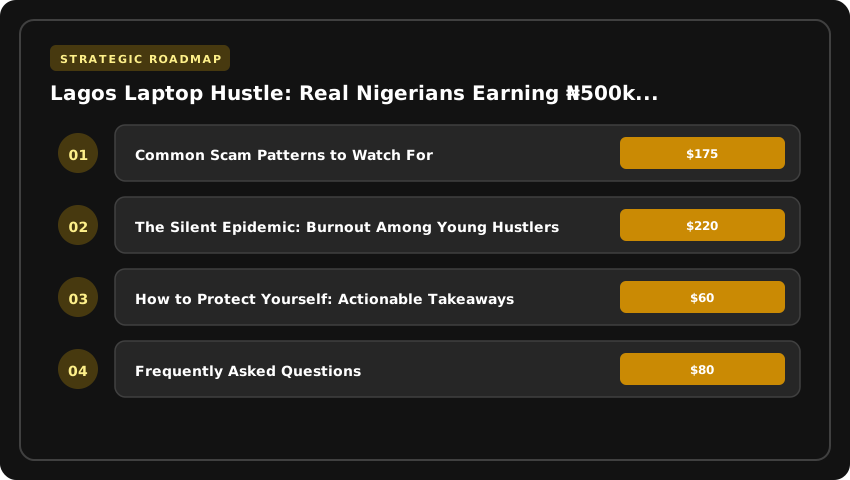
Common Scam Patterns to Watch For
- The “₦2 Million in 30 Days” Promise: Legitimate digital skills — whether copywriting, web development, or affiliate marketing — take months to monetize. Any course guaranteeing specific income within weeks is a red flag.
- WhatsApp Group Fraud Schemes: Some mentors run closed WhatsApp groups where they upsell increasingly expensive “inner circle” packages, creating a funnel that drains participants before delivering real value.
- Fake Testimonials and Bot Reviews: Many scam operators fabricate success stories using stock photos or paid actors. Always cross-check claims on independent platforms like LinkedIn or Nairaland.
- Pressure Tactics and Artificial Scarcity: “Only 5 slots left at 50% discount!” is a classic manipulation strategy designed to force impulsive payments before you can verify credibility.
The Silent Epidemic: Burnout Among Young Hustlers
Beyond financial fraud, the mental health toll of the Lagos laptop hustle is becoming impossible to ignore. Many young Nigerians, especially those balancing WAEC and NECO preparations, JAMB UTME studies, or Post-UTME screening, are attempting to build online income streams simultaneously. The result is a generation sleeping four hours a night, surviving on energy drinks, and measuring self-worth in Naira.
Student loan recipients under the NELFUND program who divert study time to chase online hustles risk academic failure and repayment challenges. The NUC CCMAS curriculum demands consistent engagement, and universities are increasingly strict about attendance and continuous assessment. Burning out before your second year helps no one.
How to Protect Yourself: Actionable Takeaways
- Verify before you pay: Check if the mentor has a verifiable digital footprint — real client work, published case studies, and traceable professional history.
- Demand value first: Reputable educators offer free foundational content. If everything is locked behind a paywall with no preview, walk away.
- Set realistic timelines: Expect 3 to 6 months minimum before seeing meaningful income from any digital skill.
- Guard your mental health: Treat rest as a non-negotiable investment. A burnt-out hustler earns less than a well-rested one.
- Report fraud: Use the FCCPC consumer complaint portal and EFCC reporting channels to flag suspicious operators.
The Lagos laptop hustle remains one of the most powerful economic mobility tools available to young West Africans in 2026. But like any frontier, it attracts opportunists. Stay sharp, verify claims relentlessly, and remember that sustainable wealth is built on skill, not hype.
| Laptop Hustle Path | Startup Cost (₦) | Monthly Income Range | Skill Cut-off / Requirement | Time to First ₦100k | Career ROI (12 months) |
|---|---|---|---|---|---|
| Freelance Copywriting (Upwork, Fiverr) | ₦150,000 – ₦300,000 (laptop + internet) | ₦200,000 – ₦800,000 | Strong English grammar, basic SEO knowledge | 3 – 6 months | High (8x – 12x ROI) |
| Social Media Management | ₦200,000 – ₦400,000 | ₦250,000 – ₦1,000,000 | Canva proficiency, content calendar planning | 2 – 4 months | High (10x+ ROI) |
| Graphic Design (Canva/CorelDraw) | ₦250,000 – ₦500,000 | ₦180,000 – ₦600,000 | Portfolio of 10+ sample designs | 4 – 8 months | Medium-High (6x – 9x) |
| Virtual Assistance | ₦150,000 – ₦250,000 | ₦150,000 – ₦500,000 | Email management, Google Workspace fluency | 1 – 3 months | Very High (15x ROI) |
| YouTube Content Creation | ₦400,000 – ₦900,000 (camera, light, laptop) | ₦150,000 – ₦2,000,000+ | 1,000 subs + 4,000 watch hours (YouTube Partner) | 6 – 12 months | Variable (3x – 20x) |
| Affiliate Marketing (Jumia, Konga, Expertnaire) | ₦100,000 – ₦250,000 | ₦200,000 – ₦700,000 | Niche website + audience (5k+ followers) | 3 – 6 months | High (8x – 15x ROI) |
| Data Analysis (Excel/Power BI) | ₦300,000 – ₦600,000 | ₦300,000 – ₦1,200,000 | SQL basics + dashboard certification | 4 – 7 months | Very High (12x+ ROI) |
Frequently Asked Questions
How can a Nigerian start earning ₦500k monthly from a bedroom laptop hustle in 2026?
Begin with a high-demand digital skill like copywriting, virtual assistance, or graphic design, requiring only a ₦150,000–₦400,000 laptop and stable internet. Build a portfolio on LinkedIn and Upwork, pitch 5 clients weekly, and reinvest first earnings into courses. Most Lagos hustlers hit ₦500k within 4–8 months.
What is the cheapest laptop hustle to start in Lagos with under ₦200,000?
Virtual assistance and freelance copywriting are the cheapest hustles, needing only a refurbished laptop, Wi-Fi, and basic Microsoft Office or Google Workspace skills. Total startup cost runs ₦150,000–₦200,000. Earnings begin within 30–90 days, making them the lowest-barrier entry into Lagos's six-figure remote economy.
Which laptop skill pays Nigerians the most money per month in 2026?
Data analysis and YouTube content creation currently top Lagos's earning charts, with skilled professionals pulling ₦1.2M–₦2M monthly. Both require intermediate training (Power BI or video editing) but command premium rates from foreign clients and Nigerian brands seeking measurable ROI on campaigns.
Are laptop money hustles in Nigeria legit or a scam?
Legit laptop hustles exist, but scams are rampant. Verify opportunities through Fiverr, Upwork, LinkedIn, or registered Nigerian platforms like Toptal and Andela. Avoid upfront payments, pyramid schemes, and unverified DM offers. Real hustlers build portfolios publicly and earn via traceable bank transfers or PayPal invoices.
Strategic Final Takeaway
Success in evaluating Lagos Laptop Hustle: Real Nigerians Earning ₦500k Monthly From Bedrooms relies on early preparation, adherence to verified accredited requirements, and cross-referencing official portals. Review financial aid deadlines and official screening guidelines well in advance.