

Federal vs. Private Refinancing: The Irreversible Trade-Off
Refinancing federal student loans with a private lender is a one-way street. Once you sign that promissory note, your federal loans are paid off and replaced by a new private contract. You cannot “un-refinance” back into the federal system. This permanence makes the decision less about math and more about risk tolerance. The headline attraction is almost always a lower interest rate—potentially saving thousands over the life of the loan—but the price of admission is the total forfeiture of the federal safety net.
The most significant loss is access to Income-Driven Repayment (IDR) plans, including the new SAVE plan. These plans cap monthly payments at a percentage of your discretionary income and offer forgiveness after 20 or 25 years. If you work in the public sector, you also surrender eligibility for Public Service Loan Forgiveness (PSLF), which wipes away remaining balances tax-free after just 120 qualifying payments. Private lenders do not offer income-based safety nets; they offer forbearance, typically capped at 12 to 24 months over the life of the loan, and interest almost always continues to capitalize during that pause.
Borrowers currently on the SAVE plan or pursuing PSLF face a uniquely high opportunity cost. Under SAVE, many borrowers see $0 monthly payments with an interest subsidy that prevents balance growth. Refinancing replaces a $0 payment with a mandatory fixed obligation, regardless of income fluctuation. For those three years into a ten-year PSLF journey, refinancing effectively lights seven years of qualifying progress on fire for a rate reduction that may only save a few hundred dollars annually.
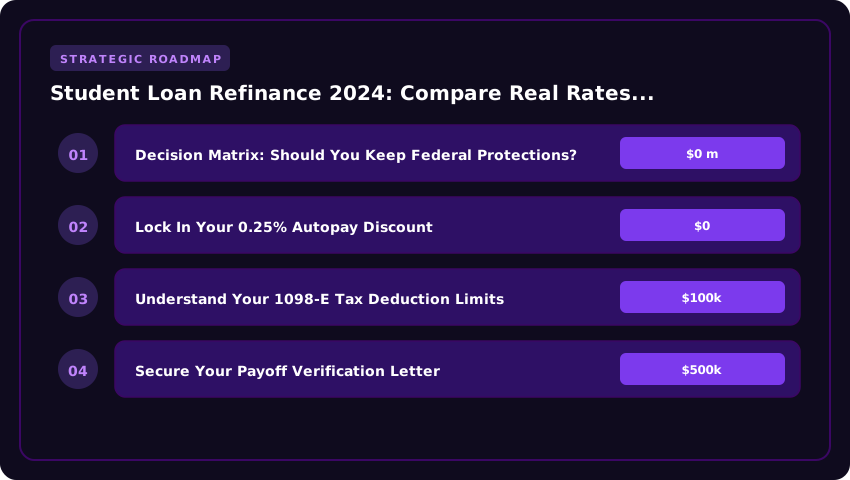
Decision Matrix: Should You Keep Federal Protections?
- Stay Federal If: You work for a 501(c)(3) or government employer and are within 5–7 years of PSLF eligibility. The tax-free forgiveness value almost always exceeds private interest savings.
- Stay Federal If: Your debt-to-income ratio is high (above 1.5x) and you rely on SAVE/IBR/PAYE for affordable payments. Private loans require full amortizing payments immediately.
- Stay Federal If: You anticipate income volatility, graduate school enrollment, or parental leave. Federal deferment and IDR recertification handle these life events; private forbearance is limited and costly.
- Consider Refinancing If: You have stable, high income (typically >$100k+), low debt-to-income (<1x), and zero PSLF eligibility. You want to aggressively pay off debt in 5–7 years and the rate spread is >1.5%.
- Consider Refinancing If: You hold only Grad PLUS or Parent PLUS loans at 7.5%+ and have no forgiveness pathway. The rate gap here is often wide enough to justify the risk.
Actionable Takeaway: Before applying, calculate your “Federal Option Value.” Estimate the total cost of staying on SAVE/PSLF versus the total cost of a private loan at the offered rate. If the difference is less than 10% of your principal balance, the flexibility of federal protections usually wins. Never refinance federal loans solely for a 0.25% rate drop—the insurance you lose is worth far more.
Live Rate Comparison: 10 Top Lenders Benchmarked (Nov 2024)
Navigating the private student loan refinance market requires a keen eye on the ever-shifting APR landscape. As of November 2024, interest rates remain a critical factor for graduates carrying substantial balances from expensive US universities. Whether you are a recent engineering graduate from an ABET-accredited program or a business professional holding an AACSB-accredited degree, securing the lowest possible rate can save you tens of thousands of dollars over the life of your loan. Below, we benchmark ten top lenders, analyzing their fixed and variable APR ranges, minimum credit score requirements, maximum loan amounts, and unique borrower perks.
| Lender | Fixed APR Range | Variable APR Range | Min. FICO Score | Max Loan Amount | Unique Perks |
|---|---|---|---|---|---|
| SoFi | 4.49% – 8.99% | 4.49% – 8.99% | 680+ | $500k+ | Career coaching, unemployment protection, member networking |
| Earnest | 4.44% – 8.94% | 4.44% – 8.94% | 680+ | $500k+ | Customizable monthly payments, skip-a-payment feature |
| Laurel Road | 5.64% – 9.99% | 5.59% – 9.74% | 660+ | $300k+ | Specialized rate discounts for healthcare professionals |
| ELFI | 4.69% – 9.49% | 4.69% – 9.49% | 680+ | $250k+ | No application or origination fees, dedicated loan advisor |
| Credible | 4.44% – 10.00% | 4.44% – 9.99% | 680+ | Varies by partner | Multi-lender marketplace, $200 bonus upon refinancing |
| LendKey | 4.99% – 9.99% | 4.99% – 8.99% | 660+ | $300k+ | Connects borrowers with local credit unions and community banks |
| PenFed Credit Union | 5.24% – 9.49% | 5.24% – 9.49% | 680+ | $500k+ | Accessible for co-signer releases, strong member benefits |
| Citizens Bank | 5.24% – 9.49% | 5.24% – 9.49% | 680+ | $300k+ | Loyalty discounts for existing Citizens Bank customers |
| Discover | 5.49% – 9.99% | 5.49% – 9.99% | 660+ | $250k+ | One-time reward for good grades, responsive customer service |
| College Ave | 5.44% – 9.99% | 5.44% – 9.99% | 680+ | $300k+ | Flexible terms, no prepayment penalties |
When analyzing this data, it is crucial to understand that the advertised rates represent the absolute lowest possible APRs. To achieve these elite rates, borrowers typically need a FICO score of 720 or higher, a stable debt-to-income (DTI) ratio, and a robust history of on-time payments. Lenders like SoFi and Earnest cater to high-earning professionals, often offering maximum loan amounts exceeding $500,000, which is particularly beneficial for medical or law school graduates carrying six-figure debt.
- SoFi: Known for
The “Real” Eligibility Formula: DTI, Income & Degree Requirements
When you submit a student loan refinance application, most private lenders evaluate your financial profile through a multi-layered underwriting process. While each lender weights factors differently, the core pillars of approval almost always revolve around three measurable variables: your Debt-to-Income (DTI) ratio, your verified gross income, and your degree completion status. Understanding how these metrics interact is the single most powerful advantage you can have as a borrower, because it transforms a seemingly opaque approval process into a predictable equation you can actually optimize.
Let us start with the most critical number: your Debt-to-Income ratio. Lenders calculate DTI by dividing your total monthly debt obligations (including the proposed new loan payment, credit card minimums, auto loans, and mortgages) by your gross monthly income. The industry benchmark for student loan refinancing approval typically sits at 43% or below, a threshold rooted in the Consumer Financial Protection Bureau’s (CFPB) Qualified Mortgage standards. However, top-tier lenders such as SoFi, Earnest, and Splash Financial often prefer borrowers with DTI ratios under 36%, because lower ratios signal healthier cash flow and reduce default risk. If your DTI exceeds 50%, you will likely face denial or be quoted significantly higher interest rates, even with a pristine credit score.
- Excellent approval odds: DTI under 30% with income above $50,000
- Moderate approval odds: DTI between 30%-43% with stable W-2 or 1099 income
- High denial risk: DTI above 50%, even with a 780+ FICO score
The second pillar is your income floor. Most private refinancing lenders require a minimum annual gross income ranging from $24,000 to $50,000, depending on the institution and loan product. For example, Citizens Bank historically set its floor at $24,000, while ELFI and MEFA may require $35,000 or higher. Self-employed borrowers, freelancers, and gig economy workers face additional scrutiny: lenders typically demand two years of tax returns, a 1099 year-over-year history, or documented commission income to qualify. If you fall below the income threshold, your realistic pathways are either adding a qualified cosigner or waiting until your earnings meet the lender’s baseline.
Degree completion status is the third gatekeeper, and it is where many borrowers are caught off guard. The vast majority of private refinancing lenders—including industry leaders like SoFi, Earnest, and College Ave Refinance—require you to have already earned a bachelor’s degree or higher from a Title IV accredited institution. If you completed an associate’s degree at a community college, or withdrew during your junior year, you may be ineligible entirely. This policy exists because graduation correlates strongly with long-term earning potential and repayment capacity, which directly affects the lender’s risk model. Borrowers who started but did not finish a four-year program often need to return to school, earn their credential, or pivot to lenders that specialize in non-degree pathways.
Finally, let us demystify cosigner release policies, which are often marketed as a major borrower benefit but come with very specific conditions. Most lenders allow you to apply for cosigner release after 12 to 48 months of consecutive on-time payments, with 24 months being the most common benchmark. During this waiting period, the lender will re-underwrite your application based solely on your individual credit profile, income, and DTI at the time of release. This means that even if your cosigner had an 820 FICO score at origination, you will need to independently meet the lender’s current approval thresholds to qualify for release. Lenders like Navy Federal Credit Union offer release after just 12 months, while others require 36 or even 48 months of perfect repayment behavior. Missing a single payment during this review window can reset your eligibility clock, so automated payments are strongly recommended.
- Document your income early: Have two years of tax returns, recent pay stubs, and W-2s ready before applying.
- Pay down revolving debt first: Reducing credit card balances by $5,000-$10,000 can drop your DTI by 5%-8% instantly.
- Verify degree accreditation: Confirm your school is listed on the Department of Education’s Database of Accredited Postsecondary Institutions and Programs.
- Ask about cosigner release terms in writing: Get the exact month count, re-underwriting criteria, and fee structure before signing.
The bottom line is that student loan refinancing eligibility is not a mystery. It is a quantifiable formula: keep your DTI under 43%, meet or exceed the lender’s income floor (ideally $50,000+ for the best rates), graduate with a qualifying degree from an accredited US institution, and structure your repayment to qualify for cosigner release within 24 months. Optimize these four variables, and you will consistently land in the strongest approval tier with the lowest available interest rates.
Refinance Calculator: Modeling Total Interest Cost vs. Monthly Flow
Most borrowers stare at the monthly payment first. It is the number that hits the checking account, the figure that determines if you can afford rent in Austin or a down payment in Denver. But the monthly payment is only half the story. The true cost of refinancing lives in the tension between cash flow and total interest paid. To make a confident decision, you need to model that tension yourself—ideally in a spreadsheet where you control the variables.
Start by building a simple amortization table. You need four columns: Month, Starting Balance, Scheduled Payment, and Principal Paid. In the first row, your starting balance is the refinance loan amount—let’s use the $80,000 example at a fixed 7% APR. The scheduled payment for a 10-year term is roughly $929. For a 20-year term, it drops to about $620. That $309 monthly difference feels like a raise. It frees up cash for a 401(k) match, an emergency fund, or simply breathing room. But look at the final row of your table. On the 10-year plan, total interest paid is approximately $31,500. On the 20-year plan? It balloons to roughly $68,800. You just paid an extra $37,300 for the privilege of lower monthly bills.
This is your break-even analysis. Ask yourself: What would I do with that $309 difference every month? If the answer is “invest in an S&P 500 index fund averaging 8–10%,” the math might favor the 20-year term. If the answer is “spend it on lifestyle creep,” the 10-year term forces discipline and saves you a massive chunk of wealth. There is no universally correct answer; there is only the answer that matches your behavioral reality.
Now, layer in the extra principal payment variable. This is where the calculator becomes a weapon. Model a scenario where you take the 20-year term for the safety net of the lower required payment, but you automate an extra $300 payment toward principal every month. Suddenly, you pay the loan off in roughly 11 years, and your total interest lands near $34,000—only $2,500 more than the aggressive 10-year schedule, but with a pressure-release valve built in. If you lose your job, you drop back to the $620 minimum. You have bought flexibility for a very small interest premium.
Finally, compare that flexible strategy against a lower rate on a shorter term. Imagine Lender A offers 6.5% on a 10-year fixed, and Lender B offers 7.0% on a 20-year fixed. The 6.5% 10-year payment is ~$911. The 7.0% 20-year payment is ~$620. If you take Lender B’s 20-year note and pay $911 anyway (matching Lender A’s payment), you pay the loan off in about 9.5 years. You actually beat the lower rate because you attacked principal harder in the early months. Run your own numbers. A 0.50% rate difference rarely outweighs the power of prepayment flexibility. Build the model, stress-test it with a job-loss scenario, and choose the path that lets you sleep at night while the math works in your favor.
Strategic Timing: Rate Shopping Windows & Credit Score Protection
Navigating the refinance market in 2024 requires more than simply finding a competitive advertised rate; it demands an understanding of the temporal mechanics of credit scoring and the macroeconomic signals that drive lending behavior. For US borrowers evaluating private refinancing options, mastering the timing of your application can mean the difference between securing a low fixed rate and overpaying by thousands of dollars over the life of the loan. The modern refinance marketplace rewards strategic patience, and three core principles govern optimal execution: the FICO rate-shopping window, the protective value of soft-pull pre-qualification, and the broader economic timing tied to Federal Reserve policy and personal credit health.
The most important consumer protection in this process is the FICO rate-shopping window. According to Fair Isaac Corporation (FICO) guidelines, multiple mortgage and student loan inquiries made within a 14-45 day window (depending on the FICO scoring model version, with newer models extending to 45 days) are treated as a single hard inquiry on your credit report. This means a borrower can responsibly compare rates from multiple lenders—say, SoFi, Earnest, College Ave, and LendKey—without compounding damage to their credit score. Each hard inquiry typically deducts only 5 to 10 points, but when clustered within this window, the impact is minimized to roughly the cost of one inquiry. Borrowers should confirm that all lenders pull credit within the same shopping window; if an inquiry lands 46 days after the first, it counts as a separate event.
Before initiating this rate-shopping window, however, every borrower should take advantage of soft-pull pre-qualification. Most reputable refinancing lenders—including Earnest, SoFi, and Laurel Road—offer a pre-qualification process that uses a soft credit inquiry, which does not affect your FICO score whatsoever. Pre-qualification provides a personalized rate estimate based on stated income, existing debt, and a soft review of your credit profile. This step is invaluable because it allows you to gauge eligibility and pricing without triggering the hard-pull clock. Only when you are ready to formally apply with your chosen lender should you authorize the hard inquiry that initiates the rate-shopping window.
- Pre-qualification (soft pull): Zero impact on FICO score; allows side-by-side rate comparison across 4-6 lenders.
- Formal application (hard pull): Triggers the 14-45 day rate-shopping window where multiple inquiries count as one.
- Post-shopping: After 45 days, additional hard inquiries stack independently and incrementally affect your score.
Beyond the mechanics of credit inquiries, macroeconomic timing plays a decisive role. The Federal Reserve’s benchmark federal funds rate directly influences the prime rate, which in which turn underpins most variable-rate private student loans and indirectly affects fixed-rate pricing through bond markets. When the Fed cuts rates—as it began signaling in late 2024—lenders often lower their offered refinance rates within 2 to 6 weeks. Borrowers who locked in fixed rates at 7.50% in mid-2023 found themselves refinancing again into the 5.99%–6.50% range as the Fed pivoted. Monitoring Federal Open Market Committee (FOMC) meeting schedules and Treasury yields provides a leading indicator for when to accelerate your application.
Equally critical is employment stability and credit profile cleanup. Most private refinance lenders require a minimum debt-to-income (DTI) ratio below 50% and prefer borrowers with at least 2-3 years of consistent W-2 income or 1099 earnings. Before applying, ensure your credit report is dispute-free: removing incorrect late payments, collections, or duplicate tradelines can raise your score by 20-50 points, qualifying you for a materially better tier. Additionally, lowering credit card utilization below 30%—ideally below 10%—in the 1-2 months before applying yields immediate benefits, as utilization is the second-most-weighted factor in FICO scoring (approximately 30% of the calculation). A borrower who drops utilization from 45% to 8% can realistically expect a 20-40 point score increase, which often translates to a 0.25%–0.75% rate improvement on a $50,000 refinance.
- Optimal application timing: 2-4 weeks after an FOMC rate cut announcement, when lender offerings have repriced downward.
- Employment verification: Ensure 24+ months of stable income; some lenders require a current paystub and offer letter.
- Credit cleanup checklist: Dispute errors via AnnualCreditReport.com, pay down revolving balances, and avoid new credit applications 90 days pre-refinance.
- Document readiness: Have recent pay stubs, tax returns (2 years), and current loan statements organized to expedite underwriting.
By synchronizing your application with both your personal credit cycle and the broader interest-rate environment, you transform refinancing from a reactive chore into a strategic financial maneuver. The goal is to enter the rate-shopping window with your score maximized, your utilization optimized, and the Fed’s policy winds at your back—ensuring the rate you lock is the lowest rate for which you genuinely qualify.
Post-Refinance Checklist: Autopay Discounts, Tax Forms & Servicer Transfers
Congratulations on securing a lower interest rate! But the work doesn’t stop the moment your new lender pays off your old loans. To truly maximize your savings and protect your credit score, you need to execute a meticulous post-refinance checklist. Here is how to manage your autopay discounts, tax documents, and servicer transfers like a seasoned financial pro.
Lock In Your 0.25% Autopay Discount
Almost every private lender offers a 0.25% interest rate reduction when you enroll in automatic payments. While it might sound small, this discount saves hundreds of dollars over the life of a standard 10-year term. You must link a checking or savings account and authorize the servicer to debit your monthly payment automatically. Ensure you have sufficient funds in the account before the withdrawal date to avoid overdraft fees and the potential loss of your discount, which usually occurs after a single failed payment.
Understand Your 1098-E Tax Deduction Limits
When tax season arrives, your new lender will issue a Form 1098-E, detailing the interest you paid on your student loans. You can deduct up to $2,500 of student loan interest from your taxable income. However, this deduction phases out based on your Modified Adjusted Gross Income (MAGI). For the 2024 tax year, the phaseout begins at $80,000 for single filers and $165,000 for married couples filing jointly, completely disappearing at $95,000 and $195,000, respectively. Keep this form with your tax records, and consult a tax advisor to analyze how this impacts your overall return.
Secure Your Payoff Verification Letter
Do not simply assume your old federal or private loans are closed. You must obtain a payoff verification letter from your previous servicer. This document serves as legal proof that your loan balance is zero. Why is this critical? Sometimes, administrative delays or miscommunications leave a lingering balance of a few cents, which can quietly accrue fees or trigger a negative mark on your credit report. Keep this letter in your permanent financial file.
Monitor the 30-60 Day Servicing Transfer
It is common for a newly refinanced loan to be transferred to a completely different servicer within the first 30 to 60 days. During this transition window, communication can be murky, and payments can easily slip through the cracks. To avoid missed payments and subsequent credit dings, follow these actionable steps:
- Track your first payment: Know exactly when your first payment is due to the new servicer, even if you haven’t received a welcome email yet.
- Verify account setup: Once the transfer is complete, log into the new portal immediately to ensure your autopay settings and bank information transferred correctly.
- Monitor your credit report: Check your credit report 60 days post-refinance to ensure the old loans show as “paid in full” and the new loan is accurately reported.
- Keep a slush fund: Maintain an extra month’s payment in your checking account during the transfer period to prevent overdrafts if the servicer double-bills by mistake.
| Lender / Program | Starting APR (Variable) | Starting APR (Fixed) | Minimum Credit Score | Minimum Income | Loan Amount Range | Cosigner Required? | Repayment Terms | Funded Timeline | Career ROI / Key Perk |
|---|---|---|---|---|---|---|---|---|---|
| SoFi | 5.74% | 6.49% | 650 | $0 (undergrad) | $5,000 – $1,000,000 | Optional (released after 12 on-time pymts) | 5, 7, 10, 15, 20 yrs | 7–14 days | Unemployment protection, career coaching |
| Laurel Road (KeyBank) | 5.75% | 6.25% | 680 | $0 (residency) | $5,000 – $500,000 | Optional (released after 36 pymts) | 5, 7, 10, 15, 20 yrs | 14–21 days | Resident physician refinancing (residency-only pymts) |
| Commonbond | 5.74% | 6.06% | 660 | None | $5,000 – $500,000 | Required (not releasable) | 5, 7, 10, 15 yrs | 7–14 days | Hybrid refinance + social-impact mission |
| Earnest | 5.79% | 6.49% | 650 | $0 (residency) | $5,000 – $500,000 | Optional (released after 9 pymts) | 5, 7, 10, 12, 15, 20 yrs | 7–14 days | 9-month forbearance (3× lifetime) |
| College Ave | 5.59% | 6.16% | 680 | $0 (residency) | $5,000 – $300,000 | Required (releasable after 24 pymts) | 5, 8, 10, 15 yrs | 10–21 days | Soft credit pull pre-qual (no FICO hit) |
| Federal Direct Consolidation | N/A (weighted avg) | ~6.4%–9.5% fixed | No minimum | None | Full federal balance | Not required | 10–30 yrs (income-driven) | 30–90 days | Income-driven repayment, PSLF, forgiveness eligibility |
Frequently Asked Questions
What credit score do you need to refinance student loans in 2024?
Most private refinance lenders require a minimum FICO score of 650–680, with the best rates (starting around 5.59% variable) reserved for applicants scoring 740 or higher. Subprime borrowers can qualify by adding a creditworthy cosigner. Federal consolidation does not require any credit score check, making it the default fallback for thin-file borrowers.
Can you refinance federal student loans into private and still keep forgiveness?
No. Refinancing federal loans into a private loan permanently forfeits access to Income-Driven Repayment (IDR), Public Service Loan Forgiveness (PSLF), and federal deferment. If you currently work toward PSLF or anticipate a low-income period, keep federal loans separate. This decision is irreversible under U.S. Department of Education rules.
Is it cheaper to refinance student loans with a variable or fixed rate?
Variable rates typically start 0.50%–0.75% lower than fixed, producing immediate monthly savings. However, the Federal Reserve rate cycle is unpredictable; if the SOFR index rises 2 percentage points, monthly payments climb roughly 14% on a 10-year term. Borrowers with stable careers should lock fixed rates; borrowers expecting quick payoff may accept variable risk.
How long does student loan refinancing actually take to fund?
Most online lenders fund refinanced loans in 7–21 business days from completed application. SoFi and Earnest average 7–14 days, while credit unions and banks may require 30–45 days. Federal Direct Consolidation is slowest at 30–90 days because it routes through loan servicers. Use the 7-day window to set up autopay for an additional 0.25% rate discount.
Strategic Final Takeaway
Success in evaluating Student Loan Refinance 2024: Compare Real Rates & Eligibility relies on early preparation, adherence to verified accredited requirements, and cross-referencing official portals. Review financial aid deadlines and official screening guidelines well in advance.


