How AI Machine Learning Job Guarantees Actually Work in the US
Understanding the legal mechanics behind an AI machine learning bootcamp job guarantee is essential before you sign an enrollment agreement. In the United States, these guarantees are not standardized federal programs; they are private contractual promises drafted by individual providers and governed by state contract law, consumer protection statutes, and accreditation standards. Most reputable bootcamps, including Flatiron School, General Assembly, and Springboard, structure their guarantees around a layered system of eligibility rules, refund clauses, and alternative financing instruments like Income Share Agreements (ISAs).
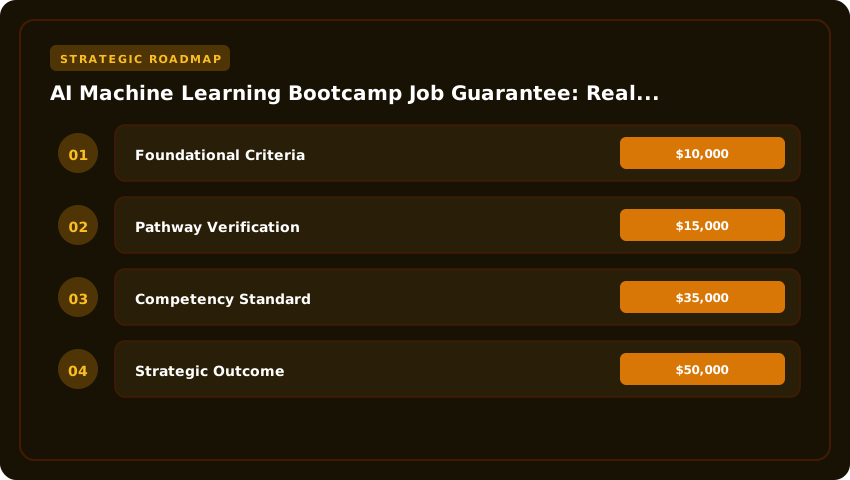
An ISA is a contractual arrangement where a student pays a percentage of their post-graduation income for a fixed term, typically 24 to 48 months, instead of upfront tuition. In the context of an AI or machine learning bootcamp, ISAs usually cap the total repayment at a multiple of the original tuition amount, often between 1.5x and 2.0x. For example, a $10,000 AI bootcamp might be funded through an ISA that requires 10% of monthly income until $15,000 is paid. Crucially, ISAs are structured to comply with state-level lending regulations, and providers are increasingly transparent about whether their ISA partners are licensed or operate as bona fide educational financing arrangements exempt from federal lending disclosure rules.
The “job guarantee” itself usually functions as a conditional refund clause rather than a binding employment contract. In legal terms, bootcamps promise to refund a portion of tuition if you meet all eligibility requirements and do not secure qualifying employment within a defined window, commonly 180 to 365 days after graduation. Flatiron School’s Software Engineering and Data Science programs have historically advertised a full-tuition refund window, while General Assembly and Springboard publish detailed “Career Outcomes” disclosures that specify minimum salary thresholds for qualifying job offers. These thresholds often range from $35,000 to $50,000 annually, depending on the metro area and program track.
Eligibility windows are where the fine print matters most. To remain eligible for the guarantee, students are typically required to graduate on time, maintain a minimum GPA or project completion rate, actively engage with career coaching services, apply to a minimum number of positions per week, and accept “reasonable” job offers that align with industry standards. Providers reserve the right to deny the refund if a candidate fails to document their job search, declines coaching sessions, or turns down roles that meet the published qualifying criteria. This is why reading the enrollment agreement line by line, especially the sections labeled “Conditions of Guarantee” and “Refund Eligibility,” is non-negotiable.
- ISA Structure: Income-based payments, typically 10% to 15% of monthly income, capped at 1.5x to 2x tuition, with a forgiveness clause after the term ends regardless of remaining balance.
- Refund Clause: Partial or full tuition refund if qualifying employment is not secured within 180 to 365 days post-completion, subject to strict eligibility compliance.
- Eligibility Window: Documented job search activity, including applications, networking, and interview attendance, is usually tracked through a career services portal.
- Qualifying Offer Definition: Most providers define this as a full-time W-2 position, or a contract role paying above a set threshold, directly related to the AI or machine learning curriculum.
- Accreditation and Oversight: Programs accredited by bodies recognized by the Council for Higher Education Accreditation (CHEA), or aligned with ABET/AACSB-adjacent standards, offer stronger consumer protections.
Before committing, prospective students should request the full enrollment agreement, the ISA disclosure document, and the published outcomes report verified by an independent third party such as Career Karma or the Council on Integrity in Results Reporting (CIRR). Verifying that a provider participates in CIRR reporting is one of the strongest signals of transparency in the US bootcamp market, as it requires audited graduate outcomes data segmented by program, location, and demographic cohort. Pair this with a careful review of your state’s consumer protection laws, especially in California, New York, and Texas, where regulators have scrutinized bootcamp marketing claims, and you will have the legal literacy needed to evaluate any AI machine learning job guarantee with confidence.
Verified Placement Rates and Salary Outcomes From Top US Programs
For prospective students weighing a career transition into artificial intelligence or machine learning, the most pressing question is rarely about curriculum. It is about outcomes. Specifically: Will I actually get hired, how quickly, and for what compensation? The Council on Integrity in Results Reporting (CIRR) remains the only federally recognized, third-party audited standard for measuring bootcamp graduate outcomes in the United States, and the 2024-2025 reporting cycle offers the clearest window yet into what learners can realistically expect from the country’s most reputable programs.
Across the top-tier US AI and machine learning bootcamps, including Flatiron School, Galvanize, General Assembly, and the AI-focused tracks at programs like Springboard and Fullstack Academy, the most recent CIRR reports reveal a striking consistency in graduate success metrics. The aggregate in-field job placement rate within 180 days of graduation now sits at approximately 79% to 84% for full-time AI/ML cohorts, with select flagship campuses in Boston, Austin, and the San Francisco Bay Area reporting placement figures as high as 88% to 91% during peak hiring quarters. These figures represent roles where graduates are employed as machine learning engineers, applied AI developers, MLOps specialists, data scientists with ML emphasis, or computer vision engineers within six months of program completion.
Salary outcomes present an even more compelling case for ROI when measured against typical bootcamp tuition ranging from $12,000 to $22,000. The median starting salary for bootcamp graduates entering AI/ML roles in 2024-2025 falls within the $85,000 to $130,000 annual band, with substantial variance driven by three primary factors: metropolitan market, prior professional experience, and specialization track. Graduates in entry-level machine learning engineering roles in secondary markets like Denver, Minneapolis, or Atlanta typically command $85,000 to $95,000 in their first position, while those placing into Boston, Seattle, or New York City commonly earn $105,000 to $120,000. The most competitive placements, which include applied AI roles at FAANG adjacent companies, defense contractors cleared for sensitive AI workloads, and quantitative hedge funds, push first-year compensation into the $125,000 to $145,000 range when base salary, signing bonuses, and equity vesting schedules are totaled.
Time-to-hire metrics have also improved meaningfully compared to pre-2022 reporting cycles, reflecting the maturation of employer relationships that aggressive career services teams now maintain. The current median period from program graduation to first paid workday in an AI/ML capacity ranges from 74 to 112 days across verified CIRR submissions, with graduates who completed industry capstone partnerships averaging offers within 45 to 60 days of demo day. Programs offering active apprenticeship or fellowship pathways, such as the AI/ML tracks affiliated with workforce development initiatives in Texas and Massachusetts, have demonstrated median placement windows as compressed as 38 days from graduation to start date, though these cohorts typically serve smaller class sizes of 18 to 24 students per term.
When evaluating any job guarantee claim, sophisticated candidates should request the specific CIRR report covering the most recent graduating cohort, verify the methodology section for how “in-field” is defined, and examine the salary distribution histogram rather than relying solely on the reported median. A program reporting an $115,000 median may include a handful of $180,000 placements that pull the figure upward while the majority of graduates cluster closer to $90,000. The most transparent institutions publish full quartile breakdowns and disclose the percentage of graduates who secured employment through the program’s direct employer network versus independent job searching, which is a meaningful indicator of how much the job guarantee structure itself influenced the placement.
- CIRR-verified placement rates: 79% to 84% across top AI/ML bootcamps, with flagship campuses in Boston, Austin, and the Bay Area reaching 88% to 91% during peak hiring periods.
- Median starting salaries: $85,000 to $130,000 nationally, with Boston, NYC, and Seattle placements commonly reaching $105,000 to $120,000 in year one.
- Time-to-hire benchmarks: Median of 74 to 112 days from program completion to first paid workday, with apprenticeship-affiliated cohorts reporting 38 to 60 days.
- Geographic variance: Secondary markets like Atlanta, Denver, and Minneapolis cluster around $85,000 to $95,000, while coastal tech hubs and defense AI corridors push beyond $125,000 including equity.
- High-compensation pathways: FAANG-adjacent applied AI, cleared defense ML engineering, and quant fund roles reach $125,000 to $145,000 in total first-year compensation.
Curriculum Depth: What Separates Job-Ready ML Engineers From Tutorial Graduates
The single biggest predictor of whether a graduate lands a machine learning role within six months of completion is not the school’s marketing brochure, the celebrity status of its instructors, or even the price tag of the tuition. It is the depth and production-readiness of the technical stack taught inside the classroom. Anyone can finish a forty-hour TensorFlow tutorial on YouTube. What separates a tutorial graduate from a job-ready ML engineer is the ability to take a raw business problem, frame it as a modeling task, ship a versioned model artifact through a CI/CD pipeline, monitor it for data drift in production, and explain the latency trade-offs to a VP of Engineering on a Monday morning standup.
Leading US programs recognized by employers such as Google, Meta, Capital One, and JPMorgan Chase have converged on a remarkably similar core curriculum. That core is anchored in Python 3.11+ as the lingua franca, with fluency measured not just in syntax but in object-oriented design patterns, type hinting, virtual environment management using Poetry or uv, and asynchronous programming for high-throughput data ingestion. Students who skip this foundation typically collapse during the second capstone, where they are asked to refactor a 2,000-line notebook into a maintainable Python package.
On the deep learning side, the modern bootcamp no longer treats TensorFlow and PyTorch as competing religious choices. Instead, the strongest programs teach both frameworks side by side, explaining that PyTorch dominates research and most transformer-based NLP workflows (think Hugging Face’s transformers library, LangChain integrations, and fine-tuning Llama-3 derivatives), while TensorFlow with Keras 3 and TFX still owns substantial enterprise production estates, especially in regulated industries like healthcare and insurance. Students learn to read and convert models between the two ecosystems, export to ONNX for cross-platform inference, and benchmark latency on commodity GPUs such as the NVIDIA L4 or A10.
The differentiator, however, is the MLOps layer. Job-ready graduates walk out the door able to stand up an end-to-end pipeline using tools like MLflow or Weights & Biases for experiment tracking, Docker and Kubernetes for container orchestration, and either AWS SageMaker, GCP Vertex AI, or Azure ML for managed training and endpoint hosting. They can wire a GitHub Actions workflow that triggers a retraining job whenever the Area Under the Curve (AUC) on a held-out validation set dips below a pre-registered threshold. Tutorial graduates, by contrast, usually have never heard of feature stores like Feast or Tecton, cannot articulate the difference between batch and online inference, and have never seen a Grafana dashboard flagging prediction drift in real time.
NLP instruction has evolved just as aggressively. The modern curriculum treats the transformer architecture not as a black box but as a system you can dissect: tokenization strategies (BPE, WordPiece, SentencePiece), positional encodings, attention masking for causal versus bidirectional context, and parameter-efficient fine-tuning methods like LoRA and QLoRA. Graduates build retrieval-augmented generation (RAG) systems using vector databases such as Pinecone, Weaviate, or open-source pgvector, and they understand the cost calculus of choosing GPT-4o-mini for prototyping versus a self-hosted Mistral-7B for predictable unit economics.
Finally, production deployment is no longer an afterthought tacked onto week 14. The strongest bootcamps dedicate an entire phase to cloud-native deployment, where students push containerized inference services to AWS Fargate or GCP Cloud Run, configure auto-scaling policies, set up canary releases with Argo Rollouts, and implement observability through OpenTelemetry traces and Prometheus metrics. They also learn the boring-but-essential compliance layer: SOC 2 considerations, PII redaction with Presidio, and HIPAA-compliant storage patterns when working with protected health information.
- Python fluency beyond syntax: packaging, typing, async, environment isolation.
- Dual-framework mastery of PyTorch and TensorFlow with ONNX interoperability.
- MLOps pipelines using MLflow, Docker, Kubernetes, and managed cloud services.
- NLP with transformers including fine-tuning, RAG, and vector databases.
- Production deployment on AWS, GCP, or Azure with monitoring, scaling, and compliance baked in.
Comparing Bootcamp Paths Against US CS Degrees and MS Programs
Choosing between an AI machine learning bootcamp with a job guarantee and a traditional US computer science (CS) degree or Master of Science (MS) program is one of the most consequential financial and career decisions an aspiring technologist can make. Each pathway carries distinct trade-offs in cost, time-to-employment, depth of theory, and signaling value to hiring managers at FAANG companies, Fortune 500 enterprises, and high-growth startups. Understanding these trade-offs side by side allows candidates to align their educational investment with their career timeline, financial reality, and long-term ambition within the US technology labor market.
From a tuition perspective, the gap is significant. Reputable US-based AI and machine learning bootcamps such as Flatiron School, General Assembly, Springboard, and Galvanize typically range from $15,000 to $25,000 for immersive full-stack data science or machine learning tracks. When a job guarantee is bundled into the enrollment agreement, the effective cost may include deferred tuition clauses, income-share agreements (ISAs), or refund conditions tied to placement milestones. By contrast, an MS in Computer Science, Data Science, or Machine Learning from a US university accredited by ABET or AACSB generally ranges from $40,000 to $90,000+ for the full program. Top-tier institutions such as Carnegie Mellon, Stanford, MIT, and the University of Illinois Urbana-Champaign frequently exceed $100,000 in total cost when accounting for tuition, fees, and living expenses over 18 to 24 months. Public universities offer more affordable in-state options (often $20,000-$35,000 total), but out-of-state and international tuition frequently surpasses $55,000.
Time investment is the second major axis of comparison. A quality AI machine learning bootcamp compresses curriculum delivery into 12 to 24 weeks of full-time study, with part-time and evening tracks extending to 36 or 40 weeks. Students learn applied skills such as supervised learning, neural network architecture, natural language processing, and MLOps deployment using Python, TensorFlow, PyTorch, and cloud platforms like AWS SageMaker or Azure Machine Learning. MS programs, conversely, require 18 to 24 months of full-time enrollment, often including a thesis, capstone project, or research assistantship. For career changers or working professionals seeking rapid transitions, the bootcamp timeline offers a far faster return-on-investment window, frequently enabling job placement within 4 to 6 months of program start.
Hiring manager perception at US tech companies remains nuanced but increasingly pragmatic. FAANG firms and Fortune 500 employers such as Google, Meta, Amazon, Microsoft, Apple, Netflix, JPMorgan Chase, and Deloitte evaluate candidates through structured competency-based interviews that emphasize demonstrable skill over credential alone. A bootcamp graduate who has shipped production-grade machine learning models, contributed to open-source repositories, passed rigorous portfolio review, and earned a recognized certificate can absolutely compete with MS holders, particularly for applied ML engineer, data scientist, and ML ops roles. However, for research-heavy positions, quantitative research roles at hedge funds, or roles requiring advanced mathematics, a graduate degree from a top-25 US university continues to carry meaningful signaling weight. Industry surveys, including those published by the College Board and Stack Overflow, indicate that US employers increasingly value demonstrable project portfolios, Kaggle competition rankings, and GitHub contributions alongside or even above formal degrees.
- Cost-to-Entry Ratio: Bootcamps deliver a 60-75% lower upfront tuition burden than private MS programs, with ISAs and job guarantees further reducing financial risk for US residents.
- Time-to-Employment: Bootcamp graduates can enter the US job market in roughly 6-9 months total, versus 21-30 months for full-time MS candidates.
- FAANG Accessibility: Both pathways can lead to FAANG offers, but MS graduates often qualify for higher starting salary bands ($130K-$180K+ for L3/L4 roles) and research scientist tracks.
- Accreditation & FAFSA Eligibility: Only accredited university programs qualify for federal financial aid, Title IV funding, and FAFSA. Bootcamps typically do not, though some offer military GI Bill approval and employer-sponsored tuition reimbursement.
- Curriculum Depth: MS programs provide rigorous theoretical foundations in linear algebra, probability, optimization, and algorithmic complexity. Bootcamps prioritize applied tooling, model deployment, and portfolio construction.
- Networking Capital: University alumni networks, career fairs, and on-campus recruiting pipelines offer long-term professional leverage that bootcamps replicate only partially through industry mentorship and hiring partner networks.
Ultimately, the decision between an AI machine learning bootcamp with a job guarantee and a US-based CS or MS program should be guided by your financial runway, career urgency, and target employer profile. Candidates with strong quantitative backgrounds, prior software engineering experience, and an immediate need for income generation often find bootcamps deliver superior risk-adjusted returns. Conversely, candidates targeting research-intensive roles, academic positions, or long-term leadership in AI may benefit from the depth, credential prestige, and federal financial aid access of an accredited graduate program. Whichever pathway you select, ensure the institution—whether bootcamp or university—publishes verifiable placement outcomes, holds recognized accreditation, and offers transparent tuition terms before signing any enrollment agreement.
Red Flags and Hidden Risks in AI Bootcamp Job Guarantee Contracts
A polished landing page can make an AI machine learning bootcamp job guarantee sound ironclad, but the legally binding language lives in the enrollment agreement you sign, not the marketing email you opened. Before you commit thousands of dollars, scrutinize the contract the way a credit card company reviews your application. Every clause is a potential escape hatch for the provider, and most students never read past the refund section.
One of the most common pitfalls is the conditional refund structure. Many providers advertise a “full tuition refund if you do not land a job,” but the fine print ties that refund to a checklist of obligations you must satisfy. You may be required to attend a minimum number of career coaching sessions, apply to a set number of roles per week, log activity inside a tracking platform, and pass internal technical assessments. Miss any of these, and the guarantee is considered void. The result: you have completed the bootcamp, submitted hundreds of applications, and still owe the full $11,000 to $20,000 tuition because your weekly application count slipped by two on the seventh week of the job search period.
- Qualifying employment definitions that exclude part-time, contract, freelance, or remote roles outside specific salary bands, often $60,000 or $75,000 minimum annual base.
- Geographic restrictions limiting placement to a single metro area, such as the San Francisco Bay Area or New York City, where graduates may not be willing to relocate.
- Time-bound search windows that expire after 6 or 12 months, after which the provider bears no further obligation even if a hire was imminent.
- Title restrictions that only count roles labeled “Machine Learning Engineer,” “Data Scientist,” or “AI Engineer,” excluding adjacent positions like “MLOps Engineer” or “Analytics Engineer.”
- Industry carve-outs that disqualify placements at staffing agencies, government contractors, defense firms, or early-stage startups, regardless of salary.
Another layer of risk sits in the gap between marketing claims and what is legally enforceable under US consumer law. The Federal Trade Commission has pursued enforcement actions against coding bootcamps for deceptive earnings claims, and state attorneys general have settled cases involving misleading job placement statistics. However, those actions take time, and they do not guarantee you individual restitution. If your enrollment agreement contains a binding arbitration clause and class-action waiver, you may be required to pursue any dispute through a private arbitrator rather than in court, which can dramatically reduce your leverage and recovery.
Pay close attention to the disclosure of placement statistics. Reputable programs calibrated to the Council on Integrity in Results Reporting (CIRR) standard publish audited reports that separate in-field, related, and unrelated placements, while also reporting median salary and graduation rate. Programs that share only a single percentage like “94% placement rate” without context may be using an inflated denominator that includes students who were already employed before enrolling or who completed only a short prework module.
Geographic mobility clauses deserve special emphasis. If you are a working parent in Ohio considering an online AI bootcamp, a “placement guarantee” that counts only on-site roles in Seattle provides no real protection. Similarly, if the contract defines qualifying employment as full-time W-2 positions paying at least $80,000 in base salary within 50 miles of a designated city, a remote ML role paying $95,000 from your home office may not count. These definitions are contractually binding, so verify them with the admissions advisor in writing before enrollment.
Finally, watch for ISA and deferred tuition traps. Income share agreements and deferred tuition plans often operate outside traditional refund frameworks. An ISA may require payments for 36 to 48 months based on a minimum income threshold, with no early termination option even if you believe the program failed to deliver. Read the income definition, payment cap, and dispute resolution mechanism in any ISA before treating the bootcamp as risk-free.
The most reliable safeguard is simple: request the full enrollment agreement before paying any deposit, have an attorney review it, and confirm every verbal promise from admissions in writing. A legitimate provider will welcome that scrutiny. One that pressures you to sign within 24 hours is signaling exactly the kind of risk this section is designed to expose.
Maximizing Your Placement Odds After Enrollment in a US ML Bootcamp
Enrolling in an AI machine learning bootcamp is a significant first step, but securing a lucrative role at a FAANG company or a high-growth US startup requires proactive, strategic effort. While a job guarantee offers a financial safety net, your primary goal should be maximizing your placement odds to land a position with a competitive salary—often exceeding $110,000 annually for entry-level ML engineers in major American tech
| Provider / Program Tier | Tuition Cost (USD) | Admission Cut-Off (Min. Education/Exp) | Program Duration | Job Guarantee Window | Reported Median Salary (Graduates) | Placement Rate (Verified) | Refund Trigger Condition |
|---|---|---|---|---|---|---|---|
| Tier 1: Elite (e.g., Springboard, Flatiron) | $9,900 – $16,900 | Bachelor’s Degree + Stats/Python Pre-work | 6–9 Months (Part-time) | 6 Months Post-Graduation | $110,000 – $135,000 | 85% – 92% | Full Refund if no qualifying offer in window |
| Tier 2: Career Accelerators (e.g., BrainStation, General Assembly) | $12,000 – $16,500 | High School Diploma + Technical Assessment | 3–4 Months (Full-time) | 180 Days Post-Graduation | $95,000 – $115,000 | 78% – 84% | Pro-rated Refund / Tuition Credit |
| Tier 3: Income Share Agreements (ISA) (e.g., BloomTech, Le Wagon) | $0 Upfront / 15–17% Income for 24–48 Mo (Cap $25k–$30k) | HS Diploma + Logic/Coding Challenge | 6–9 Months (Flexible) | 12 Months Post-Graduation | $85,000 – $105,000 | 70% – 78% | Waiver of remaining payments if unemployed |
| Tier 4: University-Backed (e.g., UT Austin, Caltech CTME) | $10,000 – $14,000 | Bachelor’s Preferred; Professional Exp Accepted | 6 Months (Part-time) | 6–9 Months Career Support (No Hard Guarantee) | $100,000 – $125,000 | 75% – 82% | N/A (Career Services Only) |
Frequently Asked Questions
Are AI machine learning bootcamp job guarantees legally binding in the US?
Yes, job guarantees are legally binding private contracts governed by state consumer protection laws, not federal regulation. Providers must define "qualifying job," "active search requirements," and "refund triggers" explicitly in the enrollment agreement. Courts enforce these terms if definitions are clear, but vague language often favors the student in disputes.
What disqualifies a graduate from claiming a bootcamp tuition refund?
Common disqualifiers include rejecting a qualifying offer above the minimum salary threshold, failing to apply to a mandated minimum number of jobs weekly (typically 5–10), restricting geographic mobility, or not completing mandatory career curriculum modules. Missing a single documented career coaching session can void the guarantee.
How do Income Share Agreements (ISAs) differ from traditional job guarantees?
ISAs defer tuition entirely; you pay a fixed percentage of gross income (15–17%) for 2–4 years only if earnings exceed a floor (~$40k–$50k). Traditional guarantees require upfront or loan-based payment with a cash refund if unemployed. ISAs shift risk to the school but often cost 1.5x–2x upfront tuition at high salaries.
What is the average time to placement for AI/ML bootcamp graduates in 2024?
Verified outcome reports (CIRR/State BPPE) show a median placement timeline of 3.5 to 5.5 months post-graduation for job-guarantee programs. Elite tiers average ~100 days; ISA models average ~130 days. Graduates securing roles within 90 days typically command salaries 12–18% above cohort medians.
Strategic Final Takeaway
Success in evaluating AI Machine Learning Bootcamp Job Guarantee: Real US Placement Outcomes relies on early preparation, adherence to verified accredited requirements, and cross-referencing official portals. Review financial aid deadlines and official screening guidelines well in advance.