
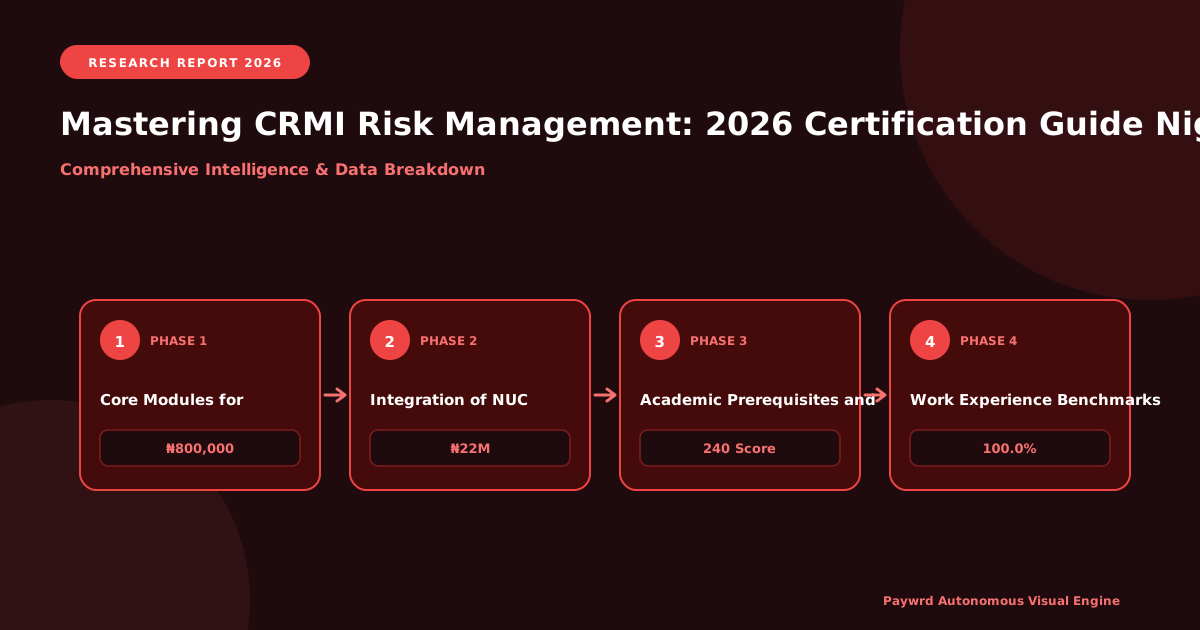
Navigating the 2026 CRMI Certification Pathway in Nigeria
Securing a Certified Risk Management Professional (CRMP) designation in 2026 requires more than just passing an exam; it demands a strategic alignment with the current volatility of the Nigerian macroeconomic landscape. The certification pathway is now structured to bridge the gap between academic theory and the practical realities of managing risk in high-inflation environments and evolving regulatory frameworks.
Core Modules for the 2026 CRMP Track
The current curriculum has been overhauled to prioritize agility and digital resilience. Candidates must navigate four primary pillars to achieve full certification:
- Enterprise Risk Management (ERM) Frameworks: Mastering the integration of risk appetite statements with corporate strategy.
- Quantitative Risk Analysis: Advanced use of Monte Carlo simulations and stress-testing for Nigerian financial markets.
- Operational Resilience & Cybersecurity: Addressing the surge in fintech vulnerabilities and data protection compliance.
- Regulatory Compliance & Governance: Deep dives into current CBN and SEC directives for 2026.
Integration of NUC CCMAS Standards
A significant shift in 2026 is the integration of the National Universities Commission (NUC) Core Curriculum and Minimum Academic Standards (CCMAS). Professional risk training is no longer siloed; it now mirrors the CCMAS emphasis on practical, industry-led learning. This means that CRMI training providers are now mandated to include “Industry Practicum” hours. For professionals, this ensures that the certification is recognized not just by corporate boards, but as an academic equivalent to postgraduate specializations in risk management, facilitating easier transitions into academia or senior consultancy roles.

Virtual vs. Hybrid Learning: The Nigerian Corporate Choice
For the 2026 cohort, the choice of delivery model depends heavily on the professional’s location and networking goals. Nigerian corporate professionals are currently split between two dominant models:
- Virtual Learning: Ideal for professionals in remote hubs or those balancing high-pressure roles in Lagos and Abuja. These models leverage AI-driven simulators and asynchronous modules, reducing costs by eliminating travel and lodging.
- Hybrid Learning: The preferred choice for those seeking high-level networking. By combining online theory with quarterly in-person “Risk Summits” in commercial centers, hybrid learners gain direct access to mentors and peer-to-peer benchmarking, which is critical for navigating the nuances of the Nigerian business ecosystem.
Current Membership Requirements for CRMI Nigeria Candidates
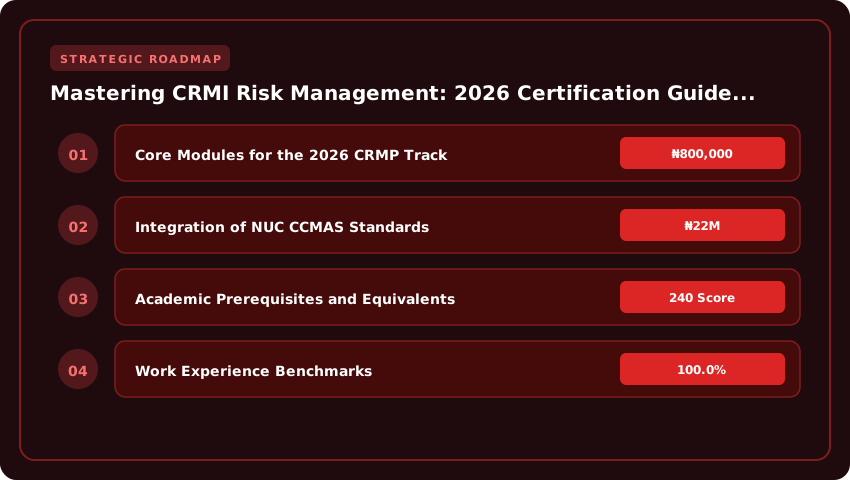
Entering the CRMI certification pipeline in 2026 requires a precise alignment of academic credentials and practical field experience. The certification body has tightened eligibility to ensure that designated professionals can navigate the complexities of Nigeria’s current volatile fiscal environment. To avoid application rejection during the 2026 cycle, candidates must categorize themselves correctly as either Associate or Full Members based on the benchmarks below.
Academic Prerequisites and Equivalents
The baseline requirement for any CRMI candidate is a minimum of a Bachelor’s degree from a recognized institution. In line with the latest NUC Core Curriculum and Minimum Academic Standards (CCMAS), degrees in Economics, Finance, Statistics, Engineering, or Business Administration are prioritized. However, the 2026 guidelines now recognize professional equivalents for those without a traditional four-year degree, provided they hold a Higher National Diploma (HND) from an accredited polytechnic combined with a postgraduate diploma (PGD) in a risk-related discipline.
Work Experience Benchmarks
Membership tiers are strictly determined by the depth of your professional exposure to risk mitigation and strategic planning:
- Associate Membership: Open to early-career professionals or recent graduates. Candidates must demonstrate at least 2 years of verifiable experience in an operational or analytical role. This tier is ideal for those transitioning into risk management from general auditing or project management.
- Full Membership: Reserved for seasoned practitioners. Candidates must provide evidence of a minimum of 5 to 7 years of progressive experience in risk management, with at least 3 years in a supervisory or managerial capacity. Full members are expected to have led risk assessment frameworks within Nigerian corporate or public sector entities.
Documentation for the 2026 Registration Cycle
The 2026 application process is entirely digital. To prevent delays in the verification phase, ensure the following documents are uploaded in high-resolution PDF format to the portal:
- Academic Transcripts: Verified copies of your degree or HND certificates.
- Employment Verification: A formal letter from your current or previous employer confirming your job title, duration of service, and specific risk-related responsibilities.
- Valid Identification: A current Nigerian International Passport, NIN slip, or Driver’s License.
- Professional References: Two letters of recommendation from existing CRMI Full Members or recognized industry leaders in the Nigerian financial or energy sectors.
Failure to provide these documents in the stipulated format often leads to automatic disqualification during the initial screening phase of the 2026 intake.
2026 Fee Structure: Membership Dues and Exam Costs in Naira
Budgeting for the CRMI certification in 2026 requires a clear-eyed look at the numbers. The Institute of Risk Management Nigeria (IRM Nigeria), the local affiliate body, has adjusted its fee schedule to reflect the current exchange rate realities and the enhanced curriculum aligned with the NUC’s CCMAS frameworks. All figures below are quoted in Naira (₦) and inclusive of the 7.5% VAT where applicable, effective from the January 2026 diet.
Core Certification Costs
- Student Registration (One-off): ₦45,000 – Covers enrollment, access to the Learning Management System (LMS), and the initial study pack.
- Annual Membership Dues: ₦35,000 – Payable every January to maintain active candidate status and access webinars, the digital library, and the IRM Nigeria networking portal.
- Module Examination Fees (Per Paper): ₦55,000 – The 2026 syllabus comprises three modules. You pay per attempt. A full first-sit run for all three modules totals ₦165,000.
- Case Study / Capstone Assessment: ₦75,000 – This is the final integrative assessment required for the “Certified” designation, replacing the old dissertation model.
- Exemption Fees (Per Module): ₦30,000 – Applicable if you hold relevant qualifications (e.g., ICAN, CIPM, or a Master’s in Risk) mapped to the CCMAS curriculum.
Putting it together, a fresh candidate budgeting for a straight run in 2026—registration, one year of dues, three module exams, and the capstone—should allocate approximately ₦355,000. Factor in an extra ₦55,000 per module for any resits.
Payment Plans and Corporate Sponsorship
IRM Nigeria recognizes the cash flow pressure on professionals. For 2026, they have formalized a Three-Tranche Payment Plan via their Remita-integrated portal: 40% on registration, 30% before the May diet, and 30% before the October diet. No interest is charged, but you must clear the balance before your exam admission slip is released on the portal.
For corporate sponsorship, organizations registering three or more candidates unlock a 10% volume discount on exam fees and a dedicated account manager for cohort tracking. Many banks (Access, GTB, Zenith) and telcos (MTN, Airtel) now pre-approve this under their L&D budgets—ask your HR for the “Professional Certification Vote” code. Ensure your employer pays directly via corporate Remita to avoid the 1.5% personal card surcharge.
NELFUND Loan Applicability
This is the most asked question in 2026. The short answer: NELFUND does not currently cover standalone professional certifications like CRMI. The Student Loan Act 2026 (as amended) restricts disbursement to tuition fees for degree programs in NUC-accredited public tertiary institutions. Since CRMI is a professional designation administered by a chartered body—not a university degree—it falls outside the “institutional tuition” definition.
However, there is a workaround. If you are enrolled in a Master’s program (e.g., M.Sc. Risk Management) at a federal university that has embedded the CRMI curriculum into its CCMAS coursework, the tuition component covering those specific credit units is eligible. You cannot use NELFUND to pay IRM Nigeria directly. For pure professionals, the best route remains the IRM payment plan, employer sponsorship, or commercial skill-up loans from platforms like CredPal or Carbon, which offer 6–12 month tenors at ~2.5% monthly flat rates.
Impact of CRMI Certification on 2026 Nigerian Salary Scales
Let’s talk numbers, because in the current economy, upskilling without a clear ROI is a luxury few can afford. In 2026, the CRMI designation isn’t just a line on a CV; it is a verified lever for crossing specific salary thresholds in Nigeria’s high-stakes sectors. We are seeing a distinct divergence between certified and non-certified risk professionals, particularly in Lagos and Abuja where the concentration of regulatory scrutiny is highest.
Banking Sector: Lagos vs. Abuja Compensation Bands
In the commercial banking space, the gap has widened significantly this year. A mid-level Risk Manager (3–5 years experience) without the CRMI in Lagos typically sits between ₦4.8 million and ₦6.5 million per annum gross. Add the CRMI credential, and that band jumps to ₦7.2 million – ₦9.5 million. Abuja figures run slightly lower on the base—roughly ₦4.2 million – ₦5.8 million uncertified—but the certification premium remains consistent at roughly 35–40%. Tier-1 banks (Access, Zenith, GTB, UBA) now explicitly list “CRMI or equivalent GARP/PRMIA credential” as a mandatory requirement for Assistant Manager roles and above, effectively making the certification a gatekeeper for the ₦8m+ bracket.
Oil & Gas and Fintech: The Premium Niches
If you want the absolute ceiling, look outside traditional banking. The Oil & Gas majors (and their service contractors) are desperate for professionals who can model operational risk against volatile forex regimes and PIA compliance. Here, a CRMI holder with sector experience commands ₦12 million – ₦18 million annually, often with hardship allowances paid in USD-indexed components. Simultaneously, the Fintech boom—driven by CBN’s licensing reforms and the push for Payment Service Banks—has created a “war for talent.” Startups and unicorns (Flutterwave, Moniepoint, OPay ecosystems) are offering ₦10 million – ₦15 million plus equity for CRMI-certified Heads of Risk and Compliance. They value the certification’s new predictive analytics modules because they map directly to real-time fraud detection and credit scoring algorithms.
Negotiating Sign-On Bonuses with Credentials
Don’t leave money on the table during the offer stage. In 2026, the CRMI is your strongest chip for negotiating a sign-on bonus. Here is how to structure the ask:
- Quantify the Regulatory Value: Explicitly state: “My CRMI certification covers the latest CBN Basel III/IFRS 9 integration frameworks. This reduces your onboarding training cost by an estimated 6 weeks.” Ask for a ₦1.5 million – ₦3 million sign-on bonus as a “regulatory readiness premium.”
- Leverage the Data Modules: The 2026 syllabus emphasizes Python/R for risk modeling. If you can demonstrate a capstone project using Nigerian credit bureau data (CRC/FirstCentral), position it as immediate IP value. Fintechs routinely pay ₦2 million+ sign-ons for this specific skill overlap.
- Clawback Clauses: Be prepared to accept a 12–18 month clawback clause. It is standard practice in Lagos HR contracts now, but it validates your commitment and justifies the upfront cash.
Bottom line: The 2026 CRMI pays for itself within the first quarter of a new role if you negotiate from a position of demonstrated regulatory and technical utility.
Strategic Exam Preparation for the 2026 Certification Cycle
The 2026 CRMI syllabus has pivoted hard toward predictive analytics and scenario-based stress testing, moving away from the static compliance checklists that dominated previous years. If you are still memorizing ISO 31000 clauses verbatim, you are studying for the wrong exam. The current framework prioritizes quantitative risk aggregation, cyber-resilience modelling, and ESG-integrated capital adequacy—specifically calibrated for the volatility of the Nigerian foreign exchange regime and the CBN’s updated prudential guidelines for banks and fintechs. High-yield areas now include Monte Carlo simulation application for liquidity risk, the practical implementation of the Basel III Finalisation standards (as domesticated by the CBN), and the nuances of the Nigeria Data Protection Act (NDPA) 2026 as it intersects with operational risk frameworks. Candidates must demonstrate they can build a risk appetite statement that survives a 40% Naira devaluation scenario, not just define the term.
Leverage Nigerian Peer Networks and Mentorship
Isolation is a primary failure vector for working professionals. The most effective preparation happens in structured peer groups where you defend your risk treatment plans under scrutiny. In 2026, the most active communities are not generic WhatsApp broadcast lists but curated cohorts. Look toward the Risk Management Association of Nigeria (RIMAN) chapter study circles in Lagos, Abuja, and Port Harcourt—they run weekly “Case Study Clinics” dissecting recent Nigerian bank resolution cases. The Institute of Risk Management (IRM) Nigeria Affiliate Group on LinkedIn hosts monthly “Mock Viva” sessions with certified fellows simulating the oral assessment component. For fintech-specific contexts, the FinTech Association of Nigeria (FintechNGR) risk working group shares anonymized incident reports that map directly to the CRMI operational risk module. Pay the membership dues; the ROI on a single clarified concept regarding CBN circulars outweighs the cost.
Time Management for the 9-to-5 Professional
You cannot “find” time; you must engineer it. The 2026 cycle demands roughly 180–220 effective study hours. Break this down using the “Two-One-Zero” protocol tailored for Nigerian work culture:
- Two Hours Daily (Weekdays): Protect 6:00 AM – 8:00 AM before Lagos traffic or shift handover. Use the Pomodoro technique (25/5) on a single Learning Outcome Statement (LOS). No email, no Slack.
- One Deep-Dive Session (Saturday): Four uninterrupted hours for a full mock exam or complex quantitative modelling practice (Excel/Python). Treat this as a non-negotiable client deliverable.
- Zero Passive Reading (Sunday): Active recall only. Create flashcards for regulatory thresholds (e.g., CBN LCR minimums, NDPA breach notification timelines) and review them during commute or downtime.
Crucially, negotiate “Study Leave” with HR early—many Nigerian banks and telcos now classify CRMI under their mandatory Continuous Professional Development (CPD) budgets, potentially unlocking 5–10 paid days off. If self-funded, check if your firm’s training vote covers the ₦450,000 – ₦650,000 exam and training package; framing it as “Basel III Compliance Readiness” often unlocks budget lines that “Certification” does not.
Future-Proofing Your Career: CRMI Outlook for 2027 and Beyond
Securing your CRMI certification in 2026 is not the finish line; it is the entry point into a rapidly evolving risk landscape. As we look toward 2027, the Nigerian corporate sector is moving away from reactive risk mitigation toward predictive resilience. For the modern Nigerian professional, the value of this certification lies in its ability to evolve alongside the volatile macroeconomic climate and the digital transformation of West African markets.
The AI Revolution in West African Risk Management
By 2027, the integration of Artificial Intelligence (AI) and Machine Learning (ML) will no longer be optional for risk managers in Lagos, Abuja, or Port Harcourt. We are seeing a decisive shift toward AI-driven risk management, where predictive analytics are used to hedge against currency fluctuations and supply chain disruptions in real-time. Future-proofing your career means mastering the intersection of CRMI principles and AI tools. Professionals who can leverage automated risk-scoring models will command significantly higher salary bands within the Nigerian banking and fintech sectors compared to those relying on traditional manual auditing.
Maintaining Edge through CPD Requirements
To prevent certification obsolescence, the CRMI framework mandates strict Continuing Professional Development (CPD) requirements. Maintaining your membership into 2027 and beyond requires a documented commitment to lifelong learning. Key requirements include:
- Completion of annual credits through accredited risk management workshops.
- Participation in peer-reviewed case studies focusing on Nigerian market volatility.
- Certification in emerging risk domains, such as Cyber-Risk and ESG (Environmental, Social, and Governance) reporting.
- Active contribution to professional forums or mentorship of junior risk analysts.
Bridging the Gap: CRMI and ISO 31000
While the CRMI provides the localized expertise necessary to navigate the Nigerian business environment, global portability remains the ultimate goal. The outlook for 2027 emphasizes a tighter alignment between CRMI protocols and the ISO 31000 international standard for risk management. By bridging this gap, Nigerian professionals ensure their skills are transferable to multinational firms and international NGOs. This synergy allows you to apply localized risk insights—such as navigating Nigerian regulatory hurdles—within a globally recognized framework, making you an indispensable asset to any organization operating across borders.
| Decision Criteria | Standard CRMP Track (2026) | Advanced Predictive Track (2027) |
|---|---|---|
| Estimated Cost (₦) | ₦450,000 – ₦650,000 | ₦800,000 – ₦1,200,000 |
| Prerequisites | Degree + 3 Years Experience | CRMP + Data Analytics Cert |
| Curriculum Focus | CCMAS Framework Alignment | AI-Driven Predictive Modeling |
| Exam Timeline | Quarterly (Jan, Apr, Jul, Oct) | Bi-Annual (June, December) |
| Salary Potential (Annual) | ₦12M – ₦18M | ₦22M – ₦35M |
Frequently Asked Questions
What are the 2026 CRMI certification requirements for Nigerian professionals?
To obtain CRMI certification in 2026, Nigerian professionals must hold a recognized degree aligned with the NUC's updated CCMAS frameworks. Candidates require a minimum of three years of verifiable risk management experience and must pass the updated data-driven predictive model examination to ensure global portability of their designation.
How much does the CRMP certification cost in Nigeria for 2026?
The 2026 CRMP certification cost typically ranges between ₦450,000 and ₦650,000 for the standard track. This fee covers training modules, examination access, and certification processing. Advanced predictive tracks for 2027 planning may cost up to ₦1,200,000 depending on the accredited training provider and specialized software tools used.
Does the 2026 CRMI certification align with NUC CCMAS frameworks?
Yes, the 2026 CRMI pathway is strictly aligned with the National Universities Commission (NUC) Core Curriculum and Minimum Academic Standards (CCMAS). This alignment ensures that the certification is recognized both locally and internationally, bridging the gap between academic theory and practical risk management in volatile macroeconomic environments.
What is the expected salary for a Certified Risk Management Professional in Nigeria for 2026?
In 2026, a Certified Risk Management Professional (CRMP) in Nigeria can expect an annual salary ranging from ₦12 million to ₦18 million for standard roles. Those specializing in the advanced predictive data track can command higher premiums, with potentials reaching ₦35 million depending on the industry sector.
How has the CRMI curriculum changed for the 2026 certification cycle?
The 2026 curriculum has shifted from traditional theoretical risk auditing to a data-driven, predictive model. It now emphasizes managing risk within high-inflation environments and evolving regulatory frameworks, requiring candidates to demonstrate proficiency in predictive analytics and strategic alignment with current Nigerian macroeconomic volatility.
Strategic Final Takeaway
When evaluating CRMI Risk Management Certification Courses And Membership Requirements Nigeria in 2026 and beyond, base your decisions on accredited institutional standards, verified return on investment (ROI), and up-to-date official guidelines. Always verify specific dates and requirements through official regulatory portals.

