PMP 2026 Exam Content Outline: Agile & Hybrid Dominance Explained
The Project Management Institute (PMI) completed its major shift away from the PMBOK Guide 6th Edition process-group structure years ago, but the 2026 Exam Content Outline (ECO) cements the new reality: methodology neutrality is dead. The exam now explicitly tests your ability to tailor predictive, agile, and hybrid approaches across three performance domains. Understanding this weighting is the single highest-ROI activity for any Nigerian professional budgeting ₦1.2M–₦1.8M for training and exam fees this year.

The Three Domain Structure
Forget the five process groups. The 2026 ECO allocates 180 scored questions across three domains that mirror the PMBOK Guide 7th Edition principles and the Agile Practice Guide:
- People (42% / ~76 questions): Leading teams, managing conflict, virtual collaboration, and servant leadership. This domain is methodology-agnostic but heavily weighted toward Agile mindsets (empowerment, psychological safety).
- Process (50% / ~90 questions): The technical execution—scope, schedule, risk, quality, and compliance. This is where the Predictive vs. Agile vs. Hybrid distribution lives.
- Business Environment (8% / ~14 questions): Strategy alignment, organizational change, governance, and benefits realization. New for 2026: heavier emphasis on ESG reporting and digital transformation governance.
Predictive vs. Agile vs. Hybrid Question Distribution
PMI no longer publishes a fixed percentage split for methodology types, but the Process domain (50%) is explicitly designed to test hybrid fluency. Based on the current ECO task mappings, expect the following practical distribution inside the exam engine:
- Hybrid Scenarios (~45-50% of Process questions): Questions presenting a predictive baseline (WBS, baseline schedule) requiring agile adaptations (rolling wave planning, sprint reviews, Kanban flow metrics).
- Pure Agile/Scrum (~30-35% of Process questions): Product backlog refinement, release planning, Definition of Done, scaling frameworks (LeSS, SAFe basics).
- Pure Predictive (~15-20% of Process questions): Critical Path Method, Earned Value Management (EVM), formal change control boards, procurement contracts.
Study Strategy Implication: Do not silo your prep. A “Process” question on risk management will likely ask how you integrate a Risk-Adjusted Backlog (Agile) into a Risk Register (Predictive) for a Hybrid rollout in a Nigerian fintech regulatory sandbox. Train with simulators updated for the 2026 ECO—older “Rita Mulcahy 9th/10th edition” banks will mislead you on domain weighting and scenario framing.
Updated 2026 PMP Certification Costs in Naira (₦) for Nigerian Professionals
Budgeting for the PMP in 2026 requires looking past the dollar price tag on PMI’s website. With the Central Bank of Nigeria (CBN) official exchange rate hovering around ₦1,650/$1 (as of Q2 2026) and parallel market rates often exceeding ₦1,700, the final Naira outlay is significantly higher than a straight conversion suggests. Most Nigerian banks also impose a ₦50 stamp duty and variable card processing fees on international transactions, so always buffer an extra 3–5% for settlement surprises.
PMI Membership vs. Non-Member Exam Fees
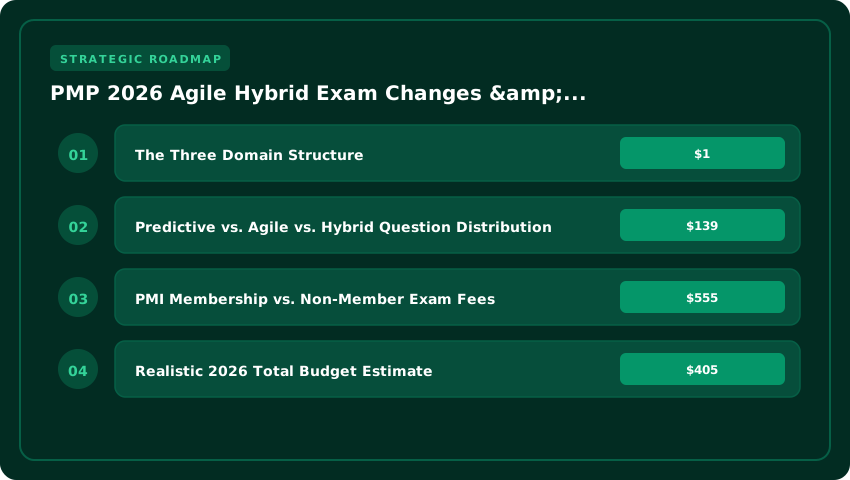
The single biggest lever you control is PMI membership. At $139 annually (≈ ₦229,350), membership drops the exam fee from $555 to $405. Do the math: the membership pays for itself instantly, saving you roughly ₦247,500 on the exam line item alone. You also unlock the PMBOK Guide – 7th Edition and Process Groups: A Practice Guide as free PDF downloads—critical resources for the new Agile/Hybrid-heavy outline.
- Member Exam Fee: $405 ≈ ₦668,250 (CBN rate) + bank charges.
- Non-Member Exam Fee: $555 ≈ ₦915,750 (CBN rate) + bank charges.
- Membership Dues: $139 ≈ ₦229,350.
- Net Member Advantage: Save ~₦247,500 + free standards access.
Hidden Costs: ATP Training, PMBOK 7th Ed, & Simulators
The 35 Contact Hours mandate is non-negotiable. Accredited Training Partners (ATPs) in Lagos, Abuja, and Port Harcourt currently charge between ₦180,000 and ₦350,000 for live-virtual or weekend physical bootcamps covering the new People (42%), Process (50%), Business Environment (8%) domains. Cheaper self-paced options exist on platforms like Udemy or Coursera (often ₦15,000–₦30,000 during sales), but verify the provider’s ATP status on the PMI registry before paying—non-ATP certificates get rejected during audit.
If you skip membership, budget ₦65,000–₦85,000 for a physical copy of the PMBOK Guide 7th Edition and Process Groups from local distributors like Roving Heights or Amazon NG (import duties apply). Finally, a quality exam simulator—essential for the new scenario-based, multi-response Agile questions—costs $100–$150 (≈ ₦165,000–₦247,500) for 90-day access from vendors like PMTraining, PM PrepCast, or Andrew Ramdayal.
Realistic 2026 Total Budget Estimate
For a working professional opting for the member route with a mid-tier ATP and a premium simulator, the all-in cost lands between ₦1.35M and ₦1.55M. Non-members using premium training should prepare ₦1.65M–₦1.85M. Pay exam fees directly via PMI.org using a domiciliary account or a verified virtual dollar card (e.g., Grey, Geegpay, or bank-issued virtual cards) to avoid parallel market markup on the transaction date. Always screenshot your payment receipt and ATP certificate immediately—audit triggers are random but strict.
New Question Formats: Drag-and-Drop, Hotspot & Case Studies Walkthrough
Walking into a Pearson VUE center in Lagos or Abuja for the 2026 PMP exam feels different the moment you launch the tutorial. The static, four-option multiple-choice grid is gone for a significant chunk of the paper. You are now facing an interactive canvas: drag-and-drop sequencing, clickable hotspot graphics, and dense, multi-tab case studies that simulate a real project dashboard. The good news? The interface is intuitive if you stop treating it like a paper test and start treating it like the project simulation it is.
Mastering the Pearson VUE Interface in Nigeria
At centers like the Ikeja or Jabi testing hubs, the hardware is standard: dual monitors (one for the case study exhibit, one for questions), a responsive mouse, and a laminated erasable noteboard. Your first 15 minutes—before the clock starts—should be spent only on the tutorial. Do not skip it. Practice dragging a “Work Package” box into a “WBS Level 3” slot. Practice clicking the specific risk threshold zone on a probability-impact matrix for a hotspot question. Nigerian candidates often lose easy marks fumbling with the mechanics rather than the methodology. Adjust the font size immediately; eye strain during a 230-minute marathon is a silent score killer.
Cracking ‘Select ALL That Apply’ Agile Scenarios
The Agile/Hybrid dominance (roughly 50% of the exam) lives heavily in the “Multiple Response” format. The prompt will explicitly state: “Select 3 options” or “Select ALL that apply.” This is where most aspirants bleed points. In a traditional single-answer question, you hunt for the best answer. Here, you hunt for correct statements. If the question asks for three Agile ceremonies that promote inspection and adaptation, and you only pick “Daily Standup” and “Sprint Review” because you forgot “Retrospective,” you get zero credit. No partial scoring exists.
- Read the constraint first: “Select 3” means exactly three. “Select ALL” means evaluate every option independently as True/False.
- Apply the Agile Manifesto filter: Does the option value “Individuals and interactions over processes and tools”? Does it embrace change? If an option suggests “Locking scope for the Sprint via a Change Control Board,” it is wrong—discard it instantly.
- Watch for Hybrid traps: Options mixing Waterfall artifacts (Project Charter sign-off) with Agile roles (Product Owner) are often distractors unless the scenario explicitly describes a Hybrid governance model.
Navigating Case Studies Without Drowning
Case studies now drop you into a 5-tab exhibit: Project Charter, Stakeholder Register, Risk Log, Backlog, and Dashboard. You get 4–6 questions per set. Do not read every tab line-by-line upfront. Read the first question, then hunt. If Q1 asks about “Current Schedule Variance,” ignore the Stakeholder Register; go straight to the Dashboard or Risk Log. Use the “Highlight” and “Strikethrough” tools aggressively on the text exhibits. For drag-and-drop sequencing (e.g., ordering the steps of a Hybrid Phase Gate), build the sequence on your noteboard first using abbreviations (Initiate > Plan > Sprint 1 > Review > Gate), then execute the drag in one clean motion. Speed and precision on the interface are now explicit exam competencies.
Choosing 2026 PMP Prep: Accredited ATPs in Nigeria vs Global Self-Paced Options
The 35 contact hours certificate is non-negotiable for PMI eligibility, but where you earn those hours determines whether you walk into the CBT centre prepared or just ticking a box. In 2026, the market splits cleanly between PMI Authorized Training Partners (ATPs) with local accountability and global on-demand platforms banking on volume. Your choice hinges on three variables: Naira liquidity, learning discipline, and the quality of the Agile/Hybrid simulation questions you’ll face on exam day.
Verified PMI Authorized Training Partners (ATPs) with Physical Presence
These providers run the official PMI ATP curriculum—updated for the 2026/2027 Exam Content Outline (ECO)—and issue the globally recognized 35 PDU/Contact Hour certificate instantly upon completion. Prices below reflect 2026 market rates for the standard 4–5 day bootcamp, inclusive of the PMI Authorized PMP Exam Prep materials and simulator access.
- Lagos (Victoria Island/Ikeja Axis): Harrybaker Training Institute and JK Michaels Consulting lead the pack. Expect ₦380,000–₦450,000 for physical classes. Harrybaker includes a post-bootcamp “Exam Readiness” clinic (virtual) at no extra cost. Piston & Fusion offers a slightly cheaper entry (~₦350,000) but verify their current ATP status on the PMI registry before paying.
- Abuja (Central Business District/Garki): Sapphire Consulting and Mandel Training run monthly cohorts. Pricing clusters around ₦400,000–₦480,000. Sapphire’s selling point is a dedicated WhatsApp support group active until you pass, manned by PMP-certified facilitators.
- Port Harcourt (GRA/Trans-Amadi): Options are thinner. Josav Resources operates as the primary verified ATP partner, often running hybrid sessions (physical venue + Zoom link) priced at ~₦380,000. If you are PH-based, confirm the physical venue isn’t a “hotel conference room pivot” to full virtual two days in.
Cost-Benefit: Physical Bootcamps vs. Live Virtual vs. On-Demand
Physical Bootcamps (₦350k–₦480k): Highest completion rates. The “airport mode” focus—phones away, facilitator pacing you through the 12 Agile Principles and 8 Performance Domains—forces engagement. You network with peers from NNPC, MTN, and banking IT PMOs. Downside: Opportunity cost of 4–5 weekdays off work; Lagos traffic risk.
Live Virtual via Nigerian ATPs (₦280k–₦350k): Same certificate, same facilitator, same simulator, but you join from home. Best for professionals in Kano, Ibadan, or offshore rigs who can’t travel. Demand a “camera-on” policy; passive attendance kills retention. Ensure the ATP records sessions for 90-day replay—critical for revisiting Earned Value Management (EVM) calculations.
Global On-Demand (Udemy/Simplilearn/GoSkills ~₦45k–₦120k @ ₦1,600/$): Cheap on paper. Joseph Phillips (Udemy) and Andrew Ramdayal (PMTraining/Simplilearn) are solid content-wise. But: zero accountability, generic simulators not always synced to the latest 2026 ECO nuances (e.g., Business Environment domain weighting), and zero local context for “Naira budget variance” scenarios. You self-source the 35-hour certificate (usually auto-generated), but PMI audits these heavily. If audited, you need facilitator sign-off—impossible with a $15 video course.
Verdict: If your employer pays or you can structure a study leave, book a verified Nigerian ATP physical or live-virtual cohort. The simulator fidelity and local facilitator access for “People domain” role-plays justify the premium. If self-funding and disciplined, a top-tier global video course plus a separate purchase of the PMI Authorized PMP Exam Prep Question Bank (approx. $130/₦208k) is a viable “DIY ATP” path—but you carry 100% of the curriculum alignment risk.
Agile Hybrid Mindset: Applying Servant Leadership & Value Delivery in Exam Scenarios
The 2026 PMP exam does not reward rote memorization of ITTOs; it tests whether you can think like a servant leader navigating complexity. Nigerian candidates often stumble because local corporate culture—think telco rollouts in Lagos or infrastructure projects in Abuja—still leans heavily on command-and-control “Waterfall” language. The exam, however, expects you to pivot instantly to Agile delivery expectations. You must internalize the PMBOK 7 Principles not as abstract theory, but as the decision-making compass for every situational question.
Mapping PMBOK 7 Principles to the Agile Practice Guide
Stop treating the 12 Principles and the Agile Practice Guide as separate study silos. In a hybrid scenario—say, a fixed-scope banking app upgrade with regulatory compliance (Waterfall) but evolving UX requirements (Agile)—the principle of Tailoring meets the Agile value of Responding to Change over Following a Plan. When a question asks how to handle a stakeholder demanding a rigid Gantt chart for a Scrum sprint, the correct answer isn’t “educate them on Scrum.” It is tailor the approach: use a high-level milestone plan for governance (Waterfall terminology) while protecting the sprint backlog’s flexibility (Agile delivery).
Similarly, Focus on Value maps directly to Early and Continuous Delivery. If a situational item presents a delayed feature with high business value versus a completed low-value feature, the hybrid mindset chooses value delivery every time, regardless of the methodology label attached to the work package.
Common Traps: Waterfall Terminology vs. Agile Expectations
The exam writers love linguistic traps. Watch for these specific patterns in 2026 items:
- “Phase Gate” vs. “Sprint Review”: A question describes a “Phase Gate approval required before next phase.” Do not select “Command the team to proceed.” The hybrid answer: Facilitate the gate review as a Sprint Review demo, ensuring the Definition of Done satisfies the governance checkpoint.
- “Project Manager assigns tasks” vs. “Self-Organizing Team”: If the stem says “The PM assigns daily tasks to developers,” the scenario is broken. The fix is never “accept the assignment.” It is Coach the PM on servant leadership; the team pulls work during Sprint Planning.
- “Baseline Scope” vs. “Product Backlog Refinement”: Hybrid projects baseline outcomes (MVP scope), not outputs (detailed requirements). When a sponsor demands “freeze scope,” the answer involves negotiating trade-offs in the backlog, not signing a change request form for every UI tweak.
- “Risk Register Updates” vs. “Daily Stand-up Impediments”: In hybrid, risks are burned down daily. A question asking “When to update the risk register?” expects “Continuously, during Daily Stand-ups and Retrospectives,” not “During the monthly steering committee.”
Your preparation strategy: For every practice question, identify the methodology language used in the stem (Waterfall, Agile, Hybrid) and the mindset required by the correct option (Predictive control vs. Adaptive empowerment). If they clash, the Agile/Hybrid mindset wins in the 2026 ECO. Drill this translation until it becomes reflex.
Application Audit Risk & PDU Strategy: Maintaining Credentials Post-2026 Pass
Passing the 2026 PMP exam is only half the battle; surviving a PMI audit and renewing cheaply in Naira terms is where the real ROI lives. PMI audits roughly 5–10% of applications globally, and Nigerian candidates often trigger flags because local corporate structures—LLCs, MDAs, and family-owned conglomerates—don’t map neatly to PMI’s Western HR templates. If you listed “Project Lead” at a Lagos fintech or a Federal Ministry parastatal, your experience description must explicitly separate leading and directing tasks from functional contribution. Use the Project Description box to quantify: “Directed a 12-person cross-functional squad delivering a ₦450M core-banking migration; managed scope, schedule, and stakeholder engagement across three vendors.” Avoid vague “assisted” language. Keep offer letters, appointment letters, and project sign-off emails (PDFs, not screenshots) in a dedicated Google Drive folder labelled PMP_Audit_2026—PMI gives you 90 days to respond, and Nigerian postal delays are not an accepted excuse.
Low-Cost 60 PDU Renewal Strategy for 2027–2030
Renewal costs $60 (PMI member) or $150 (non-member) every three years, but the 60 PDUs should cost you near ₦0 if you leverage the ecosystem strategically. The PMI Nigeria Chapter (Lagos, Abuja, Port Harcourt branches) runs monthly virtual webinars—typically 1.5 PDUs each—free for members (₦15,000/year membership). Attend eight sessions annually and you bank 12 PDUs/year, 36 over the cycle. Volunteering is the highest leverage activity: serving as a Chapter Events Coordinator or mentoring NYSC corps members under the Chapter’s “NextGen” programme earns Giving Back PDUs (max 25 per cycle) for zero cash outlay. Document hours on the Chapter’s volunteer portal; the auto-generated certificate is audit-proof.
Self-Reported & Free External Sources
- Self-Directed Learning (max 30 PDUs): Read the PMBOK Guide 7th Ed. or Agile Practice Guide (1 PDU/hour, cap 8 per book). Log via CCRS with date, duration, and key takeaway.
- Free MOOCs: Coursera/edX audit mode (no cert) counts if you track hours. Google Project Management Certificate modules (≈140 hrs) can yield 30+ PDUs if you document weekly logs.
- Internal Corporate Training: Many Nigerian banks (GTB, Access, Zenith) and telcos (MTN, Airtel) run internal PM bootcamps. Request a syllabus and attendance sheet; submit as “Course/Workshop” PDUs.
- PMI Global Webinars: Free live sessions on pmi.org/learning drop 1–2 PDUs weekly; add to calendar.
Pro tip: Set a quarterly “PDU Sweep” reminder—January, April, July, October. Log everything in CCRS immediately; backlogging 60 PDUs in month 35 is a nightmare. With Chapter membership (₦15k/yr) + volunteering + self-study, your three-year renewal cost stays under ₦50,000 total, protecting the ₦1.2M+ salary premium the credential commands in Lagos and Abuja markets.
| Criteria | PMP 2026 (Legacy) | PMP 2026/2027 (Current ECO) | Nigeria Cost Impact (₦) |
|---|---|---|---|
| Exam Structure | 5 Process Groups (Initiating, Planning, Executing, Monitoring, Closing) | 3 Performance Domains: People (42%), Process (50%), Business Environment (8%) | No direct cost change; requires updated prep materials |
| Methodology Focus | Predictive (Waterfall) ~70%, Agile/Hybrid ~30% | Agile & Hybrid ~50%, Predictive ~50% (Methodology neutral) | Agile-specific training add-on: ₦150,000–₦300,000 |
| PMI Member Exam Fee | $405 (≈₦615,000 @ ₦1,520/$) | $405 (≈₦615,000 @ ₦1,520/$) | ₦615,000 (2026 rate) |
| Non-Member Exam Fee | $555 (≈₦843,600) | $555 (≈₦843,600) | ₦843,600 (2026 rate) |
| PMI Membership (Annual) | $139 (≈₦211,280) | $139 (≈₦211,280) | ₦211,280 + $10 joining fee |
| Accredited Training (35 PDUs) | ₦250,000–₦450,000 | ₦300,000–₦550,000 (Agile/Hybrid modules included) | ₦300,000–₦550,000 |
| Exam Window 2026 | Year-round Pearson VUE | Year-round Pearson VUE (Lagos, Abuja, Port Harcourt centers) | No scheduling surcharge |
| Salary Uplift (Nigeria) | ₦4.5M–₦8M/yr (Mid-level) | ₦5.5M–₦10M/yr (Agile/Hybrid premium) | +₦1M–₦2M premium for Agile fluency |
Frequently Asked Questions
How much does the PMP exam cost in Nigeria for 2026?
The 2026 PMP exam fee is $405 (≈₦615,000) for PMI members and $555 (≈₦843,600) for non-members at ₦1,520/$. PMI membership costs $139/year (≈₦211,280) plus a $10 joining fee. Accredited 35-contact-hour training ranges ₦300,000–₦550,000 including Agile/Hybrid modules.
What are the new PMP 2026 domain weightings for People, Process, and Business Environment?
The 2026 PMP Exam Content Outline allocates 42% to People (leading teams, stakeholder engagement), 50% to Process (technical project management, tailoring methods), and 8% to Business Environment (compliance, organizational strategy). Agile and Hybrid approaches now drive roughly half of all questions across these domains.
What percentage of the 2026 PMP exam covers Agile and Hybrid methodologies?
Approximately 50% of the 2026 PMP exam tests Agile and Hybrid approaches, distributed across all three domains. Predictive (Waterfall) methods account for the remaining 50%. Candidates must demonstrate tailoring predictive, iterative, and adaptive life cycles rather than memorizing process-group silos.
When can I schedule the PMP exam in Nigeria for 2026 and 2027?
PMP exams run year-round at Pearson VUE centers in Lagos, Abuja, and Port Harcourt. Slots open 6 months ahead; book by Q1 2026 for April–June 2026 sittings and by Q3 2026 for 2027 dates. No blackout periods exist; rescheduling requires 48 hours notice to avoid forfeiture.
Do I need Agile-specific training to pass the 2026 PMP exam in Nigeria?
Yes. PMI requires 35 contact hours covering predictive, Agile, and Hybrid content. Most Nigerian ATPs now bundle Scrum, Kanban, and SAFe modules (₦150,000–₦300,000 extra) into their ₦300,000–₦550,000 packages. Self-study using only PMBOK 6th Edition will not cover the 2026 ECO scope.
Strategic Final Takeaway
When evaluating PMP 2026 Agile Hybrid Exam Changes Cost in 2026 and beyond, base your decisions on accredited institutional standards, verified return on investment (ROI), and up-to-date official guidelines. Always verify specific dates and requirements through official regulatory portals.