
Navigating Competency-Based Education (CBE) for Rapid Completion
For the modern adult learner in 2026, the traditional semester-based model is often an obstacle rather than a pathway. Competency-Based Education (CBE) disrupts this by removing the requirement for fixed credit hours. Instead of spending sixteen weeks in a course to learn a concept you mastered five years ago on the job, CBE allows you to demonstrate proficiency through assessments and move immediately to the next module. This model is particularly potent for those with extensive professional portfolios, effectively turning years of workplace experience into academic credit.
Subscription-Based Tuition vs. Per-Credit Pricing
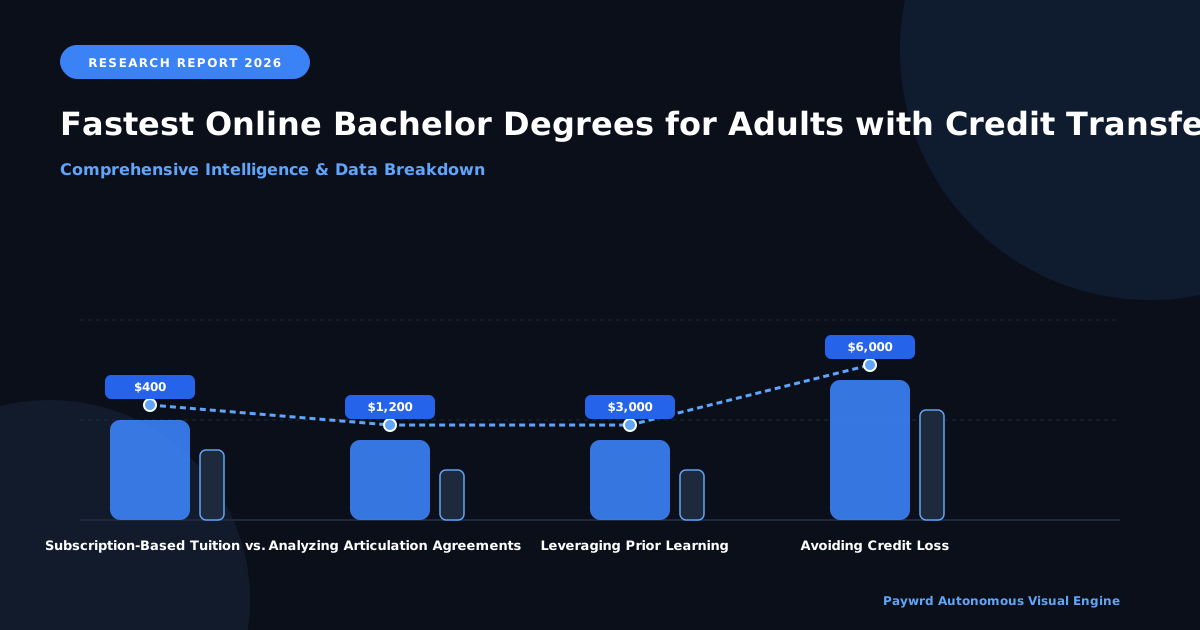
One of the most significant advantages of CBE is the shift in financial structures. While traditional universities charge per credit hour—often ranging from $400 to over $1,200 at private institutions—many CBE programs utilize a subscription-based model. In this framework, students pay a flat fee for a six-month term (typically ranging from $3,000 to $6,000), allowing them to complete as many courses as possible within that window.
- Subscription Model: Ideal for highly motivated “sprinters” who can accelerate through coursework to drastically lower the total cost of the degree.
- Per-Credit Model: Better for students who require a slower pace or have unpredictable work schedules, ensuring they only pay for what they complete.
- Financial Aid: Most CBE programs are eligible for federal funding via FAFSA, though students must carefully coordinate their enrollment pace with the US Department of Education’s SAP (Satisfactory Academic Progress) guidelines.
Aligning Learning Outcomes with 2026 Industry Standards
Speed is irrelevant if the degree lacks market currency. The most effective CBE programs now align their competencies with real-time industry demands. For those pursuing technical degrees, look for programs accredited by ABET or AACSB to ensure the “competencies” being tested meet the rigorous standards required by top-tier employers.

In 2026, this means a Bachelor’s in Business Administration isn’t just testing theoretical management; it’s measuring your ability to analyze AI-driven data sets or manage remote global teams. By mapping curriculum to current BLS (Bureau of Labor Statistics) occupational requirements, CBE ensures that rapid completion doesn’t result in a skills gap. Whether you are pursuing a PMP certification through the PMI or a full degree, the goal is to validate existing expertise while filling critical knowledge voids, slashing your time-to-degree without sacrificing professional credibility.
Strategic Credit Transfer: Community College to 4-Year University
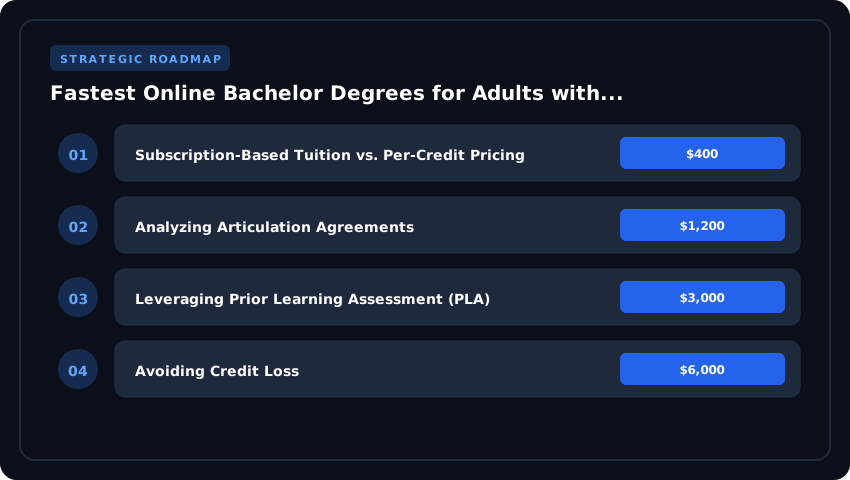
For adult learners in 2026, the goal is simple: minimize the time spent in the classroom and maximize the value of every credit already earned. The transition from a community college to a four-year university is the most effective way to slash tuition costs, provided you navigate the transfer process with tactical precision. Without a strategy, students often face “credit loss,” where hard-earned units are dismissed as elective credits rather than fulfilling core degree requirements.
Analyzing Articulation Agreements
The secret to a seamless migration is the articulation agreement. These are formal contracts between community colleges and universities that guarantee specific credits will transfer. When evaluating programs, prioritize institutions with statewide transfer maps or direct partnerships. For those pursuing technical or business degrees, ensure the receiving university holds accreditation from bodies like ABET (for engineering/tech) or AACSB (for business) to ensure the degree maintains market value.
- Check the Transfer Guide: Always request a current 2026-2027 transfer equivalency guide to see exactly how your Associate degree courses map to the university’s upper-division requirements.
- Verify General Education Blocks: Look for “block transfers” where an entire Associate of Arts (AA) or Associate of Science (AS) is accepted as a complete general education core.
- Audit Your Credits: Before enrolling, submit unofficial transcripts for a preliminary audit to avoid surprises during the FAFSA application or enrollment phase.
Leveraging Prior Learning Assessment (PLA)
Beyond traditional transcripts, 2026’s academic landscape heavily favors Prior Learning Assessment (PLA). PLA allows professionals to earn college credit for work experience, military training, or industry certifications (such as those from the PMI). Instead of paying full tuition for a course in Project Management, a certified PMP holder can often “test out” or submit a portfolio for credit.
This approach drastically reduces the remaining tuition balance. With average public university tuition hovering between $10,000 and $25,000 per year, every PLA credit earned can save hundreds of dollars in direct costs and weeks of study time.
Avoiding Credit Loss
Credit loss occurs when a university deems a course “too old” or “not rigorous enough.” To prevent this, avoid taking “random” electives at the community college level. Stick strictly to the articulated pathway. If you are transferring into a specialized online program, communicate with an academic advisor early to ensure your credits are applied toward the major, not just as general electives, ensuring the fastest possible route to graduation.
Accreditation Audit: Regional vs. National Validity in the US
For adult learners accelerating their degree through credit transfers or CBE models, the “speed” of a program is irrelevant if the credential isn’t recognized by employers or state licensing boards. In the United States, the gold standard remains regional accreditation. While the US Department of Education has moved toward a more unified system, the distinction between regional and national accreditation still dictates your professional mobility in 2026.
Regional accreditors—such as the Higher Learning Commission (HLC), the Southern Association of Colleges and Schools Commission on Colleges (SACSCOC), and the Middle States Commission to Validate Higher Education (MSCHE)—are the gatekeepers of academic prestige. Degrees from institutions backed by these bodies are universally accepted across all 50 states. If you intend to move your career from Texas to New York, a SACSCOC or MSCHE-accredited degree ensures your credits remain valid and your diploma is viewed as legitimate by Fortune 500 HR departments.
The Graduate School Trap
Choosing a program with only national accreditation can create a critical bottleneck if you plan to pursue a Master’s or PhD later. Most Ivy League institutions and top-tier public research universities strictly require an undergraduate degree from a regionally accredited school for admission. If your “fast-track” bachelor’s lacks this, you may find your credits rejected during the application process, effectively forcing you to retake undergraduate coursework at a higher cost.
Specialized Certifications: ABET and AACSB
Beyond general institutional accreditation, specific career paths require “programmatic” accreditation to ensure legal licensure and salary premiums. If you are pursuing a technical or business degree, verify these specific badges:
- AACSB (Association to Advance Collegiate Schools of Business): The premier standard for business schools. Without AACSB accreditation, your degree may not be recognized by elite consulting firms or for certain CPA licensure requirements.
- ABET (Accreditation Board for Engineering and Technology): Non-negotiable for engineering and computing degrees. ABET accreditation is often a legal prerequisite for becoming a Licensed Professional Engineer (PE).
- PMI (Project Management Institute): While not an accreditor of degrees, programs aligned with PMI standards provide a direct pipeline to PMP certification, significantly boosting mid-career salaries.
Before submitting your FAFSA or paying an enrollment deposit, cross-reference your chosen program on the official US Department of Education database. A degree that takes six months to complete is only an asset if it carries the weight of recognized authority.
Financial Impact: Accelerated vs. Traditional Degree Costs
For the adult learner in 2026, the decision between an accelerated path and a traditional four-year degree is not just about time—it is a high-stakes financial calculation. Traditional degrees often carry a heavy price tag due to “seat time” requirements. According to recent College Board data, the average annual tuition and fees for a four-year public institution now hover around $11,000 to $28,000 depending on residency. Over four years, this totals between $44,000 and $112,000, excluding housing and materials.
In contrast, accelerated programs—particularly those utilizing Competency-Based Education (CBE)—often operate on a flat-rate subscription model. Many top-tier, AACSB or ABET-accredited online programs allow students to complete a degree for as little as $5,000 to $15,000 per year. By condensing a bachelor’s degree into two years or less through aggressive credit transfers, a student can potentially save $30,000 to $70,000 in direct tuition costs alone.
The Hidden Variable: Opportunity Cost
The most significant financial gain is not found in tuition savings, but in the elimination of opportunity cost. Opportunity cost represents the wages you forfeit by remaining in school rather than entering the professional workforce. Consider the following ROI trajectory based on 2026 Bureau of Labor Statistics (BLS) median salary data:
- Traditional Path: Four years of study means an additional two years of “lost” professional earnings. For a graduate entering a field like Project Management (PMI certified) or Healthcare Administration, this delay can cost between $55,000 and $85,000 in gross income.
- Accelerated Path: By entering the workforce 24 months sooner, the learner captures those wages immediately and begins climbing the corporate ladder earlier, compounding their lifetime earnings potential.
FAFSA Eligibility and Federal Loan Limits
Navigating federal aid in an accelerated environment requires precision. Most accredited online programs are eligible for FAFSA (Free Application for Federal Student Aid), but the US Department of Education imposes strict aggregate loan limits. Because accelerated students complete credits faster, they may hit their federal loan ceilings more quickly than traditional students.
It is critical to analyze your “Cost of Attendance” (COA) carefully. While you may qualify for the same federal subsidies, the compressed timeline means you must manage your disbursements to ensure coverage for the entire program duration. For those maximizing transfer credits, the total loan burden is typically significantly lower, resulting in a much healthier debt-to-income ratio upon graduation in 2027 and beyond.
Top-Rated Accelerated Degree Paths for 2026 Career Growth
Selecting a major in 2026 requires a strategic alignment between transfer flexibility and market demand. For adult learners leveraging Competency-Based Education (CBE), certain degrees offer a faster ROI because they allow for maximum credit transfers from prior work experience and military training. Currently, the most efficient paths are found in Business Administration, Information Technology (IT), and Healthcare Management.
High-Demand Majors and Transfer Flexibility
Programs accredited by AACSB (for business) or ABET (for technical fields) provide the highest stability. Business Administration remains the gold standard for accelerated paths due to the universality of its core credits. Many institutions now allow students to transfer up to 90 credits, meaning a professional with a decade of management experience can potentially finish their degree in under a year. Similarly, Cybersecurity and Data Analytics degrees are seeing a surge in “prior learning assessments,” allowing IT veterans to bypass introductory coursework and move straight to advanced certifications.
2026 Salary Projections for CBE Graduates
The US labor market in 2026 heavily values the combination of a degree and proven skill sets. According to recent BLS data and industry trends, graduates of accelerated programs are seeing competitive starting salaries that mirror traditional degree holders:
- Cybersecurity Analyst: Median annual salaries range from $112,000 to $145,000, depending on specialized certifications.
- Project Management (PMI aligned): Professionals with a bachelor’s and PMP certification are commanding $98,000 to $120,000.
- Healthcare Administration: With the aging US population, these roles are averaging $85,000 to $110,000.
- Business Management: Generalist degrees continue to provide a stable floor of $72,000 to $95,000 for mid-level corporate roles.
Balancing Full-Time Employment with Intensive Study
The primary challenge for the 2026 adult learner is cognitive load. Balancing a 40-hour work week with an intensive online load requires a shift from “studying” to “executing.” To avoid burnout, students should utilize FAFSA for tuition assistance to reduce financial stress and employ a “sprint” methodology—focusing on one competency at a time rather than juggling four simultaneous classes. By treating the degree as a professional project, learners can maintain their current income while rapidly escalating their earning potential for 2027 and beyond.
| Degree Pathway | Average Completion Time | Estimated 2026 Cost (Per Term) | Max Credit Transfer | Primary Requirement |
|---|---|---|---|---|
| Competency-Based (CBE) | 6-18 Months | $3,000 – $5,000 | Up to 90 Credits | Professional Portfolio |
| Accelerated Online | 2-3 Years | $5,000 – $8,000 | Up to 60 Credits | Prior Academic Credits |
| Traditional Online | 4 Years | $7,000 – $12,000 | Up to 60 Credits | Semester Enrollment |
Frequently Asked Questions
What are the fastest online bachelor degrees for adults in 2026?
The fastest online bachelor degrees in 2026 are Competency-Based Education (CBE) programs in Business Administration, Healthcare Management, and Information Technology. These programs allow experienced adults to bypass traditional seat-time requirements by testing out of known material, often reducing completion timelines to 6-18 months depending on credit transfers.
How many credits can adults transfer into an accelerated degree in 2027?
For the 2027 academic cycle, many CBE-focused institutions allow transfers of up to 90 credits. This includes previous college coursework and credits earned through professional certifications or portfolio assessments, significantly shortening the path to graduation for working professionals with extensive industry experience in the US.
Is Competency-Based Education (CBE) accredited for 2026 degrees?
Yes, leading CBE programs in 2026 maintain regional accreditation, ensuring that degrees are recognized by employers and graduate schools. These programs shift the focus from credit hours to proven mastery, providing a valid, accredited bachelor's degree that reflects both academic knowledge and real-world professional competency.
What is the average cost of an accelerated online degree for adults in 2026?
In 2026, accelerated online degrees typically utilize a subscription-based pricing model, costing between $3,000 and $5,000 per six-month term. This allows students to complete as many courses as possible within a fixed window, making it more cost-effective than traditional per-credit pricing for high-achieving adults.
How do I qualify for credit transfer via professional experience in 2026?
Adult learners can qualify for credit transfers in 2026 by submitting a professional portfolio, industry certifications, or passing Prior Learning Assessments (PLAs). Institutions evaluate documented work history and technical skills to grant college credit, effectively turning years of on-the-job experience into academic progress toward a bachelor's degree.
Strategic Final Takeaway
When evaluating Best Accelerated Bachelor Degree Programs Online For Adults With Credit Transfer in 2026 and beyond, base your decisions on accredited institutional standards, verified return on investment (ROI), and up-to-date official guidelines. Always verify specific dates and requirements through official regulatory portals.

