
pap.gov.ng domain. Any URL requesting payment for “form activation” or “VIP processing” is a fraudulent clone designed to harvest your NIN and banking details.2026 PAP Scholarship Portal Access & Secure Registration Walkthrough
Navigating the 2026 PAP scholarship portal requires strict URL discipline. Type https://pap.gov.ng/scholarship directly into your browser address bar—never click links from unsolicited WhatsApp broadcasts, SMS blasts, or sponsored search results. The authentic platform uses a valid SSL certificate (look for the padlock icon and “pap.gov.ng” in the certificate details) and will never redirect you to a subdomain like pap-scholarship.xyz or pap-application.com.ng. Bookmark the verified landing page after your first successful visit to eliminate typo-squatting risks.

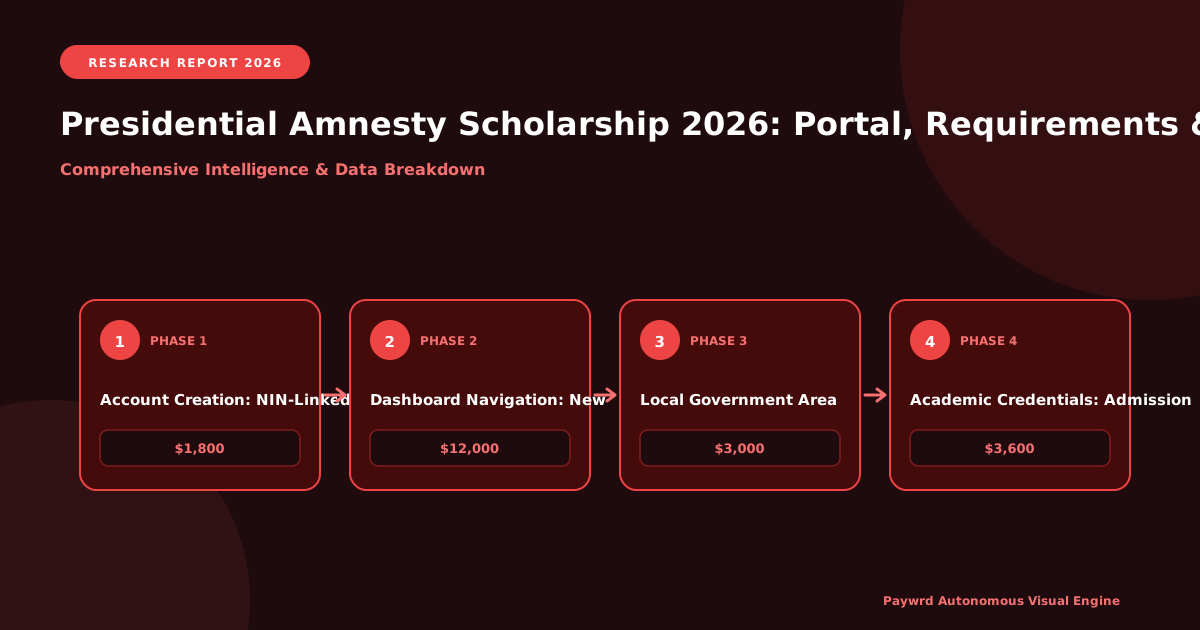
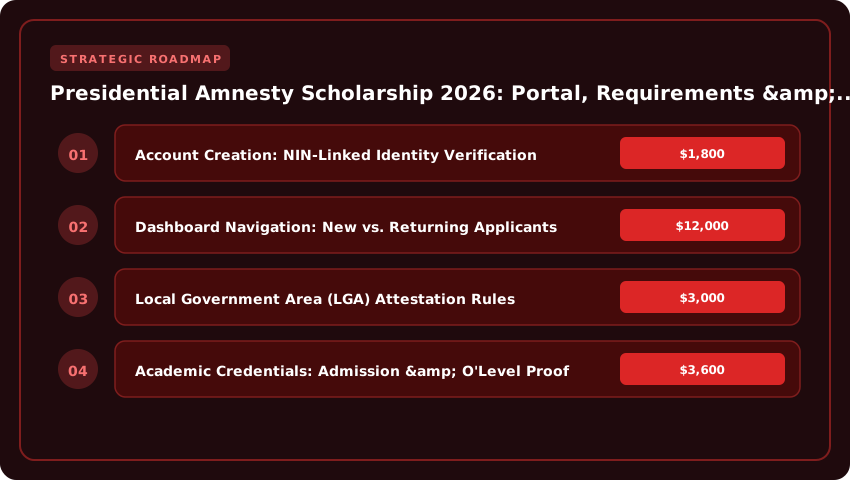
Account Creation: NIN-Linked Identity Verification
Registration begins with your National Identification Number (NIN). The system cross-references the NIMC database in real-time; the phone number you submit must be the active line registered to that NIN. You will receive a time-sensitive OTP via SMS—this expires in under five minutes. Do not use a borrowed SIM or a recently retrieved line that hasn’t fully propagated on the NIMC network. For email validation, use a personal, recoverable address (Gmail or Outlook preferred); institutional emails often block automated system mails. Create a passphrase exceeding 12 characters mixing upper, lower, numeric, and special symbols. Store credentials in a password manager; the portal does not offer a “secret question” recovery fallback.
Dashboard Navigation: New vs. Returning Applicants
Once logged in, the dashboard splits cleanly into two workflows:

- New Applicants: You will see a “Fresh Application” tile. This launches the multi-step wizard: Bio-data (auto-populated from NIN), Programme Choice (undergraduate/postgraduate), Institution Selection (filtered by NUC-accredited list), and Document Upload (WAEC/NECO result, Admission Letter, LGA Identification, Passport Photograph). Save each step; the session times out after 15 minutes of inactivity.
- Returning Applicants: Your dashboard displays “Renewal Application” with pre-filled historical data. You only need to upload the current session’s CGPA transcript (minimum 3.0/5.0 or 2.5/4.0) and a signed progress report from your Head of Department. The system flags incomplete 2026 stipend clearance automatically—resolve any outstanding verification before submitting the 2026 renewal.
Final checkpoint: Before hitting “Submit,” verify the “Application Reference Number” format (PAP/2026/XXXXXX). Screenshot the confirmation page. The PAP helpdesk (support@pap.gov.ng) only responds to queries quoting this reference. Treat your login credentials like your BVN—zero sharing, zero reuse.
Mandatory 2026 Eligibility Criteria & Document Checklist for Niger Delta Applicants
The 2026 Presidential Amnesty Programme (PAP) scholarship screening window operates with zero tolerance for incomplete documentation. Disqualification is almost always traceable to mismatched beneficiary status records or expired verification assets. You must treat this checklist as a compliance audit, not a suggestion list.
Beneficiary Status Verification: Phase 1, 2 & 3 Alignment
Your eligibility hinges on your classification within the PAP database. For 2026, the programme office cross-references your BVN and NIN against the master register to confirm active status.
- Phase 1 (Original Enrollees): Must present the original DDR (Disarmament, Demobilisation, and Reintegration) certificate and a valid 2026 PAP ID card. Expired cards require renewal at the zonal office before portal registration.
- Phase 2 & 3 (Subsequent Batches): Require the official letter of inclusion signed by the Coordinator and a verified biometric capture receipt dated no later than Q4 2026. If your name appears on the “Pending Verification” list on the pap.gov.ng dashboard, resolve it at the Abuja headquarters before applying.
Local Government Area (LGA) Attestation Rules
The 2026 guidelines mandate a fresh LGA Attestation Letter issued within 30 days of your application date. Stale letters from 2026 are automatically rejected. The letter must originate from the Chairman or Secretary of your LGA of origin—not residence—and bear the official LGA stamp, the signatory’s phone number, and a verifiable QR code linking to the LGA’s digital registry. Photocopies are invalid; you must upload the high-resolution colour scan of the original.
Academic Credentials: Admission & O’Level Proof
Admission evidence is non-negotiable. You must upload the JAMB Admission Letter printed directly from the JAMB CAPS portal (caps.jamb.gov.ng) showing “Admission Accepted” status for the 2026/2027 or 2026/2027 session. Provisional letters from institution portals without the JAMB header are insufficient.
For O’Level results (WAEC/NECO), you must provide the Scratch Card PIN and Serial Number used to check the result online. The screening team runs an automated verification script against the WAEC/NECO databases. Do not upload PDF printouts of results; the system only accepts the PIN/Serial combo for live validation. Ensure the card has at least one check remaining.
Biometric Data Capture Specifications
The 2026 cycle enforces strict ISO/IEC 19794-2 fingerprint standards. You must complete capture at an accredited PAP biometric centre (list published on the portal). The output file must be a .wsq format fingerprint template (minimum 500 DPI) and a JPEG2000 (.jp2) facial image (tokenised, 300 DPI, neutral expression, no glasses). Selfies or studio portraits uploaded manually will trigger an automatic “Biometric Mismatch” flag.
Guarantor Form Notarization Standards
The Guarantor’s Form (Form PAP/SCH/2026/03) requires a Level 10 Civil Servant or equivalent in the private sector (verified by CAC registration). For 2026, the guarantor’s signature must be notarized by a Notary Public—Commissioner for Oaths stamps are no longer accepted. The notarized document must include the Notary’s seal, NBA practicing number, and a validity stamp expiring after December 2026. Upload the notarized original scan; the guarantor receives a verification SMS on the registered phone number to confirm consent.
Breakdown of 2026 Stipend Amounts: Tuition, Maintenance & Book Allowances
The 2026 Presidential Amnesty Programme (PAP) scholarship funding structure reflects a deliberate tiering between domestic and overseas awards, a distinction that directly dictates your budgeting reality. Tuition is paid directly to the institution—never to your personal account—so the figures below represent the cash components you must manage for survival and academic materials.
Domestic Awards: Nigerian Universities & Polytechnics
For scholars admitted into NUC-accredited public universities and NBTE-approved polytechnics within Nigeria, the 2026 maintenance stipend stands at ₦120,000 per month. This rate, effective from the January 2026 disbursement cycle, accounts for the current inflationary pressure on accommodation and feeding near campus hubs like Port Harcourt, Warri, and Abuja. On top of the monthly upkeep, a ₦150,000 annual book and research grant is paid in a single lump sum at the start of the academic session. Note that this grant is not per semester; it is a once-per-year allocation intended to cover textbooks, software licenses, and fieldwork logistics for the full session.
Overseas Awards: Approved Institutions Abroad
Overseas scholars operate on a completely different currency framework. The 2026 maintenance allowance is pegged at $1,800 USD per month, converted at the prevailing CBN I&E window rate on the day of disbursement. Accommodation is handled separately: the programme pays a direct annual housing grant of $12,000 USD to the scholar’s designated account (or directly to verified student housing providers in the UK, US, and Canada) prior to resumption. A $3,000 USD annual research and book allowance is released alongside the first maintenance tranche. Medical insurance premiums for overseas awardees are settled directly by the PAP office with approved HMOs; do not budget your stipend for health cover.
Disbursement Timeline: Tranche Mechanics
Understanding the cash flow calendar prevents the “January panic” that derails many first-year scholars.
- First Tranche (Resumption Payment): Released within 14 working days of your matriculation number verification on the PAP portal. For domestic students, this includes Month 1 & 2 maintenance (₦240,000) + the full ₦150,000 book grant. For overseas students, this covers Month 1 & 2 maintenance ($3,600) + $3,000 research grant + the $12,000 housing grant.
- Subsequent Payments (Semester-Based): Maintenance stipends switch to a semester-frontload model. You receive four months’ worth of upkeep at the start of each semester (e.g., Months 3–6 paid in Month 3; Months 7–10 paid in Month 7). The final two months of the session are paid at the start of the second semester’s second half.
- Verification Gate: No tranche releases without a signed “Confirmation of Attendance” form uploaded to your scholar dashboard by your Head of Department or Dean of Student Affairs. Late submission delays payment by a minimum of 21 days—no exceptions.
Budget conservatively. The domestic ₦120k/month barely covers a decent self-contained apartment in Lagos or Abuja after transport and data costs. Overseas scholars must hedge against FX volatility; the CBN rate at disbursement day is final—there is no retrospective adjustment if the Naira weakens two weeks later.
Step-by-Step 2026 Online Application Workflow & Submission Confirmation
Once inside the authenticated dashboard at pap.gov.ng/scholarship, the 2026 application wizard splits into three mandatory phases: Bio-Data Verification, Academic Programme Alignment, and Document Perfection. Do not rush. The system auto-saves every 90 seconds, but a single validation error in the Programme of Study field will flag your file as “Incomplete” during the automated screening batch run—usually executed 48 hours after the portal closes.
Programme of Study Selection: NUC CCMAS Code Alignment
This is the most common failure point. The dropdown does not accept free-text university course names. You must select the exact NUC CCMAS 2026/2027 programme code corresponding to your admitted course. For example, “Computer Science” maps to CCMAS-CSC-001, while “Software Engineering” is CCMAS-SWE-004. Cross-reference your JAMB CAPS admission letter or your institution’s current prospectus against the portal’s searchable CCMAS lookup tool (icon: graduation cap beside the dropdown). Selecting “General Engineering” instead of “Mechanical Engineering (CCMAS-MEC-007)” triggers an automatic mismatch flag against your uploaded admission letter, requiring a manual appeal that delays stipend disbursement by months.
Document Upload Protocol: Specs, Formats & Naming Conventions
The upload module enforces strict MIME-type validation. Prepare your scans before starting this phase:
- File Formats: PDF (preferred for multi-page docs like transcripts) or JPG/PNG (single-page IDs). HEIC, WEBP, or DOCX files are rejected instantly.
- Size Limits: 2 MB maximum per file. Compress PDFs using “Reduce File Size” in Adobe Acrobat or
gs -sDEVICE=pdfwrite -dCompatibilityLevel=1.4 -dPDFSETTINGS=/screenvia command line. Photos must be under 1.5 MB; resize to 1200px max width. - Naming Convention (Mandatory):
[SURNAME][FIRSTNAME][DOCUMENTTYPE]_[YYYYMMDD]. Example:OKONKWO_CHIDI_ADMISSIONLETTER_20260115.pdf. Spaces, special characters, or generic names like “scan001.jpg” cause the OCR indexer to fail, marking the document “Unreadable.”
Required uploads: NIN Slip (front/back as single PDF), JAMB Admission Letter, Institutional Admission Letter, O’Level Result (WAEC/NECO scratch card PIN printout accepted), Birth Certificate/LGA Attestation, and a recent passport photo (white background, 35x45mm).
Generating the 2026 Acknowledgement Slip & Tracking ID
After the final “Submit Application” button click, the portal renders a 2026 PAP Scholarship Acknowledgement Slip. This is your only proof of submission. The slip displays a unique Tracking ID formatted PAP/2026/NG/XXXXXX. Print two copies immediately (Ctrl+P → Save as PDF → Print). One for your records; one for your institution’s Student Affairs Division during physical verification.
Verify the slip contains: Full Name, NIN, Tracking ID, Programme CCMAS Code, Institution Name, and the “Submission Timestamp” (WAT). If the timestamp reads “Pending Validation” after 10 minutes, refresh once. If it persists, do not resubmit. Email support@pap.gov.ng with the Tracking ID and a screenshot. The system locks duplicate submissions from the same NIN for 72 hours. Save the PDF slip to cloud storage (Google Drive/OneDrive) and your phone—losing this Tracking ID makes status checks on the portal impossible until the shortlist PDF is published.
Critical 2026 Deadlines, CBT Screening Dates & Physical Verification Centers
The 2026 Presidential Amnesty Programme (PAP) scholarship cycle operates on a rigid, non-negotiable timeline. Missing a single milestone results in automatic disqualification—there are no grace periods, no “backend” fixes, and no appeals for late submission. Treat every date below as a hard stop.
Portal Timeline & Late Submission Penalties
The application portal at https://pap.gov.ng/scholarship opens at 12:00 AM WAT on Monday, January 13, 2026 and closes sharply at 11:59 PM WAT on Friday, February 28, 2026. The system auto-locks at the deadline; incomplete profiles cannot be saved for later completion. A critical penalty clause in the 2026 guidelines states that any candidate who submits within the final 48 hours (February 26–28) but fails to complete the mandatory NIN verification step before the portal closes will have their application voided without refund of any cybercafé or processing fees incurred. Do not wait for the “last-minute rush”—server latency during the final week historically locks out thousands of applicants.
2026 CBT Screening Schedule by Geo-Political Zone
Only candidates who receive the “Shortlisted for CBT” notification via their registered email and SMS (sender ID: PAP-SCH) proceed to the Computer-Based Test. The 2026 CBT window runs from Monday, March 17 to Saturday, March 29, 2026. Slots are assigned by geo-political zone to manage server load at accredited centers. You cannot choose a center outside your registered zone of origin.
- South-South (Rivers, Bayelsa, Delta, Akwa Ibom, Cross River, Edo): March 17–20, 2026.
- South-East (Imo, Abia, Anambra, Enugu, Ebonyi): March 21–23, 2026.
- South-West (Lagos, Ogun, Oyo, Osun, Ondo, Ekiti): March 24–26, 2026.
- North-Central (Benue, Kogi, Kwara, Nasarawa, Niger, Plateau, FCT): March 27–28, 2026.
- North-East & North-West: March 29, 2026 (Consolidated session).
The CBT covers General Mathematics, English Language, Current Affairs (Nigeria 2026–2026), and Basic Digital Literacy. A minimum score of 60% is required to advance. Results are published on the portal dashboard within 72 hours of your session; no physical result slips are issued.
Physical Verification Centers: Required Originals & Biometric Protocol
Successful CBT candidates must appear in person for physical verification between April 14–25, 2026. This is the final gatekeeper. Failure to appear on your assigned date forfeits the slot to the next candidate on the reserve list. Designated centers are typically Federal Polytechnics or Universities in each state capital (e.g., Federal Polytechnic Nekede for Imo, University of Port Harcourt for Rivers, Ahmadu Bello University for Kaduna). The exact center address prints on your “Verification Slip” generated from the portal after CBT results release.
You must present the following originals—photocopies are accepted only for submission, originals are for sighting:
- National Identification Number (NIN) slip (printed from NIMC portal, not the plastic card alone).
- JAMB Admission Letter (for the current 2026/2027 or 2026/2027 session).
- Institutional ID Card & Current Semester Course Registration Form (signed/stamped).
- Birth Certificate or Sworn Declaration of Age.
- Local Government Area (LGA) Identification Letter (signed by Chairman/Secretary, dated not older than 3 months from verification date).
- Two (2) recent passport photographs (white background, ears visible).
Biometric Re-capture Protocol: At the center, you will undergo live fingerprint capture (all ten digits) and facial recognition matching against your NIN database record. Ensure fingers are clean, uninjured, and free of henna/ink stains. If the biometric match fails twice, your file is flagged for “Identity Discrepancy” and referred to the PAP Investigation Unit—a process that takes 6–8 weeks and typically misses the stipend disbursement window for the first semester. Arrive by 8:00 AM; accreditation closes by 1:00 PM daily.
Common 2026 Disqualification Triggers & Formal Appeal Procedures
The fastest way to lose a 2026 Presidential Amnesty Programme (PAP) scholarship isn’t poor grades—it’s administrative silence. Every year, qualified candidates from the Niger Delta are dropped because their records tell three different stories. The verification engine cross-references your JAMB admission profile, your National Identification Number (NIN) bio-data, and the PAP beneficiary database in real-time. A single character discrepancy in your surname spelling, a swapped date of birth, or a mismatched JAMB registration number across these three systems triggers an automatic “Data Integrity Flag.” The system does not send a polite email; it simply marks your status as “Unverified” and moves to the next applicant.
Data Mismatch Flags: The Triangulation Trap
Before you even log into the 2026 portal, open your JAMB admission letter, your NIN slip, and your PAP registration acknowledgment slip side-by-side. Check the exact character sequence of your names. If JAMB has “Oluwaseun” but your NIN reads “Oluwasegun,” you are flagged. If your JAMB profile shows a 2026 admission year but your PAP file shows 2026, you are flagged. The most common culprit is the “Middle Name” field—some databases truncate it, others merge it with the first name. Fix this before the portal opens: visit a JAMB CBT centre for a “Correction of Data” (₦2,500 service charge) and a NIMC enrolment centre for NIN modification (₦500) to force alignment. Do not assume the PAP Zonal Office can override a NIN mismatch; they cannot edit the National Identity Database.
Academic Probation & CGPA Thresholds for Renewal
New applicants need proof of admission; renewal applicants need proof of survival. For the 2026 cycle, the minimum Cumulative Grade Point Average (CGPA) threshold remains 2.50 on a 5.00 scale (or 3.00 on a 4.00 scale) for university undergraduates. Polytechnic and College of Education students on a 4.00 scale must maintain a minimum 2.50 CGPA. If your transcript shows “Academic Probation” or “Withdrawal Pending” for the 2026/2027 session, your renewal application will be rejected automatically—even if your current semester GPA is 4.5. The system reads the official sessional result uploaded by your institution’s Dean of Student Affairs. If your school has not uploaded the 2026/2027 session to the NUC CCMAS portal or NBTE equivalent by the PAP deadline, your file stalls. Chase your faculty officer now; the Zonal Coordinator cannot chase them for you.
Submitting a Formal Review Request via the PAP Zonal Coordinator
If you are disqualified, you have a narrow window—typically 14 calendar days from the publication of the “Disqualified List” on pap.gov.ng—to file a Formal Review Request. This is not a WhatsApp message to a liaison officer. You must physically submit a typed, signed letter addressed to the Zonal Coordinator of your operational zone (e.g., Zone A: Port Harcourt, Zone B: Warri, Zone C: Yenagoa, Zone D: Lagos/Abuja). Attach:
- A certified true copy of the corrected JAMB Admission Letter.
- A certified true copy of the updated NIN Slip (with the 11-digit number visible).
- An official, stamped, and signed Transcript/Statement of Result for the contested session (not a printed portal screenshot).
- A sworn Affidavit from a High Court or Magistrate Court attesting to the identity correction (if names differ).
The Coordinator forwards this to the Headquarters Verification Committee in Abuja. Track your submission via the “Grievance/Review” tab on your dashboard. No bribe speeds this up; only complete documentation does. If the review fails, the slot is reallocated immediately—there is no second appeal cycle for the 2026 award year.
Post-Award Compliance: Bond Terms, Academic Reporting & Renewal Protocols
Securing the Presidential Amnesty Scholarship for the 2026 academic cycle is a significant achievement, but the financial award is a contractual agreement, not a grant. To avoid the sudden suspension of stipends or legal demands for repayment, scholars must adhere to the strict post-award compliance framework mandated by the Presidential Amnesty Programme (PAP).
The Signed Bond Agreement & Service Obligations
Upon admission, every scholar is required to sign a legally binding bond agreement. For the 2026 cohort, this bond typically stipulates a mandatory period of service or community contribution post-graduation. While the specific duration varies based on the level of study (Undergraduate vs. Postgraduate), scholars are generally obligated to contribute their skills to national development or specific regional peace-building initiatives for a period of two to three years after completing their degree.
Failure to honor these bond terms can lead to the PAP designating the scholar as a defaulter, which may result in the revocation of certification endorsements or a legal requirement to refund the total disbursed tuition and stipend amounts in Naira (₦).
Academic Reporting & Stipend Continuity
The 2026 scholarship is performance-based. To ensure the seamless release of semesterly stipends, scholars must upload their official academic transcripts or result slips to the PAP portal within 14 working days of their release by the institution. The continuity of funding is tied to a minimum Cumulative Grade Point Average (CGPA) threshold; falling below this mark triggers a “Probationary Status,” where the scholar may be required to provide a written explanation or face a temporary freeze on funds.
- Submission Window: Results must be uploaded via the secure student dashboard on pap.gov.ng.
- Verification: The PAP compliance team cross-references uploads with institutional registries to prevent grade inflation or forgery.
- Renewal: Annual renewal is automatic provided the CGPA remains stable and the bond terms are intact.
Course and Institution Changes
Changing your course of study or transferring to another Nigerian university in 2026 is a complex process with a low approval likelihood. The PAP allocates funds based on the specific NUC CCMAS (Core Curriculum and Minimum Academic Standards) guidelines of the initial approved course.
If a transfer is absolutely necessary, the scholar must submit a formal “Request for Change of Course/Institution” via the portal, accompanied by a letter of recommendation from the current Dean of Students. Approval is granted only if the new course is deemed high-impact for regional stability and if the institution is fully accredited for the 2026/2027 session.
| Criteria | 2026 PAP Scholarship Details | 2027 Projected Outlook |
|---|---|---|
| Official Portal | pap.gov.ng | pap.gov.ng |
| Application Fee | ₦0 (Free) | ₦0 (Free) |
| Verification Req. | NIN & PAP ID | Biometric Integration |
| Stipend Coverage | Full Tuition + Monthly Allowance | Enhanced Living Grant |
| Processing Time | 4-8 Weeks | 3-6 Weeks (Digitalized) |
Frequently Asked Questions
What is the official portal for the 2026 Presidential Amnesty Scholarship?
The only legitimate gateway for the 2026 Presidential Amnesty Programme (PAP) scholarship is the official pap.gov.ng domain. Applicants must avoid third-party links or unofficial subdomains. The authentic portal is free to use and requires a valid National Identification Number (NIN) and PAP ID for secure registration and verification.
How can I identify fake 2026 PAP scholarship websites?
Fraudulent sites often use URLs like pap-scholarship.xyz or request payments for 'form activation.' To ensure security in 2026, verify the SSL padlock icon and ensure the domain ends strictly in .gov.ng. The official PAP administration will never request banking details or VIP processing fees via WhatsApp or SMS.
What are the requirements for the 2026 Presidential Amnesty Scholarship?
To qualify for the 2026 scholarship, applicants must be registered beneficiaries of the Presidential Amnesty Programme. Essential documentation includes a valid NIN, a verified PAP ID, and an admission letter from an accredited institution. All submissions must be processed through the secure pap.gov.ng portal to be considered valid.
Is there a fee to apply for the 2026 PAP Scholarship?
No, there is absolutely no application fee for the 2026 Presidential Amnesty Scholarship. Any individual or website requesting payment for registration, portal activation, or expedited processing is fraudulent. The program is fully funded by the Federal Government of Nigeria to support the educational advancement of PAP beneficiaries.
When will the 2026/2027 PAP scholarship stipend be paid?
Stipends for the 2026/2027 academic session are disbursed following the successful verification of institutional admission and portal registration. Payments are made directly to the beneficiary's verified bank account linked to their NIN. Students are advised to monitor their status via the official pap.gov.ng dashboard for payment timelines.
Strategic Final Takeaway
When evaluating Presidential Amnesty Programme Scholarship 2026 Application Portal Requirements And Stipend Amount in 2026 and beyond, base your decisions on accredited institutional standards, verified return on investment (ROI), and up-to-date official guidelines. Always verify specific dates and requirements through official regulatory portals.

