The 2026 K-12 Pipeline: Starting Your Security Journey Early
The landscape of American secondary education has undergone a radical shift. Cybersecurity is no longer a niche elective; it is becoming a core pillar of the US high school STEM curriculum. As of 2026, the integration of cybersecurity into K-12 education focuses on moving beyond theoretical coding to practical, defense-oriented application. Schools are increasingly aligning their syllabi with the National Initiative for Cybersecurity Education (NICE) Framework to ensure students are learning skills that map directly to federal and private sector job roles.

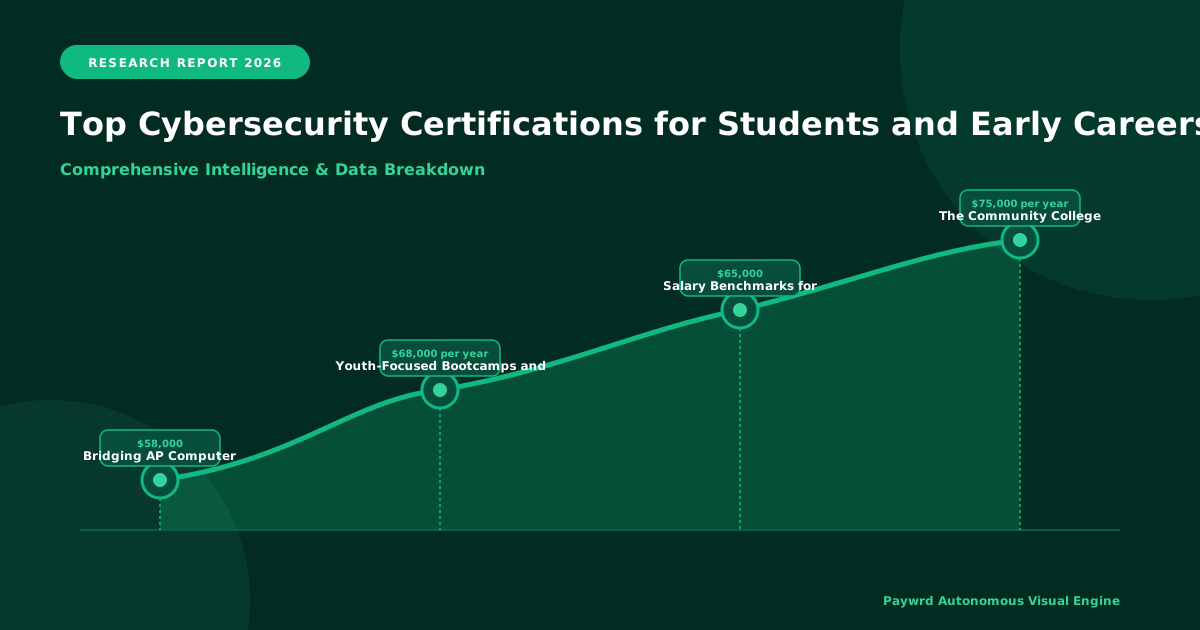
Bridging AP Computer Science and Industry Certs
For years, AP Computer Science A and Principles provided a strong foundation in Java and computational thinking. However, the 2026 trajectory emphasizes “stacking” these academic credits with entry-level certifications. Students are now encouraged to leverage their AP knowledge to fast-track certifications like the CompTIA Security+ or ISC2 Certified in Cybersecurity (CC). This hybrid approach transforms a high school diploma into a professional portfolio, allowing students to enter university with a proven technical baseline that often exempts them from introductory coursework, saving thousands in tuition costs.
Youth-Focused Bootcamps and Federal Initiatives
The US Department of Education, in coordination with federal workforce development initiatives, has scaled funding for “Cyber-Corps” style programs at the high school level. These initiatives aim to diversify the talent pipeline by providing underserved communities with access to high-intensity, youth-focused bootcamps. These programs often focus on:
- Capture The Flag (CTF) Competitions: Gamified learning that teaches penetration testing and digital forensics in real-time environments.
- Federal Apprenticeships: Early-track pipelines into agencies like CISA and the NSA, offering stipends that offset the rising cost of higher education.
- ABET-Aligned Pre-College Tracks: Partnerships between high schools and engineering colleges to ensure a seamless transition into ABET-accredited cybersecurity degrees.
By utilizing FAFSA planning early and targeting scholarships specifically for STEM-certified high school graduates, students are mitigating the financial burden of the Ivy League or top-tier state universities. The goal for 2027 and beyond is clear: create a seamless transition from the classroom to the Security Operations Center (SOC), ensuring the US maintains a dominant and secure digital infrastructure.
Entry-Level Certification Roadmap and 2026 Salary Benchmarks
Navigating the 2026 cybersecurity landscape requires a strategic approach to certification. The “entry-level” designation has evolved; employers no longer look for a single certificate but a tiered validation of skills. For students and early-career professionals, the roadmap begins with establishing a baseline of networking and security fundamentals before specializing.
The Foundational Face-Off: CompTIA Security+ vs. Cisco CCST
For those entering the field, the choice often boils down to the CompTIA Security+ and the Cisco Certified Support Technician (CCST) Cybersecurity. While both are respected, they serve different strategic purposes in a US career trajectory:
- CompTIA Security+: This remains the gold standard for generalist roles and is a mandatory requirement for many US Department of Defense (DoD) positions under Directive 8140. It provides a broad, vendor-neutral overview of risk management and threat mitigation.
- Cisco CCST Cybersecurity: This is the ideal “on-ramp” for those who prefer a hands-on, infrastructure-heavy approach. It focuses heavily on the Cisco ecosystem, making it a superior choice for students aiming for Network Security Engineer roles.
To bridge the gap for absolute beginners, the ISC2 Certified in Cybersecurity (CC) has become the primary gateway. In 2026, the CC is frequently used as a “confidence builder,” offering a streamlined path to understand the ISC2 framework—the same body that governs the prestigious CISSP—without the grueling experience requirements of advanced tiers.
2026 Salary Benchmarks for Certified Juniors
The financial incentive for early certification is significant. According to updated 2026 data reflecting BLS trends and industry payroll reports, certified juniors command a premium over their non-certified peers. While a standard bachelor’s degree provides the theoretical foundation, certifications act as the “proof of competence” that triggers higher starting offers.
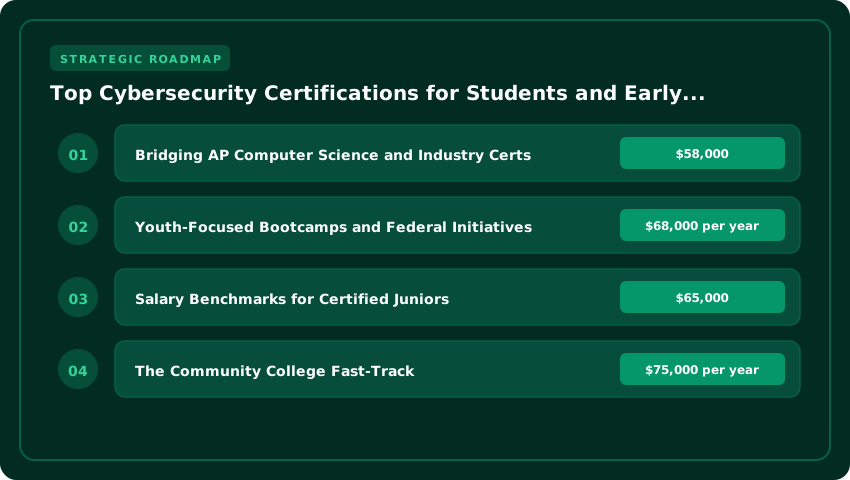
- Uncertified Junior Analyst: $58,000 – $68,000 per year.
- Single Certification (CC or CCST): $65,000 – $75,000 per year.
- Dual Certification (Security+ and CC): $72,000 – $88,000 per year.
To maximize these earnings, students should leverage the FAFSA for tuition assistance in ABET-accredited programs while pursuing these certifications independently. By aligning academic credits with industry badges, early-career professionals can bypass “entry-level” stagnation and move directly into Tier 2 SOC Analyst roles within their first 18 months of employment.
Strategic Academic Alignment with ABET-Accredited Programs
For students aiming for long-term upward mobility in 2026, the distinction between a generic IT degree and an ABET-accredited program is significant. The Accreditation Board for Engineering and Technology (ABET) ensures that cybersecurity curricula meet rigorous global standards, focusing on a deep mathematical and engineering foundation rather than just tool-based training. Graduates from ABET-accredited programs often find a smoother path into high-paying roles at defense contractors and Fortune 500 firms, where foundational theory is prized over short-term technical skill sets.
The Community College Fast-Track
While Ivy League institutions offer prestige, the 2026 economic landscape favors the agility of Community College associate degrees for rapid workforce entry. By leveraging local community colleges, students can drastically reduce their initial tuition burden—often paying under $4,000 per year compared to the $40,000+ average at private four-year institutions. This “2+2” model allows students to secure an Associate of Applied Science (AAS) in Cybersecurity, enter the workforce as a Junior Analyst earning a median starting salary of approximately $62,000 per year (per BLS data), and later complete their bachelor’s degree via employer-sponsored tuition reimbursement.
Mapping Certifications to Degree Requirements
The most strategic students in 2026 no longer treat certifications and degrees as separate tracks; they treat them as integrated credits. Many US universities now offer “Prior Learning Assessment” (PLA) credits, allowing students to map industry certifications directly to academic requirements. This alignment reduces time-to-degree and maximizes the utility of FAFSA funding.
- CompTIA Security+: Often maps to an introductory “Network Security” or “Information Assurance” course, saving 3 credit hours.
- CISSP (Associate level): Can frequently satisfy upper-division elective requirements in Cybersecurity Management or Governance.
- CCNA/Azure Security: Often replaces core networking or cloud infrastructure requirements in ABET-aligned programs.
By strategically aligning these credentials, students avoid redundant learning and enter the 2027 job market with a dual-threat profile: the theoretical rigor of a US Department of Education-recognized degree and the practical validation of industry certifications. This hybrid approach is the most reliable method to bypass the “entry-level experience gap” and command a premium starting salary in an increasingly competitive STEM landscape.
Advanced Pathways: Transitioning from Junior to Specialist
Once you have secured your first role—likely as a SOC Analyst or Junior Security Engineer—the focus shifts from generalist knowledge to high-value specialization. In the 2026 labor market, the “mid-career plateau” is avoided by strategically pivoting toward certifications that command premium salaries. According to recent BLS data, specialized cybersecurity roles now frequently exceed $120,000 annually, provided the professional can demonstrate niche mastery.
The Long-Term Trajectory: Management and Governance
For those eyeing leadership roles, the trajectory leads toward the “Gold Standards” of security management. While you cannot obtain these immediately due to experience requirements, you should begin aligning your work history with the domains of the CISSP (Certified Information Systems Security Professional) and the CISM (Certified Information Security Manager). These credentials are often mandatory for Director or CISO roles within Fortune 500 companies and are highly regarded by the US Department of Education for academic leadership roles in STEM.
Choosing Your Specialization: Cloud vs. Offensive Security
By 2027, the industry will be almost entirely defined by the tension between infrastructure resilience and proactive exploitation. You must decide between two primary paths:
- Cloud Security (AWS/Azure/GCP): As US enterprises migrate legacy systems to the cloud, specialists holding the AWS Certified Security Specialty or Microsoft Azure Security Engineer Associate certifications are seeing rapid promotion. This path is ideal for those who enjoy architecture, automation, and governance.
- Penetration Testing (OSCP): For those drawn to the “offensive” side, the Offensive Security Certified Professional (OSCP) remains the benchmark. Unlike multiple-choice exams, the OSCP requires a grueling 24-hour practical exam, proving you can actually breach a network.
Building a Verifiable Portfolio
In 2026, a resume is secondary to a proven track record. To transition from a junior to a specialist, you must develop a professional portfolio. The most effective way to do this within the US legal framework is through established Bug Bounty programs. By identifying vulnerabilities on platforms like HackerOne or Bugcrowd for US-based companies, you create a public, verifiable ledger of your skills.
Combining these real-world wins with a degree from an ABET-accredited program or a certification from a PMI-aligned project management track ensures you aren’t just a technician, but a strategic asset. Whether you are utilizing FAFSA to fund a Master’s in Cybersecurity or self-funding your certifications, the goal is to move from “knowing the tools” to “owning the strategy.”
Navigating FAFSA and Funding for Cybersecurity Training
The 2026–2027 FAFSA cycle introduces a streamlined formula that significantly expands Pell Grant eligibility for students enrolled in ABET-accredited cybersecurity and computer science programs. The Student Aid Index (SAI) now allows a negative floor of -$1,500, meaning the lowest-income applicants can qualify for the maximum Pell Grant of $7,395 plus supplemental institutional aid. If you are targeting a Bachelor of Science in Cybersecurity at a designated National Center of Academic Excellence in Cybersecurity (NCAE-C), verify the program’s ABET accreditation status immediately—this designation unlocks the highest federal funding tiers and satisfies the “program eligibility” requirement for Direct Subsidized Loans.
Employer-Sponsored Reimbursement: The New Standard
Corporate tuition assistance has shifted from a perk to a strategic retention tool. In 2026, major defense contractors (Lockheed Martin, Northrop Grumman) and tech giants (Google, Microsoft, Amazon Web Services) have standardized $5,250 annual tax-free educational assistance programs—the IRS maximum—specifically earmarked for certifications like CompTIA Security+, (ISC)² CC, and GIAC GSEC. The trend is moving toward pre-approval workflows integrated into HRIS platforms (Workday, Oracle HCM), allowing you to secure funding before you sit for the exam. Negotiate this during onboarding: ask for a “Professional Development Addendum” that guarantees reimbursement for any DoD 8570/8140 compliant certification within your first 18 months.
Targeted Scholarships for Underrepresented Talent
Federal and private capital is flowing aggressively into workforce diversification. The CyberCorps®: Scholarship for Service (SFS) program, funded by the NSF and DHS, now offers full tuition (up to $64,000/year for graduate study), a $27,000 undergraduate/$37,000 graduate stipend, and a $6,000 professional development allowance in exchange for government service. Simultaneously, identity-specific awards have scaled:
- Women in CyberSecurity (WiCyS) / Google Scholarship: $10,000 awards for undergraduate and graduate students identifying as women, plus conference travel grants.
- National Society of Black Engineers (NSBE) / Palo Alto Networks: $7,500 scholarships for Black/African American students pursuing security certifications or degrees.
- Hispanic Foundation of Silicon Valley / (ISC)²: $5,000–$10,000 awards for Latino/a students entering the cyber workforce.
- Veterans & Military Spouses: The VET TEC program covers full tuition for approved non-college degree programs (bootcamps, cert prep) without dipping into GI Bill entitlement.
Action Item: Submit your 2026–2027 FAFSA by your state’s priority deadline (often March 1 or April 1) to maximize state grant stacking. Then, stack employer reimbursement on top of federal aid for certifications—this “double-dip” is perfectly legal and the fastest way to graduate debt-free with a resume full of credentials.
2027 Outlook: Emerging Skills for the Next Generation of Analysts
The certification roadmap you build today must anticipate the threat landscape of 2027 and beyond. Hiring managers at federal contractors and Fortune 500 SOCs are already rewriting job descriptions to reflect three seismic shifts: autonomous threat hunting, post-quantum readiness, and mandatory Zero Trust execution. If your current study plan stops at Security+ objectives, you are already behind the curve.
AI-Driven Detection Reshapes the Analyst Role
By 2027, Tier-1 alert triage will be largely automated. Major vendors—Microsoft Sentinel, CrowdStrike Falcon, Palo Alto Cortex XSOAR—are embedding large language models (LLMs) that correlate telemetry, enrich IOCs, and draft incident narratives in seconds. Certifying bodies are reacting fast. CompTIA has signaled that CySA+ and PenTest+ renewals will weight “AI-assisted analysis” competencies heavily, while (ISC)² is piloting an CCSP concentration on securing generative AI pipelines. For students, this means the “analyst” title evolves from log reviewer to AI model validator. You need fluency in prompt engineering for threat intel, understanding model hallucination risks, and the ability to audit automated response playbooks—skills not yet in standard 2026 textbooks but appearing on GIAC GCIH and GCFA practical exams.
Quantum-Resistant Cryptography: No Longer Theoretical
NIST finalized its first three Post-Quantum Cryptography (PQC) standards—ML-KEM, ML-DSA, and SLH-DSA—in late 2026. By 2027, OMB Memorandum M-23-02 mandates federal agencies to inventory vulnerable cryptographic systems and initiate migration. This trickles down to every cleared contractor. Early-career professionals holding Security+ or CASP+ must grasp lattice-based key encapsulation and hash-based signatures conceptually, not just memorize RSA key lengths. ISACA has added PQC governance modules to CISM review materials, and EC-Council is weaving quantum-safe VPN labs into C|EH v13. High school and community college students should prioritize Python labs implementing liboqs or OpenSSL 3.2+ provider modules; that hands-on proof beats a transcript line item every time.
Zero Trust Architecture Becomes Contractual Law
The White House Executive Order 14028 and subsequent OMB M-22-09 set a hard 2026 deadline for federal Zero Trust Architecture (ZTA) plans. By 2027, compliance shifts from “planning” to “continuous verification” evidence. CMMC 2.0 Level 2 assessments now map directly to ZTA pillars: device integrity, micro-segmentation, and least-privilege access enforced via policy decision points (PDPs). For early-career entrants targeting the Defense Industrial Base (DIB), a generic “network security” cert holds little water. You need demonstrable experience with NIST SP 800-207 reference architectures—specifically configuring identity-aware proxies, software-defined perimeters (SDP), and continuous diagnostics and mitigation (CDM) dashboards. The Cloud Security Alliance CCSK plus Certificate of Cloud Security Knowledge with the ZTA module is rapidly becoming the baseline credential for federal cloud task orders.
- Action Item: Add a “Quantum Readiness” lab project to your GitHub—implement ML-KEM key exchange in a TLS 1.3 handshake using oqs-provider.
- Certification Watch: Track CompTIA Security+ SY0-801 (expected late 2026) for AI/ML and PQC objective domain updates.
- Clearance Path: Pair Security+ with DoD 8140 role-based mappings (CSSP Analyst/Infrastructure Support) to fast-track federal hiring.
The 2027 analyst isn’t just certified—they are architecturally literate in AI governance, quantum migration, and Zero Trust enforcement. Start building that portfolio now.
| Certification | Target Audience (2026) | Exam Cost (USD) | Prerequisites / Experience | Avg. Entry Salary Potential (US, 2026) | Renewal Cycle / CEUs | Best 2026/2027 Testing Window |
|---|---|---|---|---|---|---|
| CompTIA Security+ (SY0-701) | HS Seniors / College Freshmen | $404 | None (Network+ & 2 yrs IT admin recommended) | $72,000 – $85,000 | 3 Years / 50 CEUs | Continuous (Pearson VUE / Online) |
| ISC2 Certified in Cybersecurity (CC) | HS Grads / Career Switchers (Zero Exp) | $199 (Exam) + $50/yr AMF | None | $65,000 – $78,000 | 3 Years / 45 CPEs | Continuous (Pearson VUE / Online) |
| CompTIA CySA+ (CS0-003) | College Sophomores / SOC Analyst Track | $404 | Security+ equiv. + 4 yrs hands-on exp (recommended) | $85,000 – $100,000 | 3 Years / 60 CEUs | Continuous (Pearson VUE / Online) |
| GIAC Security Essentials (GSEC) | ROTC / Service Academy Cadets / Grad Students | $979 (includes 2 practice tests) | None (Deep technical baseline required) | $90,000 – $110,000 | 4 Years / 36 CPEs | Continuous (Proctored / Remote) |
| OffSec Certified Professional (OSCP / PEN-200) | Senior Undergrads / Red Team Aspirants | $1,749 (90-day lab access) | Strong Linux/Scripting/Networking (No formal req) | $100,000 – $125,000+ | 3 Years / 120 CPEs | Continuous (Remote Proctored 24/7) |
Frequently Asked Questions
What is the best cybersecurity certification for a high school student with no experience in 2026?
The ISC2 Certified in Cybersecurity (CC) is the optimal 2026 starting point for US high school students with zero experience. It requires no prerequisites, costs $199 for the exam, and validates foundational knowledge across five domains aligned with the NICE Framework. Earning the CC allows immediate entry into the ISC2 talent pipeline and counts toward future CISSP experience requirements.
How much does CompTIA Security+ cost in 2026 including study materials?
In 2026, the CompTIA Security+ (SY0-701) exam voucher costs $404. Budget an additional $150-$350 for quality self-study bundles (e.g., CertMaster Learn, Dion Training, or Professor Messer course notes). Total investment typically ranges $550-$750. US students should check CompTIA Academic Partner programs for potential 10-20% voucher discounts through participating high schools or colleges.
Can a high school graduate get a cybersecurity job in 2026 with only certifications and no degree?
Yes, in 2026 US employers increasingly hire high school graduates holding Security+ or ISC2 CC for Tier 1 SOC Analyst, Junior IT Auditor, or Help Desk Security roles starting at $65k-$80k. The DoD 8140/8570 mandate drives contractor demand for certified personnel regardless of degree status. Success requires a public GitHub lab portfolio, active clearance eligibility, and participation in CyberPatriot or NCL competitions.
Which cybersecurity certification has the highest ROI for college students graduating in 2027?
For 2027 graduates, CompTIA Security+ delivers the highest ROI due to universal DoD 8140 compliance, broad private sector recognition, and a $404 exam cost. It unlocks immediate eligibility for cleared defense contractor roles paying $75k+. Pairing Security+ with a cloud cert (AWS Security Specialty or AZ-500) during senior year 2026-2027 maximizes offer leverage for Cloud Security Engineer tracks starting $95k+.
What are the 2026 renewal requirements for entry-level cybersecurity certifications?
In 2026, ISC2 CC requires a $50 Annual Maintenance Fee (AMF) and 45 CPEs per 3-year cycle. CompTIA Security+ and CySA+ require 50 and 60 CEUs respectively over 3 years, earnable via higher certs, training, or teaching. GIAC GSEC requires 36 CPEs over 4 years. OSCP requires 120 CPEs over 3 years. All support remote submission via provider portals.
Strategic Final Takeaway
When evaluating Best Cybersecurity Certifications For High School Students And Early Career Pathways in 2026 and beyond, base your decisions on accredited institutional standards, verified return on investment (ROI), and up-to-date official guidelines. Always verify specific dates and requirements through official regulatory portals.