
2026 Eligibility Criteria: Female-Led Tech Startups & CAC Mandates
The Pan-Atlantic University (PAU) Women in Tech Incubator isn’t looking for slide decks; they are investing in legally structured, market-validated ventures. For the 2026 cohort, the eligibility gate is rigid: you must prove female control, Nigerian market traction, and Corporate Affairs Commission (CAC) compliance before the review panel even opens your pitch deck. Miss one mandatory document, and your application is archived instantly.
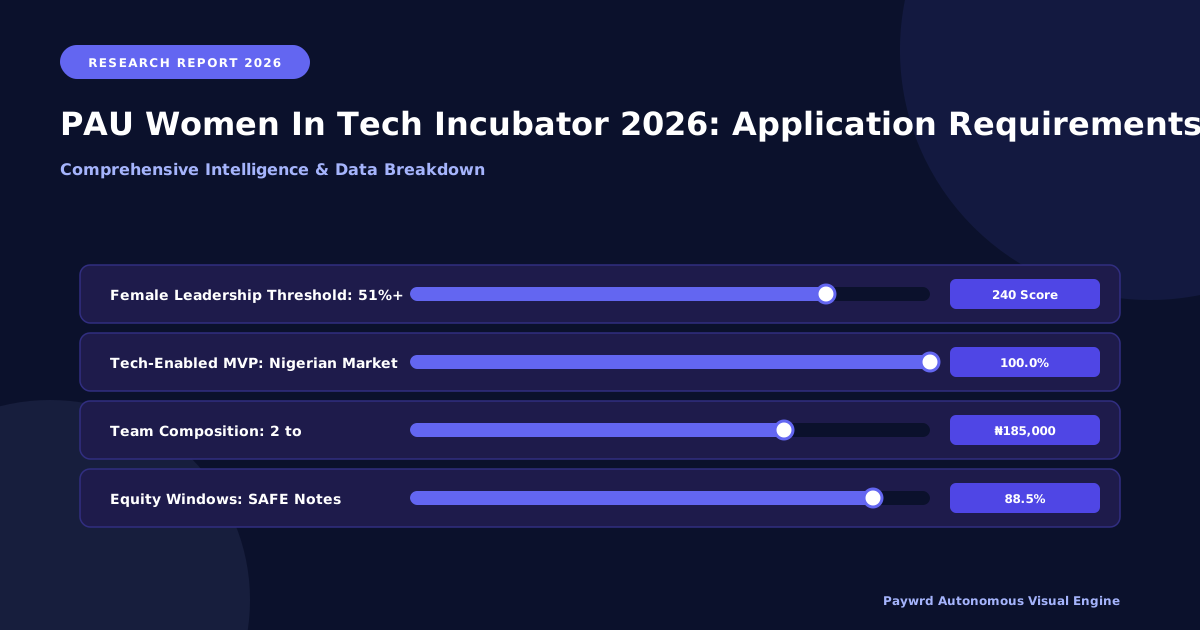
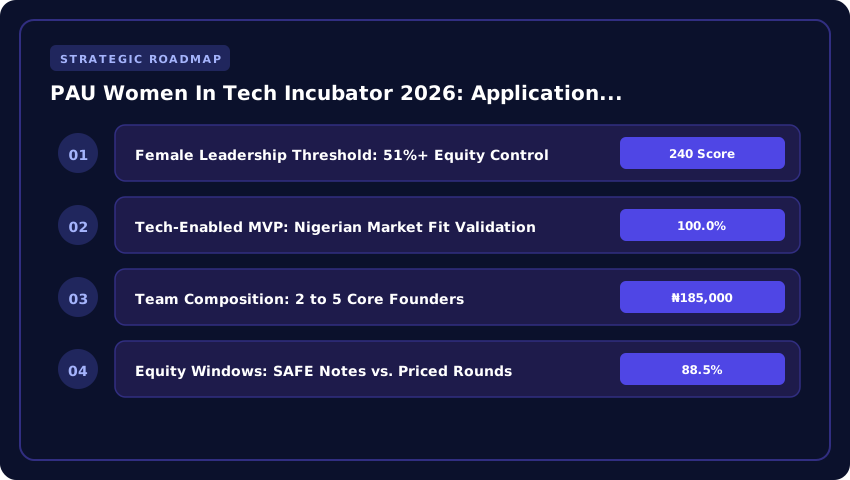
Female Leadership Threshold: 51%+ Equity Control
This is non-negotiable. The cap table must reflect majority female ownership (minimum 51%) at the point of application. PAU verifies this against your CAC Form CAC 1.1 (for Limited Liability Companies) or the Business Name Registration Certificate and Status Report (for Business Names). If your female co-founder holds 49% while a male technical lead holds 51%, you are disqualified. There is no “advisory board” workaround—equity ownership equals control. Ensure your share allotment is filed and stamped at the CAC registry before you hit submit.
Tech-Enabled MVP: Nigerian Market Fit Validation
“Tech-enabled” means your core value delivery relies on code, data, or hardware—not just a WhatsApp broadcast list. For 2026, you must demonstrate a Minimum Viable Product (MVP) live in the Nigerian market with verifiable traction metrics. Acceptable proof includes:

- Google Play Console / App Store Connect analytics showing 500+ active Nigerian users.
- Stripe, Paystack, or Flutterwave dashboard screenshots confirming ₦500,000+ in processed revenue or 50+ paying B2B clients.
- Letters of Intent (LOIs) from Nigerian enterprises (banks, telcos, FMCGs) on letterhead, signed by C-suite executives.
Concept notes, Figma prototypes, or “waitlist signups” without product access will be rejected. The selection committee prioritizes founders solving Nigerian-specific infrastructure gaps—fintech compliance, logistics visibility, agritech supply chain, or health-tech access.
CAC Incorporation: Business Name vs. Limited Liability Distinctions
You must be a registered Nigerian entity. Both structures are accepted, but they carry different weight for seed funding disbursement:
- Business Name (BN): Faster to register (₦10,000–₦15,000 via CAC portal). Accepted for application, but if selected for the ₦10M+ seed tranche, you must convert to a Private Company Limited by Shares (LTD) before fund release. NELFUND and institutional investors rarely contract with BNs.
- Private Company Limited by Shares (LTD): Preferred. Requires
Memorandum & Articles of Association (MEMART), minimum ₦100,000 authorized share capital, and at least two directors. Submit your CAC Certificate of Incorporation, Status Report (Form CAC 1.1), and MEMART as a single merged PDF.
Pro tip: Ensure your Object Clause in the MEMART explicitly covers “Technology Development,” “Software Licensing,” or “Data Processing.” Vague “General Trading” clauses trigger compliance queries during due diligence.
Team Composition: 2 to 5 Core Founders
Solo founders are automatically filtered out. PAU requires a minimum of two (2) and maximum of five (5) core founding members listed on the CAC documents. Every member must have a defined operational role (CEO, CTO, COO, CFO, Head of Growth). Advisory roles, interns, or “equity holders only” do not count toward the headcount. The team slide must match the CAC Register of Members exactly—discrepancies signal governance risk.
Bottom line: Align your cap table, CAC filings, and live MVP metrics today. The 2026 window closes fast, and administrative gaps are the #1 reason qualified female founders get rejected.
Seed Funding Architecture: Naira Amounts, Equity Stakes & Mastercard Foundation Terms
The PAU Women in Tech Incubator structures capital as a dual-layer instrument: non-dilutive grant tranches followed by optional equity windows. For the 2026 cohort, the grant layer sits at ₦5 million to ₦10 million per startup, calibrated by track—Early Validation (₦5M), Market Scale (₦7.5M), and Deep Tech/AI (₦10M). These are not convertible notes; they are straight grants disbursed in three tranches tied to CAC annual returns filing, FIRS tax clearance certificates, and verified monthly recurring revenue (MRR) thresholds. Miss a KPI gate—say, 20% month-on-month user growth for Market Scale—and the subsequent tranche pauses until remediation is documented on the incubator’s compliance dashboard.
Equity Windows: SAFE Notes vs. Priced Rounds
Founders targeting follow-on capital enter a standardized SAFE (Simple Agreement for Future Equity) with a ₦50 million valuation cap and a 20% discount to the next priced round. This is the default for Early Validation and Market Scale tracks. Deep Tech ventures—think proprietary LLMs or hardware-integrated AI—can negotiate a priced seed round at a ₦100 million pre-money cap, but only if they present a term sheet from a licensed Nigerian VC or angel syndicate (e.g., Future Africa, Ventures Platform) before Demo Day. The incubator takes pro-rata rights up to its SAFE allocation; no board seats, no observer rights. Cap table modeling tip: assume the SAFE converts at the cap. On a ₦50M cap, a ₦10M SAFE buys 20% post-conversion. Factor that into your Series A dilution waterfall now.
Mastercard Foundation Matching Capital & Reporting
The Mastercard Foundation partnership unlocks a 1:1 matching pool for the equity layer, capped at ₦25 million per venture. Trigger conditions are strict: (1) the startup must have drawn the full grant tranche, (2) the follow-on investor must be a Foundation-approved partner fund, and (3) the founder submits quarterly impact reports—female employment ratios, youth jobs created, and digital skills training hours—via the Foundation’s MEL (Monitoring, Evaluation & Learning) portal. Non-compliance triggers a clawback clause: unmatched funds revert to the pool. Budget for a part-time M&E officer (₦150k–₦250k/month) to handle this administrative load; it is non-negotiable.
Disbursement Milestones & Regulatory Gates
- Tranche 1 (30%): Released onboarding week—requires CAC Certificate of Incorporation/Business Name, SCUML certificate, and FIRS TIN verification.
- Tranche 2 (40%): Month 3 gate—audited management accounts, NDPR compliance audit report, and proof of IP assignment to the company.
- Tranche 3 (30%): Demo Day—signed term sheet or ₦5M+ ARR run-rate, plus Mastercard MEL baseline report submitted.
Runway math: a Deep Tech founder taking the full ₦10M grant + ₦25M matched SAFE at ₦100M cap secures 35% equity dilution post-Series A (assuming ₦500M Series A). Model your burn rate against the 6-month incubator timeline; the grant covers ops, the SAFE extends runway to Series A. Plan accordingly.
Curriculum Deep-Dive: AI/ML, Product Management & Regulatory Compliance Tracks
The 2026 curriculum moves beyond generic startup theory into the specific technical and regulatory trenches where Nigerian deep-tech ventures live or die. This is not a survey course; it is a rigorous, module-based sprint designed to close the gap between academic research and commercial deployment in markets like Lagos, Kano, and Port Harcourt.
Applied AI/ML: Building Under Nigerian Data Constraints
The AI/ML track confronts the reality that Western model architectures often fail on Nigerian infrastructure. You will work directly with low-resource language datasets—Yorùbá, Igbo, Hausa, and Pidgin—optimizing for inference on edge devices common in the informal retail sector. Modules cover data augmentation techniques for sparse local datasets, quantization strategies for onnx deployment on low-end Android chipsets (Transsion/Itel dominance), and building retrieval-augmented generation (RAG) pipelines grounded in Nigerian legal and financial corpora. Expect hands-on labs debugging model drift caused by “Nigerian English” semantic shifts that break standard tokenizers.
Product Management Sprint: The Informal Economy & Agent Networks
Product management here ignores Silicon Valley user personas. The sprint focuses on designing for the agent network—the POS operators, super-agents, and market women who move ₦50 trillion annually outside formal banking rails. You will run rapid user research cycles in live markets (Balogun, Ariaria, Alaba), mapping trust signals, offline-first UX patterns, and USSD/WhatsApp hybrid flows. The deliverable is a validated Minimum Lovable Product (MLP) spec that accounts for intermittent connectivity, shared device usage, and the cash-in/cash-out liquidity constraints that kill standard SaaS onboarding funnels in Nigeria.
Fundraising Masterclass: Term Sheets with Future Africa & TLcom
This module strips away the pitch deck theater. You will dissect actual term sheets from leading local VCs—Future Africa, TLcom Capital, and Ventures Platform—clause by clause. Focus areas include: negotiating liquidation preferences (1x non-participating vs. participating), anti-dilution protection (broad-based weighted average vs. full ratchet) in a high-inflation Naira environment, and structuring SAFE notes with valuation caps denominated in USD vs. NGN. Legal counsel from partners like Udo Udoma & Belo-Osagie will walk you through side letters, board observer rights, and the “major investor” definitions that determine your control runway post-Series A.
Regulatory Compliance Workshop: NDPR, SEC VASP & CBN Sandbox
Regulatory ignorance is an existential risk, not a compliance cost. This workshop is led by practitioners who have secured licenses, not academics who study them. You will perform a live NDPR Data Protection Impact Assessment (DPIA) on your architecture, mapping data controller/processor roles for cross-border cloud storage (AWS Lagos region vs. EU). For fintech/Web3 teams, the track covers the SEC VASP (Virtual Asset Service Provider) licensing framework—capital requirements, fit-and-proper person tests, and the mandatory AML/CFT program integration with the NFIU goAML platform. Finally, a dedicated session on the CBN Regulatory Sandbox entry criteria: the ₦50 million minimum capital proof, the IT security audit (ISO 27001/PCI-DSS), and the mandatory consumer protection stress testing before you touch a single live Naira.
- AI/ML Output: Deployable, quantized model artifact + data card for Nigerian language support.
- PM Output: Validated MLP spec with agent-network distribution strategy.
- Fundraising Output: Negotiated term sheet markup ready for investor review.
- Compliance Output: NDPR Audit Report + SEC VASP/CBN Sandbox application draft.
Application Portal Walkthrough: EDC PAU Submission Checklist & Document Specs
Let’s cut through the noise. The portal at edc.pau.edu.ng/witi is the only gateway—bookmark it, because Google search results often surface outdated 2026 links. Your first move is account creation using a functional corporate email address (no personal Gmail or Yahoo addresses allowed for the primary admin). The system enforces Two-Factor Authentication (2FA) via authenticator apps (Google Authenticator or Microsoft Authenticator preferred); SMS codes are not supported in the 2026 build. Complete this before* you start the form—session timeouts are aggressive at 15 minutes of inactivity, and you cannot save a draft without a verified 2FA device.
Mandatory Document Uploads: Specs & Naming Conventions
The upload module rejects files that deviate even slightly from spec. Name every file using the format: WITI2026_[StartupName]_[DocumentType].pdf (e.g., WITI2026_TechHer_CAC.pdf). Maximum file size is 5MB per document.
- Pitch Deck: 10 slides maximum, PDF only. Structure: Problem, Solution, Market Size (TAM/SAM/SOM with Nigerian data sources), Business Model, Traction (MRR, users, partnerships), Team (highlighting 51%+ female equity), Financial Projections (3-year), Ask & Use of Funds, Impact Metrics, Appendix. No animations, embedded videos, or password protection.
- CAC Certificate: Certificate of Incorporation (Form CAC 1.1 for Ltd) or Business Name Registration Certificate. Must show “Active” status on the CAC public search portal as of submission week.
- Tax Clearance Certificate (FIRS): Valid for the 2026 assessment year. Expired certificates are an auto-reject. If you are a newly incorporated Business Name (BN), upload the FIRS e-TCC acknowledgment slip showing application status.
- BVN Verification: Upload a clear PDF scan of the BVN slip for the female lead founder holding the controlling equity. The name must match the CAC Form CAC 1.1 / Particulars of Directors exactly.
Video Pitch: The 3-Minute Hard Stop
Record in landscape (16:9), 1080p minimum, MP4 container, H.264 codec. File size cap: 100MB. The portal transcoder fails on MOV or HEVC. Content structure is non-negotiable: 60 seconds Founder Story (why you, why now), 90 seconds Problem-Solution Fit (show the product, not slides), 30 seconds Traction Metrics (hard numbers: revenue, active users, churn, CAC/LTV). Do not read a script; the review panel uses AI transcription to verify authenticity against your deck.
Reference Letters & The Submission Deadline
Two references are mandatory: one Academic (HOD, Dean, or Supervisor from a Nigerian tertiary institution) and one Industry (CTO, VP Engineering, or Founder of a Series A+ startup). Letters must be on official letterhead, signed, dated within 30 days of submission, and address the founder’s technical competence and leadership capacity. Referees receive a unique upload link via email after you submit their details—do not upload scanned copies yourself; the system flags them as invalid.
Critical Deadline: The portal hard-closes at 23:59 WAT, Friday, June 28, 2026. No extensions, no “grace period” emails. If your internet fails in Lekki at 23:58, your application is lost. Submit by June 26 to sleep well.
2026 Cohort Calendar: Application Windows, Bootcamp Dates & Demo Day Schedule
The PAU Women in Tech Incubator runs two distinct cohorts in 2026, each structured around a rigorous 12-week hybrid model. Founders should treat these dates as immovable anchors for fundraising roadshows, hiring sprints, and product launch calendars. Missing a window means waiting six months—there are no rolling admissions.
Cohort 1: Lagos Residency (H1 2026)
- Applications Open: 6 January 2026 (00:00 WAT)
- Early-Bird Review Window Closes: 14 February 2026 (23:59 WAT) — Applications submitted here receive priority scoring on traction metrics and founder-video assessment.
- Final Hard Deadline: 28 February 2026 (23:59 WAT) — Portal locks automatically; no extensions for CAC document uploads or reference letters.
- Selection Announcements: 15 March 2026 via email and JAMB-style CAPS dashboard notification.
- Mandatory Virtual Pre-Work: 18 March – 12 April 2026 (4 weeks). Covers unit economics modelling, data room preparation, and Nigerian data protection (NDPR) compliance. Non-completion auto-disqualifies the team.
- Physical Bootcamp (Lagos Campus): 1 June – 21 August 2026. Residency is mandatory Monday–Friday, 9 AM–6 PM WAT at the PAU Ibeju-Lekki hub.
- Demo Day & Investor Showcase: 28 August 2026. Target audience: VCs, angel networks (e.g., Lagos Angel Network), and NELFUND venture desk representatives.
Cohort 2: Abuja Residency (H2 2026)
- Applications Open: 1 July 2026 (00:00 WAT)
- Early-Bird Review Window Closes: 15 August 2026 (23:59 WAT)
- Final Hard Deadline: 31 August 2026 (23:59 WAT)
- Selection Announcements: 15 September 2026
- Mandatory Virtual Pre-Work: 18 September – 10 October 2026
- Physical Bootcamp (Abuja Campus): 2 November 2026 – 23 January 2027. Note: This crosses the calendar year; plan holiday hiring freezes accordingly.
- Demo Day & Investor Showcase: 30 January 2027. Aligned with the Abuja Enterprise Agency (AEA) annual summit for maximum regulatory visibility.
Operational Planning Notes for Founders
All timestamps reference West Africa Time (WAT). The 23:59 WAT hard deadline is enforced by the application server—submissions timestamped 00:00 WAT the following day are rejected. The virtual pre-work modules are not optional orientation; they are graded deliverables. Your CTO must complete the technical architecture review, and your CEO must submit a finalized term sheet template before the physical residency begins. Budget ₦1.5M–₦2.5M for Lagos/Abuja relocation logistics per founder for the 12-week residency; the incubator provides a ₦500,000 stipend per selected venture, disbursed in two tranches (Week 1 and Week 7) contingent on attendance logs.
Selection Rubric & Pitch Day Mechanics: What EDC Judges Score in 2026
The Enterprise Development Centre (EDC) judging panel doesn’t grade on a curve. For the 2026 PAU Women in Tech Incubator, the scorecard is weighted explicitly toward commercial viability and investor readiness—reflecting the program’s shift from “capacity building” to “portfolio construction.” You are walking into a room with PAU faculty, Ventures Platform partners, and occasionally a rep from the Bank of Industry (BOI) or NELFUND’s equity desk. They score on a 100-point scale, and the math is public if you know where to look.
The 2026 Scoring Weightage Breakdown
- Market Size & Addressable Revenue (30%): Judges are checking for TAM/SAM/SOM logic grounded in Nigerian reality. “Africa’s fintech market is $X billion” scores zero. You need: “Our beachhead is 120,000 SMEs in Lagos State processing ₦50M+ monthly via POS, representing a ₦1.2B Serviceable Obtainable Market.” Cite NBS SMEDAN data or CBN payment stats.
- Team Execution & Founder-Market Fit (25%): The 51% female equity mandate is the gate; this score is the filter. They score depth: Has the CTO shipped production code in a regulated Nigerian environment (NDPR, CBN sandbox)? Has the CEO managed P&L or distributed payroll? Advisory boards don’t count; operational scars do.
- Tech Differentiation & Defensibility (20%): “AI-powered” is table stakes. The rubric demands: What is the moat? Proprietary data loops? Switching costs embedded in the workflow? Integration with NIBSS or Remita APIs that competitors can’t replicate easily? Open-source wrappers score low.
- Gender-Lens Impact & Inclusion Metrics (15%): Unique to PAU. Beyond the cap table, they score: % of female users/beneficiaries, female employment ratio in technical roles, and product features solving gender-specific frictions (e.g., collateral-free credit scoring for women traders).
- Traction & Unit Economics (10%): Pre-revenue is accepted only with deep pipeline validation (LOIs from named enterprise clients). Revenue teams must show Month-on-Month growth >15% and CAC payback < 6 months. Burn rate vs. runway is scrutinized against the ₦10M–₦15M seed ticket.
Pitch Day Format: 5 Minutes, 10 Minutes Q&A
You get exactly 300 seconds. No demo videos. No “let me show you the dashboard.” Slides: Problem, Solution, Market Math, Business Model, Traction, Team, The Ask, Impact. The clock is visible and hard-stopped by the EDC program manager. The subsequent 10-minute Q&A is where the cohort is made or broken. Expect investor-grade drilling: “Walk me through your cap table pre- and post-money.” “Show me the IP assignment deeds for the code your CTO wrote while employed at [Previous Corp].” “How does this comply with the new SEC rules on digital assets?” “What is your NDPR data retention policy?”
Due Diligence Red Flags: Automatic Disqualifiers
The due diligence window opens immediately after Pitch Day. Three structural flaws kill deals instantly:
- Cap Table Disputes: Undocumented founder splits, “gentleman’s agreements” with ex-co-founders, or advisors holding >5% equity without vesting schedules. Clean this before applying; the PAU legal clinic won’t fix it for you during the program.
- IP Ownership Gaps: Code sitting in a personal GitHub repo. No IP Assignment Agreement signed by contractors or employees. If the university or a former employer claims the IP, you are out.
- Regulatory Blind Spots: Operating a lending feature without an MFB license or CBN fintech sandbox approval. Processing health data without NDPR audit evidence. “We’ll figure it out later” is a fail.
Waitlist Protocol: Conversion Reality
Roughly 15–20% of the final cohort historically comes off the waitlist. Conversion triggers: A top-10 ranked team declines (usually due to conflicting accelerator terms like Greenhouse or YC), or a selected team fails the 2-week post-selection legal/financial verification sprint. Waitlisted founders are notified on a rolling basis up to Day 3 of the bootcamp. If you are waitlisted, keep your data room live—CAC portal screenshots, tax clearance (TCC), bank statements, and signed term sheets from pilot clients. The program moves fast; they won’t chase you for missing docs.
Post-Programme Ecosystem: Alumni Fund Access, Corporate Partnerships & Follow-On Capital
The PAU Women in Tech Incubator does not end at Demo Day; it transitions into a structured capital and distribution engine designed to de-risk Series A conversations for female founders. The programme’s long-term ROI is quantified through the PAU Alumni Syndicate, a dedicated ₦50 million follow-on fund exclusively accessible to graduates who hit predefined milestones within 18 months post-incubation. Access criteria are transparent: startups must demonstrate ₦15 million in cumulative revenue or 20% month-over-month user growth, maintain the mandatory 51% female equity threshold, and submit audited management accounts signed off by the EDC’s in-house accounting clinic. This is not grant money—it is patient capital priced at 12% per annum with a 24-month moratorium, structured to bridge the “valley of death” between seed traction and institutional venture tickets.
Corporate Pilot Pathways: MTN, Access Bank & Flutterwave Sandboxes
Distribution risk is solved before you graduate. The 2026 cohort secures guaranteed sandbox slots with three strategic anchors. MTN Nigeria allocates five dedicated API integration slots for fintech and edtech solutions targeting their 78 million active data subscribers, with a fast-track to the MoMo PSB agent network. Access Bank reserves three pilot corridors within the AccessAfrica platform for cross-border payment and trade finance tools, offering direct access to their SME banking relationship managers across 12 African markets. Flutterwave provides a dedicated sandbox environment and technical liaison for two cohorts building embedded finance or merchant acquiring stacks, with a revenue-share agreement template pre-negotiated by PAU legal counsel. These are not “innovation theatre” meetings; they are binding Memoranda of Understanding (MoUs) signed before Cohort Day One, converting pilot success into commercial contracts within 90 days.
International Exposure: Slush’d Lagos & GITEX Africa Delegation Priority
Visibility capital is allocated via a curated international track. Graduates receive priority selection for the Slush’d Lagos founder track—bypassing the general application pool of 2,000+ startups—and guaranteed booth space at GITEX Africa Marrakech under the Nigerian Pavilion, funded by the National Information Technology Development Agency (NITDA) partnership. The 2026 delegation includes curated investor office hours with Partech Africa, TLcom Capital, and Norrsken22 partners. Travel stipends of ₦1.2 million per founder are disbursed via the NELFUND-aligned grant window, contingent on a post-event impact report measuring qualified investor meetings and term sheets initiated.
Perpetual Infrastructure: EDC Co-Working, Legal Clinic & Tax Retainer
The physical and compliance backbone remains active indefinitely for alumni in good standing:
- EDC Co-Working Space: Unlimited hot-desking at the Lekki and Abuja Enterprise Development Centre hubs, including high-speed fibre, podcast studios, and hardware prototyping labs—valued at ₦350,000/quarter commercially.
- Legal Clinic Retainer: Quarterly cap-table health checks, ESOP scheme reviews, and data privacy (NDPR) audits handled by the PAU Law Clinic’s corporate practice group, preventing the costly legal debt that derails Series A due diligence.
- Tax Advisory Retainer: Annual FIRS tax computation filing, TCC renewal management, and pioneer status application support via the designated tax faculty, ensuring founders remain compliant while optimizing effective tax rates.
This ecosystem transforms the incubator from a six-month sprint into a decade-long institutional partner, directly addressing the opportunity cost calculation for late-stage founders who cannot afford to pause revenue generation for “learning.”
| Requirement | PAU Women In Tech 2026 Standard | Status/Threshold |
|---|---|---|
| Equity Ownership | Female-Led/Controlled | Minimum 51% Female Equity |
| Legal Structure | CAC Registration | Mandatory (Business Name or Ltd) |
| Stage of Venture | Market-Validated | Post-Idea Stage (Traction Required) |
| Target Geography | Nigerian Market | Primary Focus (NG) |
| Application Window | 2026 Cohort Cycle | Strict Deadline Compliance |
Frequently Asked Questions
What are the PAU Women In Tech Incubator 2026 eligibility requirements?
To qualify for the 2026 cohort, startups must be female-led with a minimum of 51% female equity ownership. Additionally, applicants must possess a valid Corporate Affairs Commission (CAC) registration as either a Business Name or Limited Liability Company, as idea-stage teams without legal structures are ineligible for admission.
Can I apply for the PAU Women In Tech 2026 incubator without CAC registration?
No, CAC registration is a mandatory prerequisite for the 2026 application cycle. Pan-Atlantic University requires all participating ventures to be legally registered entities before submission. Applications lacking proof of CAC compliance will be archived instantly, regardless of the project's technical merit or potential market impact.
How much female equity is required for the PAU Women In Tech 2026 program?
The 2026 mandate requires a minimum of 51% female equity control. This threshold is non-negotiable and must be clearly reflected in the startup's cap table. The program specifically targets ventures where women hold majority ownership to ensure gender-diverse leadership in Nigeria's emerging tech ecosystem.
Does the PAU Women In Tech Incubator 2026 accept idea-stage startups?
The 2026 incubator does not accept pure idea-stage applications. Applicants must demonstrate market validation and possess a legally structured entity. The review panel prioritizes ventures that have moved beyond slide decks to achieve tangible traction within the Nigerian market before applying for seed funding and support.
Strategic Final Takeaway
When evaluating Pan Atlantic University Women In Tech Incubator Programme Application Requirements And Seed Funding 2026 in 2026 and beyond, base your decisions on accredited institutional standards, verified return on investment (ROI), and up-to-date official guidelines. Always verify specific dates and requirements through official regulatory portals.


