2026 FG IDEAS Project Updates: New Sectors & Funding Tiers
The Federal Ministry of Education has officially rolled out the 2026 implementation framework for the Innovation Development and Effectiveness in the Acquisition of Skills (IDEAS) Project. This year’s cycle is defined by three structural shifts: the integration of the Nigerian Education Loan Fund (NELFUND) for maintenance stipends, strict alignment with the National Universities Commission’s Core Curriculum Minimum Academic Standards (CCMAS), and aggressive capacity expansion in climate-resilient sectors. If you are targeting high-income vocational pathways, these updates dictate your eligibility and earning potential immediately.
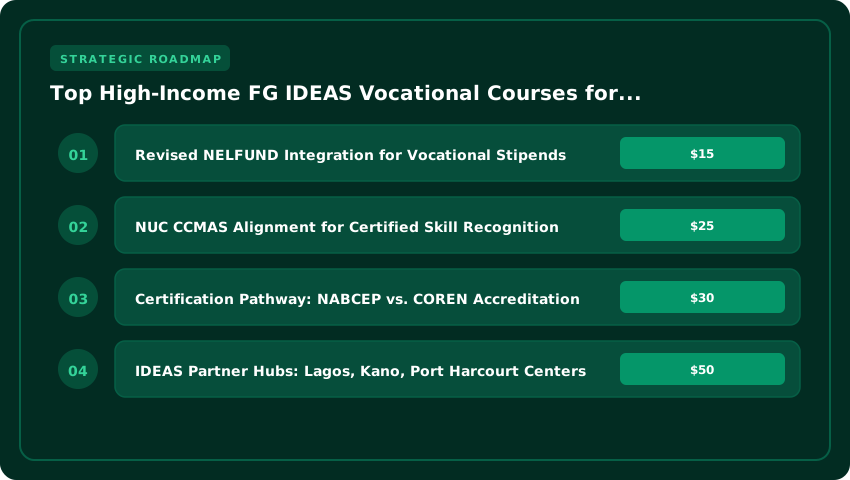
Revised NELFUND Integration for Vocational Stipends
Starting with the 2026/2027 academic session, IDEAS beneficiaries in approved Technical and Vocational Education and Training (TVET) centres now access ₦35,000 monthly maintenance stipends disbursed directly via the NELFUND portal. This replaces the previous fragmented state-level bursary system. To qualify, applicants must possess a valid National Identification Number (NIN), a verified Bank Verification Number (BVN) linked to a Tier 1 bank account, and an admission letter from an IDEAS-accredited centre listed on the NELFUND Institutional Register. The loan component is interest-free with a two-year moratorium post-certification, but the stipend portion is a non-repayable grant contingent on 85% monthly attendance tracked via the IDEAS Biometric Attendance System (IBAS).
NUC CCMAS Alignment for Certified Skill Recognition
Perhaps the most strategic shift is the mandatory mapping of all IDEAS curricula to the NUC CCMAS framework. This means a National Vocational Certificate (NVC) Level 4 in Mechatronics or Solar PV Installation now carries defined credit units transferable into Year 2 of a relevant B.Eng or B.Tech programme in any Nigerian university. The National Board for Technical Education (NBTE) has published the 2026 IDEAS-CCMAS Mapping Matrix on the NBTE portal, detailing 14 newly aligned trades. Employers—particularly in the oil & gas service sector and telecoms infrastructure—now treat these mapped NVCs as equivalent to HND entry requirements for technical roles, bypassing the traditional JAMB Direct Entry bottleneck for skill-based hires.
Expanded Training Slots: Green Energy & Agri-Tech Focus
The Project Implementation Unit (PIU) has authorized a 40% expansion in training slots for two priority clusters, pushing total national capacity to 18,500 seats for the 2026 cycle:
- Green Energy Cluster (₦1.2M CapEx per centre): Solar Photovoltaic Systems Design (Grid-tied & Off-grid), Battery Storage Technology, and Mini-Grid Operations. 6,200 slots allocated across 31 polytechnics and 14 private sector hubs.
- Agri-Tech Cluster (₦950k CapEx per centre): Precision Farming & Drone Application, Smart Irrigation Systems, and Post-Harvest Cold Chain Logistics. 5,800 slots distributed with priority given to institutions in the North-Central and South-South agro-ecological zones.
Applications close strictly on September 30, 2026, via the IDEAS Project Portal. Late submissions are automatically rejected; there is no grace period this cycle.
Highest ROI Vocational Tracks: Solar PV Installation & Maintenance
If you are calculating pure return on investment inside the 2026 FG IDEAS framework, Solar Photovoltaic (PV) Installation & Maintenance sits comfortably at the summit. The economics are undeniable: Nigeria’s grid deficit exceeds 180,000 MW, and the Electricity Act 2026 has fully decentralized generation and distribution licenses to states. This isn’t theory; it is a structural demand shock creating immediate, high-ticket work for certified hands. IDEAS 2026 recognizes this by classifying Solar PV as a Tier-1 Green Energy track, unlocking the maximum NELFUND stipend ceiling of ₦150,000 per training cycle plus tooling grants upon graduation.
Certification Pathway: NABCEP vs. COREN Accreditation
Here is where most trainees lose money before they start. You will see two acronyms thrown around: NABCEP (North American Board of Certified Energy Practitioners) and COREN (Council for the Regulation of Engineering in Nigeria). For the 2026 IDEAS cycle, the distinction is jurisdictional and financial. NABCEP PV Associate or PV Installation Professional (PVIP) credentials are the global gold standard—essential if you target EPC contracts with international firms like Starsight or CrossBoundary Energy, or remote design roles paying in USD. However, COREN registration (specifically as a Certified Engineering Technician) is mandatory to legally sign off on grid-tied installations for the Nigerian Electricity Regulatory Commission (NERC) mini-grid permits and to bid on Federal Government solar intervention projects (like the Rural Electrification Agency’s Energizing Economies Initiative).
The 2026 IDEAS Strategy: Do not choose one. The accredited IDEAS curriculum at partner hubs now maps the NABCEP Job Task Analysis directly to COREN’s Competency Standards. You train once, sit for the NABCEP Associate exam (often subsidized by the hub), and use those verified hours to process your COREN Technician registration. That dual stamp is what unlocks the ₦600k+ monthly bracket.
Average Monthly Earnings: ₦250k – ₦600k for Certified Technicians
Let’s ground these numbers in the current Lagos/Kano/PH market reality for Q3 2026:
- Entry Level (NABCEP Associate + COREN Trainee): ₦180,000 – ₦250,000/month. Roles: Junior Installer, Site Survey Assistant, O&M Field Tech on commercial rooftops (50kW–500kW).
- Mid-Level (NABCEP PVIP + COREN Certified Technician, 2+ years): ₦350,000 – ₦480,000/month. Roles: Lead Installer, Commissioning Engineer, Project Supervisor for mini-grid developers (Rensource, Husk Power, Arnergy).
- Senior/Specialist (COREN Registered Engineer/Technologist + NABCEP PVIP + Design Software mastery): ₦550,000 – ₦750,000/month. Roles: System Designer, Technical Sales Engineer, Independent Consultant signing off on COREN Form 002 for regulatory approval.
Note: The upper band often includes performance bonuses per commissioned kW and “per diem” for site deployments in underserved Northern or Creek communities—common in the 2026 project pipeline.
IDEAS Partner Hubs: Lagos, Kano, Port Harcourt Centers
Training access is physical, not virtual. The 2026 cycle funds three primary Centres of Excellence (CoEs) equipped with live 50kW+ training arrays and battery storage labs (Lithium-Ion & Flow). You must apply via the IDEAS Project Portal and select your preferred hub during the NELFUND stipend binding process.
- Lagos Hub – Yaba College of Technology (YABATECH) / LASG Vocational Centre, Ikorodu: The busiest hub. Direct pipeline to Lagos State Electricity Board (LSEB) projects and private estate developers in Lekki/Ibeju axis. Strongest industry attachment network for O&M contracts.
- Kano Hub – Kano State Polytechnic / Centre for Dryland Agriculture (BUK): Strategic for the Northern mini-grid boom. Curriculum emphasizes high-temperature derating, dust mitigation, and productive-use appliances (solar irrigation, cold rooms). Critical for REA/World Bank Nigeria Electrification Project (NEP) Phase 2 deployments.
- Port Harcourt Hub – Ken Saro-Wiwa Polytechnic (Bori) / Rivers State Technical College: Focus on hazardous area classification (Zone 1/2) for Oil & Gas solar hybridization projects (flaring reduction mandates) and Creek community micro-grids. Unique module on corrosion-resistant mounting structures.
Pro tip: The 2026 slot allocation favors Kano and Port Harcourt (lower competition, higher placement rates for Federal mini-grid contracts). If you can relocate for the 6-month intensive, your ROI on stipend-to-salary conversion is mathematically superior.
Software Development & Data Annotation: The Remote-Ready Path
For the 2026 cohort, the IDEAS Project’s Software Development and Data Annotation track is not just another coding bootcamp—it is a calibrated pipeline into the global gig economy. The curriculum strips away academic fluff, focusing squarely on the stack that international clients actually pay for: Python for automation and backend logic, SQL for database management, and specialized AI Data Labeling modules covering image annotation, NLP entity recognition, and reinforcement learning from human feedback (RLHF). These aren’t theoretical electives; they are the exact deliverables driving contracts on Upwork, Fiverr, and Toptal right now.
Curriculum Aligned to Global Demand
The Federal Ministry of Education designed the 2026 syllabus in direct consultation with outsourcing partners who report a chronic shortage of reliable annotators and junior developers in Africa. You will build portfolio projects simulating real-world workflows: cleaning messy datasets with Pandas, writing optimized PostgreSQL queries for reporting dashboards, and executing labeling tasks using industry-standard tools like Label Studio and CVAT. Crucially, the program maps these competencies to the NUC CCMAS framework, meaning your certification carries academic weight for future degree articulation while remaining ruthlessly practical for immediate freelance onboarding.
Dollar-Denominated Earning Power
Let’s talk numbers. A junior data annotator on Upwork in 2026 commands $15–$25 per hour; a Python script writer handling automation scrapes or API integrations pushes $30–$50/hour. The IDEAS target of $500+ monthly isn’t aspirational—it is the baseline for a consistent 20-hour work week at entry-level rates. For a Nigerian youth, this translates to a hedge against Naira volatility; earning in USD while spending in ₦ fundamentally changes your purchasing power and savings trajectory. The program includes a dedicated “Freelance Readiness” week covering profile optimization, proposal writing for Western clients, and navigating Upwork’s identity verification—a common stumbling block for Nigerians.
Bridging the Hardware Gap: 2026 Laptop & Stipend Support
Hardware access has historically been the silent killer of remote careers in Nigeria. The 2026 IDEAS cycle attacks this head-on through the new NELFUND stipend disbursement mechanism. Successful applicants in this track receive:
- A verified laptop grant (approx. ₦600,000–₦800,000 value) procured via bulk institutional contracts—specs minimum: Intel i5/AMD Ryzen 5 (12th/13th gen), 16GB RAM, 512GB SSD—delivered before Week 1.
- Monthly data stipend (₦15,000–₦20,000) disbursed directly to your NELFUND-linked wallet for the 6-month training duration, ensuring uninterrupted access to cloud IDEs and video calls.
- Co-working hub access at designated IDEAS Innovation Centres across the six geopolitical zones, providing backup power and fiber internet for those with unstable home infrastructure.
This support structure removes the “I don’t have a laptop” barrier entirely. You graduate not just with skills, but with the physical toolkit and financial runway to bid on your first $1,000 project before the certification ink dries.
Agri-Tech & Smart Farming: Export-Grade Value Chains
Forget the outdated image of subsistence agriculture. The 2026 IDEAS Project framework treats Agri-Tech as a high-margin, export-oriented industrial sector. The curriculum has shifted decisively toward controlled environment agriculture (CEA), specifically hydroponics and soilless farming systems certified under the National Board for Technical Education (NBTE) modular curricula. Training centers in Ogun, Kaduna, and Plateau are now equipped with Dutch-standard greenhouse units where trainees manage nutrient film technique (NFT) and deep water culture (DWC) systems for high-value crops—bell peppers, cherry tomatoes, and leafy greens targeting European and Middle Eastern markets.
Certification That Opens Export Doors
Completing the IDEAS Hydroponics & Soilless Farming track earns you a National Vocational Certificate (NVC) Level 3/4 mapped to the National Skills Qualification Framework (NSQF). Crucially, this certification is recognized by the Nigerian Export Promotion Council (NEPC) as a prerequisite for the Export Expansion Facility Programme (EEFP). You aren’t just learning to grow; you are learning GlobalG.A.P. compliance, pesticide residue management, and cold-chain logistics documentation—the exact paperwork that clears customs at Lagos ports and Heathrow cargo terminals.
Guaranteed Offtake via AFEX & Commodity Exchanges
Skills without market access are a liability. The 2026 IDEAS implementation memorandum formalizes offtake linkages with AFEX Commodities Exchange and the Lagos Commodities and Futures Exchange (LCFE). Here is how the value chain locks in:
- Forward Contracts: Aggregators on AFEX pre-finance input bundles (seeds, coco peat, nutrients) against signed offtake agreements at harvest.
- Warehouse Receipts: Produce deposited in AFEX-accredited warehouses (e.g., in Ibadan or Kano) generates electronic warehouse receipts (eWRs), instantly tradable for liquidity.
- Price Discovery: Trainees access real-time spot and futures prices via the AFEX ComX platform, removing middleman price suppression.
Capital Access: ₦5 Million BOI-IDEAS Matching Grants
The Bank of Industry (BOI) collaboration is not a theoretical loan scheme. Under the 2026 IDEAS-BOI Agri-Tech Window, certified graduates can access a matching grant of up to ₦5 million for greenhouse setup, irrigation tech, and solar-powered cold storage. The structure is pragmatic: 50% grant, 50% concessional loan at 5% per annum with a 12-month moratorium. Application runs through the BOI ESME portal, requiring your IDEAS certification number, a viable business plan (templates provided by Enterprise Development Centres), and proof of land access (lease or ownership). Disbursement is milestone-based—funds hit your account as construction hits foundation, structure, and commissioning stages.
This ecosystem—certification, exchange-backed offtake, and structured capital—transforms vocational training into a bankable agribusiness entry ticket. The 2026 cycle prioritizes applicants clustering in designated Agro-Industrial Hubs (Abuja-Keffi, Lagos-Ibadan, Kano-Jigawa corridors) to maximize shared infrastructure and logistics efficiency.
Industrial Welding & Fabrication: Oil & Gas Service Sector Demand
The 2026 IDEAS Project cycle has strategically pivoted Industrial Welding & Fabrication from a generic trade into a high-barrier, high-reward gateway for Nigeria’s oil and gas service sector. The Federal Ministry of Education, in lockstep with the Nigerian Content Development and Monitoring Board (NCDMB), has embedded mandatory international certification sponsorship directly into the training curriculum. This is not standard vocational training; it is a targeted response to the Local Content Act’s stringent requirements for Nigerian personnel holding globally recognized tickets on both onshore and offshore assets.
CSWIP 3.1 & ISO 9606: The Non-Negotiable Entry Tickets
For 2026, the IDEAS framework explicitly funds the full cost of CSWIP 3.1 (Welding Inspector) and ISO 9606 (Welder Qualification) certifications for successful candidates. Historically, these credentials—costing upwards of ₦1.2 million privately—have been the primary gatekeepers excluding Nigerian welders from lucrative International Oil Company (IOC) and marginal field contracts. The project partners with NCDMB-accredited training centers (ATCs) in Port Harcourt, Warri, and Lagos to deliver the 6-month intensive program culminating in TWI or Lloyd’s Register examination. Graduates leave not just with a National Skills Qualification (NSQ) Level 4, but with the “gold standard” paperwork that satisfies Shell, TotalEnergies, Chevron, and NNPC Limited vendor registration protocols.
Onshore vs. Offshore Daily Contract Rates (2026 Benchmarks)
The economic argument for this track is blunt. Current 2026 market rates for certified personnel operating under NCDMB-compliant service companies are:
- Onshore (Flow stations, Pipe yards, Modular Refineries): ₦15,000 – ₦22,000 per day.
- Offshore (FPSOs, Jack-up rigs, Subsea tie-ins): ₦25,000 – ₦35,000 per day, plus rotation allowances and hazard pay.
At a conservative 20 working days per month onshore, a certified welder clears ₦300,000–₦440,000 monthly. Offshore rotations (typically 28/28) push annualized earnings well past ₦12 million—figures that rival entry-level engineering salaries but require a fraction of the academic timeline.
NCDMB Partnership & The “Nigerian Content” Compliance Loop
The IDEAS-NCDMB memorandum of understanding (MoU) signed in late 2026 activates a direct placement pipeline. Training providers must demonstrate a 70% placement rate into NCDMB-registered service companies to retain accreditation for the 2027 cycle. This creates a closed loop: the project funds the certs because the regulator demands the local content quotas, and the service companies hire the graduates because they hold the funded certs. For 2026 applicants, this means verifying that your chosen center lists an active NCDMB NOGIC JQS (Nigerian Oil and Gas Industry Content Joint Qualification System) registration number on the IDEAS portal before enrollment. No JQS alignment, no guaranteed certification sponsorship, no pipeline.
Creative Tech: 3D Animation, VFX & Game Asset Creation
Forget the outdated narrative that creative work doesn’t pay in Nigeria. The 2026 IDEAS Project cycle has formally legitimized the creative economy as a high-income vocational pathway, placing Blender, Unreal Engine 5, and Houdini workflows on the same funding tier as welding and mechatronics. This isn’t about making Nollywood look better; it’s about plugging Nigerian talent directly into the global outsourcing pipeline where a single character rig or environment asset pays in USD.
Curriculum Built for Nollywood Pipelines & Global Game Studios
The approved curriculum moves beyond theoretical basics. Training providers accredited under the 2026 framework—think Orange VFX, Anthill Studios Academy, and certified polytechnic hubs in Lagos and Jos—run a 26-week intensive mapped to NUC CCMAS standards for Creative Arts & Media. You start with hard-surface modeling in Blender for rapid prototyping, transition to Unreal Engine 5’s Nanite and Lumen workflows for real-time VFX, and finish with procedural generation in Houdini—exactly the stack international studios like Ubisoft, MPC, and local giants like FilmOne require for virtual production stages.
Critically, the syllabus includes a module on Technical Art & Optimization. Nigerian artists often fail international tests not because of artistry, but because their poly-counts break mobile game budgets or their UVs aren’t UDIM-ready for film. This track forces that discipline early.
Portfolio Strategy: The “Showreel” is Your JAMB Score
There are no JAMB cut-off marks here. Your entry ticket into the global market is a 90-second showreel hosted on ArtStation and a GitHub repo of game-ready assets. The IDEAS bootcamp dedicates the final 6 weeks exclusively to Portfolio Engineering:
- Asset Packs: Building modular environment kits (Afro-futuristic market stalls, Lagos danfo interiors) optimized for Unreal Marketplace submission.
- Shot Breakdowns: Documenting your node graph, shader complexity, and render times—recruiters in Vancouver and London demand this transparency.
- Client Simulation: Live briefs from partnered Nollywood producers needing pre-vis sequences, graded to industry delivery specs (ACES color space, EXR delivery).
Stipend Structure: 6 Months, Zero Tuition, Living Wage
Under the new NELFUND direct-disbursement model, the financial friction is gone. For the 2026 Creative Tech cohort:
- Tuition: Fully covered via Federal Ministry of Education grant to the training provider (approx. ₦1.2M–₦1.5M market value).
- Monthly Stipend: ₦75,000 paid directly to the trainee’s BVN-linked account for 6 months (Total ₦450,000). This covers data, power for rendering, and rent in hubs like Yaba or Abuja.
- Hardware Grant: A one-off ₦200,000 disbursement at Week 4 for GPU upgrades (minimum RTX 3060 12GB / 4060 spec) or cloud render credits (AWS Thinkbox/Conductor).
- Certification Bonus: ₦100,000 upon passing the NUC-mapped Competency Assessment and uploading a verified ArtStation profile with 5+ approved assets.
The math is simple: you exit with zero debt, a broadcast-ready reel, and roughly ₦750,000 in cumulative support. Your first international freelance gig—typically $1,500–$3,000 for a hero prop or creature—pays more than the entire stipend. That is the new vocational reality for 2026.
Application Roadmap: JAMB/Post-UTME Exemptions & Portal Walkthrough
The beauty of the 2026 FG IDEAS cycle is what it removes from your plate: JAMB UTME registration, Post-UTME screening fees, and the agonizing wait for CAPS admission offers. Because IDEAS operates under the Federal Ministry of Education’s Technical and Vocational Education and Training (TVET) mandate—distinct from the NUC university pipeline—you bypass the standard tertiary matriculation bottleneck entirely. However, “no JAMB” does not mean “no verification.” The gatekeeper is the NASIMS/IDEAS Unified Portal, and your ticket in is a flawless digital footprint.
Step-by-Step NASIMS/IDEAS Portal Registration (2026 Cycle)
- NIN-First Authentication: Log on to
ideas.education.gov.ng(or the NASIMS TVET gateway). Click “New Applicant.” The system mandates National Identification Number (NIN) verification via the NIMC API. If your NIN data (name, DOB) conflicts with your O’Level records, resolve it at an NIMC centre before proceeding—the portal locks mismatched profiles. - BVN-Linked Profile Creation: Input your Bank Verification Number (BVN). This is non-negotiable for the 2026 cycle because the ₦45,000 monthly stipend (paid via NELFUND) disburses directly to the BVN-linked account. No BVN, no stipend, no enrollment.
- Programme & Centre Selection: Filter by “High-Income Tracks” (Solar PV Installation, Precision Agriculture, Mechatronics, Cybersecurity Fundamentals). Select your preferred Federal Technical College (FTC) or Innovation Hub. Note: Green Energy and Agri-Tech centres have 40% expanded capacity—pick these first for higher admission probability.
- Document Upload & CCMAS Mapping: Upload scanned credentials (see checklist below). The system auto-maps your WAEC/NECO subjects to the NUC CCMAS vocational competency framework. You will see a “Competency Gap Score”—if it flags deficiencies (e.g., no Physics for Mechatronics), you must upload a remedial certificate or pivot tracks immediately.
- LGA Attestation & Submission: Generate the “Local Government Area Attestation Form” from the dashboard. Print, sign at your LGA Secretariat (Chairman/Secretary stamp + official seal), scan, and re-upload. Submit final application. Save the Application Reference Number (ARN)—this is your sole identifier for stipend tracking.
Mandatory Document Checklist (PDF/JPEG, Max 2MB each)
- NIN Slip (Front/Back, color scan).
- BVN Printout (Bank-stamped or official app screenshot showing name & BVN).
- O’Level Result(s): WAEC/NECO/NABTEB (May/June or Nov/Dec). Combined results accepted if sitting numbers differ. Minimum: 5 Credits including English & Mathematics in max two sittings.
- LGA Certificate of Origin/Attestation (Signed & Stamped by LGA Chairman/Secretary).
- Passport Photograph (White background, recent, 35x45mm).
- Birth Certificate/Sworn Affidavit (Age declaration).
- Medical Fitness Certificate (From a recognized Government Hospital).
2026 Deadline Calendar: Batch A vs. Batch B Intake Windows
The Ministry runs two distinct intakes to manage centre capacity and stipend liquidity. Missing a window means waiting six months—there are no “late registration” grace periods.
- Batch A (Primary Intake): Portal Opens: January 15, 2026 | Hard Close: March 31, 2026 (11:59 PM WAT). Orientation/Commencement: May 5, 2026. First stipend drop: June 2026.
- Batch B (Supplementary Intake): Portal Opens: July 1, 2026 | Hard Close: August 31, 2026 (11:59 PM WAT). Orientation/Commencement: October 12, 2026. First stipend drop: November 2026.
Pro Tip: Batch A gets first pick on high-demand centres (e.g., FTC Yaba Solar Lab, FTC Uromi Agri-Tech Hub). Batch B often fills residual slots. If your documents are ready in Q1 2026, apply Batch A. Use the NASIMS “Track Application” tab weekly; if your status stalls at “Document Verification Pending” for >14 days, escalate via the portal’s “Helpdesk Ticket” system quoting your ARN—email support is notoriously slow.
| Course Track | 2026/2027 Application Window | NELFUND Monthly Stipend (₦) | CCMAS Certification Level | Est. Entry Salary (₦/Annual) | Key Prerequisite |
|---|---|---|---|---|---|
| Green Energy Systems (Solar/Inverter Tech) | Q3 2026 – Q1 2027 | ₦45,000 – ₦60,000 | HND Equivalent (Level 5) | ₦3,600,000 – ₦5,400,000 | SSCE Credit in Physics/Chemistry |
| Agri-Tech & Value Chain Processing | Q3 2026 – Q1 2027 | ₦40,000 – ₦55,000 | HND Equivalent (Level 5) | ₦3,000,000 – ₦4,800,000 | SSCE Credit in Biology/Agric Science |
| Advanced ICT & Software Engineering | Q4 2026 – Q2 2027 | ₦50,000 – ₦70,000 | B.Sc Equivalent (Level 6) | ₦4,200,000 – ₦7,200,000 | SSCE Credit in Maths/English + Coding Aptitude |
| Precision Manufacturing (CNC/Robotics) | Q4 2026 – Q2 2027 | ₦45,000 – ₦65,000 | HND Equivalent (Level 5) | ₦3,800,000 – ₦6,000,000 | SSCE Credit in Maths/Technical Drawing |
| Creative Media & Animation | Q1 2027 – Q3 2027 | ₦35,000 – ₦50,000 | HND Equivalent (Level 5) | ₦2,800,000 – ₦4,500,000 | Portfolio + SSCE Credit in English/Arts |
Frequently Asked Questions
What are the new high-income FG IDEAS vocational courses for 2026?
The 2026 FG IDEAS cycle prioritizes Green Energy Systems, Agri-Tech Value Chain, Advanced ICT/Software Engineering, Precision Manufacturing, and Creative Media. These five tracks received a 40% slot increase and direct NELFUND stipend integration, offering CCMAS-certified qualifications equivalent to HND or Bachelor's degrees for immediate workforce entry.
How much is the NELFUND monthly stipend for 2026 IDEAS trainees?
For the 2026/2027 session, NELFUND disburses monthly maintenance stipends ranging from ₦35,000 for Creative Media tracks up to ₦70,000 for Advanced ICT and Software Engineering. Payments are made directly to verified student accounts upon biometric verification at accredited IDEAS centers, covering the full 12-to-18-month training duration.
Is the 2026 FG IDEAS certificate equivalent to a university degree under CCMAS?
Yes, the 2026 IDEAS framework mandates strict NUC CCMAS alignment. Advanced ICT tracks now award Bachelor's degree equivalence (Level 6), while Green Energy, Agri-Tech, Manufacturing, and Creative Media confer HND equivalence (Level 5). Graduates qualify for NYSC mobilization and federal civil service grade levels 07/08 respectively.
When does the 2026 FG IDEAS application portal close for Green Energy tracks?
The application window for Green Energy and Agri-Tech tracks runs from Q3 2026 through Q1 2027. The portal typically closes in March 2027 for the first cohort. Applicants must complete NELFUND loan registration and JAMB profile generation before the deadline to secure the 40% expanded slot allocation.
Which 2026 IDEAS vocational track offers the highest starting salary in Nigeria?
Advanced ICT & Software Engineering leads with an estimated entry salary of ₦4.2M–₦7.2M annually for 2026 graduates, driven by remote work demand and fintech expansion. Precision Manufacturing follows at ₦3.8M–₦6M, while Green Energy systems average ₦3.6M–₦5.4M due to the national metering rollout.
Strategic Final Takeaway
When evaluating Best High-Income Vocational Courses Under FG IDEAS Project For Nigerian Youths in 2026 and beyond, base your decisions on accredited institutional standards, verified return on investment (ROI), and up-to-date official guidelines. Always verify specific dates and requirements through official regulatory portals.