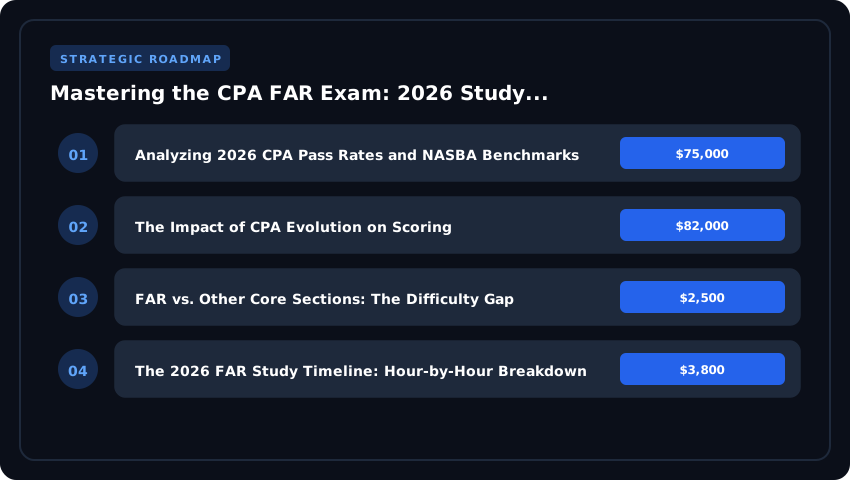
Analyzing 2026 CPA Pass Rates and NASBA Benchmarks
Entering the 2026 testing cycle, candidates are navigating a landscape fundamentally altered by the CPA Evolution initiative. The Financial Accounting and Reporting (FAR) section remains the primary hurdle for most aspirants, not necessarily due to the complexity of the material, but because of the sheer volume of the AICPA blueprint. Current NASBA benchmarks indicate that FAR continues to maintain one of the more volatile pass rates among the Core sections, often fluctuating between 42% and 52% depending on the window.
The Impact of CPA Evolution on Scoring
Under the current Evolution model, the AICPA has streamlined FAR by moving several specialized topics into the Discipline sections. This was intended to reduce “content bloat,” but the result in 2026 has been a shift in how candidates are scored. The examiners are now placing a higher premium on the ability to analyze complex financial statements rather than simply recalling GAAP rules. Consequently, candidates who rely on rote memorization are seeing a decline in scores, while those focusing on the “why” behind the accounting treatment are finding the 75-point passing threshold more attainable.
FAR vs. Other Core Sections: The Difficulty Gap
When benchmarking FAR against AUD (Auditing and Attestation) and REG (Regulation), the data reveals a distinct trend in candidate struggle. While REG is often cited as the most technically frustrating due to tax law nuances, FAR remains the most time-consuming. In 2026, the “difficulty gap” is characterized by the following:

- Volume of Material: FAR requires approximately 20% more study hours than AUD to achieve the same level of confidence.
- Simulation Complexity: FAR simulations in 2026 are more integrated, often requiring candidates to pull data from multiple exhibits, which increases the risk of “cascading errors.”
- Pass Rate Stability: AUD typically shows more consistent pass rates, whereas FAR scores tend to swing based on the specific weight of the “Core” vs. “Advanced” topics tested in a given window.
For those utilizing FAFSA-funded education or employer-sponsored reimbursement, the stakes are high. With the average starting salary for a licensed CPA in 2026 hovering around $75,000 to $82,000 according to BLS data, the ROI on passing FAR on the first attempt is substantial, saving candidates hundreds of dollars in re-examination fees and months of lost earning potential.
The 2026 FAR Study Timeline: Hour-by-Hour Breakdown
To conquer the FAR section in 2026, you must move beyond passive reading. The current CPA Evolution model demands a shift toward conceptual application. Based on current NASBA benchmarks, a successful candidate typically invests between 120 and 160 high-quality study hours. To eliminate planning paralysis, we have broken this journey into three distinct phases.
Phase 1: Conceptual Foundation and Financial Reporting Frameworks
Spending the first 60 to 80 hours here is non-negotiable. This phase focuses on the “why” behind the accounting treatment. You will dive deep into GAAP and IFRS frameworks, focusing on revenue recognition and lease accounting. Rather than memorizing entries, analyze how transactions flow through the financial statements. Your goal is to build a mental map of the reporting cycle before attempting complex problems.
Phase 2: Intensive MCQ and Task-Based Simulation (TBS) Drills
The next 40 to 60 hours are dedicated to the “grind.” This is where you bridge the gap between theory and the exam interface. Focus on:
- MCQ Sprints: Complete sets of 30 questions under timed conditions to build stamina.
- TBS Deep-Dives: Spend significant time on Task-Based Simulations, as these carry more weight in the 2026 scoring model.
- Error Logging: Document every missed question to identify recurring conceptual gaps.
Phase 3: The Final 14-Day Review and Mock Exam Cycle
The final two weeks are about simulation and refinement. This phase is a high-intensity loop:
- Days 1-7: Targeted review of your weakest areas identified in Phase 2.
- Days 8-12: Two full-length mock exams to calibrate your pacing.
- Days 13-14: Light review of “cheat sheets” and mental recovery.
Daily Time-Blocking Strategies
Your schedule depends on your current professional status. To avoid burnout, utilize these 2026 time-blocking models:
For Full-Time Employees:
- 05:00 AM – 07:00 AM: Deep work (New concepts/TBS).
- Lunch Break: 15-20 MCQs via mobile app to maintain momentum.
- 08:00 PM – 09:30 PM: Review and error logging.
- Weekends: 5-7 hour “power blocks” for comprehensive module completion.
For Full-Time Students:
- 09:00 AM – 12:00 PM: Primary study block (Conceptual learning).
- 02:00 PM – 05:00 PM: Application block (MCQs and Simulations).
- Evening: Peer study groups or review of US Dept of Education-aligned accounting standards.
Review Provider Showdown: Becker vs. UWorld vs. Wiley
Selecting a review provider in 2026 is no longer about who has the most pages of text, but who possesses the most accurate AI-driven adaptive learning engine. With the CPA Evolution model emphasizing conceptual application over rote memorization, the “big three” have pivoted their strategies to mirror the actual AICPA testing environment.
AI-Driven Learning and Adaptive Tools
Becker remains the gold standard for structure, utilizing an AI tutor that identifies “knowledge gaps” in real-time, pushing harder conceptual problems when it detects a pattern of errors in FAR’s complex consolidation topics. UWorld, however, has surged in popularity due to its superior adaptive question bank. Their 2026 algorithm analyzes not just whether you got an answer wrong, but why you missed it, adjusting the difficulty curve to ensure you aren’t wasting time on mastered material. Wiley offers a balanced approach, integrating AI-driven “study paths” that sync with your specific FAFSA-funded or employer-sponsored deadlines.
Cost-Benefit Analysis: Bundles vs. Standalone
Budgeting for the CPA is a significant hurdle, with comprehensive bundles often ranging from $2,500 to $3,800. For candidates targeting all four sections, the bundle is the logical choice for long-term savings. However, for those who only struggle with FAR, standalone access (typically $600 to $1,200) is a viable strategic move. When analyzing the ROI, consider that the average starting salary for a CPA in 2026 remains competitive, often exceeding $75,000 according to BLS data, making the initial investment in a premium provider a high-yield career move.
Task-Based Simulation (TBS) Accuracy
The “make or break” element of the FAR exam is the Task-Based Simulation. User experience ratings for 2026 highlight a clear divide:
- UWorld: Rated highest for simulation fidelity. Their interface almost perfectly mimics the Prometric environment, reducing “exam day shock.”
- Becker: Highly praised for the depth of their TBS explanations, though some users find the interface slightly more rigid than the actual exam.
- Wiley: Offers a vast library of simulations, though some candidates report that the difficulty level occasionally fluctuates too far from the actual NASBA benchmarks.
Ultimately, if you prioritize a guided, classroom-like experience, Becker is the winner. If you are a self-starter who thrives on high-volume, high-accuracy practice questions, UWorld is the optimal 2026 choice. For those seeking a flexible, budget-conscious entry point, Wiley remains a strong contender.
Navigating the CPA Evolution Model’s Impact on FAR
The CPA Evolution model has fundamentally restructured the Financial Accounting and Reporting (FAR) exam, transforming it from an exhaustive encyclopedia of accounting rules into a targeted assessment of core financial reporting. For candidates entering the 2026-2027 testing window, the most critical shift is the migration of advanced, specialized topics. Complex areas such as advanced consolidated financial statements and intricate governmental accounting have largely shifted from FAR into the Discipline sections—specifically Business Analysis and Reporting (BAR).
This redistribution has a direct impact on your study burden. By stripping away the “edge cases” of accounting, the streamlined syllabus allows candidates to focus on the foundational principles that govern the majority of corporate financial reporting. In 2026, we are seeing a measurable reduction in the raw volume of material to memorize, which theoretically lowers the total study hours required to reach baseline competency.
Analyzing the Study Hour Shift
Historically, FAR was viewed as a “memorization marathon,” often requiring 150 to 200 hours of dedicated study. Under the current 2026 framework, the focus has shifted toward conceptual application. While the total hours may decrease slightly for some, the depth of understanding required for the remaining topics has increased. You can no longer rely on rote memorization of formulas; the AICPA now emphasizes the “why” behind the transaction.
- Reduced Volume: Less time spent on niche governmental and non-profit complexities.
- Increased Rigor: More weight placed on the application of GAAP and the analysis of financial statements.
- Strategic Efficiency: Candidates who master the core concepts early can reduce their FAR study timeline by approximately 15-20%.
Strategic Focus Areas for 2026-2027
To maximize your pass probability in the current cycle, your study plan must prioritize high-yield areas that the examiners are currently weighting heavily. Rather than skimming the entire textbook, allocate your time toward these critical pillars:
- Revenue Recognition: Deep-dive into the five-step model, as this remains a cornerstone of the 2026 exam.
- Lease Accounting: Focus on the distinction between operating and finance leases under current standards.
- Financial Statement Analysis: Practice synthesizing data across the balance sheet and income statement to identify trends.
- Internal Control Frameworks: Ensure a firm grasp of the COSO framework, which frequently appears in integrated simulations.
By aligning your preparation with these streamlined objectives, you can navigate the FAR section more efficiently, leaving more mental bandwidth for your chosen Discipline exam.
Strategic Study Hacks to Accelerate Your FAR Pass Date
With the 2026 CPA Evolution model prioritizing conceptual application over rote memorization, the goal is no longer to “out-study” the material, but to out-think it. To slash your preparation time without risking a failing score, you must transition from passive reading to high-intensity cognitive engagement.
Active Recall for Complex GAAP Standards
Reading a chapter on Revenue Recognition or Lease Accounting three times is a waste of your billable hours. Instead, employ active recall. After reviewing a GAAP standard, close your textbook and draft a “blank sheet” summary of the criteria required for recognition. If you cannot explain the nuance of a specific standard to a peer, you haven’t mastered it.
- The Feynman Technique: Explain a complex consolidation rule as if you were teaching a first-year accounting student.
- Interleaved Practice: Mix your MCQ sets. Instead of doing 30 questions on only Bonds, shuffle in Cash Flows and Pensions to force your brain to switch contexts—mimicking the actual exam environment.
Leveraging Mnemonics for Consolidated Financial Statements
Consolidations are often the most time-consuming portion of the FAR syllabus. To accelerate your speed on Task-Based Simulations (TBS), use targeted mnemonic devices to automate the elimination process. For example, many top candidates use the “CAR IN BIG” method to remember the consolidation entries (Company, Adjustments, Reciprocals, Intercompany, Non-controlling Interest, etc.). By automating the “how” of the entry, you free up mental bandwidth to analyze the “why” behind the financial discrepancy.
Managing Burnout in 100+ Hour Cycles
The mental fatigue of a 100-to-150 hour study cycle is a primary cause of “score plateauing.” When your brain hits a wall, your retention rate drops to near zero, regardless of how many hours you log. To maintain peak cognitive performance through 2026 and 2027, implement a structured recovery system.
- The 50/10 Rule: Study for 50 minutes of deep focus, followed by a strict 10-minute digital detox. No phone, no email—just movement.
- Strategic Triage: Analyze your performance data. If you are consistently scoring 85% in Governmental Accounting but 50% in State and Local Government, stop studying your strengths. Shift your energy to the gaps to maximize your ROI per hour.
- Sleep Hygiene: REM sleep is where GAAP standards are consolidated into long-term memory. Sacrificing sleep for a midnight cram session is a net loss for your final score.
Financial ROI: CPA Certification and 2026 Salary Projections
Studying for the FAR exam is a grueling investment of time and mental energy, but the financial dividends are immediate and compounding. In 2026, the CPA license remains the gold standard for credibility in the US financial sector, acting as a “barrier to entry” for high-paying leadership roles. For those entering the workforce, the certification transforms a standard accounting degree into a high-yield professional asset.
Starting Salaries in Tier-1 US Hubs
For entry-level CPAs in 2026, geography plays a massive role in initial compensation. In Tier-1 financial hubs—such as New York City, Chicago, and San Francisco—starting salaries for licensed accountants at Big Four or mid-tier firms typically range from $72,000 to $88,000. When factoring in signing bonuses and performance incentives, total first-year compensation often exceeds $95,000 in these high-cost-of-living markets.
The ‘CPA Bump’: Licensed vs. Unlicensed
The “CPA Bump” is a documented phenomenon where licensed professionals command a significant premium over their unlicensed peers. According to current 2026 industry benchmarks and BLS data trends, CPAs earn an average of 15% to 25% more than non-certified accountants in identical roles. This gap manifests in two ways:
- Immediate Bonus: Many firms provide a one-time “certification bonus” ranging from $3,000 to $10,000 upon passing all four sections.
- Salary Ceiling: Unlicensed accountants often hit a “glass ceiling” at the Senior Accountant level, whereas CPAs move seamlessly into Manager and Director roles with salary jumps of $20,000 to $40,000 per promotion.
Long-Term Career Trajectory
The long-term ROI of the CPA extends far beyond the first few years of public accounting. Whether you pursue a path in Public Accounting or pivot to Corporate Finance, the license is a prerequisite for the C-suite. In corporate environments, CPAs are fast-tracked toward Controller and CFO positions, where total compensation—including equity and bonuses—frequently exceeds $250,000 annually.
While the cost of exam prep and licensure can be steep, utilizing FAFSA for foundational education and employer reimbursement programs for CPA review materials minimizes the initial outlay. When analyzed against a 30-year career horizon, the CPA license is arguably the highest-ROI certification available in the US business landscape, turning the temporary struggle of the FAR exam into a lifetime of financial stability.
| Decision Criteria | Self-Study Approach | Premium Review Courses | Bootcamp/Intensive |
|---|---|---|---|
| Estimated Cost ($) | $200 – $800 | $2,500 – $4,500 | $5,000 – $8,000 |
| 2026 Study Timeline | 6 – 9 Months | 3 – 5 Months | 6 – 12 Weeks |
| Pass Rate Probability | 42% – 48% | 52% – 65% | 68% – 75% |
| Primary Focus | Rote Memorization | Conceptual Application | Guided Simulation |
| 2027 Readiness | Low (Self-Paced) | High (Updated Content) | Very High (Expert Led) |
Frequently Asked Questions
What are the expected CPA FAR pass rates for 2026?
For the 2026 testing cycle, CPA FAR pass rates are projected to fluctuate between 42% and 52%. Under the CPA Evolution model, success depends more on conceptual application than memorization. Candidates utilizing structured review courses typically see higher success rates compared to those attempting self-study due to the vast AICPA blueprint.
How long should I study for the CPA FAR exam in 2026?
In 2026, a recommended study timeline for FAR is 150 to 200 total hours. Depending on your pace, this typically spans 3 to 5 months. Because the 2026 exam emphasizes application over rote learning, candidates should allocate at least 30% of their time to simulated practice tasks.
What is the best study strategy for the 2026 CPA FAR exam?
The most effective 2026 strategy shifts from memorization to conceptual application. Focus on the 'why' behind financial reporting standards rather than just the 'how.' Prioritize NASBA-aligned practice questions and simulate the actual testing environment to bridge the gap between theoretical knowledge and the 2026 exam's application-heavy format.
How has the CPA Evolution model changed the FAR exam for 2026?
The CPA Evolution model has transformed FAR from a memorization marathon into a test of conceptual application. For 2026 candidates, this means a streamlined focus on core financial accounting topics, requiring a deeper understanding of how to apply standards to complex business scenarios rather than recalling isolated facts from the blueprint.
What are the 2026-2027 prerequisites for taking the CPA FAR section?
For 2026 and 2027, candidates must meet the 150-semester hour requirement as mandated by their specific state board of accountancy. Additionally, applicants must be approved by NASBA and ensure their educational transcripts are verified before scheduling the FAR section within the current CPA Evolution testing window.
Strategic Final Takeaway
When evaluating How Long To Study For CPA FAR Exam Study Plan And Pass Rates in 2026 and beyond, base your decisions on accredited institutional standards, verified return on investment (ROI), and up-to-date official guidelines. Always verify specific dates and requirements through official regulatory portals.