Key Takeaway: For 2026 admission into AI & Data Science programs, your JAMB UTME subject combination must include Mathematics, Physics, and Chemistry or Economics depending on the institution. A score of 200 is no longer a safe threshold aim for 230 and above to stay competitive in CAPS.
2026 JAMB UTME Subject Combination & Cut-Off Benchmarks
If you are targeting AI, Data Science, or any computing-intensive degree in Nigeria for the 2026 admission cycle, getting your JAMB UTME subject combination right from the start is non-negotiable. A wrong subject choice at registration will disqualify you before your results even reach JAMB CAPS. Here is exactly what you need to know.

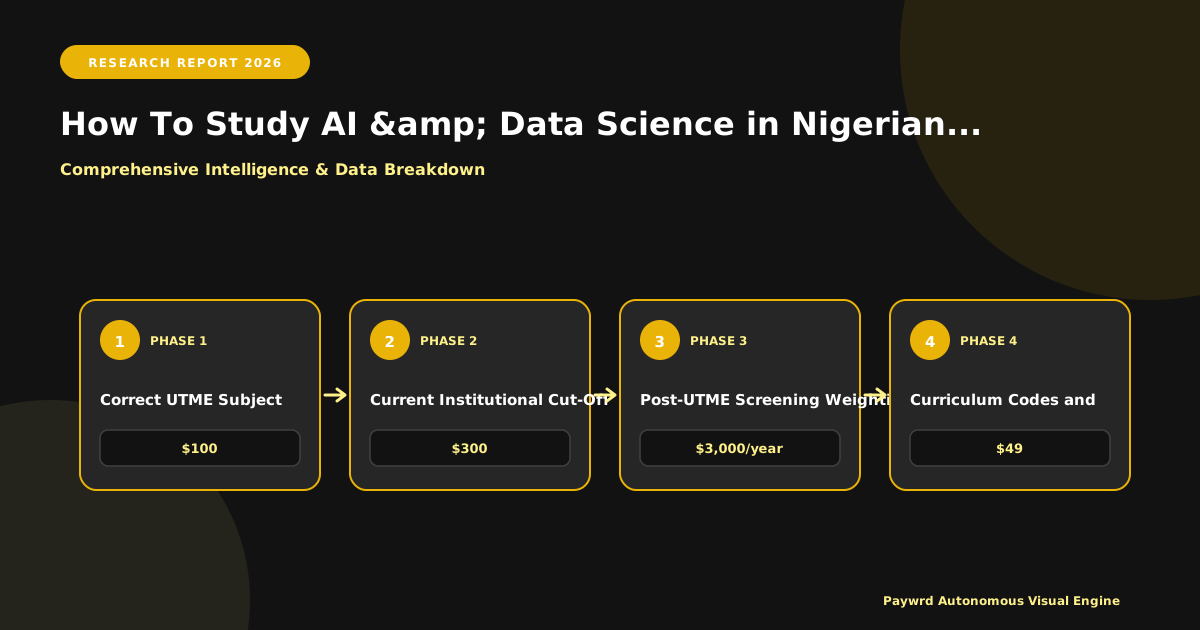
Correct UTME Subject Mix
The standard combination for most AI and Data Science programs across Nigerian universities is as follows: Use of English (compulsory), Mathematics (mandatory), Physics, and Chemistry. This four-subject mix satisfies the requirements for Science and Computing faculties at most top-tier institutions. However, some universities accept Economics in place of Chemistry. Always verify the specific subject requirements on the JAMB CAPS portal or the institution’s official admission page before finalizing your registration.
Do not assume that because a program is tagged “Data Science” it falls under a generic science category. Different faculties interpret subject combinations differently, and institutions like UNILAG and FUTA have historically been strict about Physics being present alongside Mathematics.
Current Institutional Cut-Off Marks
Cut-off marks for 2026 are shaping up to be more competitive than previous cycles. Here are realistic benchmarks:
- UNILAG: The Faculty of Engineering and Faculty of Computing generally require a minimum JAMB score of 230 and above for consideration. Scores below 220 rarely make it past the initial screening stage.
- OAU (Obafemi Awolowo University): For Technology and Computing programs, a minimum of 220 is expected, though successful candidates often score 240 or higher due to intense competition.
- FUTA: Known for its rigorous engineering and tech standards, FUTA typically sets its departmental cut-off at 230 for Computing and related programs, with Post-UTME carrying significant weight.
- Emerging Tech Hubs (e.g., Babcock University, Covenant University): These institutions are raising their benchmarks, with minimum scores now hovering around 210 to 220 for AI-adjacent programs.
Post-UTME Screening Weightings
Your JAMB score alone does not guarantee admission. Post-UTME screening is where many candidates are separated. For Computing faculties, institutions typically weight Post-UTME at 30 to 40 percent of the total admission score, while Engineering faculties may push that weighting to 40 to 50 percent. This means a candidate with a JAMB score of 230 but a poor Post-UTME performance can lose out to someone with a lower JAMB score but a stronger screening result.
Prepare specifically for institution-specific Post-UTME formats. UNILAG uses a computer-based screening test, while FUTA conducts a written examination. Budget time and resources accordingly, as these screenings often cover Mathematics, Physics, and general knowledge at an advanced secondary level.
For 2
NUC-Accredited Programmes: B.Sc. Computer Science vs B.Eng. AI Specialisations
If you are building a career around Artificial Intelligence or Data Science in Nigeria, understanding how the NUC classifies these programmes is the difference between a recognised degree and a costly misapplication. The NUC CCMAS portal lists every accredited programme by curriculum code, and the codes for Data Science, AI, and Cybersecurity are not interchangeable. Before you spend money on JAMB registration, let us break this down properly.
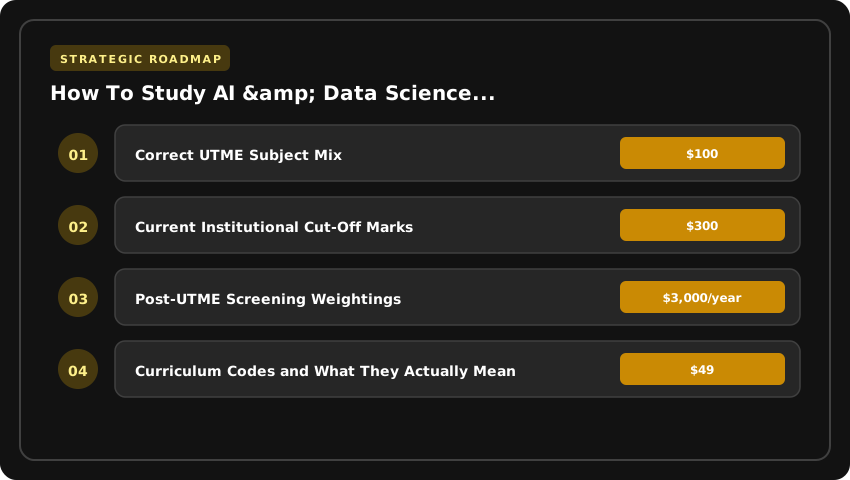
Curriculum Codes and What They Actually Mean
The NUC assigns distinct curriculum codes depending on the faculty housing the programme. A B.Sc. Computer Science programme typically carries a code under the Faculty of Science and covers foundational computing, algorithms, and software development. AI Specialisations, on the other hand, are frequently housed under the Faculty of Engineering as B.Eng. Artificial Intelligence or B.Eng. Computer Engineering with an AI pathway. These engineering-coded programmes include heavy mathematics, circuit theory, and systems design modules that Science-coded programmes do not. Cybersecurity programmes may appear under Science, Engineering, or Information Technology depending on the institution. Always cross-check the exact curriculum code on the NUC CCMAS website before applying, because a programme listed under “Emerging Technologies” without full NUC accreditation is not the same as a properly coded and accredited degree.
Full Accreditation vs Interim Approval for 2026/2027
For the 2026/2027 admission session, several Nigerian universities have received full NUC accreditation for AI and Data Science-adjacent programmes, while others operate on interim approval. Institutions like the University of Lagos, Ahmadu Bello University, and the Federal University of Technology, Minna, have established accredited computing and engineering programmes. However, many newer universities and polytechnics are still running programmes under interim status, meaning their graduates may face registration hurdles with professional bodies. Do not rely on university marketing brochures. Go directly to the NUC CCMAS portal and search by institution name and programme to confirm the current accreditation status for the exact session you are targeting.
Direct Entry Requirements You Must Meet
If you are considering Direct Entry into a B.Sc. Computer Science or B.Eng. AI programme, the standard requirement is an ND or HND at Upper Credit level in a relevant discipline such as Computer Science, Computer Engineering, or Electrical/Electronics Technology from an NBTE-approved institution. Some universities also accept a Lower Credit with additional qualifications, but this varies. For 2026, institutions are increasingly scrutinising whether your ND/HND curriculum aligns with the NUC code of the programme you are entering. A Data Science ND does not automatically qualify you for an AI Engineering B.Eng. programme if the curriculum codes do not match. Verify your ND/HND transcript against the target institution’s DE requirements before applying through JAMB CAPS.
Getting the programme nomenclature and accreditation status right is not paperwork stress. It is the foundation of your entire academic and professional trajectory in Nigeria’s AI space. Take the extra step to verify everything on official portals.
Tuition Economics: Federal vs State vs Private University Cost Analysis (₦)
Understanding the total cost of owning an AI & Data Science degree in Nigeria is the first step toward smart financial planning. The fee gap between federal, state, and private institutions is enormous, and your choice here shapes everything from household savings to post-graduation debt exposure.
2026 Session Fee Schedules: What Families Are Actually Paying
For the 2026 academic session, here is a realistic breakdown of tuition and mandatory charges for AI-related programmes:
- University of Ibadan (UI): Federal tuition sits around ₦280,000 per session for science and technology tracks. Add ₦25,000 for JAMB screening fees and roughly ₦50,000 in departmental and library charges, bringing the real figure closer to ₦355,000.
- University of Nigeria Nsukka (UNN): Similar federal pricing, with tuition near ₦300,000. UNN charges an additional ₦15,000 faculty levy, so budget approximately ₦370,000 all-in.
- Covenant University: As a private institution, Covenant charges between ₦2,800,000 and ₦3,200,000 per session for computing and engineering programmes. This includes most amenities but excludes accommodation and tech-specific costs.
- Pan-Atlantic University: Tuition ranges from ₦1,800,000 to ₦2,200,000 for data science and related courses. Pan-Atlantic’s smaller class sizes and industry-linked curriculum justify the premium, but it remains a significant household commitment.
NELFUND: Financing Your STEM Degree
NELFUND student loans are a game-changer for families targeting high-ROI tech degrees. To qualify for the 2026 cycle through the NELFUND portal, applicants must have gained admission into a NUC-accredited institution, be enrolled in a STEM programme (AI and Data Science qualify), provide a guarantor who is a civil servant or salaried professional, and maintain a minimum CGPA. The loan covers tuition, and repayment begins only after graduation with a grace period tied to your first employment. This makes federal and state universities particularly attractive, since the loan-to-tuition ratio is highest where fees are lowest.
Hidden Costs That Break Most Budgets
Tuition is barely half the story. Three cost categories quietly inflate the total cost of ownership:
- Laptop Specifications: AI coursework demands a machine with at least an Intel i7 13th Gen or AMD Ryzen 7, 16GB RAM, a dedicated GPU such as an NVIDIA RTX 3060, and a 512GB SSD. Expect to spend ₦350,000 to ₦600,000 for a capable device. Do not buy used gaming laptops; thermal throttling will cost you sleepless nights during model training.
- Cloud Compute Credits: AWS Educate, Google Cloud for Students, and Azure for Students all offer free-tier credits. Budget ₦50,000 annually for any overages when you exceed free tiers during deep learning experiments.
- Certification Budgets: Industry-recognized credentials like AWS Certified Machine Learning or Google Data Analytics cost between $100 and $300 per exam (roughly ₦150,000 to ₦450,000). Plan for at least two certifications during your degree, setting aside ₦300,000 to ₦900,000 across your studies.
When you add these hidden costs to tuition, a federal university route totals roughly ₦1.2 million across four years versus ₦14 million or more at private institutions. Families who strategically combine NELFUND financing with federal institution admission can dramatically reduce out-of-pocket spending while positioning graduates for high-paying tech roles both locally and globally.
Curriculum Reality Check: Python Stack, Cloud Labs & Industry Certifications
Getting admitted into a Nigerian university in 2026 is only the first hurdle. The real challenge is ensuring your degree isn’t just a piece of paper, but a technical toolkit. With the NUC’s Core Curriculum and Minimum Academic Standards (CCMAS) now fully integrated, most AI and Data Science programs have shifted from legacy Java-based teaching to a modern Python stack. However, there is a wide gap between academic theory and the production-ready skills required by employers in Lagos and Abuja.
Cloud Integration and Certification Alignment
In 2026, a degree without cloud competency is incomplete. Top-tier institutions are now aligning their semester projects with AWS, Microsoft Azure, and Google Cloud Platform (GCP) frameworks. To be competitive, you should not wait for your lecturers to introduce these; instead, use your university email to access student credits. Aim to secure a Cloud Practitioner certification concurrently with your 200-level coursework. This ensures that when you hit the job market post-NYSC, you can deploy models to the cloud rather than just running them on a local Jupyter Notebook.
The Hardware Gap: GPU Clusters & Compute Power
AI requires massive compute power, and not every campus is equal. While private hubs and specialized universities like FUT Minna and LAUTECH have made strides in establishing dedicated GPU clusters for deep learning, many state universities still rely on basic computer labs. If your institution lacks high-end NVIDIA A100 or H100 clusters, you must leverage external resources. Many students are now utilizing Google Colab Pro or partnering with private tech hubs in Yaba or Enugu to access the hardware necessary for training large-scale neural networks.
SIWES and the Industry Pipeline
Your Student Industrial Work Experience Scheme (SIWES) is where your academic theory meets Nigerian market reality. In 2026, the most lucrative placements are no longer in government agencies but within the Fintech and Telco ecosystems. To ensure immediate employability, target your IT placements at:
- Tier-1 Banks: Focus on fraud detection AI and credit scoring models.
- Fintech Unicorns: Engage with payment gateway optimization and automated KYC systems.
- Telcos (MTN/Airtel): Work on churn prediction and network traffic optimization using Big Data.
By aligning your SIWES placement with these high-growth sectors, you bridge the gap between a university transcript and a high-paying role in the Nigerian tech economy.
Alternative Entry Routes: Pre-Degree, JUPEB, and Foreign Transfer Pathways
Missing the direct UTME cut-off for Computer Science or AI at a top-tier university isn’t a career death sentence; it is a strategic pivot point. For the 2026 cycle, several structured alternatives preserve your timeline without forcing a gap year. The key is selecting a route that feeds directly into 200-Level admission or carries international credit recognition.
JUPEB: The 200-Level Express Lane
The Joint Universities Preliminary Examinations Board (JUPEB) remains the most reliable bridge for candidates targeting UNILAG, OAU, or UNN. It is a one-year advanced level programme examined nationally, with results accepted for Direct Entry (DE) admission into 200-Level. For AI and Data Science aspirants, your subject combination is non-negotiable: you must register for Physics, Mathematics, and Chemistry or Economics.
- UNILAG (Computer Science/AI): Requires a minimum of 13 points (out of 16) in Physics, Mathematics, and Chemistry. Economics is accepted only if Chemistry was passed at O’Level credit level. Anything below 13 points rarely clears the Departmental Post-JUPEB screening.
- OAU (Computer Engineering/Intelligent Systems): Demands a minimum of 14 points in Physics, Mathematics, and Chemistry. OAU does not typically accept Economics for core engineering-adjacent computing tracks. You must also satisfy the O’Level requirement of five credits at one sitting.
Register only at accredited JUPEB study centres affiliated with your target university. “Miracle centres” inflate scores that CAPS verification flags during DE registration, leading to disqualification.
2+2 International Transfer: Miva & Nexford Pathways
If you have the budget—typically ₦2.5 million to ₦4.5 million per session—Open and Distance Learning (ODL) universities with foreign articulation agreements offer a “study in Nigeria, graduate abroad” model. This bypasses JAMB UTME entirely; you apply directly to the institution.
- Miva Open University (Partner: UK/US Universities): Their BSc Computer Science curriculum aligns with CCMAS benchmarks. After two years (accumulating 120 ECTS credits), eligible students transfer to partner institutions like University of Suffolk (UK) or California State University (US) for the final two years. Visa success rates are higher because the student holds a valid CAS/I-20 from the partner university, not a Nigerian agent.
- Nexford University (US-Accredited): Offers a BBA or BSc in AI/Analytics. It is fully online, US-accredited (DEAC), and allows credit transfer to partner US universities for a physical degree completion. You pay in dollars (approx. $3,000/year), but you graduate with a US degree transcript without leaving Lagos initially.
Verify the specific articulation agreement on the partner university’s website before enrolling; “partnership” marketing often exceeds legal reality.
Professional Diplomas: NIIT, Aptech & Google Certificates
These are not degree equivalents for NYSC or Federal Civil Service grade levels, but they are potent for the private tech labour market. NIIT and Aptech run 12–18 month diploma programmes (approx. ₦600k–₦1.2m) covering Python, SQL, and ML Ops. Their value lies in industry-aligned capstone projects and recruitment pipelines with partner firms.
For 2026, the Google Career Certificates (Data Analytics, IT Automation with Python) via Coursera (approx. $49/month) are increasingly recognized by Nigerian fintechs (Flutterwave, Paystack, Moniepoint) for internship pipelines. They do not grant JAMB DE points, but they build a GitHub portfolio that often outweighs a 3rd Class degree in hiring rooms. Use these to skill-up while awaiting a DE admission cycle or as a parallel track during a JUPEB year.
Post-Graduation ROI: 2026 Entry-Level Salary Data & Remote Work Readiness
Entry-Level Salary Benchmarks: Junior ML Engineers vs Data Analysts
If you are investing three to five years into an AI or Data Science degree, the return on investment matters. In 2026, the Nigerian tech market has matured significantly, and entry-level compensation in Lagos and Abuja reflects genuine demand. A Junior Machine Learning Engineer in Lagos commands between ₦180,000 and ₦350,000 monthly, while the same role in Abuja ranges from ₦150,000 to ₦300,000. These figures come directly from active recruitment pipelines across fintech startups, logistics platforms, and multinational tech offices operating in both cities.
Data Analysts occupy a slightly lower band but remain lucrative. In Lagos, entry-level Data Analysts earn between ₦120,000 and ₦280,000 monthly. Abuja offers ₦100,000 to ₦240,000, driven largely by government-adjacent analytics contracts and telecom firms. The gap between these two roles widens as you progress, because ML Engineering requires deeper software engineering fundamentals that employers pay a premium for.
- Lagos Junior ML Engineer: ₦180,000 – ₦350,000/month
- Abuja Junior ML Engineer: ₦150,000 – ₦300,000/month
- Lagos Data Analyst: ₦120,000 – ₦280,000/month
- Abuja Data Analyst: ₦100,000 – ₦240,000/month
NYSC Posting Strategies for Tech Corps Members
Your NYSC posting can accelerate or stall your career depending on how deliberate you are. The 2026 cycle rewards tech corps members who understand PPA selection mechanics. When you receive your posting letter, immediately research the company or organization. Target PPAs that have structured mentorship programs, not just any ICT firm that will assign you to photocopy documents for three months.
Remote work waivers remain a viable path. Many multinational companies and well-funded startups in Lagos and Abuja request remote waivers through their State NYSC offices. To succeed, secure a written offer from your PPA first, then submit the remote work justification alongside your mobilization documents. Your university career services office can often provide supporting letters that strengthen your case.
- Target PPAs with formal tech training programs and mentorship structures
- Secure written offers before requesting remote waivers through your State NYSC office
- Leverage your university career unit for supporting recommendation letters
Building a GitHub Portfolio from Capstone Projects
Global hiring managers scan GitHub profiles before interviews. Nigerian graduates who land remote roles in 2026 almost universally credit their capstone projects as portfolio anchors. Document every project with a clear README file, architecture diagrams, and deployment links. Your capstone does not need to be revolutionary, but it must solve a defined problem with clean, version-controlled code.
Contribute to open-source repositories during your final year. Even minor pull requests demonstrate collaboration skills that separate you from candidates who only list coursework. Pair your GitHub with a simple portfolio site linking to your projects, and you will meet the baseline expectation for remote tech roles hiring from Nigeria today.
| University | Program Name (2026/2027) | JAMB Cut-Off Benchmark | Required UTME Subjects | Est. Annual Fees (₦) | Duration |
|---|---|---|---|---|---|
| University of Lagos (UNILAG) | B.Sc. Computer Science (AI Track) | 240+ | Mathematics, Physics, Chemistry | ₦126,325 | 4 Years |
| Covenant University | B.Sc. Data Science & Analytics | 220+ | Mathematics, Physics, Chemistry/Economics | ₦1,002,500 | 4 Years |
| Federal University of Technology, Minna (FUTMINNA) | B.Sc. Artificial Intelligence | 210+ | Mathematics, Physics, Chemistry | ₦61,500 | 4 Years |
| Babcock University | B.Sc. Data Science | 200+ | Mathematics, Physics, Chemistry/Economics | ₦680,000 | 4 Years |
| Ahmed Bello University (ABU Zaria) | B.Sc. Computer Science (Data Science Option) | 200+ | Mathematics, Physics, Chemistry | ₦45,000 | 4 Years |
Frequently Asked Questions
What is the JAMB subject combination for Artificial Intelligence in Nigerian universities for 2026?
The mandatory 2026 JAMB UTME subject combination for Artificial Intelligence is Use of English, Mathematics, Physics, and Chemistry. Some universities like Covenant or Babcock may accept Economics in place of Chemistry, but Physics and Mathematics are non-negotiable for all accredited AI and Data Science programs.
What JAMB score guarantees admission into Data Science in Nigeria for 2026?
No score guarantees admission, but a 2026 JAMB score of 230 and above makes you highly competitive for Data Science in federal universities like UNILAG or FUTMINNA. Private universities like Covenant or Babcock may consider scores from 200, but departmental cut-offs often rise above 220 due to high application volumes.
Which Nigerian universities offer standalone B.Sc. Artificial Intelligence degrees in 2026?
As of the 2026 admission cycle, FUTMINNA and the newly accredited programs at FUTA and OAU offer standalone B.Sc. Artificial Intelligence degrees. Most other federal universities (UNILAG, UI, ABU) offer AI as a specialized track or option within the standard B.Sc. Computer Science curriculum.
Can I study Data Science with Economics instead of Chemistry in 2026 JAMB?
Yes, several private universities (Covenant, Babcock, Afe Babalola) and some state universities accept Mathematics, Physics, and Economics for Data Science in 2026. However, all federal universities of technology strictly require Chemistry. Always verify the specific institution's brochure before registering.
What are the estimated tuition fees for AI programs in Nigerian public vs private universities 2026?
For 2026, federal universities like UNILAG or ABU charge approximately ₦45,000–₦130,000 per session for AI/Data Science tracks. Private universities such as Covenant or Babcock charge significantly higher, ranging from ₦680,000 to over ₦1,000,000 annually, inclusive of development levies and ICT fees.
Strategic Final Takeaway
When evaluating How To Study AI And Data Science In Nigerian Universities JAMB Requirements in 2026 and beyond, base your decisions on accredited institutional standards, verified return on investment (ROI), and up-to-date official guidelines. Always verify specific dates and requirements through official regulatory portals.