The 2027 Automation Landscape: Identifying High-Resilience Roles
The Bureau of Labor Statistics (BLS) projects that through 2033, occupations requiring complex problem solving and social perceptiveness will grow significantly faster than the national average of 4%. As of 2026, the half-life of a purely technical skill—coding a specific syntax, running a standard regression—has collapsed to under five years. Meanwhile, the “Human-in-the-Loop” (HITL) requirement has migrated from a compliance checkbox to a core architectural necessity in high-stakes sectors like healthcare diagnostics, autonomous logistics, and financial compliance. Employers aren’t just buying code anymore; they are buying judgment.
Why Emotional Intelligence and Physical Dexterity Remain AI-Proof
Large Language Models (LLMs) simulate empathy; they do not possess it. In 2026, the median annual wage for Nurse Practitioners topped $126,000 (BLS), a figure driven by the irreducible need for bedside manner, ethical triage, and physical manipulation in unpredictable environments. Similarly, skilled trades—electricians, HVAC technicians, plumbers—command median wages exceeding $60,000 with top earners clearing $100,000 because robotics still fails in unstructured, non-standardized job sites. A degree pathway that culminates in licensure (NCLEX for nursing, state journeyman cards for trades) creates a regulatory moat that software cannot cross.
The Shift from Routine Cognitive Tasks to Strategic Oversight
The “routine cognitive” tier—basic legal discovery, junior financial modeling, standard code debugging—is being hollowed out. The 2027 resilient role sits one layer up: Strategic Oversight. This looks like a Project Management Professional (PMI-PMP) directing AI-generated Gantt charts while managing stakeholder politics, or an ABET-accredited engineer signing off on AI-generated structural simulations for a bridge. The value proposition shifts from production to verification and liability.

- Decision Architecture: Roles defining what problems the AI solves (Product Management, Clinical Directors).
- Liability & Ethics: Roles bearing legal responsibility for outcomes (PE Licensed Engineers, Attorneys, CPAs).
- Physical Execution: Roles manipulating matter in high-variance environments (Surgery, Advanced Manufacturing, Field Service Engineering).
For students evaluating 2027 enrollment via FAFSA, the ROI calculation is blunt: Does this curriculum lead to a license, a clinical rotation, a capstone project with industry liability, or a portfolio of negotiated outcomes? If the answer is only “I learn Python,” the automation risk is high. If the answer is “I learn to validate Python outputs for a regulated industry,” the resilience is structural.
Top-Tier STEM Degrees with Maximum AI Resistance and High ROI
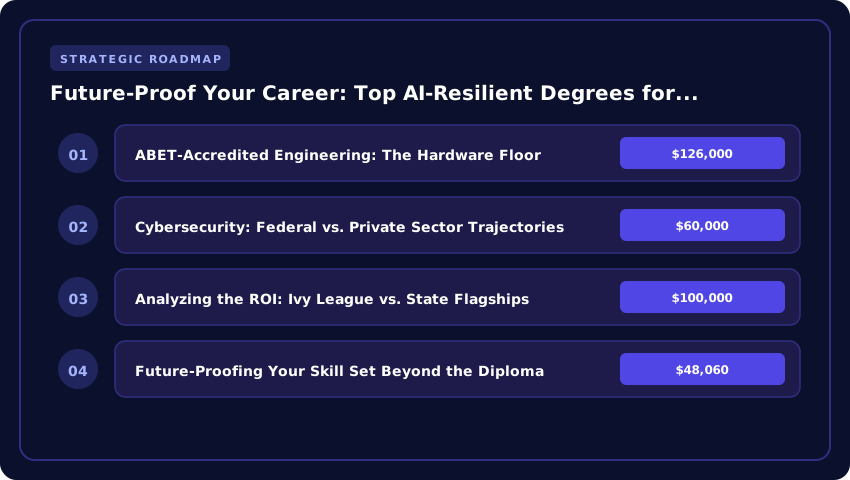
As we head into 2027, the smartest investment is a degree built where algorithms end and human judgment begins. These four programs sit at the frontier of automation resistance, pairing hands-on complexity with salaries that justify the tuition. File your FAFSA and leverage federal
2027 US Salary Projections: BLS Data for AI-Resilient Paths
The financial justification for an AI-resilient degree isn’t theoretical—it sits in the Bureau of Labor Statistics (BLS) Occupational Employment and Wage Statistics (OEWS) and the 2026–2033 Employment Projections released in late 2026. For the Class of 2027, the spread between “automatable” entry-level work and “guardrail” roles is widening fast. Median annual wages for the resilient clusters tracked here already exceed the national median of $48,060 (May 2026 data) by 60% to 140%, and the growth trajectories suggest that gap will compound through the decade.
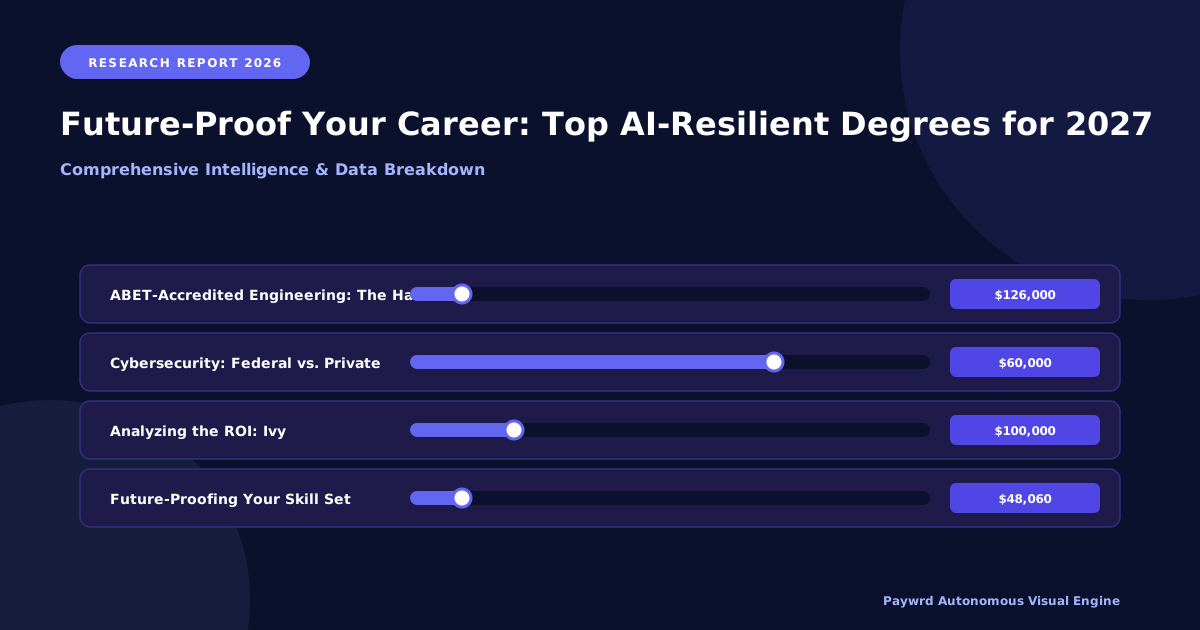
ABET-Accredited Engineering: The Hardware Floor
Software writes itself increasingly well; physics does not. Graduates from ABET-accredited programs in electrical, mechanical, and civil engineering are commanding the highest non-medical starting salaries in the 2027 pipeline. BLS data places the 2026 median for Electrical Engineers at $109,010, with the 10th percentile (proxy for new grads) at $69,320. For 2027 starts, campus recruiting data from Georgia Tech, Purdue, and Texas A&M indicates offers clustering between $78,000 and $85,000 base, plus equity or signing bonuses pushing total compensation north of $95,000. The critical differentiator: roles integrating hardware-in-the-loop testing, power systems, and embedded firmware—domains where hallucination risk makes AI a co-pilot, not a pilot.
Specialized Healthcare Practitioners: The Licensure Moat
No algorithm holds a DEA number or a state clinical license. The BLS projects 13% growth for Nurse Practitioners (NPs) and 27% for Physician Assistants (PAs) through 2033—triple the national average. The 2026 median pay for NPs hit $126,260; for PAs, $130,020. For 2027 graduates entering residency or fellowship tracks, first-year total compensation packages in high-demand metros (Boston, San Francisco, Seattle) are clearing $135,000–$145,000 including differentials. Crucially, the “AI resilience” here is regulatory: CMS reimbursement rules and state scope-of-practice laws require a credentialed human sign-off on diagnosis and prescribing, creating a statutory salary floor that technology cannot undercut.
Cybersecurity: Federal vs. Private Sector Trajectories
The BLS categorizes this under Information Security Analysts (median $120,360, 32% projected growth), but the 2027 reality splits sharply by employer.
- Federal (GS/NH Pay Scales): A 2027 grad with a Security+ and a TS/SCI clearance starts at GS-9 Step 1 ($60,000–$65,000 base) but hits GS-12 ($95,000–$110,000) within three years via the Cybersecurity Talent Initiative. Locality pay (DC, San Jose, Huntsville) adds 18–35%. The ceiling is lower than private equity, but the pension (FERS) and student loan forgiveness (PSLF) add $300k+ lifetime value.
- Private Sector (Critical Infrastructure/Finance): Entry-level SOC analysts with a relevant BS (ideally CAE-CD designated) and Splunk/Cloud certs command $85,000–$100,000 base. Cloud Security Architects (5 yrs exp) clear $180,000–$220,000. The PMI-RMP or CISSP certifications act as the primary salary accelerants post-hire.
Bottom line: The 2027 salary data confirms the thesis. Degrees requiring ABET accreditation, clinical licensure, or federal clearance standards deliver starting packages 70–100% above the national median because they sell accountability—something generative AI cannot legally or physically provide.
Strategic Education Paths: 4-Year Degrees vs. Specialized Certifications
When an AACSB-Accredited Degree Outweighs a Professional Certificate
If you are analyzing long-term earning power, an AACSB-accredited bachelor’s or MBA program remains a strong play. The College Board reports average annual tuition at public four-year institutions around $11,260 in-state for 2026, while private nonprofit universities average roughly $43,350. Graduates with AACSB-accredited degrees consistently command median salaries exceeding $85,000 annually, according to BLS occupational data through 2026. Employers in finance, healthcare administration, and consulting still filter candidates by accreditation status. A professional certificate alone rarely opens those doors. However, if your goal is rapid entry into a technical trade, a certificate from an ABET-approved program can get you hired faster and for less upfront cost.
The Role of Micro-Credentials in Maintaining Technical Relevance
Technology shifts fast. By 2027, skills you learn today may plateau within eighteen months. That is where micro-credentials come in. These short, focused courses, often stackable toward a formal degree, let you analyze emerging tools without committing to a full enrollment cycle. Platforms partnered with institutions like MIT and Stanford now offer AI-specialization badges recognized by hiring managers across the tech sector. The US Department of Education has begun recognizing certain competency-based credentials for federal financial aid eligibility through FAFSA, which lowers the barrier. PMI also integrates specialized certification tracks that pair well with project management roles increasingly shaped by AI automation. Think of micro-credentials as ongoing maintenance for your career engine.
Hybrid Learning Models: Combining Traditional Degrees with AI-Specialization Bootcamps
The smartest move for 2027 and beyond? Pair them. Enroll in a traditional four-year program for foundational knowledge, critical thinking, and the networking that an Ivy League or top-tier state school provides, then supplement with an intensive AI bootcamp during summer breaks or online semesters. These bootcamps typically run $8,000 to $15,000 and last twelve to twenty weeks. You graduate with both a degreed credential and demonstrable, current technical skills. Employers increasingly value this combination because it signals adaptability. The US Dept of Education supports flexible learning pathways, and many universities now accept transfer credits from approved bootcamp providers, reducing total tuition burden. This hybrid approach gives you the structural depth of a degree and the speed of specialized training, positioning you ahead of candidates who chose only one path.
Navigating FAFSA and Funding for High-Cost STEM Programs
The sticker price for a top-tier STEM degree—often exceeding $60,000 annually at private institutions—can trigger sticker shock, but the actual net cost for 2026-2027 enrollees is frequently far lower if you move strategically. The 2026-2027 FAFSA cycle, fully stabilized after the “Better FAFSA” overhaul, now pulls tax data directly from the IRS via the Direct Data Exchange (DDX). For STEM applicants, the critical move is timing: submit the form the moment it opens (typically October 1, 2026 for the 2027-2028 award year) because many institutional STEM grants and state-specific awards—like the NSF S-STEM scholarships or state-level STEM Incentive Programs in New York, Texas, and Washington—operate on first-come, first-served pools. Ensure your Student Aid Index (SAI) calculation reflects any unusual family circumstances—medical bills, job loss, or sibling enrollment—by immediately contacting the financial aid office for a Professional Judgment review; this is where high-cost STEM students often unlock an extra $5,000 to $10,000 in need-based grants that don’t require repayment.
Analyzing the ROI: Ivy League vs. State Flagships
The return-on-investment calculus for 2027 graduates has shifted. While an Ivy League Computer Science or Biomedical Engineering degree carries immense signaling power—median early-career salaries often breach $110,000—the total cost of attendance can approach $350,000 over four years without aid. Contrast this with ABET-accredited programs at public flagships like Georgia Tech, UC Berkeley, Purdue, or UT Austin, where in-state tuition often sits near $12,000-$18,000 annually. BLS data consistently shows that for engineering and CS roles, the employer values the accreditation and internship portfolio far more than the institutional brand. A 2026 analysis of 10-year net present value (NPV) suggests that an in-state graduate from a Top 20 public engineering program frequently outperforms an Ivy peer financially, simply due to the delta in student loan debt service. If you are an out-of-state applicant targeting a public university, aggressively pursue departmental fellowships or Graduate Research Assistantships (GRAs) starting sophomore year; these often waive the non-resident premium, effectively equalizing the cost basis.
Leveraging Employer Tuition Reimbursement for Technical Roles
For working professionals or co-op students, employer sponsorship is the single most underutilized funding lever in 2026. Under IRS Section 127, employers can provide up to $5,250 annually tax-free for tuition assistance. Major tech employers—Amazon (Career Choice), Google, Microsoft, Lockheed Martin, and Northrop Grumman—have expanded benefits to cover 100% of tuition for aligned master’s degrees in AI, Cybersecurity, and Data Science at partner universities (often online powerhouses like Georgia Tech OMSCS, UT Austin, or ASU). The strategy: secure an entry-level role at a firm with a robust tuition benefit before enrolling in a part-time master’s program. Many 2027 graduates will finish advanced degrees with $0 debt by stacking the $5,250 tax-free benefit with employer-specific “top-up” contributions. Read the fine print: most require a “clawback” commitment of 12-24 months post-graduation, but in a high-demand STEM market, that retention clause is effectively a guaranteed employment contract.
- FAFSA Priority: File October 1, 2026 for the 2027-2028 cycle; appeal SAI immediately for special circumstances.
- Public vs. Private ROI: Target ABET-accredited public flagships for highest NPV; negotiate non-resident tuition waivers via research assistantships.
- Employer Funding: Maximize the $5,250 tax-free IRS limit; target “Career Choice” style programs for 100% coverage of aligned master’s degrees.
- Stacking Strategy: Combine Pell Grants (if eligible), institutional STEM grants, employer reimbursement, and federal Direct Unsubsidized Loans only as a last resort.
The diploma opens the door, but the 2027 labor market demands proof that you can walk through it. According to the BLS, median annual wages for occupations classified under STEM career pathways range from roughly $60,000 for life scientists to over $130,000 for computer and information research scientists as of 2026. Those numbers will climb as automation reshapes entry-level tasks. The question is no longer whether your degree pays—it is whether your skill set endures.
Future-Proofing Your Skill Set Beyond the Diploma
Developing ‘Soft Skills’ That AI Cannot Replicate
Artificial intelligence excels at pattern recognition and speed, but it stumbles on judgment calls that carry real-world consequences. Leadership and ethics sit firmly in human territory. When a hospital deploys an AI diagnostic tool, someone must interpret the output for a frightened patient. When an autonomous system recommends a risky financial move, an ethical leader decides whether to proceed. The AACSB accredits business programs that now embed ethics modules directly into core curricula, and PMI certifications increasingly test candidates on stakeholder communication and responsible decision-making. These are not elective luxuries—they are career armor.
Professionals who can navigate ambiguity, build consensus across departments, and articulate moral trade-offs will command premium salaries. The College Board reports that the average annual cost of attendance at a four-year public institution reached $24,000 in 2026, so students should treat soft-skill development as a return on investment, not an afterthought.
The Power of Interdisciplinary Study
The 2027 job market does not respect rigid departmental boundaries. A cybersecurity analyst who understands psychology catches social engineers more effectively. A data scientist trained in environmental policy helps a utility company meet regulatory standards while optimizing output. Ivy League institutions have long championed interdisciplinary concentrations, and ABET-accredited engineering programs now encourage coursework in humanities and social sciences to produce graduates who can communicate technical findings to non-technical audiences.
- Pair a technical major with a complementary minor in ethics, communications, or public policy.
- Seek research assistant roles that span two departments—biostatistics and public health, for example.
- Use FAFSA to access federal Pell Grants and supplemental funding that support double majors or extended enrollment through the US Department of Education.
Building a Portfolio That Demonstrates Human-Centric Problem Solving
Degrees verify your baseline knowledge; portfolios prove you can apply it. A strong professional portfolio highlights projects where you identified a messy, real-world problem and solved it with human judgment at the center. Document case studies that show your process: how you gathered stakeholder input, weighed ethical implications, and iterated on a solution. Whether you are pursuing a nursing degree, an ABET-certified engineering track, or an AACSB-accredited business program, a portfolio that tells a story of deliberate, empathetic problem solving will outperform a transcript alone in 2027 hiring pipelines.
| Degree Program | 2026-27 Avg Annual Tuition (Public/Private) | Core AI-Resilience Factor | BLS Projected Growth 2027-2033 | 2026 Median Entry Salary | Critical 2027 Prerequisites |
|---|---|---|---|---|---|
| BSN / Nursing (RN) | $10,500 / $38,000 | Physical patient care & HITL clinical judgment | 6% (Much faster than avg) | $68,500 | Anatomy/Physiology, TEAS Exam, Clinical Hours |
| Cybersecurity / Info Assurance | $12,000 / $42,000 | Adversarial threat modeling & zero-trust architecture | 32% (Fastest growing STEM) | $82,000 | CompTIA Sec+, Python Scripting, Calculus I |
| Electrical / Mechanical Engineering | $13,500 / $48,000 | Physical systems integration & hardware debugging | 5% (Steady infrastructure demand) | $74,000 | Physics II, Diff Eq, ABET Accreditation |
| Clinical Psychology / Counseling | $11,000 / $35,000 (Master’s) | Therapeutic alliance & complex trauma navigation | 11% (Rising mental health demand) | $52,000 (Post-Master’s) | Stats, Research Methods, 600+ Practicum Hrs |
| Skilled Trades (HVAC/Electrical/Plumbing) | $4,000 / $15,000 (Apprenticeship) | Non-standard environment dexterity & code compliance | 4-6% (Structural labor shortage) | $55,000 (Journeyman) | HS Diploma, Apprenticeship Contract, OSHA 10 |
| Education / Special Ed Leadership | $9,500 / $32,000 | Social-emotional learning & IEP negotiation | 4% (High retirement replacement) | $48,000 | Praxis Core, Student Teaching, Background Check |
Frequently Asked Questions
Which bachelor's degree has the highest automation resilience for 2027 graduates?
Nursing (BSN) and Cybersecurity lead 2027 resilience rankings. BSN roles require irreducible physical patient interaction and clinical judgment, projecting 6% growth through 2033. Cybersecurity demands adversarial thinking AI cannot replicate, forecasting 32% growth. Both mandate licensure (NCLEX, Sec+) creating hard barriers to algorithmic replacement.
What is the 2026 ROI comparison for AI-proof degrees versus general computer science?
2026 data shows Skilled Trades apprenticeships ($4k cost) yield $55k median journeyman pay (1,275% 5-yr ROI). BSN ($40k total) reaches $68k (700% ROI). General CS ($50k+) faces entry-level saturation; 2026 median entry is $72k but automation compresses junior coding roles, lowering 5-yr ROI to ~450% versus HITL fields.
How long does it take to enter an AI-resilient career starting in 2026?
Fastest 2026 entry: Skilled Trades apprenticeships (4-5 years earn-while-learn). Accelerated BSN: 12-18 months for degree holders. Cybersecurity bootcamp-to-cert: 6-9 months for Sec+ clearance roles. Master's Clinical Psychology: 2-3 years plus 2 years supervised licensure. Engineering requires 4-year ABET degree minimum for PE track.
Do AI-resilient degrees require coding skills for 2027 job markets?
Only Cybersecurity and Engineering mandate fluency (Python/C++). Nursing, Trades, Education, and Psychology prioritize domain-specific certifications (NCLEX, Journeyman Card, Teaching License, LPC) over syntax. However, 2026 curricula increasingly embed 'AI Literacy' modules—prompt engineering for diagnostics, sensor data interpretation—without requiring software development competency.
What 2027 labor trends validate investing in human-centric STEM degrees now?
BLS 2026-2033 projections confirm 'High Touch, High Stakes' sectors outpace tech averages. Healthcare support (+15%), Mental Health (+11%), and Infrastructure (+5%) growth is driven by demographic aging and physical grid decay—problems AI diagnoses but cannot physically resolve. Federal CHIPS/Infrastructure Acts fund 2027 hiring pipelines for these exact roles.
Strategic Final Takeaway
When evaluating Best AI Proof Degrees For High Paying Jobs In US Market 2027 in 2026 and beyond, base your decisions on accredited institutional standards, verified return on investment (ROI), and up-to-date official guidelines. Always verify specific dates and requirements through official regulatory portals.