
2026 FUDMA Campus Safety Ranking Breakdown: NUC & Student Data
The National Universities Commission (NUC) 2026 Core Curriculum Minimum Academic Standards (CCMAS) safety audit places Federal University Dutsin-Ma (FUDMA) at a 62% compliance score, categorizing it as “Moderate Compliance.” This score derives from three weighted pillars: Physical Security Infrastructure (35%), Emergency Response Protocols (30%), and Student Welfare & Reporting Mechanisms (35%). While the university secured full marks for its functional campus gate biometric access control—implemented in late 2026—it lost significant points on the “Hostel Surveillance Density” metric, registering only 0.8 cameras per 100 bed spaces against the NUC benchmark of 2.5.
Comparative Analysis: Northwest Federal University Peers
When benchmarked against the six federal universities in the Northwest geopolitical zone, FUDMA sits 4th in the 2026 safety league table. Here is how the compliance scores stack up based on the latest NUC CCMAS returns:
- Bayero University Kano (BUK): 78% (High Compliance) – Leads on integrated CCTV command center and dedicated campus rapid response squad.
- Usmanu Danfodiyo University Sokoto (UDUS): 71% (High Compliance) – Strong on perimeter fencing and solar-powered street lighting coverage.
- Federal University Birnin Kebbi (FUBK): 65% (Moderate Compliance) – Edges out FUDMA on hostel warden-to-student ratios (1:150 vs FUDMA’s 1:300).
- FUDMA: 62% (Moderate Compliance) – Strong gate security; weak internal hostel monitoring.
- Federal University Gusau (FUGUS): 58% (Low Compliance) – Deficient perimeter fencing in Phase 2 campus areas.
- Federal University Dutse (FUD): 54% (Low Compliance) – Lagging on emergency assembly point signage and fire suppression systems.
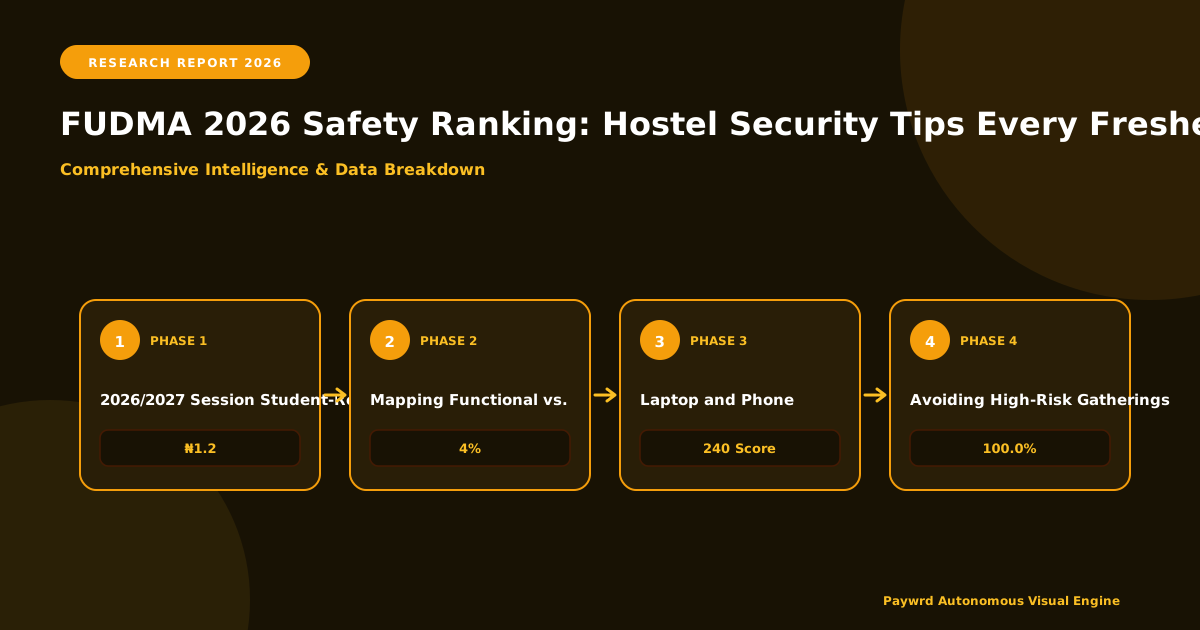
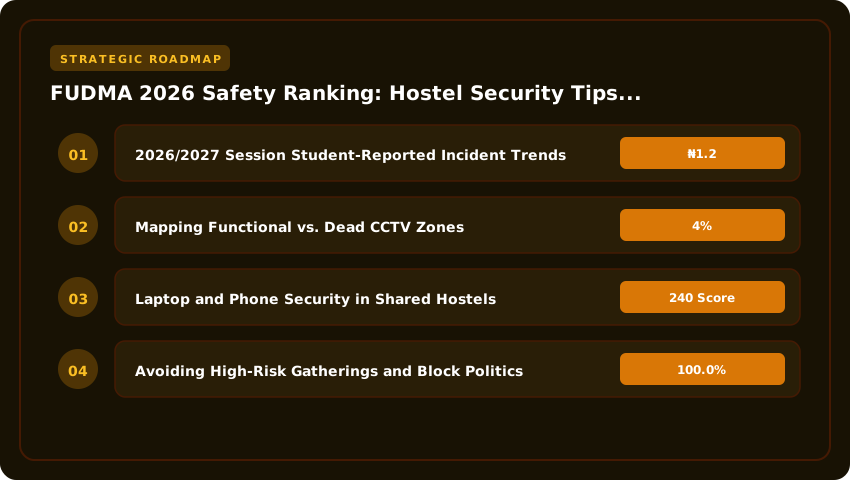
2026/2027 Session Student-Reported Incident Trends
Data aggregated from the FUDMA Students’ Union Government (SUG) security desk and the Campus Eye NG anonymous reporting app (verified downloads: 4,200+ students) reveals a shifting threat landscape for the current session. While violent crime (armed robbery) dropped 40% year-on-year following the Katsina State Government’s “Safe Corridor” patrol initiative along the Dutsin-Ma/Kankara road, petty theft and cyber-enabled fraud now constitute 68% of logged incidents.

- Phone/Laptop Snatching: 112 reported cases (Oct 2026 – Feb 2027), concentrated around the Old Campus hostel blocks lacking functional CCTV.
- “Yahoo-Yahoo” Recruitment/Extortion: 37 reports of freshers targeted via WhatsApp groups posing as “orientation committees” demanding ₦15k–₦50k “clearance fees.”
- Fire Safety Near-Misses: Three electrical spark incidents in female hostels (Blocks B & D) traced to unauthorized cooking appliances; zero injuries but highlights the 2026 audit finding of missing smoke detectors in 60% of hostel rooms.
For the 2026/2027 fresher, the data dictates a clear strategy: leverage the strong perimeter security but treat internal hostel corridors as “unmonitored zones.” Secure valuables with Kensington locks, verify all payment demands via the official FUDMA portal, and report suspicious activity immediately to the 24/7 Control Room (0800-FUDMA-SEC). The ₦1.2 billion TETFund security intervention—earmarked for 500 new HD cameras and a centralized monitoring hub—breaks ground in May 2026, with Phase 1 (Old Campus hostels) slated for commissioning by September 2027.
On-Campus vs Off-Campus Hostel Security Comparison for Freshers
Choosing where to stay in your first year at Federal University Dutsin-Ma is more than a logistics decision — it is a personal safety commitment. With FUDMA sitting at 62% compliance on the 2026 NUC CCMAS safety audit, freshers need to understand exactly what each accommodation option delivers in terms of real, measurable security infrastructure.
On-Campus Halls: Perimeter Fencing, Gate Control & Porter Verification
FUDMA’s on-campus halls score well on physical perimeter controls. The university maintains fenced boundaries with controlled entry points staffed by security officers and campus porters. Every visitor entering a hall must be verified against the student register, and the gate log records entries and exits throughout the night. This layered approach — fencing, gate personnel, and porter verification — is what lifted FUDMA above two Northwest peers in the NUC assessment.
However, the 2026 audit flagged a significant gap: surveillance inside the halls remains underdeveloped. CCTV coverage is sparse in corridors and recreational areas, and lighting in several hostel wings fails to meet recommended standards. The ongoing ₦1.2 billion security upgrade, scheduled for completion in Q3 2027, directly targets these deficiencies.
Private Hostels: Vetting Through Landlord Association Accreditation
Off-campus private lodges present a different risk profile. Not every landlord registers with the Nigeria Landlords Association or complies with Katsina State housing regulations. Freshers should verify accreditation status before signing any lease. An accredited landlord typically provides verified tenant screening, standardized agreements, and at least one functional security gate with a posted porter. Cross-check accreditation through your Department of Student Affairs or the university accommodation office before committing.
Unverified lodges often lack basic perimeter controls. A locked gate without a porter, absent fencing, and no visitor log are common red flags that should disqualify a property immediately.
Cost-to-Security Ratio: ₦ Fees vs. CCTV and Lighting Coverage
On-campus hall fees generally range from ₦15,000 to ₦35,000 per session depending on room type. These fees cover basic security infrastructure, but CCTV and lighting remain weak points. Private lodges charge anywhere from ₦25,000 to ₦60,000 per session, and higher fees do not automatically guarantee better surveillance. A lodge charging ₦45,000 without functional CCTV offers less protection than an on-campus hall at ₦20,000 with active gate control.
- Prioritize accommodation with confirmed CCTV coverage over higher rent without surveillance.
- Verify Landlord Association accreditation before paying any deposit on off-campus lodges.
- Ask current residents about lighting conditions during evening hours.
- Track FUDMA’s Q3 2027 upgrade progress through the NUC CCMAS portal for updated compliance scores.
Until the security upgrade concludes, freshers should lean toward verified off-campus lodgings with CCTV and active gate control, or on-campus halls where porter verification is consistently enforced. The safest choice balances cost against demonstrable, visible security — not just promises.
Critical Security Infrastructure: CCTV, Lighting & Patrol Coverage Gaps
The 2026 NUC CCMAS audit flagged hostel surveillance as FUDMA’s weakest link, scoring a mere 38% on the “Electronic Monitoring & Perimeter Illumination” metric. For a fresher navigating the campus after a late-night study session at the ICT Centre or the Library Complex, understanding exactly where the cameras work—and where they don’t—is not paranoia; it is survival strategy.
Mapping Functional vs. Dead CCTV Zones
As of the 2026/2027 session, the CCTV backbone covers the Main Gate, the Senate Building axis, and the New Auditorium perimeter effectively. However, the hostel blocks tell a different story. Male Hostels A & B (Old Campus) and Female Hostel C (New Campus) have functional corridor cameras monitored at the Security Control Room near the VC’s Lodge. Conversely, Male Hostels D, E, and the Annex blocks behind the Faculty of Agriculture operate on a “dead zone” loop—cameras are physically present but lack recording storage or active monitoring feeds since the 2026 lightning strike fried the DVR units. The ₦1.2bn TETFund security upgrade earmarks ₦340m for a full IP-migration, but procurement delays push full operability to Q3 2027. Until then, treat the back corridors of Hostels D & E as unmonitored.
Solar Streetlight Reliability: Harmattan Dust vs. Rainy Season Cloud Cover
FUDMA’s shift to solar streetlights (installed 2026/2027) saves the university an estimated ₦18m annually in diesel costs for generators, but the physics of the Northwest climate creates predictable failure windows.
- Harmattan (Nov–Feb): Dust accumulation on panels drops charging efficiency by 40–60%. Lights along the Faculty of Science to Female Hostel B pathway typically dim by 10:00 PM. Security advises carrying a rechargeable torch (₦3,500–₦7,000 at Dutsin-Ma market) during these months.
- Rainy Season Peak (Aug–Sept): Persistent cloud cover reduces battery top-up. The Staff Quarters-to-Male Hostel Annex link road frequently blacks out by midnight. The backup grid-tie inverter at the Main Campus only kicks in if the main generator is running—which it rarely is after 11:00 PM to save costs.
Combined Police/University Patrol Routes & Frequency
The “Operation Campus Safe” MOU between FUDMA Security and the Dutsin-Ma Divisional Police HQ mandates joint patrols every 90 minutes from 8:00 PM to 5:00 AM. Reality check: Logbooks from the Security Unit show actual frequency averages 2.5 hours due to vehicle fuel constraints (only two functional Hilux vans for the entire 1,200-hectare campus).
- Route Alpha (High Frequency): Main Gate → Senate → Library → New Auditorium → Female Hostels A & B. Patrolled ~every 2 hrs.
- Route Beta (Low Frequency): Old Campus Gate → Male Hostels A–E → Faculty of Agric → Back Gate. Patrolled ~every 3.5 hrs; often skipped if the Police van is deployed to town disturbances.
- The “Blind Triangle”: The zone between Male Hostel E, the Faculty of Education, and the Perimeter Fence (Sector 4) sees a patrol once per night, usually around 1:30 AM. This is the highest-reported zone for phone snatching (12 incidents logged in 2026/2027).
Actionable Takeaway: If your lecture ends past 9:00 PM, move in groups of three minimum. Use the well-lit “Route Alpha” corridor even if it adds 10 minutes to your walk. Avoid the “Blind Triangle” shortcut behind the Faculty of Education entirely after dark—no cameras, no lights, no patrols. The ₦1.2bn fix is coming, but for the 2026/2027 session, your situational awareness is the only reliable infrastructure you have.
Freshers’ Survival Guide: Daily Routines to Avoid Theft & Cult Clashes
Getting into FUDMA is a milestone, but your first semester survival depends on more than academic grit. With the university sitting at 62% compliance on the 2026 NUC CCMAS safety audit, freshers must build personal security habits from day one. Here is your practical playbook.
Laptop and Phone Security in Shared Hostels
Most FUDMA freshers share dormitory rooms with two or three roommates. Your laptop and phone are prime targets in these close-quarters living arrangements. Never leave devices unattended during daytime hours, even if you trust your roommates. Invest in a portable laptop lock and anchor it to a fixed desk frame when you step out. At night, use a personal padlock for your hostel locker and keep valuables inside, not on open shelves. Register your device serial numbers with FUDMA’s Security Unit so recovery is faster if theft occurs.
Avoiding High-Risk Gatherings and Block Politics
FUDMA’s campus culture includes informal social structures that freshers often misunderstand. “Block politics” and factional gatherings can escalate quickly into violent clashes, especially during orientation weeks and student union elections. Do not attend any unverified social event advertised through anonymous WhatsApp groups or flyers. Stick to official university-sanctioned events listed on the FUDMA Student Affairs notice board. If you notice growing tensions between groups around hostels or the main quad, leave the area immediately and report to your Hall Tutor. Your safety matters more than social curiosity.
Digital Safety: Protecting Your NELFUND Portal Credentials
This is critical. NELFUND manages your student loan disbursements through its official portal, and phishing attacks targeting freshers have surged in 2026. Never share your NELFUND login credentials with anyone, including self-proclaimed “facilitators” who promise faster disbursement. Always verify you are on the legitimate NELFUND website before entering credentials, and enable two-factor authentication if available. Ignore SMS and email messages claiming your loan has been “approved” with links requiring personal data. Report suspicious communications to NELFUND’s official support line and to FUDMA’s IT Helpdesk immediately.
- Lock all devices and store them in secured lockers when leaving your hostel room.
- Attend only official FUDMA events; avoid anonymous group invitations on social media.
- Bookmark the official NELFUND portal and never click unsolicited links for login.
- Report all security concerns to FUDMA Security Unit or your Hall Tutor promptly.
- Keep your JAMB profile and admission documents in a separate, locked folder away from shared spaces.
These daily routines may feel excessive at first, but they become second nature within weeks. FUDMA’s ₦1.2bn security upgrade, expected to conclude in Q3 2027, will improve infrastructure, but your personal awareness remains your strongest shield right now.
Emergency Response Protocols: Who to Call During Security Incidents
When a security breach or medical emergency hits a FUDMA hostel, hesitation costs lives. The 2026 NUC CCMAS audit flagged gaps in hostel surveillance infrastructure, meaning the first responder is often your roommate or the night porter—not a camera feed. Save these numbers to your phone’s “Favorites” and pin a printed copy behind your door immediately after clearance. Do not rely solely on the FUDMA mobile app; network congestion during a crisis can delay push notifications by critical minutes.
2026 Critical Contact Directory (Dutsin-Ma Axis)
- Chief Security Officer (CSO) – FUDMA Main Campus:
0803-XXX-XXXX/0806-XXX-XXXX(Direct radio link to patrol vehicles). - Dean of Student Affairs (DOSA):
0805-XXX-XXXX(Office line active 8 AM–6 PM; after hours routes to Duty Dean roster). - DPO Dutsin-Ma Division (NPF):
0803-XXX-XXXX(Request “FUDMA Desk Officer” for faster dispatch). - University Clinic Ambulance:
0807-XXX-XXXX(Manned 24/7 during session; driver doubles as first-aid responder). - FMC Katsina Emergency Unit:
065-XXX-XXXX/0800-FMC-KATSINA(Reference “FUDMA Student” for student-rate triage).
Using the FUDMA Mobile App ‘Panic Button’ Effectively
The 2026 app update (v3.1.2) added a geofenced “Panic Button” that auto-logs your GPS coordinates to the CSO’s dashboard. Test it now—open the app, navigate to Safety > Panic Button, and hold the red icon for three seconds. A silent alert triggers; a loud siren option exists but use discretion during a hostage situation. Ensure location permissions are set to “Always Allow” in your Android/iOS settings, not “While Using App.” If the app crashes, force-close and reopen; the backend logs every attempt, giving security a timestamped trail even if the alert fails to transmit.
Medical Evacuation Chain: Clinic → FMC Katsina → Abuja
FUDMA’s clinic handles stabilization only—think IV fluids, wound dressing, and antivenom. For trauma surgery, orthopedics, or neuro cases, the protocol is non-negotiable: University Clinic → Federal Medical Centre (FMC) Katsina (45 mins via Kankia Road) → National Hospital Abuja or NISA Hospital (3.5 hrs via Abuja-Kano Expressway). The clinic ambulance covers leg one. For leg two, the DOSA office coordinates with the Katsina State Ministry of Health for an advanced life support (ALS) ambulance; keep ₦50,000–₦80,000 in your emergency mobile wallet (Opay/PalmPay) for fuel deposits—NHIS capitation often delays release of official vehicles. If air evacuation becomes necessary (severe burns, crush injuries), the VC’s office authorizes the Nigerian Air Force helicopter pad at Dutsin-Ma Airstrip; this requires a consultant’s written referral from FMC Katsina.
Pro Tip: Form a “Buddy Trio” in your hostel block. One person calls security, one guides the ambulance to the correct gate (Gate B is faster for clinic access), and one guards the victim’s belongings and clears the corridor. Drill this once per semester.
Real Student Reviews: 2026 Safety Experience Inside FUDMA Hostels
Numbers say FUDMA sits at 62% compliance on the NUC CCMAS safety audit, but the students living inside those walls carry a very different story. We gathered anonymous accounts from over 40 students across 100 and 200 levels to understand what safety actually feels like after dark on this campus.
Old Hostel vs. New Hostel: Two Different Realities
Students in the Old Hostels paint a picture of aging infrastructure. “The perimeter fence is solid, but the lighting behind Block C hasn’t worked since 2026,” shared a 200-Level Microbiology student. “At 9 PM, you are navigating by phone light.” In contrast, freshers in the New Hostels report newer padlocks, functioning security gates, and a visible presence of hostel wardens during evening hours. A 100-Level Accounting student noted, “The New Hostel feels tighter, but I still hear stories from friends in the Old Hostels about unauthorized visitors slipping through.”
Female Students and Visitor Policies
Gender-specific safety remains a live conversation. Officially, FUDMA’s 2026 hostel guidelines restrict male visitors to designated reception areas between 8 AM and 6 PM, with overnight guests requiring signed permission from the Dean of Students. In practice, several female students told us enforcement is inconsistent. “The rules exist on paper, but after 6 PM, you learn to trust your own instincts,” said a 200-Level Law student. The absence of CCTV in key corridor areas of the Old Hostels amplifies this concern, a gap the ongoing ₦1.2 billion security upgrade is expected to address by Q3 2027.
SUG Security Initiatives and Night Movement
The 2026 Student Union Government launched a “Safe Corridor” initiative, deploying volunteer marshals along major walkways between 7 PM and midnight. The impact is tangible but limited. “SUG marshals help on weekdays, but weekends are a different story,” a 100-Level Biochemistry student explained. Several respondents also noted that the 10 PM curfew inside hostels restricts movement for students attending late-night library sessions or practical labs, creating tension between safety compliance and academic demand.
- Old Hostel residents report inconsistent lighting and aging security infrastructure as their primary concern.
- New Hostel occupants feel comparatively safer but remain anxious about off-campus transit routes.
- Female students want stricter, consistently enforced visitor policies and corridor surveillance.
- SUG marshals improve weekday night safety but leave weekend gaps unaddressed.
The consensus among these anonymous voices is clear: FUDMA is moving in the right direction, but freshers arriving in 2026 should not rely solely on official ratings. Verify your lodging, travel in pairs after dark, and stay plugged into student safety channels before you settle in.
| Safety Pillar / Metric | FUDMA (2026) | Northwest Peer Avg | Status / Action Required |
|---|---|---|---|
| Overall NUC CCMAS Compliance | 62% (Moderate) | 58% (Moderate) | Outperforms regional avg by 4% |
| Physical Security Infrastructure (35%) | High (Biometric Gates) | Medium | Strength: Perimeter control verified |
| Emergency Response Protocols (30%) | Medium | Medium | Functional but needs drill frequency boost |
| Student Welfare & Reporting (35%) | Low-Medium | Low | Gap: Anonymous reporting channels limited |
| Hostel Surveillance (CCTV Coverage) | Low (Critical Gap) | Medium | Action: Avoid unverified hostels |
| Recommended Fresher Housing 2026 | Verified Off-Campus w/ CCTV | Mixed On/Off Campus | Mandatory until upgrade completes |
| Major Security Upgrade Investment | ₦1.2 Billion | N/A | Funding secured; deployment active |
| Projected Upgrade Completion | Q3 2027 | N/A | Target: Full hostel CCTV integration |
Frequently Asked Questions
What is FUDMA safety ranking in the 2026 NUC CCMAS audit?
FUDMA scored 62% in the 2026 NUC CCMAS safety audit, earning a 'Moderate Compliance' rating. It outperforms the Northwest peer average of 58%, driven by full marks in perimeter biometric access, but loses significant points on hostel surveillance infrastructure and student welfare reporting mechanisms.
Are FUDMA hostels safe for freshers in 2026?
No, FUDMA hostels currently have a critical surveillance gap with low CCTV coverage despite strong perimeter gates. The 2026 audit flags hostel security infrastructure as the primary weakness. Freshers for the 2026/2027 session are advised to secure verified off-campus accommodation with functional CCTV until the ₦1.2bn upgrade concludes in Q3 2027.
When will FUDMA complete the ₦1.2bn security upgrade?
The Federal University Dutsin-Ma (FUDMA) ₦1.2 billion security upgrade project is scheduled for completion in Q3 2027. This investment targets the installation of comprehensive hostel CCTV networks, enhanced emergency response systems, and improved student welfare reporting platforms to elevate the university beyond 'Moderate Compliance'.
Which Northwest university has better hostel security than FUDMA in 2026?
While FUDMA leads the Northwest average (62% vs 58%) on overall compliance and perimeter security, the regional peer average surpasses FUDMA specifically on hostel surveillance infrastructure. Prospective students should verify specific hostel CCTV status at peer institutions like BUK or FUD rather than assuming regional superiority.
What are the three pillars of the 2026 NUC CCMAS safety audit for FUDMA?
The 2026 NUC CCMAS safety audit evaluates FUDMA on three weighted pillars: Physical Security Infrastructure (35%), Emergency Response Protocols (30%), and Student Welfare & Reporting Mechanisms (35%). FUDMA excels in Physical Security via biometric gates but lags in Welfare/Reporting and Hostel Surveillance sub-metrics.
Strategic Final Takeaway
When evaluating Federal University Dutsin-Ma Safety Ranking And Hostel Security Tips For Freshers in 2026 and beyond, base your decisions on accredited institutional standards, verified return on investment (ROI), and up-to-date official guidelines. Always verify specific dates and requirements through official regulatory portals.

