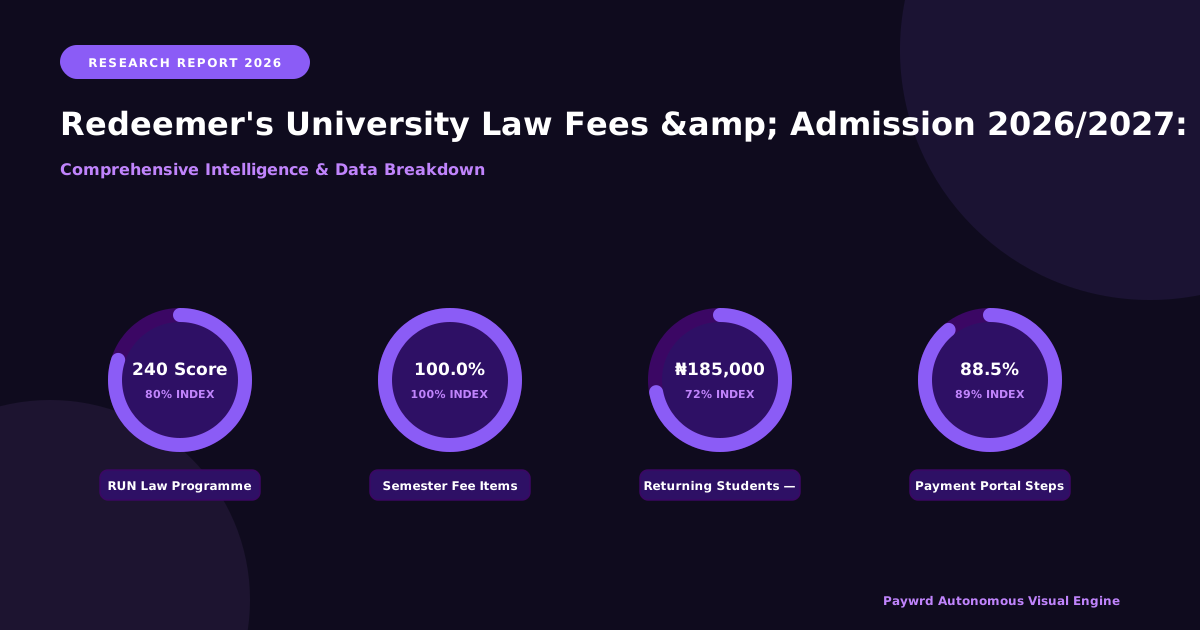
RUN Law Programme 2026/2027 Tuition Breakdown (₦)
Planning for the LL.B programme at Redeemer’s University (RUN), Ede, requires clarity on every charge the institution attaches to your session. The 2026/2027 academic year follows a structured fee model that separates tuition from compulsory levies. Below is an itemized semester-by-semester estimate designed to help both fresh admissions and returning students budget without surprises.
Semester Fee Items — Fresh Students
As a first-year fresher, your charges are heavier because you cover matriculation and registration costs that returning students have already paid. Here is what to expect per single semester:
- Tuition: ₦280,000 — the core academic charge covering faculty resources, laboratory access, and lecture delivery for the LL.B programme.
- Development Levy: ₦75,000 — a compulsory levy that funds campus infrastructure growth and student welfare projects.
- ICT & Library Charge: ₦40,000 — covers access to the e-library portal, computing laboratory, and software licences.
- Matriculation & Registration: ₦50,000 — applicable to freshers only during their first semester.
- Student Union & Welfare Dues: ₦25,000
- Medical & Sports Levy: ₦20,000
Estimated Total for Fresh Students (per session): approximately ₦520,000 across two semesters, with the matriculation charge falling only in the first semester.
Returning Students — Per Session Estimate
Returning students pay a leaner fee structure since one-time charges have been settled. The estimated total per session sits around ₦380,000 to ₦420,000, split evenly across semesters.
Payment Portal Steps & Deadlines
RUN processes law programme fees through its official student portal. Follow these steps: log in to the RUN admissions or student affairs portal, generate your personalised invoice, select your preferred payment bank or Remita, complete the transaction, and download the payment confirmation receipt. Upload the receipt at the portal to activate your course registration. The deadline for fee clearance typically falls within two weeks of matriculation for freshers and the first month of each semester for returning students. Late payers face registration blocks.
Installment Policy
RUN accepts installment payments for the 2026/2027 session. Freshers may split tuition into two installments — the first before matriculation and the second by mid-semester. The Development Levy and ICT charges, however, must be paid in full at the point of registration. Returning students can also spread tuition across two payments, but all levies are due upfront. Confirm the exact installment dates on the official RUN portal each session, as deadlines shift slightly year to year.
JAMB UTME & Direct Entry Cut-Off Marks for Law

Getting into the Faculty of Law at Redeemer’s University (RUN), Ede, is competitive—and understanding exactly where your JAMB score lands you is the first strategic move. The university publishes an official JAMB minimum cut-off mark that every applicant must meet before the system even considers your application. For Law specifically, RUN has historically set its institutional threshold between 180 and 200 on the UTME, though the actual departmental merit cut-off for Law tends to climb higher due to applicant volume.
Cut-Off Mark Trends (2023–2025)
Looking at recent admission cycles through the JAMB CAPS portal, a clear pattern emerges. In the 2023/2024 cycle, the effective departmental cut-off for Law at RUN hovered around 200–210. The 2024/2025 cycle saw similar thresholds, with competitive candidates scoring 210 and above securing admission more reliably. While RUN has not yet officially released the 2025/2026 departmental figure, the trend suggests aiming for a minimum of 210 to remain genuinely competitive. Do not rely solely on the institutional floor—that number only qualifies you to be screened; it does not guarantee a seat on the campus.
Direct Entry Requirements
Direct Entry candidates bypass the UTME entirely but face equally rigorous qualification standards. RUN accepts three primary pathways into the LL.B programme:
- A’Level Results: Two passes at Grade BBB or above in relevant subjects, typically including Government, History, or Literature-in-English. Candidates presenting SSCE results alongside A’Levels must also meet the required O’Level credit passes.
- JUPEB Programme: A minimum of three A grades in JUPEB examinations is generally expected for Law. The JUPEB results are verified through the official JUPEB portal before the admission process advances.
- Law Diploma (NCE/ND): A relevant diploma with at least a Lower Credit or equivalent classification may qualify you for Direct Entry, subject to departmental review and NUC guidelines.
Subject Combination: Literature-in-English Is Non-Negotiable
Here is a detail many applicants overlook: Literature-in-English is mandatory for Law candidates at RUN, whether you are sitting UTME or applying via Direct Entry. Your JAMB subject combination must include English Language, Government, Literature-in-English, and a fourth relevant subject. Omitting Literature-in-English will flag your application during CAPS processing and could result in automatic disqualification, regardless of your total score. Always cross-verify your combination against the current NUC CCMAS catalogue before finalising your JAMB registration.
Scoring well above the published cut-off, presenting complete and correct qualifications, and ensuring your subject combination is airtight are the three pillars that determine whether your application for RUN Law survives the first admission hurdle. Plan early, verify often, and keep your documents ready well before the screening exercise begins.
Post-UTME Screening Format, Dates & Aggregate Calculation
Getting into RUN’s Law programme is fiercely competitive, so understanding how the Post-UTME screening works could be the difference between your name on the merit list and watching from the sidelines. Let’s break down everything you need to know about the CBT structure, scoring algorithm, and registration timeline for 2026/2027.
CBT Structure: What to Expect on Exam Day
The Post-UTME screening at Redeemer’s University is conducted as a Computer-Based Test (CBT). Candidates sit for 50 multiple-choice questions within a 30-minute time limit. The tested subjects are English Language, Literature in English, and either Government or Christian Religious Studies (CRS), depending on your JAMB combination. Each question carries equal weight, and there is no negative marking, so never leave a question unanswered.
How RUN Calculates Your Aggregate Score
RUN uses a weighted aggregate formula that combines three components. Understanding this algorithm is essential because it determines your final ranking on the Law merit list:
- JAMB UTME Score — Your JAMB score is divided by 8 (maximum of 400/8 = 50%). This forms the largest single weighting in your aggregate.
- Post-UTME Screening Score — Your CBT performance contributes up to 30% of the total aggregate. This is where sharp preparation pays off massively.
- O’Level Result — Your WAEC/NECO/NABTEB results account for the remaining 20%. RUN considers the number of credit passes and grades in relevant subjects including English and Literature.
The formula essentially looks like this: Aggregate = (JAMB/8) + (Post-UTME × 0.30) + (O’Level weighting × 0.20). For competitive Law admission, candidates typically need a combined aggregate of 65% or higher, though this shifts each session based on the applicant pool.
2026/2027 Registration Timeline & Portal
RUN typically opens Post-UTME registration between May and June for the 2026/2027 academic year, shortly after JAMB releases UTME results. The screening exercise usually runs through July. To register, visit the official RUN Post-UTME portal at https://run.edu.ng and navigate to the admissions section. You will need your JAMB registration number, O’Level result details, and a valid means of payment.
Screenshot Walkthrough
Once on the portal homepage, click Post-UTME Registration. You will see a form requiring your personal and JAMB details — fill these accurately. After submission, the system generates a payment invoice. Complete the payment via Remita or bank transfer, then upload a passport photograph and your O’Level result. Finally, print your screening slip, which contains your exam date, time, and venue. Keep this slip safe, as you will need it for entry into the examination hall.
O’Level (WAEC/NECO) Grade Requirements & Sitting Rules
If you are dreaming of studying Law at Redeemer’s University (RUN), Ede, the 2026/2027 admission cycle demands that your SSCE result meets very specific grade and sitting standards. Many brilliant candidates have lost out simply because they misunderstood the combination rules or assumed a “pending” result would be tolerated. Let us break down exactly what the institution expects so you can avoid costly mistakes before you even apply through JAMB CAPS.
Required Credit Passes & Subject Combination
RUN’s Law programme does not accept generic “five credits.” The university specifies a targeted subject profile: you must obtain at least five (5) credit passes in your O’Level examination, and those credits must include the following compulsory subjects:
- English Language — non-negotiable, as Law is heavily dependent on precise language skills.
- Literature in English — this is the core Arts subject that distinguishes Law candidates from other applicants.
- Mathematics — required to demonstrate analytical competence essential for legal reasoning and statutory interpretation.
- Two (2) additional Arts or Social Science subjects — options typically include Government, History, CRS, Islamic Studies, Economics, or Civic Education. Sciences are generally not counted toward this specific combination for the Law programme at RUN.
Crucially, the credit grade expected is Credit (C6) or better on the WAEC/NECO scale. A pass (P7 or below) will not satisfy the requirement, no matter how many other subjects you excel in. This is one of the most common disqualification traps — candidates who scored a Pass in Literature or Mathematics often discover this only after their JAMB registration is completed.
One Sitting vs. Two Sittings Policy
For the 2026/2027 admission cycle, Redeemer’s University strongly favours candidates who achieved all five required credits in a single sitting. While the institution may, at its discretion, consider applicants who spread their credits across two sittings, the preference is explicitly stated in admission guidelines. A two-sitting candidate must still present all five credits together, combined from either WAEC and NECO or two results from the same examination body. Do not assume two sittings automatically disqualify you — but know that you are competing against candidates with a cleaner, single-sitting profile.
‘Awaiting Results’ & NABTEB Acceptability
RUN does not typically accept “Awaiting Results” (AR) entries for the 2026/2027 Law intake. You must have a result with confirmed, released grades before your admission is finalized. If your WAEC or NECO result is still pending on the official portal, you risk having your admission offer withdrawn during the NUC CCMAS verification stage.
Regarding NABTEB, the institution accepts NABTEB results, but only when the subject combination aligns precisely with the five-credit requirement outlined above — including English, Literature, and Mathematics. Candidates presenting NABTEB results should verify that their certificate clearly displays the required credit grades and that the examination body is recognized on the JAMB CAPS platform.
Before you proceed to register on JAMB CAPS, pull up your O’Level result, confirm every grade, and ensure your sitting status matches RUN’s expectations. This single step saves thousands of naira and months of unnecessary stress.
NELFUND Student Loan Eligibility for RUN Law Students
If you have secured admission into the LL.B programme at Redeemer’s University (RUN) but are worried about financing, the Nigerian Education Loan Fund (NELFUND) offers a lifeline. Established under the Education Loan Act of 2023, NELFUND is a Federal Government initiative designed to ensure that no qualified Nigerian student is denied higher education on account of financial hardship. Here is everything you need to know as a prospective RUN Law student.
Step-by-Step Application via the NELFUND Portal
Applying for NELFUND funding is straightforward, but precision matters. Follow these steps:
- Visit the official NELFUND portal and create an account using your personal details and RUN matriculation number.
- Upload your JAMB result, O’Level certificates, and the official RUN admission letter.
- Select your institution (Redeemer’s University, Ede) and programme (LL.B) from the dropdown options.
- Submit your application and await verification. NELFUND cross-checks your details against JAMB and NUC databases through the NUC CCMAS system.
- Once approved, funds are disbursed directly to RUN on your behalf, so you do not handle the money yourself.
Keep your matriculation number handy throughout the process. Errors in your institutional details are the most common reason for application delays, so double-check every entry before final submission.
Coverage Limits: Full or Partial Tuition?
This is where RUN Law students need realistic expectations. NELFUND was structured primarily with public university students in mind, where tuition is often below ₦100,000 per session. For private institutions like RUN, where the LL.B programme costs between ₦380,000 and ₦520,000 per session, the loan typically covers a capped amount rather than the full tuition. The current NELFUND cap for private universities may not bridge the entire gap, meaning you will still need a supplementary funding plan. Some state governments have also introduced additional scholarship schemes to close this shortfall, so explore those alongside your NELFUND application rather than assuming the loan handles everything.
Repayment Terms for Law Graduates
NELFUND offers a generous grace period for graduates pursuing professional qualifications. For Law graduates proceeding to the Nigerian Law School, repayment does not begin immediately. Instead, the repayment clock starts after you are called to bar and begin legal practice. The standard repayment plan spans a defined period with flexible monthly deductions tied to your income as a practicing lawyer. This structure recognises that Law graduates face additional years of training before earning a professional salary, and NELFUND accommodates that reality. Failure to repay, however, attracts penalties and can affect your credit standing, so plan responsibly.
Securing NELFUND funding for a private university Law degree is achievable, but it requires early action, accurate documentation, and a clear understanding of what the loan does and does not cover. Start your application the moment you receive your admission offer.
Accreditation Status, NUC CCMAS Curriculum & Law School Transition
If you are investing in a legal career in Nigeria, the first question you must answer is whether your chosen institution meets the regulatory standards set by the National Universities Commission (NUC). Redeemer’s University (RUN), Ede, holds full NUC accreditation for its LL.B programme, a status confirmed during the 2024/2025 verification cycle. This is not a provisional or visiting-lecturer arrangement. RUN’s Law faculty operates under a substantive, permanently approved curriculum that qualifies graduates to proceed directly to the Nigerian Law School without remedial coursework.
What the NUC CCMAS Curriculum Actually Delivers
The Council for Legal Education (CLE) mandates that all accredited law faculties adopt the Common Curriculum and Minimum Academic Standards (CCMAS). RUN’s implementation stands out in two critical areas:
- Clinical Legal Education: RUN integrates supervised moot courts, mock trials, and pro-bono client representation into its third and fourth-year modules. Students do not just read about courtroom procedure — they practise it under licensed faculty supervisors.
- Compulsory Internships: Every LL.B candidate must complete a structured internship at a registered law firm or judicial chamber before graduation. This hands-on requirement aligns precisely with CLE expectations and strengthens your Bar Part I application portfolio.
These elements matter because the Nigerian Law School evaluates not just your academic transcripts but also your practical readiness. A curriculum rich in clinical exposure gives RUN graduates a measurable advantage during orientation and Bar examinations.
Council of Legal Education Clearance & Bar Part I Success
RUN’s LL.B graduates have maintained a consistently high Council of Legal Education clearance rate when presenting for Bar Part I at the Nigerian Law School. The institution’s compliance with CLE’s academic benchmarks means graduates typically transition without being placed on supplementary or catch-up programmes — a distinction not every Nigerian law faculty earns.
To verify accreditation status independently, you can check RUN’s programme details on the NUC CCMAS portal (ccmas.nuc.edu.ng) or confirm specific faculty approvals through the JAMB CAPS system when selecting RUN as your first choice during UTME registration.
Bottom line: your LL.B from Redeemer’s University is not just a degree — it is a fully regulated, professionally recognised qualification that clears the regulatory hurdles required to practise law in Nigeria. That regulatory confidence is exactly what makes the ₦380,000–₦520,000 session fee a worthwhile investment in your future.
Hostel Accommodation Costs & Campus Life for Law Students
Living on Redeemer’s University’s faith-based campus comes with both structured affordability and a regulatory environment that shapes every aspect of your daily routine. Understanding the cost and cultural landscape before arrival is essential for law students planning for the 2026/2027 session.
On-Campus Hostel Fees vs Off-Campus Rent
RUN operates male and female hostel blocks within the campus estate. On-campus accommodation for law students typically costs between ₦50,000 and ₦150,000 per session, depending on the block and room type. These fees are competitive, but availability is not guaranteed, so early application through the university’s accommodation portal is strongly advised.
For students who prefer off-campus options, Ede and the neighbouring Mowe area offer flats and shared apartments ranging from ₦80,000 to ₦200,000 per session. While off-campus living gives you more independence, factor in transportation costs and the time it takes to commute to the Faculty of Law building.
- On-campus (Male/Female Blocks): ₦50,000–₦150,000 per session
- Off-campus (Ede/Mowe): ₦80,000–₦200,000 per session
- Recommendation: Freshers benefit most from on-campus hostels for integration and security.
Library Access, Moot Court & Law Clinic
The Faculty of Law library operates from 8:00 AM to 6:00 PM on weekdays, with limited weekend access during examination periods. Law students get priority borrowing rights and access to the Nigerian Law Reports and international jurisprudence databases.
RUN’s moot court facility is one of the standout features for practical legal training. Students participate in simulated court proceedings, preparing them for the Nigerian Bar examinations. The campus law clinic, operational during each semester, offers free legal advisory services to the surrounding community, giving students real-world casework exposure under supervising lecturers.
Dress Code, Chapel Attendance & Academic Calendar
As a faith-based institution, RUN enforces a strict dress code. Law students are expected to maintain formal or semi-formal attire during lectures and official functions—no casual wear is permitted on campus. Chapel attendance is compulsory every semester, and absence records are tracked; persistent absence can affect your academic standing.
The academic calendar follows a two-semester structure with an unusual mid-semester break aligned with the university’s spiritual emphasis programmes. Note that the first semester typically begins in late September, slightly later than some public universities, so plan your relocation early.
- Formal dress code enforced daily across all faculties
- Compulsory chapel attendance each semester
- Two semesters with a faith-based mid-break programme
Budgeting for these lifestyle costs alongside your LL.B tuition gives you a complete financial picture. Plan early, embrace the campus culture, and you will find RUN’s structured environment builds both discipline and character.
| Fee Category | Fresh Students (₦) | Returning Students (₦) | Payment Frequency |
|---|---|---|---|
| Tuition Fee | 250,000 | 250,000 | Per Session |
| Acceptance Fee | 50,000 | 0 | One-time (Freshers) |
| Matriculation & Registration | 30,000 | 15,000 | Per Session |
| Library & ICT Levy | 25,000 | 25,000 | Per Session |
| Health Services / Medical | 15,000 | 15,000 | Per Session |
| Sports & Recreation | 10,000 | 10,000 | Per Session |
| Examination & Verification | 20,000 | 20,000 | Per Session |
| Faculty/Departmental Levy (Law) | 20,000 | 20,000 | Per Session |
| Estimated Total | ~420,000 – 450,000 | ~355,000 – 380,000 | Per Academic Year |
Frequently Asked Questions
What is the total school fees for Law at Redeemer's University for 2026/2027?
For the 2026/2027 session, fresh Law students at Redeemer's University should budget approximately ₦420,000–₦450,000, while returning students pay roughly ₦355,000–₦380,000. Fees cover tuition, acceptance (freshers only), ICT, library, health, and faculty levies per academic year.
Does Redeemer's University accept second choice for Law?
No, Redeemer's University (RUN) generally does not accept second-choice candidates for competitive programmes like Law (LL.B). Applicants must select RUN as their first choice during JAMB registration and meet the departmental cut-off mark to be eligible for admission screening.
What is the JAMB cut-off mark for Law at Redeemer's University?
The general JAMB cut-off mark for Redeemer's University is 180, but the departmental cut-off for Law is typically higher, often ranging between 220 and 240 depending on the year's competition. Candidates must also score high in the POST-UTME screening to secure admission.
How many years does it take to study Law at Redeemer's University?
The Bachelor of Laws (LL.B) programme at Redeemer's University runs for five (5) academic years (10 semesters) for UTME candidates. Direct Entry applicants with relevant qualifications typically complete the programme in four (4) years.
Can I pay Redeemer's University Law fees in installments?
Yes, Redeemer's University allows students to pay fees in two installments per session (per semester). However, fresh students must pay the Acceptance Fee and a significant portion of first-semester fees before matriculation. Late payment attracts penalties per the bursary policy.
Strategic Final Takeaway
When evaluating Redeemer's University 2026/2027 Law Programme Tuition Fees And Admission Requirements, base your decisions on accredited institutional standards, measurable return on investment (ROI), and up-to-date official guidelines. Always verify specific dates and requirements through official regulatory portals.