Decoding CTC vs. Standard Transcripts: What Nigerian Employers & Visa Officers Actually Require
If you have ever held a Nigerian university transcript in your hands and wondered why some forms ask for a Certified True Copy (CTC) while others accept a regular printout, you are not alone. This confusion has cost countless Nigerian applicants their admissions, jobs, and visa approvals. The difference is not cosmetic — it is legal, procedural, and increasingly scrutinised by evaluation bodies and government agencies.
A standard transcript is simply an academic record printed from your university’s system or student portal. It shows your courses, grades, and cumulative GPA, but it carries no independent verification. A CTC, on the other hand, is that same transcript physically compared against the original records held by the institution. The authorised official — typically the Registrar or Academic Registrar — stamps, signs, and dates each page, declaring it a true copy of the original on file. In Nigeria, universities like the University of Nigeria Nsukka (UNN), University of Lagos (UNILAG), and Ahmadu Bello University (ABU) each maintain strict protocols for issuing CTCs through their respective Academic Registrars’ offices.
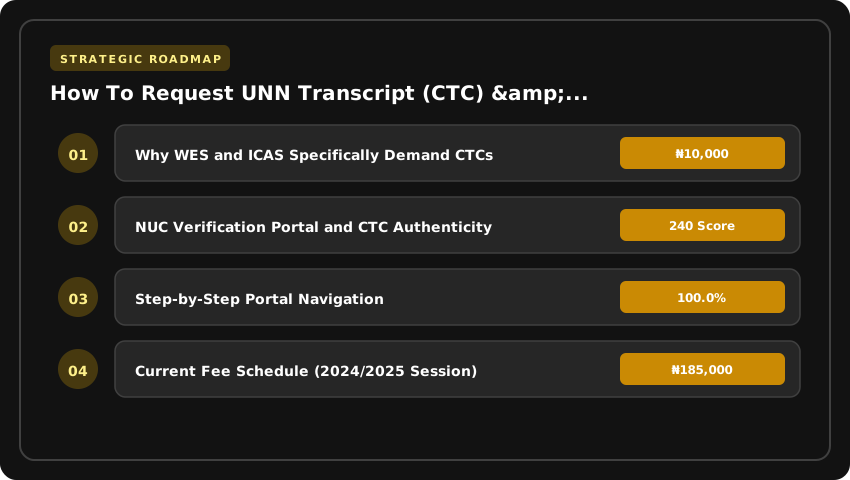
Why WES and ICAS Specifically Demand CTCs
World Education Services (WES) and the International Credential Assessment Service (ICAS) evaluate Nigerian qualifications for Canadian, Australian, and other international labour markets. These bodies require CTCs because they must cross-reference your declared credentials against verified institutional records. A standard transcript, no matter how professional it looks, can be fabricated or altered. The CTC stamp from your university’s Registrar serves as the first layer of trust that WES and ICAS build their assessment upon. Without it, your application sits in a rejection pile.
NUC Verification Portal and CTC Authenticity
The National Universities Commission (NUC) now operates the CCMAS (Central Clearing and Matriculation System) portal, which plays a growing role in verifying academic credentials across Nigerian institutions. When employers or immigration officers validate a CTC, they may cross-check it through NUC’s verification channels. This means your CTC must carry the correct institutional stamps, the Registrar’s signature, and a date of issue that aligns with NUC’s records. A transcript without these elements is essentially worthless in federal recruitment exercises conducted by the Civil Service Commission.
- CTC: Stamped, signed, and verified by your university’s Registrar — required for visas, WES/ICAS, and federal jobs.
- Standard Transcript: Acceptable for personal records, internal applications, or where explicitly stated by the requesting body.
- Always confirm the specific document type before applying through JAMB CAPS, NELFUND, or international evaluation portals.
The bottom line is straightforward. Before you submit any application — whether to a Canadian visa officer, a WES evaluator, or the Nigerian Civil Service — confirm whether they require a CTC or a standard transcript. Requesting the wrong document type is the fastest way to watch your application collapse at the first hurdle. Plan ahead, visit your university’s Academic Registrar, and get that CTC properly certified.
UNN Transcript Request Walkthrough: Portal Navigation, Fees (₦), & Processing Timelines
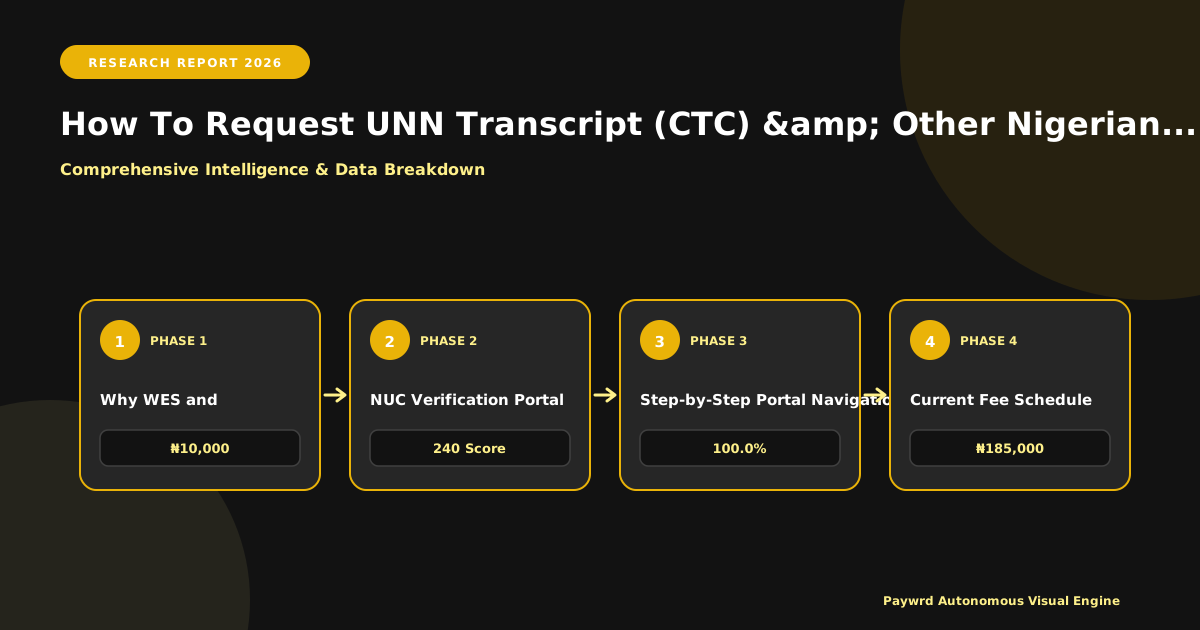
Let’s cut through the noise. If you graduated from the University of Nigeria, Nsukka (UNN), the Transcript Portal at portal.unn.edu.ng is your primary gateway—physically queuing at the Registry in Nsukka or Enugu is largely a legacy fallback for exceptional cases or verification disputes. The digital workflow is mandatory for the vast majority of alumni now, whether you are in Lagos, London, or New York.
Step-by-Step Portal Navigation
- Log in to portal.unn.edu.ng using your matriculation number and password (or create an alumni account if you never activated yours).
- Navigate to the Transcript Request tab under Student Services or Alumni Services.
- Select the destination type: Local (Nigerian addresses/institutions) or International (Foreign embassies, WES, ICAS, universities abroad).
- Fill in the recipient details exactly as they appear on the request letter—WES requires a specific Reference Number; foreign universities need the Registrar’s official address.
- Submit to generate your Remita Retrieval Reference (RRR). Do not close the page until you copy this code.
Current Fee Schedule (2024/2025 Session)
UNN reviews fees periodically, but the current approved band sits here:
- Local Delivery: ₦5,000 – ₦7,500 (covers processing + EMS/Speedpost within Nigeria).
- International Delivery: ₦12,000 – ₦15,000 (covers processing + DHL/FedEx international courier charges).
- Certified True Copy (CTC) Surcharge: Occasionally an extra ₦1,000–₦2,000 if you need the Registrar’s physical stamp on a separate certification letter.
Pro Tip: Pay via the Remita portal (remita.net) using the RRR—Card, USSD, or Bank Branch. Keep the PDF receipt; the system auto-links payment to your request, but screenshot the “Payment Successful” page as your insurance.
Tracking & Realistic Timelines
After payment, return to the UNN portal. The status moves: Pending Payment → Processing → Dispatched → Delivered. Here is the truth on speed:
- Local: 2–4 weeks during off-peak; 4–6 weeks during NYSC mobilization or convocation peaks.
- International: 3–6 weeks minimum. Courier logistics (DHL customs clearance) add unpredictable days.
If your status stalls at Processing beyond 3 weeks, email transcripts@unn.edu.ng with your RRR, Matric Number, and a polite follow-up. Do not rely solely on the portal auto-emails—they often lag. For urgent visa deadlines, budget 6 weeks minimum from payment date; anything less is gambling with your travel date.
Comparative Workflow: Requesting Transcripts from UI, OAU, UNILAG, ABU & Federal Varsities
If you are applying to multiple Nigerian institutions or chasing visa approvals simultaneously, understanding how each university handles Certified True Copy (CTC) requests is the difference between a smooth run and weeks of frustrating follow-ups. The workflow varies dramatically depending on whether you are dealing with a fully digital system, a hybrid manual-digital model, or an institution with unique clearance bottlenecks.
Fully Digital Portals: UI & UNILAG
The University of Ibadan (UI) and the University of Lagos (UNILAG) have moved aggressively toward digital transcript processing. UI directs applicants through its Online Academic Records system, where you submit requests, pay processing fees (typically ₦5,000–₦15,000 depending on urgency), and track delivery electronically. UNILAG operates a similar framework through its Registrar’s office portal, though you should expect occasional portal downtime during peak academic calendar periods. Both institutions offer relatively predictable turnaround times of 5–10 working days for standard requests.
Hybrid Manual-Digital Systems: OAU & ABU
Obafemi Awolowo University (OAU) and Ahmadu Bello University (ABU) still blend digital intake with physical verification. At OAU, you may initiate your request online, but the institution requires original documents or handwritten authorization letters before the Academic Registrar releases a CTC. ABU follows a comparable pattern where your faculty must countersign the request before it reaches the central records office. Budget extra time here — expect 10–15 working days, and always confirm your faculty’s clearance status before assuming the process is stalled at the registry level.
State Universities: The Bursary Clearance Bottleneck
State universities like Lagos State University (LASU), Delta State University (DELSU), and Kaduna State University (KASU) present a unique hurdle that many applicants overlook: bursary clearance. Before these institutions will issue any CTC, they require proof that your student account is fully settled. If you owe any library fines, accommodation fees, or departmental levies — even as small as ₦2,000 — your transcript request will be held indefinitely. Always visit the bursary office first, obtain a formal clearance letter, then proceed to the academic records unit. Skipping this step is the single most common reason for rejected applications.
Private Universities: Expedited 48-Hour Services
Here is where things get exciting. Private institutions like Covenant University, Babcock University, and Afe Babalola University (ABUAD) have streamlined their CTC processes to compete with global standards. Covenant University, for instance, can deliver a certified transcript within 48 hours for a premium fee ranging from ₦10,000 to ₦25,000. Babcock and Afe Babalola follow similar expedited models, leveraging smaller student populations and centralized administrative structures to bypass the bureaucratic delays common in federal institutions.
- Fastest Tier: Covenant, Babcock, Afe Babalola — 48–72 hours
- Standard Digital Tier: UI, UNILAG — 5–10 working days
- Hybrid Tier: OAU, ABU — 10–15 working days
- Bottleneck Tier: LASU, DELSU, KASU — variable, bursary-dependent
The JAMB Matriculation Number & NIN Verification Bottleneck (Post-2020 Graduates)
If you graduated from a Nigerian university between 2020 and now, there is a good chance your transcript request has hit a wall — and that wall has a name: the JAMB Matriculation Number and NIN verification bottleneck. Since the Joint Admissions and Matriculation Board tightened its data alignment protocols, the JAMB profile code linked to your university record must match exactly what appears on your NIN and your academic documents. When it does not, the NUC Verification Portal returns a dreaded “No Record Found” error, and your Certified True Copy request stalls indefinitely.
Linking Your JAMB Profile Code to the University Transcript Request
Here is what most graduates miss: your JAMB profile code is not just for UTME registration. Universities now use it as a cross-reference key when processing transcript and CTC requests. When you submit your request through your institution’s academic registry or the NUC CCMAS portal, the system pulls your JAMB number to validate your admission records. If your profile code is missing, incorrect, or tied to a different name variant, the verification chain breaks immediately. Before you request any transcript, log into your JAMB profile on the official JAMB portal, confirm your profile code, and ensure it matches the name and date of birth on your university records. If there is a mismatch, you need to resolve it at the JAMB office or through your university’s admissions unit before proceeding.
Resolving the ‘No Record Found’ Error on the NUC Verification Portal
The NUC Verification Portal (accessible via the NUC CCMAS system) is the final gatekeeper for transcript authentication. When you encounter a “No Record Found” error, it typically means one of three things: your JAMB data has not been synchronized with the university’s records, your NIN was not linked to your admission file, or your institution has not yet uploaded your graduation data to the NUC database. Start by visiting the NUC portal and entering your matriculation number exactly as it appears on your student ID. If the error persists, contact your university’s Academic Registrar directly and request a data reconciliation. In many cases, a simple update request filed by your institution resolves the issue within two to four weeks. Do not ignore this error — it will block your CTC, visa application, and employment screening.
Correcting Name Discrepancies: Affidavit vs. Gazette vs. JAMB Correction
Name mismatches are the silent killer of transcript requests. If your JAMB records show “Chukwuma” but your university certificate reads “Chukwuemeka,” you have a problem. Here is how to handle each path:
- Affidavit: A sworn statement before a Magistrate or Commissioner of Oaths confirming your correct name. This is accepted in many cases but carries less weight than a Gazette entry.
- Gazette: An official government publication announcing your legal name change. This is the strongest document for correcting institutional records and is typically required for federal employment shortlists.
- JAMB Correction: A direct update to your JAMB profile through the JAMB office or their online correction portal. This resolves the mismatch at the source and costs around ₦2,500 per correction, though fees may vary.
Always pursue the JAMB correction first, then update your university records. The Gazette should be your backup if a legal name change is involved. Getting this sequence right saves months of frustration and keeps your transcript timeline on track.
Courier & Delivery Logistics: Sending CTC to WES, ICAS, NELFUND & Foreign Embassies
Getting your Certified True Copy from the university is only half the battle. The real danger zone begins when you hand it to a courier. A single routing mistake or unsealed envelope can land your document back at square one — at additional cost you did not budget for.
Approved Couriers: DHL, NIPOST EMS & FedEx vs. University Dispatch Riders
For international destinations like WES (World Education Services) or ICAS (International Credential Assessment Service), DHL remains the gold standard. Most embassies and credential evaluation bodies specifically require DHL or FedEx because these services provide end-to-end tracking and proof of delivery. A typical DHL shipment from Lagos or Nsukka to a North American address costs between ₦25,000 and ₦55,000 depending on weight and destination.
NIPOST EMS is a viable and significantly cheaper alternative for domestic deliveries or within-West-Africa submissions. Expect rates around ₦3,500 to ₦8,000 for interstate transport. However, NIPOST EMS lacks the granular tracking transparency that WES and ICAS auditors prefer, so confirm with your destination body before choosing this option.
Many universities offer in-house dispatch riders, particularly UNN, which charges a nominal fee through its Registry. These are excellent for local pickups but are almost never accepted for international credential evaluations. The receiving institution abroad will not recognize a university-staffed rider as a verifiable shipping method.
Sealing Requirements: The Stamp and Signature Rule
This is where most Nigerian applicants fail. WES and ICAS require your CTC to arrive in a sealed envelope with the official university stamp placed across the flap — not merely on the document inside. The Registrar or Academic Registrar must also sign across the seal. If the envelope arrives opened or with a sticker seal instead of an institutional stamp, the evaluating body will reject it outright and request a resubmission, which adds weeks and another ₦15,000 to ₦30,000 in processing fees.
Before dispatching, photograph the sealed envelope showing the stamp and signature. This reference image protects you if a dispute arises about tampering during transit.
Electronic Transmission: e-Script and National Postgraduate College Options
Some institutions now support e-Script transmission, where your verified transcript is sent digitally through a secure platform. The National Postgraduate College also offers digital credential services for PG candidates. While faster and cheaper, not all foreign bodies accept e-Script as a substitute for a physical sealed CTC. Always verify acceptance with WES, ICAS, or NELFUND before opting for the digital route.
- Use DHL or FedEx for international WES/ICAS submissions.
- Confirm NIPOST EMS acceptance before domestic shipping.
- Never use university dispatch riders for foreign credential evaluations.
- Seal with institutional stamp across the flap and Registrar’s signature.
- Verify e-Script acceptance with NELFUND before choosing digital transmission.
Troubleshooting Rejected Transcripts: Common Errors, Re-issue Costs & Appeal Process
Receiving a rejection on your Certified True Copy can feel devastating, especially when deadlines are non-negotiable. But here is the good news: most rejected transcripts are fixable. The key is understanding why your document was turned down and knowing exactly which door to knock on next.
Missing Senate Approval Stamp or Wrong Registrar Signatory
This is the single most common reason CTCs get rejected by JAMB CAPS, NELFUND, or visa processing units. Your transcript must bear the Senate Approval Stamp — a validation mark confirming that the academic Senate formally endorsed the document. Without it, the document is essentially an unsigned draft. Similarly, the signatory must be the current Registrar or Academic Registrar of your university. A transcript bearing a Dean’s signature alone, or a retired Registrar’s stamp, will raise immediate red flags.
- Visit your university’s Academic Registry and request a Senate endorsement on the existing CTC.
- Confirm the current Registrar’s name and official stamp through the NUC CCMAS portal.
- Some institutions like UNN require a separate verification letter alongside the CTC for external use.
Grade Disputes: Senate Appeal vs. Departmental Re-computation
If your transcript was rejected because of a grade discrepancy, you have two distinct paths. A Departmental Re-computation involves your faculty reviewing the original exam scripts and grading rubrics to confirm or correct the scores. This route is faster but limited to clerical or computational errors. A Senate Appeal is a formal process where you petition the university Senate to review the departmental decision. This is appropriate when you believe the grading was substantively unfair or inconsistent with established marking standards.
Start with the departmental route — it typically resolves within two to four weeks. If unsatisfied, escalate to the Senate Committee on Academic Matters through your faculty’s Dean office. Keep every original marking sheet and course outline as supporting evidence.
Cost of Re-issue and 14-Day Expedite Feasibility
Most Nigerian universities charge between ₦10,000 and ₦20,000 for a CTC re-issue, depending on institution and processing tier. UNN falls squarely within this range, while some newer federal universities may charge slightly less. If you are facing a tight deadline, a 14-day expedite is technically feasible at most institutions, but it usually requires an additional urgent processing surcharge of around ₦3,000 to ₦5,000. Confirm current fees directly through your university’s bursary or registry office, as rates are reviewed periodically.
Budget for at least ₦25,000 total to cover the re-issue, potential re-computation fees, and any supplementary verification letters. This buffer ensures you are not caught short when multiple agencies like NELFUND or JAMB CAPS request separate attestations.
Power of Attorney & Third-Party Collection: Authorizing Agents Legally in Nigeria
If you are sitting abroad or tied up with work deadlines, you do not need to physically queue at the University of Nigeria Nsukka (UNN) registry to collect your Certified True Copy (CTC). Nigerian universities increasingly permit third-party collection, but only when backed by a legally sound Power of Attorney (POA). Without one, your agent will be turned away at the gate—and your visa or employment timeline crumbles.
Drafting a Valid Power of Attorney for Transcript Collection
A POA for academic document retrieval is not a generic template you download from the internet. It must specifically name the university, the type of document being collected (CTC, degree certificate, or transcript), and the exact scope of authority granted. Include your full legal name as the principal, your matriculation number or registration number, and your current contact details. The agent’s full name, passport photograph, and a valid means of identification must appear explicitly. Most Nigerian registries, including UNN’s Academic Registrar office, require the POA to state that it is “not revocable for the purpose of this specific transaction” to prevent ambiguity. Keep the language clear, direct, and free of vague phrases like “any documents whatsoever.”UNN Official Portal
Notarization Requirements: Commissioner for Oaths vs. Notary Public
This is where many diaspora applicants stumble. In Nigeria, a POA can be authenticated by either a Commissioner for Oaths or a Notary Public, but they are not interchangeable in every context. A Commissioner for Oaths, typically found at magistrates’ courts or among legal practitioners, is ideal for affidavits and statutory declarations within Nigeria. A Notary Public, however, carries international recognition—critical if your agent is collecting documents on your behalf while you are overseas. For foreign-based principals, having the POA notarized by a Notary Public in your country of residence, then authenticated by the nearest Nigerian High Commission or Embassy, adds an extra layer of legitimacy that Nigerian registries trust. Do not assume a regular lawyer’s stamp suffices; the seal must be from an officially designated notary.
Agent ID Requirements: International Passport vs. NIN vs. Driver’s License
When your agent arrives at the registry, they will need more than the POA. Nigerian universities now demand government-issued photo identification. Here is the hierarchy of acceptance:
- International Passport — the gold standard, especially for agents operating across borders. It satisfies both the university and immigration checkpoints.
- National Identification Number (NIN) — accepted for domestic agents, though some registries require it alongside a driver’s license for verification.
- Driver’s License — widely accepted within Nigeria but may be rejected by strict registry officers if it appears expired or lacks a recent photograph.
Always carry at least two forms of ID. A passport photograph matching the one on the POA is non-negotiable. Registrars cross-reference these documents meticulously, and a single mismatch can halt the entire process. Plan ahead, delegate smartly, and never let paperwork cost you your future.
| Criteria | Standard Transcript | Certified True Copy (CTC) |
|---|---|---|
| Verification Level | Academic Record Summary | Legally Verified Original Copy |
| Authentication | University Seal/Stamp | Registrar’s Signature & Official Stamp |
| Primary Use Case | General Job Applications | Visa Applications & Foreign Admissions |
| Risk of Rejection | High (for official government use) | Very Low (Industry Standard) |
| Processing Time | 2-6 Weeks (Average) | 1-4 Weeks (Depending on Institution) |
| Cost (Est.) | ₦5,000 – ₦20,000 | ₦10,000 – ₦30,000 |
Frequently Asked Questions
What is the difference between a UNN transcript and a CTC?
A standard UNN transcript is a record of your academic performance. A Certified True Copy (CTC) is a specific version of that transcript or certificate that has been officially verified, signed, and stamped by the University Registrar, confirming it is an authentic duplicate of the original document for legal or visa purposes.
How do I request a Certified True Copy (CTC) from a Nigerian university?
To request a CTC, visit your university's portal or Registrar's office. You typically need to provide your matriculation number, a clear photocopy of the document to be certified, and proof of payment for the certification fee. Some universities now offer online requests via their academic transcript portals for international delivery.
Why is a CTC required for visa applications and foreign admissions?
Visa officers and foreign universities require a CTC to prevent document fraud. Because a CTC is signed and stamped by the university's Registrar, it serves as a legal guarantee that the document is not forged, making it the only acceptable format for official government and international academic screenings.
How long does it take to get a transcript from UNN in 2024?
Processing times for UNN transcripts vary based on the method of request. Online applications typically take 2 to 6 weeks for processing. However, timelines can be extended during peak graduation seasons. It is recommended to apply at least two months before your submission deadline to avoid delays.
Can I use a scanned copy of my transcript instead of a CTC?
While some initial application stages allow scanned copies, final verification for visas or federal employment almost always requires a physical CTC or a direct electronic transmission from the university to the institution. Submitting a standard scan where a CTC is requested often leads to immediate application rejection.
Strategic Final Takeaway
When evaluating How To Request Academic Transcript CTC From UNN And Other Nigerian Universities, base your decisions on accredited institutional standards, measurable return on investment (ROI), and up-to-date official guidelines. Always verify specific dates and requirements through official regulatory portals.