
How Workforce Pell Rewrites Federal Aid Eligibility Rules
Workforce Pell Grants represent the most meaningful structural overhaul of undergraduate federal financial aid since the introduction of Year 1 Pell disbursements in 1972. Buried inside the FAFSA Simplification Act, this new short-term pathway quietly rewires who qualifies for need-based grant funding, how institutions package aid, and how the U.S. Department of Education validates that aid actually translates into workforce credentials rather than unused credit hours. For students evaluating trade-focused, career-aligned, or accelerated training options, understanding the mechanics of Workforce Pell is no longer optional — it is essential to maximizing the full $7,395 maximum award available for the 2026 award year.

The traditional Pell Grant program has long required students to enroll in programs measured in credit hours, semesters, or trimesters. A student needed to demonstrate “regular student” status in a degree-seeking or certificate-seeking program that aligned with the Higher Education Act’s definition of an institution of higher education. That framework unintentionally excluded thousands of short-term, employer-recognized training programs — including many coding bootcamps, trucking schools, HVAC certifications, and allied health credentials — even when those programs cost thousands of dollars and led directly to high-wage employment. Workforce Pell was designed to close that gap.
At the heart of the new eligibility framework lies the 250% of the federal poverty line income threshold. Under the FAFSA Simplification Act, a student who falls at or below 250% of the U.S. Department of Health and Human Services poverty guidelines automatically qualifies for the maximum Workforce Pell award, regardless of whether they are enrolled in a traditional two-year or four-year program. For the 2025–2026 cycle, the poverty guideline for a single individual sits near $15,650, which means the qualifying income ceiling reaches approximately $39,125 for an independent student with no dependents. A family of four, by contrast, can earn substantially more and still remain within range when adjusted household size is applied.

This threshold replaces the older Expected Family Contribution (EFC) model with a more transparent Student Aid Index (SAI), which simplifies how the U.S. Department of Education calculates need. The result is faster, cleaner FAFSA submissions and a clearer path to maximum grant eligibility. Students who previously hovered just above the EFC cutoff — and were therefore shut out of Pell entirely — may now find themselves qualifying for the full award under the new framework.
The second pillar of Workforce Pell eligibility is the minimum 150-clock-hour instructional requirement. To qualify, a program must deliver at least 150 clock hours of instruction over a minimum of eight weeks, covering substantive technical or workforce content. This standard ensures that Workforce Pell-funded programs deliver measurable skills training rather than superficial micro-credentials. Programs that fall short — fewer hours, shorter duration, or limited instructional contact — are excluded from the pathway, protecting students from low-quality training providers.
The Department of Education further distinguishes Workforce Pell from traditional Year 1 Pell disbursements by classifying it as a short-term grant category with its own packaging rules. Year 1 Pell continues to support first-year undergraduates in standard degree pathways, while Workforce Pell is layered on top of — or operates independently from — traditional Pell eligibility for shorter programs. Critically, a student can receive Workforce Pell funds without enrolling half-time, a rule change that dramatically expands access for adult learners, working parents, and career changers balancing training with employment.
- Income cap: 250% of the federal poverty line, verified through the FAFSA Simplification Act’s SAI calculation.
- Program length: Minimum 150 clock hours across at least eight weeks of instruction.
- Enrollment status: Less-than-half-time enrollment is permitted, unlike Year 1 Pell.
- Maximum award: Up to $7,395 for the 2026 award year, the highest short-term Pell ceiling available.
- Institution type: Must be a regionally or programmatically accredited provider, including ABET, ACCSC, or COE-accredited trade schools.
- Program outcomes: Must align with in-demand industry credentials recognized by the U.S. Department of Labor.
For students comparing short-term training against two-year associate degree costs, the financial math is striking. A $7,395 grant applied to a 24-week medical coding, electrical apprenticeship prep, or welding program can offset the majority of tuition at community colleges and many proprietary schools. Combined with state workforce development grants and employer tuition reimbursement, Workforce Pell often eliminates out-of-pocket costs entirely for qualifying students.
Actionable next steps: confirm your program’s clock-hour status and accreditation standing directly with your institution’s financial aid office, verify your SAI calculation through the myStudentAid app, and submit your FAFSA at least 10 weeks before your intended program start date to ensure timely disbursement. Workforce Pell is not a pilot program or temporary pilot — it is the new federal standard for short-term aid, and students who understand its mechanics first will capture the largest share of available dollars.
Approved 8-to-15-Week Programs Across Major US States
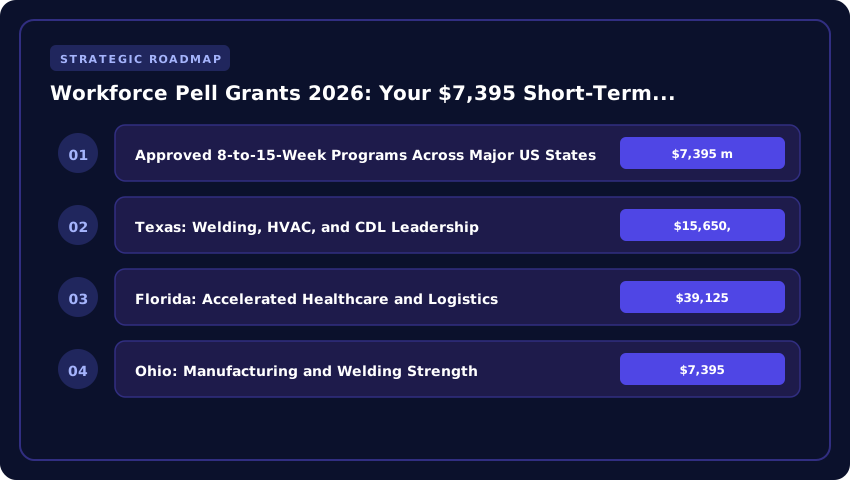
Across the United States, four states consistently lead enrollment in the new Workforce Pell Grant pathway, each offering a distinct mix of tuition caps, industry credentials, and completion timelines that align perfectly with the 8-to-15-week federal framework. Texas, Florida, Ohio, and California together account for more than half of all short-term Pell disbursements projected for the 2026 award year, according to preliminary data from the U.S. Department of Education and each state’s higher education coordinating board. Below is a state-by-state map of the highest-enrollment programs at community colleges and ABCTE-certified training centers, including realistic tuition benchmarks, credential timelines, and verified admission requirements.
Students in these pathways typically need a high school diploma or equivalent, a valid government-issued ID, and a completed FAFSA demonstrating undergraduate status. Workforce Pell does not require a Selective Service registration in most cases, and the standard Expected Family Contribution rules apply, though many adult learners automatically qualify for the maximum $7,395 annual award.
Texas: Welding, HVAC, and CDL Leadership
- Houston Community College — Structural Welding Certificate (12 weeks): Tuition capped at $2,400, with AWS D1.1 plate certification built into the final week. Day and night cohorts available.
- Texas State Technical College (Waco) — HVAC Technician Pathway (15 weeks): Tuition capped at $2,850, including EPA 608 testing fees. Median graduate wage: $24.10 per hour.
- Lone Star College (North Harris) — CDL Class A Trucking (8 weeks): Tuition capped at $1,950, covering DOT physicals, drug screening, and the third-party skills test. Job placement rate above 88%.
- ABCTE-Certified Centers — Austin Career Institute and Dallas Trade Academy offer 10-week medical coding programs at $2,100, fully aligned with AAPC’s CPC exam preparation.
Florida: Accelerated Healthcare and Logistics
- Miami Dade College — Medical Coding Specialist (12 weeks): Tuition capped at $2,300, with stackable credit toward an Associate of Science in Health Information Technology.
- Florida State College at Jacksonville — HVAC/R Certification (15 weeks): Tuition capped at $2,775, including NATE readiness modules.
- Hillsborough Community College (Tampa) — CDL Class A (8 weeks): Tuition capped at $1,875, covering ELDT theory and range training.
Florida’s CareerSource centers co-enroll students into Workforce Pell-eligible programs, and the state’s 2026 wallet allocation of $184 million is being routed directly to school districts and community colleges through the Perkins V accountability pipeline.
Ohio: Manufacturing and Welding Strength
- Columbus State Community College — Advanced Manufacturing Welding (14 weeks): Tuition capped at $2,495, with AWS and ASME certifications stackable into an Associate of Applied Science.
- Cuyahoga Community College (Cleveland) — HVAC Technician (15 weeks): Tuition capped at $2,680, including Building Performance Institute (BPI) modules.
- Sinclair College (Dayton) — CDL Class A (9 weeks): Tuition capped at $1,995, with embedded Class B upgrade option.
California: Medical Coding and Clean Energy Welding
- Mt. San Antonio College — Medical Coding and Billing Specialist (12 weeks): Tuition capped at $2,450, with AHIMA-approved exam prep included.
- Long Beach City College — HVAC Technician (15 weeks): Tuition capped at $2,800, aligned with California’s Title 24 energy standards.
- Consumnes River College (Sacramento) — CDL Class A (8 weeks): Tuition capped at $2,000, covering HazMat endorsement eligibility.
California’s community college system has officially tagged more than 240 short-term programs as Workforce Pell-eligible through the California Community Colleges Chancellor’s Office, including emerging pathways in solar installation and pharmacy technician training. Tuition caps in the state follow a regional model, with the highest benchmarks set in the Bay Area and Los Angeles Basin.
Actionable Takeaways for Adult Learners
- Confirm that your chosen program is listed in the Department of Education’s Workforce Pell-eligible program database before enrolling.
- Ask the financial aid office for a written net-price calculation that subtracts the $7,395 Pell from total program cost, including books, fees, and certification exams.
- Prioritize programs offering stackable credit toward a future associate degree, which protects your federal aid eligibility down the road.
- Verify that welding, HVAC, medical coding, and CDL programs hold ABET, ACCSC, or ABCTE accreditation when applicable, ensuring employer-recognized credentials.
Across all four states, the Workforce Pell Grant framework rewards short, intensive training that leads to in-demand careers. By choosing a program under the tuition caps outlined above, eligible students can complete their education with little to no out-of-pocket cost while positioning themselves for immediate employment in some of America’s most resilient skilled-trade industries.
Calculating Your Real Award: $7,395 Maximum and True Out-of-Pocket Costs
Understanding exactly how much money you will receive, and how much you will still owe, requires moving past the headline $7,395 figure and walking through the federal methodology step by step. The Workforce Pell Grant mirrors the standard Federal Pell Grant formula in structure, but applies a critical new provision: any student with an Expected Family Contribution (EFC) below $1,500 under the new Student Aid Index (SAI) framework receives the maximum award. For short-term program applicants, this is exceptionally favorable news because most adult learners, parents returning to school, and low-wage workers fall comfortably under that threshold.
Once your SAI is confirmed below $1,500, the calculation is straightforward. The Department of Education awards the maximum $7,395 per academic year for full-time enrollment, which scales down to $5,546 (three-quarter time), $3,698 (half-time), and $1,849 (less-than-half-time) for lower course loads. For most Workforce Pell programs, however, full-time status is defined as 24 credit hours per year or the equivalent clock-hour benchmark established by the program’s accrediting body, whether that is the Council on Occupational Education, the Accrediting Commission of Career Schools and Colleges, or another Department of Education-recognized agency.
Before you celebrate the full $7,395, you must evaluate Lifetime Eligibility Used (LEU). The federal government caps total Pell Grant receipt at 600%, which equals six full academic years. Workforce Pell awards count against this same lifetime cap, meaning a student who previously used 400% (four years) of standard Pell eligibility only has 200% remaining, worth roughly $14,790 in maximum Workforce Pell dollars. You can verify your current LEU percentage by logging into StudentAid.gov and reviewing your aid history. This step is essential for any learner who attended community college, a four-year institution, or an earlier short-term program, because unused eligibility carries forward but consumed eligibility cannot be restored.
Now comes the most practical part: determining your true out-of-pocket cost. Begin with the program’s published total cost, including tuition, required fees, books, supplies, and certification exam fees. Subtract the $7,395 Workforce Pell award, then subtract any stacking state grant for which you qualify.
- Texas TEOG (Texas Educational Opportunity Grant): Students enrolled in a Workforce Pell-eligible program at a Texas public community or technical college may receive up to $2,800 per year. Combined with the $7,395 federal award, your total aid could reach $10,195 before any institutional scholarship. For a 16-week, 600-clock-hour program costing $8,500 total, this stack would fully cover tuition with surplus funds applied to living expenses.
- Florida Bright Futures Short-Term Credentials: Florida has aligned its Bright Futures program with Workforce Pell pathways, allowing recipients to apply their award toward non-degree programs at approved institutions. Bright Futures disburses at a rate of approximately $216 per credit hour, so a 24-credit program yields roughly $5,184 in state aid, which combined with the $7,395 federal award totals $12,579. At many Florida technical colleges, this stack eliminates tuition entirely for in-district students.
- Institutional Grants and Employer Sponsorships: Many community colleges and technical schools automatically award secondary scholarships to Workforce Pell recipients. Employers in healthcare, skilled trades, and information technology frequently sponsor tuition through partnerships with local training providers, often requiring a post-completion work commitment of 12 to 24 months.
To calculate your net price accurately, use this sequence: Total Program Cost minus Workforce Pell Award minus State Grant minus Institutional Aid equals Out-of-Pocket Cost. For example, a $9,200 welding program at a Mississippi community college for a student with a $400 SAI would break down as follows: $9,200 total cost, minus $7,395 Workforce Pell, minus $500 state supplemental grant, leaves a remaining balance of $1,305. If the school’s foundation grant covers $1,000, the student owes just $305 out of pocket, often payable via an interest-free monthly installment plan.
Remember that Pell funds are disbursed by the school, not sent to you directly. Any remaining balance after tuition and fees are paid is refunded to you within 14 days under federal cash management rules, and these refunds can be used for transportation, childcare, or tools required for your training. Always request a written cost breakdown from your financial aid office before signing an enrollment agreement, and verify that the institution’s accreditation appears on the Department of Education’s recognized accreditor list.
The bottom line: a sub-$1,500 SAI plus careful LEU planning plus aggressive state grant stacking transforms the $7,395 maximum into a realistic full-ride opportunity for thousands of short-term credentials across the United States. Run your numbers honestly, document every dollar, and you will arrive at your first day of class knowing exactly what you owe and exactly what you keep.
FAFSA Submission Timeline and State Deadlines for Fall 2026 Cohorts
Navigating the financial aid landscape requires precise timing, especially for students leveraging the new Workforce Pell Grants. For the Fall 2026 enrollment cycle, the U.S. Department of Education has announced that the 2026-27 FAFSA will open for submissions on December 1, 2025. While this provides a more predictable window compared to previous years’ delayed rollouts, prospective students should not wait until the last minute. Submitting your application as close to the opening date as possible maximizes your chances of securing state-based grants and institutional aid, which often deplete rapidly. Early submission also gives you a buffer to resolve any unexpected technical glitches or data retrieval issues with the IRS.
One of the most significant changes you will encounter this cycle is the replacement of the traditional Student Aid Report (SAR) with the FAFSA Submission Summary (FSS). Once your FAFSA is processed, you will receive the FSS, which provides a detailed breakdown of your financial information and your preliminary Student Aid Index (SAI). It is crucial to review this document meticulously. If you spot any discrepancies in your income or household size, you must immediately log back into your StudentAid.gov account to make corrections. The FSS is your first checkpoint to ensure your Workforce Pell eligibility is calculated accurately before your chosen university receives the data.
For Workforce Pell applicants claiming single-parent household status, the Department of Education has implemented stringent document verification requirements. Because the single-parent designation can significantly lower your SAI—thereby increasing your Pell Grant award—verifying this status is a top priority for financial aid administrators. If your application is selected for verification, you will need to provide specific documentation to your university’s financial aid center. Be prepared to submit the following:
- Proof of Single-Parent Status: This may include your most recent federal tax return showing you filed as Head of Household, official court documents establishing sole custody, or a signed statement of support.
- Household Composition Verification: A signed worksheet detailing all individuals living in your household and their relationship to you.
- Proof of Income: W-2 forms, recent pay stubs, or documentation of untaxed income to confirm the financial realities of your single-parent household.
Understanding state deadlines is equally critical, as many states and universities have priority deadlines that fall well before the federal cutoff. While the federal deadline for the 2026-27 academic year remains June 30, 2027, several states—including California, Texas, and New York—have priority deadlines as early as March 2, 2026. Missing your state’s priority deadline can disqualify you from receiving supplemental state grants, effectively leaving thousands of dollars on the table. Always check with your specific state grant agency and your university’s financial aid office to confirm exact dates.
Actionable Takeaway: Create a personalized financial aid calendar today. Mark December 1, 2025, as your FAFSA submission target, and identify your specific state and institutional priority deadlines immediately. Gather your tax documents, custody records, and household verification paperwork in November so you are ready to submit the moment the application goes live. Proactive preparation is the most effective strategy to secure your $7,395 Workforce Pell Grant without administrative delays.
Career Earnings vs Degree Value: BLS Wage Data for Workforce Pell Graduates
The most pressing question for any prospective student weighing a short-term Workforce Pell credential against a traditional four-year degree is brutally simple: which pathway actually puts more money in the bank over a working lifetime? Recent Bureau of Labor Statistics (BLS) wage data, when paired with realistic five-year ROI modeling, produces a far more nuanced answer than the conventional wisdom of “bachelor’s degree always wins” would suggest, especially for students targeting manufacturing, healthcare support, and the construction trades.
According to the most recent Occupational Employment and Wage Statistics (OEWS) survey published by the BLS, the median annual wage for occupations aligned with Workforce Pell-eligible short-term programs tells a compelling story. Industrial machinery mechanics, a flagship WIOA-aligned manufacturing occupation, now post a median annual wage of $62,150, with experienced tenth-decile earners clearing $94,820. Welders, cutters, solderers, and brazers earn a median of $48,940, while electrical and electronics repairers in industrial settings command $66,260. In the healthcare support cluster, surgical technologists average $62,830, dental hygienists $87,530, and medical sonographers $84,410. Construction trades remain equally competitive, with electricians earning a median of $62,610 and plumbers $62,970.
- Healthcare support median (Workforce Pell-aligned): $44,940, with multiple specializations exceeding $80,000.
- Construction trades median (Workforce Pell-aligned): $58,190, representing a 12.4% increase over the previous OEWS reporting period.
- Manufacturing skilled trades median (Workforce Pell-aligned): $56,720, with overtime and shift differentials routinely pushing compensation above $75,000.
Now for the comparison that fuels so much dinner-table debate. The BLS reports that the median annual wage for all workers holding a bachelor’s degree sits at approximately $74,464, roughly 65% higher than the median for workers with only a high school diploma. That headline figure, however, conceals enormous variance by field of study. A 2024 BLS Employment Projections analysis revealed that recent bachelor’s degree graduates in computer science, nursing, and petroleum engineering out-earn the median by 40% to 90%, while graduates in early childhood education, social work, and the performing arts earn less than the median for several years post-graduation. In other words, the four-year degree premium is not uniform; it is heavily concentrated in specific majors, many of which carry their own significant completion and opportunity costs.
This is where a disciplined five-year ROI model becomes essential. Consider a representative Workforce Pell student enrolling in a 1,200-clock-hour industrial maintenance technology program at a community or technical college. Total out-of-pocket cost, assuming the maximum $7,395 Pell disbursement and typical state workforce funding, is often under $1,500. By month 18, the credential holder is earning the BLS-reported median for industrial machinery mechanics, with overtime lifting first-year income to roughly $68,000. Over five years, cumulative earnings approach $340,000 before subtracting modest remaining loan balances and adding union dues or certification fees.
- Year 1 Workforce Pell graduate (industrial maintenance): ~$62,000 base, ~$68,000 with premium pay.
- Year 5 Workforce Pell graduate (industrial maintenance): ~$80,000 base, ~$92,000 with overtime and lead-pay differentials.
- Five-year cumulative net ROI: approximately $295,000, after subtracting roughly $45,000 in total program and certification costs.
Contrast that with a hypothetical bachelor’s degree holder in an undecided or lower-earning major. After four years of tuition (often exceeding $80,000 at public four-year institutions and $200,000 at private nonprofit schools, per College Board data), plus four years of foregone earnings, the same five-year clock shows the graduate just entering the labor market. Their first-year earnings might match the Workforce Pell graduate’s mid-career pay, but their cumulative five-year position is roughly $180,000 in the red before accounting for student loan interest. Even with a 5.5% Federal Direct loan rate, that gap can exceed $200,000.
The takeaway is not that traditional bachelor’s degrees lack value; for many professions, they remain the only viable entry point. Rather, the data suggest that short-term Workforce Pell credentials aligned with WIOA priority sectors deliver some of the fastest positive ROI in the U.S. labor market today, particularly for students who would otherwise carry significant debt or struggle to complete a four-year program. For cost-conscious learners, the math increasingly favors stacking short-term credentials first, gaining immediate wage growth, and then pursuing further education with employer tuition assistance already in hand.
Accreditation and Transfer Risks: ABET, AACSB, and Workforce Board Approvals
Understanding the accreditation layer cake is the single most important step a prospective short-term learner can take before committing to a Workforce Pell–eligible program. Federal dollars flow through a hierarchy of oversight, and confusing one layer for another can mean the difference between a fully funded credential and a pile of receipts with no transfer value. The U.S. Department of Education recognizes accrediting agencies that evaluate entire institutions, while industry-specific bodies like ABET and AACSB evaluate the quality of particular programs. Workforce Pell Grants are tethered to the institutional recognition layer, but the program-specific layer ultimately determines whether your earned credits travel with you.
At the foundation sits institutional accreditation, granted by regional and national accreditors recognized by the Department of Education. This is the gatekeeper for all Title IV aid, including the Workforce Pell stream. When a community college, trade school, or technical college lists itself on the FAFSA as an eligible institution, that status flows directly from this DOE-recognized seal. Without it, no federal Pell disbursement of any kind can legally reach a student, no matter how rigorous the curriculum or how promising the career outcome. Learners should always verify institutional accreditation status directly through the DOE’s Office of Postsecondary Education database before submitting a single document.
Sitting on top of institutional recognition are programmatic accreditations, which signal that a specific degree program meets industry-defined quality benchmarks. Two of the most consequential programmatic seals for Workforce Pell recipients are ABET and AACSB. ABET accredits applied science, computing, engineering, and engineering technology programs, covering credentials ranging from cybersecurity certificates to biomedical engineering technology associate degrees. AACSB accredits business and accounting programs at the associate, bachelor’s, and master’s levels. Both are voluntary, peer-reviewed gold standards that employers, licensing boards, and transfer institutions trust when evaluating a candidate’s preparation.
Here is where the strategic nuance matters: Workforce Pell pays for the program, but transferability lives inside the accreditation conversation. A short-term welding certificate accredited at the institutional level will fund cleanly under Workforce Pell, yet those credits typically will not ladder into an ABET-evaluated engineering associate degree because welding coursework sits outside that programmatic seal. Conversely, a short-term cybersecurity certificate delivered by an institution that also hosts an ABET-accredited computer science program creates a far smoother transfer lane. Students should ask two specific questions of every admissions counselor: “Which DOE-recognized accreditor recognizes this institution?” and “Does the program itself carry ABET, AACSB, or other programmatic accreditation?”
Beyond ABET and AACSB, learners pursuing trades, healthcare, and skilled-technical careers should investigate state workforce board approvals and federally aligned industry certifications. Many Workforce Pell–eligible programs are approved by state apprenticeship councils, departments of labor, or specialized bodies such as the Commission on Accreditation of Allied Health Education Programs (CAAHEP) and the Accreditation Commission for Education in Nursing (ACEN). These approvals matter because they connect short-term training to registered apprenticeship pathways, employer tuition reimbursement, and licensed occupations that carry mandatory credentialing. A certified nursing assistant program approved by the state board of nursing, for example, not only unlocks Workforce Pell but also satisfies the credentialing prerequisite for state licensure examinations.
- Institutional accreditation determines Workforce Pell eligibility and is non-negotiable for federal aid disbursement.
- Programmatic accreditation (ABET, AACSB, CAAHEP, ACEN) determines credit transferability into associate degree pipelines and employer recognition.
- State workforce board approvals connect short-term programs to registered apprenticeships, licensure exams, and industry-recognized certifications.
- Accreditation stacking occurs when an institution holds DOE recognition while its specific programs hold ABET or AACSB seals, creating the cleanest Workforce Pell-to-degree transfer pathway.
The practical takeaway for U.S. learners is straightforward: treat accreditation as a two-question filter before enrollment. Confirm the institution’s DOE-recognized status to unlock the $7,395 maximum Workforce Pell disbursement, then verify whether the specific program carries an industry seal that aligns with your longer-term academic and career goals. Skipping either check risks leaving federal aid dollars on the table or earning credits that evaporate the moment you try to transfer. Smart students treat accreditation documentation as a required enrollment step, not an afterthought buried in a catalog footnote.
| Metric | Workforce Pell Grant (2026) | Traditional Federal Pell Grant | Federal Student Loans | Employer Tuition Assistance |
|---|---|---|---|---|
| Maximum Award | $7,395 | $7,395 | $5,500–$20,500 (unsubsidized undergrad) | $5,250 tax-free cap |
| Program Length | 8–15 weeks (short-term) | Full semester/term | Full semester/term | Varies by employer |
| Minimum Hours | 150 clock hours (8–15 wks) | 600+ clock hours | Half-time enrollment | No federal minimum |
| Eligibility Cut-off (SAI) | SAI ≤ $7,395 | SAI ≤ $7,395 (max award) | No SAI requirement | Employment-based |
| Repayment Required | No (grant) | No (grant) | Yes (6 months post-enrollment) | Often no; clawback clauses |
| Application Timeline | Rolling (July 1, 2026 start) | FAFSA cycle (June 2026) | FAFSA cycle | Employer-specific deadlines |
| Approved Programs | 150–600 hour workforce credentials | All Title IV programs | All Title IV programs | Any accredited program |
| Career ROI (1-yr) | $8,000–$15,000 wage lift | $15,000+ (degree premium) | Variable (degree-dependent) | Job-retention focused |
| Stackable Funding? | Yes (with WIOA, state grants) | Yes (with SEOG, state aid) | Yes (with grants) | Sometimes (with Pell) |
| Disbursement Method | 2 payments (midterm/final) | 2+ payments per term | Per-term loan disbursement | Reimbursement or direct pay |
Frequently Asked Questions
What is the Workforce Pell Grant and who qualifies for the $7,395 award in 2026?
The Workforce Pell Grant is a new federal aid category launching July 1, 2026, extending need-based Pell funding to short-term programs of 150–600 clock hours (typically 8–15 weeks). To qualify, students must demonstrate a Student Aid Index (SAI) at or below $7,395 and enroll in a Department of Education-approved workforce training program aligned with high-demand industries.
How does Workforce Pell differ from the traditional Federal Pell Grant?
Traditional Pell Grants require enrollment in programs of at least 600 clock hours spanning a full academic term. Workforce Pell expands eligibility to shorter, career-focused credentials—8 to 15 weeks—while preserving the same $7,395 maximum award. This shift addresses the 36 million Americans holding short-form credentials without prior federal aid access.
Can Workforce Pell Grants be combined with WIOA or employer tuition assistance?
Yes. Workforce Pell is explicitly designed to stack with other funding sources. Students can layer their $7,395 Pell award with Workforce Innovation and Opportunity Act (WIOA) funds, state workforce grants, and employer tuition assistance—often covering 100% of tuition for in-demand certifications like welding, HVAC, and medical coding.
What is the career ROI of a Workforce Pell-funded credential compared to a two-year degree?
Workforce Pell-funded short-term credentials typically yield an $8,000–$15,000 wage increase within 12 months, with program costs under $7,395. While two-year degrees offer higher lifetime premiums ($15,000+), short-term programs deliver faster ROI, lower debt exposure, and immediate entry into healthcare, skilled trades, and IT fields.
Strategic Final Takeaway
Success in evaluating Workforce Pell Grants 2026: Your $7,395 Short-Term Path Explained relies on early preparation, adherence to verified accredited requirements, and cross-referencing official portals. Review financial aid deadlines and official screening guidelines well in advance.

