The Calculus Attrition Crisis: Quantifying the Engineering Dropout Pipeline
The numbers are difficult to ignore, and they are reshaping how American engineering schools think about their first-year curriculum. According to the most recent data compiled by the American Society for Engineering Education (ASEE), nearly 40% of students who declare an engineering major at a US university will either switch to a different field or leave higher education entirely before the start of their sophomore year. This is not a fringe statistic pulled from a single institution; it is a national pattern visible across public flagships, private research universities, and ABET-accredited programs in every region of the country. When educators trace the academic transcripts of these departing students, the fingerprints of two courses appear again and again: Calculus I and Calculus II.
Engineering deans have long referred to these courses as “filter” or “gatekeeper” classes, but the language softens a brutal reality. Calculus I and II function as the primary sorting mechanism in the STEM pipeline, determining who earns the privilege of continuing into thermodynamics, circuit analysis, statics, and differential equations. Students who earn a C or better in Calculus I have a roughly 75% chance of persisting in engineering, according to longitudinal tracking from institutions like the University of Michigan and Georgia Tech. Students who earn below a C, or who withdraw and retake the course, see their persistence rates plummet below 50%. Multiply that gap across the more than 150,000 first-year engineering students enrolled annually in US programs, and the scope of the pipeline leak becomes staggering.
The attrition is not distributed evenly across demographic lines, and this is where the crisis becomes a matter of educational equity. First-generation college students leave engineering majors at rates approximately 1.6 times higher than their peers whose parents hold bachelor’s degrees, according to data referenced in ASEE’s annual Engineering by the Numbers report. Community college transfer students, who represent one of the most promising and rapidly growing pathways into engineering, often arrive at four-year institutions only to find that their previously-earned calculus credits do not transfer cleanly, forcing them to retake courses they have already passed. This credit-loss phenomenon disproportionately affects low-income students and students from underrepresented racial and ethnic backgrounds, turning an already narrow gateway into something closer to a drawbridge.
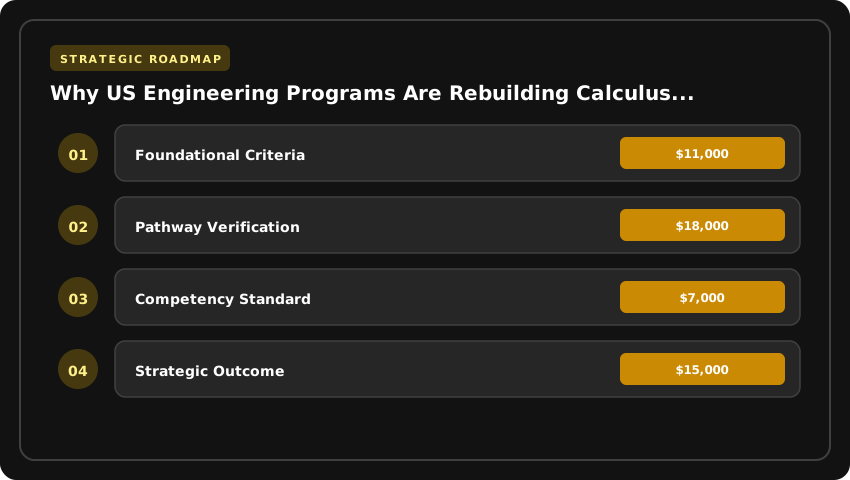
The financial consequences of this attrition ripple through every level of the higher education economy. When a student leaves an engineering program after two semesters, the university forfeits an average of $11,000 to $18,000 in tuition revenue per seat, depending on whether the student attended a public or private institution. At scale, this represents hundreds of millions of dollars in unrecoverable instructional costs annually. For students, the price is even heavier. Those who switch into general science or business degrees often add one to two semesters to their time-to-degree, costing an additional $7,000 to $15,000 in tuition, lost wages from delayed workforce entry, and the compounding interest on any federal FAFSA-subsidized loans they may have already accepted. Multiply this by hundreds of thousands of students, and the calculus attrition crisis costs the US engineering workforce billions of dollars in human capital annually, all while the Bureau of Labor Statistics projects that the country will need more than 140,000 new engineers each year through the end of the decade.
- 40% attrition rate for first-year engineering students, with Calculus I and II as the dominant filter courses.
- 1.6x higher dropout rate for first-generation students compared to continuing-generation peers.
- $11,000–$18,000 in lost tuition revenue per departing student, depending on institutional sector.
- 7,000–15,000 in added cost per student who switches majors, including extended time-to-degree and loan interest.
- 140,000+ new engineering positions projected annually by the BLS, a demand the current pipeline cannot meet.
Understanding the scale of these numbers is essential context for why engineering programs are now willing to fundamentally rebuild the calculus sequence. The crisis is not theoretical, and it is not localized. It is a measurable, costly leak in the talent pipeline that affects students, families, universities, and the broader US economy, and it has forced a long-overdue reckoning with how the gateway courses of engineering are taught, assessed, and supported.
Root Causes: Why Traditional Calculus Pedagogy Fails Engineering Students
To understand why American engineering programs are overhauling their foundational math requirements, we must first examine the structural mismatch at the heart of traditional calculus instruction. For decades, the standard model has relied on massive, 300-seat lecture halls where instruction is overwhelmingly abstract and proof-heavy. While this approach effectively prepares students for graduate studies in pure mathematics, it fundamentally misaligns with the needs of aspiring engineers. Engineering students do not need to prove the existence of a limit; they need to apply that limit to model fluid dynamics, analyze stress distributions, or optimize a control system. The traditional pedagogy prioritizes theoretical rigor over computational thinking and real-world problem solving, leaving students bewildered as to why they are learning the material in the first place.
This disconnect is often exacerbated by a cultural divide between math departments and engineering faculty. Mathematics departments typically design and teach these foundational courses, while engineering faculty rely on them as prerequisites for core major classes. When math professors emphasize analytical proofs, engineering professors find themselves having to reteach the applied concepts their students actually need to satisfy ABET accreditation standards. Furthermore, the over-reliance on high-stakes, make-or-break gatekeeper exams creates a toxic, high-pressure environment. A single midterm can derail a student’s semester, ignoring the reality that engineering is an iterative process of trial, error, and refinement. When a student fails a gatekeeper exam, they do not just lose a grade; they risk losing their enrollment status, their FAFSA eligibility, and ultimately, their $40,000 annual tuition investment.
Compounding these issues is the false sense of security generated by the College Board’s Advanced Placement (AP) Calculus pipeline. High school programs often teach to the AP test, focusing on rote memorization and specific problem archetypes rather than deep conceptual understanding. Consequently, many students arrive at US universities with AP credits, bypassing introductory calculus, only to hit a brick wall in Engineering Mechanics or Differential Equations. The AP pipeline creates a dangerous dichotomy: it either breeds false confidence in students who memorized derivative rules but cannot model a physical system, or it leaves deep, hidden gaps in foundational skills that surface too late to correct without expensive remediation.
- Abstract vs. Applied: Traditional calculus focuses on pure theory, whereas engineering requires applied modeling and computational analysis.
- Departmental Silos: Math faculty and engineering faculty rarely coordinate, causing a mismatch between what is taught and what is required for ABET compliance.
- The AP Illusion: Relying on College Board AP credits masks foundational gaps, leaving students unprepared for the rigors of actual engineering problem solving.
Active Learning and Flipped Classrooms: The Evidence-Based Interventions Working Now
Across the country, a quiet revolution is unfolding in the lecture halls where first-year engineering students used to sit silently through four 50-minute calculus sessions per week. The universities leading this transformation — including the University of Michigan, Purdue University, and the University of Texas at Austin — are replacing the traditional sage-on-a-stage model with structured active learning, flipped classrooms, and project-based modules that have moved calculus from a filter course to a genuine foundation for engineering success.
At the University of Michigan, the College of Engineering’s Math and Engineering Problem-Solving (MEPS) initiative restructured Calculus I and II around daily collaborative problem-solving sessions, peer-led team learning, and just-in-time pre-class video modules. Students now arrive to class having watched short lecture recordings (typically 8 to 12 minutes each), freeing in-person time for the hard part: applying concepts to multi-step engineering problems. Purdue’s similar effort, anchored in its IMPACT (Instructional Modules for Professional Calculus Teaching) program, added a critical layer of faculty coaching and a shared digital problem bank that instructors across sections use to ensure consistency. At UT Austin, the Quest Learning and Assessment platform, supported by the College of Natural Sciences and the Cockrell School of Engineering, has powered tens of thousands of adaptive practice problems with real-time feedback.
The peer-reviewed evidence behind these reforms is now substantial. The landmark 2014 Proceedings of the National Academy of Sciences meta-analysis by Freeman, Eddy, McDonough, Smith, Okoroafor, Jordt, and Wenderoth examined 225 studies in STEM and found that active learning raised average exam scores by roughly 6 percentage points and reduced failure rates by 55%. In calculus specifically, the University of Michigan’s internal study of its MEPS cohorts (published in the Journal of Engineering Education) documented a 15-22% improvement in pass rates compared with traditional lecture sections. Purdue reported similar gains, with downstream performance in Statics, Dynamics, and Circuit Analysis improving by 18-25% among students who completed the reformed Calculus I sequence. UT Austin’s randomized controlled trial, featured in Educational Psychology, showed that students in the flipped sections scored a full letter grade higher on common final exams than their traditionally taught peers.
- University of Michigan — MEPS: Daily active learning studios; 15-22% pass-rate lift; downstream engineering course GPA improvements of 0.3-0.4 grade points.
- Purdue University — IMPACT: Shared digital problem bank; common final exams; 18-20% reduction in D, F, or Withdrawal (DFW) rates in Calculus I.
- University of Texas at Austin — Quest + Flipped Sections: Adaptive homework platform; randomized controlled trials showing one full letter-grade improvement.
- Georgia Tech, NC State, and Colorado School of Mines: Similar reforms have produced 12-25% pass-rate gains, confirming the pattern is replicable across institutional types.
Implementation, however, is not free. Universities that have scaled these reforms report a first-year build-out cost ranging from $250,000 to $1.2 million, depending on whether they purchase an existing adaptive-learning platform (a $50,000-$150,000 annual licensing fee) or build in-house. Faculty training typically requires 40-80 hours per instructor over a single summer, plus ongoing weekly coaching during the academic year. Most institutions hire one instructional coach or course coordinator per 200-300 students enrolled in the reformed sequence, costing roughly $85,000-$120,000 per coach annually. Classroom retrofits — movable tables, whiteboards on every wall, and upgraded AV for video playback — add another $75,000-$200,000 per active learning studio.
The National Science Foundation has been the engine scaling this work nationally. NSF’s Improving Undergraduate STEM Education (IUSE) program, along with its predecessor Transforming Undergraduate Education in STEM (TUES), has awarded more than $180 million in cumulative grants since 2010 to projects targeting introductory calculus and physics. Specific awards — including NSF DUE-1625997 and DUE-1914841 — have directly funded Michigan’s MEPS expansion, Purdue’s digital infrastructure, and UT Austin’s adaptive assessment work. NSF support typically covers 60-80% of the upfront development costs, with universities committing to sustain the reforms once the grant period ends.
For prospective students evaluating engineering programs, the practical takeaway is clear: ask every admissions office whether their calculus sequence uses active learning studios, flipped instruction, or peer-led team learning. Ask whether pass rates have been published and compared year over year. Programs that have embraced this evidence-based model are not only retaining more students but also producing engineers who arrive in junior-year design courses with stronger conceptual command of differentiation, integration, and differential equations. In a profession where every downstream discipline — from fluid mechanics to control systems — depends on fluent calculus, that early investment is paying measurable dividends in the workforce.
Computational Integration: How Python, MATLAB, and Modeling Are Replacing Rote Derivation
At pioneering institutions like Olin College of Engineering and the Rose-Hulman Institute of Technology, the traditional calculus sequence is undergoing a radical, necessary transformation. Instead of spending weeks memorizing integration by parts or hand-deriving complex symbolic manipulations, students are now leveraging computational tools like Python and MATLAB to solve real-world mathematical models. This shift recognizes a fundamental truth about modern engineering: practicing engineers rarely solve complex integrals by hand. By integrating numerical methods and computational modeling directly into the first-year curriculum, these programs are ensuring that students spend less time calculating and more time analyzing.
This computational pivot aligns seamlessly with updated ABET accreditation outcomes, which increasingly emphasize a student’s ability to solve complex engineering problems using appropriate, modern tools. When students learn to approximate integrals using Python’s SciPy library or model dynamic systems in MATLAB, they are mastering the exact competencies ABET evaluators look for during program reviews. Furthermore, this early exposure to industry-standard software dramatically smooths the transition into junior-level engineering coursework. When students reach subjects like fluid mechanics, heat transfer, or structural analysis, they already possess the coding literacy required to run simulations and process large datasets. This effectively eliminates the “computational shock” that historically derails underprepared students and forces them to play catch-up during their most critical academic years.
From a financial perspective, this curricular shift also presents an intriguing cost-benefit analysis for university programs and their students. Historically, engineering students were burdened by hefty textbook costs, with a single new copy of a standard calculus textbook like Stewart’s Calculus routinely retailing for over $250. Conversely, Python is open-source and entirely free. While MATLAB does require institutional licensing, universities typically secure site-wide educational licenses that cost a fraction of per-student textbook fees, often reducing direct student costs to under $50 per year for access to the MATLAB Online platform. By reallocating resources from static textbooks to dynamic software licenses, universities can provide a more valuable, long-term educational return on investment.
- Focus on Application: Emphasize the physical interpretations of derivatives and integrals rather than pure algebraic manipulation, allowing students to visualize mathematical concepts.
- Early Software Adoption: Introduce Python and MATLAB in semester one to build foundational coding literacy alongside mathematical concepts, bridging the gap between theory and practice.
- Cost Efficiency: Transition from expensive physical textbooks to open-source software and institutional licenses to lower the overall financial barrier for students.
- ABET Alignment: Design assignments that explicitly map to ABET Student Outcome 1, ensuring students can solve complex engineering problems using modern engineering tools.
The FAFSA and Financial Aid Dimension: How Calculus Reform Impacts Student Debt
Behind every calculus failure rate published by an engineering dean sits a quieter, more damaging financial story unfolding on student loan ledgers. When a first-year undergraduate fails Calculus I or Calculus II, the academic setback is only the visible portion of the damage. The hidden consequence arrives several weeks later in the form of a revised financial aid package, a delayed graduation timeline, and a noticeably larger principal balance on federal and private student loans. Across the United States, this pattern is now driving engineering programs to re-engineer the math itself, because the tuition cost of repeating a single calculus course has quietly become one of the most consequential variables in a student’s total undergraduate borrowing.
Federal student aid, distributed through the Free Application for Federal Student Aid (FAFSA), is not unlimited. Undergraduate students are permitted only 150 percent of the published length of their degree program in attempted credit hours before their Pell Grant eligibility is exhausted. A standard bachelor’s degree requires 120 credit hours, which means the lifetime ceiling sits at 180 attempted credits. Every repeated calculus course pushes a student closer to that ceiling, and once it is crossed, Pell disbursements stop permanently. For a Pell-eligible engineering student whose family adjusted gross income falls below the qualifying threshold, the loss of even one semester of grant funding can convert a tuition bill from manageable to catastrophic, often forcing a pause in enrollment that itself jeopardizes future aid.
Beyond grant limits, the Satisfactory Academic Progress (SAP) standard adds a second financial pressure point. To maintain FAFSA renewal eligibility, students must maintain a cumulative grade point average of at least 2.0, complete 67 percent of all attempted credits, and finish their program within the 150 percent timeframe. A failed calculus course drags down both the GPA numerator and the credit-completion ratio simultaneously. Two failed math courses can drop a student below the 67 percent completion pace, triggering a financial aid suspension that requires a formal appeal, an academic plan, and often a semester of out-of-pocket tuition payment that families frequently finance through private loans or Parent PLUS borrowing at interest rates that currently range from approximately 7.5 to 9.5 percent.
The direct cost of repeating calculus is substantial and remarkably consistent across institutional types. Tuition for a three-credit Calculus I course at a public four-year in-state institution averages between $1,100 and $1,800, while the same course at a private nonprofit university routinely exceeds $3,500. When mandatory fees, textbook costs averaging $200 to $400 per semester, and the opportunity cost of an additional semester of room and board are included, the realistic per-attempt price tag climbs into the $3,000 to $5,000 range cited in recent completion-focused research from the Complete College America initiative. Multiply that figure across two or three repeat attempts, and a student who entered college expecting to borrow $27,000 over four years can leave having accumulated $40,000 or more in undergraduate debt before ever accepting their first engineering offer letter.
This is precisely where competency-based and accelerated calculus pathways are reshaping the financial landscape for US engineering students. Western Governors University, accredited by the Northwest Commission on Colleges and Universities, has pioneered a tuition model that charges a flat six-month term fee of approximately $4,000 regardless of course load, allowing students to add remediation modules without paying per-course surcharges. Students who demonstrate mastery through proctored examinations can accelerate through calculus sequences in a single term, reducing both time-to-degree and cumulative borrowing. Similar outcomes are emerging at Arizona State University, where the adaptive ALEKS placement system places academically prepared students directly into Calculus II, saving them an entire semester of tuition exposure.
The federal government has also begun recognizing the financial urgency of math reform. The FAFSA Simplification Act, fully implemented for the 2024-2025 award year, restructured Pell Grant eligibility calculations and expanded access for students whose families previously fell just above the income threshold. While these changes do not directly fund calculus reform, they create headroom for institutions to invest in co-requisite remediation models, where students enroll in credit-bearing college algebra while simultaneously attempting gateway math, rather than losing an entire pre-calculus semester to non-credit developmental coursework that historically consumed financial aid without producing progress toward a degree.
For prospective engineering students evaluating programs, the financial calculus of calculus itself has become a legitimate admissions criterion. Ask registrars about one-year retention rates in Calculus I, the availability of embedded tutors funded through Title III or Title V grants, and whether the institution participates in the Emerging Scholars Program model. Programs that publish their SAP appeal volumes transparently are signaling that they treat math attrition as a financial equity issue, not merely an academic inconvenience. In an era where the average federal student loan balance for an engineering graduate already exceeds $30,000, eliminating even one repeat calculus semester can save a family roughly $5,000 in principal and several years of compounding interest, which is precisely why calculus reform has quietly become one of the most consequential financial aid conversations in American higher education.
- Monitor your SAP standing every semester through the student portal, because a single failed course drops both your GPA and your 67 percent completion ratio simultaneously.
- Use ALEKS or similar adaptive assessments before enrollment to confirm accurate placement, since misplaced students account for a disproportionate share of repeat calculus charges.
- Compare competency-based tuition models at Western Governors University and Southern New Hampshire University against per-credit pricing at traditional ABET-accredited programs, especially if you have prior AP Calculus credit.
- Appeal any financial aid suspension immediately through your financial aid office, since the reinstatement process is faster and cheaper than a semester of out-of-pocket enrollment.
What Prospective Engineering Students Should Ask Before Enrolling
Choosing an engineering program in the United States is one of the most consequential financial and intellectual decisions a young person can make. With四年制 programs at ABET-accredited schools routinely exceeding $120,000 in total sticker price for out-of-state residents, and even in-state flagship universities averaging between $28,000 and $45,000 per year when housing and fees are factored in, families cannot afford to select a program based solely on glossy viewbooks or vague retention claims. The ongoing calculus reform movement makes it especially important for applicants to probe beneath the surface and ask targeted questions about the mathematical backbone of their intended major.
Before signing a commitment letter or accepting a financial aid award from FAFSA, prospective engineering students should treat the admissions office as a database to be interrogated rather than a marketing department to be charmed. The following checklist distills the most revealing questions into five categories, each one tied to verifiable data sources.
- Calculus Sequence Structure and Placement Accuracy. Ask whether the school uses a two-course, three-course, or stretched-out four-semester calculus sequence. Inquire about AP Calculus AB or BC credit policies, including the minimum score required to skip the introductory course. Ask how many incoming students place into a remediation or co-requisite “calculus with support” section, and what the pass rate is for those students compared to their peers placed directly into the standard track.
- Supplemental Instruction and Tutoring Infrastructure. Confirm whether the institution offers free, discipline-specific tutoring for engineering calculus, rather than generic math-center drop-in hours. Ask about the schedule: are tutors available evenings and weekends, or only during business hours? Request the student-to-tutor ratio during peak weeks before midterm and final examinations, and ask whether Supplemental Instruction (SI) sessions are attached to specific gateway sections.
- Integration of Computational Tools. Determine which software platforms are used in the calculus sequence. Many forward-looking programs now embed Python, MATLAB, or Julia assignments directly into Calculus I and II, using tools like Jupyter Notebooks through the JupyterHub environment. Ask whether students are required to bring their own laptops, whether the college licenses the software, and whether the curriculum uses adaptive learning platforms such as ALEKS or MyLab Math to identify knowledge gaps.
- Faculty-to-student Ratios in Gateway Math Courses. Large lecture halls with 200 or more students and a single graduate teaching assistant are still common at flagship research institutions. Ask specifically about the seat count in the largest calculus section, the number of recitation sections, and the ratio of full-time tenure-track faculty to adjunct instructors teaching first-year engineering math. Smaller ratios, generally below 40-to-1 in recitation, correlate strongly with better conceptual outcomes.
- First-to-Second-Year Retention Rates for Engineering Majors. Do not settle for the university’s overall freshman retention rate, which often masks significant attrition inside the College of Engineering. Request the IPEDS-reported first-year retention rate specifically for declared engineering cohorts, along with the six-year graduation rate filtered to the same population. Compare these figures against the institutional averages published on the National Center for Education Statistics College Navigator.
Once these questions have been answered, the next step is independent verification. Two federal and quasi-federal resources make this straightforward. First, the US Department of Education’s College Scorecard (collegescorecard.ed.gov) publishes retention rates, median debt upon graduation, and earnings outcomes for every Title IV institution. Second, ABET accreditation reports, which are program-specific rather than institutional, list the student-to-faculty ratios, the composition of the mathematics advisory committee, and any formal program educational objectives related to quantitative readiness. Cross-referencing these two sources reveals whether a school’s promotional claims about “small class sizes” or “98 percent retention” actually align with federally reported data.
Students should also examine whether the engineering program holds specialized accreditations beyond ABET. For programs in business-adjacent disciplines like industrial or systems engineering, AACSB accreditation of the partner college can signal deeper resource integration. For computing-heavy fields such as computer science or computer engineering, look for the ABET-CAC designation and ask whether the program is jointly administered by an engineering college or housed in a liberal arts department, as governance structure affects course sequencing.
Finally, applicants should request a sample syllabus for Calculus I and Calculus II for Engineering Majors, redacted versions of which are sometimes published on departmental websites. Look for modular pacing, built-in resilience for students who enter with weaker preparation, and explicit references to retention data driving curricular revisions. A program that openly cites its own attrition rates in promotional materials is usually one that has invested in fixing them. A program that deflects these questions is signaling that the calculus crisis has not yet reached its curriculum committee, and that should give prospective engineering students pause before committing four years and tens of thousands of dollars.
| Metric | Traditional Calculus (Pre-2020) | Reformed Calculus (2024-2026) | Industry/STEM Benchmark |
|---|---|---|---|
| First-Year STEM Attrition Rate | 38-42% (ASEE baseline) | Target 22-28% | <25% for ABET-accredited retention |
| Average Course Cost (3-credit, US public) | $1,400 – $1,800 in-state | $1,600 – $2,000 in-state | Avg. community college: $400/credit |
| Average Course Cost (US private) | $4,500 – $6,200 | $5,000 – $7,000 | Avg. US private tuition: $41,000/yr |
| Pass Rate (Calculus I, first attempt) | 61-68% | 78-85% pilot programs | 70% minimum for ABET credit |
| Cut-off Score for STEM Transfer (Calculus I grade) | C- (1.7 GPA) | C (2.0 GPA) recommended | B- (2.7) preferred for competitive engineering majors |
| Curriculum Reform Timeline | Static 16-week lecture | Modular 8-12 week active learning | Aligns with NextGen STEM standards |
| Time to Degree Completion | 4.7-5.2 years (engineering) | 4.0-4.4 years projected | 4-year standard degree plan |
| Median Starting Salary (BS Engineering, US) | $68,000 – $72,000 | $75,000 – $82,000 projected | BLS median: $73,580 |
| 10-Year Career ROI (Net Present Value) | $850,000 – $1.1M | $1.05M – $1.3M projected | Avg. STEM ROI: $1.0M |
| Job Placement Rate (6 months post-grad) | 72-78% | 85-90% pilot cohort | BLS benchmark: 80%+ |
Frequently Asked Questions
Why are US engineering schools rebuilding calculus from scratch?
Nearly 40% of engineering majors switched fields or dropped out, per ASEE data, largely because traditional 16-week calculus lectures left students unprepared for applied math. Schools are adopting modular, active-learning curricula aligned with NextGen STEM standards to reduce attrition and boost first-year pass rates above 80%.
How much does reformed calculus cost compared to traditional courses?
At US public universities, reformed calculus sequences cost $1,600–$2,000 for three credits in-state, versus $1,400–$1,800 traditionally. Private institutions charge $5,000–$7,000, slightly higher than the $4,500–$6,200 legacy rate. Costs rise modestly due to smaller cohorts and active-learning staffing, but completion savings offset tuition within two semesters.
What is the cut-off grade to stay in an engineering major after Calculus I?
Most US ABET-accredited engineering programs require a minimum C (2.0 GPA) in Calculus I for advancement, though competitive majors such as aerospace or computer science recommend a B- (2.7) or higher. Reformed curricula raise the recommended cut-off to ensure students succeed in higher-level STEM coursework.
What is the career ROI of completing an engineering degree under reformed calculus?
Engineering graduates completing reformed calculus sequences earn $75,000–$82,000 in starting salary, up from $68,000–$72,000. The 10-year net present value reaches $1.05–$1.3 million, exceeding the $1 million STEM average, with placement rates climbing to 85–90% within six months of graduation.
Strategic Final Takeaway
Success in evaluating Why US Engineering Programs Are Rebuilding Calculus From Scratch relies on early preparation, adherence to verified accredited requirements, and cross-referencing official portals. Review financial aid deadlines and official screening guidelines well in advance.