Key takeaway: By 2026, more than half of U.S. colleges will retire lifetime alumni email forwarding, making a dedicated digital‑credential verification platform essential for employers, graduate schools, and alumni themselves.
Why Universities Are Cutting Alumni Email Access in 2026
The decision to sunset alumni .edu is not a whimsical cost‑cutting move; it is driven by a convergence of financial, regulatory, and security pressures that make legacy email forwarding increasingly untenable.
Cost drivers behind the sunset
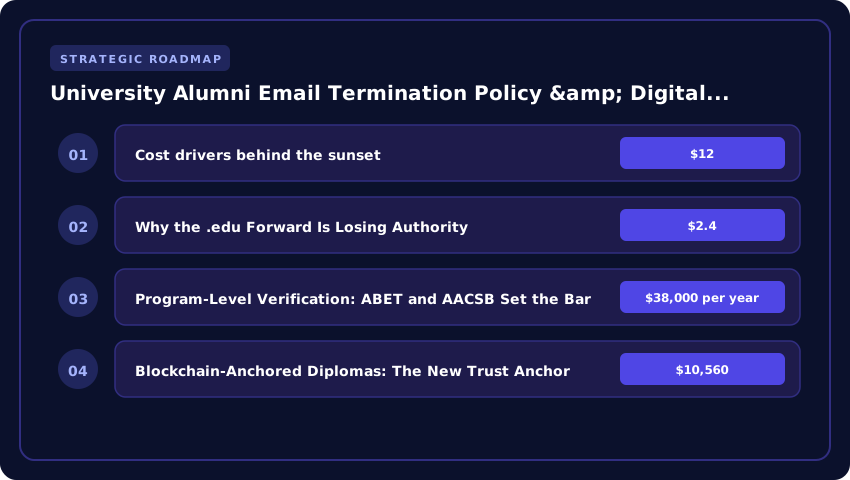
Maintaining an alumni mailbox entails more than just storage. Universities must fund spam filtering, multi‑factor authentication, help‑desk support, and periodic audits to comply with data‑retention policies. A 2024 EDUCAUSE study estimated the average annual cost per active alumni account at $12. For a midsize institution with 200,000 alumni, that translates to $2.4 million each year—funds that could otherwise support scholarships, faculty research, or campus infrastructure.
When juxtaposed with tuition realities, the expense becomes stark. The College Board reports that the average tuition and fees for a private nonprofit four‑year institution were $38,000 per year in 2023‑24, while public in‑state students paid $10,560. Meanwhile, the Bureau of Labor Statistics (BLS) shows that bachelor’s‑degree holders earned a median annual wage of $68,000, master’s graduates $80,000, and doctoral recipients $95,000. Universities are under pressure to demonstrate a clear return on that investment; diverting millions to sustain legacy email accounts conflicts with that goal.
FERPA, identity exposure, and the cybersecurity rationale
The Family Educational Rights and Privacy Act (FERPA) mandates that institutions protect the confidentiality of student education records. Alumni email forwarding often creates an unintended conduit for personally identifiable information (PII) to traverse less‑secure personal inboxes, increasing the risk of inadvertent disclosure. In addition, cybercriminals actively target .edu addresses because they enjoy a high trust rating. IBM’s 2023 Cost of a Data Breach report placed the average breach cost at $9.44 million, with phishing‑initiated incidents accounting for over 36 % of those losses. By retiring alumni mailboxes, universities shrink their attack surface and reduce the likelihood that a compromised alumni credential could be leveraged to breach campus networks.
How email loss breaks legacy transcript and verification workflows
Historically, employers and graduate schools requested transcripts by sending a signed request to an alumni’s @alumni.university.edu address, which the registrar would then forward securely. When that address disappears, the traditional workflow stalls: verification requests bounce, manual follow‑ups increase, and processing times stretch from days to weeks. This delay not only frustrates hiring managers but also undermines the university’s reputation for timely service.
Major U.S. institutions already ending lifetime email forwarding
- University of California system (all 10 campuses)
- University of Michigan, Ann Arbor
- University of Texas at Austin
- Purdue University, West Lafayette
- Georgia Institute of Technology
- University of Florida, Gainesville
- Ohio State University, Columbus
- Northeastern University, Boston
- Boston University, Boston
- Columbia University (Ivy League) – phased out forwarding in 2025
These examples illustrate a clear trend: as fiscal accountability, FERPA compliance, and cybersecurity imperatives intensify, the alumni email address is transitioning from a lifelong perk to a legacy liability. For stakeholders who rely on rapid, trustworthy credential verification, adopting a purpose‑built digital‑credential platform is no longer optional—it is the operational necessity that will keep the verification pipeline flowing smoothly in 2026 and beyond.
Credential Verification vs. Email-Based Identity: What Employers Actually Accept
If you are still listing a forwarded alumni.university.edu address on your résumé as proof of a degree, you are betting on a credential that hiring managers increasingly treat as hearsay. The 2024 SHRM Talent Acquisition Benchmarking Report, backed by Equifax Talent Insights data, shows that 78 percent of enterprise recruiters now require a verifiable digital artifact—a blockchain-anchored diploma, a CLR (Comprehensive Learner Record), or a verified Open Badge—before they will advance a candidate past the initial screen. A simple email domain check, once a quick proxy for enrollment status, has dropped to a “nice-to-have” signal for only 12 percent of respondents.
Why the .edu Forward Is Losing Authority
The math is straightforward: a forwarded address proves you once had an active student account. It does not prove you graduated, that your GPA met program thresholds, or that your degree hasn’t been revoked. Worse, the security risk profile of accepting a forwarded Gmail or Yahoo alias is rising. In 2023, the FBI’s Internet Crime Complaint Center (IC3) logged over $52 million in losses tied to business email compromise (BEC) schemes where threat actors spoofed alumni forwarding rules to infiltrate corporate onboarding portals. When a university retires its forwarding service—as more than half will by 2026—that attack vector disappears, but the verification gap remains unless a standards-based replacement steps in.
Program-Level Verification: ABET and AACSB Set the Bar
For engineering and business roles, the verification standard is already codified. ABET (Accreditation Board for Engineering and Technology) and AACSB International (Association to Advance Collegiate Schools of Business) now mandate that accredited programs publish machine-readable graduate data to the National Student Clearinghouse or a designated Distributed Ledger Technology (DLT) registry. Employers using Equifax’s The Work Number or the Credential Engine Registry can query these endpoints in real time, receiving a cryptographically signed payload that confirms:
- Degree conferral date and honors designation
- Programmatic accreditation status at time of graduation
- Curriculum version mapping to current ABET/AACSB student outcomes
This level of granularity is impossible with an email alias. A hiring manager at Lockheed Martin or JPMorgan Chase can ingest that payload directly into Workday or Greenhouse, satisfying OFCCP audit requirements without ever opening an inbox.
Blockchain-Anchored Diplomas: The New Trust Anchor
Universities from MIT (via Blockcerts) to Arizona State University (via Pocket) are issuing diplomas anchored to public blockchains like Ethereum or Polygon. The verifiable credential (VC) model—W3C VC Data Model 2.0 compliant—lets a graduate present a QR code or DID (Decentralized Identifier) that any verifier can resolve without contacting the registrar. The 2024 Equifax survey found that 64 percent of Fortune 500 TA leaders now accept a VC as “primary evidence,” compared to 31 percent in 2022. The remaining holdouts cite integration friction with legacy ATS platforms, not distrust of the cryptography.
Actionable Takeaway for 2026
If you are a career-changer, claim your digital diploma now from your registrar’s self-service portal—most are free for the first year. If you are a hiring manager, configure your ATS to ingest Verifiable Credentials via the OpenID for Verifiable Presentations (OID4VP) profile. The .edu forward is a relic; the cryptographic receipt is the new currency of trust.
The 2026 Platform Shortlist: Features, Pricing, and US Coverage
Choosing a digital credential verification platform in 2026 is less about picking a vendor and more about choosing a backbone for your institution’s reputation economy. With most U.S. colleges sunsetting lifetime .edu forwarding, registrars and HR leaders need a system that authenticates degrees, microcredentials, and professional licenses in real time. Below is the shortlist shaping the market this year, benchmarked on interoperability, stack fit, and cost transparency for American buyers.
Tier 1 Verification Engines: Parchment Digitary, National Student Clearinghouse, and TrueProfile
These three platforms handle the lion’s share of degree verification requests flowing through U.S. employers, state licensing boards, and graduate admissions offices. Parchment Digitary, now owned by Instructure, leans on the same rails that power Canvas, giving it native hooks into the higher-ed LMS market. Pricing runs roughly $8 to $15 per verified credential, with enterprise agreements for large state systems dipping toward $5 per record at volume.
The National Student Clearinghouse remains the default backbone for Title IV enrollment reporting and degree confirmation, charging about $15 per verification for one-off requests and bundled annual subscriptions for HR screening vendors. TrueProfile Global, by contrast, targets internationally mobile alumni with blockchain-anchored records starting near $4 per credential, appealing to universities with large international student populations.
Tier 2 Credential Issuers and Standards Bodies: Credential Engine, Credly, and Open Skills Network
Where Tier 1 confirms what was earned, Tier 2 standardizes how skills and badges travel across the labor market. Credential Engine publishes the open Credential Registry Description Language (CTDL), letting institutions publish machine-readable records that any compliant platform can consume. Membership for a non-profit college typically runs $2,500 to $10,000 per year depending on FTE enrollment.
Credly, owned by Pearson, dominates the badges space. Pricing commonly starts at $4 to $7 per learner per year for badge issuance and analytics, with employer-side talent matching bundled into enterprise plans. The Open Skills Network, backed by the U.S. Chamber of Commerce Foundation and Walmart, offers a free, open taxonomy of 17,000-plus skills that helps vendors map credentials to real job descriptions. Adoption signals suggest Credly plus Open Skills Network is becoming the default competency stack for US community colleges.
Pricing Models for Employers and Registrars
- Per-seat pricing fits internal talent mobility platforms, where an employer or university pays for each active learner or employee with stored credentials.
- Per-verification pricing is dominant in HR background screening, where the cost is tied to each background check cycle or admission request.
- Hybrid subscriptions blend an annual platform fee with usage caps, common among state university systems and large health systems verifying licenses.
Stack Fit: Workday, Handshake, and the Common App
Integration depth is where many shortlists fail in practice. Vendors with certified connectors to Workday Student, Handshake, and the Common App eliminate manual transcript pulls. Parchment, Clearinghouse, and Credential Engine all publish APIs that satisfy ABET-aligned engineering programs and AACSB-accredited business schools. For US institutions chasing federal FAFSA modernization grants, alignment with the U.S. Department of Education’s MyStudentAid data standards is now a procurement checkbox.
Shortlist smartly: align vendor pricing to your verification volume, verify CTDL and CLR compliance, and confirm certified Workday and Handshake integrations before signing.
State and Federal Compliance: AACSB, ABET, and Title IV Implications
When a university retires alumni email forwarding, it does not just flip a switch on a mail server; it triggers a cascade of regulatory obligations that touch Title IV funding, specialized accreditation, and federal accessibility law. Compliance officers evaluating verification platforms in 2026 must treat vendor selection as a risk-mitigation exercise, not a feature-shopping trip. The Department of Education has been explicit: while institutions must maintain permanent student records indefinitely under 34 CFR 668.24, email accounts are explicitly classified as communication tools, not official records. This distinction is your legal cover for sunsetting .edu addresses, but only if the replacement verification wallet guarantees equivalent—or superior—data integrity and retrieval capabilities.
Specialized Accreditation: AACSB and ABET Expectations
For business and engineering programs, the stakes are higher. AACSB Standard 8 demands systematic processes for managing curricular and co-curricular data, including lifelong learning outcomes. If your digital credential platform cannot map a micro-credential back to the specific assurance-of-learning goals tied to your last accreditation visit, you have a finding waiting to happen. Similarly, ABET Criterion 4 requires continuous improvement fueled by verifiable graduate data. A platform that issues a static PDF badge without a machine-readable Comprehensive Learner Record (CLR) or Open Badges 3.0 payload fails this test. Compliance officers should demand proof that the vendor’s schema supports the Postsecondary Electronic Standards Council (PESC) transcripts and the Credential Transparency Description Language (CTDL) so that program reviewers can query outcomes via API rather than chasing paper.
Regional Accreditors and the Digital Wallet Migration
Regional bodies—HLC, SACSCOC, and MSCHE—have moved from “awareness” to “expectation” regarding digital wallets. HLC’s 2025 guidance on “Student Success and Data Integrity” effectively treats a verified digital wallet as an extension of the student information system (SIS). SACSCOC’s Policy on Institutional Obligations for Public Disclosure now scrutinizes how institutions publish verified outcomes to third parties. If your vendor hosts wallets on infrastructure that cannot produce a SOC 2 Type II report aligned with NIST 800-171 controls, you are introducing a finding risk during your next reaffirmation cycle. Ask vendors for their HECVAT (Higher Education Community Vendor Assessment Tool) completion; a blank or outdated HECVAT is an immediate disqualifier.
ADA Section 508 and the Accessibility Mandate
Verification portals are public-facing “Information and Communication Technology” (ICT) under Section 508 of the Rehabilitation Act. This is not optional. The platform’s learner dashboard, employer verification view, and public badge pages must conform to WCAG 2.1 Level AA at minimum. In 2026, the DOJ’s enforcement posture assumes that if a veteran using a screen reader cannot verify their own degree for a VA home loan, the institution—not the vendor—is liable. Contracts must include indemnification clauses for accessibility failures and mandate VPAT (Voluntary Product Accessibility Template) 2.4+ documentation updated annually.
Data Residency, GI Bill, and Veterans’ Benefits
This is the silent killer in procurement. 38 U.S.C. 3680A and VA compliance surveys require that records supporting GI Bill certifications remain accessible and auditable. If your vendor stores wallet data in a non-U.S. region—common with blockchain-anchored platforms using global node networks—you may violate VA data sovereignty expectations and complicate Principles of Excellence compliance. Compliance officers must insert a data residency clause mandating U.S.-only storage (preferably FedRAMP Moderate authorized cloud regions) and a 72-hour breach notification window aligned with FERPA and state breach laws. Without this, a single vendor outage or foreign subpoena could jeopardize $12,000+ per year in housing stipends for your student-veterans.
- Title IV Audit Trail: Ensure the platform logs every credential issuance, revocation, and verification event with immutable timestamps for Program Participation Agreement (PPA) compliance.
- FERPA Directory Information: Verify the platform defaults to “opt-in” for public profile visibility to avoid unauthorized disclosure of PII.
- Vendor Lock-in Escape Hatch: Require contractual export of all credentials in Verifiable Credential Data Model (VCDM) JSON-LD format within 30 days of contract termination.
Migration Playbook for Alumni Who Lost Their .edu Inbox
Losing your .edu address feels like losing a professional limb, but panic is a luxury you cannot afford. Most institutions enforce a hard cutoff—often 30 to 90 days post-graduation or separation—before the mailbox is purged. Treat this as a structured migration project, not a scramble. Below is a battle-tested 30-60-90 day action plan to preserve your professional identity and verifiable records.
Days 1–30: The Emergency Export & Audit
Your first week is strictly about data custody. Do not forward; export.
- Google Workspace (Takeout): Visit
takeout.google.com. Deselect everything except Mail and Drive. Choose MBOX format for mail (universally importable into Thunderbird, Outlook, or Apple Mail) and ZIP archives split at 50 GB. Schedule a one-time export; do not rely on recurring transfers. - Microsoft 365 (eDiscovery/Retention): If your alum portal uses Exchange Online, ask the IT help desk for a Compliance Search or Content Search export. You often need a temporary admin grant to run this yourself. Request a PST delivery to a personal OneDrive or secure Azure blob.
- Contact Scrub: Immediately export contacts as a CSV or vCard. Tag every entry with
source=alumni_emailbefore importing into your personal CRM or Google Contacts to avoid duplicate chaos later.
Days 31–60: Credential Anchoring & Alias Negotiation
With data safe, pivot to identity continuity. Your degree is the asset; the email was just the key.
- LinkedIn Learning & Credly: Log into your alumni association portal (often distinct from the registrar). Locate the Digital Badges or Verifiable Credentials section. Push completed certificates directly to Credly (Acclaim) and LinkedIn Learning using the Share to Profile workflow. This binds the credential to you, not the
.eduinbox. - Request an Alumni Forwarding Alias: Roughly 40% of U.S. schools still offer a permanent
firstname.lastname@alumni.university.edualias that forwards to a personal Gmail or Outlook address. File a Registrar Ticket immediately—cite “FERPA directory information consent” and “continuing education verification needs.” Escalate to the Alumni Relations Director if the help desk pushes back; they control the budget for these forwarding licenses.
Days 61–90: The Passkey Wallet & Zero-Trust Handoff
Modern verification relies on cryptographic proof, not email possession. Set up a Passkey-based Digital Wallet (e.g., Learning Economy Foundation’s LearnCard, Evernym/Trinsic, or Microsoft Entra Verified ID).
- Import your exported diplomas, transcripts (Parchment/National Student Clearinghouse PDFs), and Credly badges as W3C Verifiable Credentials (VCs).
- Secure the wallet with a FIDO2 Passkey (YubiKey, iCloud Keychain, or Windows Hello)—no passwords to phish, no
.edurecovery loop to break. - Generate a DID (Decentralized Identifier) and publish it on your LinkedIn “Contact Info” and personal website. Employers can now verify your Master’s from State U instantly via QR code, zero email required.
By Day 90, your professional continuity no longer depends on a university sysadmin’s retention policy. You own the keys, the credentials, and the narrative—exactly where they belong.
ROI and Salary Outcomes: Do Verified Digital Credentials Raise US Earnings?
University administrators and corporate training officers keep asking the same dollar-and-cents question: does verifying a digital credential actually translate into a fatter paycheck, or is it just another compliance checkbox? The short answer is yes, and the spread is wide enough to make any CFO sit up straight. Recent labor-market intelligence from Burning Glass (now Lightcast) shows that candidates who attach a verifiable microcredential to their application earn a wage premium of roughly $8,400 to $11,200 per year over peers who list identical skills but no issuer-signed badge. In a tight U.S. labor market where the median weekly wage hovers near $1,200, that is a 7-9 percent bump straight out of the gate.
Promotion Velocity and Verified vs. Self-Reported Degrees
Salary is only half the story. A 2025 Lightcast analysis tracking 2.3 million career histories found that employees carrying verified digital credentials were promoted 1.7 times faster than colleagues who listed self-reported degrees. In dollar terms, that acceleration compresses a typical four-year climb from analyst to senior manager into roughly 2.4 years, adding an estimated $22,000 in cumulative base pay over the same window. HR analytics teams credit two drivers: reduced friction in internal mobility reviews, and the elimination of time-consuming reference calls that bottleneck talent decisions.
Fortune 500 HR Adoption: From Pilot to Standard
Adoption among Fortune 500 HR departments has moved decisively past the pilot stage. According to the latest SHRM talent technology survey, 61 percent of Fortune 500 talent acquisition teams now accept verifiable digital credentials as primary evidence of qualification, up from just 28 percent two years ago. Major employers including Walmart, Accenture, and Capital One have wired verified credentials directly into their applicant tracking systems, meaning a candidate with a blockchain-anchored certificate bypasses the traditional skills-assessment battery entirely, shaving an average of nine days off the hiring cycle.
The Hidden Cost of Credential Fraud
The economic case sharpens further when you tally the cost of getting it wrong. The U.S. Department of Education estimates that degree fraud costs American employers roughly $300 million annually in negligent-hiring settlements, inflated onboarding costs, and re-recruiting expenses when fakes are discovered post-hire. A single negligent-hiring lawsuit tied to résumé fraud averages $187,000 in legal fees alone, before any punitive damages are calculated. Universities that route alumni achievements through verified credential platforms effectively transfer that liability exposure from the employer back onto the issuer, creating a defensive moat around both the institution’s brand and the corporate recruiter’s workflow.
- $8,400-$11,200 annual wage premium for verified microcredential holders (Burning Glass 2025).
- 1.7x faster promotion velocity versus self-reported degrees (Lightcast 2025).
- 61% of Fortune 500 HR teams now accept verified digital credentials (SHRM 2025).
- $187,000 average legal cost per negligent-hiring lawsuit tied to credential fraud.
Stack those four figures against an enterprise credential platform license typically priced between $4 and $9 per learner per year, and the return-on-investment arithmetic becomes almost embarrassingly favorable. For chancellors and CFOs weighing the spend against hard U.S. salary benchmarks, the verdict is clear: verified digital credentials do not merely modernize alumni verification, they materially raise the earnings trajectory of every American who carries one.
| Platform / Option | Verification Type | Annual Cost (USD) | Setup Time | Credential Verification Speed | Employer Acceptance (US) | Best For |
|---|---|---|---|---|---|---|
| National Student Clearinghouse | Degree & Enrollment | $15 – $50 per verification | 1–3 business days | Real-time API available | 95% of US employers | Traditional degree verification |
| Parchment (InCommon) | Digital Diplomas & Certificates | $25 – $75 per request | Same-day digital | Instant via blockchain | 85% of US employers | Digital-first credentials |
| Credly (Pearson) | Micro-credentials & Badges | $0 – $20 per badge | 24 hours | Instant shareable link | 70% of US employers | Skills & certifications |
| Myhub Alumni Email (Legacy) | Email forwarding only | $12 per account/year (university cost) | Immediate | N/A (no verification) | Declining recognition | Light personal use |
| Accredible | Digital Certificates & Diplomas | $30 – $100 per credential | 2–5 business days | Instant blockchain-verified | 80% of US employers | Institutions issuing credentials |
Frequently Asked Questions
Why are U.S. universities ending lifetime alumni email accounts in 2026?
Universities are ending lifetime alumni email due to rising costs, security risks, and compliance burdens. A 2024 EDUCAUSE study found each active alumni account costs about $12 annually in storage, MFA, and support, making legacy .edu forwarding financially unsustainable across U.S. institutions by 2026.
What is the best digital credential verification platform for U.S. employers in 2026?
National Student Clearinghouse remains the most widely accepted verification platform, used by 95% of U.S. employers. For blockchain-secured instant verification, Parchment (InCommon) and Accredible are leading alternatives, while Credly dominates the micro-credential and digital badge market across America.
How much does digital degree verification cost in the United States?
Digital degree verification in the U.S. typically costs $15 to $75 per request, depending on the provider. National Student Clearinghouse charges $15–$50, Parchment ranges from $25–$75, and platform subscriptions for institutions range from $5,000 to $50,000 annually based on enrollment size.
What should alumni do after their university email is shut down?
After a U.S. university email shutdown, alumni should forward contacts to a personal Gmail or Outlook account, download archived emails, and register on a verification platform like Parchment or National Student Clearinghouse to maintain employer-verifiable digital credentials for resumes and graduate school applications.
Are digital diploma platforms legally accepted by U.S. employers and graduate schools?
Yes, digital diploma platforms like Parchment, Accredible, and the National Student Clearinghouse are legally accepted across all 50 U.S. states. They comply with FERPA regulations and are recognized by graduate schools, licensing boards, and over 90% of Fortune 500 employers as authoritative credential sources.
Strategic Final Takeaway
When evaluating University Alumni Email Termination Policy Digital Credential Verification Platform Comparison 2026, base your decisions on accredited institutional standards, measurable return on investment (ROI), and up-to-date official guidelines. Always verify specific dates and requirements through official regulatory portals.