
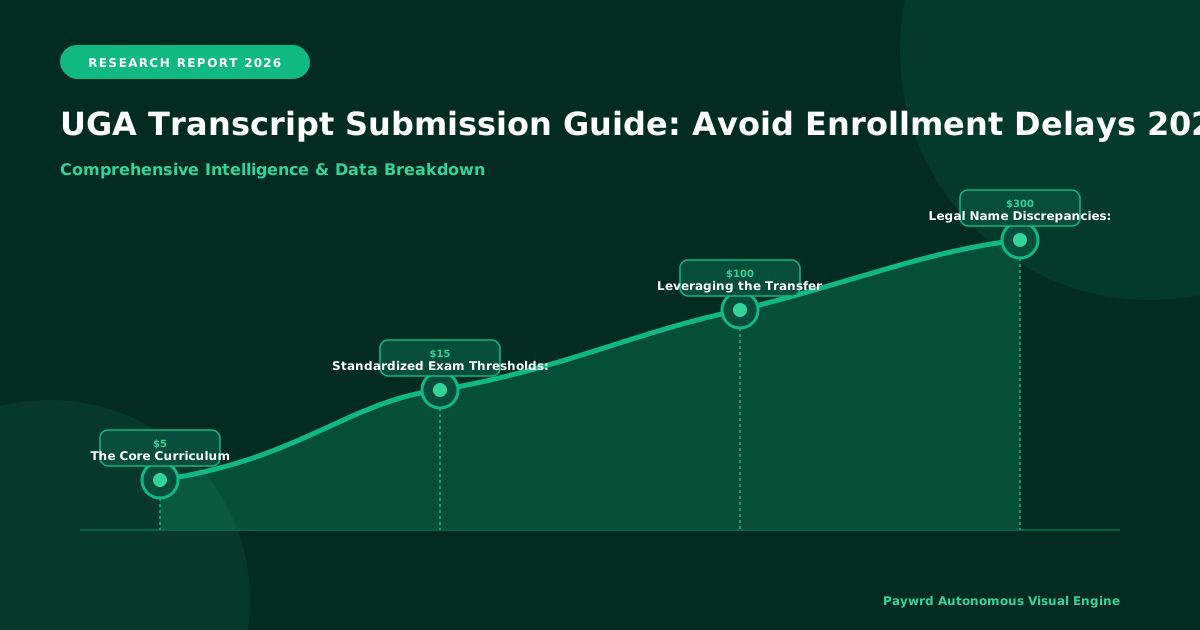
UGA’s Official Transcript Requirements for 2026 Admission Cycles
Understanding the University of Georgia’s transcript policies is one of the most important steps you can take to avoid enrollment delays. For the 2026 admission cycles, UGA has refined its requirements for first-year, transfer, and dual-enrollment applicants, emphasizing verified digital delivery over traditional paper processes. Knowing exactly what qualifies as an “official” transcript, how it must be sent, and the strict windows for Early Action and Regular Decision will keep your application competitive and on track.

What Qualifies as an “Official” Transcript at UGA. The Office of Undergraduate Admissions accepts only documents that arrive directly from the issuing institution or a trusted digital intermediary. An official transcript must bear the registrar’s signature, the school seal, and the date of issuance. It must remain in a sealed envelope or be transmitted through a secure electronic network. A copy you upload yourself, a scanned PDF, or an opened envelope will be deemed unofficial and will not fulfill the requirement. For dual-enrollment coursework, UGA typically requires the official college transcript from the institution where you earned the credit (for example, through the University System of Georgia or a regionally accredited program), alongside your high school record.
Acceptable Sending Methods for 2026. UGA encourages electronic transmission to minimize processing time. The three approved vendors are:

- eSCRIP-SAFE — A widely used network that connects high schools and colleges directly to UGA’s admissions portal. It is the fastest method, with most transcripts received within 24–48 hours.
- Parchment — Common among independent schools, charter networks, and homeschool cooperatives. You can order official documents online and route them to UGA in minutes.
- National Student Clearinghouse — Frequently used by large public school districts and community colleges. Many transfer applicants will already have records on file with the Clearinghouse, simplifying the process.
- Sealed Mail — A printed, signed, and sealed transcript sent by the registrar is still acceptable. However, expect 7–14 business days for delivery and additional processing, which can be risky for time-sensitive deadlines.
Deadlines for First-Year Applicants. For students entering Fall 2026, Early Action applicants must submit the application by October 15, 2025, with all official transcripts arriving by mid-November 2025. Regular Decision applicants have until January 15, 2026, with transcripts expected by early-to-mid February 2026. UGA does not grant application review extensions for late transcripts; missing these windows can move a student to a lower priority review pool or trigger a deferral.
Deadlines for Transfer and Dual-Enrollment Applicants. Transfer students applying for Fall 2026 should target a March 1, 2026 postmark or electronic submission date for the application and supporting transcripts. UGA’s transfer process is competitive, and Articulation Agreements through the University System of Georgia require every college-level course to be verified. Dual-enrollment applicants follow the first-year timeline but must submit both their high school transcript and any collegiate transcripts at the time of application. Sending partial documents will result in an automatic hold.
Actionable Takeaways. Begin requesting transcripts at least four weeks before the deadline. Confirm receipt through your UGA Application Status Portal, and follow up with counselors or registrars to confirm dispatch. If you are a transfer student with credits from multiple institutions, request a transcript from each school — UGA does not accept consolidated or aggregated records. Finally, retain copies of all confirmation emails and tracking numbers, as they will be essential if a discrepancy arises.
By aligning your submission method, timing, and document type with UGA’s verified 2026 standards, you safeguard your admission decision and ensure a smooth transition into enrollment, housing selection, and orientation scheduling.
Step-by-Step: Requesting and Transmitting Transcripts to UGA Undergraduate Admissions
Requesting transcripts from your prior institutions might feel like a simple administrative checkbox, but it is one of the most common stumbling blocks that delays enrollment at the University of Georgia. Whether you are a transfer student coming from a Georgia community college, a recent high school graduate, or a working adult who completed coursework through an online provider, every transcript must arrive at UGA’s Office of Undergraduate Admissions in a verifiable, sealed, or electronically authenticated format. Taking a careful, methodical approach from day one will save you from the panic of an admission deferral, a lost financial aid package, or a frustrating registration hold on your first day of classes.
The first step is to identify every institution that ever issued you a credit-bearing grade or a high school diploma. Many students forget about dual enrollment coursework taken during high school, summer courses at a different university, or online certificates from providers like Coursera, edX, or StraighterLine. UGA requires official documentation from every institution listed on your application, regardless of whether the credit transferred or counted toward a degree. Skipping a school—even if you only took one course there—is one of the fastest ways to trigger an admission delay or a request for additional information that can stall your enrollment timeline.
Once you have compiled your list, contact each institution’s Office of the Registrar (for colleges) or School Counseling Office (for high schools) to confirm their transcript request procedures. Most US institutions charge between $5 and $15 per transcript request, though some states cap fees at lower amounts and a handful of online providers offer electronic transcripts for free or at a reduced rate. Be prepared to provide your full legal name, date of birth, the last semester attended, and the exact mailing or email address for UGA. Always retain a copy of your payment receipt, the request confirmation number, and any tracking information. These documents are your proof that you acted in good faith if a transcript is lost in transit or delayed by a third-party processor.
When routing transcripts, pay close attention to UGA’s accepted delivery methods. The Office of Undergraduate Admissions accepts both electronic transcripts through approved vendors like Parchment, the National Student Clearinghouse, and eSCRIP-SAFE, as well as physical sealed envelopes sent directly from the issuing institution. If you are mailing a paper transcript, use a trackable courier service such as USPS Priority Mail, UPS, or FedEx, and never open the envelope yourself once it arrives. A broken seal, even an accidental one, will render the transcript unofficial in UGA’s system, forcing you to start the process over and pay another fee. Save your tracking receipt in a dedicated folder—either physical or digital—so you can quickly confirm delivery status if UGA flags a missing document.
Finally, build a confirmation system that keeps you informed every step of the way. After UGA receives your transcripts, log into your UGA Admissions Portal within seven to ten business days to verify that each document has been marked as received and processed. If anything is missing or marked as unofficial, contact the Office of Undergraduate Admissions immediately at the number listed on their official website, and keep a written record of every email, phone call, and case number. By treating transcript submission as an active project rather than a passive task, you protect yourself from last-minute surprises and position yourself for a smooth, on-time enrollment at the University of Georgia.
- List every high school, college, and online provider that issued credit or a diploma before applying.
- Budget roughly $5 to $15 per transcript request and confirm fee waivers if you received a fee waiver for college applications.
- Use electronic delivery through Parchment or the National Student Clearinghouse whenever possible for faster processing.
- Save payment receipts, confirmation numbers, and tracking details in a dedicated transcript folder.
- Verify receipt in your UGA Admissions Portal within seven to ten business days and follow up on any missing documents.
The Five Most Common Transcript Mistakes That Block UGA Enrollment
Every year, hundreds of students who are otherwise academically qualified for the University of Georgia find their enrollment frozen in administrative limbo because of avoidable transcript mistakes. A single error can push back course registration by weeks, delay Federal Pell Grant disbursement through FAFSA, and in some cases, force a student to defer their entire semester. Because UGA operates on a tightly sequenced admissions calendar that feeds into the University System of Georgia’s registration windows, the transcript review process is unforgiving. Below is a detailed breakdown of the five most common pitfalls, why they matter, and how each one ripples through your financial aid and registration timeline.
- Sending Transcripts Before Final Grades Post. Many students rush to beat a deadline and submit transcripts while coursework is still in progress. UGA’s Office of Undergraduate Admissions requires official final grades for every course listed on the application, including the final term of high school or any previously attended college. A transcript marked “Issued to Student Prior to Completion” is automatically rejected. The real-world impact is severe: your admissions file is flagged as incomplete, your FAFSA-verified enrollment status is not pushed to the Department of Education, and you will be unable to register for Orientation sessions, which means you lose access to the best course sections. Wait until your registrar confirms that all spring grades, IB scores, or transfer credits are posted before requesting a sealed envelope or electronic send.
- Omitting Dual-Enrollment or Summer Program Transcripts. Dual-enrollment coursework completed through programs like Georgia’s Dual Achievement Program or summer courses taken at institutions such as Georgia Tech, Kennesaw State, or out-of-state community colleges must be reported separately. Many students assume UGA will automatically pull these credits, but UGA does not have cross-enrollment access. If you fail to send an official transcript from every institution, your academic history will be audited, and credit articulation is paused. This directly delays your Tuition Classification (in-state versus out-of-state) decision, which can affect your HOPE Scholarship and Zell Miller Scholarship eligibility, both of which are administered by the Georgia Student Finance Commission and require verified credit hours.
- Submitting a Student Copy Instead of an Official Record. A student copy, even one printed on security paper or stamped by your counselor, will not be accepted. UGA’s ABET-aligned registrar standards require that transcripts arrive directly from the issuing institution, whether through the Parchment network, the National Student Clearinghouse, or a sealed registrar mailer. Emailed screenshots, photocopies, or counselor-attached PDFs do not meet FERPA compliance and are returned without review. The downstream impact is felt immediately in financial aid: the federal financial aid disbursement schedule is contingent on the National Student Loan Clearinghouse confirming your enrollment intensity, which only happens after official transcripts are processed.
- Missing the July 1 Deadline for Final Transcripts. UGA enforces a hard July 1 deadline for incoming freshmen and a corresponding deadline for transfer admits to submit their final official transcripts. This is not a suggestion; it is a contractual condition of your admissions offer. Missing this cutoff can trigger an automatic rescission of admission, particularly if the document is needed to certify that you have graduated from high school. For students depending on the Federal Supplemental Educational Opportunity Grant (FSEOG) or state-funded programs like the Georgia Tuition Equalization Grant, a missed deadline means the aid is returned to the funding pool and redistributed. Calendar reminders, overnight shipping, and electronic submission through Parchment are the safest ways to guarantee arrival.
- Failing to Match Legal Name Across Documents. Name mismatches between your FAFSA, your UGA application, and your official transcript are an underestimated source of enrollment delays. If your transcript reads “Jonathan Michael Smith” but your FAFSA and admissions portal show “Jon M. Smith,” the financial aid office will place a federal compliance hold on your file. This hold cannot be resolved until you submit government-issued identification and complete a name reconciliation form. The result is a freeze on your federal loan origination, a delay in your work-study assignment, and a block on your ability to sign a housing contract through University Housing. Standardize your legal name across the College Board, FAFSA, and every transcript request before submission.
Actionable takeaway: Build a one-page transcript tracker that lists every institution you attended, the date you requested each official record, the delivery method used, and the legal name on file. Confirm delivery through your admissions portal at least 15 business days before the July 1 cutoff, and verify with the UGA Office of Student Financial Aid that your FAFSA signature and enrollment intensity are both verified. These five minutes of diligence can save you a semester of lost momentum, lost dollars, and lost credit hours.
Tracking Transcript Status Inside the UGA Applicant Portal
Once your transcripts are en route to the University of Georgia, your next priority is verifying that the Office of Undergraduate Admissions has actually received, matched, and processed them. UGA makes this process largely self-service through the Applicant Status Portal, the same online system you used to submit your application. Logging back into this portal regularly during the weeks following your transcript order is the single most reliable way to confirm that your academic record is moving through the review pipeline without interruption. Treat the portal as your central dashboard: every official document you submit, including transcripts, test scores, and residency forms, eventually surfaces as a checklist item with a status that you can read and interpret at a glance.
When you navigate to the “Materials” or “Checklist” tab of your application, you will see distinct line items for each transcript UGA expects to receive. These typically include a high school transcript, any college transcripts from dual enrollment or previously attended institutions, and, for transfer applicants, transcripts from every regionally accredited postsecondary school you have attended. Each item will be tagged with one of several status labels that admissions officers update manually as documents are matched to your application file. Understanding these labels is essential because the wording is specific, and misinterpreting them can lead to unnecessary panic or, worse, overlooked deficiencies.
- “Received” means the physical or electronic transcript has arrived at UGA and has been scanned into the system. At this point, the document is in the queue but has not yet been evaluated for authenticity or course content.
- “In Review” indicates that an admissions reader has pulled your file and is actively comparing the transcript against your self-reported coursework, verifying accreditation, and calculating core GPA components.
- “Complete” or “Satisfied” signals that the transcript has passed all verification steps and the requirement is officially fulfilled.
- “Missing” or “Not Received” means UGA has no record of the document, usually because it was never sent, was sent to the wrong address, or is still in transit from the issuing institution.
If you see a red “Action Required” flag next to any transcript line item, do not ignore it. This designation usually appears when UGA has received a document but cannot match it to your application due to a name discrepancy, an incorrect Social Security number, or a missing date of birth. It can also appear if the transcript is missing a required signature, lacks the issuing institution’s official seal, or arrives as an unofficial copy. When this flag appears, read the accompanying message carefully because it often contains a direct link to an online form, a fax number, or specific instructions for resubmitting corrected documentation. Acting on an Action Required prompt promptly is the difference between an on-time admissions decision and a delayed enrollment.
During the busiest application windows, UGA typically lists a processing window of 7 to 10 business days from the moment a transcript arrives on campus to the moment it shows a status update in your portal. Peak season, which generally runs from late November through mid-January for Early Action and Regular Decision applicants, can extend that window to 14 business days. Summer and rolling-admission windows tend to move faster, often updating within 3 to 5 business days. Always build a buffer of at least two to three weeks when calculating back-to-back from your transcript request to a status change in the portal, particularly if you are applying close to a scholarship deadline where decisions hinge on academic verification.
If more than 14 business days have passed and your portal still shows “Not Received” or “Missing,” it is time to contact the Office of Undergraduate Admissions directly. Before you call, gather the following: your full application reference number, the name of the issuing institution, the date the transcript was sent, the tracking number if it was mailed, and a screenshot of your current portal status. When you contact the admissions office, you can reach the main line at (706) 542-8776 or submit a secure message through the “Ask Admissions” feature of your portal. Be polite but persistent, and ask the representative to confirm whether anything has been received under your Social Security number, your full legal name, and any prior names you may have used. This step often reveals simple data-entry issues, such as a misspelled surname, that can be corrected on the spot and save your application from being marked incomplete.
One practical tip: refresh your portal at consistent intervals rather than obsessively, because the system updates in batches rather than in real time. Most status changes post overnight, so checking once in the morning and once in the evening is usually sufficient. Also, remember that UGA’s Applicant Status Portal is the only official communication channel for document status. Emails and phone calls will never override what the portal displays, so always treat the portal checklist as the authoritative source of truth as you navigate the final stretch toward an on-time enrollment.
After Receipt: How UGA Evaluates Transfer and Dual-Enrollment Credits
Once the University of Georgia’s Office of the Registrar receives your official transcripts, the evaluation engine kicks into gear. This is not a simple checkbox exercise; it is a course-by-course articulation process designed to protect the integrity of your UGA degree while maximizing the credit you have legitimately earned. Understanding this workflow helps you set realistic expectations for your degree audit and prevents surprises during your first advising session.
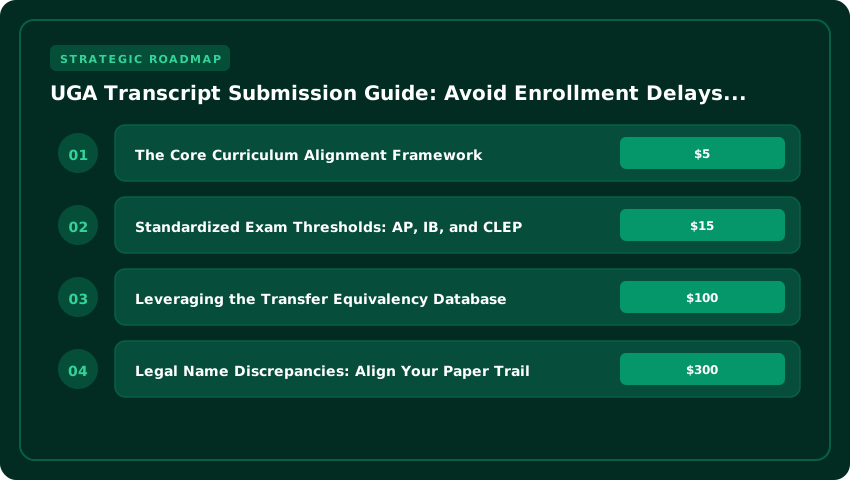
The Core Curriculum Alignment Framework
UGA operates under the University System of Georgia (USG) Core Curriculum guidelines, meaning the evaluators first map incoming courses to the five core areas: Essential Skills (English/Math), Institutional Options, Humanities/Fine Arts, Science/Math/Technology, and Social Sciences. If you completed an Associate of Arts (A.A.) or Associate of Science (A.S.) degree at a USG or Technical College System of Georgia (TCSG) institution, you generally receive Core-to-Core transfer protection—your core requirements are considered satisfied block-by-block. For out-of-state or private institution credits, evaluators scrutinize syllabi, credit hours, and grading scales to determine equivalency to specific UGA course numbers (e.g., does your “English 101” equate to ENGL 1101 or ENGL 1102?).
Standardized Exam Thresholds: AP, IB, and CLEP
Standardized exam credit is posted automatically once official score reports arrive from the College Board (AP/CLEP) or the International Baccalaureate Organization. UGA maintains published minimum score thresholds that are strictly enforced:
- Advanced Placement (AP): A score of 3 is the baseline for elective credit, but most core curriculum courses (like Calculus, Biology, or U.S. History) require a 4 or 5 to satisfy specific UGA course requirements. For example, AP Calculus AB requires a 4 for MATH 2250 credit.
- International Baccalaureate (IB): Credit is awarded for Higher Level (HL) exams with scores of 5, 6, or 7. Standard Level (SL) exams rarely carry credit unless specified by a specific department.
- CLEP: UGA accepts a limited suite of CLEP exams (typically College Composition, Humanities, Natural Sciences, Social Sciences/History) with a minimum scaled score of 50–65, depending on the subject. These apply primarily to core elective areas.
Leveraging the Transfer Equivalency Database
Before you even apply, you should audit your previous coursework using the UGA Transfer Equivalency Database (often called the “Transfer Equivalency Search” on the Registrar’s site). This tool shows how courses from specific institutions have transferred in the past. Pro tip: If a course appears as “No Rule” or “Departmental Review,” do not panic—it simply means a syllabus review is required. Save your syllabi now; you will need them for the appeal process if the initial evaluation yields only elective credit (e.g., XXXX 1XXX) rather than a direct course match.
The Appeals Process: Turning Electives into Requirements
If a critical major prerequisite transfers as generic elective credit, you have the right to appeal. The process is formal but navigable:
- Step 1: Log into your DegreeWorks audit via Athena to identify the specific course deficiency.
- Step 2: Gather the official course description and a detailed syllabus (including textbooks, lab components, and grading breakdown) from the term you took the class.
- Step 3: Submit a Transfer Credit Re-evaluation Request through the Registrar’s online portal. Route it to the specific UGA academic department (e.g., the Chemistry Department for CHEM 1211/1212 equivalency), not just the Registrar.
- Step 4: Follow up with the departmental undergraduate coordinator. A polite, concise email attaching the syllabus often accelerates the review, which typically takes 10–15 business days.
Actionable Takeaway: Treat your syllabi as legal documents. Digital backups saved in a labeled cloud folder (e.g., “UGA_Transfer_Appeals_Fall2025”) can save you weeks of runaround when you are trying to register for upper-division major courses during your first semester in Athens.
Special Circumstances: International Transcripts, Name Changes, and Re-Admission
Not every academic journey follows a straight line, and the University of Georgia’s Office of Undergraduate Admissions has specific protocols for the edge cases that often derail enrollment timelines. If you fall into one of these categories, proactive communication is your strongest asset. Do not wait for a missing document notification to appear in your UGA Status Check portal; by then, you may have already missed priority registration windows or financial aid disbursement deadlines.
International Transcripts: Evaluations Are Non-Negotiable
If you completed coursework outside the United States, UGA does not accept raw transcripts or mark sheets for transfer credit evaluation, nor do they perform internal credential assessments. You must submit a course-by-course evaluation from a NACES-approved member agency—most commonly WES (World Education Services) or ECE (Educational Credential Evaluators). Budget $100–$300 for this service, depending on the complexity of your academic history and the turnaround speed you select. Standard processing takes 7–10 business days after the agency receives all required documents, but “rush” options exist for a premium. Crucially, request that the agency sends the official evaluation electronically directly to UGA Admissions; paper copies sent by the applicant are rarely accepted as official. If your documents are not in English, certified translations are required alongside the original language records.
Legal Name Discrepancies: Align Your Paper Trail
A mismatch between the name on your application (e.g., “Elizabeth A. Smith”) and your transcript (“Elizabeth Anne Smith-Jones” or a maiden name) will trigger a manual hold. This is one of the most common—and easily avoidable—delays. If you have legally changed your name due to marriage, divorce, or court order, you must submit a Name Change Form (available on the Registrar’s website) accompanied by legal documentation: a marriage license, divorce decree, or court order. Upload these via the Document Upload tool in your applicant portal immediately after submitting your application. Do not email them to individual counselors; the centralized system ensures the Registrar and Financial Aid offices update simultaneously, preventing FAFSA verification conflicts later.
Re-Admission After Three or More Semesters
Former Bulldogs returning after an absence of three or more semesters (excluding summer) are classified as Re-Admit students. You are not a freshman applicant, but you are not a standard transfer either. You must submit official transcripts from every institution attended since you last enrolled at UGA. If you have been away for five years or more, UGA may require you to re-submit your original UGA transcript (which they retain) alongside new work, but the burden of proof for recent coursework rests on you. Critically, any academic suspension or dismissal at another institution during your absence must be disclosed; failure to do so constitutes a violation of the UGA Code of Conduct and can result in revocation of admission.
FAFSA Implications: The Cost of Delay
Missing transcripts do more than stall your class schedule—they freeze your money. The Office of Student Financial Aid cannot package or disburse Federal Pell Grants, Direct Loans, or HOPE/Zell Miller Scholarships until your admission file is complete and you are fully admitted. If your international evaluation arrives in late August, you miss the fall disbursement cycle, potentially forcing you to pay out-of-pocket or drop classes for non-payment. For re-admit students, Satisfactory Academic Progress (SAP) is calculated on your entire history; a gap in enrollment does not reset your SAP clock. Submit early, verify receipt in your portal weekly, and treat “pending” as “action required.”
| Applicant Type | Official Transcript Cost (Est.) | Priority Submission Cut-off | Final Deadline (Hard) | Processing Timeline | Career ROI Impact |
|---|---|---|---|---|---|
| First-Year (Domestic) | $0–$15 (Parchment/Naviance) | Nov 1, 2025 (Early Action) | July 1, 2026 | 5–7 Business Days | Locks HOPE/Zell Miller eligibility; prevents registration holds |
| Transfer Students | $0–$15 per institution | Mar 1, 2026 | June 15, 2026 | 7–10 Business Days | Determines transfer credit articulation; impacts graduation timeline |
| Dual Enrollment | $0–$10 (HS/College portal) | July 1, 2026 | Aug 1, 2026 (Pre-semester) | 3–5 Business Days | Validates college credit earned; affects class standing & prerequisites |
| International Applicants | $25–$75 (WES/ECE eval + shipping) | Jan 15, 2026 | May 1, 2026 | 15–20 Business Days | Required for I-20 issuance; visa compliance & credential verification |
Frequently Asked Questions
What is the final deadline to submit official transcripts to UGA for Fall 2026 enrollment?
The final hard deadline for Fall 2026 first-year applicants is July 1, 2026. Transfer students must submit by June 15, 2026. UGA requires final, degree-conferred transcripts electronically via Parchment, Naviance, or eSCRIP-SAFE; paper copies delay processing by 2–3 weeks and risk registration cancellation.
Does UGA accept electronic transcripts for 2026 admission cycles?
Yes, UGA strongly prefers and prioritizes verified electronic delivery (Parchment, National Student Clearinghouse, eSCRIP-SAFE) for all 2026 cycles. Electronic transcripts process in 5–7 business days versus 15+ days for mail. Unofficial uploads or student-portal screenshots are rejected; only secure, institution-sent digital files satisfy 'official' status.
How long does UGA take to process transcripts once received in 2026?
Electronic transcripts typically post to the applicant portal within 5–7 business days during peak season (April–July). Mailed transcripts require 10–15 business days for opening, scanning, and indexing. International credential evaluations (WES/ECE) add 10–20 days. Applicants should monitor the 'Check Status' portal for 'Received' confirmation.
What happens if my UGA transcript arrives after the 2026 deadline?
Late transcripts trigger an enrollment hold preventing course registration, housing selection, and financial aid disbursement (including HOPE/Zell Miller). First-year students risk admission rescission after July 1. Transfers lose credit articulation priority. Immediate contact with the Admissions Office (706-542-2112) is required to negotiate a provisional extension.
Strategic Final Takeaway
Success in evaluating UGA Transcript Submission Guide: Avoid Enrollment Delays 2026 relies on early preparation, adherence to verified accredited requirements, and cross-referencing official portals. Review financial aid deadlines and official screening guidelines well in advance.

