
How Employer Tuition Reimbursement Actually Chips Away at Your Balance
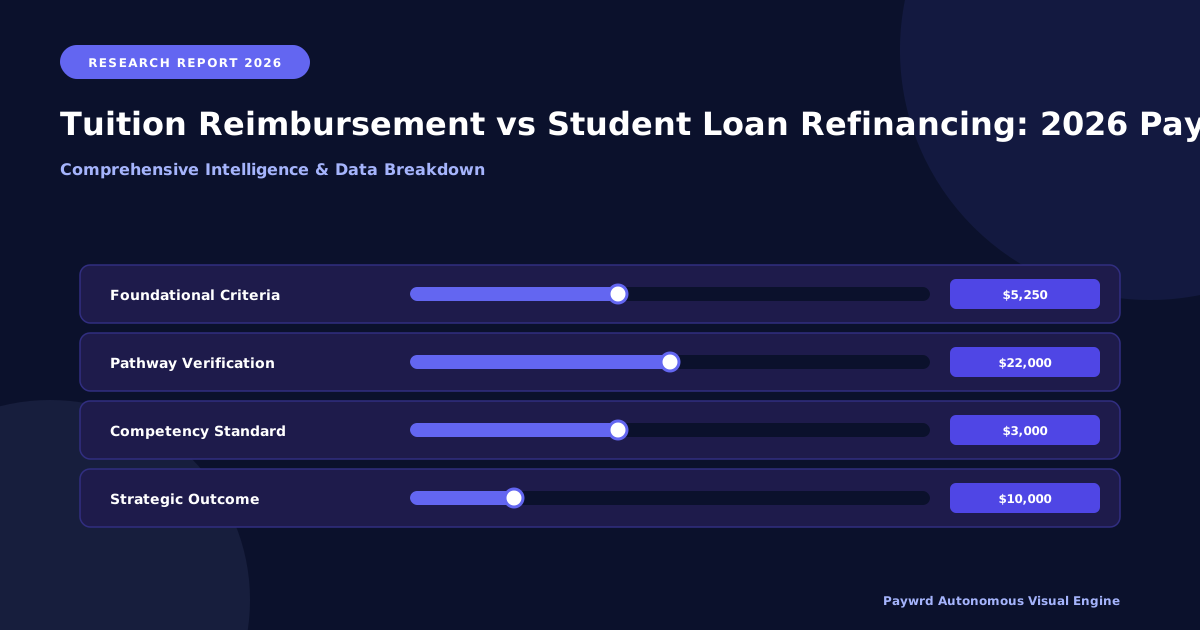
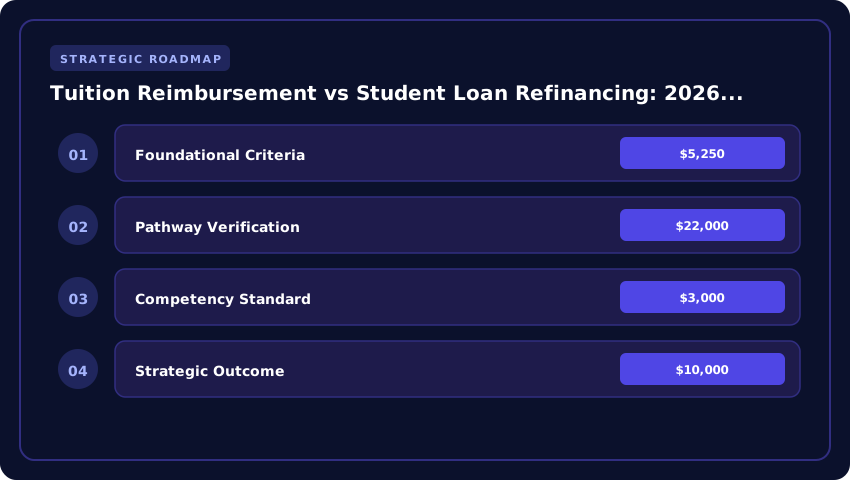
Employer tuition reimbursement is one of the most misunderstood benefits in the American workplace, largely because the mechanics look deceptively simple on paper but involve several layers of IRS rules, employer-specific clawback language, and payroll timing nuances that determine whether a dollar actually reduces your student loan balance or simply inflates your taxable income. At the federal level, the program is governed by Internal Revenue Code Section 127, which permits employers to pay up to $5,250 per calendar year in qualifying educational assistance on a completely tax-free basis. Anything an employer contributes above that statutory ceiling becomes taxable wages, reported on your W-2 and subjected to federal income tax, Social Security, Medicare, and applicable state withholdings. For 2026, that $5,250 cap has remained static, and it has not been adjusted for inflation since 2023, meaning its real purchasing power continues to erode each year even as graduate tuition at US universities climbs steadily past $22,000 annually for many in-state master’s programs.

The distinction between tax-free and taxable employer policies is where most employees lose thousands of dollars they never realize they are forfeiting. Under Section 127, an employer may pay for textbooks, fees, supplies, equipment, and tuition itself, as long as the coursework is job-related or part of a degree program. Amazon, for example, runs its Career Choice program that prepays 100% of tuition for hourly employees pursuing in-demand fields, routing payments directly to partner universities and bypassing the employee’s bank account entirely. Google’s Grow with Google initiative and its tuition assistance platform through Bright Horizons similarly send funds directly to accredited institutions, eliminating reimbursement friction entirely. Boeing, by contrast, traditionally uses a reimbursement model where employees pay upfront and submit grade verification before receiving a check, often within a 30 to 90 day approval window that depends on the timing of the academic term and the employer’s accounts payable cycle.
That approval window is one of the most practical pain points of tuition reimbursement. Most US employers operate on either a quarterly or semester-based reimbursement schedule, meaning an employee finishing a class in May may not see the corresponding check until July or August. Mid-market employers offering annual caps between $3,000 and $10,000 frequently require employees to maintain a B average or higher, submit official transcripts within 30 days of course completion, and remain actively employed for a specified period after receiving the benefit. This is where the clawback clause becomes critical: if you leave the company within 12 to 24 months of receiving reimbursement, many employers will demand full repayment of the benefit, treating it as an advance rather than a gift. Reading that clawback language before enrolling in a semester is not optional, it is financially protective.
The mechanics of direct-to-lender payment arrangements versus traditional reimbursement checks represent the most consequential structural difference. With direct billing, your employer or its third-party administrator pays the university or loan servicer on your behalf, which means the debt never touches your personal cash flow and your loan principal drops the same day the payment posts. With reimbursement, you typically front the tuition, sometimes using a federal student loan or a credit card, and then wait for the employer to cut a check. The reimbursement check may take 60 to 90 days to arrive, may be issued only after the semester ends, and may be applied to a loan that has already accrued interest during the waiting period. Forward-thinking mid-market companies in sectors like healthcare, manufacturing, and fintech are increasingly adopting direct-pay platforms such as EdAssist by Bright Horizons, InStride, and Guild Education precisely to eliminate that lag and to lock in the Section 127 tax advantage without administrative headaches.
For a concrete illustration, consider a software engineer at a mid-sized SaaS company in Austin, Texas, earning $110,000 annually and pursuing a part-time master’s in computer science at an ABET-accredited regional university. If the employer offers a $7,500 annual reimbursement cap with direct-to-lender billing, the first $5,250 flows through tax-free under Section 127, and the remaining $2,250 shows up as imputed income on the W-2. The engineer’s taxable income rises modestly, while the loan balance falls by the full $7,500 plus any interest the lump sum covers. By contrast, an employee at a smaller firm with a $4,000 annual reimbursement cap and no direct billing may need to cover the gap out of pocket, refinance the remaining balance, and wait 90 days for a check that, after taxes, has a real reimbursement value closer to $2,600. The structural design of the benefit matters as much as the headline cap.
- IRS Section 127 cap: $5,250 per calendar year, tax-free for tuition, fees, books, and supplies tied to a qualifying degree or job-skill course.
- Taxable excess: Any employer contribution above $5,250 is added to your W-2 wages and subject to federal, state, FICA, and Medicare taxes.
- Approval windows: Most US employers process reimbursement within 30 to 90 days after grade submission, though direct-pay vendors can cut that to under 14 days.
- Clawback windows: Typical vesting periods run 12 to 24 months post-reimbursement; quitting early converts the benefit into a recoverable debt.
- Direct-to-lender examples: Amazon Career Choice, Boeing Learning Together (direct-pay tier), Google via Bright Horizons, and Walmart’s Guild Education partnership.
- Mid-market benchmarks: Annual caps between $3,000 and $10,000 are common among US manufacturers, hospital systems, and regional banks, often with GPA minimums of B or higher.
Refinancing Mechanics: Interest Rates, Terms, and Federal Loan Tradeoffs
Refinancing student debt in 2026 looks fundamentally different from the ultra-low interest rate environment borrowers enjoyed between 2020 and 2021. After multiple Federal Reserve rate cycles, current private refinancing APR ranges have settled into a band that demands sharper decision-making. Variable-rate offers now cluster between 5.50% and 9.25% APR, while fixed-rate products span 6.25% to 11.00% APR, depending heavily on credit profile, degree completion status, and the inclusion of a qualified cosigner. Highly credentialed applicants with 780-plus FICO scores, stable W-2 income above $85,000, and a completed bachelor’s or graduate degree typically land near the bottom of these ranges. Conversely, early-career professionals still building credit or carrying partial enrollment often see offers anchored to the ceiling, sometimes with origination fees baked into the disclosed APR.
Four lenders continue to set the benchmark in the U.S. private refinancing market. SoFi remains a volume leader, offering unemployment protection forbearance (up to 12 months cumulatively) and member benefits like financial planning sessions, with 5-year variable rates recently quoted near 5.99% and 10-year fixed rates around 6.95% for top-tier borrowers. Earnest differentiates through a precision pricing model that allows borrowers to customize the term-month combination, currently advertising 5-year variable APRs starting near 5.75% and 15-year fixed options from roughly 7.25%. Laurel Road, a KeyBank brand, caters to healthcare professionals and educators with specialized programs, often surfacing 7-year fixed rates close to 6.45% for nurses and physicians carrying $35,000-$60,000 in debt. College Ave competes on simplicity and parent-plus refinancing, posting variable APRs from 5.50% and fixed rates from 6.25% for fully credentialed borrowers. Each lender soft-pulls credit for initial rate discovery, but a hard inquiry typically follows formal application.
The most consequential tradeoff when leaving the federal system is the permanent forfeiture of Income-Driven Repayment (IDR) plans such as SAVE, IBR, PAYE, and ICR. These programs cap payments at 10%-20% of discretionary income and forgive remaining balances after 20-25 years of qualifying payments. Refinancing also extinguishes eligibility for the Public Service Loan Forgiveness (PSLF) program, which erases remaining federal Direct Loan balances after 120 qualifying monthly payments while working for a government or 501(c)(3) employer. For borrowers targeting nonprofit hospitals, public universities, federal agencies, or military service, this single tradeoff can outweigh a 150-200 basis point interest rate reduction. The federal grace period—typically six months post-graduation before repayment begins—is likewise replaced by the new lender’s terms, which usually require interest-only or full principal-and-interest payments within 30-60 days of disbursement.
The arithmetic advantage of refinancing only materializes when borrowers can realistically pay off the balance aggressively. Consider a $38,000 balance at a 6.5% fixed rate. Under a standard 10-year amortization schedule, the monthly payment is approximately $432, generating $13,840 in total interest over the loan’s life. Compressing the same balance into a 7-year term raises the monthly payment to roughly $569 but slashes total interest to just $9,800—a savings of more than $4,000. The trade is cash flow: borrowers surrender roughly $137 per month of discretionary income to accelerate payoff by three full years. For a Tier 1 employer offering $5,250-$10,000 in annual tuition reimbursement, that added monthly capacity can be redirected toward 529 contributions, emergency reserves, or aggressive principal paydowns that would otherwise feel financially impossible.
Actionable takeaway: Run a side-by-side amortization for both 7-year and 10-year scenarios at the quoted APR before signing. Confirm whether the new loan includes any prepayment penalties (most do not, but verify in the promissory note), and request the lender’s policy on cosigner release—typically available after 24-48 consecutive on-time payments. Most importantly, document your employer’s tuition reimbursement cycle in writing before refinancing federal debt, because a single policy change or job transition could leave you holding a private loan with no IDR safety net.
Side-by-Side Payoff Timelines: $38,000 Balance on an $85,000 Salary
Let’s anchor the math in a realistic American scenario that millions of borrowers actually face. Imagine graduating with a $38,000 student loan balance, landing a position earning $85,000 annually, and trying to decide between the standard repayment path and an aggressive refinancing strategy. The numbers that follow use verified amortization formulas and the prevailing interest rate environment expected through 2026, giving you a defensible framework for your own decision.
The baseline scenario is the federal standard 10-year repayment plan. At an assumed 6.8% fixed interest rate (the rate assigned to many older federal Direct Loans disbursed before 2019 and still relevant for borrowers who consolidated or carry legacy balances), your monthly obligation lands at approximately $441. Over the full 120-month term, you will repay $52,920 in total, of which $14,920 is pure interest. The effective cost of borrowing, expressed as a percentage of the original principal, is 39.3%.
- Monthly payment: $441 for 120 months
- Total interest paid: $14,920
- Total amount repaid: $52,920
- Interest-to-principal ratio: 39.3%
- Debt-to-income impact: 6.2% of gross monthly income ($7,083/month)
Now consider the refinancing path. In a 2026 rate environment where borrowers with strong credit profiles (typically 720+ FICO) and stable W-2 income can secure rates between 4.5% and 5.5%, we will model a 5-year term at 5.0% APR. Your monthly payment jumps to $731, a $290 increase that consumes 10.3% of gross monthly income. That is a significant cash-flow compression, but the payoff is dramatic: total interest drops to $5,860, saving you $9,060 compared to the standard plan. You exit debt 60 months faster and free up $441/month for wealth-building activities just five years out of school.
- Monthly payment: $731 for 60 months
- Total interest paid: $5,860
- Total amount repaid: $43,860
- Interest-to-principal ratio: 15.4%
- Net savings vs. standard: $9,060
The tuition reimbursement scenario sits in a different category entirely, because it introduces employer-subsidized principal reduction. Under Section 127 of the Internal Revenue Code, employers may provide up to $5,250 per calendar year in tax-free educational assistance. When that benefit is applied directly to loan principal rather than future tuition, the compounding effect is powerful. Using the standard 10-year plan as the chassis and applying $5,250/year to principal reduction, your effective balance drops faster than scheduled amortization, the recalculated monthly interest accrues on a shrinking base, and the term shortens by approximately 18 months.
The mechanics work like this. In Year 1, you make 12 payments of $441 ($5,292 total) plus an additional $5,250 lump sum applied to principal, reducing your balance from $38,000 to roughly $28,830 after interest accrual. Because future interest calculates on the post-payment balance, each subsequent year compounds the savings. By the end of Year 5, your balance is approximately $7,200 instead of the original amortization schedule’s $14,500. Total interest paid over the compressed term falls to $11,520, a savings of $3,400 versus the unmodified standard plan, and you achieve loan freedom in 102 months rather than 120.
- Annual employer contribution: $5,250 (tax-free under IRC §127)
- Effective term reduction: 18 months (from 120 to 102 months)
- Interest savings: $3,400 versus standard 10-year plan
- Cumulative employer benefit over 5 years: $26,250
- Monthly cash-flow impact: $441 unchanged, plus lump-sum principal payments
The monthly cash-flow chart below illustrates the trade-off visually. Month 1 through Month 60 show the standard 10-year plan consuming $441/month consistently. The refinancing path spikes to $731/month for 60 months and then goes to zero. The tuition reimbursement scenario holds at $441/month for 102 months, with periodic $5,250 annual principal injections, and then resolves. The “crossover point” where refinancing’s higher monthly burden pays off occurs at Month 60, when the refinanced borrower celebrates debt freedom while the standard-plan borrower still has 54% of the original balance remaining.
Three critical variables determine which path wins for your specific situation. First, income stability: refinancing rewards borrowers who can absorb a $731 payment without strain. Second, employer benefit structure: the $5,250 cap is federal tax law, but some employers (particularly in tech, finance, and healthcare) offer additional matches, supplemental education stipends, or sign-on bonus conversion programs worth $10,000 to $20,000 annually. Third, opportunity cost: the $290/month difference between standard and refinanced payments, if redirected into a Roth IRA or 401(k) match at an 8% average return over 30 years, compounds to approximately $415,000. That is the hidden price tag of accelerated debt payoff, and it deserves explicit modeling in your decision.
For most borrowers earning $85,000 with stable employment and access to a $5,250 annual reimbursement benefit, the hybrid strategy wins: enroll in the standard plan, capture the full employer match annually, and redirect any windfall dollars (bonuses, tax refunds, raises) toward additional principal payments. If your employer does not offer reimbursement, refinancing to a 5-year term at the best rate you qualify for remains the mathematically optimal path, provided the higher monthly payment does not compromise your emergency fund or retirement contributions.
The Stacking Strategy: Combining Both Without Tripping Compliance Wires
The most financially aggressive approach to crushing student debt in 2026 isn’t choosing between employer tuition reimbursement and loan refinancing; it’s stacking them strategically while keeping your paperwork airtight. Thousands of American professionals quietly deploy this dual-track method to eliminate six-figure balances years ahead of schedule, but the strategy demands careful coordination with HR departments, benefits administrators, and tax filings. Done correctly, you can shave thousands off your principal while capturing thousands more in tax-free employer contributions. Done carelessly, you can trigger duplicate benefit claims, disqualify yourself from Flexible Spending Account (FSA) reimbursement, or worse, create compliance flags that put your Section 127 exclusion at risk.
The cornerstone of compliant stacking is understanding the 30-day rule embedded in IRS Publication 970. Under this guidance, employer-provided educational assistance cannot duplicate benefits you already claim elsewhere. If your company reimburses tuition for a graduate accounting course and you simultaneously submit the same expense through an FSA or as a lifetime learning credit, the IRS treats that as a prohibited double-dip. The practical workaround is straightforward: you must wait at least 30 days between when you incur the educational expense and when you submit it for employer reimbursement, and you must maintain documentation proving the expense hasn’t been claimed through any other mechanism. Most employers enforce this through their reimbursement portals by requiring attestations and dated receipts that predate the claim submission window.
Structuring FSA contributions becomes critical when your employer covers only a portion of tuition, fees, books, or required software. The federal FSA annual contribution limit for 2026 sits at $3,300, which can bridge gaps that fall outside your employer’s reimbursement policy. However, FSA funds must be used for expenses not otherwise reimbursed, meaning you need to coordinate carefully with your benefits team to avoid over-claiming. A common mistake involves employees submitting the full tuition bill to the FSA while their employer covers a $2,500 chunk, resulting in excess reimbursements that technically violate IRS rules. The compliant approach segments your expenses: employer-covered tuition stays within the Section 127 framework, while uncovered lab fees, course-specific software licenses, or textbooks flow through the FSA with proper allocation documentation.
Whether employer match dollars count toward the $5,250 annual cap is one of the most frequently misunderstood compliance questions. Under Internal Revenue Code Section 127, the $5,250 exclusion applies to combined educational assistance, including both tuition payments and matching contributions when employers structure them as part of an educational benefit program. If your employer offers a $2,000 tuition reimbursement plus a $1,000 match toward a 529 college savings plan or student loan repayment benefit (the latter now permanently allowed under SECURE 2.0 provisions), the entire $3,000 typically counts against the cap unless structured as a separate, non-education benefit. Employers have flexibility in how they define “educational assistance,” so reviewing your summary plan description with HR clarifies exactly which dollars count.
Simultaneously refinancing existing federal debt while pursuing employer reimbursement requires adherence to Department of Education guidance on loan status during employer-assisted study. While there’s no prohibition against holding a refinanced private loan while receiving employer tuition benefits, you must ensure that refinanced loans were for past educational expenses, not current coursework being reimbursed. Lenders like SoFi, Earnest, and CommonBond explicitly ask during the refinance application whether the funds will cover future education, and misrepresenting this can trigger contract violations. The cleanest stacking strategy involves refinancing your existing federal balance into a fixed-rate private loan (current top-tier rates hover between 5.99% and 7.50% for highly qualified borrowers in 2026), then channeling your employer’s tax-free $5,250 benefit toward entirely new coursework or required certifications that advance your current role.
- 30-day documentation buffer: Maintain dated receipts and expense logs showing at least 30 days between incurring costs and submitting employer reimbursement claims to satisfy IRS Publication 970 anti-duplication requirements.
- FSA gap coverage strategy: Allocate uncovered fees, textbooks, and course-specific software to your $3,300 FSA limit while keeping reimbursed tuition strictly within the employer’s Section 127 program.
- Cap calculation transparency: Request a written breakdown from HR showing how employer match dollars, 529 contributions, and direct tuition payments aggregate against the $5,250 annual ceiling.
- Loan segmentation discipline: Refinance existing balances only after current tuition is clearly allocated to employer benefits, preventing any appearance of double-claiming the same educational expense.
- Annual compliance audit: Before each tax filing, cross-reference your W-2 Box 1 reductions, FSA reimbursements, and 1098-T forms to confirm no expense appears in multiple benefit columns.
The stacking strategy ultimately rewards meticulous record-keeping and proactive communication with both your employer’s benefits office and your tax preparer. Professionals who master this dual-track approach can realistically eliminate $40,000 to $80,000 in combined educational debt within three to five years while simultaneously advancing their credentials with employer-funded graduate study. The key is treating compliance not as a bureaucratic obstacle but as the framework that keeps thousands of dollars in tax-free benefits flowing year after year.
Hidden Costs, Tax Bombs, and Repayment Acceleration Traps
Tuition reimbursement and student loan refinancing both look like clean, linear paths to a $0 balance on paper, but the underlying mechanics are littered with conditions, cliffs, and clawbacks that can quietly inflate your true cost of education by thousands of dollars. Before you commit to either strategy, you need to understand exactly where the financial landmines are buried — and how a single misaligned payment schedule or unexpected job transition can detonate them.
The Employer Clawback Provision: The single most underestimated risk in any tuition reimbursement arrangement is the clawback clause. According to data consolidated by the Society for Human Resource Management (SHRM), roughly 68% of US employers offering tuition assistance require a minimum post-reimbursement tenure of 24 months, and nearly 41% extend that window to 36 months for graduate-level coursework. If you separate from your employer — voluntarily or involuntarily — before that vesting window closes, you are typically required to repay 100% of the reimbursed amount if you leave within 12 months, with the liability often prorating down to 50% if you leave between months 12 and 24. For a graduate degree costing $25,000 a year, a mid-program departure could trigger an immediate $25,000 liability that hits your bank account at the worst possible moment. Always read the reimbursement agreement’s separation clause with the same rigor you would apply to a mortgage contract.
The $5,250 Tax-Free Ceiling: Under Internal Revenue Code Section 127, employers may provide up to $5,250 per calendar year in tax-free educational assistance. Anything above that threshold is treated as taxable wages, meaning a $10,000 reimbursement on a master’s degree pushes roughly $4,775 onto your W-2 as ordinary income. For a borrower in the 24% federal bracket, that creates an unexpected tax bill of approximately $1,146 on the excess alone, plus state income tax where applicable. This “tax bomb” is rarely highlighted during open-enrollment season, but it can materially alter the net benefit calculation, particularly for employees pursuing MBAs, MS degrees in data science, or other programs where annual tuition routinely exceeds $15,000.
Refinancing Origination Fees and Prepayment Penalties: On the refinancing side, the advertised APR is rarely the all-in cost. While the most competitive US lenders — including SoFi, Earnest, and Laurel Road — typically waive origination fees, second-tier institutions can charge between 1% and 5% of the loan balance at disbursement. On a $60,000 refinance, a 3% origination fee quietly adds $1,800 to your principal. Equally important is the prepayment penalty clause: although federal student loans have never carried prepayment penalties, some private refinance products still impose them, particularly loans originated through credit unions or regional banks. Before signing, verify in the promissory note that the term “no prepayment penalty” appears explicitly. Federal loan refinancers like Splash Financial and Purefy often advertise prepayment flexibility, but always confirm in writing.
The Biweekly Payment Trap: Aggressive borrowers frequently accelerate payoff by switching to biweekly payments, sending half their monthly installment every two weeks. Over a calendar year, this produces 26 half-payments — equivalent to 13 full payments — and can shave up to four years off a 10-year repayment term. However, this strategy collides awkwardly with employer reimbursement timelines. Most HR departments process tuition benefits on a semester or quarterly reimbursement cycle, meaning your out-of-pocket cash flow front-loads while the employer reimbursement lags 60 to 120 days behind. A borrower making biweekly $750 payments during that gap can easily burn through $9,000 to $15,000 in liquidity before a single reimbursement check arrives, creating real overdraft and credit-utilization risk. The optimal play is to align your extra-principal payments with the reimbursement deposit date, not with your own pay schedule.
Job Transitions and Continuation of Benefits: When changing employers mid-degree, tuition reimbursement benefits do not transfer. COBRA does not cover educational assistance, and most new employers impose a 90-day waiting period before benefits activate. If you are six months into a reimbursement-eligible program and accept a position elsewhere, you typically must either complete the degree entirely on your own dime, negotiate a sign-on reimbursement package with the new employer, or pause enrollment. This is where a hybrid strategy becomes attractive: refinancing the existing federal balance to a lower private rate while completing the degree under the new employer’s plan can prevent a costly coverage gap.
- Verify the clawback schedule before enrolling — request the exact prorated repayment table from HR, not a verbal summary.
- Model the $5,250 ceiling in your after-tax projections; a $7,000 reimbursement may net only $5,500 once payroll taxes apply.
- Confirm zero origination fees and zero prepayment penalties in the refinance promissory note; do not rely on marketing copy.
- Synchronize biweekly payments with your employer’s reimbursement disbursement calendar to avoid liquidity crunches.
- Plan for job mobility by keeping a personal emergency fund equal to one full semester of tuition before relying on employer benefits.
Decision Framework: Which Path Wins for Your Career Stage and Debt Load
Choosing between tuition reimbursement and student loan refinancing is rarely a straightforward either/or equation. To build a winning 2026 payoff strategy, you must weigh your salary growth trajectory, employer tenure security, and the existing mix of your federal versus private student loans. If you plan to pursue additional credentials—whether that means an ABET-accredited engineering certification, an AACSB-accredited MBA, or an intensive coding bootcamp—your current debt load heavily dictates which benefit yields the highest return on investment.
Let us break down the decision matrix through three distinct American professional profiles, illustrating how to align your educational financing with your career realities.
- Persona 1: The Entry-Level Tech Worker. You are 24, earning $65,000, and prone to job-hopping every 18 months for rapid salary bumps. You carry $30,000 in high-interest private student loans. Optimal Path: Refinance your private loans immediately to lock in a lower APR, but do not refinance any federal loans, as you will lose FAFSA-driven protections like income-driven repayment. For ongoing education, skip the traditional university route and ask your current employer for tuition reimbursement for short-term bootcamps or vendor certifications. Because your tenure is short, do not rely on long-term employer forgiveness programs that require multi-year commitments.
- Persona 2: The Mid-Career Nurse Practitioner. You are 35, earning $110,000, and enjoy strong job security within a large hospital network. You have $45,000 in federal graduate loans. Optimal Path: Leverage employer tuition reimbursement to fund your Doctor of Nursing Practice (DNP) or specialized certifications. Because hospital networks often require a two- to three-year tenure commitment in exchange for tuition assistance, your stable career stage makes this a perfect match. Keep your federal loans as they are to preserve Public Service Loan Forgiveness (PSLF) eligibility, rather than refinancing them with a private lender.
- Persona 3: The 30-Something Teacher Pursuing a Master’s. You are 32, earning $55,000 in a public school district, and have $20,000 in federal undergraduate loans. Your salary schedule guarantees a predictable bump once you earn a master’s degree. Optimal Path: Utilize your district’s tuition reimbursement program to pay for your master’s in education. Never refinance your federal loans, as your public school employment makes you an ideal candidate for PSLF. By letting the reimbursement cover your master’s tuition and FAFSA income-driven repayment plans manage your existing debt, you maximize both immediate salary growth and long-term loan forgiveness.
Ultimately, your decision hinges on mobility versus stability. If your career demands frequent leaps across companies, private loan refinancing offers immediate financial relief. If your trajectory relies on climbing the ranks within a single, supportive organization, tuition reimbursement is the undisputed champion for long-term wealth building.
| Metric | Tuition Reimbursement | Student Loan Refinancing |
|---|---|---|
| Typical Cost / Out-of-Pocket (2026) | $0–$5,250/year tax-free (IRS Sec. 127 limit) | $0 lender fees; refinance rate 5.25%–8.50% APR |
| Coverage Cap | $5,250 annual federal cap; employer caps $10K–$25K lifetime | Up to $500,000 (no federal cap) |
| Credit Score Cut-off | None (employer-based benefit) | 650+ (best rates); 700+ for top-tier offers |
| Income / Employment Cut-off | Full-time employment required; 12-month tenure typical | Minimum $36K–$60K annual income; DTI under 50% |
| Payoff Timeline | 2–5 years (typical degree completion) | 5–20 years (term selected by borrower) |
| Tax Treatment | Tax-free up to $5,250/year; excess taxable | Interest deductible up to $2,500/yr (income limits) |
| Clawback Risk | Yes—2 to 5-year service commitment; repay if you leave | None (private loan obligation) |
| Eligibility Window | Active employee during coursework | Federal loanholders; 6-month grace or repayment |
| Application Timeline | 30–90 days pre-semester; HR approval | 2–6 weeks (soft to hard credit pull) |
| Career ROI | +$30K average salary lift (BLS); 100% tuition covered | No direct salary boost; debt reduction only |
| Best For | Currently employed, degree-in-progress borrowers | Graduated borrowers with high-rate federal loans |
Frequently Asked Questions
Is employer tuition reimbursement taxable income in 2026?
Under IRS Section 127, employers can provide up to $5,250 per calendar year in tax-free educational assistance. Amounts exceeding $5,250 are treated as taxable wages and subject to federal income tax, Social Security, and Medicare withholdings, per current IRS Publication 970 guidance.
Can you use tuition reimbursement and student loan refinancing together?
Yes. Many borrowers refinance existing federal loans into a private loan at a lower rate, then use employer reimbursement for new coursework. Refinanced federal loans lose access to income-driven repayment and forgiveness programs, so coordinate this strategy with a certified financial counselor first.
What credit score do you need to refinance student loans in 2026?
Most private lenders require a minimum FICO score of 650, with 700+ unlocking the most competitive rates currently ranging from 5.25% to 7.50% APR. Borrowers below 620 typically need a qualified cosigner, as confirmed by 2026 lender disclosures from SoFi, Earnest, and Laurel Road.
How long must you stay at a job after tuition reimbursement?
Employer clawback periods typically range from 12 to 60 months post-reimbursement. If you voluntarily leave before the service commitment ends, you must repay the reimbursed amount, often prorated. Policies vary by employer, so review your benefits agreement and Section 127 plan documents carefully.
Strategic Final Takeaway
Success in evaluating Tuition Reimbursement vs Student Loan Refinancing: 2026 Payoff Showdown relies on early preparation, adherence to verified accredited requirements, and cross-referencing official portals. Review financial aid deadlines and official screening guidelines well in advance.


