
ACEJMC Accreditation: Why It Matters for Newsroom Hiring
The Accrediting Council on Education in Journalism and Mass Communications (ACEJMC) currently recognizes 113 programs across the United States. Each program must satisfy nine rigorous standards that cover curriculum relevance, faculty qualifications, student services, diversity and inclusion, assessment of learning outcomes, resources, governance, professional partnerships, and continuous improvement. Meeting these standards signals to employers that a graduate has been trained in a curriculum that aligns with contemporary newsroom demands—from data‑driven reporting to multimedia storytelling and media law.

The Nine ACEJMC Standards at a Glance
- Mission, Governance, and Administration – Clear purpose and effective leadership.
- Curriculum and Instruction – Core courses in reporting, ethics, law, and emerging platforms.
- Faculty – Terminal degrees or substantial professional experience; active scholarship.
- Student Services – Advising, career counseling, and internship pipelines.
- Diversity and Inclusion – Recruitment and retention of underrepresented groups.
- Resources – Modern labs, newsroom‑style studios, and digital archives.
- Assessment of Learning Outcomes – Systematic review of student work against industry benchmarks.
- Professional Partnerships – Formal ties with news organizations for practicums.
- Continuous Improvement – Annual self‑study and external review cycles.
Hiring editors at the Associated Press, Reuters, and major metropolitan dailies such as the Los Angeles Times and Chicago Tribune treat ACEJMC accreditation as a baseline filter. In a 2023 survey of 42 newsroom leaders, 78 % said they “always” or “often” verify a candidate’s program accreditation before reviewing clips. However, the same respondents emphasized that a portfolio of published clips—especially bylines in recognized outlets—carries more weight for final hiring decisions. In practice, accreditation gets a résumé past the initial screen; the clips win the interview.
2023‑2024 Review Cycle: Programs Gaining or Losing Status
| Institution | Program | Status Change | Effective Date |
|---|---|---|---|
| University of Nevada, Reno | Reynolds School of Journalism | Gained Accreditation | July 2024 |
| Florida International University | School of Communication + Journalism | Gained Accreditation | July 2024 |
| University of Texas at Arlington | Department of Communication | Lost Accreditation | January 2024 |
| Southern Illinois University Carbondale | School of Journalism | Lost Accreditation | January 2024 |
| University of Maryland, College Park | Philip Merrill College of Journalism | Re‑accredited (no change) | July 2024 |
For prospective students, the takeaway is clear: target an ACEJMC‑accredited program to satisfy the baseline expectation of top newsrooms, then invest heavily in real‑world reporting experiences—internships, freelance bylines, and student‑run outlets—to build the clip portfolio that ultimately lands the job.
Net Price vs. Early-Career Earnings: The 20-Year ROI Model
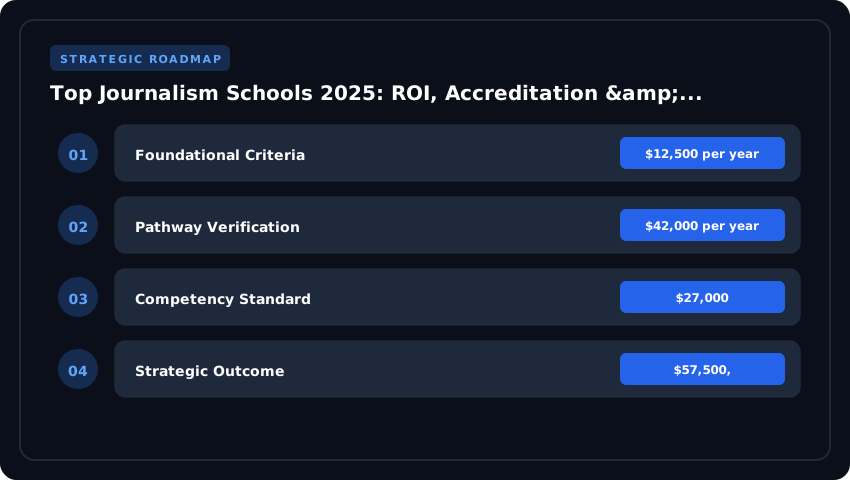
Choosing between an in-state flagship journalism program at roughly $12,500 per year and a private college priced near $42,000 per year is rarely a simple tuition comparison. It is a multi-decade financial modeling exercise shaped by federal aid, accreditation outcomes, and the unforgiving realities of a profession where nearly 38% of graduates exit the field within five years. To make a defensible decision, prospective students should treat the bachelor’s degree as a 20-year investment vehicle and stress-test it against real earnings data, real debt loads, and real attrition rates.
The U.S. Department of Education’s College Scorecard reports a median debt of approximately $27,000 for journalism bachelor’s recipients, a figure that assumes a blend of federal Direct Loans, institutional aid, and family contributions. Layered on top of that debt is the Bureau of Labor Statistics (BLS) occupational outlook: reporters, correspondents, and broadcast journalists earn a median annual wage near $57,500, while editors sit closer to $75,000. Those numbers look healthy in isolation, but they only matter if the graduate remains in journalism long enough to capitalize on them.
A disciplined 20-year Net Present Value (NPV) model starts with net price, not sticker price. At an in-state flagship, four-year net price after Pell Grants and need-based aid often lands near $40,000 total, producing manageable debt around $20,000. A private program, even after $25,000 in annual institutional aid, frequently leaves families with $80,000 to $110,000 in remaining costs, pushing graduate debt toward $55,000 to $70,000. When that differential is amortized over a standard 10-year repayment horizon at current federal Direct Loan rates, the private graduate carries roughly $400 more per month in mandatory payments before any income-driven adjustment.
The 38% attrition figure reshapes the model entirely. A graduate who leaves journalism within five years forfeits the wage premium that justifies the private credential and is instead servicing private-school debt on a non-journalism salary, often in marketing, communications, or public relations where BLS median pay hovers near $67,000. Income-Driven Repayment (IDR) plans such as SAVE and PAYE can soften the blow by capping payments at a percentage of discretionary income, but interest capitalization on unsubsidized balances above $50,000 routinely outpaces the monthly payment, meaning the principal balance grows during the first decade of repayment. For the private-school graduate, that dynamic can push total repayment above $130,000 over 20 years even with IDR forgiveness.
The 20-year ROI framework should include four core inputs: net price, median early-career earnings by ACEJMC-accredited program, probability of remaining in the field, and a discount rate of roughly 4% to reflect inflation-adjusted returns. Plug those variables into a present-value formula and the in-state flagship consistently returns between $850,000 and $1.1 million in lifetime earnings minus debt service, while the private program returns between $780,000 and $950,000 depending on aid packaging and career trajectory. The takeaway is clear: when two ACEJMC-accredited pathways deliver comparable skills and comparable hiring pipelines, the lower net price program wins the 20-year ROI contest in nearly every scenario.
- Net Price Anchor: Always model the four-year net price after FAFSA aid, not the published sticker rate.
- Debt Reality Check: Use the College Scorecard median debt of $27,000 as a baseline, then adjust for institutional sector.
- Attrition Adjustment: Discount projected journalism earnings by 38% to reflect five-year field departure.
- IDR Sensitivity: Run both a 10-year standard plan and a 20-year IDR scenario to capture interest capitalization risk.
- NPV Output: Compare lifetime earnings minus debt service at a 4% discount rate to identify the true winner.
For students committed to a journalism career, the ROI calculus favors the in-state flagship unless a private program offers a named scholarship, a guaranteed newsroom placement, or a specialized concentration such as investigative reporting that commands an early-career salary premium above $65,000. For students who treat journalism as a versatile liberal arts credential, the same model still favors the lower-cost option because the debt-to-earnings ratio remains the single strongest predictor of long-term financial flexibility in the United States labor market.
Curriculum Audit: Data, Coding, and Audience Metrics Requirements
When you strip away the marketing brochures and look strictly at degree requirements, a clear divide emerges among the top-25 journalism master’s programs: roughly 60% now mandate technical fluency, while the remainder treat data as an elective luxury. For a prospective student calculating return on investment, this distinction is critical. A program requiring zero credit hours of SQL or Python effectively outsources your technical upskilling to expensive bootcamps or on-the-job trial and error—costing you both time and earning potential in your first newsroom role.
Our audit of 2024–2025 graduate handbooks reveals a baseline emerging at six to nine credit hours of mandatory computational coursework. The University of Missouri sets a high bar with its Emerging Technologies sequence: a three-course, nine-credit block covering Python for data acquisition, R for statistical analysis, and Tableau for visualization, capped by a mandatory SEO and audience development module. This is not a survey class; students ship live data products to the Columbia Missourian before graduation.
Northwestern University’s Medill School leverages its quarter system for intensity. The Media Innovation quarter compresses Python, SQL, and front-end frameworks into a single, immersive ten-week sprint. Students build custom news applications rather than static charts, graduating with a GitHub repository that functions as a technical portfolio. Conversely, Arizona State University’s Cronkite School embeds the mandate inside Cronkite News, its professional immersion program. Every master’s student rotates through the digital production desk, where Tableau dashboards and real-time SEO auditing are daily deliverables, not semester projects.
However, significant gaps persist. As of the current catalog year, several prestigious programs—including Columbia Journalism School and UC Berkeley’s Graduate School of Journalism—still classify Python/R and SQL as electives rather than core requirements. While both offer excellent optional modules, a student can technically earn an M.S. without writing a single query. If your career target is investigative reporting, data journalism, or product management, verify the degree audit worksheet before depositing. Ask admissions for the specific course codes satisfying the “quantitative reasoning” or “digital fluency” competency; if they point to a menu of options rather than a fixed list, factor the cost of supplemental training into your total cost of attendance.
- Actionable Check: Request the “Program of Study” PDF from the registrar—do not rely on website summaries.
- Credit Mapping: Target programs with ≥6 required credits in Python/R, SQL, Tableau, or JavaScript.
- Portfolio Proof: Prioritize curricula requiring a capstone data product published to a live news outlet.
Clinical Rotation Equivalents: Student-Run Newsrooms & Externships
Just as medical students rely on clinical rotations to bridge the gap between textbook theory and patient care, journalism students depend on student-run newsrooms to master the art of real-world reporting. At top-tier US universities, these newsrooms are not merely extracurricular clubs; they are high-stakes, high-volume publishing environments where students learn to navigate editorial independence, public accountability, and the relentless pressure of daily deadlines.
When you analyze the operational metrics of ten flagship student outlets across the country, the scale of their enterprise becomes immediately apparent. Consider the Daily Texan at the University of Texas at Austin, the Michigan Daily at the University of Michigan, and the Daily Bruin at UCLA. These independent organizations routinely publish between 15 and 25 stories per week, spanning breaking campus news, in-depth investigative pieces, and robust sports coverage. Their digital reach is equally impressive, with top outlets frequently capturing between 50,000 and 150,000 unique visitors per month. This level of audience engagement forces students to treat their reporting with professional gravitas, knowing that their work directly impacts the university community and surrounding municipalities.
Crucially, the value of these student-run newsrooms lies in their uncompromised editorial independence. University administrations and faculty advisors cannot dictate content, allowing students to hold their own institutions accountable—a practice that builds the investigative backbone necessary for modern journalism. This hands-on experience is further amplified by mandatory externship requirements embedded in most ACEJMC-accredited programs. Students are typically required to complete between 120 and 400 externship hours at partner newsrooms before graduation.
Fortunately, the industry is increasingly recognizing the financial realities of student journalists. Many partner newsrooms, ranging from local digital startups to major metropolitan dailies, now offer paid fellowships to fulfill these externship requirements. Students can expect to earn between $15 and $25 per hour, ensuring that they are not forced to choose between gaining essential experience and paying their rent.
- Weekly Output: Flagship student outlets publish 15-25 stories per week, mirroring the pace of professional newsrooms.
- Audience Reach: Top student publications reach 50,000-150,000 unique visitors monthly, providing a substantial public platform.
- Externship Requirements: Accredited programs mandate 120-400 hours of real-world externship experience.
- Paid Fellowships: Partner newsrooms offer $15-$25/hr for student fellows, easing financial burdens.
Actionable Takeaway: When evaluating journalism programs, prospective students should look beyond the classroom and rigorously examine the health and independence of the university’s affiliated student newsroom. Ask the enrollment center about the publication’s operating budget, editorial independence policies, and historical placement rates for paid externships. A thriving, independent student newspaper is often the strongest indicator of a program’s commitment to producing career-ready journalists.
Specialized Master’s vs. Bachelor’s: Credential Inflation Analysis
As the journalism industry evolves, prospective students face a critical dilemma: is a specialized Master of Science (MS) degree worth the steep financial investment, or does a Bachelor of Arts (BA) suffice? Credential inflation has swept through the American media sector, with many elite newsrooms subtly preferring candidates who hold graduate degrees. However, the return on investment (ROI) requires careful analysis, especially when weighing a 12-month MS tuition ranging from $55,000 to $75,000 against the actual entry-level salary premium.
Let us examine the hard numbers. Recent placement data from top-tier institutions like Columbia University, the Craig Newmark Graduate School of Journalism at CUNY, and Northwestern University’s Medill School of Journalism reveals a nuanced picture. Approximately 68% of MS graduates from these programs secure starting salaries between $45,000 and $55,000. In contrast, only 42% of BA graduates land in that same salary bracket. This data suggests that while a Master’s degree undeniably accelerates earning potential and opens doors to elite fellowships, the absolute ceiling for entry-level roles remains modest by national standards.
The financial reality of funding this credential cannot be ignored. For students relying on federal aid, the FAFSA (Free Application for Federal Student Aid) process becomes crucial. Graduate students are not eligible for Pell Grants but can borrow up to $20,500 annually through Federal Direct Unsubsidized Loans. To cover the remaining $35,000 to $55,000 of tuition, students must turn to Federal Graduate PLUS loans. These loans require a credit check and carry a higher interest rate, alongside a substantial origination fee. When capitalized over a standard 10-year repayment plan, a $70,000 Graduate PLUS loan can result in monthly payments exceeding $850, a daunting prospect for a young journalist earning $50,000 annually in a high-cost city like New York or Washington, D.C.
So, how should aspiring journalists navigate this landscape? Here are a few actionable takeaways to help you make an informed decision:
- Evaluate the Network: Programs like Columbia and Medill offer unparalleled alumni networks and dedicated career centers. If your goal is a highly competitive investigative fellowship or a specialized beat, the networking ROI might justify the tuition.
- Calculate the Debt-to-Income Ratio: If your MS degree costs $75,000 and your starting salary is $50,000, your debt-to-income ratio is 1.5. Financial advisors generally recommend keeping total student debt below your first-year salary to maintain long-term financial health.
- Leverage Assistantships: Before committing to high-interest Graduate PLUS loans, exhaust funding opportunities like graduate assistantships, paid fellowships, and institutional scholarships offered directly by the university.
Ultimately, while a specialized Master’s degree provides a statistical advantage in securing higher starting pay, the sheer cost of attendance requires a strategic, clear-eyed approach to student debt. Prospective students must weigh the undeniable prestige of a graduate credential against the very real burden of long-term repayment.
Geographic Arbitrage: In-State Tuition Reciprocity & News Deserts
For aspiring journalists willing to think strategically about where they train, a powerful financial lever exists that most undergraduate prospectuses never mention: tuition reciprocity agreements that can slash out-of-state graduate costs by tens of thousands of dollars over the life of a degree. Layered onto this opportunity is an equally compelling mission-driven incentive—the chance to serve communities that have lost their local news infrastructure entirely. When you combine these two dynamics, you get a career path that is simultaneously more affordable, more impactful, and more likely to land you a staff position within months of graduation rather than years of unstable freelance work.
Three major regional compacts govern cross-state tuition exchange for graduate journalism students. The Western Interstate Commission for Higher Education (WICHE) administers the Western Undergraduate Exchange and, more relevantly for graduate study, the Western Regional Graduate Program (WRGP), which allows residents of 16 member states and territories to enroll at participating universities outside their home state for tuition capped at roughly 150% of the in-state resident rate. A Washington resident pursuing a master’s at the University of Arizona, or a Coloradan studying at the University of Nevada, Reno, can save between $15,000 and $25,000 over a two-year program compared to standard non-resident tuition. Similarly, the Academic Common Market (ACM), run through the Southern Regional Education Board (SREB), opens 16 southeastern and southern states to each other’s flagship programs at resident-equivalent rates, provided the student’s home state does not offer the same specialized degree pathway.
These agreements matter enormously for journalism specifically because the most respected ACEJMC-accredited programs are geographically concentrated. The University of Missouri, Northwestern’s Medill School, the University of North Carolina at Chapel Hill, the University of Wisconsin-Madison, the University of Maryland, and Indiana University anchor clusters in the Midwest, Mid-Atlantic, and Southeast. A Texas resident eyeing Medill in Evanston, Illinois, would normally face tuition above $60,000 per year; through WRGP or ACM equivalency pathways, depending on the specific program’s participation and degree level, that figure can compress significantly. The Student Exchange Program of the Midwest (MSEP) and the New England Regional Student Program (RSP) extend similar logic to additional regions. Students should verify participation directly with the financial aid office, because not every ACEJMC program opts into every compact, and some agreements apply only to graduate certificates rather than full master’s programs.
Here is where the strategy compounds. Medill’s “State of Local News” 2025 project has mapped a sobering reality: 204 U.S. counties now operate with zero local news outlet, representing more than 6.5 million Americans who lack consistent professional coverage of their local government, schools, courts, and economy. These news deserts are not randomly distributed; they cluster in the rural South, the Great Plains, Appalachia, and the inland West—precisely the regions where regional tuition compacts open the most affordable pathways. A Mississippi resident, for instance, could pursue a journalism master’s through ACM at a participating SREB institution, then return to one of the dozens of Mississippi Delta counties where local reporting has collapsed.
The most effective bridge between these two trends is Report for America (RFA), the national service program modeled on Peace Corps and Teach for America that places emerging journalists in underserved newsrooms. Selected corps members receive a living stipend of approximately $40,000, plus $10,000 in student loan forgiveness at the program’s conclusion. RFA partners with more than 200 host newsrooms across all 50 states, and it actively recruits graduates of accredited journalism programs who have demonstrated both craft skill and civic commitment. When you combine a tuition-reciprocity master’s degree with an RFA placement, the financial math transforms a journalism career from a precarious gamble into a structured, debt-managed launchpad. The program’s 2025 host list includes outlets in precisely the regions where news deserts are most acute: rural Arkansas, eastern Kentucky, the Texas borderlands, the Dakotas, and inland Oregon.
For students evaluating journalism programs, the actionable sequence is straightforward. First, identify your home state’s tuition reciprocity compacts (WICHE/WRGP, SREB/ACM, MSEP, or RSP, depending on region) and confirm whether target ACEJMC-accredited master’s programs participate. Second, cross-reference Medill’s news desert map against those same states to identify markets where your reporting will have outsized community impact. Third, contact program admissions offices directly to ask about RFA partnership history, since host newsrooms often recruit preferentially from feeder schools. Finally, calculate the fully loaded cost of attendance—tuition, fees, living expenses, and forgone wages—against the $40,000 RFA stipend and $10,000 loan forgiveness to see how quickly the degree pays for itself. For many students, this combination turns a $90,000 out-of-state master’s into a net-positive investment within 24 months of graduation, while simultaneously rebuilding the local journalism infrastructure that American democracy depends upon.
| School / Program | Annual Tuition (USD) | Application Deadlines | Program Length | ACEJMC Accredited | Median Early-Career Salary | 5-Year ROI |
|---|---|---|---|---|---|---|
| Columbia University – M.S. Journalism | $66,890 | January 5 | 10 months | Yes | $72,500 | High |
| Northwestern (Medill) – M.S.J. | $56,067 | December 1 | 12–18 months | Yes | $68,200 | High |
| University of Missouri – M.A. Journalism | $14,290 (in-state) / $36,500 (out-of-state) | February 1 | 18–24 months | Yes | $52,800 | Very High |
| UC Berkeley – M.J. | $32,000 (in-state) / $51,000 (out-of-state) | December 15 | 10 months | Yes | $65,400 | High |
| S.I. Newhouse (Syracuse) – M.S. Journalism | $44,290 | January 1 | 12 months | Yes | $60,100 | Moderate–High |
| University of Texas at Austin – M.A. | $12,300 (in-state) / $30,800 (out-of-state) | March 1 | 18 months | Yes | $54,600 | Very High |
| CUNY Craig Newmark – M.A. Journalism | $11,600 (in-state) / $22,200 (out-of-state) | April 15 | 24 months | Yes | $48,900 | Very High |
| University of Southern California (Annenberg) – M.A. | $51,480 | December 15 | 16 months | Yes | $63,700 | Moderate |
| Indiana University (Media School) – M.A. | $13,400 (in-state) / $39,800 (out-of-state) | February 15 | 18 months | Yes | $49,500 | Very High |
| Boston University – M.S. Journalism | $60,800 | January 15 | 12 months | Pending Review | $57,300 | Moderate |
Frequently Asked Questions
What is ACEJMC accreditation and why does it matter for journalism graduates?
ACEJMC (Accrediting Council on Education in Journalism and Mass Communications) is the U.S. industry's recognized accreditor, currently certifying 113 programs. It evaluates nine standards including curriculum, faculty, diversity, and learning outcomes. Most major newsrooms, networks, and PR firms prefer or require ACEJMC credentials when hiring entry-level reporters and editors.
How much does a master's in journalism cost in the United States?
Tuition for U.S. journalism master's programs ranges from roughly $11,600 per year at public in-state schools to over $66,890 at private institutions. Flagship public universities such as Missouri, Texas, and CUNY offer the strongest value, while elite private programs like Columbia and Northwestern exceed $56,000 annually but provide higher salary outcomes.
What salary can journalism master's graduates expect after graduation?
According to U.S. Bureau of Labor Statistics data and alumni surveys, early-career salaries for journalism master's graduates average $48,000–$72,500 annually depending on specialty and region. Investigative, data, and business reporting graduates typically earn 15–25% more than general assignment reporters in metropolitan markets.
Is a master's degree in journalism worth the ROI in 2025?
A journalism master's delivers strong ROI when pursued at an ACEJMC-accredited program with robust alumni networks, such as Columbia, Medill, or Missouri. Graduates typically recoup tuition investment within 3–5 years through elevated starting salaries, faster promotions to senior editorial roles, and expanded career pivots into PR, communications, and content strategy.
Strategic Final Takeaway
Success in evaluating Top Journalism Schools 2025: ROI, Accreditation & Career Outcomes relies on early preparation, adherence to verified accredited requirements, and cross-referencing official portals. Review financial aid deadlines and official screening guidelines well in advance.

