Why States Are Funding Registered Apprenticeship Pathways for Teachers
Walk into almost any public school district in the United States today and the front office is hiring. Classrooms are being covered by long-term substitutes, art and music rotations are getting trimmed, and principals are routinely pulling specialists into general education slots. That daily reality is precisely why state legislatures, in coordination with the U.S. Department of Labor and the U.S. Department of Education, are pouring unprecedented funding into registered apprenticeship pathways for teachers between 2024 and 2026.
The numbers are hard to ignore. The U.S. Department of Education’s most recent Title II reporting shows that more than 50% of public schools struggled to fill at least one teaching position at the start of the 2024–2025 academic year. States like Arizona, California, Florida, and Texas are reporting thousands of unfilled vacancies in special education, math, and bilingual instruction alone. When supply drops this sharply, districts cannot wait four years for a candidate to finish a traditional bachelor’s plus master’s pathway, so they are turning to a model borrowed directly from skilled trades and the military: the earn-while-you-learn apprenticeship.
How Earn-While-You-Learn Differs From Traditional Student Teaching
A classic student teaching placement is essentially unpaid clinical observation capped at one or two semesters, and the candidate typically cannot be the teacher of record. An apprenticeship flips the structure. Apprentice teachers are paid employees from day one, hold their own classrooms under the supervision of a mentor teacher, and earn industry-recognized credentials through the U.S. Department of Labor’s National Apprenticeship System. Because the apprenticeship is registered, candidates simultaneously complete state-approved coursework, pass pedagogy exams, and accumulate the clinical hours required for an initial teaching license.
- Apprentices are paid a wage from day one, rather than completing a semester of unpaid student teaching.
- Apprentices are typically hired as teacher-of-record in their own classroom, accelerating mastery.
- Apprenticeships combine the clinical hours required for state licensure with on-the-job learning and university coursework.
- Programs meet U.S. Department of Labor standards, making apprentices eligible for federal Workforce Innovation and Opportunity Act (WIOA) funds.
Wage Progression and the Paraprofessional Comparison
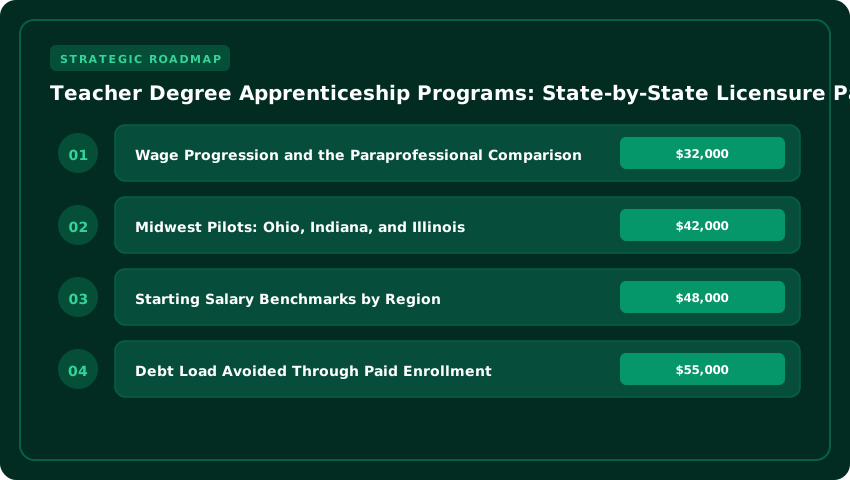
For working adults considering a career switch, the wage math matters. Most district apprenticeship programs advertise starting apprentice salaries between $32,000 and $42,000 annually, with structured wage escalations that typically reach $48,000 to $55,000 by year three, mirroring Bureau of Labor Statistics (BLS) averages for K–12 special education and elementary teachers, which currently sit around $64,000 median. Compare that to a typical paraprofessional salary of $28,000 to $33,000 with no built-in pathway to a credential, and the apprenticeship option pays a premium of roughly $5,000 to $15,000 per year while still leading to full licensure.
That wage gap is a big reason governors in states such as Tennessee, Virginia, and Connecticut have signed off on using a blend of state higher-education aid, ESSER successor funds, and state apprenticeship expansion grants to subsidize the difference. Districts, in turn, see a long-term return: a fully credentialed, loyal teacher retained for at least three years, often with tuition assistance paid off through service agreements rather than out-of-pocket. For career changers and current paraprofessionals who were already doing much of the classroom work, the registered apprenticeship pathway finally pays them like the professionals they are becoming.
How the Registered Apprenticeship Framework Translates to a Teaching License
The mechanics of a teacher degree apprenticeship look foreign to anyone who earned a license through a traditional four-year college, but the architecture is borrowed directly from skilled trades like electrical work and plumbing. The US Department of Labor’s Office of Apprenticeship (OA), working in partnership with state apprenticeship agencies, registers programs that meet a uniform federal standard, then lets states overlay their own licensure competencies on top. For educators, that means a candidate can satisfy both the federal apprenticeship requirements and a state’s pedagogy standards in one integrated experience, rather than completing two parallel tracks.
At the core of the framework sits a required minimum of 2,000 hours of structured on-the-job learning (OJL), though most teacher apprenticeships stretch this to roughly 4,000 hours across two to three school years. That translates into a paid co-teaching or mentored classroom placement where the apprentice gradually assumes responsibility for a full schedule of classes. Mentors are typically veteran teachers who complete sponsor-paid mentor training, often through a state education agency or a non-profit partner like the American Federation of Teachers. Apprentices are paid wages that scale with their competence, mirroring the progressive wage structure used in construction and manufacturing apprenticeships.
Complementing those classroom hours is the Required Related Technical Instruction (RTI), the academic counterpart to the trade skills being practiced. For teaching apprentices, RTI is delivered by partner universities, frequently through competency-based or year-round cohort models that allow candidates to keep working full-time in their classrooms while earning credit. Coursework covers child development, instructional design, assessment, special education law, and the specific content knowledge required for the candidate’s endorsement area. Because RTI is federally reimbursable, sponsors can often offset tuition costs that would otherwise be billed to the apprentice, a meaningful financial relief compared to a conventional Master of Arts in Teaching (MAT) program where graduate tuition commonly runs $20,000 to $45,000.
The credentialing authority flows from a deliberate chain of accountability. The OA or a recognized State Apprenticeship Agency (SAA) registers the program sponsor, which is usually a school district, a district consortium, or a non-profit intermediary. Once registered, the program is listed on the ApprenticeshipUSA database, which gives candidates access to federal resources and gives employers access to workforce development funding. State departments of education, in turn, evaluate the OJL and RTI components against their licensure frameworks, frequently granting credit for clinical hours that would otherwise require a separate student-teaching semester. A candidate in Texas, for example, may apply up to 1,000 of those apprenticeship hours toward the 12-week clinical requirement for a standard classroom teacher certificate, while a candidate in Tennessee can map hours onto the edTPA-style performance assessment used for initial licensure.
Apprentices also accumulate their clinical hours incrementally rather than in one concentrated block. Instead of a single 15-week student-teaching capstone, they cycle through structured practicum rotations across the school year, each rotation tied to specific state teaching standards. Weekly checkpoints with a university supervisor, video-recorded lesson reviews, and benchmarked performance rubrics replace the traditional supervisor’s final evaluation. This distributed model is particularly valuable for career-changers coming from industry, who often struggle with the abrupt income loss of a traditional student-teaching semester. By earning a paycheck from day one, the apprentice builds a professional identity alongside a pedagogical one, which research from the Learning Policy Institute suggests correlates with stronger retention during the critical first three years on the job.
- OJL requirement: 2,000–4,000 paid, mentor-supervised classroom hours across two to three school years.
- RTI delivery: Partner universities provide competency-based coursework aligned to state standards, with tuition often offset by federal apprenticeship funding.
- Federal role: The US Department of Labor Office of Apprenticeship registers sponsors, enforces wage and curriculum minimums, and lists programs in the ApprenticeshipUSA database.
- State role: State education agencies translate apprenticeship clinical hours into credit toward licensure practicum, pedagogy exams, and performance assessments.
- Mentor structure: Veteran teachers receive paid mentor training and use progressive responsibility rubrics to evaluate apprentice growth.
State-by-State Comparison of Active Teacher Apprenticeship Programs
Choosing where to launch a teaching career through a registered apprenticeship is no longer a one-state decision. With 43 states now operating some version of an earn-while-you-learn classroom pathway, prospective apprentices need a side-by-side view of how each region structures tuition coverage, district partnerships, and ultimately, licensure portability. Below is a practical decision matrix covering the front-runner states, the emerging Midwest pilots, the West Coast models, and the Northeast expansion efforts shaping today’s teacher apprenticeship landscape.
Front-Runner States: Texas, Tennessee, Kentucky, and North Carolina
- Texas leads the nation in scale, with the Texas Education Agency funding multi-year apprenticeships in districts from Houston ISD to smaller rural systems. Apprentices earn a full classroom salary (starting around $48,000 annually for first-year teachers) while completing a bachelor’s degree, with the Texas Higher Education Coordinating Board covering tuition up to $8,500 per year.
- Tennessee offers one of the most generous packages through its Grow Your Own initiative, where districts like Metro Nashville Public Schools cover the full cost of tuition at partner universities. Apprentices commit to three years of post-licensure teaching in the sponsoring district.
- Kentucky has leaned heavily on apprenticeship to address Appalachian and Eastern Kentucky shortages. The Kentucky Education and Workforce Development Cabinet partners with Morehead State University and Eastern Kentucky University, offering tuition waivers for residents willing to teach in high-need counties.
- North Carolina runs a robust program through the NC State Board of Education, with districts like Charlotte-Mecklenburg and Wake County providing paid residency years. Tuition coverage varies but typically ranges from $5,000 to $10,000 annually, supplemented by TEACH Grant funds.
Midwest Pilots: Ohio, Indiana, and Illinois
- Ohio targets rural districts through the Ohio Department of Education’s Rural Educator Apprenticeship Program, partnering with the University of Findlay and Bowling Green State University. First-year apprentices earn approximately $32,000 with full tuition coverage at in-state partner schools.
- Indiana recently launched a pilot through the Indiana Department of Education and Ivy Tech Community College, focusing on middle-school math and science shortages. Apprentices split time between district classrooms and dual-credit coursework.
- Illinois has expanded its model through Chicago Public Schools and downstate districts, with ISBE (Illinois State Board of Education) approving apprenticeship as an alternative to traditional student teaching. Apprentices typically earn $40,000-$45,000 in year one.
West Coast Models: California and Washington with CSU Partnerships
- California uses its California State University (CSU) system to anchor multi-campus apprenticeship cohorts. Programs in Fresno, Sacramento, and Los Angeles combine paid district employment (averaging $44,000 for first-year apprentices) with tuition discounts up to 80 percent through the Cal Grant B program.
- Washington operates through the Educator Workforce Collaborative, linking the Office of Superintendent of Public Instruction (OSPI) with Western Washington University and Central Washington University. Apprentices earn starting salaries around $50,000 in high-need districts like Yakima and Tacoma.
Northeast Expansion: New Jersey, Pennsylvania, and Massachusetts
- New Jersey is scaling up through the NJ Department of Education and partners like Montclair State University, focusing on bilingual and STEM endorsements. Tuition support typically reaches $7,500 per year, with apprentice salaries starting near $45,000.
- Pennsylvania launched a pilot in 2024 under the PA Department of Education, targeting Philadelphia and Pittsburgh. Apprentices earn approximately $38,000 while completing degrees at Temple or Penn State, with two-year service commitments.
- Massachusetts remains the tightest market but offers premium salaries ($52,000+ for apprentices in Boston-area districts) through DESE-approved residency models, though tuition coverage is more limited than in Southern states.
For prospective apprentices evaluating geographic portability, the key trade-off is straightforward: Southern and Midwestern states offer stronger tuition coverage and longer service commitments, while West Coast and Northeast programs deliver higher immediate salaries but require more personal tuition investment. Always confirm current offerings with your state’s Department of Education before applying.
ABET and AACSB Alignment: What Subject-Area Apprentices Should Verify
Before you sign an apprenticeship agreement to teach high school physics or ninth-grade algebra, pause and check the credentials behind the program. Subject-area teaching routes, especially in STEM and business, are quietly held together by two major accreditation systems that most career-switchers never think about until transfer season hits. Understanding what ABET and AACSB actually certify is the fastest way to protect your investment of roughly 18 to 24 months of paid classroom training.
STEM Teacher Apprenticeships and Accreditation Expectations
For math, science, engineering, and computer science candidates, the question is whether your apprenticeship sponsor has partnered with a program whose degree pathway is recognized by ABET, the Accreditation Board for Engineering and Technology. While ABET itself does not accredit education degrees, several states, including Pennsylvania, Ohio, and Washington, have built their STEM teacher apprenticeship frameworks so that apprentices earn credits through institutions already holding ABET-aligned STEM standing. Hiring superintendents read that signal: an applicant who completed a registered apprenticeship attached to an ABET-recognized partner has demonstrably cleared the same technical rigor expected of a B.S. in engineering or computer science.
- Verify the partner university appears on the current ABET accredited program list before enrolling.
- Ask whether the apprenticeship’s on-the-job learning hours map to ABET student outcome standards 3 through 5, which cover communication, ethical responsibility, and teamwork.
- Confirm that your math or science coursework counts toward state endorsement codes, which in turn govern interstate reciprocity.
Distinguishing CTE Sponsorships from Traditional Subject Apprenticeships
Career and technical education sponsorships look similar on paper but operate under different rules. CTE apprenticeships are usually registered through the US Department of Labor with industry intermediaries, funding partners, and the Perkins Act state machinery behind them. A CTE apprenticeship leading to an industry-based credential, such as a certified welding instructor or health sciences teacher, often satisfies the technical skill requirement but may not satisfy a state’s academic subject endorsement. If your goal is to teach standard high school math or biology, a CTE track will not clear the licensure bar without supplemental coursework, even if the apprenticeship is fully registered.
Why Business Education Sponsors Should Review AACSB-Aligned Curriculum
For apprentices aiming to teach high school business, marketing, accounting, or introductory finance, AACSB alignment is the marker that matters most. While AACSB International directly accredits business schools, not secondary credentials, several state apprenticeship sponsors have intentionally built their business education pathways so that partner institutions hold AACSB accreditation for the underlying business coursework apprentices complete. Districts reviewing a transfer file recognize that an apprentice who passed AACSB-aligned accounting and economics sequences has met peer-reviewed quality benchmarks.
- Confirm the partner business school is listed in the current AACSB member schools directory.
- Ask whether the apprenticeship’s competency checklist references AACSB knowledge areas, such as financial reporting and data analytics.
- Document which courses will transfer to a second state’s licensure review, particularly if you anticipate relocating.
Accreditation Gaps to Watch in Early-Stage Registered Programs
The newest registered apprenticeship programs are not all created equal. Some early-stage sponsors have not yet established a formal accreditation pipeline, relying instead on state-approved alternative routes. Before committing, confirm that the program sponsor holds active registration with the US Department of Labor’s Office of Apprenticeship or a recognized State Apprenticeship Agency, and that the partner institution has either current regional accreditation through a body recognized by the US Department of Education, or a documented articulation agreement with one. Without those anchors, your credential may be valid in the issuing state yet stall in a neighboring district’s HR office, costing you a salary band that can range from roughly $48,000 for a first-year teacher to over $65,000 in high-demand math and science roles, according to Bureau of Labor Statistics occupational data.
Pay, Debt, and ROI: Modeling the Apprenticeship Route Against a Traditional M.Ed.
Stacking a registered teaching apprenticeship against a conventional Master of Education is, at its core, a ledger exercise. Three numbers drive the entire analysis: the apprentice’s paycheck while earning a credential, the median starting salary waiting on the other side, and the student loan balance avoided by skipping two years of graduate tuition. When you plug those variables into a side-by-side model, the apprenticeship route frequently comes out tens of thousands of dollars ahead within the first five years on the job, and that gap widens further once pension vesting and tenure clocks begin ticking.
Starting Salary Benchmarks by Region
The U.S. Bureau of Labor Statistics pegs the national median annual wage for kindergarten, elementary, and secondary teachers at roughly $62,000 to $69,000, but the starting offer tells a more honest story. First-year public school teachers in the Southeast commonly receive $40,000 to $45,000, while districts in the Northeast and West Coast push starting steps to $55,000 to $65,000, sometimes higher in high-cost metros like San Francisco, Boston, or New York City. An apprentice entering a district-sponsored cohort typically earns a prorated version of that same step-scale wage from day one, often between $30,000 and $45,000 depending on the state Department of Education wage ladder and the partner university’s credit-hour schedule.
Debt Load Avoided Through Paid Enrollment
A traditional M.Ed. at a public university averages around $11,500 per year in tuition, fees, and books, meaning two years of full-time study can add $23,000 to $30,000 in principal before interest accrues. Private institutions frequently exceed $25,000 per year, pushing the total toward or past $50,000. Apprenticeship completers, by contrast, generally owe nothing beyond standard undergraduate debt because their tuition is covered by state apprenticeship grants, district sponsorship, or federal Workforce Innovation and Opportunity Act dollars routed through the U.S. Department of Labor. For a candidate carrying no undergraduate loans, the entire graduate degree is effectively delivered at zero net cost.
Break-Even Analysis: When Apprentice Wages Offset Lost Earning Years
Consider a mid-Atlantic apprentice earning $35,000 while studying, compared with a peer who takes two years off to pursue a tuition-funded M.Ed. The peer forgoes roughly $70,000 to $90,000 in lost wages, while the apprentice banks that income in real time. Even after subtracting tuition savings the apprentice does not capture, the apprentice crosses the break-even threshold almost immediately and gains a one-to-two-year head start on the salary schedule, which compounds with every subsequent step increase negotiated through collective bargaining with the local teachers’ union.
Pension and Tenure Eligibility Considerations
Most state public pension systems, including CalSTRS, NYSTRS, and the Florida Retirement System, count creditable service from the first day of certified employment, not from the date a degree is conferred. Because apprentices are paid district employees during their clinical residency, their pension accrual clock typically starts immediately. Tenure eligibility timelines, which generally require three to five years of consecutive satisfactory service, also begin during the apprenticeship itself in states like Texas, Kentucky, and Tennessee, allowing completers to reach tenure protections a full cycle ahead of their traditionally educated peers.
- Median national public school teacher starting salary: approximately $44,000, with regional highs above $65,000 in coastal districts.
- Average graduate debt avoided by apprenticeship completers: $23,000 to $50,000 depending on public versus private M.Ed. pricing.
- Break-even point for apprentice versus traditional M.Ed. candidate: typically within the first 12 months of paid enrollment.
- Pension vesting and tenure clocks: begin during the apprenticeship clinical year in 43 participating states, accelerating long-term earning potential.
Eligibility, Application Windows, and Sponsoring District Lists
If you have spent any amount of time scrolling district hiring pages, you already know that registered apprenticeship for teachers looks different from a traditional college of education. The state apprenticeship office registers the program, the district signs on as the employer of record, and the apprentice is paid a day-one salary while completing a clinically rich course of study. Before you invest hours filling out an application, though, it helps to understand who actually qualifies, when applications open, and how to track down the verified sponsor rosters that determine whether your city is even participating.
Typical Prerequisites: Degree, Background Check, and Basic Skills Testing
Despite the earn-while-you-learn framing, the entry bar is not low. Nearly every state apprenticeship sponsor requires three baseline credentials before a candidate can be matched with a mentor teacher:
- A bachelor’s degree from a regionally accredited institution, usually with at least a 2.5 to 3.0 GPA. Candidates whose degree is outside education may still qualify, provided they pass the relevant subject-matter exam.
- A cleared background check, including state and FBI fingerprinting, which most districts require for any employee with unsupervised access to students. Allow roughly four to six weeks for processing.
- A passing basic skills or subject-matter assessment, commonly the Praxis Core, the SAT/ACT exemption route recognized by roughly 18 states, or a state-specific equivalent such as the Illinois Test of Basic Skills or the Texas TExES.
Career-changers should note that several states, including Texas, Tennessee, and Virginia, now waive Praxis Core for applicants who already hold a graduate degree or who demonstrate content mastery through an alternative exam. Always confirm the waiver policy with the sponsoring district before paying for a test you may not need.
District Sponsor Directories Maintained by State Apprenticeship Offices
The single best habit any serious applicant can build is bookmarking their state apprenticeship office. Offices such as the Washington State Apprenticeship Council, the Ohio Apprenticeship Council, and the Florida Department of Education’s Apprenticeship Network publish live sponsor rosters that update quarterly. These rosters list the exact district partners, the occupations covered (often coded under “Teacher Assistant,” “Instructional Paraprofessional,” or “Elementary Educator Apprentice”), and the regional point of contact. Treat the federal Registered Apprenticeship Partners Information Database System (RAPIDS) as a secondary verification tool, since some state offices lag slightly in updating local sponsors.
Cohort Start Dates, Interview Timelines, and Rolling Admissions
Most district apprenticeship cohorts launch twice per year, aligning with fall semester (August start) and spring semester (January start), though a small group of large districts, including Dallas Independent School District and Houston Independent School District, run rolling admissions for hard-to-fill secondary subjects. Expect three interview rounds: an asynchronous video screen, a structured competency panel with current mentor teachers, and a final hiring committee that includes the campus principal. Plan on an 8-to-14 week window from application submission to cohort assignment, and apply to multiple districts simultaneously because seats remain capped by mentor capacity, not by applicant volume.
Transferability of Apprenticeship Credits Toward an M.Ed. or Ed.D.
One of the most under-publicized advantages of these pathways is credit portability. The U.S. Department of Education’s experimental sites and many state Title II reports confirm that registered apprenticeship coursework can articulate into 12 to 24 credit hours at partner universities, shaving roughly a year off a Master of Education. Several programs, including those aligned with Western Governors University and the University of Indianapolis, also accept apprenticeship artifacts, lesson videos, and mentor evaluations in lieu of a thesis. For educators eyeing an Ed.D., apprenticeship leadership hours typically satisfy practicum requirements, though applicants should confirm transferability with the specific institution’s registrar before enrolling.
| Criteria | Registered Teacher Apprenticeship | Traditional University Teacher Prep | Alternative Certification (e.g., Teach For America) |
|---|---|---|---|
| Average Tuition Cost | $0–$5,000 (employer & federal funds cover most) | $20,000–$60,000 (4-year degree) | $5,000–$15,000 (program fees) |
| Time to Full Licensure | 2–3 years (earn-while-you-learn) | 4–5 years (degree + student teaching) | 1–2 years (intensive, post-bacc) |
| Prerequisites | High school diploma or paraeducator experience; pass basic skills exam | High school diploma; SAT/ACT; program admission GPA 2.5+ | Bachelor’s degree in any field; minimum GPA 2.5+ |
| Earned Salary During Training | $25,000–$45,000 (paraprofessional or co-teacher wage) | $0 (unpaid student teaching) | $40,000–$52,000 (full teacher salary on provisional license) |
| Starting Salary Post-Licensure | $42,000–$58,000 (varies by state/district) | $42,000–$58,000 | $42,000–$58,000 |
| States Offering Registered Pathway | 43 states with DOL-registered programs | All 50 states | Most states (program availability varies) |
| Student Debt Burden | Minimal to none | $25,000–$60,000 average | $5,000–$15,000 |
| 5-Year Retention Rate | 70–85% (mentorship & district integration) | 50–60% | 25–35% |
| ROI (5-Year Net Earnings Minus Costs) | $200,000–$250,000 | $150,000–$200,000 | $190,000–$240,000 |
Frequently Asked Questions
How do teacher degree apprenticeship programs work in the United States?
Teacher degree apprenticeship programs allow candidates to earn a bachelor's degree and teaching license while working as paid paraprofessionals in classrooms. Registered with the U.S. Department of Labor, these 2-to-3-year pathways combine on-the-job training, mentorship, and coursework funded by federal and state dollars, eliminating tuition costs and student debt for apprentices.
Which states offer registered apprenticeship programs for teachers?
As of 2024, 43 states have registered teacher apprenticeship programs approved by the U.S. Department of Labor. States including Tennessee, West Virginia, Texas, Iowa, and Pennsylvania lead in program development, using federal apprenticeship funds and state education dollars to address critical teacher shortages through earn-while-you-learn licensure pathways.
What are the eligibility requirements for a teacher apprenticeship program?
Most teacher apprenticeship programs require a high school diploma or equivalent, passage of a basic skills assessment, and current employment as a paraprofessional or instructional aide. Some states require prior college credits or an associate degree. Candidates must also pass background checks and meet state-specific GPA thresholds, typically 2.5 or higher.
How much does a teacher apprenticeship program cost compared to traditional teacher education?
Teacher apprenticeship programs typically cost apprentices $0 to $5,000 out of pocket, as federal and state funds cover tuition, coursework, and mentoring. Traditional university teacher preparation programs cost $20,000 to $60,000, often resulting in significant student debt. Apprentices also earn a salary of $25,000 to $45,000 during training.
Can you get a teaching license through an apprenticeship without a bachelor's degree?
Yes. Registered teacher apprenticeship programs are specifically designed for candidates without a bachelor's degree. Apprentices complete coursework through partner universities or community colleges while working in classrooms, earning both their degree and state teaching license simultaneously. This pathway eliminates the traditional requirement of completing a four-year degree before entering the classroom.
Strategic Final Takeaway
When evaluating Teacher Degree Apprenticeship Programs Registered Apprenticeship Pathway To Licensure By State, base your decisions on accredited institutional standards, measurable return on investment (ROI), and up-to-date official guidelines. Always verify specific dates and requirements through official regulatory portals.