Why State-Specific Certification Pathways Matter for Early Childhood Educators
When it comes to training the next generation of early childhood educators, there is no one-size-fits-all approach in the United States. Because the US Dept of Education delegates licensure authority to individual states, the requirements to lead a PreK-3 classroom vary wildly from coast to coast. A teaching certificate in Florida does not automatically transfer to California. Prospective teachers must analyze their local job market and align their enrollment with their specific state department of education’s hiring standards.
Childcare Credentials vs. Full State Teaching Certification
There is a massive difference between holding an associate-level childcare credential and earning full state teaching certification. An associate degree or a Child Development Associate (CDA) credential qualifies you to work in private daycares and Head Start programs. However, if you want to teach in a public elementary school as a PreK-3 teacher, you need a bachelor’s degree and a state-issued teaching license. This licensure typically requires passing state exams, completing supervised clinical hours, and holding a degree with an approved curriculum.
Bypassing Traditional Four-Year University Tuition Costs
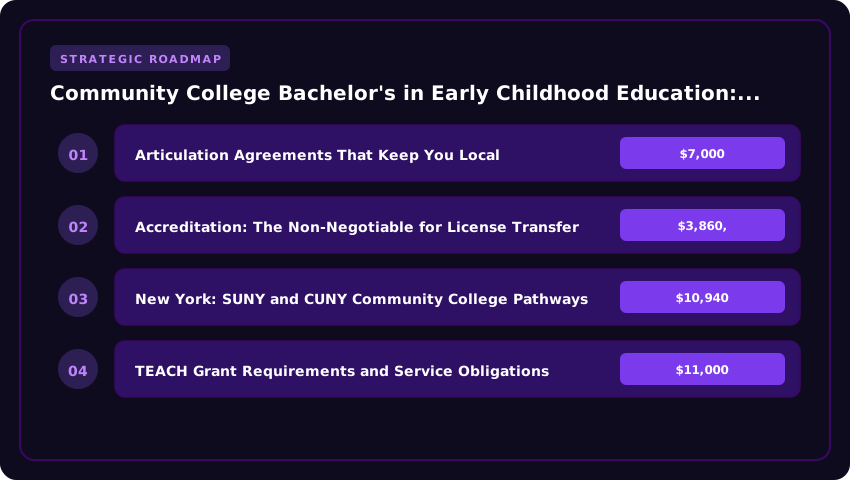
Historically, earning a bachelor’s degree meant transferring to a four-year university. Today, more than 20 states allow community colleges to offer their own bachelor’s degrees in high-need fields like early childhood education. This pathway is a game-changer for working professionals. According to the College Board, the average annual tuition and fees at a public two-year community college are roughly $3,860, compared to $10,940 at an in-state public four-year university. By completing a four-year degree at a community college, students can bypass thousands of dollars in tuition while still qualifying for FAFSA and state reimbursement programs.
- Verify State Licensure: Ensure the community college program is explicitly approved by your state’s Department of Education for PreK-3 licensure.
- Check Transferability: If you plan to move, confirm whether your target state recognizes out-of-state teaching certificates through reciprocity agreements.
- Maximize FAFSA: Fill out the FAFSA to access federal grants and state-specific reimbursement programs designed to address teacher shortages.
Ultimately, geographic location dictates not just where you work, but how you must be trained. By selecting a community college bachelor’s program tailored to state-specific standards, aspiring educators can graduate with the right credentials, minimal debt, and immediate employability in their local school districts.
Comparing Community College Bachelor’s Programs vs. Traditional State University Routes
For career-changers eyeing the classroom, the choice between a community college bachelor’s program and a traditional state university track often comes down to three variables: money, mobility, and time-to-certification. A standard four-year university in the U.S. can easily run $11,000–$15,000 per year in tuition alone, according to College Board averages, while a community college bachelor’s pathway typically lands between $3,500 and $7,800 annually. Over a four-year span, that delta translates into $14,000–$45,000 in savings before you ever set foot in a PreK-3 classroom. For working childcare professionals already earning $32,000–$38,000 as an assistant teacher, that gap isn’t trivial, it’s the difference between graduating debt-free and starting your teaching career $30,000 underwater.
Articulation Agreements That Keep You Local
The real engine behind the community college model is the articulation agreement, a formal contract between a two-year institution and a four-year partner that guarantees your associate degree credits transfer seamlessly into an upper-division bachelor’s completion program. States like Washington, Florida, and Texas have spent the last decade building “2+2” pipelines specifically for Early Childhood Education (ECE) cohorts. The practical effect? You can complete your junior and senior-level coursework, including practicum and student teaching, on a community college campus near your home, while still earning a baccalaureate issued by the partner university. This matters enormously for career-changers who cannot relocate or quit their day job at a daycare center.
Hybrid and Weekend Cohort Models for Working Professionals
Traditional state universities schedule most ECE methods courses Tuesday through Thursday between 9 a.m. and 3 p.m., a format that excludes roughly 64% of adult learners who work full-time. Community college bachelor’s programs have responded with hybrid cohorts: Friday-evening Zoom seminars, Saturday intensives, and asynchronous modules built around a working childcare professional’s calendar. Programs like the one at St. Petersburg College in Florida and Bellevue College in Washington advertise 18-to-24-month completion tracks once general-education credits are banked, with tuition structured at the community college rate even for the upper-division year.
Accreditation: The Non-Negotiable for License Transfer
Cost savings vanish instantly if your program lacks the right accreditation stamp. State Departments of Education typically only accept ECE degrees accredited by NCATE (now transitioning under the CAEP umbrella) or a state-approved regional body. Without that designation, your license may be valid in Oregon but worthless in Arizona when you relocate. Before enrolling, verify on the Council for the Accreditation of Educator Preparation (CAEP) website that your community college’s baccalaureate holds “recognized” status, and cross-reference with your target state’s reciprocity list through the US Department of Education’s title-iv portal.
The ROI verdict is straightforward: if your state offers a CAEP-accredited community college bachelor’s with a solid articulation deal, the lower-cost route typically delivers a teaching credential 12-18 months faster and for roughly half the out-of-pocket cost of a traditional state university. Your salary as a new public-school teacher, starting around $44,000 per Bureau of Labor Statistics data, arrives on the same timeline either way, meaning the cheaper path mathematically wins.
State-by-State Breakdown of Community College Early Childhood Education Certification
Understanding your state’s certification framework is the single most important step before enrolling in any early childhood education program. Because teacher licensure is granted at the state level, a degree that earns you a credential in Texas may not transfer cleanly to New York without additional coursework or reciprocity paperwork. Below is a state-by-state breakdown of how community college bachelor’s pathways align with regional certification requirements, so working educators and career changers can make informed enrollment decisions.
Texas: Field-Based Certification Through University Partnerships
Texas Education Agency (TEA) approved educator preparation programs (EPPs) are the gateway to standard certification in PreK-3 classrooms. Many community colleges, including those in the Dallas College and Houston Community College systems, have built formal 2+2 articulation agreements with regional universities such as Texas A&M University-Commerce and the University of Houston. Students complete roughly 60 credit hours at the community college level (tuition around $1,200 per semester for in-district students) before transitioning to a bachelor’s completion program that embeds clinical teaching directly into the degree. Total annual tuition savings compared to a four-year university commonly exceed $7,000.
California: Child Development Permit Matrix and Credential Upgrades
California operates on a five-tier Child Development Permit system administered by the California Commission on Teacher Credentialing (CTC). Most community college ECE programs prepare students for the Associate Teacher or Teacher Permit, which require an associate degree plus fieldwork hours. Completing a bachelor’s degree through a community college-to-CSU pathway, such as those offered through the Associate Degree for Transfer (ADT) in Early Childhood Education, automatically elevates a candidate to the Site Supervisor Permit, and with additional testing, the full Multiple Subject Teaching Credential. The Permit matrix is highly prescriptive, so verifying each Permit level’s requirements with the CTC before enrollment is critical.
Florida: State-Approved Articulation to the Professional Educator Certificate
Florida’s Department of Education recognizes the Educator Certification pathway built on AS, AAS, and bachelor’s degree foundations. Through the state’s 2+2 articulation agreements, students at institutions like Miami Dade College or St. Petersburg College can transfer seamlessly into a state university bachelor’s program and qualify for the Florida Professional Educator Certificate. Bachelor’s holders in Early Childhood Education who pass the Florida Teacher Certification Examinations (FTCE) including the Subject Area Exam in PreK-3 are immediately eligible for full professional certification.
New York: SUNY and CUNY Community College Pathways
New York issues Initial and Professional Childhood Education Certification (Birth-Grade 2) through the NYSED Office of Teaching Initiatives. Students enrolled at CUNY or SUNY community colleges can pursue an associate degree in Early Childhood Education, then transition into bachelor’s completion programs at senior campuses, such as CUNY Lehman College or SUNY Old Westbury. These pathways satisfy the NYSED requirement of a bachelor’s degree plus a state-approved teacher preparation program, clinical experience, and passing scores on the Educating All Students (EAS) and Content Specialty Tests (CST).
Illinois, Ohio, and Pennsylvania: Midwest Two-Year-Plus Models
Midwestern states offer robust community college articulation systems through the Illinois Articulation Initiative (IAI), Ohio’s Transfer Assurance Guide (TAG), and Pennsylvania’s statewide Articulation Agreement. In Illinois, Early Childhood Education majors at City Colleges of Chicago transfer to institutions like UIC or Illinois State. Ohio’s TAG pathways connect Sinclair College and Cuyahoga Community College to public universities offering the Early Childhood Intervention Specialist license. Pennsylvania educators benefit from the PK-4 PreK-4 certification pathway, where community college graduates articulate to PASSHE universities for bachelor’s completion. Reciprocity agreements between these states are limited, so candidates relocating should expect to complete additional coursework before being granted an equivalent license.
- Texas: 2+2 partnerships with TEA-approved EPPs; savings exceed $7,000 annually.
- California: Child Development Permit matrix governs progression; ADT pathway streamlines transfer to CSU.
- Florida: Statewide articulation leads to Professional Educator Certificate after FTCE passage.
- New York: SUNY and CUNY 2+2 models satisfy NYSED Initial Childhood Certification requirements.
- Illinois, Ohio, Pennsylvania: IAI, TAG, and statewide agreements provide transfer guarantees, though reciprocity across state lines is restricted.
Transferable Credit, Prior Learning Assessment, and CDA Credential Acceptance
For working childcare professionals, the smartest way to finish a Bachelor of Applied Science in Early Childhood Education without draining your savings is to turn the experience you already have into college credit. Across the United States, community colleges have built dedicated systems that recognize the Child Development Associate (CDA) credential, evaluate field-based learning, and even reclaim credits from a four-year university you may have already attended. Understanding exactly how these three credit-recovery pathways work can easily shave 30 to 45 credit hours off your degree, which translates into $4,500 to $9,000 in tuition savings based on the average $150 per credit hour rate reported by College Board for two-year institutions.
CDA Credential Conversion: Turning a National Certificate into College Credit
The Child Development Associate credential, administered by the Council for Professional Recognition, covers 120 hours of formal training plus a verified 480 hours of field experience. Because of this rigorous structure, most accredited community colleges in states like Texas, Florida, Virginia, and Washington accept the CDA as equivalent to between 9 and 15 semester credit hours. At institutions such as Houston Community College or Northern Virginia Community College (NOVA), advisors typically apply the credential toward foundational early childhood coursework, often satisfying an entire practicum requirement. To convert your CDA, you will generally need an official transcript from the Council for Professional Recognition, a portfolio showing age-group specialization (birth to 5, preschool, or family childcare), and a letter from your current employer documenting at least one year of supervised teaching.
Prior Learning Assessment (PLA) for Field-Experienced Childcare Workers
Prior Learning Assessment is the formal mechanism that allows US community colleges to evaluate knowledge gained outside a traditional classroom. If you have spent years managing a licensed childcare center, leading a Head Start classroom, or directing an after-school program, PLA can convert that expertise into upper-division credits. Each college sets its own evaluation standards, but the typical PLA process includes a written portfolio, a competency-based examination like the College Level Examination Program (CLEP), or a faculty-led evaluation of a professional artifact. On average, childcare workers can earn 6 to 18 credit hours through PLA, saving roughly $1,000 to $2,700 per semester. Schools frequently use these credit recommendations to satisfy the US Dept of Education’s accreditation expectations for demonstrated competency rather than seat-time, meaning your real-world classroom hours count just as much as a textbook chapter.
Reverse Transfer: Reclaiming Credits from a Four-Year University
Many future educators start at a state university, accumulate 60 or more credit hours, then step away to raise a family or work full-time in a daycare center. A reverse transfer agreement allows you to send those previously earned credits back to a participating community college, which then awards an associate degree once all graduation requirements are met. This credential acts as a financial and academic safety net: it preserves your GPA, qualifies you for federal FAFSA aid at the two-year level, and keeps your four-year transcript on standby. States with the most robust reverse transfer networks include Ohio, Arkansas, and Maryland, where the US Dept of Education-backed statewide agreements guarantee that universities with regional accreditation will automatically share transcripts with community college partners.
- CDA holders can typically bypass 9 to 15 credit hours of practicum and theory courses.
- PLA portfolios often unlock 6 to 18 credits for licensed center directors or Head Start lead teachers.
- Reverse transfer secures an associate degree, protecting your prior four-year credits while you re-enroll locally.
- Combined savings from all three pathways can exceed $9,000 across a full bachelor’s program.
FSA Aid, Scholarships, and Workforce Funding for Aspiring Preschool Teachers
Financing a bachelor’s degree through a community college does not have to saddle you with decades of student debt, especially when federal and state funding programs were practically designed for the working adults who pursue Early Childhood Education (ECE). The US Department of Education channels over $120 billion in federal student aid each year, and a surprising share of that money flows directly to career-changers earning teaching licensure. Understanding how to stack these benefits is the difference between graduating with a $4,200 bill and a $40,000 one.
FAFSA Eligibility and Pell Grant Limits for Returning Adult Learners
Filing the Free Application for Federal Student Aid (FAFSA) is the mandatory first step for any US citizen pursuing a community college bachelor’s in education. For the 2024-25 award year, the maximum Pell Grant award is $7,395 per academic year, a figure that covers the full tuition at many in-district programs where the average sticker price hovers around $4,800. Independent students over age 24 automatically qualify for the higher income protection allowances, meaning a single adult earning up to roughly $30,000 annually often receives the full award with no expected family contribution. Returning learners enrolled at least half-time can also borrow federal Direct Subsidized Loans at 5.50% interest, though most ECE candidates avoid this by combining Pell funds with the following targeted grants.
TEACH Grant Requirements and Service Obligations
The Teacher Education Assistance for College and Higher Education (TEACH) Grant offers up to $4,000 per year to students completing coursework required to begin a career in teaching. To qualify, you must maintain a 3.25 GPA and enroll in a TEACH Grant-eligible program at a participating institution. In exchange, recipients sign an Agreement to Serve pledging four full academic years as a highly qualified teacher in a low-income public school or educational service agency serving low-income students. For early childhood educators, this obligation extends to Title I-funded PreK classrooms in districts identified by the state Department of Education. Failing to complete the service requirement converts the grant into an Unsubsidized Direct Loan, so documenting your teaching service is essential.
State-Funded Tuition Waivers and Childcare Workforce Bonuses
States are aggressively competing for qualified early childhood educators, and that translates into direct cash for your training. Several major programs worth investigating include:
- California Child Development Permit incentives: Reimbursement of up to $6,000 in tuition through the California Commission on Teacher Credentialing for permit holders working in subsidized programs.
- New York P-12 ECE Scholarships: Awards of $10,000 annually for teachers committing to high-need districts, administered by the New York State Education Department.
- Texas T.E.A.C.H. Early Childhood Scholarship: Pays 90% of tuition and books for early educators pursuing associate or bachelor’s degrees while working at least 30 hours weekly at a licensed childcare program.
- Florida Child Care Workforce Retention Bonuses: Monthly stipends ranging from $300 to $1,000 issued by the Department of Children and Families for credentialed teachers staying in early learning roles for at least 12 months.
Because most states require an Employment Verification Form and proof of continued enrollment, file these applications alongside your FAFSA rather than after. Many community college ECE advisors are specifically trained to bundle federal Pell, state retention bonuses, and TEACH Grant dollars into a single financial aid package that reduces your net cost to under $1,000 per year.
Salary Expectations and Job Outlook for Certified Early Childhood Teachers in the US
Earning a bachelor’s degree through a community college pathway is not just an academic milestone; it is a calculated financial investment. To understand the true return on that investment, aspiring educators need to examine hard data from the US Bureau of Labor Statistics (BLS) and regional labor markets across the country.
BLS Projections for Preschool and Kindergarten Teacher Employment Through 2032
The BLS currently projects steady employment growth for both preschool teachers and kindergarten teachers through 2032. Preschool teacher employment is expected to grow approximately 3 percent, adding roughly 36,600 jobs nationwide as states expand public PreK programming. Kindergarten teacher employment is projected to grow around 1 percent, reflecting stable but slower enrollment shifts in elementary districts.
Demand is strongest in states investing heavily in universal PreK, including California, Florida, New York, and Illinois. Metropolitan districts in the Sun Belt, particularly Austin, Phoenix, and Atlanta, are also posting consistent vacancies, according to state Departments of Education job boards.
State-by-State Median Annual Wage Comparisons for Licensed Early Childhood Educators
Geography plays an enormous role in compensation. According to the latest BLS Occupational Employment and Wage Statistics, preschool teachers earn a national median annual wage of approximately $37,120, while kindergarten teachers earn roughly $62,690.
- New York: Kindergarten teachers average $84,830, among the highest in the nation due to strong union contracts.
- California: Kindergarten teachers average $86,380, with preschool teachers earning $43,990 in coastal metros.
- Massachusetts: Kindergarten teachers average $84,250, reflecting aggressive state education funding.
- Mississippi and West Virginia: Kindergarten teachers average closer to $50,000, while preschool teachers may earn $28,000.
Public school salaries typically follow state minimum salary schedules set by the State Department of Education, while private center and Head Start wages vary significantly. Filing the FAFSA and securing state grants can offset tuition costs, particularly when completing lower-division coursework at a community college.
How Bachelor’s-Level Certification Influences Promotion to Lead Teacher, Curriculum Specialist, or Center Director Roles
Salary advancement is closely tied to credentials. A bachelor’s degree paired with state licensure opens doors to three primary career ladders:
- Lead Teacher: Often a $2,000 to $5,000 pay increase over an assistant role, plus eligibility for Title I public school classrooms.
- Curriculum Specialist or Instructional Coach: Salaries typically range from $55,000 to $75,000, requiring a bachelor’s plus teaching experience.
- Center Director or Program Administrator: According to BLS data on education administrators, preschool and childcare center directors earn a median of $54,290, with directors in high-cost states exceeding $85,000.
Industry credentials such as the Child Development Associate (CDA) supplement but rarely replace a bachelor’s. For professionals pursuing corporate upskilling, the bachelor’s path delivers the strongest long-term earning trajectory, especially when paired with tuition reimbursement programs through employers.
Application Checklist and Enrollment Timeline for Fall or Spring Cohorts
Transitioning into a community college bachelor’s completion program requires strategic planning, especially if you are balancing current work obligations. Because these programs are specifically designed for working professionals and career changers, staying organized is the best way to secure your spot without missing critical enrollment windows. Whether you are aiming for a Fall or Spring start, here is exactly what you need to prepare to keep your academic journey on track.
Prerequisite Coursework and Academic Requirements
Before you can formally enroll in upper-division early childhood education courses, most community colleges require you to complete specific foundational prerequisites. Admissions committees typically look for a minimum “C” grade in introductory child development, general psychology, and English composition. If you earned an associate degree years ago, request your official transcripts early to verify which credits will transfer. If you are missing a required class, consider completing it at your local community college during the summer or winter intersession to ensure you meet the prerequisites for your desired cohort.
Clearances, Fingerprinting, and Fieldwork Hours
Working with young children means strict safety protocols are non-negotiable. Before you can be placed in a student teaching practicum, you must clear a comprehensive background check and complete state and federal fingerprinting. Do not wait until acceptance to start this process; FBI background checks can take several weeks to process. Additionally, many state Departments of Education require a set number of preliminary fieldwork observation hours—often 30 to 45 hours—in a licensed PreK-3 setting before you even begin your student teaching placement. Document these hours meticulously, as your program director will need signed verification from the host school before clearing you for advanced fieldwork.
Rolling vs. Fixed-Deadline Admission Cycles
Community colleges offering bachelor’s completion programs generally operate on one of two admission timelines. Understanding the difference dictates how you should structure your application strategy:
- Rolling Admissions: Programs with rolling deadlines review applications as they are received until the cohort fills up. If you are targeting a Fall start, submit your application by early spring. These programs reward early birds, and applying early often gives you priority access to financial aid through the FAFSA.
- Fixed Deadlines: These programs have hard cut-off dates, typically March 1 for Fall cohorts and October 1 for Spring cohorts. You must have every document, from transcripts to fingerprinting clearances, submitted by this exact date to be considered for admission.
Regardless of the admission cycle, file your FAFSA as soon as possible to maximize your eligibility for Pell Grants and state-specific tuition assistance. By mapping out these steps six to eight months in advance, you can transition smoothly into your bachelor’s program and step confidently into your new teaching career.
| Decision Criteria | Community College Bachelor’s (In-State Public) | Traditional 4-Year University (In-State Public) | Private/Out-of-State University | Alternative: Community College Associate + Alt. Certification |
|---|---|---|---|---|
| Average Annual Tuition Cost | $3,500 – $5,500 | $10,000 – $12,000 | $35,000 – $55,000 | $2,500 – $4,000 (Associate only) |
| Total 4-Year Program Cost | $14,000 – $22,000 | $40,000 – $48,000 | $140,000 – $220,000 | $5,000 – $8,000 (2 years) |
| Program Timeline to Certification | 4 Years (concurrent clinicals) | 4 Years (standard cohort) | 4 Years (standard cohort) | 2-3 Years (varies by state) |
| State Licensure Alignment | High (tailored to state DOE) | Moderate (may require add-ons) | Low (requires state reciprocity review) | State-specific (PreK-3 only in select states) |
| Entry Requirements (GPA/Testing) | 2.5+ GPA, no SAT required | 2.75+ GPA, SAT/ACT required | 3.0+ GPA, SAT/ACT required | 2.0+ GPA, passing scores on basic skills test |
| Starting Salary Potential (US Avg.) | $42,000 – $48,000/yr | $42,000 – $48,000/yr | $42,000 – $48,000/yr | $38,000 – $44,000/yr |
| ROI Timeline (Years to Break Even) | 1-2 Years | 2-4 Years | 8-12 Years | < 1 Year |
| Classroom Flexibility (PreK-3) | High (state-specific endorsements) | Moderate | Low (requires transfer) | High (immediate classroom placement) |
Frequently Asked Questions
Can you get a bachelor's degree in early childhood education from a community college?
Yes, select US community colleges offer fully accredited Bachelor of Science or Bachelor of Applied Science degrees in Early Childhood Education. These programs typically align directly with your state's Department of Education certification requirements for PreK-3 classrooms, often saving students over $7,000 annually compared to public universities.
How long does it take to earn a teaching certificate through a community college bachelor's program?
A community college bachelor's degree in Early Childhood Education typically takes four years of full-time study, including embedded clinical practicums and student teaching. Some states offer accelerated tracks where students with an Associate of Arts in Teaching can finish in two additional years.
Will an early childhood teaching certificate transfer to another state?
No, teaching certificates generally do not automatically transfer across state lines because the US Department of Education delegates licensure authority to individual states. Educators typically must apply for reciprocity or complete additional state-specific coursework, such as state history or approved reading interventions, to obtain a new license.
What is the cheapest way to become a PreK-3 certified teacher in the US?
The lowest-cost pathway is earning an Associate of Arts in Teaching at an in-district community college for roughly $2,500 to $4,000 per year, then completing an alternative state certification program while earning a salary. This bypasses traditional bachelor's tuition costs entirely in many states.
What GPA do you need for a community college early childhood education program?
Most community college bachelor's in Early Childhood Education programs require a minimum 2.5 high school GPA for incoming freshmen, with no SAT or ACT required. Students must typically maintain a 2.75 GPA in upper-division teacher preparation coursework to qualify for state clinical placements.
Strategic Final Takeaway
When evaluating Community College Bachelors Degree Early Childhood Education Teacher Certification Pathway By State, base your decisions on accredited institutional standards, measurable return on investment (ROI), and up-to-date official guidelines. Always verify specific dates and requirements through official regulatory portals.