How Registered Teacher Apprenticeship Programs Actually Work in 2026
Registered Teacher Apprenticeship Programs represent a fundamental reimagining of how educators enter the classroom, replacing the traditional “earn-then-teach” sequence with a true “earn-while-you-teach” model. In 2026, these programs operate under the rigorous framework established by the U.S. Department of Labor (DOL) Office of Apprenticeship, meaning every pathway you encounter is held to the same federal standards that have trained electricians, nurses, and skilled tradespeople for nearly a century.
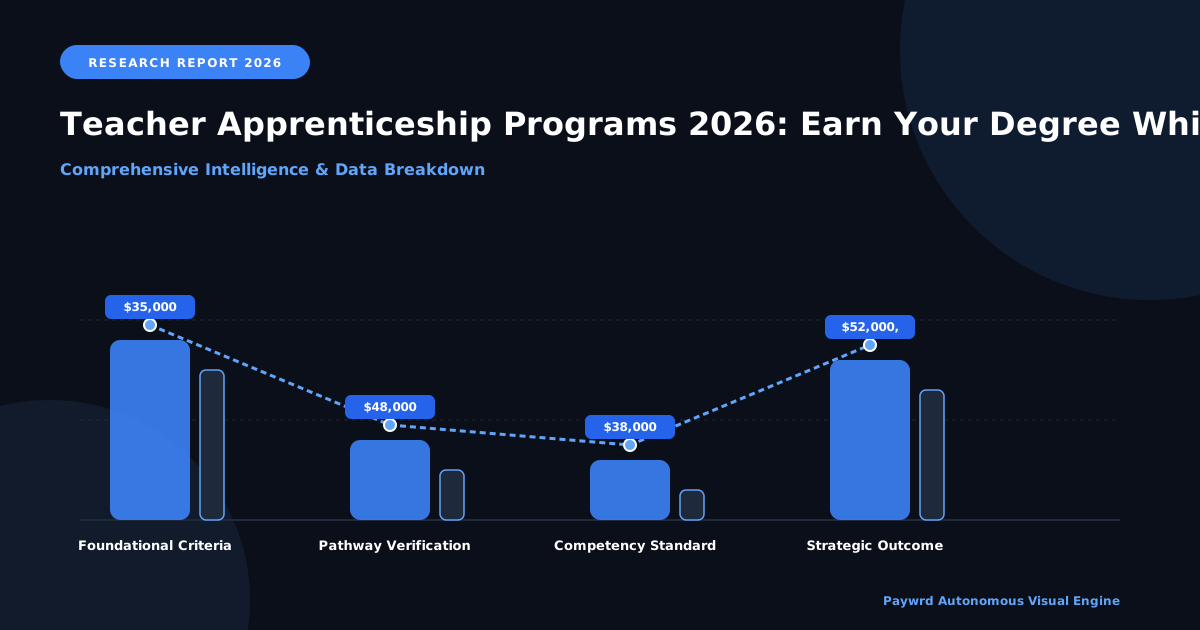
At the heart of the model sits a non-negotiable structural requirement: a minimum of 2,000 hours of structured on-the-job learning. For teacher apprentices, this translates into paid classroom time where candidates serve as full employees of a school district, typically over a two-year period. While instructing under the mentorship of a cooperating teacher or clinical educator, apprentices complete the same daily responsibilities as any first-year teacher, but with the added safety net of structured coaching, observation cycles, and competency checkpoints. This isn’t student teaching—it’s a real job, complete with a paycheck ranging from approximately $35,000 to $48,000 annually in most participating districts, plus benefits.
The second pillar is the 144 hours of Related Instruction, the academic backbone delivered through a partner university or community college. This coursework is mapped directly to state teaching standards and often satisfies degree requirements for a Bachelor’s in Education or a Master of Arts in Teaching. Crucially, in 2026, these 144 hours are no longer tethered to rigid semester boundaries. Instead, programs leverage competency-based progression, meaning apprentices advance by demonstrating mastery of specific skills, like classroom management, lesson design, and assessment literacy, rather than accumulating traditional credit hours on a fixed timeline.
The glue holding everything together is the DOL Office of Apprenticeship sponsor. This sponsor, which may be the school district itself, a labor union, a state agency, or a consortium of employers, is legally accountable for registering the program, tracking apprentice progress, and ensuring federal compliance. Sponsors also facilitate the articulation agreements that allow apprentices to convert their work-based hours into college credit, dramatically reducing overall tuition costs.
Three pathway examples illustrate how the model flexes across different American contexts:
- American Federation of Teachers (AFT) GROW Model: A national template that pairs union locals with universities, allowing paraprofessionals and career-changers to remain in their districts while completing certification. GROW emphasizes cohort support and embeds union mentorship directly into the 2,000-hour requirement.
- Texas Grow Your Own (GYO) Initiatives: Backed by the Texas Education Agency, these programs specifically recruit from high school student aides and district substitutes, routing them through regional Education Service Centers and partner universities like Texas A&M or the University of Texas system. Texas has become the nation’s largest sponsor of teacher apprentices.
- Tennessee’s State Apprenticeship Plan: Approved by the DOL in 2023 and now scaling statewide, Tennessee’s model integrates with the Tennessee Department of Education’s alternative licensure pathways, allowing apprentices to teach on a Practitioner License while completing a competency-aligned residency through institutions like Lipscomb University and Austin Peay State University.
For prospective candidates, the practical takeaway is this: you are no longer choosing between a paycheck and a pedagogy degree. By trading semester credit hours for demonstrated competencies, registered apprenticeship programs can reduce total tuition debt by 40% to 60% compared to traditional four-year education programs, while guaranteeing you a wage every step of the way.
Tuition Coverage, Stipend Amounts, and the Real Paycheck Math

One of the most compelling financial realities of a Registered Teacher Apprenticeship program in 2026 is that you do not have to choose between a paycheck and a degree. From your very first day as an apprentice, you are a fully employed, salaried educator in your partner school district. First-year apprentice teachers in the United States typically earn a starting salary between $38,000 and $52,000, depending on the cost-of-living index of the region and the local collective bargaining agreement. In high-demand districts across Texas, Florida, and the Carolinas, that figure frequently lands closer to $48,000, while metropolitan districts in California and New York may push the entry-level floor even higher. Because you are classified as a W-2 employee rather than a student-teacher intern, you receive full health benefits, state pension contributions, and access to district retirement matching programs, often within your first 90 days of service.
While you are earning that salary, your university tuition is being covered through a layered funding model that minimizes or completely eliminates out-of-pocket costs. The primary funding stream comes from the Workforce Innovation and Opportunity Act (WIOA), a federal workforce development program that allocates dollars specifically for earn-and-learn career pathways. Registered apprenticeship programs, including those in education, qualify for WIOA Title I funding through your local American Job Center, which can cover tuition, required textbooks, and certification exam fees for eligible apprentices. On top of that, state apprenticeship grants—such as those administered through the U.S. Department of Labor’s Office of Apprenticeship and state-level Workforce Development Boards—provide supplemental dollars. Finally, the partner district itself typically picks up any remaining tuition balance through a Memorandum of Understanding with the accredited university, meaning the apprentice often owes $0 in tuition by the time they cross the graduation stage.
Now, let’s run the real paycheck math against a traditional four-year bachelor’s degree. The College Board reports that the average published annual tuition and fees for a public four-year in-state institution now hover near $11,950, with room and board pushing the total cost of attendance above $28,000 per year. Multiplied across four years, the average student accumulates roughly $111,000 in total education-related debt before they ever earn their first paycheck as a licensed teacher. Factor in the four years of opportunity cost—the income you forgo while studying full-time—and the true economic gap widens dramatically. An apprentice, by contrast, earns an estimated $190,000 to $208,000 in cumulative salary over the same four-year window, all while their tuition is funded by WIOA, state grants, and district partnerships.
- Apprentice Path: $0 tuition out-of-pocket, plus $190,000–$208,000 in earned salary, plus full benefits and pension vesting.
- Traditional Path: $111,000 average total cost, plus zero earned income for four years, plus accrued federal loan interest.
- Net Financial Advantage: Approximately $300,000 in favor of the apprenticeship model by year four, before tax benefits.
For learners evaluating both pathways, the math is straightforward. When tuition is fully covered by WIOA dollars, state apprenticeship grants, and district partnerships, and you are simultaneously earning a $38,000-to-$52,000 district salary from day one, the financial risk profile of becoming a teacher inverts entirely. You are no longer betting four years of unpaid labor on the hope of a future salary—you are building your credential, your retirement, and your classroom experience on the same payroll cycle. That is the real paycheck math of 2026, and it is reshaping how an entire generation will choose to enter the teaching profession.
State-by-State Comparison of Apprenticeship Degree Pathways
As registered teacher apprenticeships move from pilot programs into permanent state policy, the geographic landscape of “earn-while-you-teach” degree pathways has matured dramatically by 2026. Five states have emerged as the most developed ecosystems for these programs, each offering distinct advantages in tuition coverage, salary parity, and institutional partnerships. Understanding how Tennessee, Texas, Kentucky, Ohio, and California have structured their apprenticeship frameworks is essential for any prospective educator evaluating where to launch their career without sacrificing earning potential or academic rigor.
Across all five leading states, programs must meet two parallel accreditation standards. The degree-granting component typically requires regional institutional accreditation from agencies recognized by the U.S. Department of Education, while the apprenticeship component must hold CAEP accreditation (Council for the Accreditation of Educator Preparation) to ensure the on-the-job learning and related instruction meet national educator quality benchmarks. States that have successfully aligned their alternative route to certification with the USDOL Registered Apprenticeship framework allow apprentices to earn simultaneously toward a bachelor’s or master’s degree, a state teaching license, and a nationally portable Journeyworker certificate recognized by the U.S. Department of Labor.
- Tennessee: Austin Peay State University stands out as the flagship apprenticeship partner, holding CAEP accreditation for its apprenticeship-aligned educator preparation. Through the Tennessee Grow Your Own initiative, tuition is fully covered for apprentices who commit three years of service in priority districts. Apprentices earn a starting salary of approximately $44,500, with full state employee benefits, while completing a bachelor’s degree at no out-of-pocket cost.
- Texas: Texas has leveraged its TEA-approved alternative certification programs to create robust apprenticeship pipelines. Districts in Houston, Dallas, and San Antonio frequently partner with regional universities, and Western Governors University has expanded its competency-based, CAEP-aligned programs to serve Texas apprentices, allowing them to accelerate degree completion while teaching. Apprentice stipends typically range from $32,000 to $38,000, with significant variation by district.
- Kentucky: The Kentucky Education and Workforce Development Cabinet has fully aligned its alternative route with the USDOL framework, making it one of the cleanest integrated models in the country. Apprentices earn while completing degrees through partner institutions, with tuition offsets funded through the state apprenticeship system and local district contributions, generally landing apprentices at salaries between $38,000 and $42,000.
- Ohio: Ohio’s apprenticeship growth has been fueled by the Straight A Fund and state apprenticeship expansion grants. Relay Graduate School of Education (Relay GSE) operates CAEP-accredited apprenticeship programming across Ohio districts, offering a rigorous master’s degree pathway. Apprentice teachers in Ohio commonly earn $40,000 or more while pursuing licensure, with districts absorbing significant tuition costs in exchange for multi-year service commitments.
- California: California’s Golden State Teacher Pathways and local district initiatives have made it the largest apprenticeship market in the West. Universities across the California State University system and partners like Relay GSE hold CAEP accreditation, and the state has fully aligned its intern credential with the USDOL apprenticeship framework. Apprentice compensation varies widely, ranging from approximately $45,000 in higher-paying districts to lower stipends in rural regions, reflecting California’s diverse cost-of-living landscape.
The critical differentiator among these states lies not only in which institutions hold CAEP accreditation for the apprenticeship portion but also in how seamlessly each state has aligned its alternative route to certification with the USDOL apprenticeship framework as of 2026. Tennessee, Kentucky, and Ohio have achieved full alignment, meaning apprentices graduate with a recognized Journeyworker credential in addition to their degree and license, dramatically boosting long-term wage portability. Texas and California maintain strong alignment for many programs but allow district-level flexibility, which creates variability in whether apprentices receive full USDOL credentials or only state-recognized certifications.
For prospective teacher apprentices evaluating their options, the actionable takeaway is clear: prioritize programs where your degree-granting institution holds CAEP accreditation, your state has aligned its alternative certification with USDOL standards, and your employer contributes meaningfully to tuition. These three factors together determine whether your apprenticeship delivers maximum return on educational investment, true earning-while-learning benefits, and a credential portfolio that travels with you across state lines throughout your career.
From Apprentice to Teacher of Record: Classroom Responsibilities and Mentor Support
One of the most important shifts for apprentices entering a Registered Teacher Apprenticeship Program in 2026 is the legal and professional transition from “supporting adult” to teacher of record long before the bachelor’s degree is finished. Under the model approved by the U.S. Department of Labor and adapted by participating states, an apprentice is typically issued either a state-specific adjunct credential, a provisional license, or an emergency permit that authorizes them to be the officially designated educator for a class of students. This is a meaningful departure from traditional student-teaching, where the candidate is always paired with a cooperating teacher who carries legal responsibility. In the apprenticeship pathway, the apprentice assumes instructional, grading, and safety obligations on day one of classroom placement, while still being supported by a structured mentorship framework.
Because each state regulates credentials differently, apprentices should verify the exact title of their permit with their state’s Department of Education. Common designations include the Adjunct Teaching Permit in Illinois, the Provisional Internship Permit in California, the Adjunct Educator License in Ohio, and the Apprentice Teaching License in several Midwestern states. Regardless of the label, the credential is valid only while the apprentice remains enrolled in a Department of Labor-registered program and is paired with an approved mentor. If the apprentice leaves the program, the permit is withdrawn.
Mentor support is the structural backbone that makes the legal authority safe for students. Most registered programs require a 1:1 mentor-to-apprentice ratio during the first year, with some states requiring an additional school-based coach for apprentices placed in high-needs schools. Coaching follows a structured cycle: a weekly pre-conference to plan instruction, a classroom observation using a research-based rubric, a post-observation debrief, and a written reflection submitted to the program. Cycles are logged in a digital portfolio that is later used for the final competency assessment.
Competency evaluation typically relies on either the edTPA, the PPAT (Praxis Performance Assessment for Teachers), or a state-approved alternative such as the New York edTPA-equivalent ATS-W or Texas’s PPR for Apprenticeship. The assessment is completed near the end of the apprenticeship and scores the apprentice on planning, instruction, assessment, and professional practice. Most states require a passing score before converting the apprentice’s adjunct credential into a full professional license.
Apprentices who are also members of a local teachers’ union, such as the National Education Association or American Federation of Teachers, generally receive the same contract protections as other first-year teachers, including due process rights, grievance procedures, and access to planning time. In non-union states, apprentices are still covered by the school district’s employee handbook, which must align with state law. Planning time is particularly important: federal ESSA guidelines and most state statutes require a minimum of 30 to 45 minutes of daily planning time for full-time teachers, and apprentices must receive this allocation on the same basis as peers.
Caseload limits are another key safeguard. For elementary apprentices, class size caps typically range from 20 to 26 students, depending on the district and state. Secondary apprentices may have daily student loads of 150 or more, but many apprenticeship programs negotiate a reduced caseload of 120 students during the first year to allow for intensive coaching. Special education apprentices follow IDEA-mandated caseload ceilings, usually 15 to 18 students, regardless of their apprenticeship status.
For apprentices considering this path, the practical takeaway is clear: you will be the legally responsible teacher from the start, but you will not be doing it alone. Before accepting a placement, confirm three details in writing: the mentor’s release time for coaching, the daily planning period, and the maximum class size. These three structural elements, combined with a strong union contract or district handbook, are what distinguish a high-quality apprenticeship from a district simply filling a vacancy.
2026 Teacher Salary Projections: How Apprenticeship Graduates Compare to Traditionally Certified Peers
Understanding the long-term financial trajectory of a teaching career requires looking beyond the starting salary figure and examining the cumulative earnings, pension vesting implications, and opportunity-cost differentials between alternative certification pathways. According to the National Education Association’s (NEA) annual Rankings and Estimates report covering the 2024-2025 academic year, the average public school teacher salary in the United States reached $69,597, marking a meaningful step forward after years of inflationary pressure that had effectively eroded educator purchasing power. When the Bureau of Labor Statistics (BLS) Occupational Employment and Wage Statistics (OEWS) data is projected forward to the 2026 school year, factoring in typical collective bargaining adjustments, state legislative appropriations, and the ongoing teacher shortage driving competitive recruitment packages, base salaries for fully credentialed K-12 educators are expected to cluster between $72,000 and $76,000 nationally, with high-cost states like California, New York, and Massachusetts pushing average compensation well above the $90,000 threshold.
The financial divergence between apprenticeship graduates and their traditionally certified peers begins long before either group reaches the average salary benchmark. A candidate pursuing a conventional Bachelor of Arts in Education or Master of Arts in Teaching typically spends four to six years in a pre-service preparation sequence, accumulating an average undergraduate debt load of between $20,000 and $30,000, according to Federal Student Aid (FSA) reporting. During those years, they earn no classroom salary, no retirement credits, and no service years toward tenure-track pension vesting under state Teachers’ Retirement Systems (TRS). A Registered Apprenticeship graduate, by contrast, enters the paid classroom two to three years earlier, earning a salary and accruing service credit from day one. Even at a modest first-year salary of $48,000 to $52,000, the cumulative earnings advantage over a traditional pathway reaches $96,000 to $156,000 by the time the traditionally prepared peer completes their degree and earns their initial state licensure.
- Years 1-3 Earnings Differential: Apprentices earn a full classroom salary plus benefits while their traditional peers remain in unpaid student teaching or full-time graduate study.
- Retirement Vesting Acceleration: Most state TRS plans require five years of credited service for vesting. Apprenticeship graduates frequently hit this milestone 24 to 36 months sooner, securing their employer-matching contributions and unlocking the path to lifetime monthly retirement benefits.
- Loan Amortization Savings: By entering the workforce earlier and avoiding an additional one to two years of tuition, apprenticeship graduates preserve $15,000 to $40,000 in lifetime interest payments.
- Step-and-Lane Scale Advantages: Many districts credit prior paraprofessional or apprenticeship years toward the salary schedule, allowing apprentices to advance one to two lanes ahead of same-age traditional peers.
The retirement-system implications deserve particularly close scrutiny because they compound over a 25-to-30-year career. Under most state-defined benefit pension plans administered through systems like CalSTRS, NYSTRS, TRS Illinois, or the Florida Retirement System, the final retirement benefit calculation incorporates the highest consecutive or final average salary, the years of credited service, and an age multiplier that commonly ranges from 2.0% to 2.5% per year of service. Because apprenticeship graduates accumulate two to three additional years of credited service and reach higher salary tiers earlier, their lifetime monthly pension distributions are typically 4% to 8% higher than otherwise identical traditionally certified peers. Translated into retirement income, that differential can amount to an additional $250 to $600 per month for the remainder of the retiree’s life, which over a 25-year post-retirement horizon represents $75,000 to $180,000 in cumulative present-day value, depending on the discount rate and cost-of-living adjustment structure of the host state system.
For candidates weighing a Registered Apprenticeship against a conventional M.A.T. or B.A. in Education pathway, the projected 2026 salary landscape strongly favors the earn-while-you-learn model. The combination of earlier entry into the salary schedule, accelerated TRS vesting, reduced student loan exposure, and the compounding power of additional retirement credits produces a lifetime earnings advantage that frequently exceeds $200,000 when measured in total compensation, which includes salary, benefits, and pension wealth. For career-changers, first-generation college students, and adults balancing financial obligations, this margin transforms teacher apprenticeship programs from a stopgap alternative into a strategically superior route into the profession.
Financial Aid, Loan Forgiveness, and Long-Term ROI for Apprentice Teachers
The financial architecture surrounding a teaching apprenticeship is one of the most misunderstood yet powerful advantages in American education today. While many prospective educators assume that skipping the traditional undergraduate route means forfeiting federal aid, the opposite is often true. Registered Apprenticeships sponsored by the U.S. Department of Labor are explicitly tied to wage progression, meaning apprentices are classified as paid employees rather than full-time students. That single distinction unlocks a different set of federal protections, repayment timelines, and forgiveness pathways that can dramatically reshape a new teacher’s lifetime earnings. To make a smart decision, you have to understand exactly how Public Service Loan Forgiveness (PSLF), Teacher Loan Forgiveness (TLF), and the TEACH Grant interact with an employed apprentice’s salary, and where the break-even line falls between the apprenticeship pathway and a conventional four-year degree.
PSLF eligibility begins the moment you sign your apprenticeship contract. Because apprentices are W-2 employees of a public school district, charter network, or nonprofit education employer, every paycheck counts as a qualifying payment toward the 120-payment threshold. You do not need to wait until you finish your bachelor’s degree to begin certifying employment through the Federal Student Aid portal. In practice, an apprentice earning roughly $38,000 to $44,000 in year one can make income-driven repayments of about $250 to $350 per month on existing federal loans while simultaneously earning credit toward loan forgiveness. By the time your degree is conferred, you may already have 24 to 36 qualifying payments logged, leaving only seven to eight additional years of public service before the remaining Direct Loan balance is forgiven tax-free under current Internal Revenue Code treatment.
Teacher Loan Forgiveness stacks on top of PSLF for highly qualified educators. Under the Higher Education Act, teachers serving in low-income schools designated by the Department of Education can receive up to $17,500 in loan forgiveness after five consecutive years of complete service. This benefit is particularly valuable for apprenticeship graduates, who often begin their careers in Title I districts that desperately need credentialed math, science, special education, and bilingual instructors. The key compliance step is submitting the Teacher Loan Forgiveness Application annually and ensuring your employing district’s code appears on the Department’s annual list of low-income schools. Apprentice teachers should also be aware that TLF and PSLF cannot be double-counted for the same teaching period, so most financial advisors recommend claiming TLF first, then switching to PSLF for the remaining balance.
TEACH Grant conversion is the silent risk to plan around. The Teacher Education Assistance for College and Higher Education (TEACH) Grant provides up to $4,000 per year for students who pledge to teach in a high-need field at a low-income school. If a recipient fails to complete the four-year service obligation, every dollar of grant funding retroactively converts into an unsubsidized Direct Loan with accrued interest. Apprenticeship candidates who received TEACH Grants during prior enrollment should request a detailed counseling session from their university’s financial aid office to confirm whether their current apprenticeship contract satisfies the “academic year” definition. In most cases, full-time apprentice employment combined with concurrent degree coursework does qualify, but documentation must be airtight to avoid surprise conversion.
Graduate enrollment becomes faster and cheaper after an apprenticeship-completed bachelor’s degree. Candidates who finish a registered apprenticeship carry three advantages into Master of Education (M.Ed.) or Doctor of Education (Ed.D.) programs: a clean academic transcript, at least two to four years of in-district teaching experience, and an employment record that strengthens graduate assistantship applications. Many accredited institutions, including those holding CAEP accreditation, give preferential admission and tuition discounts of 15% to 30% to in-service teachers. Because you earned your undergraduate degree debt-free or near debt-free, you can pursue a graduate program funded by employer tuition reimbursement, often between $3,000 and $6,000 per year, rather than taking on new federal loans.
Break-even analysis: the numbers in plain English. Consider two pathways starting in 2026. Pathway A is a traditional four-year degree with $30,000 in cumulative federal debt, beginning teaching at $48,000. Pathway B is an apprenticeship-completed degree with $8,000 in remaining debt, beginning teaching at $42,000 but earning a salary during the four-year training period that totals roughly $160,000. After five years, Pathway A’s net position is approximately $208,000 in cumulative earnings minus debt service and lost wages. Pathway B’s net position is approximately $370,000 in cumulative earnings minus debt service, because the apprentice was paid the entire time. The crossover advantage to apprenticeships typically appears between year two and year three of post-degree teaching, and it widens substantially when loan forgiveness is factored in.
Actionable takeaways for apprentice teachers right now. First, file your PSLF Employment Certification Form within 30 days of your apprenticeship start date and recertify every year without fail. Second, check your TEACH Grant status through the NSLDS portal before signing any new apprenticeship contract. Third, ask your district’s human resources office whether they offer 529 plan contributions or tuition reimbursement, which can offset M.Ed. or Ed.D. costs tax-free. Fourth, keep meticulous records of all service certifications, because the Department of Education does not retroactively credit paperwork submitted late. By approaching the apprenticeship pathway as both an employment decision and a financial planning decision, you position yourself for immediate income, long-term loan forgiveness, and a credential that compounds in value across an entire teaching career.
| Program Type | Avg. Cost ($) | Time to Complete | Entry Cut-Off | Starting Salary (2026) | Career ROI (5-Year) |
|---|---|---|---|---|---|
| Registered Teacher Apprenticeship (DOL) | $0–$5,000 | 2–3 Years | High School Diploma + 18+ | $48,000–$55,000 | High — Earn while learning, debt-free licensure |
| Traditional Bachelor’s in Education | $40,000–$100,000 | 4 Years | HS Diploma + SAT/ACT | $45,000–$52,000 | Moderate — Student debt offsets early gains |
| Alternative Certification (e.g., Teach For America) | $2,000–$6,000 | 1–2 Years | Bachelor’s Degree Required | $46,000–$53,000 | Moderate — Fast entry but limited classroom prep |
| Master of Arts in Teaching (MAT) | $30,000–$60,000 | 1–2 Years | Bachelor’s Degree + GPA 3.0+ | $50,000–$58,000 | Moderate — Higher salary ceiling, significant debt |
Strategic Final Takeaway
Success in evaluating Teacher Apprenticeship Programs 2026: Earn Your Degree While You Teach relies on early preparation, adherence to verified accredited requirements, and cross-referencing official portals. Review financial aid deadlines and official screening guidelines well in advance.