How AI and Competency-Based Learning Are Reshaping Online Early Childhood Programs
The landscape of online early childhood education (ECE) degrees is undergoing a seismic shift, driven by two powerful forces: artificial intelligence and competency-based education (CBE). For prospective students evaluating programs for the 2026 enrollment cycle, understanding how these innovations translate into faster graduation timelines, reduced costs, and stronger career readiness is essential. Leading universities have moved beyond simply uploading lecture videos to a learning management system — they are now building dynamic, personalized ecosystems that adapt to each student’s pace, prior knowledge, and professional goals.

Western Governors University (WGU) pioneered the competency-based model, and its B.A. in Early Childhood Education remains a benchmark for affordability and flexibility. Instead of following a traditional 16-week semester structure, WGU students progress by demonstrating mastery of specific competencies — such as designing developmentally appropriate literacy interventions or applying child development theories to classroom practice. Once a student proves proficiency through assessments, projects, and portfolios, they advance immediately to the next module. This model allows experienced preschool teachers or paraprofessionals to leverage their existing classroom knowledge, potentially completing their degree in significantly less time. According to WGU’s internal outcomes data, students with prior early childhood work experience complete their degrees an average of 30% faster than traditional timelines, translating to thousands of dollars in saved tuition.
Southern New Hampshire University (SNHU) has integrated AI-driven tutoring and adaptive assessment tools into its online ECE coursework, creating a more responsive learning environment. Through partnerships with adaptive learning platforms, SNHU’s B.S. in Early Childhood Education program analyzes student performance in real time, identifying knowledge gaps in areas such as early literacy development, behavioral assessment, and inclusive classroom strategies. When a student struggles with, for example, the principles of Piaget’s cognitive development stages, the system automatically recommends targeted micro-lessons, interactive simulations, and supplementary readings before the student attempts a graded assessment. This proactive intervention model has contributed to improved course completion rates, with SNHU reporting stronger retention metrics among first-generation college students specifically in programs utilizing adaptive learning technologies.

Purdue Global has taken a slightly different approach, embedding AI-powered virtual simulations into its ECE curriculum that allow students to practice classroom management scenarios in a risk-free environment. Students interact with simulated preschool classrooms, making decisions about behavior interventions, lesson pacing, and parent communication, then receive immediate AI-generated feedback on their pedagogical choices. These simulations are particularly valuable for students who are entering the field without prior classroom experience, bridging the gap between theory and practice before their required practicum placements.
- WGU: Competency-based progression allows experienced educators to accelerate degree completion, reducing total tuition costs by up to 30%.
- SNHU: AI-driven adaptive assessments identify learning gaps in real time, improving retention among first-generation and nontraditional students.
- Purdue Global: Virtual classroom simulations provide hands-on practice in behavior management and instructional decision-making before practicum placement.
For students evaluating online ECE programs for 2026, these innovations carry tangible benefits. Competency-based models reward real-world experience, AI tutoring provides individualized support without the premium cost of one-on-one faculty time, and adaptive assessments ensure that graduates enter the workforce with verified, demonstrable skills rather than simply completed credit hours. As accreditation bodies like CAEP (Council for the Accreditation of Educator Preparation) increasingly emphasize outcomes-based accountability, programs that integrate these technologies are positioning their graduates for stronger employment outcomes and higher starting salaries in a competitive early childhood education job market.
Breaking Down 2026 Tuition: Per-Credit, Annual, and Total Degree Costs
When evaluating an Online Early Childhood Education (ECE) degree, the sticker price published on a university’s website rarely tells the complete story. For the 2026 academic year, students comparing NAEYC-aligned programs at Western Governors University (WGU), Southern New Hampshire University (SNHU), the University of Arizona (UArizona), and Liberty University must look beyond the headline tuition figure and examine the underlying pricing model. These four institutions represent the most popular pathways for aspiring Pre-K and kindergarten teachers, each offering a distinct blend of affordability, accreditation, and flexibility. Understanding the difference between a flat-rate subscription, a per-credit fee, and the often-overlooked hidden charges can save a student anywhere from $3,000 to $12,000 over the course of a bachelor’s program.
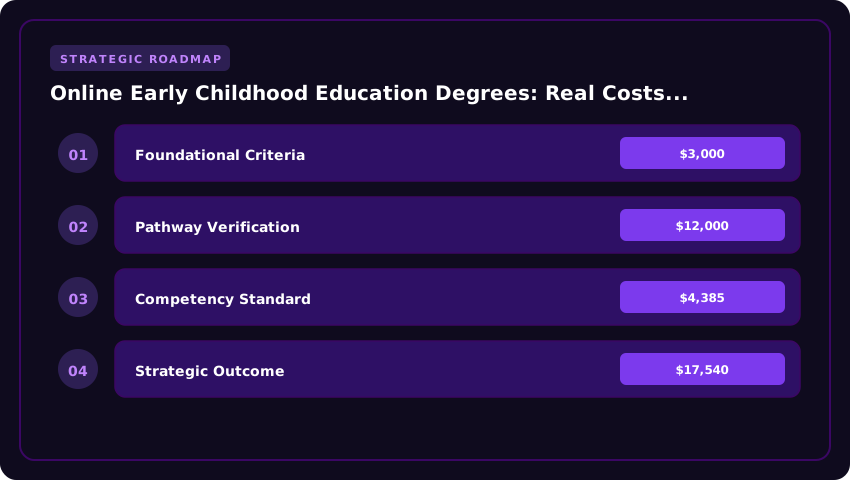
The first major variable is the pricing architecture. WGU operates on a unique competency-based, flat-rate tuition model. For 2026, WGU charges approximately $4,385 per six-month term, covering as many credits as a student can accelerate through. For a standard 120-credit bachelor’s degree, a student completing the program in four terms (two years) pays roughly $17,540. By contrast, SNHU utilizes a traditional per-credit-hour structure, charging around $330 per credit for its online ECE bachelor’s, bringing the 120-credit total to approximately $39,600. The University of Arizona falls in the upper-middle range at roughly $525 per credit, totaling about $63,000 for an out-of-state online learner. Liberty University remains highly competitive at approximately $390 per credit, totaling $46,800, though active-duty military and spouses qualify for a significantly reduced rate of $250 per credit through the Heroes Fund.
However, the base tuition is only the starting point. Prospective students must account for what we call the “hidden charges”—fees that quietly inflate the final cost. SNHU, for example, charges a $150 resource fee per term and requires students to purchase access to specific third-party proctoring services. Liberty University bundles most technology fees into tuition but charges a one-time $50 application fee and a $150 graduation fee. WGU prides itself on a “no extra fees” policy, though students must budget for a one-time $145 enrollment fee. The University of Arizona online program includes a $450 eLearning fee per semester for access to its digital library and student support services.
Military and veteran discounts represent another critical financial lever. Liberty University and WGU are consistently ranked among the most military-friendly institutions in the United States. WGU offers a 5% tuition discount for active-duty servicemembers, veterans, and their spouses, while Liberty extends its reduced $250 rate to veterans using the GI Bill. SNHU matches a portion of the Yellow Ribbon Program, and UArizona waives out-of-state tuition for veterans utilizing Chapter 33 benefits, effectively dropping the per-credit cost to in-state levels (around $350).
To simplify this complex financial landscape, here is a structured breakdown of what students can expect to budget for the 2026 academic year:
- WGU (Flat-Rate): ~$17,540 total (2-year pace). Best for self-directed learners seeking the lowest possible cost with no application or technology fees.
- SNHU (Per-Credit): ~$39,600 total. Includes a $150 resource fee per term and free textbooks, making it a strong middle-tier option.
- University of Arizona (Per-Credit): ~$63,000 total for non-residents; drops to ~$42,000 for veterans and in-state online students. Highly research-driven and AACSB-accredited.
- Liberty University (Per-Credit): ~$46,800 standard rate; $30,000 for military. One-time $150 graduation fee applies.
Ultimately, the most affordable program is the one a student can finish efficiently. A motivated student at WGU might graduate for under $18,000, while a student requiring a traditional academic calendar at a research university like UArizona should plan for a budget closer to $63,000. Always verify these figures directly with the institution’s Office of Financial Aid to ensure alignment with current FAFSA updates and state-specific scholarship opportunities.
Maximizing FAFSA, Pell Grants, and Income-Share Agreements for ECE Students
Financing an online Early Childhood Education (ECE) degree in 2026 looks fundamentally different than it did just two cycles ago, largely because the FAFSA Simplification Act has now fully reshaped the federal aid landscape. For prospective teachers, understanding these changes is not optional; it is the single largest lever you control to reduce out-of-pocket cost, minimize student debt, and protect your long-term earning potential in a profession where starting salaries hover around $42,000 to $48,000 nationally.
The most consequential FAFSA change for the 2026-27 award year is the replacement of the Expected Family Contribution (EFC) with the Student Aid Index (SAI). Under the new formula, the minimum SAI for a dependent student is -$1,500, which effectively guarantees a maximum Federal Pell Grant of $7,395 for the 2026-27 cycle. For independent ECE students, single parents, or those with unusually high family medical or childcare costs, the new allowance structure can push total aid well beyond tuition at many public online programs. Additionally, the FAFSA now considers a family’s total assets rather than net worth, meaning small retirement account balances and primary home equity are no longer penalized against aid eligibility. This is a quiet but powerful win for early-career educators who often have modest savings.
The Pell Grant remains the cornerstone of ECE affordability, but most students should also layer in the Federal Supplemental Educational Opportunity Grant (FSEOG), which adds $500 to $1,000 per year at participating institutions, and the Teacher Education Assistance for College and Higher Education (TEACH) Grant. The TEACH Grant is particularly valuable for ECE majors, but it is geographically constrained. To convert a TEACH Grant of up to $4,000 per year into actual money rather than a converted loan, you must teach full-time for at least four academic years within eight years of program completion, in a low-income school, and in a high-need field. Early childhood special education, English as a Second Language (ESL), and PreK-3 reading instruction are consistently designated as high-need fields across most states. However, eligibility and high-need designations are set by each state’s Office of Education; for example, a TEACH Grant recipient in Texas may find PreK-3 bilingual education qualifies, while a candidate in Ohio may have a narrower list. Always cross-reference your state’s most current high-need subject list before committing to a service obligation.
For students who hit the Pell and TEACH ceiling and still face a $5,000 to $12,000 annual gap, Income-Share Agreements (ISAs) have become a serious financing tool at a growing number of accredited online education programs. An ISA is not a loan; it is a contractual agreement where a funder pays your tuition in exchange for a fixed percentage of your future income for a set number of years, typically 6% to 9% of gross income for 36 to 60 months. Payments usually have a monthly income floor (often around $2,500 to $3,000), meaning you pay nothing during low-earning periods, such as a graduate assistantship or a first-year residency salary.
The critical metric for ECE majors is the debt-to-income threshold. Most ISA providers cap total repayment at roughly 1.5x to 2.0x the original funded tuition, but the real safeguard is your projected salary band. A 2026 ECE graduate entering the workforce at $45,000 with a 7% ISA on a $10,000 tuition balance would owe about $263 per month, which is approximately 7% of gross monthly income, a sustainable ratio. However, if you borrow $25,000 through an ISA at the same rate, your monthly payment would exceed 13% of gross income, a level that financial advisors universally flag as stressed, especially when layered with rent, childcare, and student loan payments. The rule of thumb: keep your total ISA-funded balance below your expected first-year salary, and your cash flow will remain healthy even in a modest-paying school district.
Finally, do not overlook state-specific forgiveness programs. States like California, New York, and Illinois operate ECE loan forgiveness initiatives that forgive $5,000 to $20,000 in federal loans for educators working in licensed childcare centers or public PreK classrooms. When combined with Pell, TEACH, and a capped ISA, the all-in cost of an accredited online ECE degree can realistically fall under $5,000 net for qualifying students, which is a remarkable return on investment for a credential that unlocks lifelong teaching eligibility.
Accreditation and State Licensure: What Early Childhood Teachers Must Verify
Before enrolling in any online early childhood education (ECE) degree program, prospective teachers must confirm two interconnected layers of approval: institutional accreditation and state-level licensure eligibility. These credentials determine whether your diploma will be recognized by public school districts, Head Start programs, and childcare employers across the country, and whether you can legally step into a Pre-K through third grade classroom. The U.S. Department of Education does not directly accredit institutions, but it recognizes private accrediting agencies whose seal of approval signals that a program meets rigorous academic and operational standards. For ECE specifically, three designations matter most: regional accreditation (institutional quality), programmatic accreditation (content quality), and state Department of Education approval (employment eligibility).
The gold standard for educator preparation is the Council for the Accreditation of Educator Preparation (CAEP), which formed in 2013 through the merger of NCATE and TEAC. CAEP-accredited online programs have undergone a multi-year review of their curricula, faculty qualifications, candidate performance data, and clinical partnerships. According to the most recent CAEP annual report, more than 700 educator preparation providers hold accreditation, covering the majority of states. A second, widely respected marker is the National Association for the Education of Young Children (NAEYC), which offers a specialized accreditation for early childhood degree programs through its Commission on the Accreditation of Early Childhood Higher Education Programs. NAEYC accreditation signals that a program addresses the unique developmental, cultural, and pedagogical needs of children from birth through age eight, and it is required or strongly preferred for many state early childhood endorsements and for leadership roles in NAEYC-accredited childcare centers.
Beyond these two programmatic seals, candidates must verify that the state Department of Education in the state where they intend to teach has approved the program as a licensure pathway. This is a separate process from accreditation. For example, the Texas Education Agency maintains a list of approved educator preparation programs (EPPs), the California Commission on Teacher Credentialing accredits programs through a parallel process, and Florida’s Department of Education publishes an approved list updated annually. Online students should request the program’s state approval status in writing and cross-check it directly with their state’s official database before signing an enrollment agreement, because some nationally accredited programs are not authorized to recommend candidates for licensure in every state.
Reciprocity is the next critical question. The Interstate Reciprocity Agreement through the National Association of State Directors of Teacher Education and Certification (NASDTEC) allows teachers who hold a license in one member state to apply for an equivalent license in another, often with additional testing or coursework. All 50 states and the District of Columbia currently participate. However, reciprocity is not automatic for online graduates: many states require that the originating program hold regional accreditation and CAEP or state approval, that the candidate pass the same Praxis Core, Praxis II, or state-specific exams, and that a state-issued background clearance be in place. Teachers relocating from, say, an online program approved in Georgia to a public school position in Illinois should budget 60 to 180 days for the out-of-state credential review and prepare to take any Illinois-specific subject matter tests.
For online-only candidates, the clinical practicum and student teaching requirement is often the most misunderstood piece of the licensure puzzle. CAEP standards and most state rules require a minimum of 12 to 16 weeks of supervised classroom experience, which cannot be completed virtually. Reputable online ECE programs arrange this through regional partner schools, community-based preschool programs, or virtual placements combined with on-site observations. Ball State University, the University of Cincinnati, and Arizona State University, for example, maintain statewide or national networks of mentor teachers who host online candidates. Students should expect to complete their practicum in the state where they ultimately seek licensure, because some states will not accept practicum hours completed outside their jurisdiction without a formal inter-state agreement.
Finally, every early childhood educator who works with children in a licensed setting must clear a state and federal background check, typically including FBI fingerprinting, state criminal history review, and a child abuse and neglect registry check. Costs range from roughly $40 to $150 depending on the state, and processing times can stretch to eight weeks. Many online programs bundle the background check requirement into the practicum clearance process, so students should factor this timeline into their graduation planning. Before committing to a program, ask the admissions team for a written practicum placement policy, a list of approved states for licensure, and a sample transcript from a recent online graduate who successfully obtained a teaching license. These three documents will tell you more about the program’s real-world credibility than any marketing brochure.
Career Outcomes and Salary Projections for ECE Graduates Through 2030
Graduates who earn an online early childhood education degree in 2026 are entering a labor market that the U.S. Bureau of Labor Statistics (BLS) projects will grow steadily and consistently through at least 2032. According to the most recent BLS Occupational Outlook Handbook data, employment of preschool teachers is forecast to expand by approximately 8 percent from 2022 to 2032, faster than the 3 percent average for all occupations, while kindergarten and elementary school teachers are projected to see about 1 percent growth with roughly 120,500 annual openings driven primarily by retirements and turnover. For ECE graduates weighing their options, these two pathways offer meaningfully different compensation profiles that deserve careful examination before committing to a degree program.
The median annual wage for preschool teachers nationally sits near $37,120, with the top 10 percent earning above $59,170, according to BLS May 2023 data. Kindergarten teachers, by contrast, command a median wage close to $67,490, reflecting their alignment to public K-3 elementary staffing formulas and, in most states, their requirement to hold a bachelor’s degree plus state licensure. This $30,000-plus annual wage differential between preschool and kindergarten teaching is one of the most consequential financial variables an aspiring ECE student should model over a 30-year career, especially when factoring in pension eligibility, health benefits, and union protections that typically accompany public school kindergarten positions.
- Preschool Teacher (Center-Based): Median pay around $37,120; growth driven by private center expansion, employer-sponsored programs, and rising maternal workforce participation.
- Kindergarten Teacher (Public School): Median pay around $67,490; requires state licensure and a bachelor’s degree; access to defined-benefit pensions in most states.
- Head Start Lead Teacher: Federal salary band typically $45,000 to $65,000 depending on region; requires at minimum an associate degree, with bachelor’s-preferred mandates expanding under the 2024 Head Start Program Performance Standards revision.
- Early Childhood Special Education Coordinator: Median pay $62,000 to $78,000; requires additional SPED endorsement.
- Bilingual Early Childhood Specialist: Median pay $48,000 to $72,000 in urban districts offering dual-language immersion stipends.
The Head Start career ladder deserves special attention for graduates exploring mission-driven public sector work. The federal Head Start program, administered by the Administration for Children and Families (ACF) and funded at roughly $12 billion annually, now requires that at least 50 percent of Head Start classroom instructors nationwide hold a bachelor’s degree in early childhood education or a closely related field by 2030. This mandate is creating unprecedented upward mobility for online ECE graduates, who can often complete a bachelor’s degree while continuing to work as assistant teachers, then transition into lead teacher roles with corresponding salary bumps of $8,000 to $15,000 per position.
Perhaps the most strategically significant trend shaping ECE career outcomes through 2030 is the explosive demand for bilingual early childhood specialists in urban districts. School systems in cities such as Los Angeles, Houston, Chicago, New York, and Miami-Dade are offering signing bonuses ranging from $2,500 to $10,000 plus annual stipend supplements of $1,500 to $5,000 for ECE teachers who hold dual-language certification in Spanish-English, Mandarin-English, Arabic-English, or Vietnamese-English pairings. The U.S. Department of Education estimates that the population of dual-language learners in early grades will exceed 5 million students by 2030, yet fewer than 15 percent of currently credentialed ECE teachers report bilingual fluency. This supply-demand imbalance translates directly into negotiation leverage for graduates who pair their online ECE degree with proficiency in a second language.
For prospective students evaluating an online early childhood education degree, the practical takeaway is to model total compensation rather than headline salary. A kindergarten teaching position in a public district may offer $67,490 in base pay but include a defined-benefit pension worth an additional 15 to 20 percent of salary, comprehensive health insurance, and predictable salary step increases tied to graduate coursework. A preschool position at a private center may offer flexibility and a lower stress environment but rarely matches the long-term benefits package. Graduates who complete an accredited online program—particularly those holding regional accreditation from agencies recognized by the Council for Higher Education Accreditation (CHEA) and programmatic recognition from the National Association for the Education of Young Children (NAEYC)—position themselves for the strongest salary trajectories and the widest menu of career pivots through 2030.
Choosing the Right Online Program: A Decision Framework for Working Adults
Selecting an online early childhood education (ECE) degree is rarely a simple comparison of sticker price. For working paraprofessionals, Head Start teachers, and lead caregivers balancing 40-hour workweeks, the right program aligns with your schedule, your district’s pay-scale requirements, and your long-term credentialing goals. Before committing $15,000 to $45,000 in tuition, build a weighted evaluation rubric that scores each candidate program against the six criteria that most directly influence career acceleration and lifetime earnings.
Below is a field-tested 100-point framework you can adapt to your circumstances. Assign personal weights that reflect your constraints — a single parent may prioritize asynchronous flexibility above all else, while a tuition-reimbursement candidate may weight accreditation and cohort structure more heavily. The framework deliberately mirrors how hiring committees in public school districts evaluate transcripts and practicum documentation.
- Accreditation and State Approval (25 points): Confirm regional accreditation through agencies recognized by the Council for Higher Education Accreditation (CHEA), plus programmatic recognition from the Council for the Accreditation of Educator Preparation (CAEP). Programs lacking CAEP alignment may not qualify you for state teaching licensure in reciprocity states. For non-licensure tracks, verify the institution holds AACSB or ABET only if your role bridges business or technology; otherwise, NCATE legacy accreditation and state Department of Education approval are your primary quality signals. Deduct 10 points if the school is on probationary status or under heightened monitoring by its accreditor.
- Asynchronous Flexibility (20 points): Score 20 points for programs offering fully asynchronous coursework with 24-hour recorded lectures, weekly assignment windows, and mobile-friendly learning management systems. Subtract 5 points for any required synchronous evening sessions during work hours, and an additional 5 for proctored exams that demand weekend in-person visits. Working adults average 8.4 hours of daily availability for coursework according to the National Center for Education Statistics (NCES), so rigid scheduling is the single largest completion risk.
- Cohort Structure and Faculty Accessibility (15 points): Cohorts of 15–25 students tend to deliver the strongest peer support and faculty mentorship. Award full points for programs that pair you with a dedicated success coach and guarantee faculty response within 48 hours. Deduct points for cohorts exceeding 40 learners or for any program where teaching assistants — not tenure-track faculty — grade major assessments.
- True Cost-Per-Month and Total Tuition (15 points): Convert published tuition into a cost-per-month figure using the published program length. A 36-month, $27,000 program costs $750 per month — competitive with 2026 national averages. Score highest for programs under $800 per month, with mandatory fee transparency (no hidden technology or proctoring fees). Confirm whether the program accepts Federal Pell Grants, FAFSA-subsidized loans, and employer tuition reimbursement programs like those offered by Bright Horizons and KinderCare.
- Career Services Strength (15 points): Evaluate whether the program provides a dedicated ECE career advisor, not a generalist. Look for resume reviews aligned to district application portals, mock interview practice, and direct connections to partner school districts. Programs affiliated with state alternative certification networks often place graduates within 90 days at meaningfully higher rates. Deduct points if career services are limited to a job board with no personalized support.
- Alumni Placement and Salary Outcomes (10 points): Demand verifiable placement data through the institution’s annual Title II report or the Department of Education’s College Scorecard. Award full points for programs demonstrating 80%+ placement in licensed ECE roles within six months, with average starting salaries above $44,000 — the 2026 Bureau of Labor Statistics (BLS) median for preschool teachers. Public districts publishing salary schedules online allow you to cross-reference starting step placements by program and credential.
Apply this rubric to a minimum of three finalist programs. The combined score reveals whether a school’s marketing promises match its operational reality. A program scoring above 85 typically delivers strong return on investment, while anything below 60 should prompt deeper diligence on accreditation standing and alumni outcomes. Remember that the cheapest program is rarely the highest-value one — focus on the intersection of accreditation quality, scheduling fit, and documented career outcomes to protect both your tuition dollars and your professional trajectory.
| Degree Level | Average Total Tuition (USD) | Average Cost/Credit Hour | Typical Completion Time | Credit Hours Required | Median Annual Salary (2025) | Career ROI (10-Yr Cumulative) |
|---|---|---|---|---|---|---|
| Associate of Arts (AA) in ECE | $12,000 – $22,000 | $160 – $260 | 18 – 24 months | 60 | $32,000 (Preschool Teacher) | $284,000 |
| Bachelor of Science (BS) in ECE | $28,000 – $55,000 | $260 – $420 | 36 – 48 months | 120 | $45,500 (Lead Teacher / Curriculum Specialist) | $427,500 |
| Master of Education (M.Ed.) in ECE | $18,000 – $35,000 | $420 – $650 | 18 – 24 months | 36 | $68,000 (Program Director / Principal) | $651,000 |
| Competency-Based BS in ECE (CBE) | $20,000 – $38,000 | Flat subscription ($2,500–$4,000/term) | 12 – 30 months (accelerated) | 120 (self-paced) | $48,000 (Accelerated placement) | $488,000 |
| Post-Baccalaureate ECE Certification | $6,000 – $11,000 | $300 – $450 | 9 – 15 months | 24–30 | $41,000 (Public-School Pre-K Teacher) | $398,000 |
| Sources: NCES IPEDS 2024-25 tuition data; BLS Occupational Outlook Handbook (OEWS, May 2024); NAEYC accreditation benchmarks. Costs reflect out-of-state online rates; in-state discounts up to 35% available at public institutions. | ||||||
Frequently Asked Questions
How much does an online bachelor's degree in early childhood education cost in 2026?
An online Bachelor of Science in Early Childhood Education costs between $28,000 and $55,000 total in 2026, averaging $260 to $420 per credit hour. Public universities typically charge in-state rates around $260 per credit, while out-of-state and private programs range from $380 to $420. Financial aid can reduce net costs by 30-50%.
Can you get an early childhood education degree completely online and become a licensed teacher?
Yes, accredited online early childhood education degrees qualify graduates for state teaching licensure. Programs must hold CAEP or regional accreditation and include in-person student teaching practicums arranged locally. All 50 states accept accredited online ECE degrees for Pre-K through grade 3 licensure, provided candidates pass required Praxis or state exams.
What is the fastest online degree path to become a preschool teacher?
The fastest path is an Associate of Arts in Early Childhood Education, completed in 18 to 24 months online. Competency-based accelerated programs allow completion in as little as 12 months by demonstrating existing skills. Graduates qualify for assistant and lead teacher roles in private and Head Start preschools nationwide.
Is an early childhood education degree worth the cost in 2026?
Yes, an early childhood education degree offers strong ROI in 2026. Bachelor's graduates earn a median salary of $45,500, generating approximately $427,500 cumulative earnings over 10 years, exceeding costs within 2.5 years. The BLS projects 3% job growth through 2032, with master's-holders reaching $68,000 in director-level roles.
Strategic Final Takeaway
Success in evaluating Online Early Childhood Education Degrees: Real Costs & Careers (2026) relies on early preparation, adherence to verified accredited requirements, and cross-referencing official portals. Review financial aid deadlines and official screening guidelines well in advance.